AAU - EiABC
CONSTRUCTION TECHNOLOGY AND MANAGEMENT BSc.
Program - Year IV (Regular)
CONSTRUCTION EQUIPMENT AND
PLANT MANAGEMENT(COTM 4202)
CHAPTER-1
INTRODUCTION
OCTOBER 2011
(Getaneh G.)
CONTENTS
1. INTRODUCTION
1.1. General
1.2. Selection of Construction Equipment
1.3. Properties of Soil
1. Introduction
1.1. General
 Today contractors undertake many types of construction activities
that require different types, sizes, and groupings of equipment for
earth moving, excavating, and lifting.
 There is a piece of equipment for practically any work activity, large
or small.
 Materials, Money, Manpower and Machineries (the 4 M's) are usual
resources recognized in most situations.
 The dependency and need for heavy construction equipment have
grown with the size and complexity of construction projects.
 The development of automated heavy construction equipment for
earthmoving, excavating, and lifting occurred in the last two
centuries.
3
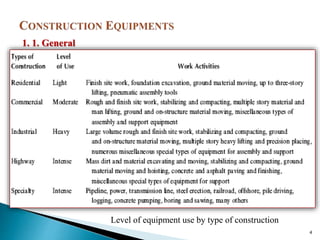
1. 1. General
4
Level of equipment use by type of construction
1. 2 Selection of Construction Equipment
 The efficient and effective implementation of construction
projects requires good management of relationships for and
among resources, activities and stakeholders as applied to the
context where such projects are implemented.
 Selection of Equipment types used in a construction project is largely
dependent on their :
 Direct input to unit prices or not
 Type of work or trades
 Scope of work
 Mobility
 System of control
 Availability
5
1. 2 Selection of Construction Equipment
 Specification requirement
 Weather condition
 Time schedule
 Management conditions
 Material influence
 Machine influence
6
1.3. Properties of Soil
A) Excavation Types
 Common Excavation: refers to ordinary earth excavation.
 Rock Excavation: rock excavation cannot be done by ordinary earth
handling equipment.
 Rock materials must be removed by drilling and blasting or by
some other methods.
 This normally results in a considerably greater expense than
earth excavation.
 Muck Excavation: includes materials that will decay or produce
subsidence in embankments.
 It is usually a soft organic material having a high water content.
7
 Muck Excavation:
 Typically, it would include such things as decaying stumps,
roots, logs, and humus.
 These materials are hard to handle and can present special
construction problems both at their point of excavation, and in
transportation and disposal.
 Unclassified Excavation: refers to the materials that cannot be
defined as soil or rock.
 The removal of common excavation will not require the use of
explosives, although tractors equipped with rippers may be used
to loosen consolidated formations.
8
B) General Soil Characteristics
 As earth moving equipments are mostly related to woks related to
soil, important aspects of soil shall be reviewed.
 From the characteristics of soils trafficability, loadability and volume
change are vital for earth works. Accordingly,
 Trafficability - property that shows the ability of soil to support
repeated traffic loading
 Loadability - property that tells the ease or difficulty of excavating
and loading
 Soil Volume Change - property that is related with volumes of soil
samples on different stress or compaction levels.
9
C) Soil Volume Change Characteristics
 There are three principal conditions or states in which soil may exist:
bank, loose, and compacted. The meanings of these terms are as
follows:
 Bank State - This is the state when the material is in its natural
state i.e. before disturbance. Often referred to as “in – place’’ or “in
situ.’’
 Unit - Bank cubic meter [Bm3]
 Loose State - This is the state after the material is excavated or
disturbed.
 Unit - Loose cubic meter [Lm3]
 Compacted State - This is the state after the material is compacted.
 Unit- Compact cubic meter [Cm3].
10
C) Soil Volume Change Characteristics
11
Bank Unit (Bm3) Loose cubic meter [Lm3] Compact cubic meter [Cm3].
C) Soil Volume Change Characteristics
Relationship between the three states
12
C) Soil Volume Change Characteristics
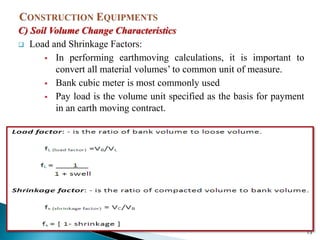
 Load and Shrinkage Factors:
 In performing earthmoving calculations, it is important to
convert all material volumes’ to common unit of measure.
 Bank cubic meter is most commonly used
 Pay load is the volume unit specified as the basis for payment
in an earth moving contract.
13
C) Soil Volume Change Characteristics
 Swell values for different class of earth
14
THANK YOU!
15

Chapter-1.ppt

  • 1.
    AAU - EiABC CONSTRUCTIONTECHNOLOGY AND MANAGEMENT BSc. Program - Year IV (Regular) CONSTRUCTION EQUIPMENT AND PLANT MANAGEMENT(COTM 4202) CHAPTER-1 INTRODUCTION OCTOBER 2011 (Getaneh G.)
  • 2.
    CONTENTS 1. INTRODUCTION 1.1. General 1.2.Selection of Construction Equipment 1.3. Properties of Soil
  • 3.
    1. Introduction 1.1. General Today contractors undertake many types of construction activities that require different types, sizes, and groupings of equipment for earth moving, excavating, and lifting.  There is a piece of equipment for practically any work activity, large or small.  Materials, Money, Manpower and Machineries (the 4 M's) are usual resources recognized in most situations.  The dependency and need for heavy construction equipment have grown with the size and complexity of construction projects.  The development of automated heavy construction equipment for earthmoving, excavating, and lifting occurred in the last two centuries. 3
  • 4.
    1. 1. General 4 Levelof equipment use by type of construction
  • 5.
    1. 2 Selectionof Construction Equipment  The efficient and effective implementation of construction projects requires good management of relationships for and among resources, activities and stakeholders as applied to the context where such projects are implemented.  Selection of Equipment types used in a construction project is largely dependent on their :  Direct input to unit prices or not  Type of work or trades  Scope of work  Mobility  System of control  Availability 5
  • 6.
    1. 2 Selectionof Construction Equipment  Specification requirement  Weather condition  Time schedule  Management conditions  Material influence  Machine influence 6
  • 7.
    1.3. Properties ofSoil A) Excavation Types  Common Excavation: refers to ordinary earth excavation.  Rock Excavation: rock excavation cannot be done by ordinary earth handling equipment.  Rock materials must be removed by drilling and blasting or by some other methods.  This normally results in a considerably greater expense than earth excavation.  Muck Excavation: includes materials that will decay or produce subsidence in embankments.  It is usually a soft organic material having a high water content. 7
  • 8.
     Muck Excavation: Typically, it would include such things as decaying stumps, roots, logs, and humus.  These materials are hard to handle and can present special construction problems both at their point of excavation, and in transportation and disposal.  Unclassified Excavation: refers to the materials that cannot be defined as soil or rock.  The removal of common excavation will not require the use of explosives, although tractors equipped with rippers may be used to loosen consolidated formations. 8
  • 9.
    B) General SoilCharacteristics  As earth moving equipments are mostly related to woks related to soil, important aspects of soil shall be reviewed.  From the characteristics of soils trafficability, loadability and volume change are vital for earth works. Accordingly,  Trafficability - property that shows the ability of soil to support repeated traffic loading  Loadability - property that tells the ease or difficulty of excavating and loading  Soil Volume Change - property that is related with volumes of soil samples on different stress or compaction levels. 9
  • 10.
    C) Soil VolumeChange Characteristics  There are three principal conditions or states in which soil may exist: bank, loose, and compacted. The meanings of these terms are as follows:  Bank State - This is the state when the material is in its natural state i.e. before disturbance. Often referred to as “in – place’’ or “in situ.’’  Unit - Bank cubic meter [Bm3]  Loose State - This is the state after the material is excavated or disturbed.  Unit - Loose cubic meter [Lm3]  Compacted State - This is the state after the material is compacted.  Unit- Compact cubic meter [Cm3]. 10
  • 11.
    C) Soil VolumeChange Characteristics 11 Bank Unit (Bm3) Loose cubic meter [Lm3] Compact cubic meter [Cm3].
  • 12.
    C) Soil VolumeChange Characteristics Relationship between the three states 12
  • 13.
    C) Soil VolumeChange Characteristics  Load and Shrinkage Factors:  In performing earthmoving calculations, it is important to convert all material volumes’ to common unit of measure.  Bank cubic meter is most commonly used  Pay load is the volume unit specified as the basis for payment in an earth moving contract. 13
  • 14.
    C) Soil VolumeChange Characteristics  Swell values for different class of earth 14
  • 15.