2
Chapter Goals
• Describethe two main responsibilities of an
operating system
• Define memory and process management
• Explain how timesharing creates the virtual
machine illusion
• Explain the relationship between logical and
physical addresses
• Compare and contrast memory management
techniques
3.
3
Chapter Goals
• Distinguishbetween fixed and dynamic partitions
• Define and apply partition selection algorithms
• Explain how demand paging creates the virtual
memory illusion
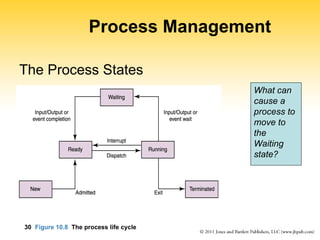
• Explain the stages and transitions of the process
life cycle
• Explain the processing of various CPU
scheduling algorithms
4.
4
Software Categories
Application software
Softwarewritten to address specific needs
—to solve problems in the real world
System software
Software that manages a computer system
at a fundamental level
Can you name examples of each?
5.
5
Roles of anOperating System
Operating system
System software that
– manages computer resources, such as
memory and input/output devices
– provides an interface through which a human
can interact with the computer
– allows an application program to interact with
these other system resources
6.
6
Roles of anOperating System
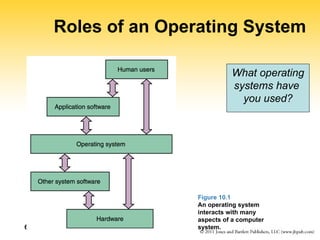
Figure 10.1
An operating system
interacts with many
aspects of a computer
system.
What operating
systems have
you used?
7.
7
Roles of anOperating System
The various roles of an operating system
generally revolve around the idea of “sharing
nicely”
An operating system manages resources,
and these resources are often shared in one
way or another among programs that want
to use them
8.
8
Resource Management
Multiprogramming
The techniqueof keeping multiple programs that
compete for access to the CPU in main memory at
the same time so that they can execute
Memory management
The process of keeping track of what programs are
in memory and where in memory they reside
9.
9
Resource Management
Process
A programin execution
Process management
The act of carefully tracking the progress of a
process and all of its intermediate states
CPU scheduling
Determining which process in memory is executed
by the CPU at any given point
10.
10
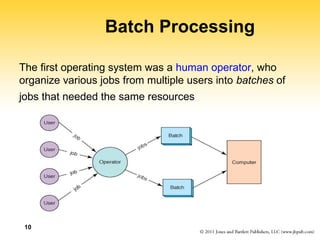
Batch Processing
The firstoperating system was a human operator, who
organize various jobs from multiple users into batches of
jobs that needed the same resources
11.
11
Timesharing
Timesharing system
A systemthat allows multiple users to interact with
a computer at the same time
Virtual machine
The illusion created by a time-sharing system that
each user has his/her own machine
As computer speed increased, the human
operator became the bottleneck
12.
12
Other Factors
Real-time System
Asystem in which response time is crucial given the
nature of the application
Response time
The time delay between receiving a stimulus and
producing a response
Device driver
A small program that “knows” the way a particular
device expects to receive and deliver information
13.
13
Memory Management
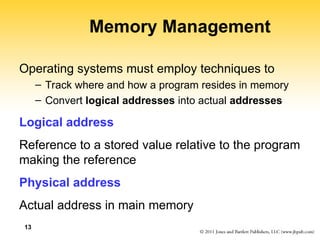
Operating systemsmust employ techniques to
– Track where and how a program resides in memory
– Convert logical addresses into actual addresses
Logical address
Reference to a stored value relative to the program
making the reference
Physical address
Actual address in main memory
14.
14
Memory Management
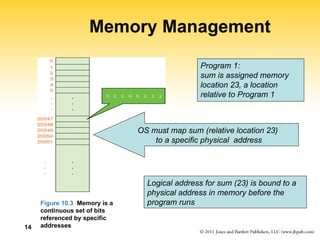
Figure 10.3Memory is a
continuous set of bits
referenced by specific
addresses
Program 1:
sum is assigned memory
location 23, a location
relative to Program 1
OS must map sum (relative location 23)
to a specific physical address
Logical address for sum (23) is bound to a
physical address in memory before the
program runs
15.
15
Single Contiguous MM
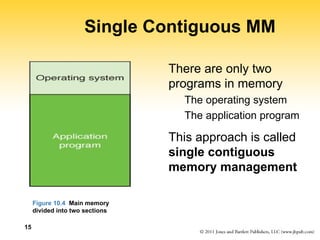
Thereare only two
programs in memory
The operating system
The application program
This approach is called
single contiguous
memory management
Figure 10.4 Main memory
divided into two sections
16.
16
Single Contiguous MM
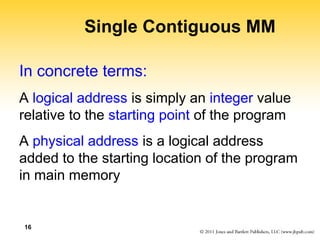
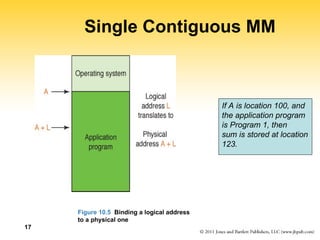
Inconcrete terms:
A logical address is simply an integer value
relative to the starting point of the program
A physical address is a logical address
added to the starting location of the program
in main memory
17.
17
Single Contiguous MM
Figure10.5 Binding a logical address
to a physical one
If A is location 100, and
the application program
is Program 1, then
sum is stored at location
123.
18.
18
Partition Memory Management
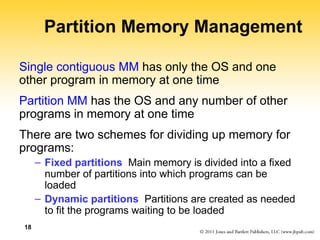
Singlecontiguous MM has only the OS and one
other program in memory at one time
Partition MM has the OS and any number of other
programs in memory at one time
There are two schemes for dividing up memory for
programs:
– Fixed partitions Main memory is divided into a fixed
number of partitions into which programs can be
loaded
– Dynamic partitions Partitions are created as needed
to fit the programs waiting to be loaded
19.
19
Partition Memory Management
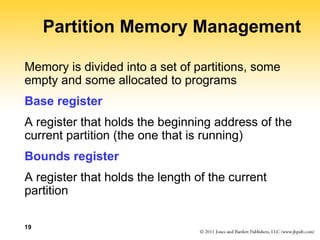
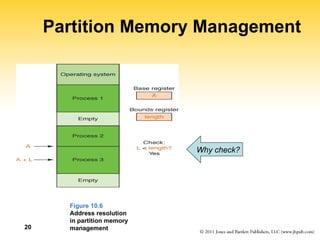
Memoryis divided into a set of partitions, some
empty and some allocated to programs
Base register
A register that holds the beginning address of the
current partition (the one that is running)
Bounds register
A register that holds the length of the current
partition
21
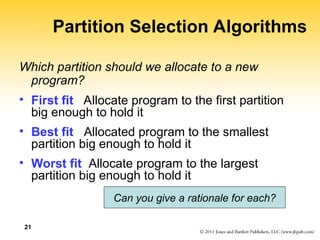
Partition Selection Algorithms
Whichpartition should we allocate to a new
program?
• First fit Allocate program to the first partition
big enough to hold it
• Best fit Allocated program to the smallest
partition big enough to hold it
• Worst fit Allocate program to the largest
partition big enough to hold it
Can you give a rationale for each?
22.
22
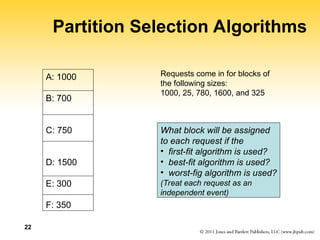
Partition Selection Algorithms
A:1000
B: 700
C: 750
D: 1500
E: 300
F: 350
Requests come in for blocks of
the following sizes:
1000, 25, 780, 1600, and 325
What block will be assigned
to each request if the
• first-fit algorithm is used?
• best-fit algorithm is used?
• worst-fig algorithm is used?
(Treat each request as an
independent event)
23.
23
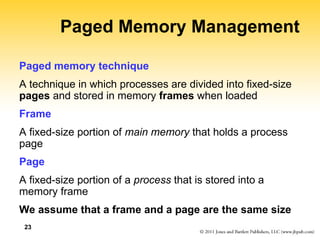
Paged Memory Management
Pagedmemory technique
A technique in which processes are divided into fixed-size
pages and stored in memory frames when loaded
Frame
A fixed-size portion of main memory that holds a process
page
Page
A fixed-size portion of a process that is stored into a
memory frame
We assume that a frame and a page are the same size
24.
24
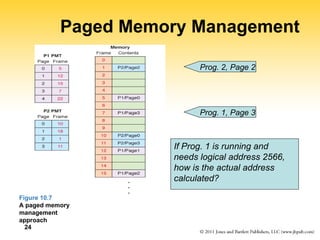
Paged Memory Management
Figure10.7
A paged memory
management
approach
Prog. 1, Page 3
Prog. 2, Page 2
If Prog. 1 is running and
needs logical address 2566,
how is the actual address
calculated?
25.
25
Paged Memory Management
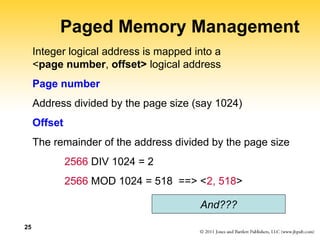
Integerlogical address is mapped into a
<page number, offset> logical address
Page number
Address divided by the page size (say 1024)
Offset
The remainder of the address divided by the page size
2566 DIV 1024 = 2
2566 MOD 1024 = 518 ==> <2, 518>
And???
26.
26
Paged Memory Management
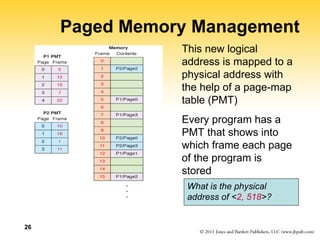
Thisnew logical
address is mapped to a
physical address with
the help of a page-map
table (PMT)
Every program has a
PMT that shows into
which frame each page
of the program is
stored
What is the physical
address of <2, 518>?
27.
27
Paged Memory Management
Demandpaging
An extension of paged memory management
in which pages are brought into memory on
demand
Page swap
The act of bringing in a page from secondary
memory, which often causes another page to be
written back to secondary memory
28.
28
Paged Memory Management
Virtualmemory
The illusion that there are no restrictions on the
size of a program because an entire process
doesn't have to be in memory at the same time
Thrashing
Inefficient processing caused by constant page
swaps
Relate the expression "all computing is a
tradeoff" to this process
29.
29
Process Management
Process management
Theact of managing the use of the CPU by
individual processes
Recall that a process is a program in
execution
What stages does a process go
through?
31
Process Management
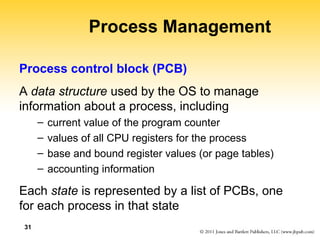
Process controlblock (PCB)
A data structure used by the OS to manage
information about a process, including
– current value of the program counter
– values of all CPU registers for the process
– base and bound register values (or page tables)
– accounting information
Each state is represented by a list of PCBs, one
for each process in that state
32.
32
Process Management
There isonly one CPU and therefore only one set of CPU
registers, which contain the values for the currently
executing process
Each time a process is moved to the running state:
– Register values for the currently running process
are stored into its PCB
– Its PCB is moved to the list of the state into which it goes
– Register values of the new process moving into the running
state are loaded into the CPU
– This exchange of register information is called a context
switch
33.
33
CPU Scheduling
CPU Scheduling
Theact of determining which process in the ready
state should be moved to the running state
– Many processes may be in the ready state
– Only one process can be in the running state, making
progress at any one time
Which one gets to move from ready to
running?
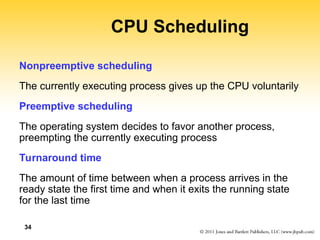
34.
34
CPU Scheduling
Nonpreemptive scheduling
Thecurrently executing process gives up the CPU voluntarily
Preemptive scheduling
The operating system decides to favor another process,
preempting the currently executing process
Turnaround time
The amount of time between when a process arrives in the
ready state the first time and when it exits the running state
for the last time
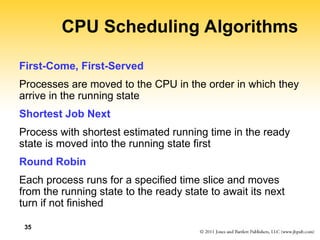
35.
35
CPU Scheduling Algorithms
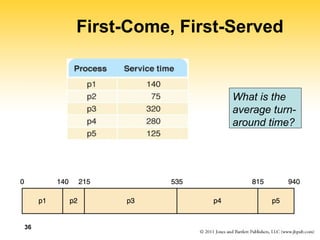
First-Come,First-Served
Processes are moved to the CPU in the order in which they
arrive in the running state
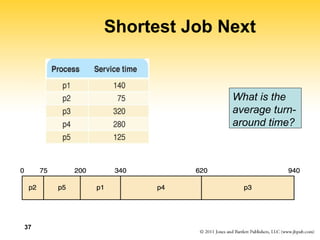
Shortest Job Next
Process with shortest estimated running time in the ready
state is moved into the running state first
Round Robin
Each process runs for a specified time slice and moves
from the running state to the ready state to await its next
turn if not finished
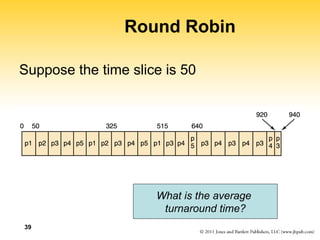
38
Round Robin
Every processis treated the same!
Time slice (quantum)
The amount of time each process receives
before being preempted and returned to the
ready state to allow another process its turn
40
CPU Scheduling Algorithms
Arethese scheduling algorithms preemptive
or non-preemptive? Explain
First-Come, First-Served?
Shortest Job Next?
Round Robin?
41.
41
Ethical Issues
Digital RightsManagement
What is Digital Rights Management
(DRM) technology?
Explain the Sony incident.
Do you think DRM systems are
necessary to protect content
owners?
42.
42
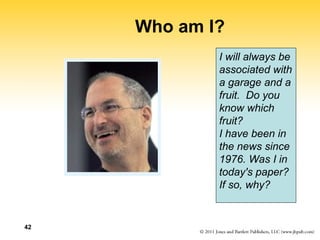
Who am I?
Iwill always be
associated with
a garage and a
fruit. Do you
know which
fruit?
I have been in
the news since
1976. Was I in
today's paper?
If so, why?
43.
43
Do you know?
Whois Blank Ross?
What was the most influential computing job
in the early '60s? Why?
Do your sneakers talk to your iPod?
Explain the relationship between Nike and
ITunes