MANAGERIAL ECONOMICS
  An Analysis of Business Issues


         Howard Davies
        and Pun-Lee Lam
      Published by FT Prentice Hall


                                      1
Chapter 1:
       The Definition and Scope of
       Managerial Economics
Objectives:
After studying the chapter, you should
understand:
1. the subject matter of Managerial Economics
2. the analytical approach used in Managerial
Economics

                                    2
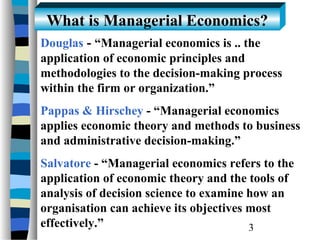
What is Managerial Economics?
Douglas - “Managerial economics is .. the
application of economic principles and
methodologies to the decision-making process
within the firm or organization.”
Pappas & Hirschey - “Managerial economics
applies economic theory and methods to business
and administrative decision-making.”
Salvatore - “Managerial economics refers to the
application of economic theory and the tools of
analysis of decision science to examine how an
organisation can achieve its objectives most
effectively.”                           3
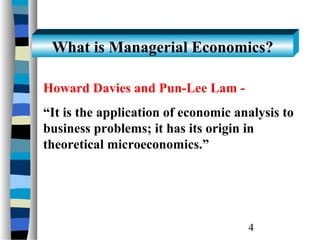
What is Managerial Economics?

Howard Davies and Pun-Lee Lam -
“It is the application of economic analysis to
business problems; it has its origin in
theoretical microeconomics.”


                                     4
These Definitions Cover a Number of
            Different Approaches

1. Analysis based on the theory of the firm
2. Analysis based upon management sciences
3. Analysis based upon industrial economics

Related to, but not the same as management science
and industrial economics.


                                         5
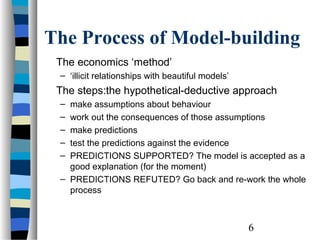
The Process of Model-building
 The economics ‘method’
 – ‘illicit relationships with beautiful models’
 The steps:the hypothetical-deductive approach
 – make assumptions about behaviour
 – work out the consequences of those assumptions
 – make predictions
 – test the predictions against the evidence
 – PREDICTIONS SUPPORTED? The model is accepted as a
   good explanation (for the moment)
 – PREDICTIONS REFUTED? Go back and re-work the whole
   process


                                                   6
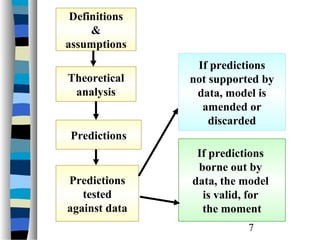
Definitions
     &
assumptions
                If predictions
Theoretical    not supported by
 analysis       data, model is
                 amended or
                   discarded
 Predictions
                If predictions
                borne out by
Predictions    data, the model
   tested        is valid, for
against data     the moment
                          7
Should Assumptions be Realistic?
   Should Assumptions be Realistic?
The assumption of profit-maximising may be
unrealistic or inaccurate
However, what matters is the explanatory or
predictive power of a theory (or model), not the
descriptive realism of its assumptions.
A model built on unrealistic assumptions may give
good predictions.
Assumptions are a necessary simplifying device
Example: Overtaking
                                       8
What Is A “Good” Model?

 It allows us to make predictions and set
 hypotheses
 The predictions can be tested against the
 empirical evidence
 The predictions are supported by the
 empirical evidence


                                   9
The Use of Economic Models

Positive Economics:-
Derives useful theories with testable
propositions about WHAT IS.

Normative Economics:-
Provides the basis for value judgements on
economic outcomes.WHAT SHOULD BE

                                    10
Managerial Economics
 Economics in general takes a ‘positive’ and
 predictive approach not prescriptive or
 ‘normative’
 – trying to explain “what is” not what “should be”
 – the main objective is to understand how a market
   economy works
 Not very concerned about the descriptive realism
 of assumptions: “I assume X” does not mean “I
 believe X to be true”
 Some real tension if the models are used for
 prescription
 – assume “perfect knowledge”: OK for model-building
 – cannot say to a manager: “behave AS IF you had perfect
   knowledge”                              11
Economic Analysis
 Comparative Statics
  – begin with an initial equilibrium position - the starting point
  – change something
  – identify the new equilibrium, e.g:in neo-classical model of the firm
      • When demand increases?
      • When costs rise?
      • When a fixed cost increases?
  – This is the main purpose of the model -what it was designed to do
 Normative prescriptions
  – it will cost me $30 per unit to supply something which will give me
    $20 per unit in revenue- should I do it?
  – I must pay $20 billion to set up in my industry. Should I charge
    higher prices to get that money back?
 Positive and Normative are linked by “if?” IF the aim of the firm
 is to maximise profit what will it do/what should it do?

                                                        12
What is the purpose of economic analysis?
Why do we want to apply economic analysis to
business problems?
business problems?
For the academic economist: to understand, to make
predictions about firm’s behavior
The “positive” approach to theory: What is?
For the businessperson: “to assist decision-making”,
to provide decision-rules which can be applied
The “normative” approach to theory: What should be?
These purposes are different, they can lead to
misunderstanding, and economists are not always
honest about the limitations of their approach for
                                           13
practical purposes.
What are these limitations?
          What are these limitations?

If the aim is prediction, unrealistic assumptions
are acceptable and may be needed;
for instance, the firm may be assumed to behave “as if”
its managers had perfect knowledge of its environment

If the aim is to produce decision-rules which can
be applied by practising managers, unrealistic
assumptions will produce decision-rules which
are not operational
for instance, set output and price by MC=MR
                                         14
How Can Managerial Economics Assist
   How Can Managerial Economics Assist
           Decision-Making?
           Decision-Making?

1. Adopt a general perspective, not a
sample of one
2. Simple models provide stepping stone to
more complexity and realism
3. Thinking logically has value itself and can
expose sloppy thinking


                                     15
Why Managerial Economics?
A powerful “analytical engine”.
A broader perspective on the firm.
   • what is a firm?
   • what are the firm’s overall objectives?
   • what pressures drive the firm towards profit and
     away from profit
The basis for some of the more rigourous
analysis of issues in Marketing and Strategic
Management.

                                         16
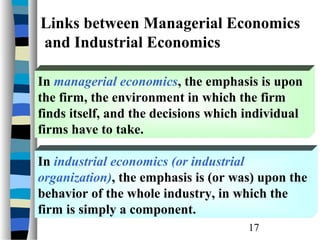
Links between Managerial Economics
and Industrial Economics

In managerial economics, the emphasis is upon
the firm, the environment in which the firm
finds itself, and the decisions which individual
firms have to take.

In industrial economics (or industrial
organization), the emphasis is (or was) upon the
behavior of the whole industry, in which the
firm is simply a component.
                                      17
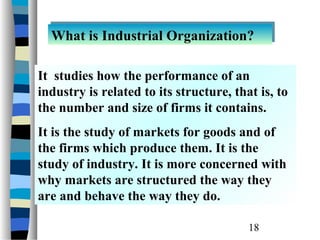
What is Industrial Organization?
  What is Industrial Organization?

It studies how the performance of an
industry is related to its structure, that is, to
the number and size of firms it contains.
It is the study of markets for goods and of
the firms which produce them. It is the
study of industry. It is more concerned with
why markets are structured the way they
are and behave the way they do.

                                         18
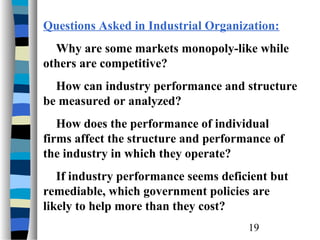
Questions Asked in Industrial Organization:
  Why are some markets monopoly-like while
others are competitive?
  How can industry performance and structure
be measured or analyzed?
   How does the performance of individual
firms affect the structure and performance of
the industry in which they operate?
   If industry performance seems deficient but
remediable, which government policies are
likely to help more than they cost?
                                      19
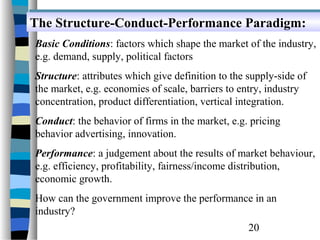
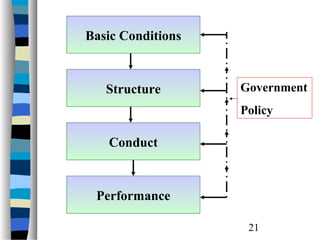
The Structure-Conduct-Performance Paradigm:
Basic Conditions: factors which shape the market of the industry,
e.g. demand, supply, political factors
Structure: attributes which give definition to the supply-side of
the market, e.g. economies of scale, barriers to entry, industry
concentration, product differentiation, vertical integration.
Conduct: the behavior of firms in the market, e.g. pricing
behavior advertising, innovation.
Performance: a judgement about the results of market behaviour,
e.g. efficiency, profitability, fairness/income distribution,
economic growth.
How can the government improve the performance in an
industry?
                                                   20
Basic Conditions


   Structure       Government
                   Policy

   Conduct


 Performance

                    21
Links between Managerial Economics
and Management Science
Managerial economics: is often concerned with finding
optimal solutions to decision problems.However, the
primary purpose of using models is to predict how firms
will behave, not to advise them what ought to do.
Managers are assumed to find the optimal solutions for
themselves and that is how predictions are made.
Management science: is essentially concerned with
techniques for the improvement of decision-making and
hence it is essentially normative;firms are not assumed to
find the optimal solutions for themselves. They are found
by the researchers who then present them as prescriptions
for what the firm should do.
                                             22

Chapter1

  • 1.
    MANAGERIAL ECONOMICS An Analysis of Business Issues Howard Davies and Pun-Lee Lam Published by FT Prentice Hall 1
  • 2.
    Chapter 1: The Definition and Scope of Managerial Economics Objectives: After studying the chapter, you should understand: 1. the subject matter of Managerial Economics 2. the analytical approach used in Managerial Economics 2
  • 3.
    What is ManagerialEconomics? Douglas - “Managerial economics is .. the application of economic principles and methodologies to the decision-making process within the firm or organization.” Pappas & Hirschey - “Managerial economics applies economic theory and methods to business and administrative decision-making.” Salvatore - “Managerial economics refers to the application of economic theory and the tools of analysis of decision science to examine how an organisation can achieve its objectives most effectively.” 3
  • 4.
    What is ManagerialEconomics? Howard Davies and Pun-Lee Lam - “It is the application of economic analysis to business problems; it has its origin in theoretical microeconomics.” 4
  • 5.
    These Definitions Covera Number of Different Approaches 1. Analysis based on the theory of the firm 2. Analysis based upon management sciences 3. Analysis based upon industrial economics Related to, but not the same as management science and industrial economics. 5
  • 6.
    The Process ofModel-building The economics ‘method’ – ‘illicit relationships with beautiful models’ The steps:the hypothetical-deductive approach – make assumptions about behaviour – work out the consequences of those assumptions – make predictions – test the predictions against the evidence – PREDICTIONS SUPPORTED? The model is accepted as a good explanation (for the moment) – PREDICTIONS REFUTED? Go back and re-work the whole process 6
  • 7.
    Definitions & assumptions If predictions Theoretical not supported by analysis data, model is amended or discarded Predictions If predictions borne out by Predictions data, the model tested is valid, for against data the moment 7
  • 8.
    Should Assumptions beRealistic? Should Assumptions be Realistic? The assumption of profit-maximising may be unrealistic or inaccurate However, what matters is the explanatory or predictive power of a theory (or model), not the descriptive realism of its assumptions. A model built on unrealistic assumptions may give good predictions. Assumptions are a necessary simplifying device Example: Overtaking 8
  • 9.
    What Is A“Good” Model? It allows us to make predictions and set hypotheses The predictions can be tested against the empirical evidence The predictions are supported by the empirical evidence 9
  • 10.
    The Use ofEconomic Models Positive Economics:- Derives useful theories with testable propositions about WHAT IS. Normative Economics:- Provides the basis for value judgements on economic outcomes.WHAT SHOULD BE 10
  • 11.
    Managerial Economics Economicsin general takes a ‘positive’ and predictive approach not prescriptive or ‘normative’ – trying to explain “what is” not what “should be” – the main objective is to understand how a market economy works Not very concerned about the descriptive realism of assumptions: “I assume X” does not mean “I believe X to be true” Some real tension if the models are used for prescription – assume “perfect knowledge”: OK for model-building – cannot say to a manager: “behave AS IF you had perfect knowledge” 11
  • 12.
    Economic Analysis ComparativeStatics – begin with an initial equilibrium position - the starting point – change something – identify the new equilibrium, e.g:in neo-classical model of the firm • When demand increases? • When costs rise? • When a fixed cost increases? – This is the main purpose of the model -what it was designed to do Normative prescriptions – it will cost me $30 per unit to supply something which will give me $20 per unit in revenue- should I do it? – I must pay $20 billion to set up in my industry. Should I charge higher prices to get that money back? Positive and Normative are linked by “if?” IF the aim of the firm is to maximise profit what will it do/what should it do? 12
  • 13.
    What is thepurpose of economic analysis? What is the purpose of economic analysis? Why do we want to apply economic analysis to Why do we want to apply economic analysis to business problems? business problems? For the academic economist: to understand, to make predictions about firm’s behavior The “positive” approach to theory: What is? For the businessperson: “to assist decision-making”, to provide decision-rules which can be applied The “normative” approach to theory: What should be? These purposes are different, they can lead to misunderstanding, and economists are not always honest about the limitations of their approach for 13 practical purposes.
  • 14.
    What are theselimitations? What are these limitations? If the aim is prediction, unrealistic assumptions are acceptable and may be needed; for instance, the firm may be assumed to behave “as if” its managers had perfect knowledge of its environment If the aim is to produce decision-rules which can be applied by practising managers, unrealistic assumptions will produce decision-rules which are not operational for instance, set output and price by MC=MR 14
  • 15.
    How Can ManagerialEconomics Assist How Can Managerial Economics Assist Decision-Making? Decision-Making? 1. Adopt a general perspective, not a sample of one 2. Simple models provide stepping stone to more complexity and realism 3. Thinking logically has value itself and can expose sloppy thinking 15
  • 16.
    Why Managerial Economics? Apowerful “analytical engine”. A broader perspective on the firm. • what is a firm? • what are the firm’s overall objectives? • what pressures drive the firm towards profit and away from profit The basis for some of the more rigourous analysis of issues in Marketing and Strategic Management. 16
  • 17.
    Links between ManagerialEconomics and Industrial Economics In managerial economics, the emphasis is upon the firm, the environment in which the firm finds itself, and the decisions which individual firms have to take. In industrial economics (or industrial organization), the emphasis is (or was) upon the behavior of the whole industry, in which the firm is simply a component. 17
  • 18.
    What is IndustrialOrganization? What is Industrial Organization? It studies how the performance of an industry is related to its structure, that is, to the number and size of firms it contains. It is the study of markets for goods and of the firms which produce them. It is the study of industry. It is more concerned with why markets are structured the way they are and behave the way they do. 18
  • 19.
    Questions Asked inIndustrial Organization: Why are some markets monopoly-like while others are competitive? How can industry performance and structure be measured or analyzed? How does the performance of individual firms affect the structure and performance of the industry in which they operate? If industry performance seems deficient but remediable, which government policies are likely to help more than they cost? 19
  • 20.
    The Structure-Conduct-Performance Paradigm: TheStructure-Conduct-Performance Paradigm: Basic Conditions: factors which shape the market of the industry, e.g. demand, supply, political factors Structure: attributes which give definition to the supply-side of the market, e.g. economies of scale, barriers to entry, industry concentration, product differentiation, vertical integration. Conduct: the behavior of firms in the market, e.g. pricing behavior advertising, innovation. Performance: a judgement about the results of market behaviour, e.g. efficiency, profitability, fairness/income distribution, economic growth. How can the government improve the performance in an industry? 20
  • 21.
    Basic Conditions Structure Government Policy Conduct Performance 21
  • 22.
    Links between ManagerialEconomics and Management Science Managerial economics: is often concerned with finding optimal solutions to decision problems.However, the primary purpose of using models is to predict how firms will behave, not to advise them what ought to do. Managers are assumed to find the optimal solutions for themselves and that is how predictions are made. Management science: is essentially concerned with techniques for the improvement of decision-making and hence it is essentially normative;firms are not assumed to find the optimal solutions for themselves. They are found by the researchers who then present them as prescriptions for what the firm should do. 22