Cis339
Modern Systems Analysis
and Design
Fifth Edition
Chapter 8
Structuring System
Logic Requirements:
8.1
Cis339
Learning Objectives
Use Structured English as a tool for
representing steps in logical processes in
data flow diagrams
Use decision tables and decision trees to
represent the logic of choice in conditional
statements
Select among Structured English, decision
tables, and decision trees for representing
processing logic
8.2
Cis339
Logic Modeling
Data flow diagrams do not show the logic
inside the processes
Logic modeling involves representing
internal structure and functionality of
processes depicted on a DFD
Logic modeling can also be used to show
when processes on a DFD occur
8.3
Cis339
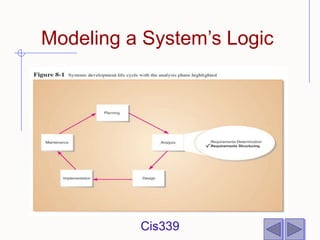
Modeling a System’s Logic
Cis339
Logic Modeling
Deliverables and Outcomes
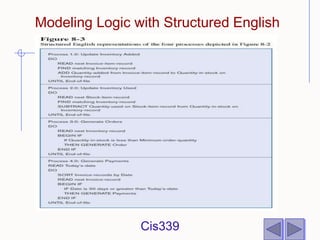
Structured English representation of process logic.
Decision Tables representation.
Sequence diagram.
Activity diagram
 Structured English
 Decision Tables
 Decision Trees
 State-transition diagrams
 Sequence diagrams
 Activity diagrams
8.5
Cis339
Modeling Logic with
Structured English
Structured English: modified form of English language used to
specify the logic of information system processes.
No single standard.
Typically relies on action verbs and noun phrases and contains
no adjectives or No specific standards.
Uses a subset of English
 Action verbs
 Noun phrases
 No adjectives or adverbs
No specific standards
8.6
Cis339
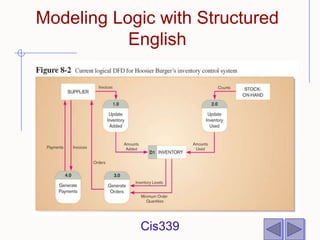
Modeling Logic with Structured
English
Cis339
Modeling Logic with Structured English
Cis339
Modeling Logic with
Decision Tables
A matrix representation of the logic
of a decision which Specifies the
possible conditions and the resulting
actions
Best used for complicated decision
logic
8.9
Cis339
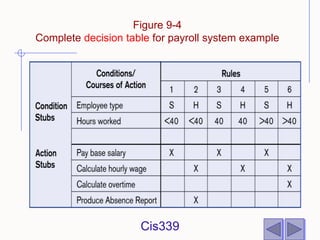
Figure 9-4
Complete decision table for payroll system example
Cis339
Modeling Logic with
Decision Tables
Consists of three parts
Condition stubs: that part of a decision table
that lists the conditions relevant to the
decision.
Action stubs: that part of a decision table
that lists the actions that result for a given set
of conditions.
Rules: that part of a decision table that
specifies which actions are to be followed for
a given set of condition.
8.11
Cis339
Modeling Logic with
Decision Tables
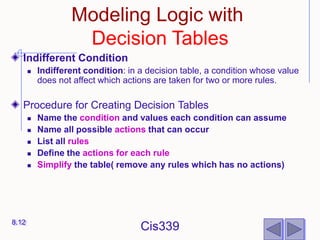
Indifferent Condition
 Indifferent condition: in a decision table, a condition whose value
does not affect which actions are taken for two or more rules.
Procedure for Creating Decision Tables
 Name the condition and values each condition can assume
 Name all possible actions that can occur
 List all rules
 Define the actions for each rule
 Simplify the table( remove any rules which has no actions)
8.12
Cis339
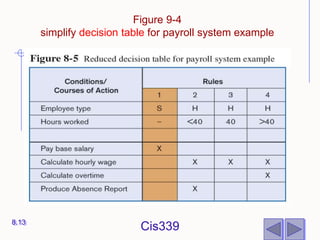
Figure 9-4
simplify decision table for payroll system example
8.13
Cis339
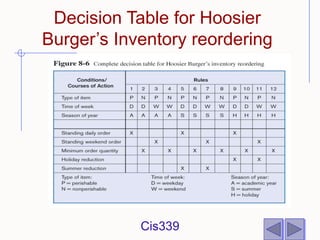
Decision Table for Hoosier
Burger’s Inventory reordering
Cis339
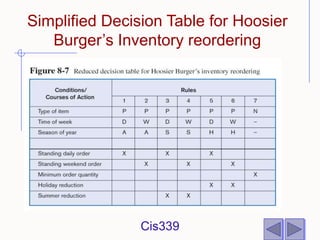
Simplified Decision Table for Hoosier
Burger’s Inventory reordering
Cis339
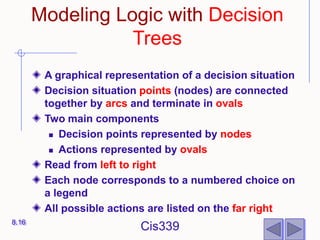
Modeling Logic with Decision
Trees
A graphical representation of a decision situation
Decision situation points (nodes) are connected
together by arcs and terminate in ovals
Two main components
 Decision points represented by nodes
 Actions represented by ovals
Read from left to right
Each node corresponds to a numbered choice on
a legend
All possible actions are listed on the far right
8.16
Cis339
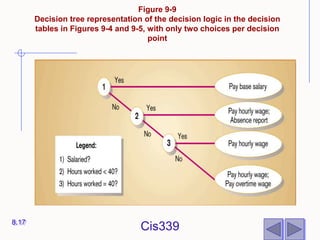
Figure 9-9
Decision tree representation of the decision logic in the decision
tables in Figures 9-4 and 9-5, with only two choices per decision
point
8.17
Cis339
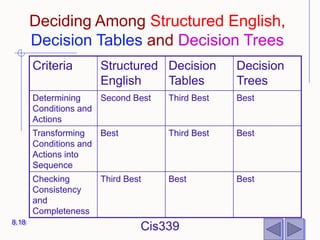
Deciding Among Structured English,
Decision Tables and Decision Trees
Criteria Structured
English
Decision
Tables
Decision
Trees
Determining
Conditions and
Actions
Second Best Third Best Best
Transforming
Conditions and
Actions into
Sequence
Best Third Best Best
Checking
Consistency
and
Completeness
Third Best Best Best
8.18
Cis339
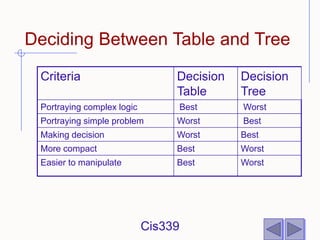
Deciding Between Table and Tree
Criteria Decision
Table
Decision
Tree
Portraying complex logic Best Worst
Portraying simple problem Worst Best
Making decision Worst Best
More compact Best Worst
Easier to manipulate Best Worst

chapter08structuring systemlogic requ.ppt

  • 1.
    Cis339 Modern Systems Analysis andDesign Fifth Edition Chapter 8 Structuring System Logic Requirements: 8.1
  • 2.
    Cis339 Learning Objectives Use StructuredEnglish as a tool for representing steps in logical processes in data flow diagrams Use decision tables and decision trees to represent the logic of choice in conditional statements Select among Structured English, decision tables, and decision trees for representing processing logic 8.2
  • 3.
    Cis339 Logic Modeling Data flowdiagrams do not show the logic inside the processes Logic modeling involves representing internal structure and functionality of processes depicted on a DFD Logic modeling can also be used to show when processes on a DFD occur 8.3
  • 4.
  • 5.
    Cis339 Logic Modeling Deliverables andOutcomes Structured English representation of process logic. Decision Tables representation. Sequence diagram. Activity diagram  Structured English  Decision Tables  Decision Trees  State-transition diagrams  Sequence diagrams  Activity diagrams 8.5
  • 6.
    Cis339 Modeling Logic with StructuredEnglish Structured English: modified form of English language used to specify the logic of information system processes. No single standard. Typically relies on action verbs and noun phrases and contains no adjectives or No specific standards. Uses a subset of English  Action verbs  Noun phrases  No adjectives or adverbs No specific standards 8.6
  • 7.
    Cis339 Modeling Logic withStructured English
  • 8.
    Cis339 Modeling Logic withStructured English
  • 9.
    Cis339 Modeling Logic with DecisionTables A matrix representation of the logic of a decision which Specifies the possible conditions and the resulting actions Best used for complicated decision logic 8.9
  • 10.
    Cis339 Figure 9-4 Complete decisiontable for payroll system example
  • 11.
    Cis339 Modeling Logic with DecisionTables Consists of three parts Condition stubs: that part of a decision table that lists the conditions relevant to the decision. Action stubs: that part of a decision table that lists the actions that result for a given set of conditions. Rules: that part of a decision table that specifies which actions are to be followed for a given set of condition. 8.11
  • 12.
    Cis339 Modeling Logic with DecisionTables Indifferent Condition  Indifferent condition: in a decision table, a condition whose value does not affect which actions are taken for two or more rules. Procedure for Creating Decision Tables  Name the condition and values each condition can assume  Name all possible actions that can occur  List all rules  Define the actions for each rule  Simplify the table( remove any rules which has no actions) 8.12
  • 13.
    Cis339 Figure 9-4 simplify decisiontable for payroll system example 8.13
  • 14.
    Cis339 Decision Table forHoosier Burger’s Inventory reordering
  • 15.
    Cis339 Simplified Decision Tablefor Hoosier Burger’s Inventory reordering
  • 16.
    Cis339 Modeling Logic withDecision Trees A graphical representation of a decision situation Decision situation points (nodes) are connected together by arcs and terminate in ovals Two main components  Decision points represented by nodes  Actions represented by ovals Read from left to right Each node corresponds to a numbered choice on a legend All possible actions are listed on the far right 8.16
  • 17.
    Cis339 Figure 9-9 Decision treerepresentation of the decision logic in the decision tables in Figures 9-4 and 9-5, with only two choices per decision point 8.17
  • 18.
    Cis339 Deciding Among StructuredEnglish, Decision Tables and Decision Trees Criteria Structured English Decision Tables Decision Trees Determining Conditions and Actions Second Best Third Best Best Transforming Conditions and Actions into Sequence Best Third Best Best Checking Consistency and Completeness Third Best Best Best 8.18
  • 19.
    Cis339 Deciding Between Tableand Tree Criteria Decision Table Decision Tree Portraying complex logic Best Worst Portraying simple problem Worst Best Making decision Worst Best More compact Best Worst Easier to manipulate Best Worst