Chapter Two: Bidding procedures and contract types.pdf
1.
Learning Objectives:
At theend of this Chapter , students should be able to:
Explain the bidding procedures for engineering works and
service contract
Mention the different types of tendering
List the different types of service and works contract.
Understand the major components of contract document 1
2.
Standard Bidding Document
Thesignificance of having standard bidding procedure,
specially for public funded projects is:
To simplify the drafting of a specific bidding document for
Procurement of Works by procurement staff;
To minimise the time required by the Tender Committee to approve
Bidding Documents prior to release;
To reduce Bidders’ time and effort in the preparation of Bids;
To facilitate and simplify the evaluation and comparison of bids and
Contract award by the Procuring Entity
To ensure this, for instance, the Ethiopian
government established an agency (PPA) that
supervises procuring entities and sets procedures of
public procurement [proclamation no. 430/2005] 2
3.
Scope and Valueof Contract
This SBD is suitable for a standard contract, where the works
have been fully designed by or for the Procuring Entity
(Employer), prior to bidding, and the Contractor will be
responsible for construction only.
It is suitable for works valued at up to US$10 million.
This SBD for the Procurement of Works is not suitable for
the following situations:
Complex works under US$10 million, such as large water
treatment plants;
Works over US$10 million;
Works designed by the Contractor, including turnkey
contracts.
3
Types of Tender
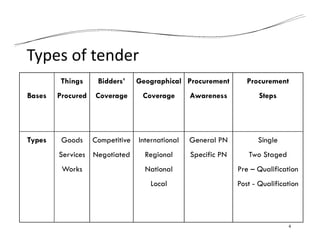
Basedof things to be procured tenders can be classified as:
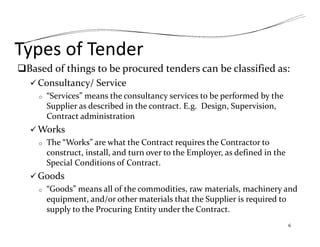
Consultancy/ Service
o “Services” means the consultancy services to be performed by the
Supplier as described in the contract. E.g. Design, Supervision,
Contract administration
Works
o The “Works” are what the Contract requires the Contractor to
construct, install, and turn over to the Employer, as defined in the
Special Conditions of Contract.
Goods
o “Goods” means all of the commodities, raw materials, machinery and
equipment, and/or other materials that the Supplier is required to
supply to the Procuring Entity under the Contract.
6
7.
Bidding procedure forService
Contract
Selection of Bidders;
Preparation and Issue of RFP Documents;
Bidding Period and Receipt of proposal;
Proposal Opening;
Proposal Evaluation; and
Bid Acceptance, Contract Award and Signing.
7
8.
Selection of Bidder
Underthe Request for Proposals method, the Procuring
Entity will normally publish a notice seeking expressions of
interest, so that all potential bidders have the opportunity to
participate.
The notice must be published in a newspaper of wide
international circulation or in a relevant trade publication or
technical or professional journal of wide international
circulation.
The Procuring Entity will then evaluate the expressions of
interest received and develop a shortlist of between three and
seven bidders.
The RFP document should be accompanied by a letter of
invitation 8
9.
Preparation and Issuingof RFP
Documents
The Procuring Entity is responsible for the preparation and
issue of the RFP
The Procuring Entity must use the standard RFP or other
appropriate standard document issued by the Public
Procurement Agency, as this is a mandatory requirement for
contracts to be funded by the Government of the Federal
Democratic Republic of Ethiopia.
In deciding the deadline for proposal submission the PE
should allow Bidders sufficient time for obtaining and
studying the RFP, preparing complete and responsive
proposals and submitting the proposals.
9
10.
Bidding Period andReceipt of
Proposals
The Bidder is responsible for proposal preparation and the
submission of its proposal. During the bidding period, the
Procuring Entity shall:
Hold any pre bid meeting, if one is required, and issue minutes
promptly;
Promptly respond to requests for clarifications from Bidders;
Issue amendments to the RFP if necessary;
Receive and record sealed proposals from Bidders or make a Bid
Box available up to the deadline for proposal submission;
Close bidding at the precise date and time of the deadline and
ensure that no late proposals are received;
Keep all proposals received secure until the time for proposal
opening.
10
11.
Proposal Opening
The TenderCommittee is responsible for the Proposal
Opening, which is a critical event in the procurement
process.
Conduct the Proposal Opening strictly following the
procedures specified in the ITB Sub‐Clause 20 for all proposals
received on or prior to the date and time of the proposal
submission deadline.
Ensure that all proposals that were received on time are
accounted for, before starting the Proposal Opening, as
proposals that are not opened and read out at Proposal
Opening shall not be further considered.
Ensure that only technical proposals are opened and that
financial proposals are kept sealed and removed to a secure
place after the opening. 11
12.
…Continued
Agree before theProposal Opening on the details to be read
out
Not reject any proposal at Proposal Opening, except for late
proposals received after the date and time of proposal
submission deadline.
Examine the proposals at Proposal Opening in accordance
with the provisions of ITB Sub‐Clause 17
12
13.
Proposal Evaluation
For Consultancyservices, proposal evaluation will be
conducted in two stages and Tender Committee approval of
the technical evaluation report must be obtained before
opening financial proposals and conducting the financial
evaluation.
The Tender Committee shall:
Maintain the evaluation process strictly confidential
Reject any attempts or pressures to distort the outcome of the
evaluation, including fraud and corruption
13
14.
…Continued
Strictly applyonly and all of the evaluation criteria specified in
the RFP to determine the proposals which proceed to the
financial evaluation and subsequently to make a
recommendation for award of contract to the Tender
Committee.
For consultancy services, negotiations are often held with the
recommended Bidder, to finalise all technical details, prior to
placing the contract.
14
15.
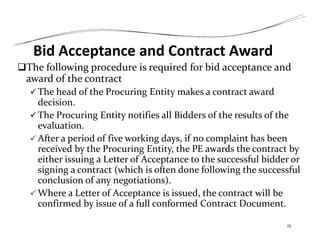
Bid Acceptance andContract Award
The following procedure is required for bid acceptance and
award of the contract
The head of the Procuring Entity makes a contract award
decision.
The Procuring Entity notifies all Bidders of the results of the
evaluation.
After a period of five working days, if no complaint has been
received by the Procuring Entity, the PE awards the contract by
either issuing a Letter of Acceptance to the successful bidder or
signing a contract (which is often done following the successful
conclusion of any negotiations).
Where a Letter of Acceptance is issued, the contract will be
confirmed by issue of a full conformed Contract Document.
15
16.
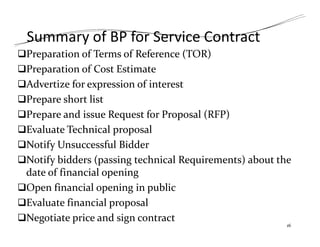
Summary of BPfor Service Contract
Preparation of Terms of Reference (TOR)
Preparation of Cost Estimate
Advertize for expression of interest
Prepare short list
Prepare and issue Request for Proposal (RFP)
Evaluate Technical proposal
Notify Unsuccessful Bidder
Notify bidders (passing technical Requirements) about the
date of financial opening
Open financial opening in public
Evaluate financial proposal
Negotiate price and sign contract
16
17.
…continued
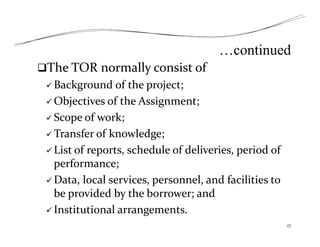
The TOR normallyconsist of
Background of the project;
Objectives of the Assignment;
Scope of work;
Transfer of knowledge;
List of reports, schedule of deliveries, period of
performance;
Data, local services, personnel, and facilities to
be provided by the borrower; and
Institutional arrangements.
17
18.
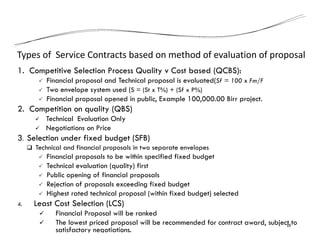
Types of ServiceContracts based on method of evaluation of proposal
1. Competitive Selection Process Quality v Cost based (QCBS):
Financial proposal and Technical proposal is evaluated(Sf = 100 x Fm/F
Two envelope system used (S = (St x T%) + (Sf x P%)
Financial proposal opened in public, Example 100,000.00 Birr project.
2. Competition on quality (QBS)
Technical Evaluation Only
Negotiations on Price
3. Selection under fixed budget (SFB)
Technical and financial proposals in two separate envelopes
Financial proposals to be within specified fixed budget
Technical evaluation (quality) first
Public opening of financial proposals
Rejection of proposals exceeding fixed budget
Highest rated technical proposal (within fixed budget) selected
4. Least Cost Selection (LCS)
Financial Proposal will be ranked
The lowest priced proposal will be recommended for contract award, subject to
satisfactory negotiations.
18
19.
Types of ServiceContracts based on mode of payment
I. lump-sum
planning and feasibility studies, environmental studies, Design etc.
Contents, duration, and output clearly defined. payments linked to outputs
only.
II. Time-based
Quality Control, supervision, Contract administration, technical assistance.
payments linked to inputs, agreed staff rates and reimbursable items.
Example: AAHDPO
III. Percentage contracts
The consultant will paid based on a percentage of the works being
executed (Cost plus %) or % of the project cost
IV. Indefinite delivery contracts
specialized services “on call”
19
20.
Bidding procedure forworks
The relevant parts of the bidding process are summarised
here as follows:
Selection of Bidders;
Preparation and Issue of Bidding Documents;
Bidding Period and Bid Receipt;
Bid Opening;
Bid Evaluation; and
Bid Acceptance, Contract Award and Signing.
20
21.
Selection of Bidders
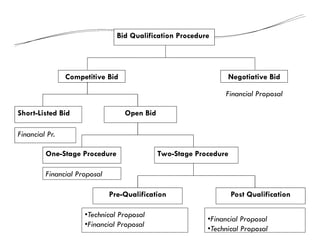
a.Open tendering without pre‐Qualification
The PE must publish an Invitation to Bid notice, so that
bidding is open to all interested bidders
The notice must be published in at least one national
newspaper of general circulation
Where tendering is international, the notice must also be
published, in a newspaper using the same language as the
notice and of sufficient circulation to attract foreign
competition
Notices should also be published on the internet, wherever
possible.
PEs should also ensure that bidding documents are finalised
and approved before publishing the Invitation to Bid notice,
to avoid any delays in the process.
21
22.
….Continued
b. Restricted Tendering
the bidders invited will be those included on the shortlist, who
should be selected from among contractors registered in the
contractors list.
There is no need to publish an Invitation to Bid notice, but the
bidding document should be accompanied by an invitation to
bid letter
the Procuring Entity may advertise the opportunity, to invite
companies to express interest in being invited to bid.
22
23.
Preparation and Issueof Bidding Documents
The Procuring Entity is responsible for the preparation and
issue of the Bidding Document and must use the appropriate
SBD, as this is a mandatory requirement for contracts to be
funded by the Government.
A record must be kept of the Bidders to whom Bidding
Documents have been issued. Receipts must be issued for all
fees paid
23
24.
Bidding Period andBid Receipt
During the bidding period, the Procuring Entity shall:
Hold any pre bid meeting or site visit and issue minutes
promptly;
Promptly respond to requests for clarifications from Bidders;
Issue amendments to the Bidding Documents if necessary;
Receive and record sealed bids from Bidders or make a Bid Box
available up to the deadline for bid submission;
Close bidding at the precise date and time of the deadline and
ensure that no late bids are received; and
Keep all bids received secure until the time for bid opening.
24
25.
Bid Opening
Best Bid‐OpeningPractices to Observe
Conduct the Bid Opening strictly following the procedures
specified in the ITB Sub‐Clause 23 for all bids received on or
prior to the date and time of the bid submission deadline.
Ensure that all bids that were received on time are accounted
for, before starting the Bid Opening,
Examine the bids at Bid Opening in accordance with the
provisions of ITB Sub‐Clause 19.
25
26.
Bid Evaluation
The TenderCommittee shall:
Maintain the bid evaluation process strictly
confidential
Reject any attempts or pressures to distort the
outcome of the evaluation, including fraud and
corruption
Strictly apply only and all of the evaluation and
qualification criteria specified in the Bidding
Documents to determine the lowest evaluated bid and
to make a recommendation for award of contract to
the Tender Committee.
26
27.
Types of WorksContract
Type of contracts:
1. lump sum contract
Such a contract might be used for the supply of a
particular unit of process plant or material, or for a
package deal in which the Contractor is responsible for
both
o Detailed design and
o Construction.
2. Cost ‐ reimbursable contract
Cost‐ reimbursable contracts are used when the requirements of
the promoter are vague or
when it is desirable for design to proceed concurrently with
construction.
Such contracts are also used when the promoter wishes to be
directly involved in the management of the contract or to reduce
the financial risk to the contractor 27
28.
Types of WorksContract
3. Cost ‐ plus contract
A cost‐plus contract is the extreme form of the cost reimbursable type
and is so called because
The contractor is reimbursed for all costs incurred during the
fulfillment of the contract,
Plus an agreed fee to cover overheads and profit.
The fee may be defined as a percentage of the agreed actual cost
or as a fixed amount
4. Admeasurements Contracts
The most common types of construction contract which facilitate
competitive tendering but
Which incorporate some mechanism for the introduction and
evaluation of changes in the work content of the contract.
28
29.
Types of WorksContract
a) Bill of quantities :Bidders are required to enter unit prices against the
estimated quantities of many items of completed work
b) Activity Schedule :
This types of contract is similar to the bill of quantities, but the estimated
quantities of work items which are expected to be less accurate than those
given in the bill of quantities.
5. Target Contracts:
A promoter may introduce additional incentives into a contract by
offering the contractor a bonus payment for the achievement of
some previously defined target in terms of
Time,
Cost, or
Performance
29
30.
Delivery System
Assignment number01.
Explain various types of delivery systems, where do
we apply each delivery system, their advantages
and disadvantages.
Force Account
Design Bid Build (DBB)
Design Build (DB) / Turnkey
Finance / Build Operate Transfer (BOT)
Construction / Facility Management Consultancy
others
30
31.
Provisions of Contract/ContractDocument
For works contract include:
a. Invitation to Bid;
b. Construction Agreement and its Appendices;
c. Letter of Acceptance;
d. Signed form of Bid of the Contractor, Appendices and Annexes ;
e. Particular Conditions of Contract
f. General Condition of Contract;
g. Priced Bill of Quantities;
h. Drawings;
i. Technical Specifications and Methods of Measurement;
j. The Standard Instructions and Information to Bidders for Building
k. Construction Works and the Particular Project Information and
Instruction thereto;
l. Any other documents required to form part of the Contract.
31
32.
Commencement of siteSupervision
As per sub clause 41.1 of the GCC of FIDIC 1987 edition, the
Contractor shall commence the Works as soon as is
reasonably possible after the receipt by him of a notice to this
effect from the Engineer, which notice shall be issued within
the time stated in the Appendix to tender after the date of
the Letter of Acceptance
Hence, the supervision service of the Engineer will
commence in parallel
32
![Standard Bidding Document
The significance of having standard bidding procedure,
specially for public funded projects is:
To simplify the drafting of a specific bidding document for
Procurement of Works by procurement staff;
To minimise the time required by the Tender Committee to approve
Bidding Documents prior to release;
To reduce Bidders’ time and effort in the preparation of Bids;
To facilitate and simplify the evaluation and comparison of bids and
Contract award by the Procuring Entity
To ensure this, for instance, the Ethiopian
government established an agency (PPA) that
supervises procuring entities and sets procedures of
public procurement [proclamation no. 430/2005] 2](https://image.slidesharecdn.com/chaptertwo-250306073937-7d6c6673/85/Chapter-Two-Bidding-procedures-and-contract-types-pdf-2-320.jpg)