1-1
Chapter 1
Introduction to
probability and
Statistics
1-2
 Statistics is a science deals with collect, organize,
analyze, and draw meaningful inferences from data,
which lead to good decisions.
 Statistics is a science that helps us make better decisions
in business and economics as well as in other fields.
1.1 Definition of STATISTICS
1-3
 Descriptive Statistics helps to describe a given set of
data without going beyond that data
 It consists of collection, organization, summarization and
analysis of the data
 Inferential Statistics helps to make inference/conclusion
about a population based on the selected sample
• it consists of predict and forecast values of population
parameters; test hypotheses about values of
population parameters; make decisions
1.2 Classification of Statistics
1-4
 Stage 1: Data collection
 Stage 2: Organization and presentation of data
 Stage 3: Data analysis
 Stage 4: Interpretation of the result
1.3 Stages in Statistical Investigation
1-5
 Data collection
The process of measuring, gathering, assembling the raw data up on
which the statistical investigation is to be based.
Data can be collected by using survey. Survey can also be done in
different methods, three of the most common methods are:
 Telephone survey
 Mailed questionnaire
 Personal interview.
1-6
 Organization and presentation of data
The process of organization, classification, compilation, and
summarization of data to present it in a meaningful form.
Example;- graphs, charts and tables.
Analysis of data
The process of extracting relevant information from the
summarized data, mainly through the use of elementary
mathematical operation.
Inference of data
By using analysis of the data conclusions are formed and inferences
made.
1-7
 A population consists of the set of all
measurements/elements under study.
 A sample is a subset of the measurements selected
from the population.
 A census is a complete enumeration of every item
in a population.
 Sampling is the process of taking a sample form a
population
1.4 Definition of some basic terms
1-8
 Parameter is a statistical measure obtained from
a population data
 Statistic is a statistical measure obtained from a
population data
 Variable is a characteristics under study that
assumes different values for different elements
1-9
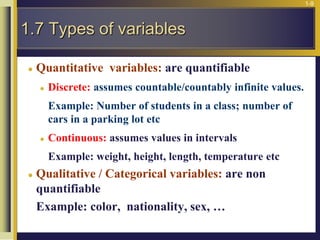
 Quantitative variables: are quantifiable
 Discrete: assumes countable/countably infinite values.
Example: Number of students in a class; number of
cars in a parking lot etc
 Continuous: assumes values in intervals
Example: weight, height, length, temperature etc
 Qualitative / Categorical variables: are non
quantifiable
Example: color, nationality, sex, …
1.7 Types of variables
1-10
 It is applied in any field of study which seeks
quantitative evidence
 For instance,
 To compare breaking strength of two products
 For quality control of products in a given production
process
 To compare the improvement in yield due to
application of fertilizer, pesticide….
1.5 Application of Statistics
1-11
 It does not study qualitative characteristics
directly
 It doesn’t deals with a single individuals but deals
with aggregate of facts
 Statistical findings are approximate
 It is sensitive to misuse
1.6 Limitation of Statistics
1-12
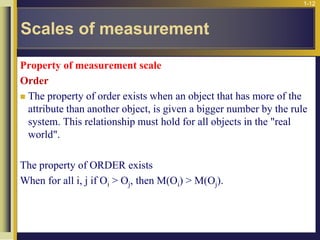
Scales of measurement
Property of measurement scale
Order
 The property of order exists when an object that has more of the
attribute than another object, is given a bigger number by the rule
system. This relationship must hold for all objects in the "real
world".
The property of ORDER exists
When for all i, j if Oi > Oj, then M(Oi) > M(Oj).
1-13
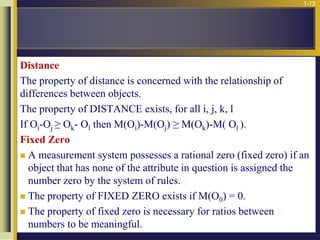
Distance
The property of distance is concerned with the relationship of
differences between objects.
The property of DISTANCE exists, for all i, j, k, l
If Oi-Oj ≥ Ok- Ol then M(Oi)-M(Oj) ≥ M(Ok)-M( Ol ).
Fixed Zero
 A measurement system possesses a rational zero (fixed zero) if an
object that has none of the attribute in question is assigned the
number zero by the system of rules.
 The property of FIXED ZERO exists if M(O0) = 0.
 The property of fixed zero is necessary for ratios between
numbers to be meaningful.
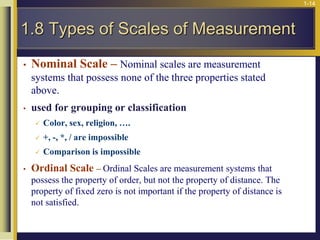
1-14
• Nominal Scale – Nominal scales are measurement
systems that possess none of the three properties stated
above.
• used for grouping or classification
 Color, sex, religion, ….
 +, -, *, / are impossible
 Comparison is impossible
• Ordinal Scale – Ordinal Scales are measurement systems that
possess the property of order, but not the property of distance. The
property of fixed zero is not important if the property of distance is
not satisfied.
1.8 Types of Scales of Measurement
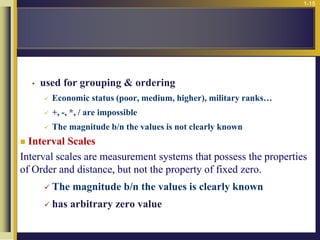
1-15
• used for grouping & ordering
 Economic status (poor, medium, higher), military ranks…
 +, -, *, / are impossible
 The magnitude b/n the values is not clearly known
 Interval Scales
Interval scales are measurement systems that possess the properties
of Order and distance, but not the property of fixed zero.
 The magnitude b/n the values is clearly known
 has arbitrary zero value
1-16
 Temperatures (0F, 0C)
 + & - are possible but * & / are impossible
• Ratio Scale –Ratio scales are measurement systems that
possess all three properties: order, distance, and fixed zero.
 Has true zero point
 +, -, *, / are possible
 salary, weight, height,….

chapter one.ppt edit.ppt

  • 1.
  • 2.
    1-2  Statistics isa science deals with collect, organize, analyze, and draw meaningful inferences from data, which lead to good decisions.  Statistics is a science that helps us make better decisions in business and economics as well as in other fields. 1.1 Definition of STATISTICS
  • 3.
    1-3  Descriptive Statisticshelps to describe a given set of data without going beyond that data  It consists of collection, organization, summarization and analysis of the data  Inferential Statistics helps to make inference/conclusion about a population based on the selected sample • it consists of predict and forecast values of population parameters; test hypotheses about values of population parameters; make decisions 1.2 Classification of Statistics
  • 4.
    1-4  Stage 1:Data collection  Stage 2: Organization and presentation of data  Stage 3: Data analysis  Stage 4: Interpretation of the result 1.3 Stages in Statistical Investigation
  • 5.
    1-5  Data collection Theprocess of measuring, gathering, assembling the raw data up on which the statistical investigation is to be based. Data can be collected by using survey. Survey can also be done in different methods, three of the most common methods are:  Telephone survey  Mailed questionnaire  Personal interview.
  • 6.
    1-6  Organization andpresentation of data The process of organization, classification, compilation, and summarization of data to present it in a meaningful form. Example;- graphs, charts and tables. Analysis of data The process of extracting relevant information from the summarized data, mainly through the use of elementary mathematical operation. Inference of data By using analysis of the data conclusions are formed and inferences made.
  • 7.
    1-7  A populationconsists of the set of all measurements/elements under study.  A sample is a subset of the measurements selected from the population.  A census is a complete enumeration of every item in a population.  Sampling is the process of taking a sample form a population 1.4 Definition of some basic terms
  • 8.
    1-8  Parameter isa statistical measure obtained from a population data  Statistic is a statistical measure obtained from a population data  Variable is a characteristics under study that assumes different values for different elements
  • 9.
    1-9  Quantitative variables:are quantifiable  Discrete: assumes countable/countably infinite values. Example: Number of students in a class; number of cars in a parking lot etc  Continuous: assumes values in intervals Example: weight, height, length, temperature etc  Qualitative / Categorical variables: are non quantifiable Example: color, nationality, sex, … 1.7 Types of variables
  • 10.
    1-10  It isapplied in any field of study which seeks quantitative evidence  For instance,  To compare breaking strength of two products  For quality control of products in a given production process  To compare the improvement in yield due to application of fertilizer, pesticide…. 1.5 Application of Statistics
  • 11.
    1-11  It doesnot study qualitative characteristics directly  It doesn’t deals with a single individuals but deals with aggregate of facts  Statistical findings are approximate  It is sensitive to misuse 1.6 Limitation of Statistics
  • 12.
    1-12 Scales of measurement Propertyof measurement scale Order  The property of order exists when an object that has more of the attribute than another object, is given a bigger number by the rule system. This relationship must hold for all objects in the "real world". The property of ORDER exists When for all i, j if Oi > Oj, then M(Oi) > M(Oj).
  • 13.
    1-13 Distance The property ofdistance is concerned with the relationship of differences between objects. The property of DISTANCE exists, for all i, j, k, l If Oi-Oj ≥ Ok- Ol then M(Oi)-M(Oj) ≥ M(Ok)-M( Ol ). Fixed Zero  A measurement system possesses a rational zero (fixed zero) if an object that has none of the attribute in question is assigned the number zero by the system of rules.  The property of FIXED ZERO exists if M(O0) = 0.  The property of fixed zero is necessary for ratios between numbers to be meaningful.
  • 14.
    1-14 • Nominal Scale– Nominal scales are measurement systems that possess none of the three properties stated above. • used for grouping or classification  Color, sex, religion, ….  +, -, *, / are impossible  Comparison is impossible • Ordinal Scale – Ordinal Scales are measurement systems that possess the property of order, but not the property of distance. The property of fixed zero is not important if the property of distance is not satisfied. 1.8 Types of Scales of Measurement
  • 15.
    1-15 • used forgrouping & ordering  Economic status (poor, medium, higher), military ranks…  +, -, *, / are impossible  The magnitude b/n the values is not clearly known  Interval Scales Interval scales are measurement systems that possess the properties of Order and distance, but not the property of fixed zero.  The magnitude b/n the values is clearly known  has arbitrary zero value
  • 16.
    1-16  Temperatures (0F,0C)  + & - are possible but * & / are impossible • Ratio Scale –Ratio scales are measurement systems that possess all three properties: order, distance, and fixed zero.  Has true zero point  +, -, *, / are possible  salary, weight, height,….