Download free for 30 days
Sign in
Upload
Language (EN)
Support
Business
Mobile
Social Media
Marketing
Technology
Art & Photos
Career
Design
Education
Presentations & Public Speaking
Government & Nonprofit
Healthcare
Internet
Law
Leadership & Management
Automotive
Engineering
Software
Recruiting & HR
Retail
Sales
Services
Science
Small Business & Entrepreneurship
Food
Environment
Economy & Finance
Data & Analytics
Investor Relations
Sports
Spiritual
News & Politics
Travel
Self Improvement
Real Estate
Entertainment & Humor
Health & Medicine
Devices & Hardware
Lifestyle
Change Language
Language
English
Español
Português
Français
Deutsche
Cancel
Save
Submit search
EN
Uploaded by
compassdave
PPT, PDF
11 views
CHAPTER ONE - RESORTS MANAGEMENT: AN INTRODUCTION
Resort Management - Introduction
Travel
◦
Read more
0
Save
Share
Embed
Embed presentation
Download
Download to read offline
1
/ 11
2
/ 11
3
/ 11
4
/ 11
5
/ 11
6
/ 11
7
/ 11
8
/ 11
9
/ 11
10
/ 11
11
/ 11
More Related Content
PPT
Subham resort
by
subham sah
PPT
planning resort planning
by
arq0407 Quinones
PPT
Resort
by
Malek abed al ghafour
PPTX
Introduction to resort (1).pptx
by
Milcah6
PPTX
Resort Planning - 2.pptx
by
PaoloPineda11
PPT
ITFT-Resort planing
by
Himkiran Maunta
PDF
Resort Industry.pdf
by
PaoloPineda11
PPT
ITFT-Resort introduction
by
Himkiran Maunta
Subham resort
by
subham sah
planning resort planning
by
arq0407 Quinones
Resort
by
Malek abed al ghafour
Introduction to resort (1).pptx
by
Milcah6
Resort Planning - 2.pptx
by
PaoloPineda11
ITFT-Resort planing
by
Himkiran Maunta
Resort Industry.pdf
by
PaoloPineda11
ITFT-Resort introduction
by
Himkiran Maunta
Similar to CHAPTER ONE - RESORTS MANAGEMENT: AN INTRODUCTION
PPT
Emerging Concepts In Indian Hospitality Industry
by
shashank777
PPT
resort management chapter 3 complete lecture
by
annejo20
PPT
Indian Hotel Industry - Emerging Concepts
by
Utpal Parekh
PPT
Vacation Ownership What Is It Really
by
greavespaula
PPTX
Resorts (Travel Management Prelim Notes)
by
Dairy Queen Philippines
PPTX
Comparison of vacation ownership amenities with hotel amenities and resorts
by
AMALDASKH
PPTX
Resort Management Dr Sunil kumar.pptx
by
Dr. Sunil Kumar
PPTX
Classification of hotels
by
Bhavess
PPT
Chapter 3
by
jezratty
PPTX
Classification of hotels
by
Dr. Sunil Kumar
PPTX
Resorts
by
Gaby Pabilo
PPTX
Ski Resorts, beach resorts, Amusement parks and theme parks
by
AnnieVarghese21
PPT
Time share
by
Dr. Sunil Kumar
PPT
Week (1) introuduction to hospitality industry
by
dmyrna
PPT
Week (1) introuduction to hospitality industry
by
dmyrna
PPT
Chapter 5
by
jezratty
PPT
Emerging Concepts In Indian Hospitality
by
Mahesh Samala
PPT
RESORT MANAGEMENT BY Lalit rava btm mdu rohtak
by
Lalit Rava
PPTX
Classificationofhotels 101017085146-phpapp01
by
Domingo Aquino
PDF
Characteristics
by
Jackwinder Uppal
Emerging Concepts In Indian Hospitality Industry
by
shashank777
resort management chapter 3 complete lecture
by
annejo20
Indian Hotel Industry - Emerging Concepts
by
Utpal Parekh
Vacation Ownership What Is It Really
by
greavespaula
Resorts (Travel Management Prelim Notes)
by
Dairy Queen Philippines
Comparison of vacation ownership amenities with hotel amenities and resorts
by
AMALDASKH
Resort Management Dr Sunil kumar.pptx
by
Dr. Sunil Kumar
Classification of hotels
by
Bhavess
Chapter 3
by
jezratty
Classification of hotels
by
Dr. Sunil Kumar
Resorts
by
Gaby Pabilo
Ski Resorts, beach resorts, Amusement parks and theme parks
by
AnnieVarghese21
Time share
by
Dr. Sunil Kumar
Week (1) introuduction to hospitality industry
by
dmyrna
Week (1) introuduction to hospitality industry
by
dmyrna
Chapter 5
by
jezratty
Emerging Concepts In Indian Hospitality
by
Mahesh Samala
RESORT MANAGEMENT BY Lalit rava btm mdu rohtak
by
Lalit Rava
Classificationofhotels 101017085146-phpapp01
by
Domingo Aquino
Characteristics
by
Jackwinder Uppal
Recently uploaded
PDF
Cusco Plaza de Armas: Exploring the Heart of the Inca Capital
by
mavad45458
PDF
Hunza Blossom. Hunza Cherry Blossom Tour. Hunza Blossom Tours
by
Hunzaadventuretours
PDF
Visit Dubai | Best Places, Adventures & Modern Landmarks
by
preetisaini02hd
PPTX
🦓 Top 5 Safari Companies in Tanzania (2025–2026
by
deepatiwari2501
PPTX
Mercedes Sprinter Hire — Prague.....pptx
by
MOTTIFY s.r.o.
PDF
Why Israel Group Tours for Christians Are a Life-Changing Experience
by
Coral Travel & Tours
PDF
Guided Tour of Vienna History, Culture, and Hidden Gems .pdf
by
Wienguide
PDF
Sundarnarayan Temple Nashik: A Complete History & Travel Guide
by
EpicYatra
PDF
Langtang Valley Trek hidden trek of Nepal
by
seoprabik
PDF
Book Affordable Chandigarh to Delhi Taxi with H&B Cabs
by
H & B Cab
Cusco Plaza de Armas: Exploring the Heart of the Inca Capital
by
mavad45458
Hunza Blossom. Hunza Cherry Blossom Tour. Hunza Blossom Tours
by
Hunzaadventuretours
Visit Dubai | Best Places, Adventures & Modern Landmarks
by
preetisaini02hd
🦓 Top 5 Safari Companies in Tanzania (2025–2026
by
deepatiwari2501
Mercedes Sprinter Hire — Prague.....pptx
by
MOTTIFY s.r.o.
Why Israel Group Tours for Christians Are a Life-Changing Experience
by
Coral Travel & Tours
Guided Tour of Vienna History, Culture, and Hidden Gems .pdf
by
Wienguide
Sundarnarayan Temple Nashik: A Complete History & Travel Guide
by
EpicYatra
Langtang Valley Trek hidden trek of Nepal
by
seoprabik
Book Affordable Chandigarh to Delhi Taxi with H&B Cabs
by
H & B Cab
CHAPTER ONE - RESORTS MANAGEMENT: AN INTRODUCTION
1.
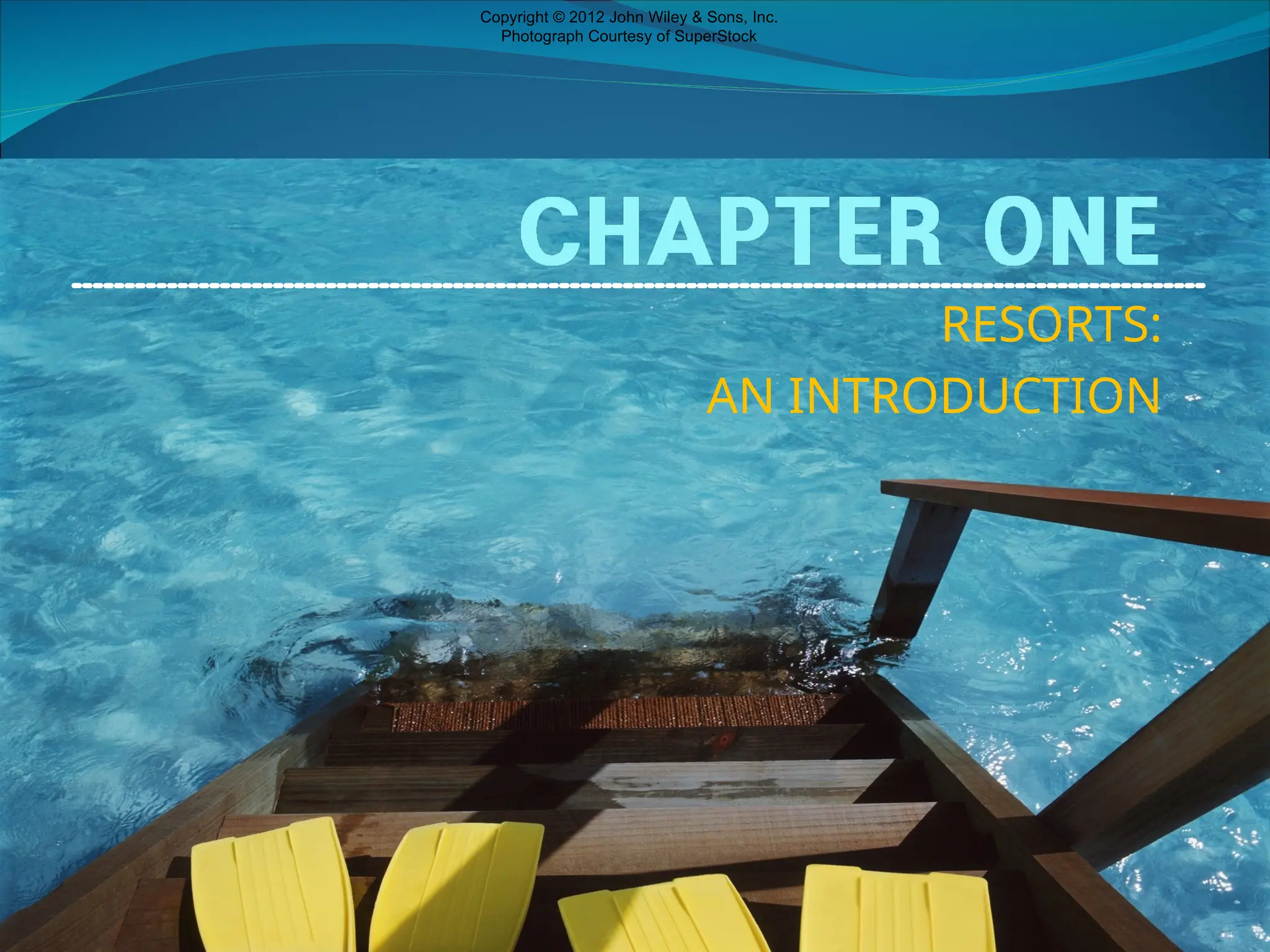
RESORTS: AN INTRODUCTION Copyright ©
2012 John Wiley & Sons, Inc. Photograph Courtesy of SuperStock
2.
Learning Objectives Identify
the major factors influencing the development of the resort industry. Identify the various ways resorts can be classified. Place different types of resort offerings on a time-equity continuum. Copyright © 2012 John Wiley & Sons, Inc.
3.
21st Century Lodging, Recreation
and Entertainment concepts are merging. Long weekends are replacing long vacations. Increased popularity of multi-generational family gatherings. More multi-use resort destinations. Resort waterparks are growing and getting bigger. Copyright © 2012 John Wiley & Sons, Inc.
4.
21st Century Adventure sports
are going mainstream. Movement from natural to man-made facilities. Every outdoor sport will have an indoor version. New structures and enclosures cover large spaces affordably. Copyright © 2012 John Wiley & Sons, Inc.
5.
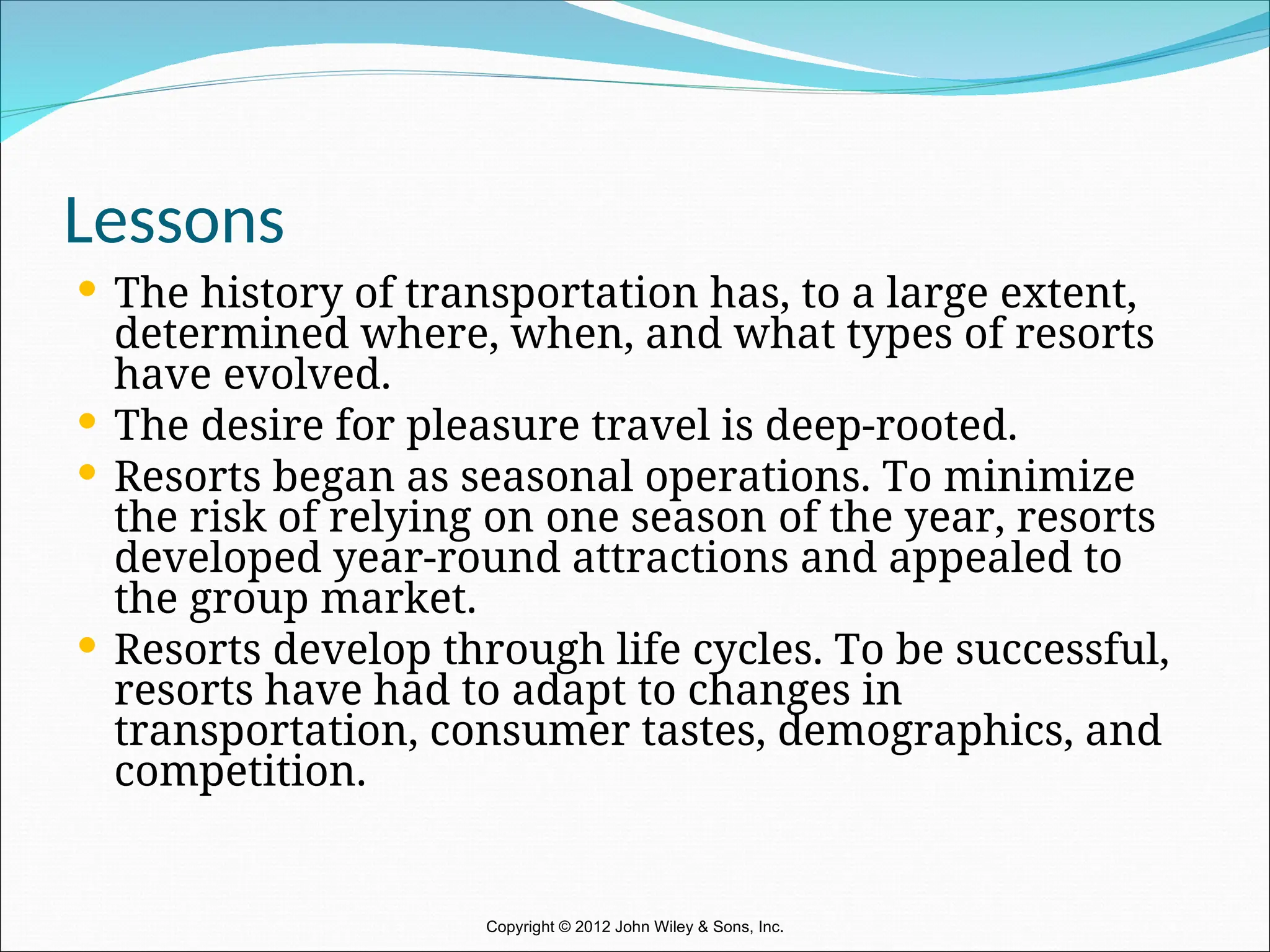
Lessons The history
of transportation has, to a large extent, determined where, when, and what types of resorts have evolved. The desire for pleasure travel is deep-rooted. Resorts began as seasonal operations. To minimize the risk of relying on one season of the year, resorts developed year-round attractions and appealed to the group market. Resorts develop through life cycles. To be successful, resorts have had to adapt to changes in transportation, consumer tastes, demographics, and competition. Copyright © 2012 John Wiley & Sons, Inc.
6.
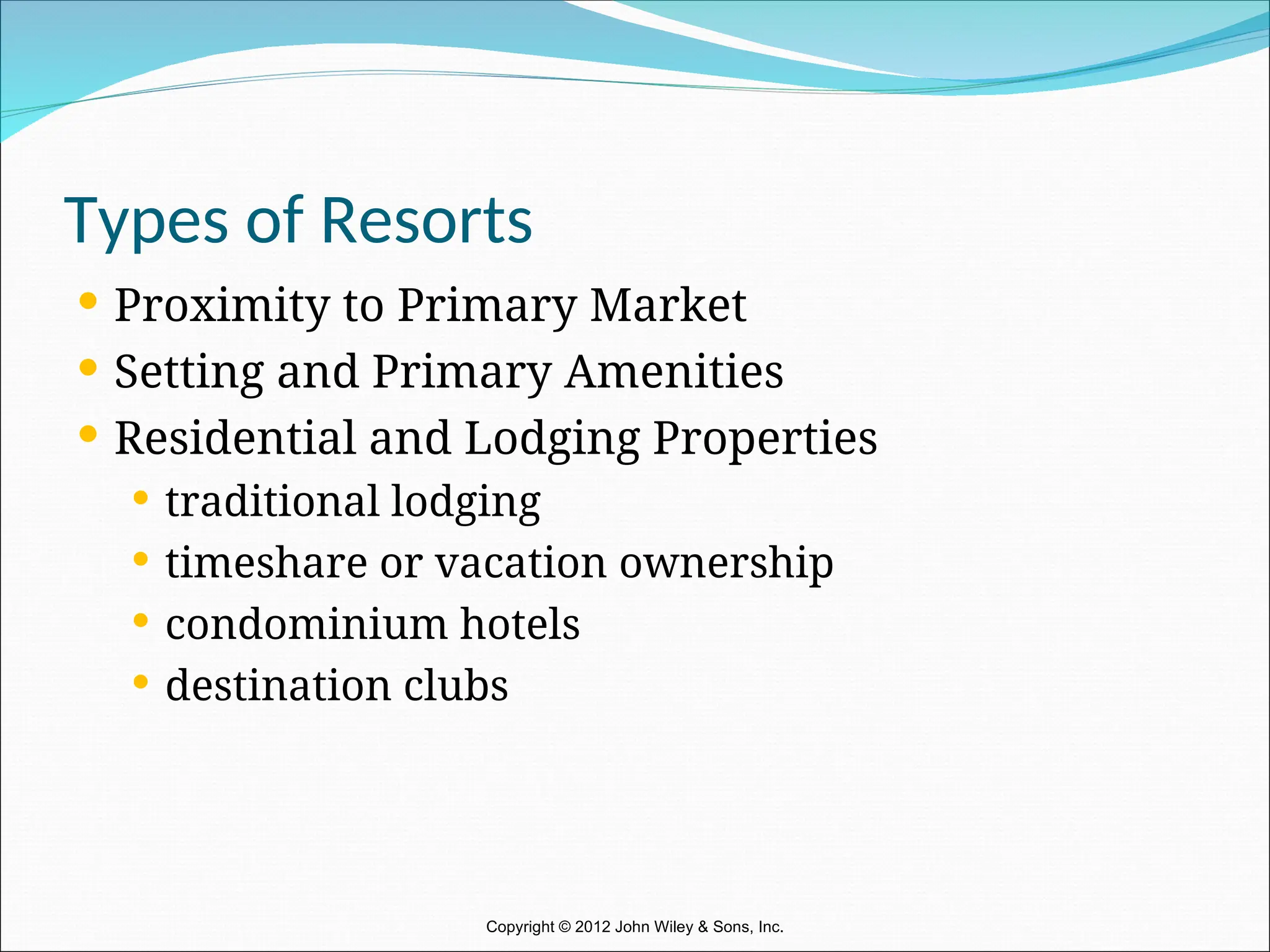
Types of Resorts
Proximity to Primary Market Setting and Primary Amenities Residential and Lodging Properties traditional lodging timeshare or vacation ownership condominium hotels destination clubs Copyright © 2012 John Wiley & Sons, Inc.
7.
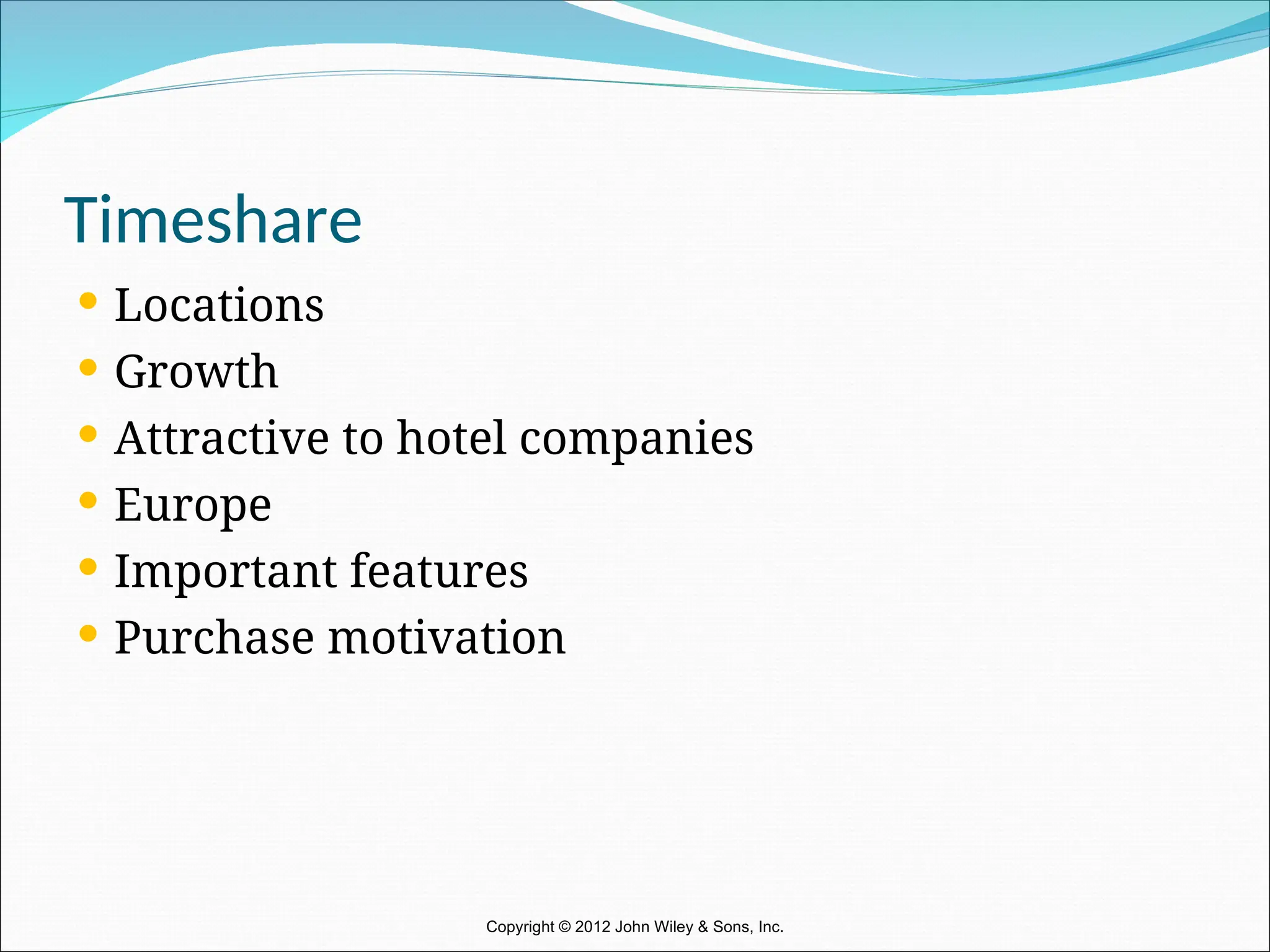
Timeshare Locations Growth
Attractive to hotel companies Europe Important features Purchase motivation Copyright © 2012 John Wiley & Sons, Inc.
8.
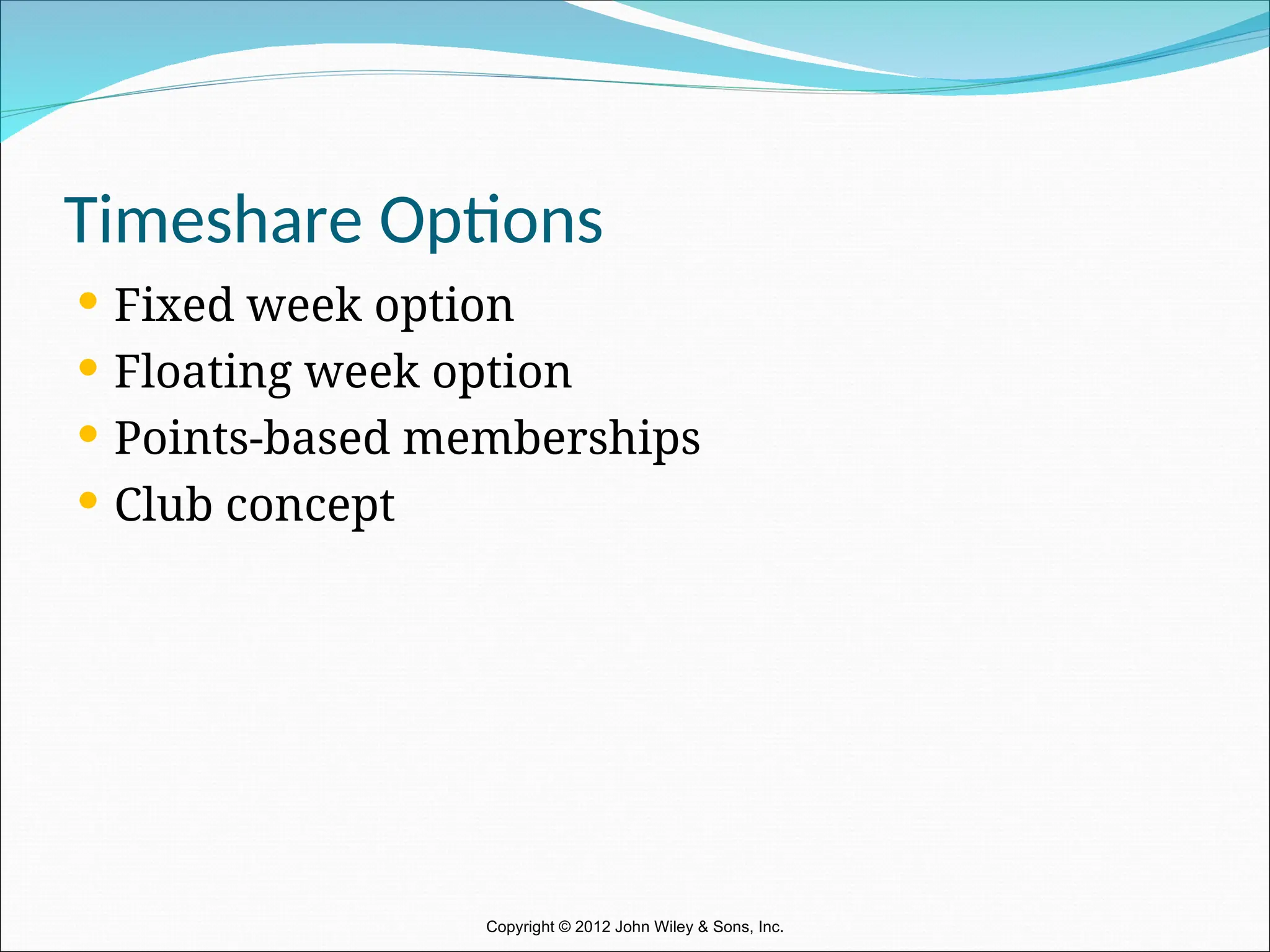
Timeshare Options Fixed
week option Floating week option Points-based memberships Club concept Copyright © 2012 John Wiley & Sons, Inc.
9.
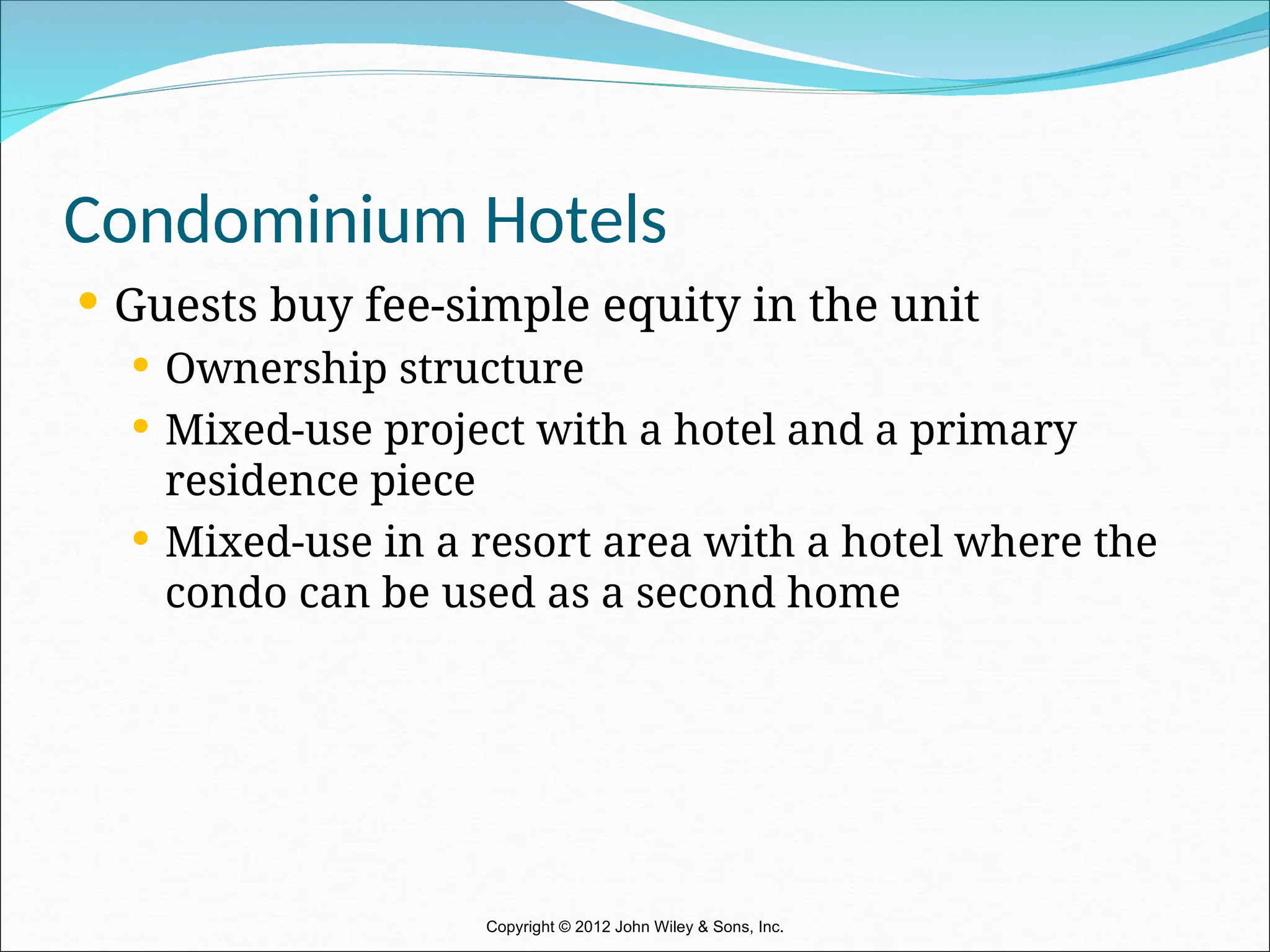
Condominium Hotels Guests
buy fee-simple equity in the unit Ownership structure Mixed-use project with a hotel and a primary residence piece Mixed-use in a resort area with a hotel where the condo can be used as a second home Copyright © 2012 John Wiley & Sons, Inc.
10.
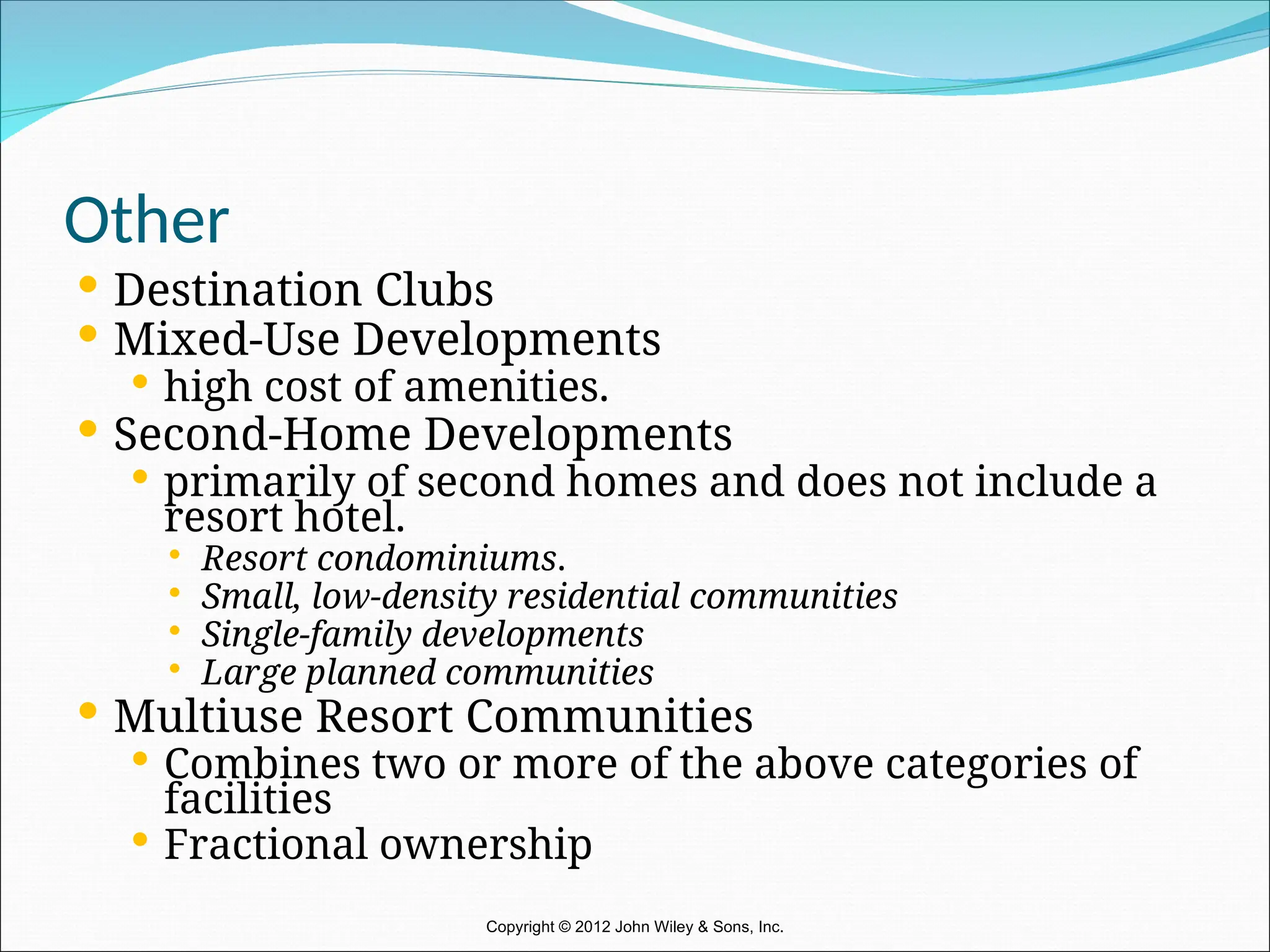
Other Destination Clubs
Mixed-Use Developments high cost of amenities. Second-Home Developments primarily of second homes and does not include a resort hotel. Resort condominiums. Small, low-density residential communities Single-family developments Large planned communities Multiuse Resort Communities Combines two or more of the above categories of facilities Fractional ownership Copyright © 2012 John Wiley & Sons, Inc.
11.
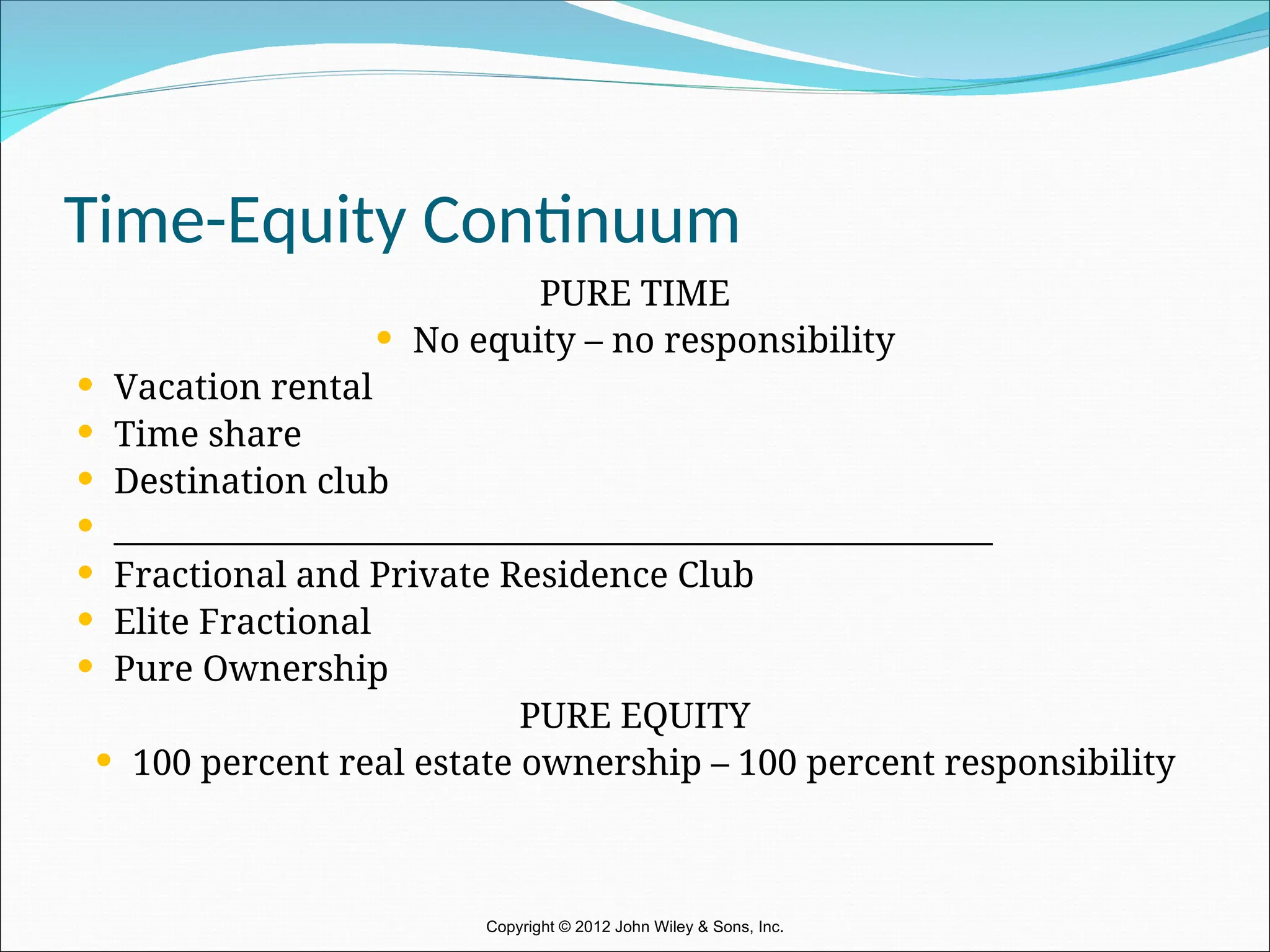
Time-Equity Continuum PURE TIME
No equity – no responsibility Vacation rental Time share Destination club ______________________________________________________ Fractional and Private Residence Club Elite Fractional Pure Ownership PURE EQUITY 100 percent real estate ownership – 100 percent responsibility Copyright © 2012 John Wiley & Sons, Inc.
Download