BUSINESS ETHICS
CHAPTER ONE
INTRODUCTION OF BUSINESS ETHICS
HAVING COMPLETED THIS CHAPTER YOU SHOULD BE ABLE TO:
■ PROVIDE A BASIC DEFINITION OF BUSINESS ETHICS.
■ DESCRIBE THE RELATIONSHIP BETWEEN BUSINESS ETHICS AND THE LAW.
■ DISTINGUISH BETWEEN ETHICS, MORALITY, AND ETHICAL THEORY.
■ EVALUATE THE IMPORTANCE OF BUSINESS ETHICS AS AN ACADEMIC SUBJECT
AND AS A PRACTICAL MANAGEMENT ISSUE IN ORGANIZATIONS.
■ SPECIFY ETHICAL CHALLENGES IN DIFFERENT TYPES OF ORGANIZATIONS.
■ DESCRIBE HOW GLOBALIZATION REPRESENTS A CRITICAL CONTEXT FOR
BUSINESS ETHICS.
■ ELABORATE ON DIFFERENT INTERNATIONAL PERSPECTIVES ON BUSINESS ETHICS,
INCLUDING EUROPEAN, ASIAN, AND NORTH AMERICAN PERSPECTIVES.
■ EXPLAIN HOW THE ‘TRIPLE BOTTOM LINE’ OF SUSTAINABILITY IS A KEY GOAL FOR
BUSINESS ETHICS
What is business ethics
 business ethics is the study of business situations, activities, and decisions
where issues of right and wrong are addressed.
 It is worth stressing that by ‘right’ and ‘wrong’ we mean morally right and
wrong, as opposed to, for example, commercially, strategically, or
financially right or wrong. Moreover, by ‘business’ ethics, we do not mean
only commercial businesses, but also government organizations, pressure
groups, not-for-profit businesses, charities, and other organizations. For
example, questions of how to manage employees fairly, or what
constitutes deception in advertising, are equally as important for
organizations such as Wikimedia, Seoul National University, or the
German Christian Democrat Party as they are for Facebook, Samsung, or
Deutsche Bank
Business ethics and the law
 Having defined business ethics in terms of issues of right and wrong, one
might quite naturally question whether this is in any way distinct from the
law. Surely the law is also about issues of right and wrong?
 This is true, and there is considerable overlap between ethics and the law.
In fact, the law is essentially an institutionalization or codification of
ethics into specific social rules, regulations, and proscriptions.
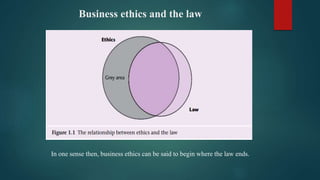
Nevertheless, the two are not equivalent. Perhaps the best way of thinking
about ethics and the law is in terms of two intersecting domains (see
Figure 1.1).
 The law might be said to be a definition of the minimum acceptable
standards of behavior. However, the law does not explicitly cover every
possible ethical issue in business—or for that matter outside of business.
Business ethics and the law
 For example, just as there is no law preventing you from being
unfaithful to your significant other (although this is perceived by many
to be unethical), so there is no law in many countries preventing
businesses from testing their products on animals, selling landmines to
oppressive regimes, or preventing their employees from joining a
union—again, issues that many feel very strongly about.
 Similarly, it is possible to think of issues that are covered by the law
but which are not really about ethics.
 For example, the law prescribes whether we should drive on the right
or the left side of the road. Although this prevents chaos on the roads,
the decision about which side we should drive on is not an ethical
decision as such.
Business ethics and the law
In one sense then, business ethics can be said to begin where the law ends.
Business ethics and the law
 As we shall see many times over in this book, the problem of trying to make
decisions in the grey areas of business ethics, or where values may be in
conflict, means that many of the questions we face are equivocal. What this
suggests is that there simply may not be a definitive ‘right’ answer to many
business ethics problems. It is often not just a matter of deciding between
right and wrong, but between courses of action that different actors, for
different reasons, both believe are right—or both believe are wrong.
 such as The Story of Stuff Project’s Annie Leonard (2010), argue that it
promotes needless consumption, creates waste, and has been deceptively
advertised as superior to tap water. Proponents, such as Nestlé, contend that
it meets customers’ need for convenience, it encourages more healthy
lifestyles (by substituting for sugary drinks), and has a low carbon footprint
compared to other bottled drinks (Kitts 2013).
Business ethics and the law
 With issues such as bottled water, as well as countless others including
sweatshop working conditions, executive compensation, or corporate tax
avoidance, we can see that business ethics problems tend to be very
controversial and open to widely different points of view. In this sense,
business ethics is not like subjects such as accounting, finance, engineering,
or business law where you are supposed to learn specific procedures and facts
in order to make objectively correct decisions. Rather, it is about gathering
relevant evidence, and systematically analyzing it through particular lenses
and tools (as discussed in more detail in Chapter 3) in order to come to an
informed decision that has taken account of the most important
considerations. So studying business ethics should help you to make better
decisions, but this is not the same as making unequivocally right decisions.
Business ethics is principally about developing good judgement
Defining morality, ethics, and ethical theory
 Morality is concerned with the norms, values, and beliefs embedded in social processes
which define right and wrong for an individual or a community.
 Ethics is concerned with the study of morality and the application of reason to explicate
specific rules and principles that determine morally acceptable courses of action. Ethical
theories are the codifications of these rules and principles.
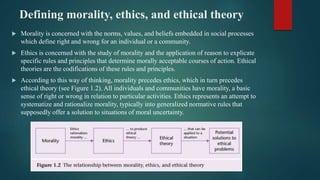
 According to this way of thinking, morality precedes ethics, which in turn precedes
ethical theory (see Figure 1.2). All individuals and communities have morality, a basic
sense of right or wrong in relation to particular activities. Ethics represents an attempt to
systematize and rationalize morality, typically into generalized normative rules that
supposedly offer a solution to situations of moral uncertainty.
Why business ethics is important?
 1. Business has huge power within society. Business affects almost every aspect of our lives, and
can even have a major impact on the democratic process of government. Evidence suggests that
many members of the public are uneasy with such developments. For instance, one recent poll
revealed that a large majority of the US population believe that lobbyists (71%), major companies
(67%), and banks and financial institutions (67%) have too much power, This raises a host of
ethical questions and suggests we need to find new answers to the question of how we can either
restrain this power or ensure that it is used for social good rather than exploitation of the less
powerful.
 2. Business has the potential to provide a major contribution to our societies. Whether in terms of
producing the products and services that we want, providing employment, paying taxes, acting as
an engine for economic development, or solving complex social problems, business can be a
tremendous force for good. How, or indeed whether, this contribution is actually realized in
practice goes to the heart of the business ethics debate. As a global survey conducted by McKinsey
showed, only about 50% of business executives actually think that corporations make a mostly or
somewhat positive contribution to society, while some 25% believe that their contribution is mostly
or somewhat negative (McKinsey Quarterly 2006).
Why business ethics is important?
 3. Business malpractice has the potential to inflict enormous harm on individuals,
communities, and the environment. When the Rana Plaza building collapsed in
Bangladesh in 2013, more than 1,000 garment workers stitching clothes for
suppliers of Western retailers died having been forced to return to work after the
building was evacuated and declared unsafe (Yardley 2013). Through helping us to
understand more about the causes and consequences of these malpractices,
business ethics seeks, as the founding editor of the Journal of Business Ethics has
suggested, ‘to improve the human condition’ (Michalos 1988)
 4. The demands being placed on business to be ethical by its various stakeholders
are becoming more complex and challenging. It is critical to understand these
challenges and to develop responses to them. to address the demands of
stakeholders but also enable firms to perform their economic role effectively.
Getting this balance right remains a critical challenge for managers.
Why business ethics is important?
 5. Employees face significant pressure to compromise ethical standards. For
example, a survey of 500 financial services professionals in the UK and the US
found that more than one in four had observed wrongdoing in the workplace, while
a quarter of respondents agreed that financial services professionals might need to
engage in unethical or illegal conduct in order to be successful. Studying business
ethics provides us with a way of looking at the reasons behind such infractions, and
the ways in which such problems might be dealt with by managers, regulators, and
others interested in improving ethical practice.
 6. Business faces a trust deficit. Globally, only 18% of the general population trusts
business leaders to tell the truth and just 19% trust them to make ethical decisions.
Enhancing business ethics will be a critical component in restoring that trust in the
future.
Business ethics in different organization context
 It should be clear by now that whatever else we may think it of it, business ethics clearly
matters. It matters not just for huge multinational corporations like McDonald’s, Nestlé,
Shell, or HSBC, but also for a range of other types of organizations.
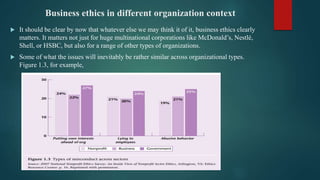
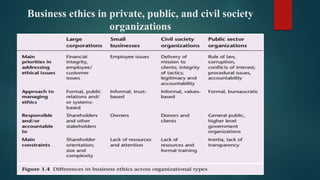
 Some of what the issues will inevitably be rather similar across organizational types.
Figure 1.3, for example,
Business ethics in private, public, and civil society
organizations
Globalization
 What is globalization?
 Globalization The ongoing integration of political, social, and
economic interactions at the transnational level, regardless of
physical proximity or distance.
 The new and game-changing feature ‘globalization’ is that it
makes real-time social, political, economic, and cultural
exchanges possible between people or organizations without
any need for direct physical contact. Globalization makes these
interactions possible regardless of how close or how far away
the different partners are actually located from each other.
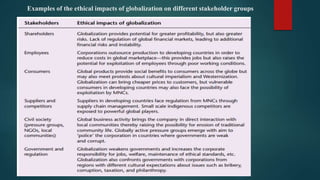
Examples of the ethical impacts of globalization on different stakeholder groups
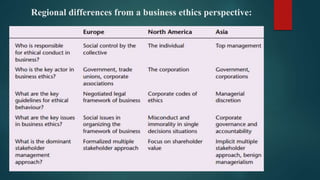
Regional differences from a business ethics perspective:

chapter one ethics.pptx

  • 1.
    BUSINESS ETHICS CHAPTER ONE INTRODUCTIONOF BUSINESS ETHICS HAVING COMPLETED THIS CHAPTER YOU SHOULD BE ABLE TO: ■ PROVIDE A BASIC DEFINITION OF BUSINESS ETHICS. ■ DESCRIBE THE RELATIONSHIP BETWEEN BUSINESS ETHICS AND THE LAW. ■ DISTINGUISH BETWEEN ETHICS, MORALITY, AND ETHICAL THEORY. ■ EVALUATE THE IMPORTANCE OF BUSINESS ETHICS AS AN ACADEMIC SUBJECT AND AS A PRACTICAL MANAGEMENT ISSUE IN ORGANIZATIONS. ■ SPECIFY ETHICAL CHALLENGES IN DIFFERENT TYPES OF ORGANIZATIONS. ■ DESCRIBE HOW GLOBALIZATION REPRESENTS A CRITICAL CONTEXT FOR BUSINESS ETHICS. ■ ELABORATE ON DIFFERENT INTERNATIONAL PERSPECTIVES ON BUSINESS ETHICS, INCLUDING EUROPEAN, ASIAN, AND NORTH AMERICAN PERSPECTIVES. ■ EXPLAIN HOW THE ‘TRIPLE BOTTOM LINE’ OF SUSTAINABILITY IS A KEY GOAL FOR BUSINESS ETHICS
  • 2.
    What is businessethics  business ethics is the study of business situations, activities, and decisions where issues of right and wrong are addressed.  It is worth stressing that by ‘right’ and ‘wrong’ we mean morally right and wrong, as opposed to, for example, commercially, strategically, or financially right or wrong. Moreover, by ‘business’ ethics, we do not mean only commercial businesses, but also government organizations, pressure groups, not-for-profit businesses, charities, and other organizations. For example, questions of how to manage employees fairly, or what constitutes deception in advertising, are equally as important for organizations such as Wikimedia, Seoul National University, or the German Christian Democrat Party as they are for Facebook, Samsung, or Deutsche Bank
  • 3.
    Business ethics andthe law  Having defined business ethics in terms of issues of right and wrong, one might quite naturally question whether this is in any way distinct from the law. Surely the law is also about issues of right and wrong?  This is true, and there is considerable overlap between ethics and the law. In fact, the law is essentially an institutionalization or codification of ethics into specific social rules, regulations, and proscriptions. Nevertheless, the two are not equivalent. Perhaps the best way of thinking about ethics and the law is in terms of two intersecting domains (see Figure 1.1).  The law might be said to be a definition of the minimum acceptable standards of behavior. However, the law does not explicitly cover every possible ethical issue in business—or for that matter outside of business.
  • 4.
    Business ethics andthe law  For example, just as there is no law preventing you from being unfaithful to your significant other (although this is perceived by many to be unethical), so there is no law in many countries preventing businesses from testing their products on animals, selling landmines to oppressive regimes, or preventing their employees from joining a union—again, issues that many feel very strongly about.  Similarly, it is possible to think of issues that are covered by the law but which are not really about ethics.  For example, the law prescribes whether we should drive on the right or the left side of the road. Although this prevents chaos on the roads, the decision about which side we should drive on is not an ethical decision as such.
  • 5.
    Business ethics andthe law In one sense then, business ethics can be said to begin where the law ends.
  • 6.
    Business ethics andthe law  As we shall see many times over in this book, the problem of trying to make decisions in the grey areas of business ethics, or where values may be in conflict, means that many of the questions we face are equivocal. What this suggests is that there simply may not be a definitive ‘right’ answer to many business ethics problems. It is often not just a matter of deciding between right and wrong, but between courses of action that different actors, for different reasons, both believe are right—or both believe are wrong.  such as The Story of Stuff Project’s Annie Leonard (2010), argue that it promotes needless consumption, creates waste, and has been deceptively advertised as superior to tap water. Proponents, such as Nestlé, contend that it meets customers’ need for convenience, it encourages more healthy lifestyles (by substituting for sugary drinks), and has a low carbon footprint compared to other bottled drinks (Kitts 2013).
  • 7.
    Business ethics andthe law  With issues such as bottled water, as well as countless others including sweatshop working conditions, executive compensation, or corporate tax avoidance, we can see that business ethics problems tend to be very controversial and open to widely different points of view. In this sense, business ethics is not like subjects such as accounting, finance, engineering, or business law where you are supposed to learn specific procedures and facts in order to make objectively correct decisions. Rather, it is about gathering relevant evidence, and systematically analyzing it through particular lenses and tools (as discussed in more detail in Chapter 3) in order to come to an informed decision that has taken account of the most important considerations. So studying business ethics should help you to make better decisions, but this is not the same as making unequivocally right decisions. Business ethics is principally about developing good judgement
  • 8.
    Defining morality, ethics,and ethical theory  Morality is concerned with the norms, values, and beliefs embedded in social processes which define right and wrong for an individual or a community.  Ethics is concerned with the study of morality and the application of reason to explicate specific rules and principles that determine morally acceptable courses of action. Ethical theories are the codifications of these rules and principles.  According to this way of thinking, morality precedes ethics, which in turn precedes ethical theory (see Figure 1.2). All individuals and communities have morality, a basic sense of right or wrong in relation to particular activities. Ethics represents an attempt to systematize and rationalize morality, typically into generalized normative rules that supposedly offer a solution to situations of moral uncertainty.
  • 9.
    Why business ethicsis important?  1. Business has huge power within society. Business affects almost every aspect of our lives, and can even have a major impact on the democratic process of government. Evidence suggests that many members of the public are uneasy with such developments. For instance, one recent poll revealed that a large majority of the US population believe that lobbyists (71%), major companies (67%), and banks and financial institutions (67%) have too much power, This raises a host of ethical questions and suggests we need to find new answers to the question of how we can either restrain this power or ensure that it is used for social good rather than exploitation of the less powerful.  2. Business has the potential to provide a major contribution to our societies. Whether in terms of producing the products and services that we want, providing employment, paying taxes, acting as an engine for economic development, or solving complex social problems, business can be a tremendous force for good. How, or indeed whether, this contribution is actually realized in practice goes to the heart of the business ethics debate. As a global survey conducted by McKinsey showed, only about 50% of business executives actually think that corporations make a mostly or somewhat positive contribution to society, while some 25% believe that their contribution is mostly or somewhat negative (McKinsey Quarterly 2006).
  • 10.
    Why business ethicsis important?  3. Business malpractice has the potential to inflict enormous harm on individuals, communities, and the environment. When the Rana Plaza building collapsed in Bangladesh in 2013, more than 1,000 garment workers stitching clothes for suppliers of Western retailers died having been forced to return to work after the building was evacuated and declared unsafe (Yardley 2013). Through helping us to understand more about the causes and consequences of these malpractices, business ethics seeks, as the founding editor of the Journal of Business Ethics has suggested, ‘to improve the human condition’ (Michalos 1988)  4. The demands being placed on business to be ethical by its various stakeholders are becoming more complex and challenging. It is critical to understand these challenges and to develop responses to them. to address the demands of stakeholders but also enable firms to perform their economic role effectively. Getting this balance right remains a critical challenge for managers.
  • 11.
    Why business ethicsis important?  5. Employees face significant pressure to compromise ethical standards. For example, a survey of 500 financial services professionals in the UK and the US found that more than one in four had observed wrongdoing in the workplace, while a quarter of respondents agreed that financial services professionals might need to engage in unethical or illegal conduct in order to be successful. Studying business ethics provides us with a way of looking at the reasons behind such infractions, and the ways in which such problems might be dealt with by managers, regulators, and others interested in improving ethical practice.  6. Business faces a trust deficit. Globally, only 18% of the general population trusts business leaders to tell the truth and just 19% trust them to make ethical decisions. Enhancing business ethics will be a critical component in restoring that trust in the future.
  • 12.
    Business ethics indifferent organization context  It should be clear by now that whatever else we may think it of it, business ethics clearly matters. It matters not just for huge multinational corporations like McDonald’s, Nestlé, Shell, or HSBC, but also for a range of other types of organizations.  Some of what the issues will inevitably be rather similar across organizational types. Figure 1.3, for example,
  • 13.
    Business ethics inprivate, public, and civil society organizations
  • 14.
    Globalization  What isglobalization?  Globalization The ongoing integration of political, social, and economic interactions at the transnational level, regardless of physical proximity or distance.  The new and game-changing feature ‘globalization’ is that it makes real-time social, political, economic, and cultural exchanges possible between people or organizations without any need for direct physical contact. Globalization makes these interactions possible regardless of how close or how far away the different partners are actually located from each other.
  • 15.
    Examples of theethical impacts of globalization on different stakeholder groups
  • 16.
    Regional differences froma business ethics perspective:

Editor's Notes

  • #10 Tremendous = hugely