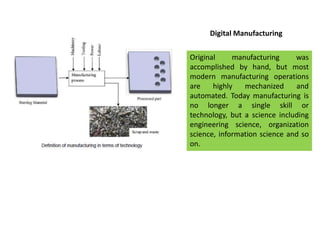
Original manufacturing was
accomplished by hand, but most
modern manufacturing operations
are highly mechanized and
automated. Today manufacturing is
no longer a single skill or
technology, but a science including
engineering science, organization
science, information science and so
on.
Digital Manufacturing
Why DM?
With the rapid changes in market demand,
global economic competition and the rapid
development of high-tech, the profound
revolution in the manufacturing industry, the
depth and width of manufacturing activities
are greatly expanded, and the manufacturing
industry is developing in the direction of
automation, intelligence, integration,
network and globalization. Science and
technologies, such as microelectronics,
automation, computers, telecommunications,
networks and informatics, have undergone
rapid development. Manufacturing industry
gradually shifts from the traditional energy-
driven state to being information-driven.
Digital manufacturing is the use of an
integrated, computer-based system
comprised of simulation, three-
dimensional (3D) visualization,
analytics and various collaboration
tools to create product and
manufacturing process definitions
simultaneously.
Digital production is based on
maximum interaction among the
automated design and management
systems governing the whole product
life cycle, including resources and
personnel.
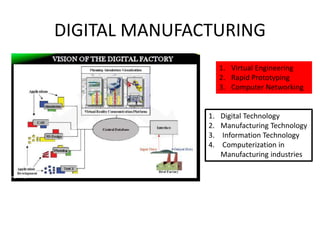
DIGITAL MANUFACTURING
1. Virtual Engineering
2. Rapid Prototyping
3. Computer Networking
1. Digital Technology
2. Manufacturing Technology
3. Information Technology
4. Computerization in
Manufacturing industries
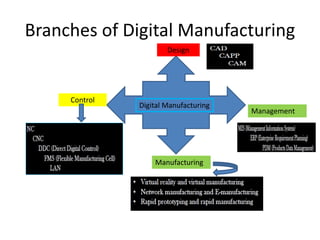
Branches of Digital Manufacturing
Digital Manufacturing
Control
Design
Management
Manufacturing
Features of Digital Manufacturing
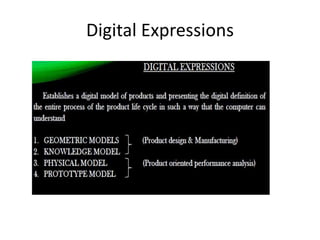
Establishing a digital model of products and presenting
the digital definition of the entire process of the product
lifecycle in a way that the computer can understand.
Digital expression of product and process has exclusive
meaning and is reusable
In the network environment, manufacturing activities
have independence in distance, time and location.
Digital manufacturing allows for the whole manufacturing
process to be created virtually before it is implemented
physically. This enables designers to see the results of
their process before investing time and money into
creating the physical plant.
The effects caused by changing the machines or tooling
processes can be seen in real-time.
Optimization of a parts manufacturing process.
Digital manufacturing systems often incorporate optimization capabilities to reduce time, cost, and
improve the efficiency of most processes. These systems improve optimization of floor schedules,
production planning, and decision making. The system analyzes feedback from production, such as
deviations or problems in the manufacturing system, and generates solutions for handling them.
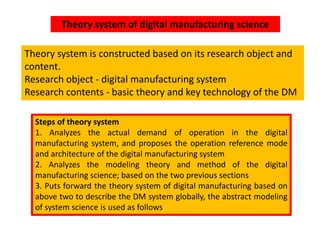
Theory system is constructed based on its research object and
content.
Research object - digital manufacturing system
Research contents - basic theory and key technology of the DM
Steps of theory system
1. Analyzes the actual demand of operation in the digital
manufacturing system, and proposes the operation reference mode
and architecture of the digital manufacturing system
2. Analyzes the modeling theory and method of the digital
manufacturing science; based on the two previous sections
3. Puts forward the theory system of digital manufacturing based on
above two to describe the DM system globally, the abstract modeling
of system science is used as follows
Theory system of digital manufacturing science
Digital Expressions
Operational Reference mode of DM
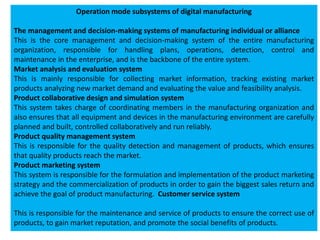
Operation mode subsystems of digital manufacturing
The management and decision-making systems of manufacturing individual or alliance
This is the core management and decision-making system of the entire manufacturing
organization, responsible for handling plans, operations, detection, control and
maintenance in the enterprise, and is the backbone of the entire system.
Market analysis and evaluation system
This is mainly responsible for collecting market information, tracking existing market
products analyzing new market demand and evaluating the value and feasibility analysis.
Product collaborative design and simulation system
This system takes charge of coordinating members in the manufacturing organization and
also ensures that all equipment and devices in the manufacturing environment are carefully
planned and built, controlled collaboratively and run reliably.
Product quality management system
This is responsible for the quality detection and management of products, which ensures
that quality products reach the market.
Product marketing system
This system is responsible for the formulation and implementation of the product marketing
strategy and the commercialization of products in order to gain the biggest sales return and
achieve the goal of product manufacturing. Customer service system
This is responsible for the maintenance and service of products to ensure the correct use of
products, to gain market reputation, and promote the social benefits of products.
The key technology of digital manufacturing system includes
1. Product description technology refers to the use of digital technology to
describe product information, including description and expression norms
2. Manufacturing process expression and control technology includes how to
express and control various certain and uncertain manufacturing processes, and
the examples of uncertain manufacturing processes include the process of tool
wear, market development.
3. Manufacturing data acquisition, storage and processing, include the
acquisition, expression, storage, processing and application of manufacturing
knowledge.
4. Network and grid technology refer to the network support technology which
guarantees the collaborative design and production of the system.
5. Engineering database technology: data storage and a management in a
manufacturing system
6. Virtual and simulation technologies include virtual design, manufacturing
process simulation and digital prototyping.
7. Metadata is data about data, by which we can understand the name, purpose
and usage of data.
Modeling Theory and Method of Digital Manufacturing Science
The digital manufacturing model is an indispensable tool in the whole lifecycle of the
digital manufacturing system. This whole lifecycle includes data acquisition, data
processing, data transmission, implementation of control, affairs management and
decision support, and so on. Accordingly, it would be the basic theory for analyzing and
solving problems in digital manufacturing science. In digital manufacture, the objects that
need to be described by model include:
(1) Product: The life-cycle of a product needs a variety of product and process models to
be described;
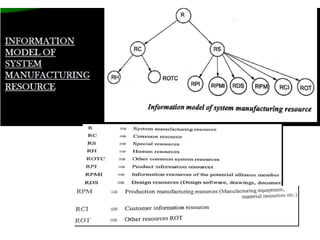
(2) Resources: Various resources in the digital manufacturing system need the
corresponding models to be described, such as manufacturing equipment, funds, various
materials, persons, computing devices, and kinds of application software;
(3) Information: It is necessary to establish the appropriate information model for
information acquisition, processing and usage in the whole process of digital
manufacture;
(4) Organization and decision-making: This is an important approach for actualizing the
optimal decision-making for modeling organization and the decision-making process in
digital manufacture;
(5) Production process.
This is the premise that the modeling production process will realize the
optimization of the production and scheduling process in the
manufacturing system;
(6) Network environment modeling.
The various objects mentioned above are modeled when the digital
manufacturing system is in a network environment.
Digital manufacturing modeling abstractly expresses every object and
process of the entire lifecycle of digital manufacturing through an
appropriate modeling method, and analyzes, synthesizes, optimizes and
simulates them through researching their structures and features. The
target that digital modeling is pursuing is firstly to establish the model of
the entire digital system and then to establish the important models aiming
at one or more objects mentioned above by using a specific modeling
method
The classifications of the digital manufacturing model
By form
Global structure model (such as the architecture of manufacturing
system)
• Local structure model (such as the FMS model)
• Product structure model
• Scheduling model of production planning
By modeling methods
• Mathematical model
• Graphic conceptual model
• Hybrid diagram –analysis model
By function
• Structure description model
• System analysis model
• System design and implementation model
• System operation and management model
Critical Modeling Theories and Technologies in Digital Manufacturing Science
Critical Theory, in basic terms, is any theory founded on critique, and is used in many
different fields. Its main points are the problem definition and understanding, the
search for solutions, evaluation, and iteration. Analysis is breaking down the problem
into parts and finding the relationships between them. Synthesis is thinking about
other ways to solve the problem either by incorporating new information or
combining the parts in a different way. Finally, evaluation is making a judgment about
the results using the evidence at hand. “A well-defined problem is half solved”.
Modelling and analysing method in manufacturing industry.
Chapter one digital manufacturing.pptx

Chapter one digital manufacturing.pptx

  • 1.
    Original manufacturing was accomplishedby hand, but most modern manufacturing operations are highly mechanized and automated. Today manufacturing is no longer a single skill or technology, but a science including engineering science, organization science, information science and so on. Digital Manufacturing
  • 7.
    Why DM? With therapid changes in market demand, global economic competition and the rapid development of high-tech, the profound revolution in the manufacturing industry, the depth and width of manufacturing activities are greatly expanded, and the manufacturing industry is developing in the direction of automation, intelligence, integration, network and globalization. Science and technologies, such as microelectronics, automation, computers, telecommunications, networks and informatics, have undergone rapid development. Manufacturing industry gradually shifts from the traditional energy- driven state to being information-driven. Digital manufacturing is the use of an integrated, computer-based system comprised of simulation, three- dimensional (3D) visualization, analytics and various collaboration tools to create product and manufacturing process definitions simultaneously. Digital production is based on maximum interaction among the automated design and management systems governing the whole product life cycle, including resources and personnel.
  • 9.
    DIGITAL MANUFACTURING 1. VirtualEngineering 2. Rapid Prototyping 3. Computer Networking 1. Digital Technology 2. Manufacturing Technology 3. Information Technology 4. Computerization in Manufacturing industries
  • 10.
    Branches of DigitalManufacturing Digital Manufacturing Control Design Management Manufacturing
  • 11.
    Features of DigitalManufacturing Establishing a digital model of products and presenting the digital definition of the entire process of the product lifecycle in a way that the computer can understand. Digital expression of product and process has exclusive meaning and is reusable In the network environment, manufacturing activities have independence in distance, time and location. Digital manufacturing allows for the whole manufacturing process to be created virtually before it is implemented physically. This enables designers to see the results of their process before investing time and money into creating the physical plant. The effects caused by changing the machines or tooling processes can be seen in real-time. Optimization of a parts manufacturing process. Digital manufacturing systems often incorporate optimization capabilities to reduce time, cost, and improve the efficiency of most processes. These systems improve optimization of floor schedules, production planning, and decision making. The system analyzes feedback from production, such as deviations or problems in the manufacturing system, and generates solutions for handling them.
  • 12.
    Theory system isconstructed based on its research object and content. Research object - digital manufacturing system Research contents - basic theory and key technology of the DM Steps of theory system 1. Analyzes the actual demand of operation in the digital manufacturing system, and proposes the operation reference mode and architecture of the digital manufacturing system 2. Analyzes the modeling theory and method of the digital manufacturing science; based on the two previous sections 3. Puts forward the theory system of digital manufacturing based on above two to describe the DM system globally, the abstract modeling of system science is used as follows Theory system of digital manufacturing science
  • 13.
  • 14.
  • 15.
    Operation mode subsystemsof digital manufacturing The management and decision-making systems of manufacturing individual or alliance This is the core management and decision-making system of the entire manufacturing organization, responsible for handling plans, operations, detection, control and maintenance in the enterprise, and is the backbone of the entire system. Market analysis and evaluation system This is mainly responsible for collecting market information, tracking existing market products analyzing new market demand and evaluating the value and feasibility analysis. Product collaborative design and simulation system This system takes charge of coordinating members in the manufacturing organization and also ensures that all equipment and devices in the manufacturing environment are carefully planned and built, controlled collaboratively and run reliably. Product quality management system This is responsible for the quality detection and management of products, which ensures that quality products reach the market. Product marketing system This system is responsible for the formulation and implementation of the product marketing strategy and the commercialization of products in order to gain the biggest sales return and achieve the goal of product manufacturing. Customer service system This is responsible for the maintenance and service of products to ensure the correct use of products, to gain market reputation, and promote the social benefits of products.
  • 17.
    The key technologyof digital manufacturing system includes 1. Product description technology refers to the use of digital technology to describe product information, including description and expression norms 2. Manufacturing process expression and control technology includes how to express and control various certain and uncertain manufacturing processes, and the examples of uncertain manufacturing processes include the process of tool wear, market development. 3. Manufacturing data acquisition, storage and processing, include the acquisition, expression, storage, processing and application of manufacturing knowledge. 4. Network and grid technology refer to the network support technology which guarantees the collaborative design and production of the system. 5. Engineering database technology: data storage and a management in a manufacturing system 6. Virtual and simulation technologies include virtual design, manufacturing process simulation and digital prototyping. 7. Metadata is data about data, by which we can understand the name, purpose and usage of data.
  • 18.
    Modeling Theory andMethod of Digital Manufacturing Science The digital manufacturing model is an indispensable tool in the whole lifecycle of the digital manufacturing system. This whole lifecycle includes data acquisition, data processing, data transmission, implementation of control, affairs management and decision support, and so on. Accordingly, it would be the basic theory for analyzing and solving problems in digital manufacturing science. In digital manufacture, the objects that need to be described by model include: (1) Product: The life-cycle of a product needs a variety of product and process models to be described; (2) Resources: Various resources in the digital manufacturing system need the corresponding models to be described, such as manufacturing equipment, funds, various materials, persons, computing devices, and kinds of application software; (3) Information: It is necessary to establish the appropriate information model for information acquisition, processing and usage in the whole process of digital manufacture; (4) Organization and decision-making: This is an important approach for actualizing the optimal decision-making for modeling organization and the decision-making process in digital manufacture;
  • 19.
    (5) Production process. Thisis the premise that the modeling production process will realize the optimization of the production and scheduling process in the manufacturing system; (6) Network environment modeling. The various objects mentioned above are modeled when the digital manufacturing system is in a network environment. Digital manufacturing modeling abstractly expresses every object and process of the entire lifecycle of digital manufacturing through an appropriate modeling method, and analyzes, synthesizes, optimizes and simulates them through researching their structures and features. The target that digital modeling is pursuing is firstly to establish the model of the entire digital system and then to establish the important models aiming at one or more objects mentioned above by using a specific modeling method
  • 20.
    The classifications ofthe digital manufacturing model By form Global structure model (such as the architecture of manufacturing system) • Local structure model (such as the FMS model) • Product structure model • Scheduling model of production planning By modeling methods • Mathematical model • Graphic conceptual model • Hybrid diagram –analysis model By function • Structure description model • System analysis model • System design and implementation model • System operation and management model
  • 21.
    Critical Modeling Theoriesand Technologies in Digital Manufacturing Science Critical Theory, in basic terms, is any theory founded on critique, and is used in many different fields. Its main points are the problem definition and understanding, the search for solutions, evaluation, and iteration. Analysis is breaking down the problem into parts and finding the relationships between them. Synthesis is thinking about other ways to solve the problem either by incorporating new information or combining the parts in a different way. Finally, evaluation is making a judgment about the results using the evidence at hand. “A well-defined problem is half solved”. Modelling and analysing method in manufacturing industry.