Chapter 8 :

Tracing the Growth of Tourist Arrival Index Since 1981


Malaysia is on the verge of a tourism boom, experiencing tremendous growth
in the sector with 24.7 million in tourist arrivals achieved in 2011, a remarkable
notch over the 1981 figure which recorded a mere 2,533,104. So does the
tourism receipts which increase with the increase of tourist arrivals, where 2011
marked a total of RM58.3 billion, compared to RM618.9 million earned in the
last three decade.

Today, tourism has become one of the key economic drivers to Malaysia’s
development, emerging as the second largest foreign exchange earner with
RM1 billion a week. The sector has contributed a total of RM37.4 billion to the
Gross National Income (GNI) in 2011, thus becoming the fifth biggest
contributor to the country’s revenue. Tourism is also contributing towards
socio-economic development, while fostering national intergration and unity.
Tourism Minister, Dato' Sri Dr. Ng Yen Yen, in a statement released by Tourism
Malaysia, announced that Malaysia welcomed 11,632,478 tourist arrivals for
the first six months of 2012, registering a growth of 2.4% compared to
11,362,862 arrivals for the same period last year.


Correspondingly, total tourist receipts from January to June 2012 rose by 4.0%,
generating RM26.8 billion to the country’s revenue compared to RM25.7
billion in 2011. This upward trend, if continues, is an indication that tourism
might be able to surpass manufactaring sector which has been the country’s
engine growth since 1987.


Situated between Indian Ocean and the South China Sea, Malaysia is the
only country with territory on both the Asian mainland and the Malay
archipelago. More than half of its land are covered with lush tropical
rainforest and home to few UNESCO World Heritage Site, from Kinabalu
National Park where rafflesia, world’s biggest flower can be found and where
Mount Kinabalu, the tallest mountain in the country is located to Mulu Caves,
the largest cave system in the world besides the heritage sites of
Georgetown, Penang and the city of Melaka.
The richness in its natural environment and ecology, heightened by the fact of
its uniquely multi culture society and the government policy in maintaining its
political and economic stability is a contributing factor towards the growth of
Malaysian tourism. In fact, the Ministry of Tourism is embarking on its Malaysia
Tourism Transformation Plan 2020 towards achieving 36 million tourist arrivals
and RM168billion in receipts by 2020.

The World Tourism Organisation (WTO), according to Deputy Prime Minister
Tan Sri Muhyiddin Yassin, forecast that international tourist arrivals will reach
1.8 billion by 2030, with the Asia and Pacific areas gaining most of the new
arrivals. “ In addition, these countries will enjoy an increased share of the
global tourist market, from 22% in 2011 to 30% in 2030,” he was quoted at the
opening of the 2012 Pacific Asia Travel Association (PATA) Annual
Conference in Kuala Lumpur.


He urged the business entities and entrepreneurs to anticipate opportunities in
the travel and tourism sector as 217 million international tourists flowed into
Asia Pacific in 2011, compared to the 22 million recorded in 1980. "I must say
that Malaysia is fortunate to have its fair share of the global tourism market. A
little over a decade ago, we received only seven million tourists, but last year
(2011), we had 24.7 million tourists,” he said.


The first six months of 2012 indicated a large portion of the number came from
the Asean region which contributed 73.8% of the total arrivals. A finding
released by Tourism Malaysia showed that the tourists’ per capita expenditure
for that period is estimated at RM 2,309, an increase of 0.7% from 2011.

Data on tourist arrivals, supplied by Immigration Department of Malaysia,
have shown highest growth are from the Phillippines market with 45.3%, which
accumulated a total number of 238,175 while Oman tops the list of highest
growth for long-haul markets with 33.2%.

Singapore, however has always been dominating the market which
contributed 5,832,339 in tourist arrivals even though the arrivals were declining
-4.8%. Other top generating markets were Indonesia (1,108,361 / +20.0%),
China (758,289 / +34.2%), Thailand (638,641/ -11.5%), Brunei (588,165/ -1.2%),
India (365,104/ +6.9%), Australia (242,579/ -10.4%), the Philippines (238,175/
+45.3%), Japan (215,872/ +32.5%) and United Kingdom (196,738/ +5.9%),
besides Singapore. The data was accounted for 87.55% of the total tourist
arrivals.
While, long-haul markets that had posted remarkable growth were Russia
(28.2%), France (20.6%), United States of America (18.9%), South Korea
(18.0%), Kuwait (17.4%) and Denmark (15.7%), besides Oman.


In 2011, the top 10 tourist generating markets were Singapore (13,372,647),
Indonesia (2,134,381), Thailand (1,442,048), China (1,250,536), Brunei
(1,239,404), India (693,056), Australia (558,411), United Kingdom (403,940),
Japan (386,974) and Philippines (362,101).


Markets showing double digit growth in arrivals were mainly from the medium
and long-haul countries with Kazakhstan arrivals surging by 65.9% assisted by
the thrice weekly direct Air Astana flights from Almaty to Kuala
Lumpur.
 
 Other markets showing strong growth included New Zealand
(23.0%) which benefited from the opening of a Tourism Malaysia office in
Auckland last May. Russian tourist arrivals saw an increase of 21.3% on the
back of strong promotional efforts there in addition to the weekly Trans Aero
flights which began operations in December.
 
 Double digit growth arrivals
were also recorded for the following markets: Iran (20.1%), South Africa
(19.1%), France (15.1%), Myanmar (12.6%), Taiwan (10.7%), China (10.6%), and
Brunei (10.2%).


Yen Yen in the release, attributed the growth to the strong support from trade
partners and the increased air connectivity to key destinations such as Beijing
in China, Hong Kong and Kansai in Japan. Additionally, the ministry is trying to
encourage more long haul flights from Russia, Oman and France to make
travel here more convenient.


"Key international-level tourism events such as the Formula 1 PETRONAS
Malaysia Grand Prix, 1Malaysia GP Sale, 1Malaysia International Shoe Festival
and Citrawarna, are also contributors to the continued growth," she said.


Arab Saudi, as stated in the same release, saw a 71.7% increase in arrivals
because of the Arab Saudi Immigration’s new rule which requires all outgoing
travelers to own individual passports. Prior to this ruling, children travelled on
their parent’s passports. Two periods of long holidays – January to March and
June to July – also contributed to the increase in Arab Saudi travelers.
Asean saw a 1% decrease in arrivals due to the change in recording arrivals
based on nationality instead of country of residence; thus expatriates working
or living in Asean countries were not regarded as Asean travelers. This
reflected in the decreased arrivals from Singapore (-4.8%), Thailand (-11.5%),
Brunei (-1.2%) and Cambodia (-4.2%).
This change has also affected Australia arrivals which declined by 10.4% since
many Australian permanent residents were nationals of other countries such
as New Zealand, Europe, Middle East, India and China. The decline is also
attributed to Malaysia Airlines’ withdrawal of the Perth-Kota Kinabalu flight
operations since January 2012.


New Zealand also suffered a decline of 16.3% in arrivals this year due to
AirAsia X’s termination of its Christchurch-Kuala Lumpur service in March 2012.
Sweden’s 22.4% decline in arrivals is attributed to the lack of direct flight
services between Sweden and Malaysia compared to Thailand, while South
Africa showed a 10.7% decrease in arrivals due to the cessation of Malaysia
Airlines’ flight service between Kuala Lumpur and Johannesburg as well as
Cape Town in early 2012.


On related matters, Yen Yen said the official promotional visits to various
countries such as Iran, Indonesia, China, Russia, Philippines, Vietnam, and
United Arab Emirates in conjunction with the Arab Travel Mart in 2011 had also
increased tourist arrivals, boost revenue as well as opening new markets.


“For instance, tourists from China increased by 10.6% from 1,130,261 visitors in
2010 to 1,250,536 in 2011, generating 12.6% increase in revenue from RM3.1
billion to RM3.5 billion,” she said, adding they visited Singapore, Phillipines and
Germany in conjunction with the Internationale Tourismus Borse (ITB) between
January and August, 2012.


As Malaysia secured its place as a shopping haven, she said, such leisure has
also becoming a factor that lure foreigners to the country, even contributed
to tourist major expenditures share as Kuala Lumpur beat Singapore, Sydney,
Tokyo, Seoul, Bangkok and Shanghai to be named as the 2012 second best
shopping city within the Asia Pacific region.


“Shopping holds 30%, the second biggest share of tourist expenditures,
contributing RM17.5 billion in 2011, compared to 28.7% or RM16.2 billion in the
previous year,” she said. “Avid shoppers can benefit from three sale periods
namely the 1Malaysia GP Sale in March, the 1Malaysia Mega Sale Carnival in
June and the 1Malaysia Year-End Sale in November.”
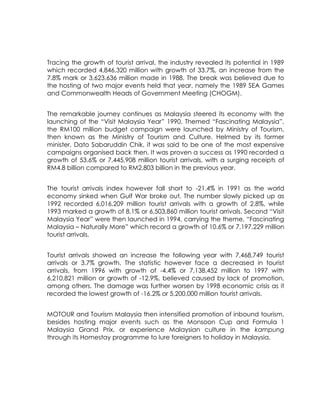
Tracing the growth of tourist arrival, the industry revealed its potential in 1989
which recorded 4,846,320 million with growth of 33.7%, an increase from the
7.8% mark or 3,623,636 million made in 1988. The break was believed due to
the hosting of two major events held that year, namely the 1989 SEA Games
and Commonwealth Heads of Government Meeting (CHOGM).


The remarkable journey continues as Malaysia steered its economy with the
launching of the “Visit Malaysia Year” 1990. Themed “Fascinating Malaysia”,
the RM100 million budget campaign were launched by Ministry of Tourism,
then known as the Ministry of Tourism and Culture. Helmed by its former
minister, Dato Sabaruddin Chik, it was said to be one of the most expensive
campaigns organised back then. It was proven a success as 1990 recorded a
growth of 53.6% or 7,445,908 million tourist arrivals, with a surging receipts of
RM4.8 billion compared to RM2.803 billion in the previous year.


The tourist arrivals index however fall short to -21.4% in 1991 as the world
economy sinked when Gulf War broke out. The number slowly picked up as
1992 recorded 6,016,209 million tourist arrivals with a growth of 2.8%, while
1993 marked a growth of 8.1% or 6,503,860 million tourist arrivals. Second “Visit
Malaysia Year” were then launched in 1994, carrying the theme, “Fascinating
Malaysia – Naturally More” which record a growth of 10.6% or 7,197,229 million
tourist arrivals.


Tourist arrivals showed an increase the following year with 7,468,749 tourist
arrivals or 3.7% growth. The statistic however face a decreased in tourist
arrivals, from 1996 with growth of -4.4% or 7,138,452 million to 1997 with
6,210,821 million or growth of -12.9%, believed caused by lack of promotion,
among others. The damage was further worsen by 1998 economic crisis as it
recorded the lowest growth of -16.2% or 5,200,000 million tourist arrivals.


MOTOUR and Tourism Malaysia then intensified promotion of inbound tourism,
besides hosting major events such as the Monsoon Cup and Formula 1
Malaysia Grand Prix, or experience Malaysian culture in the kampung
through its Homestay programme to lure foreigners to holiday in Malaysia.
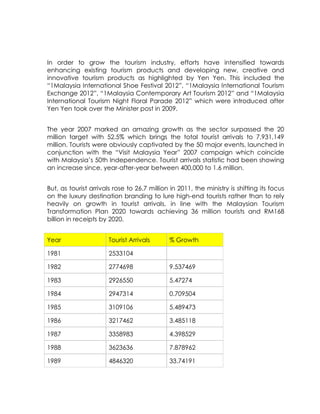
In order to grow the tourism industry, efforts have intensified towards
enhancing existing tourism products and developing new, creative and
innovative tourism products as highlighted by Yen Yen. This included the
“1Malaysia International Shoe Festival 2012”, “1Malaysia International Tourism
Exchange 2012”, “1Malaysia Contemporary Art Tourism 2012” and “1Malaysia
International Tourism Night Floral Parade 2012” which were introduced after
Yen Yen took over the Minister post in 2009.


The year 2007 marked an amazing growth as the sector surpassed the 20
million target with 52.5% which brings the total tourist arrivals to 7,931,149
million. Tourists were obviously captivated by the 50 major events, launched in
conjunction with the “Visit Malaysia Year” 2007 campaign which coincide
with Malaysia’s 50th Independence. Tourist arrivals statistic had been showing
an increase since, year-after-year between 400,000 to 1.6 million.


But, as tourist arrivals rose to 26.7 million in 2011, the ministry is shifting its focus
on the luxury destination branding to lure high-end tourists rather than to rely
heavily on growth in tourist arrivals, in line with the Malaysian Tourism
Transformation Plan 2020 towards achieving 36 million tourists and RM168
billion in receipts by 2020.


Year                   Tourist Arrivals      % Growth

1981                   2533104

1982                   2774698               9.537469

1983                   2926550               5.47274

1984                   2947314               0.709504

1985                   3109106               5.489473

1986                   3217462               3.485118

1987                   3358983               4.398529

1988                   3623636               7.878962

1989                   4846320               33.74191
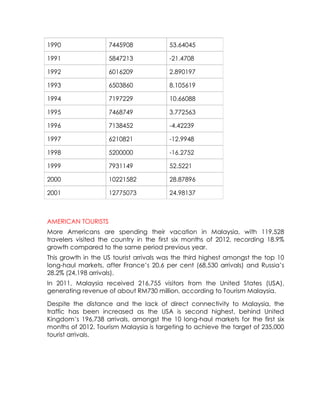
1990                7445908             53.64045

1991                5847213             -21.4708

1992                6016209             2.890197

1993                6503860             8.105619

1994                7197229             10.66088

1995                7468749             3.772563

1996                7138452             -4.42239

1997                6210821             -12.9948

1998                5200000             -16.2752

1999                7931149             52.5221

2000                10221582            28.87896

2001                12775073            24.98137


AMERICAN TOURISTS
More Americans are spending their vacation in Malaysia, with 119,528
travelers visited the country in the first six months of 2012, recording 18.9%
growth compared to the same period previous year.
This growth in the US tourist arrivals was the third highest amongst the top 10
long-haul markets, after France’s 20.6 per cent (68,530 arrivals) and Russia’s
28.2% (24,198 arrivals).
In 2011, Malaysia received 216,755 visitors from the United States (USA),
generating revenue of about RM730 million, according to Tourism Malaysia.

Despite the distance and the lack of direct connectivity to Malaysia, the
traffic has been increased as the USA is second highest, behind United
Kingdom’s 196,738 arrivals, amongst the 10 long-haul markets for the first six
months of 2012. Tourism Malaysia is targeting to achieve the target of 235,000
tourist arrivals.
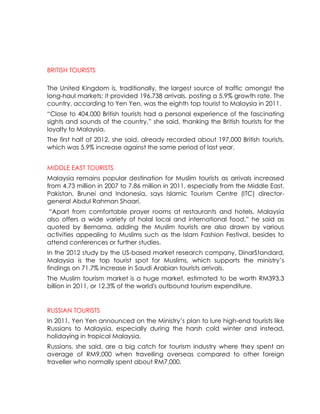
BRITISH TOURISTS

The United Kingdom is, traditionally, the largest source of traffic amongst the
long-haul markets; it provided 196,738 arrivals, posting a 5.9% growth rate. The
country, according to Yen Yen, was the eighth top tourist to Malaysia in 2011.
“Close to 404,000 British tourists had a personal experience of the fascinating
sights and sounds of the country,” she said, thanking the British tourists for the
loyalty to Malaysia.
The first half of 2012, she said, already recorded about 197,000 British tourists,
which was 5.9% increase against the same period of last year.


MIDDLE EAST TOURISTS
Malaysia remains popular destination for Muslim tourists as arrivals increased
from 4.73 million in 2007 to 7.86 million in 2011, especially from the Middle East,
Pakistan, Brunei and Indonesia, says Islamic Tourism Centre (ITC) director-
general Abdul Rahman Shaari.
“Apart from comfortable prayer rooms at restaurants and hotels, Malaysia
also offers a wide variety of halal local and international food,” he said as
quoted by Bernama, adding the Muslim tourists are also drawn by various
activities appealing to Muslims such as the Islam Fashion Festival, besides to
attend conferences or further studies.
In the 2012 study by the US-based market research company, DinarStandard,
Malaysia is the top tourist spot for Muslims, which supports the ministry’s
findings on 71.7% increase in Saudi Arabian tourists arrivals.
The Muslim tourism market is a huge market, estimated to be worth RM393.3
billion in 2011, or 12.3% of the world's outbound tourism expenditure.


RUSSIAN TOURISTS
In 2011, Yen Yen announced on the Ministry’s plan to lure high-end tourists like
Russians to Malaysia, especially during the harsh cold winter and instead,
holidaying in tropical Malaysia.
Russians, she said, are a big catch for tourism industry where they spent an
average of RM9,000 when travelling overseas compared to other foreign
traveller who normally spent about RM7,000.
“This may result in a smaller number of tourist arrivals but the money the big
spenders splash here may be much higher than what we have seen in recent
years,” she was quoted after the launching of Cuti-Cuti 1Malaysia Travelogue
in October, 2011.


EAST ASIA TOURISTS
The Government has made East Asia its “primary focus” and is working hard
to make Malaysia more attractive to Chinese and Japanese tourists, said Yen
Yen
“Between January and June this year, tourists from China recorded 34% in
growth while Japan recorded 32.5%,” said Yen Yen, adding “We are
fortunate to have started working with China since 1999 and today it is the
third on the tourist arrivals chart.”
Yen Yen said Malaysia received about 300,000 visitors from Japan every year
and her ministry hoped to breach the one million arrivals mark in four years.
Also included in the focus for East Asian tourists are visitors from South Korea
and Taiwan. She noted, Malaysia’s eco-tourism and great outdoors has been
attracting younger tourists from East Asia.


AMERICAN TOURISTS
More Americans are spending their vacation in Malaysia, with 119,528
travelers visited the country in the first six months of 2012, recording 18.9%
growth compared to the same period previous year.
In 2011, Malaysia received 216,755 visitors from the United States (USA),
generating revenue of about RM730 million, according to Tourism Malaysia.

Despite the distance and the lack of direct connectivity to Malaysia, the
traffic has been increased as the USA is second highest, behind United
Kingdom’s 196,738 arrivals, amongst the 10 long-haul markets for the first six
months of 2012. Tourism Malaysia is targeting to achieve the target of 235,000
tourist arrivals.

Chapter 8V1

  • 1.
    Chapter 8 : Tracingthe Growth of Tourist Arrival Index Since 1981 Malaysia is on the verge of a tourism boom, experiencing tremendous growth in the sector with 24.7 million in tourist arrivals achieved in 2011, a remarkable notch over the 1981 figure which recorded a mere 2,533,104. So does the tourism receipts which increase with the increase of tourist arrivals, where 2011 marked a total of RM58.3 billion, compared to RM618.9 million earned in the last three decade. Today, tourism has become one of the key economic drivers to Malaysia’s development, emerging as the second largest foreign exchange earner with RM1 billion a week. The sector has contributed a total of RM37.4 billion to the Gross National Income (GNI) in 2011, thus becoming the fifth biggest contributor to the country’s revenue. Tourism is also contributing towards socio-economic development, while fostering national intergration and unity. Tourism Minister, Dato' Sri Dr. Ng Yen Yen, in a statement released by Tourism Malaysia, announced that Malaysia welcomed 11,632,478 tourist arrivals for the first six months of 2012, registering a growth of 2.4% compared to 11,362,862 arrivals for the same period last year. Correspondingly, total tourist receipts from January to June 2012 rose by 4.0%, generating RM26.8 billion to the country’s revenue compared to RM25.7 billion in 2011. This upward trend, if continues, is an indication that tourism might be able to surpass manufactaring sector which has been the country’s engine growth since 1987. Situated between Indian Ocean and the South China Sea, Malaysia is the only country with territory on both the Asian mainland and the Malay archipelago. More than half of its land are covered with lush tropical rainforest and home to few UNESCO World Heritage Site, from Kinabalu National Park where rafflesia, world’s biggest flower can be found and where Mount Kinabalu, the tallest mountain in the country is located to Mulu Caves, the largest cave system in the world besides the heritage sites of Georgetown, Penang and the city of Melaka.
  • 2.
    The richness inits natural environment and ecology, heightened by the fact of its uniquely multi culture society and the government policy in maintaining its political and economic stability is a contributing factor towards the growth of Malaysian tourism. In fact, the Ministry of Tourism is embarking on its Malaysia Tourism Transformation Plan 2020 towards achieving 36 million tourist arrivals and RM168billion in receipts by 2020. The World Tourism Organisation (WTO), according to Deputy Prime Minister Tan Sri Muhyiddin Yassin, forecast that international tourist arrivals will reach 1.8 billion by 2030, with the Asia and Pacific areas gaining most of the new arrivals. “ In addition, these countries will enjoy an increased share of the global tourist market, from 22% in 2011 to 30% in 2030,” he was quoted at the opening of the 2012 Pacific Asia Travel Association (PATA) Annual Conference in Kuala Lumpur. He urged the business entities and entrepreneurs to anticipate opportunities in the travel and tourism sector as 217 million international tourists flowed into Asia Pacific in 2011, compared to the 22 million recorded in 1980. "I must say that Malaysia is fortunate to have its fair share of the global tourism market. A little over a decade ago, we received only seven million tourists, but last year (2011), we had 24.7 million tourists,” he said. The first six months of 2012 indicated a large portion of the number came from the Asean region which contributed 73.8% of the total arrivals. A finding released by Tourism Malaysia showed that the tourists’ per capita expenditure for that period is estimated at RM 2,309, an increase of 0.7% from 2011. Data on tourist arrivals, supplied by Immigration Department of Malaysia, have shown highest growth are from the Phillippines market with 45.3%, which accumulated a total number of 238,175 while Oman tops the list of highest growth for long-haul markets with 33.2%. Singapore, however has always been dominating the market which contributed 5,832,339 in tourist arrivals even though the arrivals were declining -4.8%. Other top generating markets were Indonesia (1,108,361 / +20.0%), China (758,289 / +34.2%), Thailand (638,641/ -11.5%), Brunei (588,165/ -1.2%), India (365,104/ +6.9%), Australia (242,579/ -10.4%), the Philippines (238,175/ +45.3%), Japan (215,872/ +32.5%) and United Kingdom (196,738/ +5.9%), besides Singapore. The data was accounted for 87.55% of the total tourist arrivals.
  • 3.
    While, long-haul marketsthat had posted remarkable growth were Russia (28.2%), France (20.6%), United States of America (18.9%), South Korea (18.0%), Kuwait (17.4%) and Denmark (15.7%), besides Oman. In 2011, the top 10 tourist generating markets were Singapore (13,372,647), Indonesia (2,134,381), Thailand (1,442,048), China (1,250,536), Brunei (1,239,404), India (693,056), Australia (558,411), United Kingdom (403,940), Japan (386,974) and Philippines (362,101). Markets showing double digit growth in arrivals were mainly from the medium and long-haul countries with Kazakhstan arrivals surging by 65.9% assisted by the thrice weekly direct Air Astana flights from Almaty to Kuala Lumpur.
 
 Other markets showing strong growth included New Zealand (23.0%) which benefited from the opening of a Tourism Malaysia office in Auckland last May. Russian tourist arrivals saw an increase of 21.3% on the back of strong promotional efforts there in addition to the weekly Trans Aero flights which began operations in December.
 
 Double digit growth arrivals were also recorded for the following markets: Iran (20.1%), South Africa (19.1%), France (15.1%), Myanmar (12.6%), Taiwan (10.7%), China (10.6%), and Brunei (10.2%). Yen Yen in the release, attributed the growth to the strong support from trade partners and the increased air connectivity to key destinations such as Beijing in China, Hong Kong and Kansai in Japan. Additionally, the ministry is trying to encourage more long haul flights from Russia, Oman and France to make travel here more convenient. "Key international-level tourism events such as the Formula 1 PETRONAS Malaysia Grand Prix, 1Malaysia GP Sale, 1Malaysia International Shoe Festival and Citrawarna, are also contributors to the continued growth," she said. Arab Saudi, as stated in the same release, saw a 71.7% increase in arrivals because of the Arab Saudi Immigration’s new rule which requires all outgoing travelers to own individual passports. Prior to this ruling, children travelled on their parent’s passports. Two periods of long holidays – January to March and June to July – also contributed to the increase in Arab Saudi travelers. Asean saw a 1% decrease in arrivals due to the change in recording arrivals based on nationality instead of country of residence; thus expatriates working or living in Asean countries were not regarded as Asean travelers. This
  • 4.
    reflected in thedecreased arrivals from Singapore (-4.8%), Thailand (-11.5%), Brunei (-1.2%) and Cambodia (-4.2%). This change has also affected Australia arrivals which declined by 10.4% since many Australian permanent residents were nationals of other countries such as New Zealand, Europe, Middle East, India and China. The decline is also attributed to Malaysia Airlines’ withdrawal of the Perth-Kota Kinabalu flight operations since January 2012. New Zealand also suffered a decline of 16.3% in arrivals this year due to AirAsia X’s termination of its Christchurch-Kuala Lumpur service in March 2012. Sweden’s 22.4% decline in arrivals is attributed to the lack of direct flight services between Sweden and Malaysia compared to Thailand, while South Africa showed a 10.7% decrease in arrivals due to the cessation of Malaysia Airlines’ flight service between Kuala Lumpur and Johannesburg as well as Cape Town in early 2012. On related matters, Yen Yen said the official promotional visits to various countries such as Iran, Indonesia, China, Russia, Philippines, Vietnam, and United Arab Emirates in conjunction with the Arab Travel Mart in 2011 had also increased tourist arrivals, boost revenue as well as opening new markets. “For instance, tourists from China increased by 10.6% from 1,130,261 visitors in 2010 to 1,250,536 in 2011, generating 12.6% increase in revenue from RM3.1 billion to RM3.5 billion,” she said, adding they visited Singapore, Phillipines and Germany in conjunction with the Internationale Tourismus Borse (ITB) between January and August, 2012. As Malaysia secured its place as a shopping haven, she said, such leisure has also becoming a factor that lure foreigners to the country, even contributed to tourist major expenditures share as Kuala Lumpur beat Singapore, Sydney, Tokyo, Seoul, Bangkok and Shanghai to be named as the 2012 second best shopping city within the Asia Pacific region. “Shopping holds 30%, the second biggest share of tourist expenditures, contributing RM17.5 billion in 2011, compared to 28.7% or RM16.2 billion in the previous year,” she said. “Avid shoppers can benefit from three sale periods namely the 1Malaysia GP Sale in March, the 1Malaysia Mega Sale Carnival in June and the 1Malaysia Year-End Sale in November.”
  • 5.
    Tracing the growthof tourist arrival, the industry revealed its potential in 1989 which recorded 4,846,320 million with growth of 33.7%, an increase from the 7.8% mark or 3,623,636 million made in 1988. The break was believed due to the hosting of two major events held that year, namely the 1989 SEA Games and Commonwealth Heads of Government Meeting (CHOGM). The remarkable journey continues as Malaysia steered its economy with the launching of the “Visit Malaysia Year” 1990. Themed “Fascinating Malaysia”, the RM100 million budget campaign were launched by Ministry of Tourism, then known as the Ministry of Tourism and Culture. Helmed by its former minister, Dato Sabaruddin Chik, it was said to be one of the most expensive campaigns organised back then. It was proven a success as 1990 recorded a growth of 53.6% or 7,445,908 million tourist arrivals, with a surging receipts of RM4.8 billion compared to RM2.803 billion in the previous year. The tourist arrivals index however fall short to -21.4% in 1991 as the world economy sinked when Gulf War broke out. The number slowly picked up as 1992 recorded 6,016,209 million tourist arrivals with a growth of 2.8%, while 1993 marked a growth of 8.1% or 6,503,860 million tourist arrivals. Second “Visit Malaysia Year” were then launched in 1994, carrying the theme, “Fascinating Malaysia – Naturally More” which record a growth of 10.6% or 7,197,229 million tourist arrivals. Tourist arrivals showed an increase the following year with 7,468,749 tourist arrivals or 3.7% growth. The statistic however face a decreased in tourist arrivals, from 1996 with growth of -4.4% or 7,138,452 million to 1997 with 6,210,821 million or growth of -12.9%, believed caused by lack of promotion, among others. The damage was further worsen by 1998 economic crisis as it recorded the lowest growth of -16.2% or 5,200,000 million tourist arrivals. MOTOUR and Tourism Malaysia then intensified promotion of inbound tourism, besides hosting major events such as the Monsoon Cup and Formula 1 Malaysia Grand Prix, or experience Malaysian culture in the kampung through its Homestay programme to lure foreigners to holiday in Malaysia.
  • 6.
    In order togrow the tourism industry, efforts have intensified towards enhancing existing tourism products and developing new, creative and innovative tourism products as highlighted by Yen Yen. This included the “1Malaysia International Shoe Festival 2012”, “1Malaysia International Tourism Exchange 2012”, “1Malaysia Contemporary Art Tourism 2012” and “1Malaysia International Tourism Night Floral Parade 2012” which were introduced after Yen Yen took over the Minister post in 2009. The year 2007 marked an amazing growth as the sector surpassed the 20 million target with 52.5% which brings the total tourist arrivals to 7,931,149 million. Tourists were obviously captivated by the 50 major events, launched in conjunction with the “Visit Malaysia Year” 2007 campaign which coincide with Malaysia’s 50th Independence. Tourist arrivals statistic had been showing an increase since, year-after-year between 400,000 to 1.6 million. But, as tourist arrivals rose to 26.7 million in 2011, the ministry is shifting its focus on the luxury destination branding to lure high-end tourists rather than to rely heavily on growth in tourist arrivals, in line with the Malaysian Tourism Transformation Plan 2020 towards achieving 36 million tourists and RM168 billion in receipts by 2020. Year Tourist Arrivals % Growth 1981 2533104 1982 2774698 9.537469 1983 2926550 5.47274 1984 2947314 0.709504 1985 3109106 5.489473 1986 3217462 3.485118 1987 3358983 4.398529 1988 3623636 7.878962 1989 4846320 33.74191
  • 7.
    1990 7445908 53.64045 1991 5847213 -21.4708 1992 6016209 2.890197 1993 6503860 8.105619 1994 7197229 10.66088 1995 7468749 3.772563 1996 7138452 -4.42239 1997 6210821 -12.9948 1998 5200000 -16.2752 1999 7931149 52.5221 2000 10221582 28.87896 2001 12775073 24.98137 AMERICAN TOURISTS More Americans are spending their vacation in Malaysia, with 119,528 travelers visited the country in the first six months of 2012, recording 18.9% growth compared to the same period previous year. This growth in the US tourist arrivals was the third highest amongst the top 10 long-haul markets, after France’s 20.6 per cent (68,530 arrivals) and Russia’s 28.2% (24,198 arrivals). In 2011, Malaysia received 216,755 visitors from the United States (USA), generating revenue of about RM730 million, according to Tourism Malaysia. Despite the distance and the lack of direct connectivity to Malaysia, the traffic has been increased as the USA is second highest, behind United Kingdom’s 196,738 arrivals, amongst the 10 long-haul markets for the first six months of 2012. Tourism Malaysia is targeting to achieve the target of 235,000 tourist arrivals.
  • 8.
    BRITISH TOURISTS The UnitedKingdom is, traditionally, the largest source of traffic amongst the long-haul markets; it provided 196,738 arrivals, posting a 5.9% growth rate. The country, according to Yen Yen, was the eighth top tourist to Malaysia in 2011. “Close to 404,000 British tourists had a personal experience of the fascinating sights and sounds of the country,” she said, thanking the British tourists for the loyalty to Malaysia. The first half of 2012, she said, already recorded about 197,000 British tourists, which was 5.9% increase against the same period of last year. MIDDLE EAST TOURISTS Malaysia remains popular destination for Muslim tourists as arrivals increased from 4.73 million in 2007 to 7.86 million in 2011, especially from the Middle East, Pakistan, Brunei and Indonesia, says Islamic Tourism Centre (ITC) director- general Abdul Rahman Shaari. “Apart from comfortable prayer rooms at restaurants and hotels, Malaysia also offers a wide variety of halal local and international food,” he said as quoted by Bernama, adding the Muslim tourists are also drawn by various activities appealing to Muslims such as the Islam Fashion Festival, besides to attend conferences or further studies. In the 2012 study by the US-based market research company, DinarStandard, Malaysia is the top tourist spot for Muslims, which supports the ministry’s findings on 71.7% increase in Saudi Arabian tourists arrivals. The Muslim tourism market is a huge market, estimated to be worth RM393.3 billion in 2011, or 12.3% of the world's outbound tourism expenditure. RUSSIAN TOURISTS In 2011, Yen Yen announced on the Ministry’s plan to lure high-end tourists like Russians to Malaysia, especially during the harsh cold winter and instead, holidaying in tropical Malaysia. Russians, she said, are a big catch for tourism industry where they spent an average of RM9,000 when travelling overseas compared to other foreign traveller who normally spent about RM7,000.
  • 9.
    “This may resultin a smaller number of tourist arrivals but the money the big spenders splash here may be much higher than what we have seen in recent years,” she was quoted after the launching of Cuti-Cuti 1Malaysia Travelogue in October, 2011. EAST ASIA TOURISTS The Government has made East Asia its “primary focus” and is working hard to make Malaysia more attractive to Chinese and Japanese tourists, said Yen Yen “Between January and June this year, tourists from China recorded 34% in growth while Japan recorded 32.5%,” said Yen Yen, adding “We are fortunate to have started working with China since 1999 and today it is the third on the tourist arrivals chart.” Yen Yen said Malaysia received about 300,000 visitors from Japan every year and her ministry hoped to breach the one million arrivals mark in four years. Also included in the focus for East Asian tourists are visitors from South Korea and Taiwan. She noted, Malaysia’s eco-tourism and great outdoors has been attracting younger tourists from East Asia. AMERICAN TOURISTS More Americans are spending their vacation in Malaysia, with 119,528 travelers visited the country in the first six months of 2012, recording 18.9% growth compared to the same period previous year. In 2011, Malaysia received 216,755 visitors from the United States (USA), generating revenue of about RM730 million, according to Tourism Malaysia. Despite the distance and the lack of direct connectivity to Malaysia, the traffic has been increased as the USA is second highest, behind United Kingdom’s 196,738 arrivals, amongst the 10 long-haul markets for the first six months of 2012. Tourism Malaysia is targeting to achieve the target of 235,000 tourist arrivals.