Chapter 8
Deeds
Objectives
• After reading this chapter, you should be able
to
– Identify the types of deeds used in modern real
estate practice.
– Explain the basic requirements of a valid deed.
– Prepare a deed.
Historical Development of Deeds
• Originally, land conveyed by the actual delivery of
vacant possession to the land in which a seller
would place or “seize” the purchaser in
possession
• Later, the fine became the preferred method of
conveyance
• Today, written deeds are used to describe
property and parties
– Recorded in public files
Types of Deeds
• General warranty deed
– Covenants (warranties) by grantor to grantee
• Covenant of seisin
• Covenant of right to convey
• Covenant against encumbrances
• Covenant of further assurance
• Covenant of quiet enjoyment
• Covenant of warranty
Types of Deeds
• Present versus future covenants
– Case
• Lunsford v. King, 132 Ga. App. 749, 209 S.E.2d 27 (1974)
– Plaintiff entitled to prove case before jury
» Including amount of unliquidated damages
Types of Deeds
• Limited (special) warranty deed
– Warranty deed in which the grantor covenants
only against lawful claims of people claiming by,
through, or under the grantor
– Grant deed
• Transfers only the interest the grantor has in the land
and not the land itself
• Type of limited warranty deed commonly used in
California
Types of Deeds
• Quitclaim deed
– Contains no covenants or warranties of title
– Found in other forms of deeds
• Foreclosure deeds
• Executor’s deeds
• Administrator’s deeds
• Trustee’s deeds
Types of Deeds
• Executor’s and administrator’s deeds
– Transfer of a title to real property from the estate
of a deceased individual
– Without warranty of title
• Trustee deeds
– Deed transferring property held in trust for a
beneficiary
– Without warranty of title
Basic Requirements of a Valid
Deed
• Written instrument
• Competent grantor
• Identity of grantee
• Words of conveyance
• Adequate description of land
Basic Requirements of a Valid
Deed
• Consideration
• Signature of grantor
• Witnesses
• Delivery of completed deed to grantee
Preparation of a Valid Deed
• Most deeds have the following parts:
– Caption
– Premises or preamble
– Granting clause
– Description
– Habendum
– Warranty clause
– Testimonium
Completing Sections of a Deed
• Preamble
– Grantor designations
– Grantee designations
• Granting clause
• Description
• Testimonium
Correction of Deeds
• Grantor must execute and deliver corrective
deed to the grantee
• Corrective deed is valid without any additional
consideration
• Acceptance by the grantee is admission of
error found in the original deed
• Reformation and cancellation of deed
Practical Tips for the Paralegal
• Grantor
– Legal ownership (individual or business entity)
must be verified through a title report
• Or court documents, if necessary
– Name must be spelled correctly
Practical Tips for the Paralegal
• Grantee
– Same attention to detail applies to the grantee
– If grantees are receiving property as co-owners,
that language must be in the deed
• Legal description
Practical Tips for the Paralegal
• Witnessing a deed
– If acting as a witness, must see grantee(s) sign the
deed
– If acting as a notary public, must properly identify
the parties signing the deed
• Notarizing a deed without seeing the actual
signature(s) is a violation of the notary oath
– May be considered perjury in many states
Checklist: Preparing a Deed
• Research before preparation
– Review the contract or other agreement covering
the transfer of ownership to the property
– Review the title examination to ensure the correct
name of title owner to the property
Checklist: Preparing a Deed
• Research before preparation
– Confirm the correct spellings of all names of the
grantor and grantee
– Carefully review the title examination and
determine what title exceptions should be
identified in the deed
Checklist: Preparing a Deed
• Research before preparation
– Confirm prospective purchasers have no special
requirements for taking title
• E.g., joint tenancy with right of survivorship
– Review survey legal description against
description in grantor’s current deed to ensure no
difference exists between the two descriptions
Checklist: Preparing a Deed
• Preparing the deed
– Draft the caption and preamble
• Indicate the county and state where the deed signed
• Date the deed with the date of execution and delivery
• Indicate the correct name of the grantor
• Indicate the correct name of the grantee, noting any
special forms of ownership
Checklist: Preparing a Deed
• Preparing the deed
– Draft the consideration
– Draft the legal description
• Use the correct legal description verified by survey and
title examination
• If the legal description is too long to be included on the
face of the deed, use an exhibit
• List all title exceptions being transferred with the
property
Checklist: Preparing a Deed
• Preparing the deed
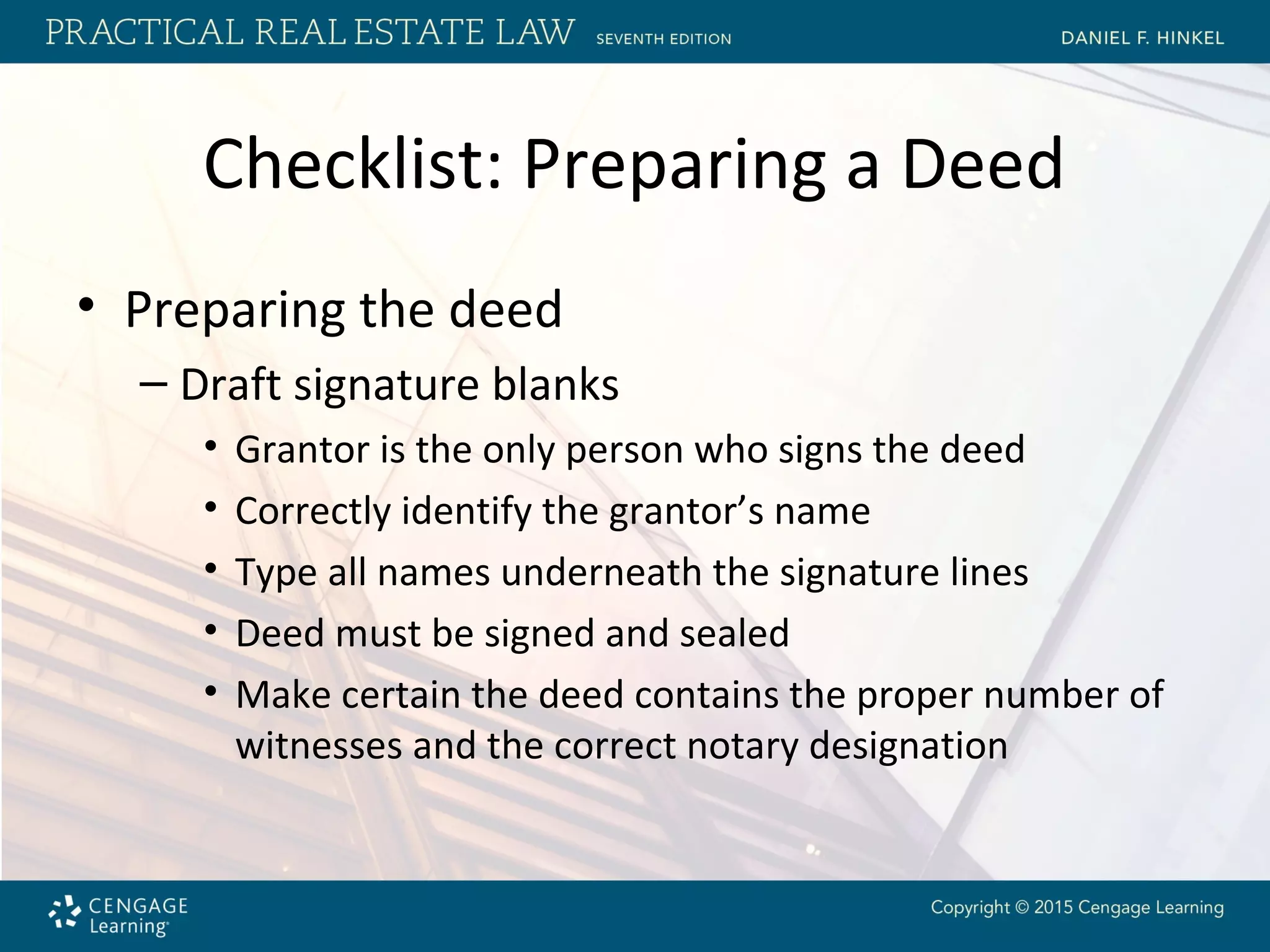
– Draft signature blanks
• Grantor is the only person who signs the deed
• Correctly identify the grantor’s name
• Type all names underneath the signature lines
• Deed must be signed and sealed
• Make certain the deed contains the proper number of
witnesses and the correct notary designation
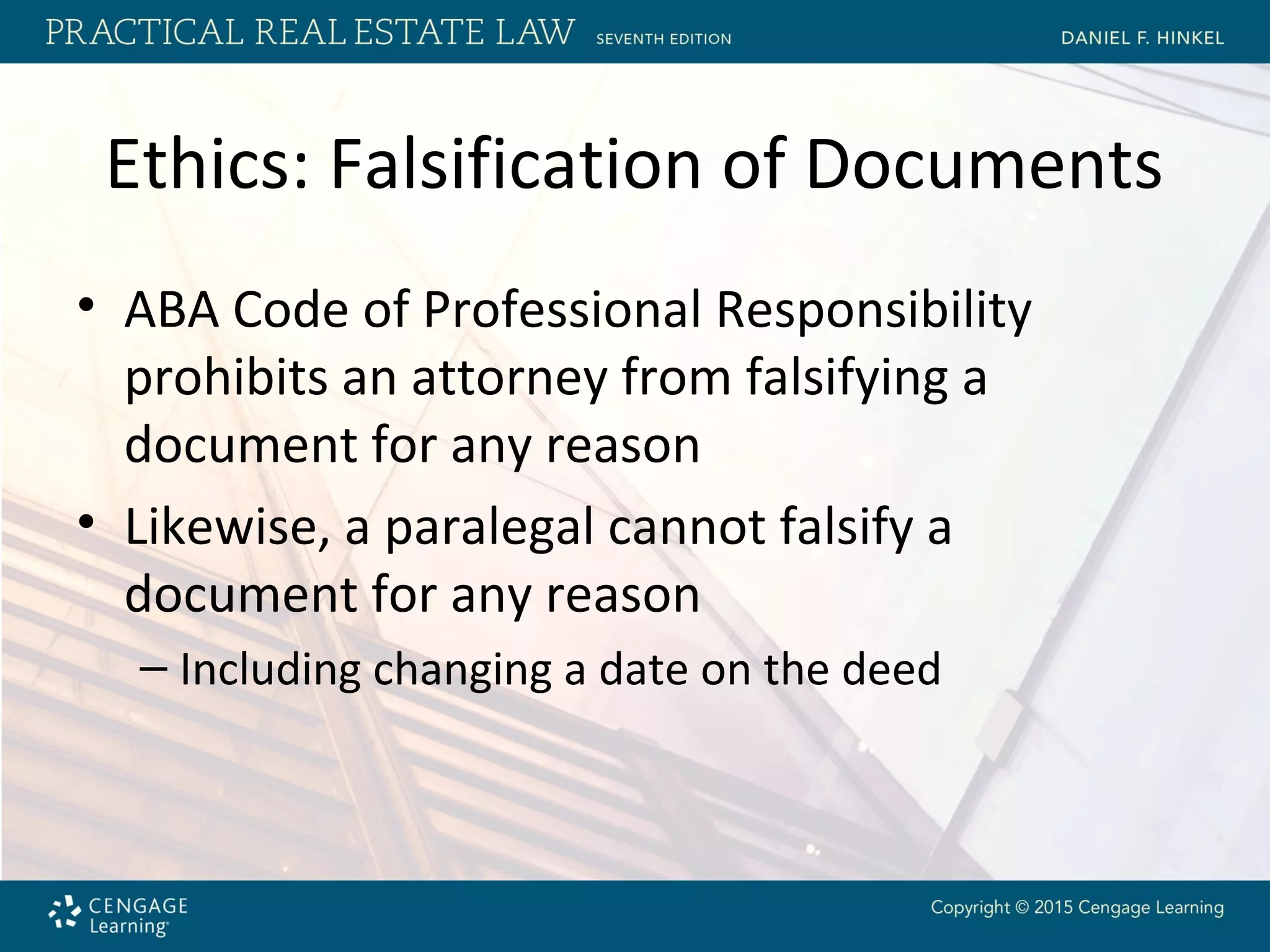
Ethics: Falsification of Documents
• ABA Code of Professional Responsibility
prohibits an attorney from falsifying a
document for any reason
• Likewise, a paralegal cannot falsify a
document for any reason
– Including changing a date on the deed
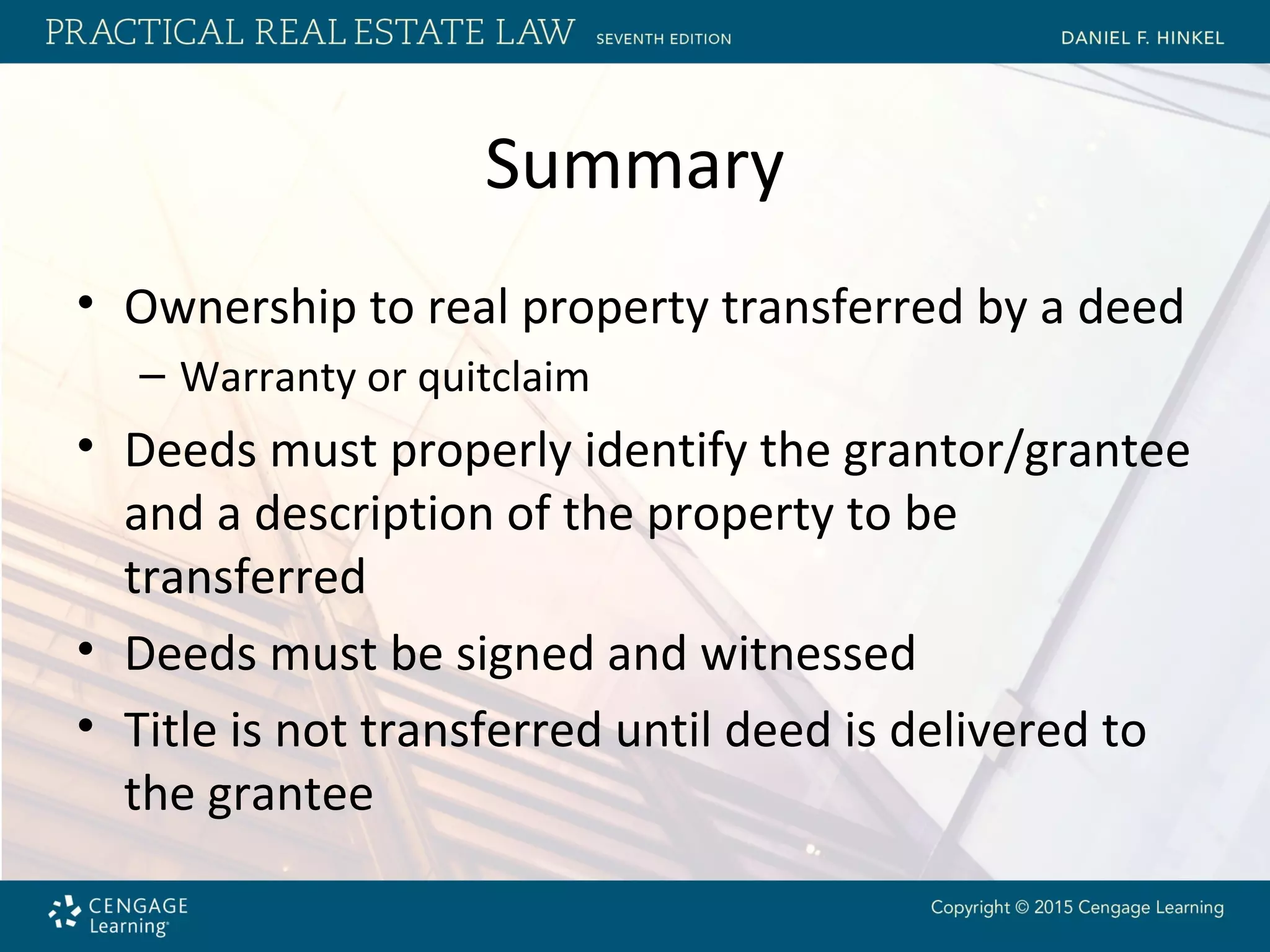
Summary
• Ownership to real property transferred by a deed
– Warranty or quitclaim
• Deeds must properly identify the grantor/grantee
and a description of the property to be
transferred
• Deeds must be signed and witnessed
• Title is not transferred until deed is delivered to
the grantee

Chapter 8 Requirements for Deeds and Various Types of Real Property Deeds-Summary

  • 1.
  • 2.
    Objectives • After readingthis chapter, you should be able to – Identify the types of deeds used in modern real estate practice. – Explain the basic requirements of a valid deed. – Prepare a deed.
  • 3.
    Historical Development ofDeeds • Originally, land conveyed by the actual delivery of vacant possession to the land in which a seller would place or “seize” the purchaser in possession • Later, the fine became the preferred method of conveyance • Today, written deeds are used to describe property and parties – Recorded in public files
  • 4.
    Types of Deeds •General warranty deed – Covenants (warranties) by grantor to grantee • Covenant of seisin • Covenant of right to convey • Covenant against encumbrances • Covenant of further assurance • Covenant of quiet enjoyment • Covenant of warranty
  • 5.
    Types of Deeds •Present versus future covenants – Case • Lunsford v. King, 132 Ga. App. 749, 209 S.E.2d 27 (1974) – Plaintiff entitled to prove case before jury » Including amount of unliquidated damages
  • 6.
    Types of Deeds •Limited (special) warranty deed – Warranty deed in which the grantor covenants only against lawful claims of people claiming by, through, or under the grantor – Grant deed • Transfers only the interest the grantor has in the land and not the land itself • Type of limited warranty deed commonly used in California
  • 7.
    Types of Deeds •Quitclaim deed – Contains no covenants or warranties of title – Found in other forms of deeds • Foreclosure deeds • Executor’s deeds • Administrator’s deeds • Trustee’s deeds
  • 8.
    Types of Deeds •Executor’s and administrator’s deeds – Transfer of a title to real property from the estate of a deceased individual – Without warranty of title • Trustee deeds – Deed transferring property held in trust for a beneficiary – Without warranty of title
  • 9.
    Basic Requirements ofa Valid Deed • Written instrument • Competent grantor • Identity of grantee • Words of conveyance • Adequate description of land
  • 10.
    Basic Requirements ofa Valid Deed • Consideration • Signature of grantor • Witnesses • Delivery of completed deed to grantee
  • 11.
    Preparation of aValid Deed • Most deeds have the following parts: – Caption – Premises or preamble – Granting clause – Description – Habendum – Warranty clause – Testimonium
  • 12.
    Completing Sections ofa Deed • Preamble – Grantor designations – Grantee designations • Granting clause • Description • Testimonium
  • 13.
    Correction of Deeds •Grantor must execute and deliver corrective deed to the grantee • Corrective deed is valid without any additional consideration • Acceptance by the grantee is admission of error found in the original deed • Reformation and cancellation of deed
  • 14.
    Practical Tips forthe Paralegal • Grantor – Legal ownership (individual or business entity) must be verified through a title report • Or court documents, if necessary – Name must be spelled correctly
  • 15.
    Practical Tips forthe Paralegal • Grantee – Same attention to detail applies to the grantee – If grantees are receiving property as co-owners, that language must be in the deed • Legal description
  • 16.
    Practical Tips forthe Paralegal • Witnessing a deed – If acting as a witness, must see grantee(s) sign the deed – If acting as a notary public, must properly identify the parties signing the deed • Notarizing a deed without seeing the actual signature(s) is a violation of the notary oath – May be considered perjury in many states
  • 17.
    Checklist: Preparing aDeed • Research before preparation – Review the contract or other agreement covering the transfer of ownership to the property – Review the title examination to ensure the correct name of title owner to the property
  • 18.
    Checklist: Preparing aDeed • Research before preparation – Confirm the correct spellings of all names of the grantor and grantee – Carefully review the title examination and determine what title exceptions should be identified in the deed
  • 19.
    Checklist: Preparing aDeed • Research before preparation – Confirm prospective purchasers have no special requirements for taking title • E.g., joint tenancy with right of survivorship – Review survey legal description against description in grantor’s current deed to ensure no difference exists between the two descriptions
  • 20.
    Checklist: Preparing aDeed • Preparing the deed – Draft the caption and preamble • Indicate the county and state where the deed signed • Date the deed with the date of execution and delivery • Indicate the correct name of the grantor • Indicate the correct name of the grantee, noting any special forms of ownership
  • 21.
    Checklist: Preparing aDeed • Preparing the deed – Draft the consideration – Draft the legal description • Use the correct legal description verified by survey and title examination • If the legal description is too long to be included on the face of the deed, use an exhibit • List all title exceptions being transferred with the property
  • 22.
    Checklist: Preparing aDeed • Preparing the deed – Draft signature blanks • Grantor is the only person who signs the deed • Correctly identify the grantor’s name • Type all names underneath the signature lines • Deed must be signed and sealed • Make certain the deed contains the proper number of witnesses and the correct notary designation
  • 23.
    Ethics: Falsification ofDocuments • ABA Code of Professional Responsibility prohibits an attorney from falsifying a document for any reason • Likewise, a paralegal cannot falsify a document for any reason – Including changing a date on the deed
  • 24.
    Summary • Ownership toreal property transferred by a deed – Warranty or quitclaim • Deeds must properly identify the grantor/grantee and a description of the property to be transferred • Deeds must be signed and witnessed • Title is not transferred until deed is delivered to the grantee