CHAPTER 6
Application of Power Electronics
Converters
DC Drives
• Basic Characteristic
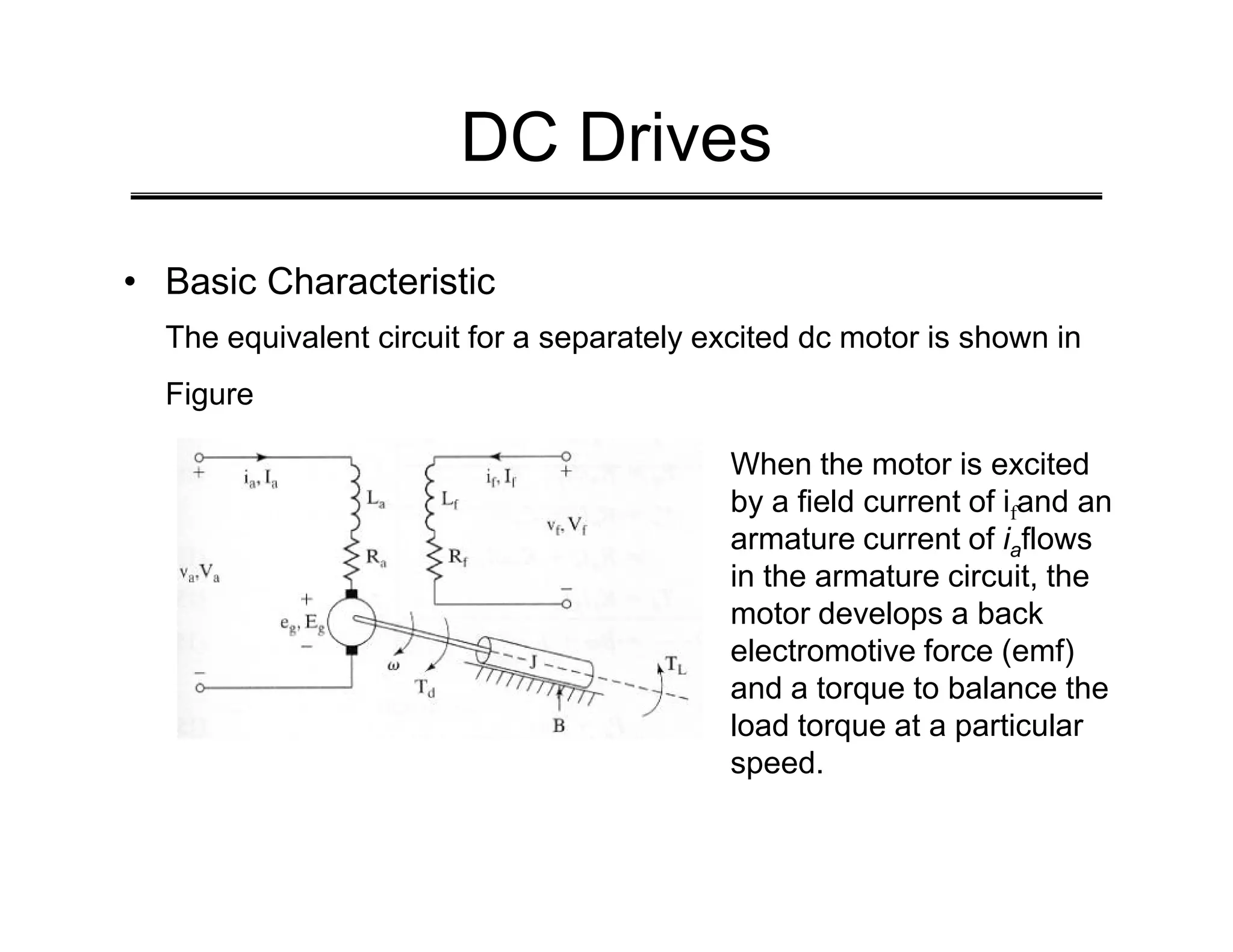
The equivalent circuit for a separately excited dc motor is shown in
Figure
When the motor is excited
by a field current of ifand an
armature current of iaflows
in the armature circuit, the
motor develops a back
electromotive force (emf)
and a torque to balance the
load torque at a particular
speed.
DC Drives
• Basic Characteristic
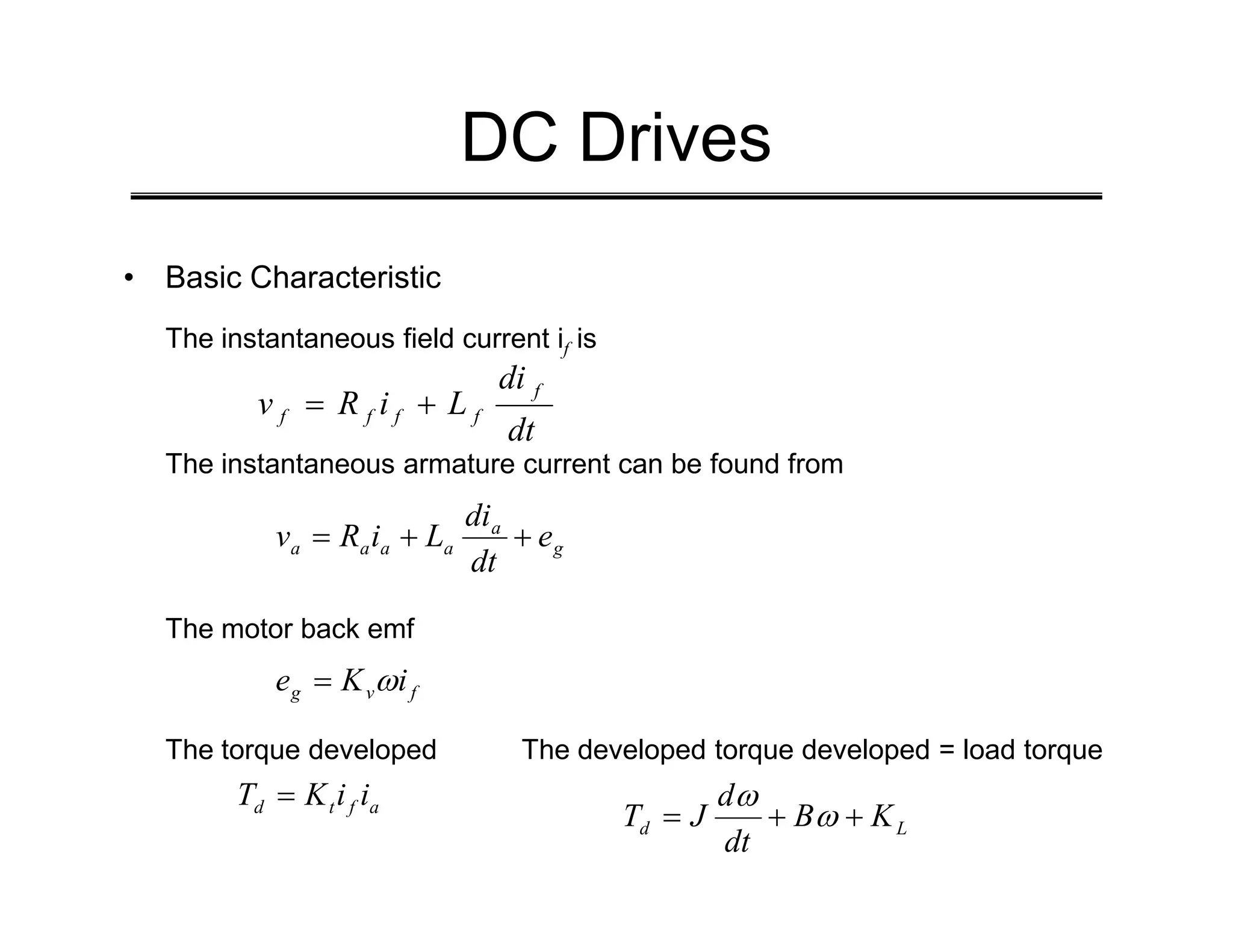
The instantaneous field current if is
The instantaneous armature current can be found from
dt
di
L
i
R
v
f
f
f
f
f +
=
The instantaneous armature current can be found from
The motor back emf
The torque developed The developed torque developed = load torque
g
a
a
a
a
a e
dt
di
L
i
R
v +
+
=
f
v
g i
K
e ω
=
a
f
t
d i
i
K
T =
L
d K
B
dt
d
J
T +
+
= ω
ω
DC Drives
• Single-Phase Drives
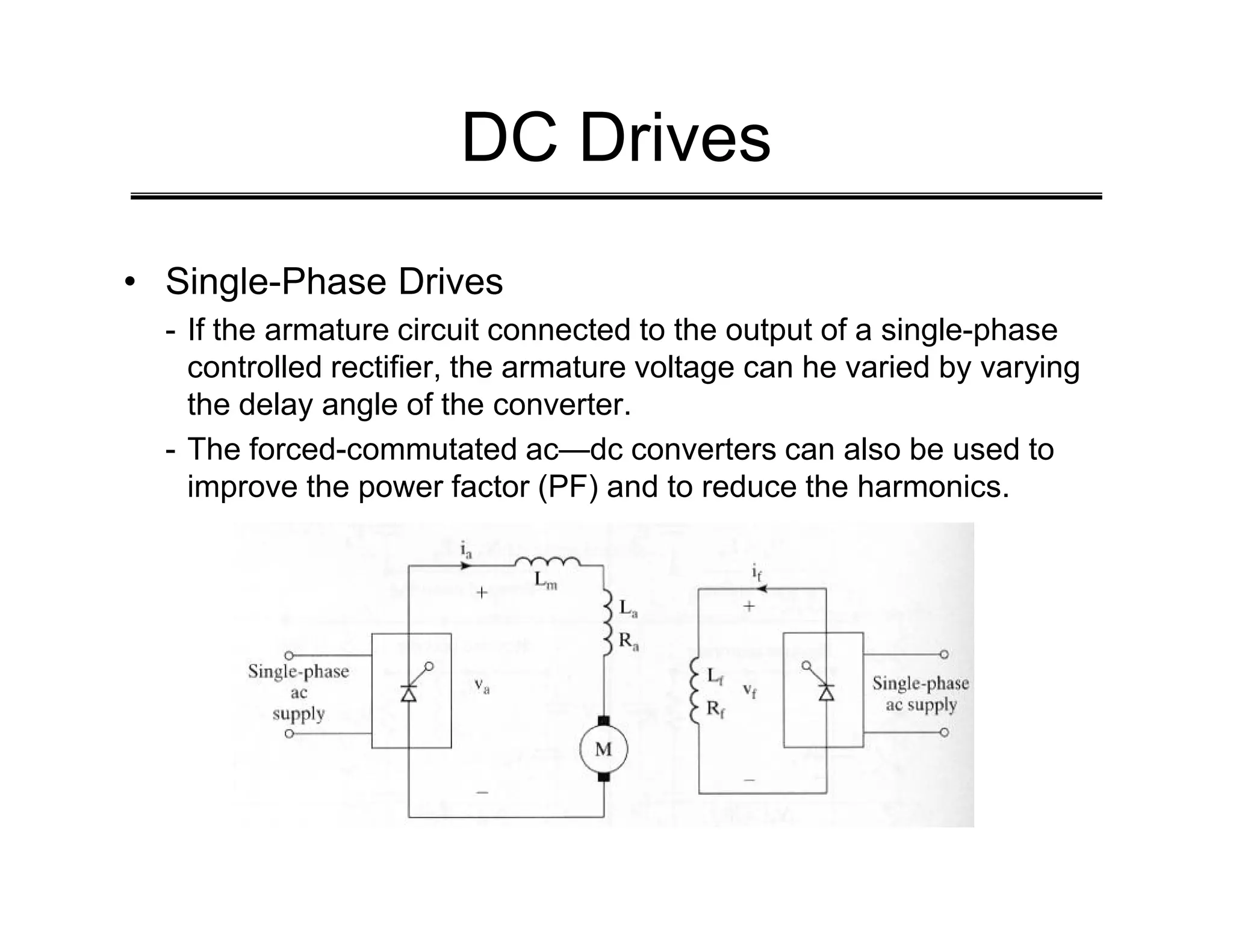
- If the armature circuit connected to the output of a single-phase
controlled rectifier, the armature voltage can he varied by varying
the delay angle of the converter.
- The forced-commutated ac—dc converters can also be used to
improve the power factor (PF) and to reduce the harmonics.
DC Drives
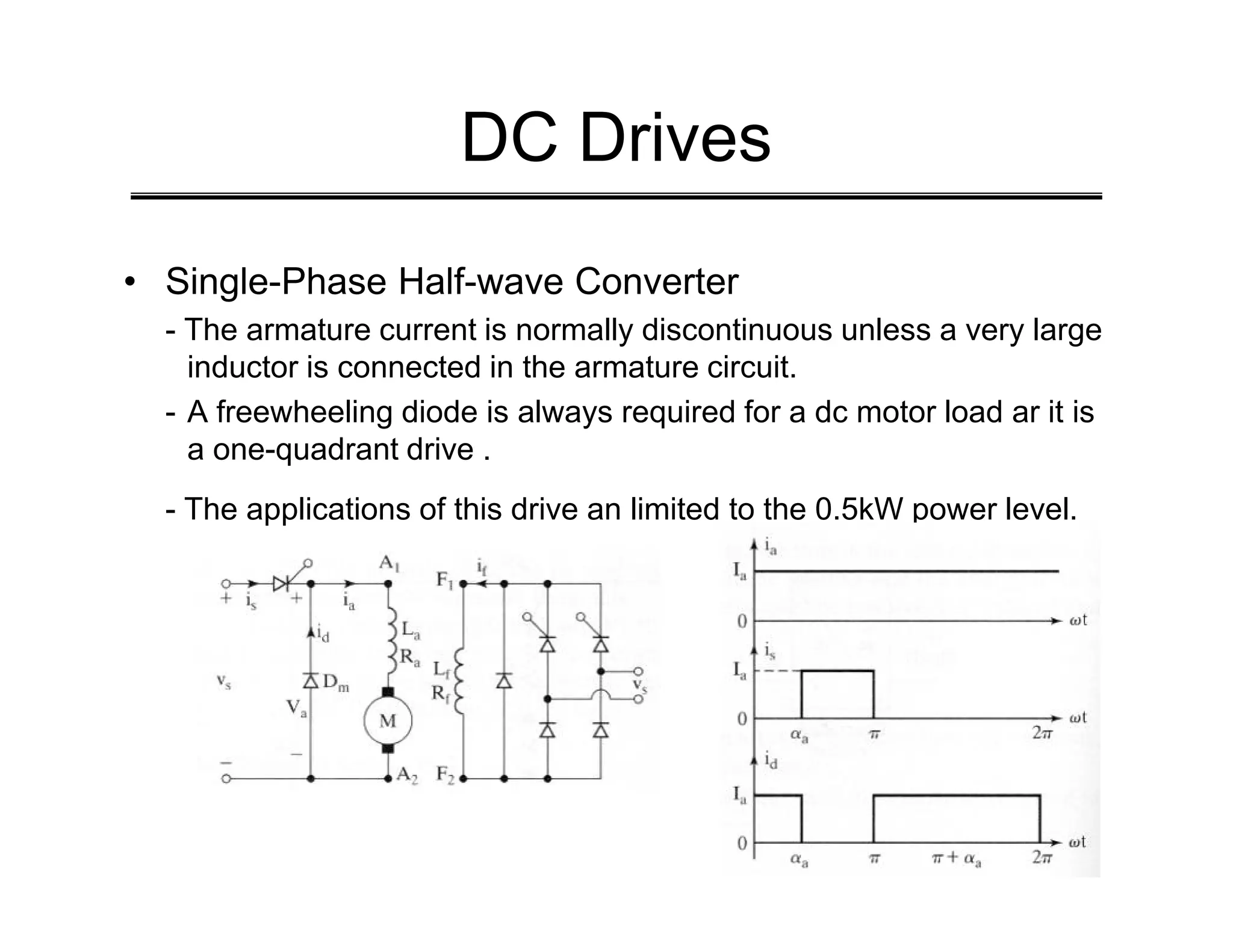
• Single-Phase Half-wave Converter
- The armature current is normally discontinuous unless a very large
inductor is connected in the armature circuit.
- A freewheeling diode is always required for a dc motor load ar it is
a one-quadrant drive .
- The applications of this drive an limited to the 0.5kW power level.
DC Drives
• Single-Phase Half-wave Converter
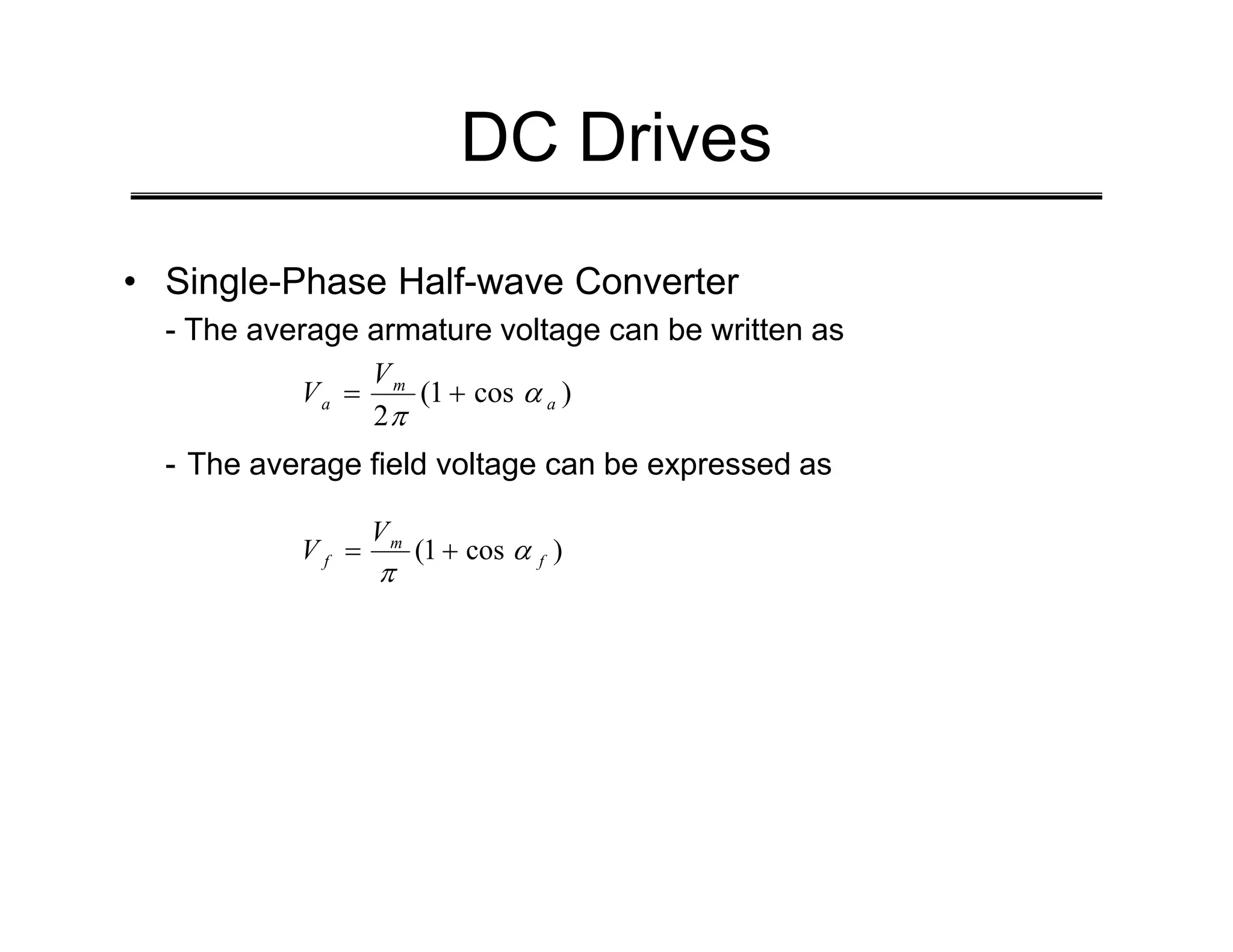
- The average armature voltage can be written as
- The average field voltage can be expressed as
)
cos
1
(
2
a
m
a
V
V α
π
+
=
- The average field voltage can be expressed as
)
cos
1
( f
m
f
V
V α
π
+
=
DC Drives
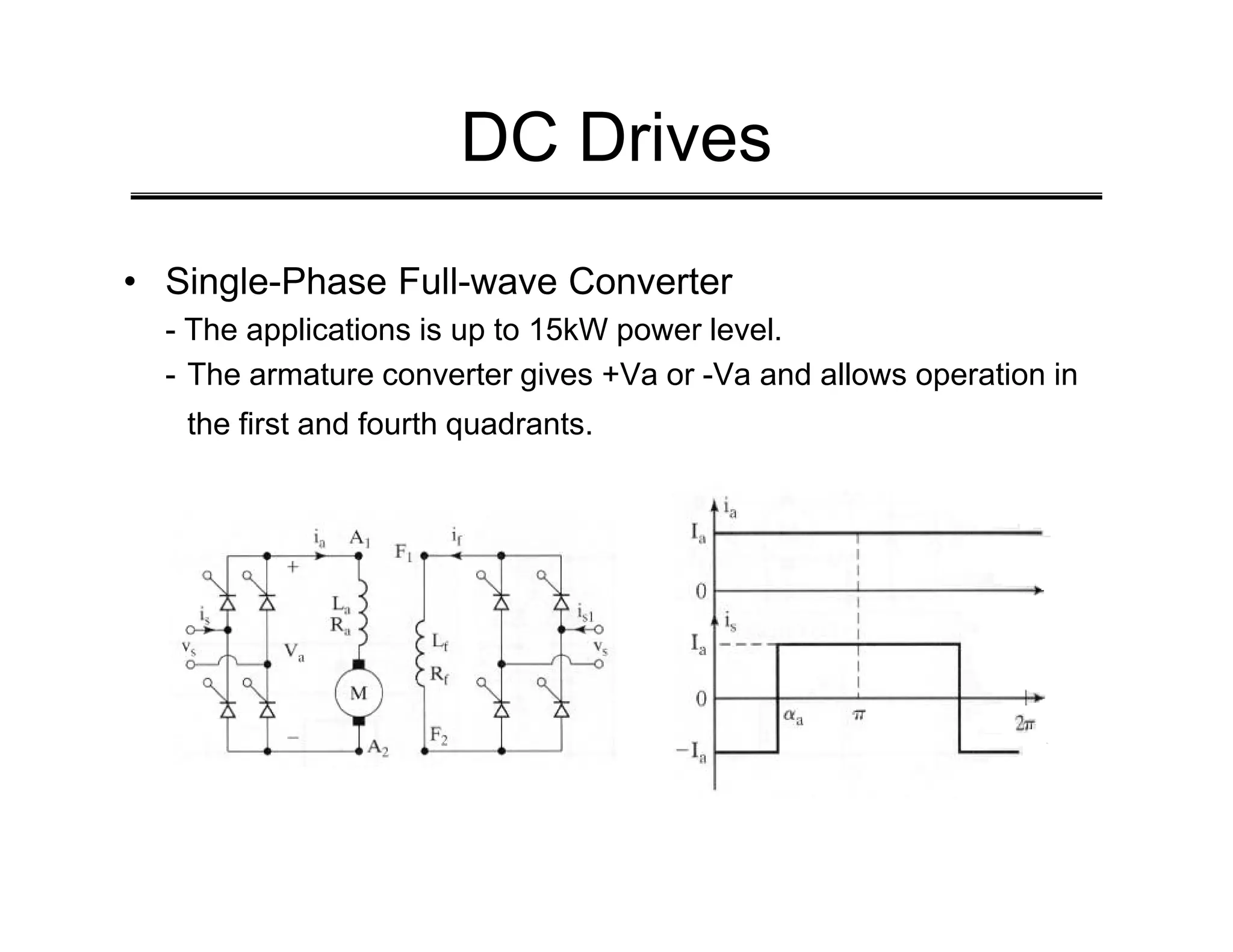
• Single-Phase Full-wave Converter
- The applications is up to 15kW power level.
- The armature converter gives +Va or -Va and allows operation in
the first and fourth quadrants.
DC Drives
• Single-Phase Full-wave Converter
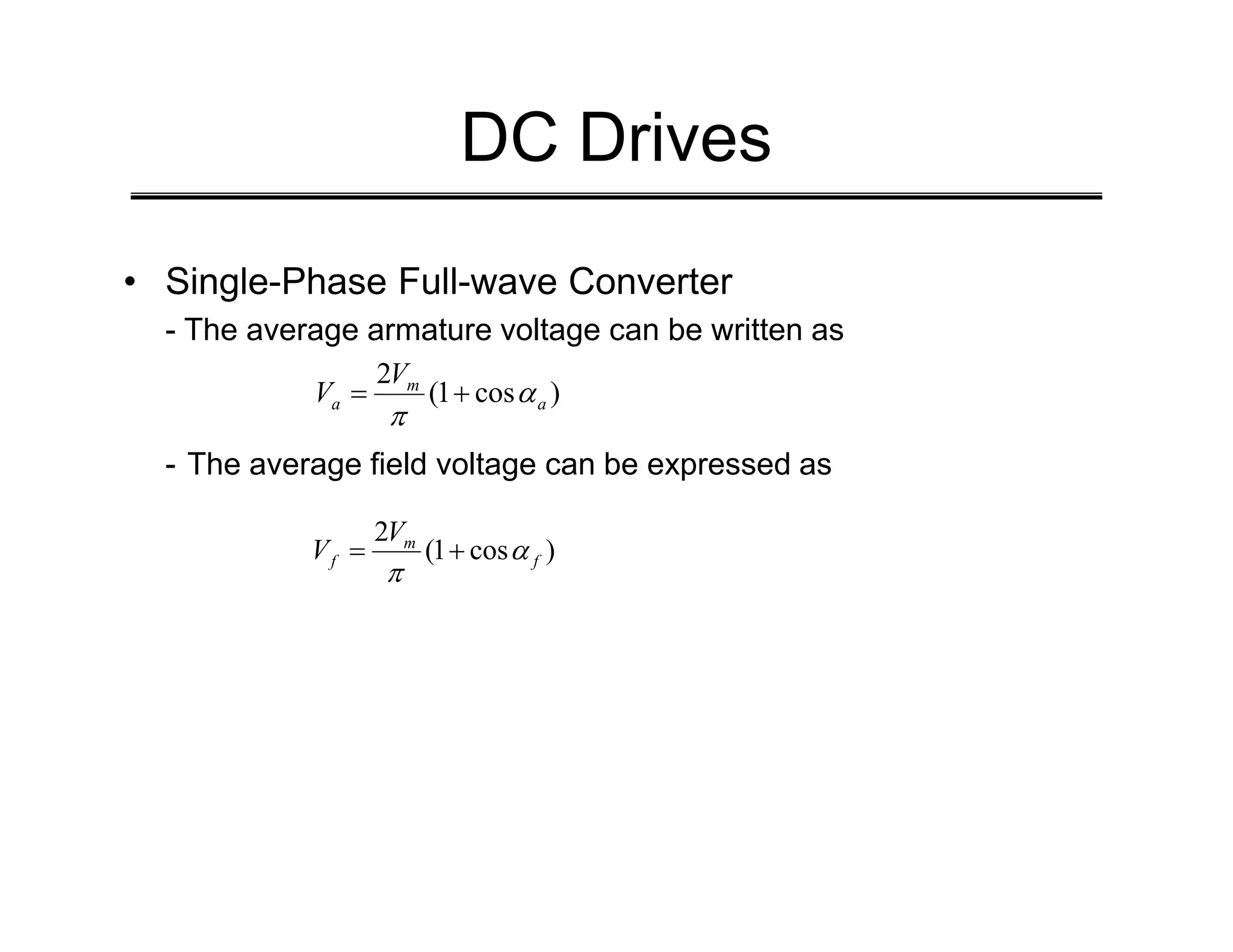
- The average armature voltage can be written as
- The average field voltage can be expressed as
)
cos
1
(
2
a
m
a
V
V α
π
+
=
- The average field voltage can be expressed as
)
cos
1
(
2
f
m
f
V
V α
π
+
=
DC Drives
• Three-Phase Half-wave Converter
- A three-phase half-wave converter dc motor drive operates in one
quadrant and can be used up to 40 kW power level.
- The field converter could be single-phase or three-phase
semiconductor.
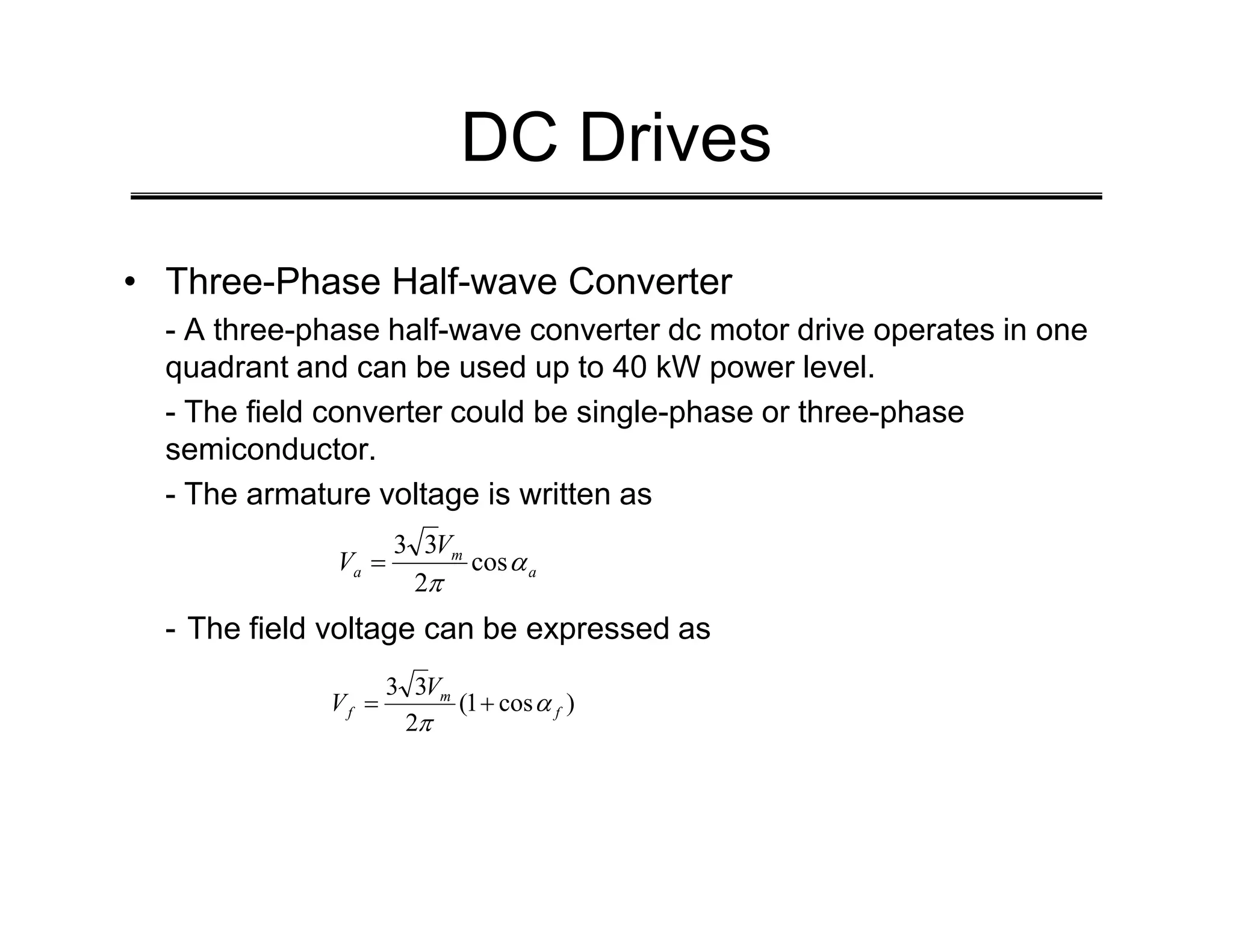
- The armature voltage is written as
- The field voltage can be expressed as
a
m
a
V
V α
π
cos
2
3
3
=
)
cos
1
(
2
3
3
f
m
f
V
V α
π
+
=
AC Drives
• Induction machines
A. Cage induction motor
- The 3-phase magnetizing currents flowing in the stator set up a
rotating air-gap flux (at speed Nsyn) and thus induces a voltage in
the rotor winding, causing current to flow in the rotor.
- The interaction of the rotor currents and flux produces a torque in
the same direction as the rotating field.
- The rotor must always rotate at a speed (Nr) different from Nsyn for
a voltage to be induced in the rotor.
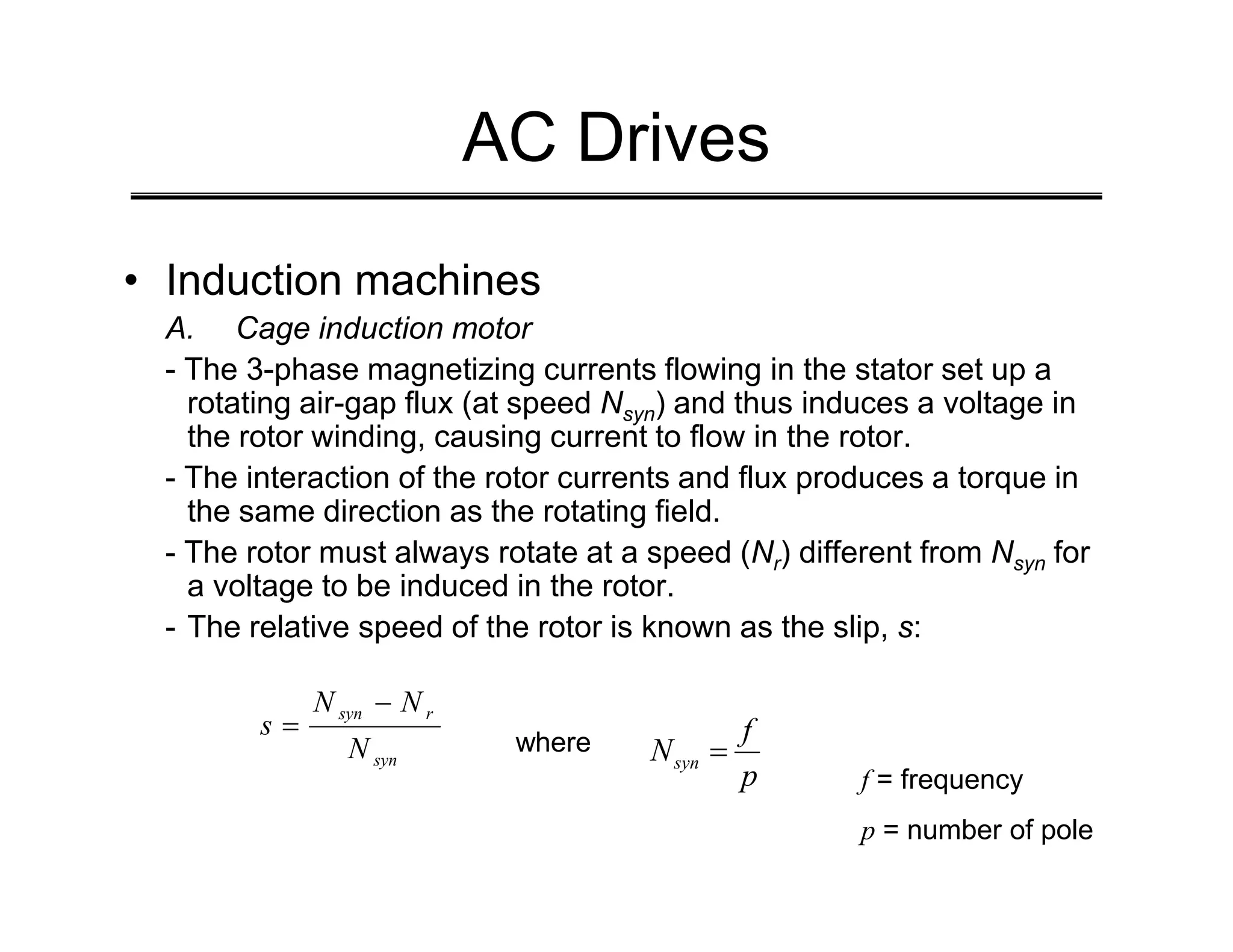
- The relative speed of the rotor is known as the slip, s:
syn
r
syn
N
N
N
s
−
=
p
f
Nsyn =
where
f = frequency
p = number of pole
AC Drives
• Induction machines
A. Cage induction motor
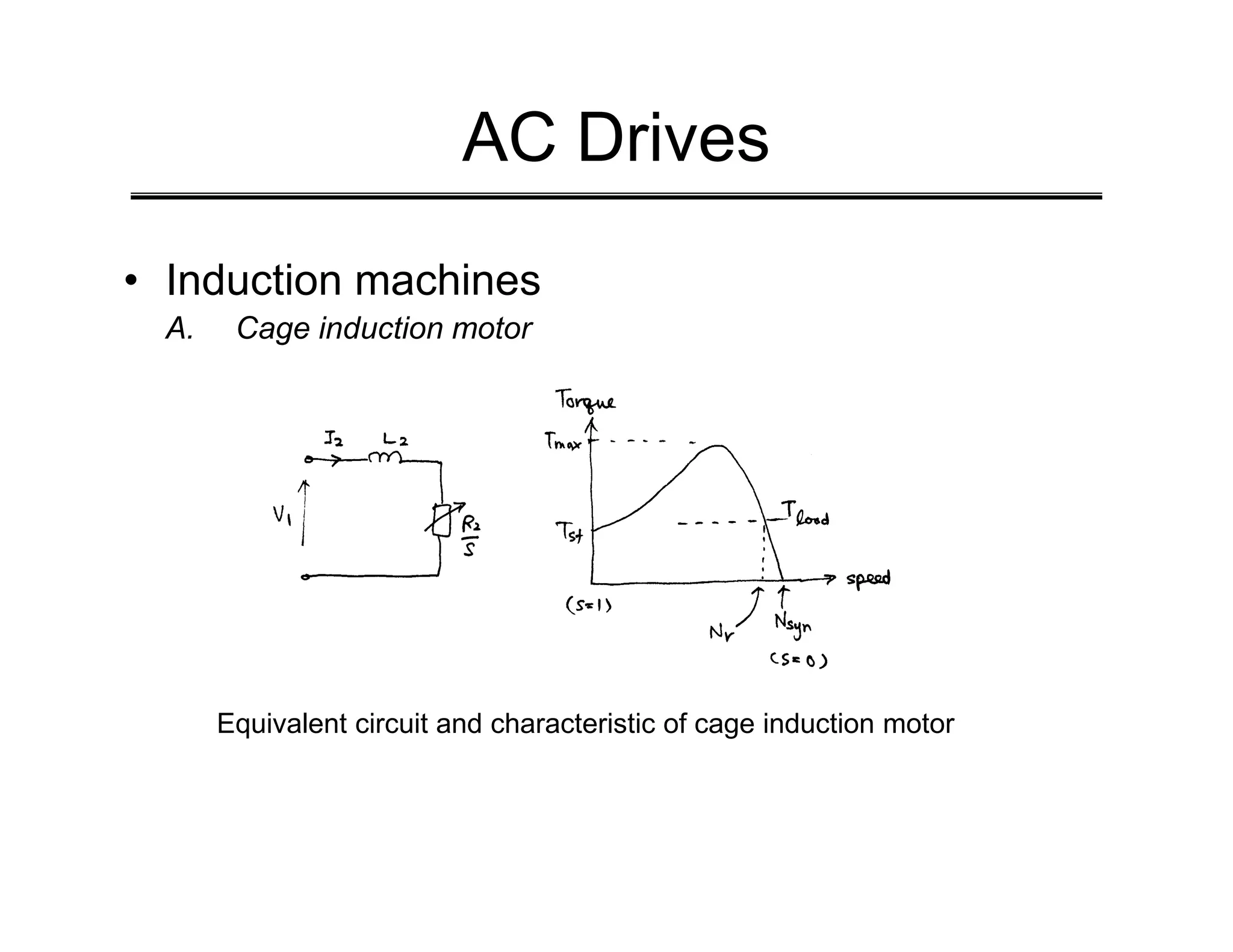
Equivalent circuit and characteristic of cage induction motor
AC Drives
• Induction machines
A. Cage induction motor
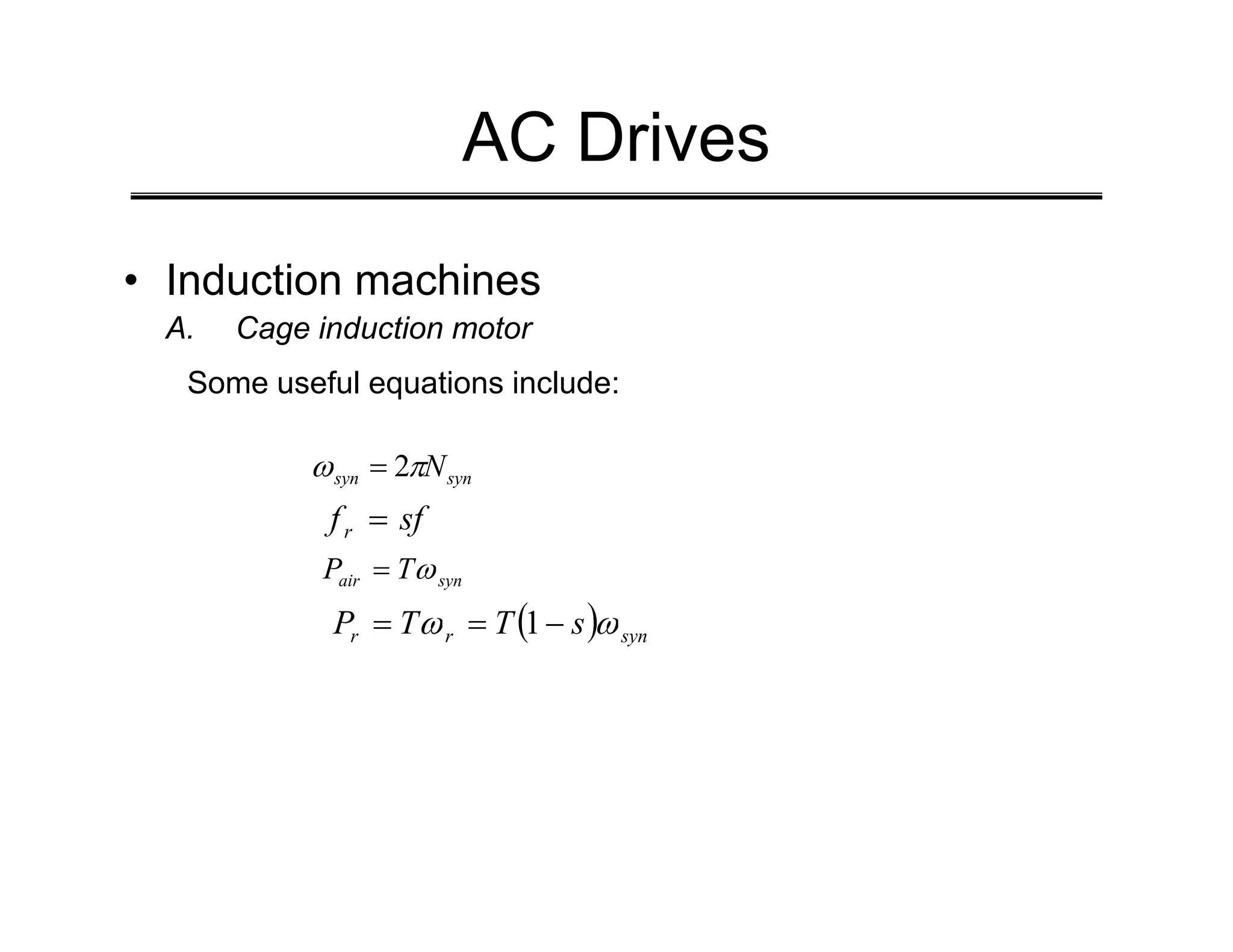
Some useful equations include:
syn
syn N
π
ω 2
= syn
syn N
π
ω 2
=
sf
fr =
syn
air T
P ω
=
( ) syn
r
r s
T
T
P ω
ω −
=
= 1
AC Drives
• Induction machines
A. Cage induction motor
If the stator winding resistance and leakage reactance (R) are
ignored, the flux may be considered constant at all loads and
proportional to the applied stator voltage.
( )
[ ]
2
2
2
2
2
2
1
2 R
sfL
R
sV
T
syn +
=
π
ω
AC Drives
• Induction machines
B. Slip-ring induction motor
- The slip-ring induction motor has a wound rotor carrying a 3-phase
winding similar to that of the stator.
- The ends of the winding are taken to slip-rings.
- The operating principle is similar to a cage induction motor, but
more flexible since means of control can be done on rotor via the
slip-rings.
AC Drives
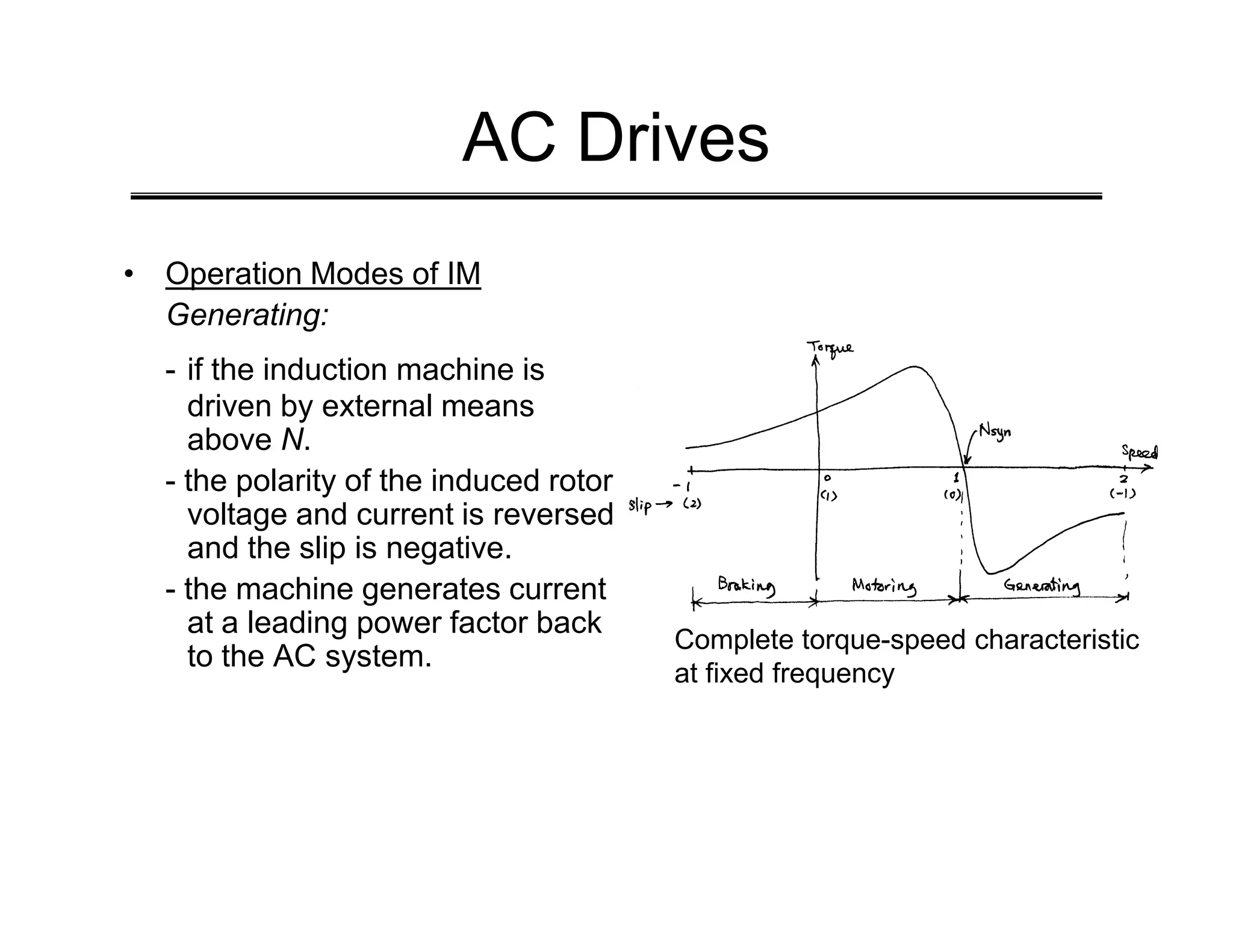
• Operation Modes of IM
Generating:
- if the induction machine is
driven by external means
above N.
- the polarity of the induced rotor
voltage and current is reversed
and the slip is negative.
- the machine generates current
at a leading power factor back
to the AC system.
Complete torque-speed characteristic
at fixed frequency
AC Drives
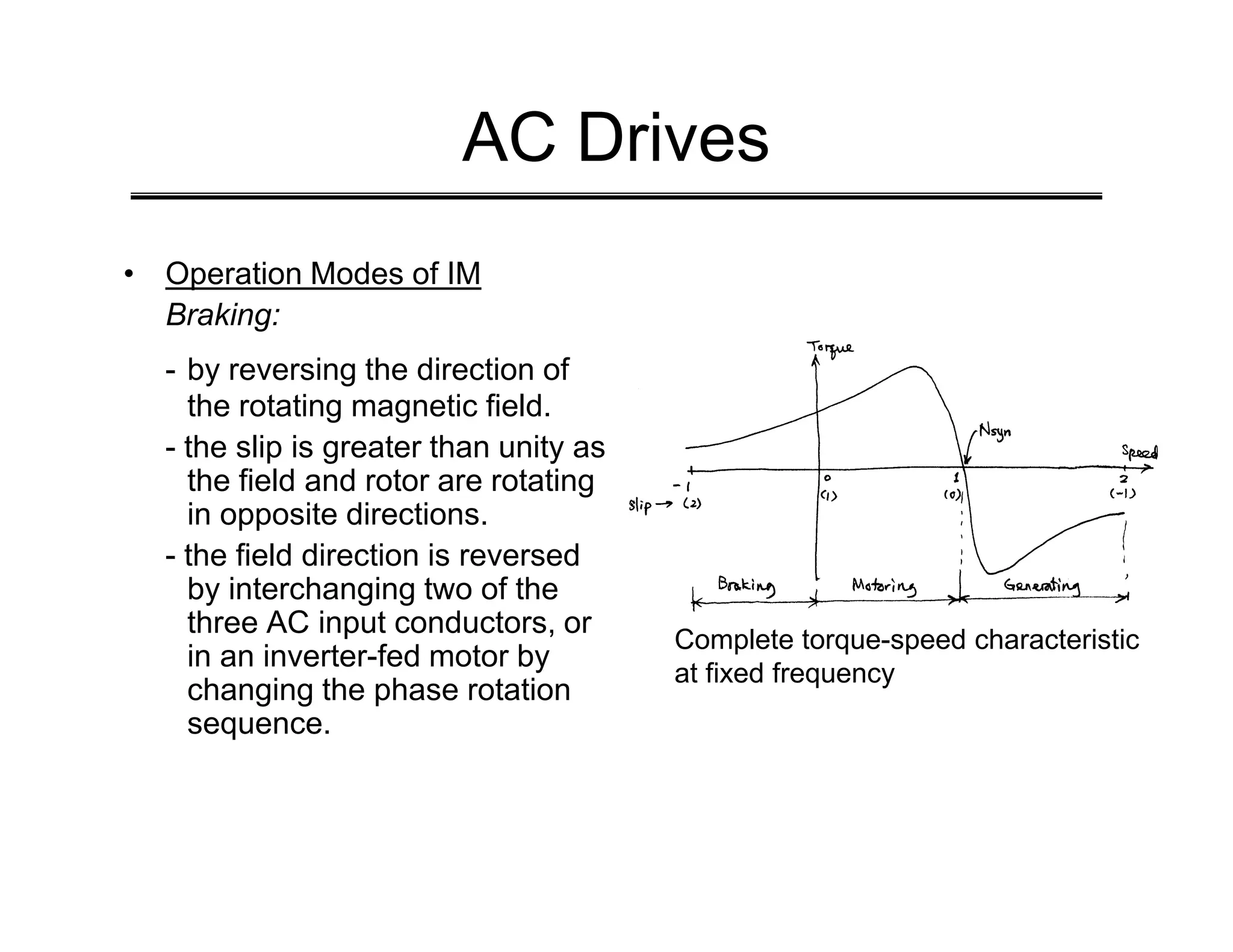
• Operation Modes of IM
Braking:
- by reversing the direction of
the rotating magnetic field.
- the slip is greater than unity as
the field and rotor are rotating
in opposite directions.
- the field direction is reversed
by interchanging two of the
three AC input conductors, or
in an inverter-fed motor by
changing the phase rotation
sequence.
Complete torque-speed characteristic
at fixed frequency
AC Drives
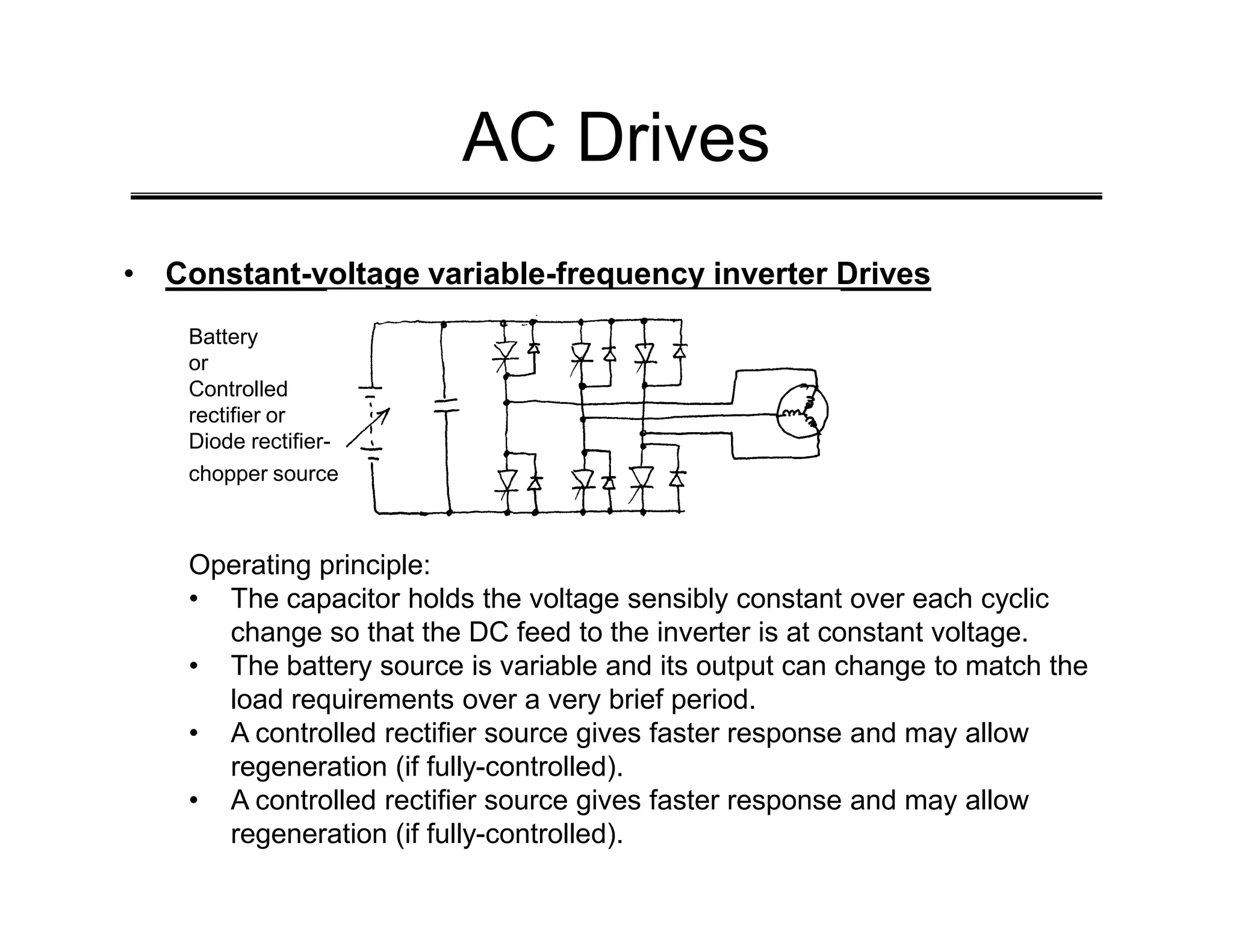
• Constant-voltage variable-frequency inverter Drives
Battery
or
Controlled
rectifier or
Diode rectifier-
chopper source
chopper source
Operating principle:
• The capacitor holds the voltage sensibly constant over each cyclic
change so that the DC feed to the inverter is at constant voltage.
• The battery source is variable and its output can change to match the
load requirements over a very brief period.
• A controlled rectifier source gives faster response and may allow
regeneration (if fully-controlled).
• A controlled rectifier source gives faster response and may allow
regeneration (if fully-controlled).
AC Drives
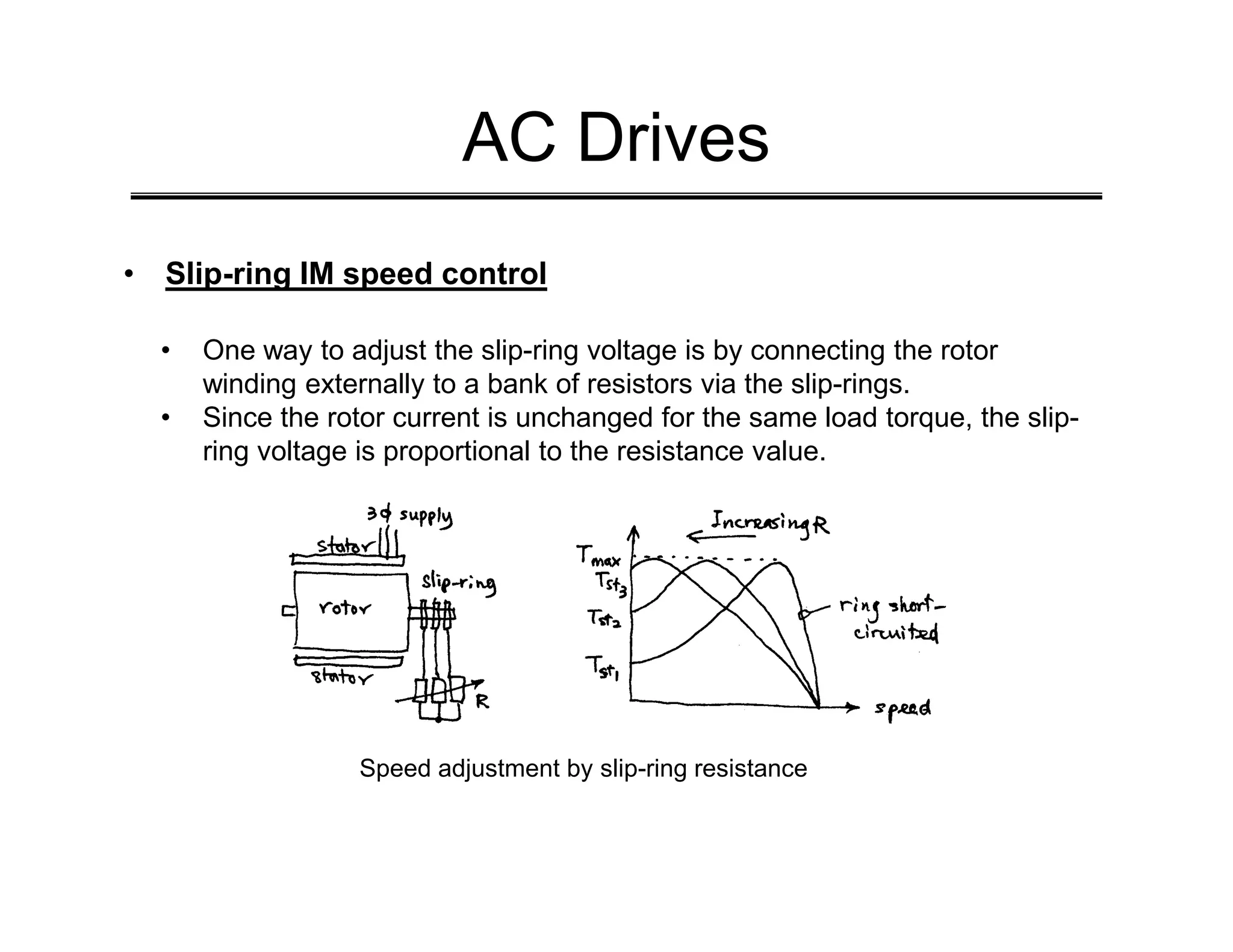
• Slip-ring IM speed control
• One way to adjust the slip-ring voltage is by connecting the rotor
winding externally to a bank of resistors via the slip-rings.
• Since the rotor current is unchanged for the same load torque, the slip-
ring voltage is proportional to the resistance value.
Speed adjustment by slip-ring resistance
AC Drives
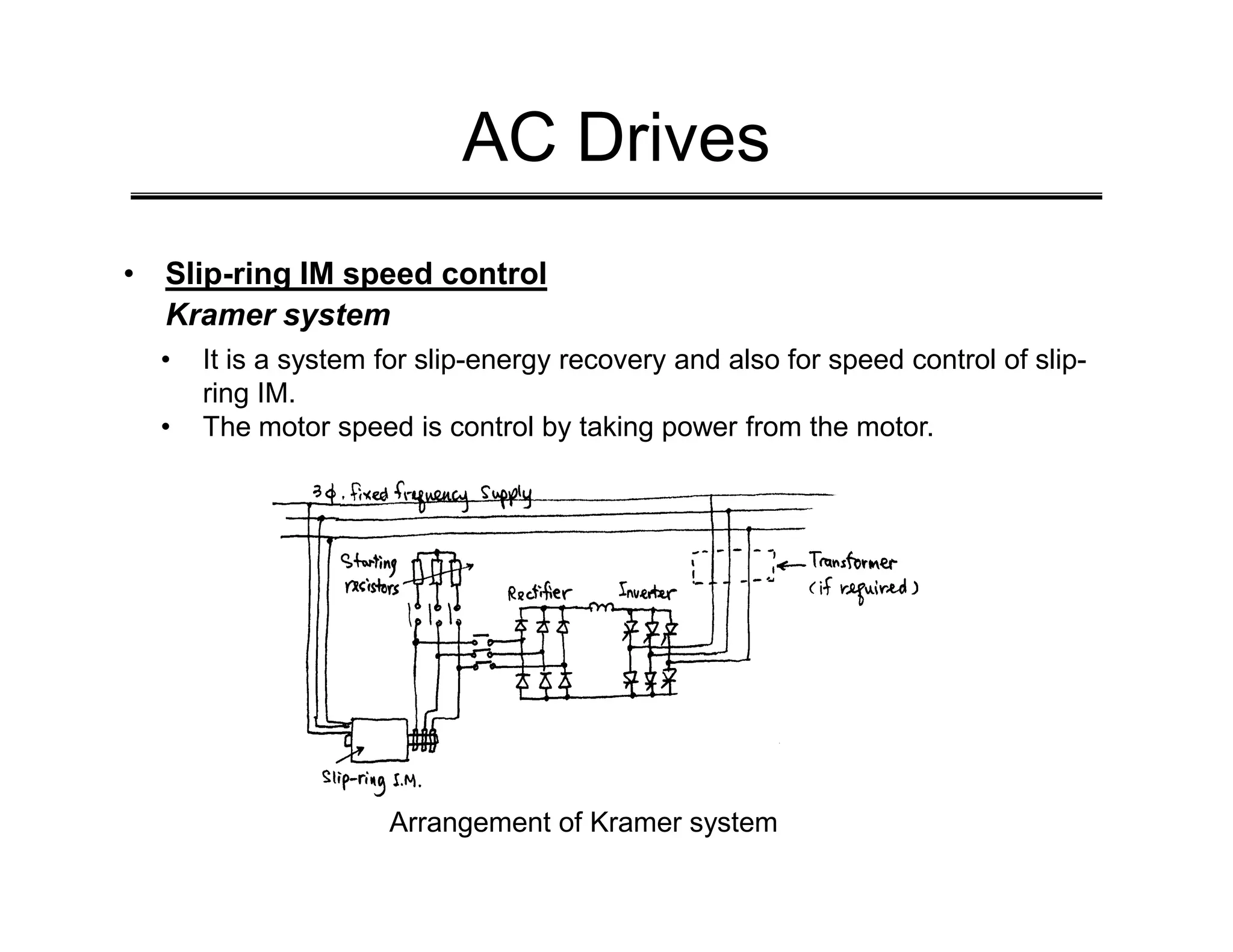
• Slip-ring IM speed control
Kramer system
• It is a system for slip-energy recovery and also for speed control of slip-
ring IM.
• The motor speed is control by taking power from the motor.
Arrangement of Kramer system
High Voltage Direct Current (HVDC)
MAIN PURPOSE FOR APPLICATION OF HVDC SCHEMES:
 LONG DISTANCE TRANSMISSION
 DC IS LESS EXPENSIVE ( REDUCE RIGHT OF WAY AND SMALL TOWER)
 STABILITY COSIDERATIONS UNNECESSARY
 NO REACTANCE DROP/LESS LOSSES IN TRANSMISSION
 CONNECTION OF ASYNCHRONOUS SYSTEMS
 ONLY SOLLUTION FOR DIFFERENT FREQUENCY INTERCONNECTION
 DC IS ONLY PRACTICAL TECHNICAL SOLUTION FOR ASSYCHRONOUS
SYSTEM
 LONG SUBMARINE CABLE
 DC CABLE MORE LESS EXPENSIVE COMPARE WITH AC CABLE
TRANSMISSION
 NO CHARGING CURENT
 LESS REACTIVE POWER GENERATED AND LESS TRANSMISSION
LOSSES
 INCREASE EFFICIENCY OF POWER CONTROL
 DC TRANSMISSION CAN DELIVER POWER TO GIVEN POINT IN AN AC
NETWORK.
 HIGH SPEED DC CONTROLS CAN IMPROVE SYSTEM PERFORMANCE BY
WHY HVDC ?
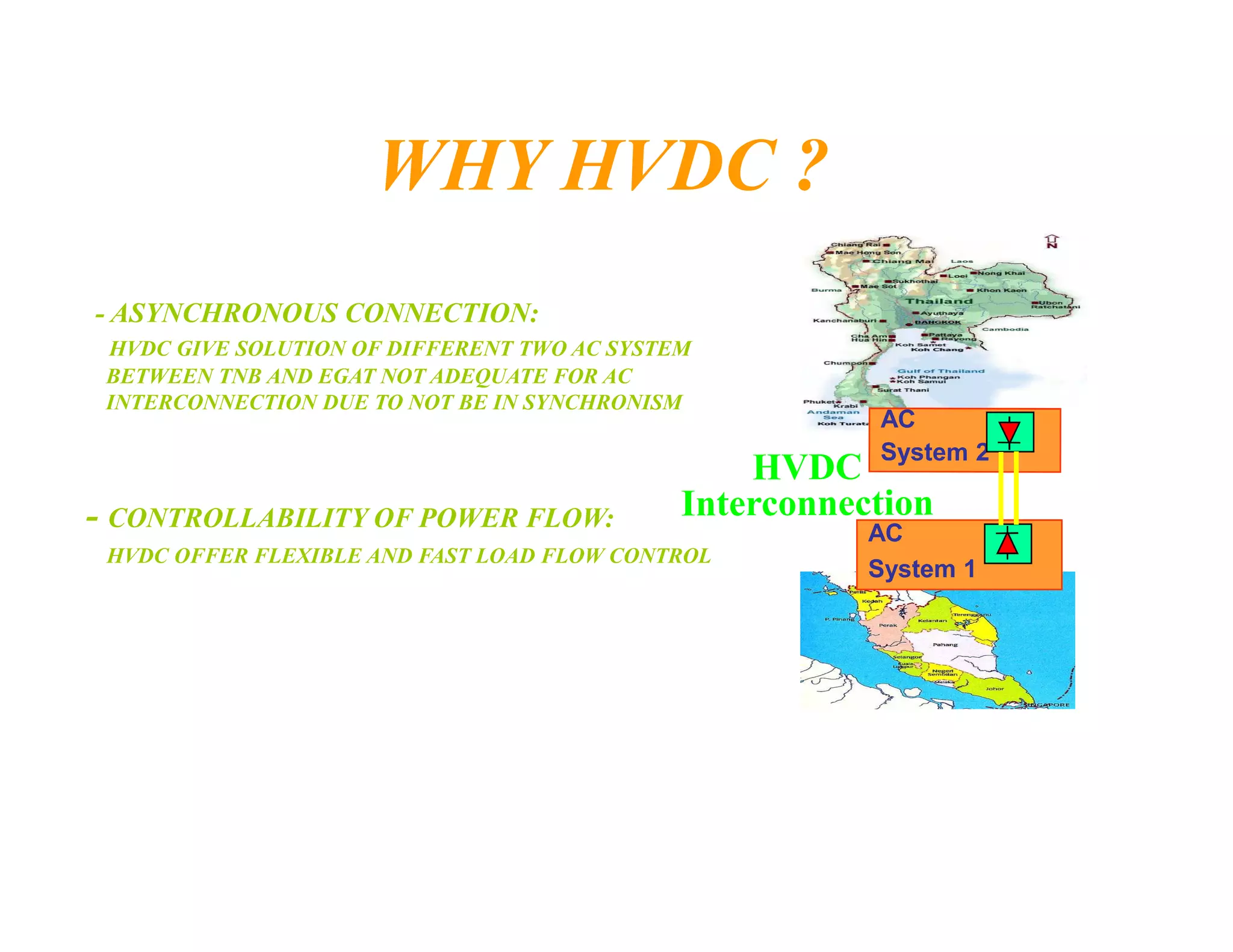
- ASYNCHRONOUS CONNECTION:
HVDC GIVE SOLUTION OF DIFFERENT TWO AC SYSTEM
BETWEEN TNB AND EGAT NOT ADEQUATE FOR AC
INTERCONNECTION DUE TO NOT BE IN SYNCHRONISM
- CONTROLLABILITY OF POWER FLOW:
HVDC OFFER FLEXIBLE AND FAST LOAD FLOW CONTROL
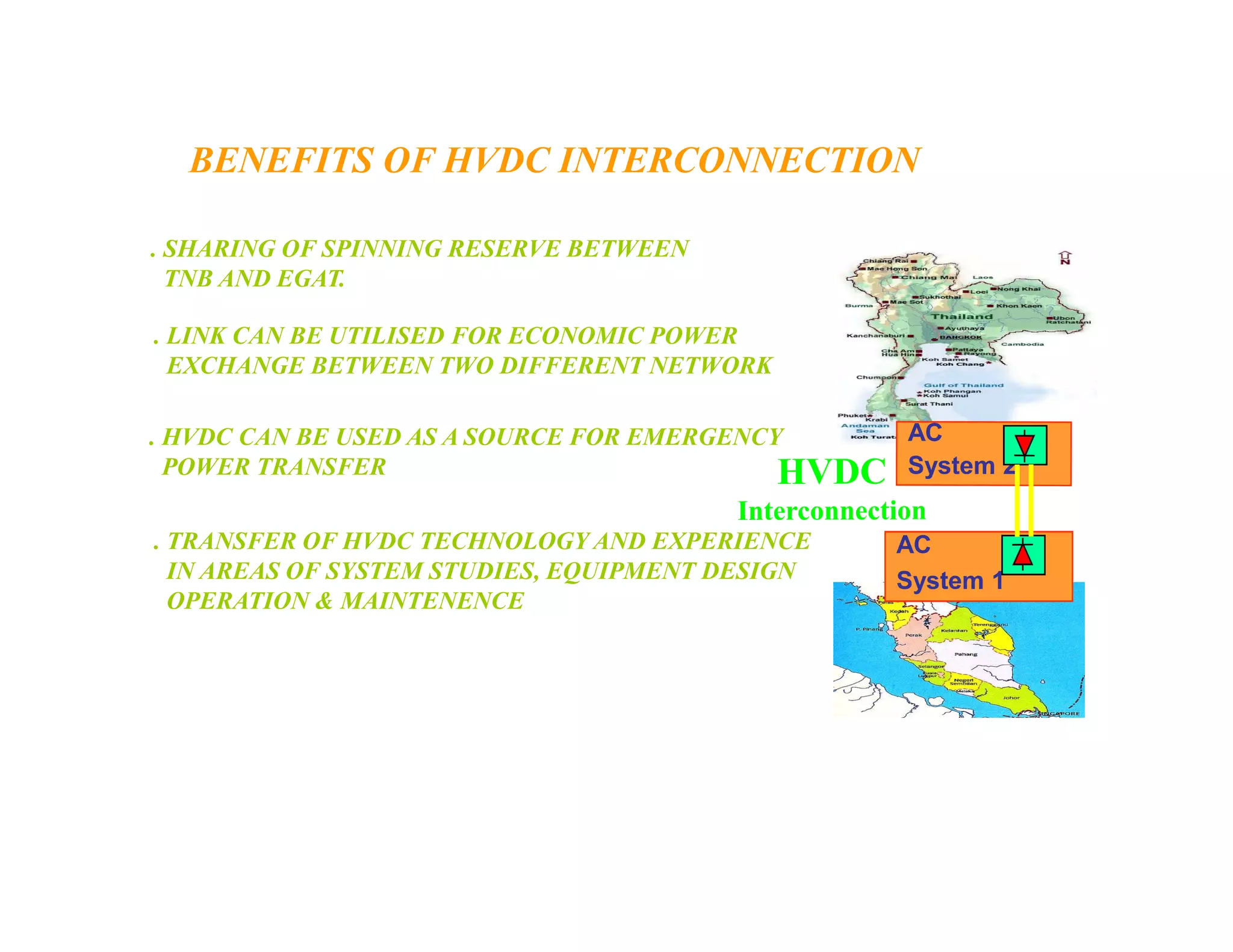
BENEFITS OF HVDC INTERCONNECTION
. SHARING OF SPINNING RESERVE BETWEEN
TNB AND EGAT.
. LINK CAN BE UTILISED FOR ECONOMIC POWER
EXCHANGE BETWEEN TWO DIFFERENT NETWORK
. HVDC CAN BE USED AS A SOURCE FOR EMERGENCY
POWER TRANSFER
POWER TRANSFER
. TRANSFER OF HVDC TECHNOLOGY AND EXPERIENCE
IN AREAS OF SYSTEM STUDIES, EQUIPMENT DESIGN
OPERATION  MAINTENENCE
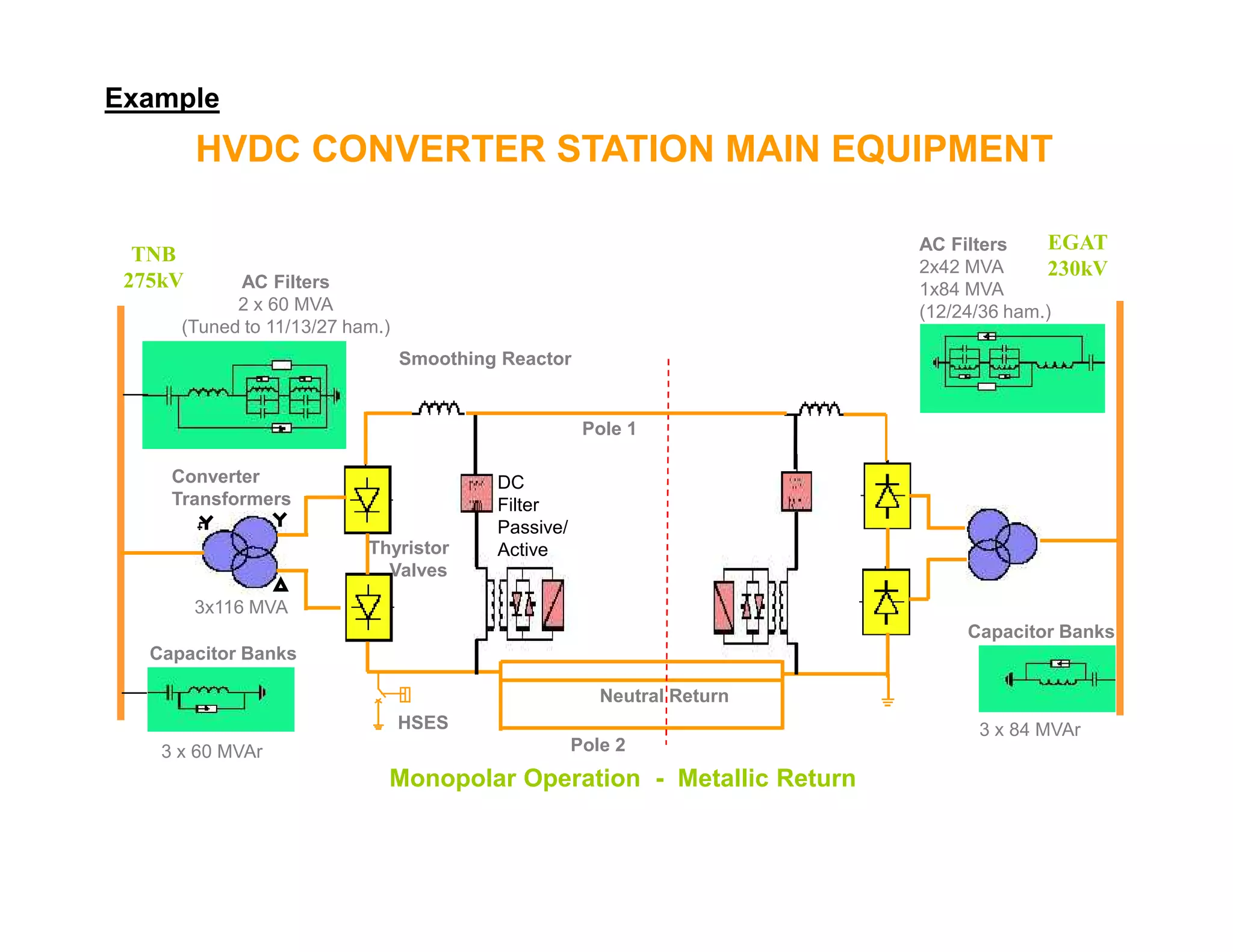
HVDC CONVERTER STATION MAIN EQUIPMENT
DC O/H Line 110 km
TNB
275kV
EGAT
230kV
AC Filters
2 x 60 MVA
(Tuned to 11/13/27 ham.)
AC Filters
2x42 MVA
1x84 MVA
(12/24/36 ham.)
Converter
Smoothing Reactor
DC
Pole 1
Example
MALAYSIA THAILAND
Monopolar Operation - Metallic Return
3x116 MVA
Thyristor
Valves
Converter
Transformers
DC
Filter
Passive/
Active
Capacitor Banks
3 x 60 MVAr
Capacitor Banks
3 x 84 MVAr
HSES
Pole 2
Neutral Return

Chapter 7 Application of Electronic Converters.pdf

  • 1.
    CHAPTER 6 Application ofPower Electronics Converters
  • 2.
    DC Drives • BasicCharacteristic The equivalent circuit for a separately excited dc motor is shown in Figure When the motor is excited When the motor is excited by a field current of ifand an armature current of iaflows in the armature circuit, the motor develops a back electromotive force (emf) and a torque to balance the load torque at a particular speed.
  • 3.
    DC Drives • BasicCharacteristic The instantaneous field current if is The instantaneous armature current can be found from dt di L i R v f f f f f + = The instantaneous armature current can be found from The motor back emf The torque developed The developed torque developed = load torque g a a a a a e dt di L i R v + + = f v g i K e ω = a f t d i i K T = L d K B dt d J T + + = ω ω
  • 4.
    DC Drives • Single-PhaseDrives - If the armature circuit connected to the output of a single-phase controlled rectifier, the armature voltage can he varied by varying the delay angle of the converter. - The forced-commutated ac—dc converters can also be used to improve the power factor (PF) and to reduce the harmonics. improve the power factor (PF) and to reduce the harmonics.
  • 5.
    DC Drives • Single-PhaseHalf-wave Converter - The armature current is normally discontinuous unless a very large inductor is connected in the armature circuit. - A freewheeling diode is always required for a dc motor load ar it is a one-quadrant drive . - The applications of this drive an limited to the 0.5kW power level.
  • 6.
    DC Drives • Single-PhaseHalf-wave Converter - The average armature voltage can be written as - The average field voltage can be expressed as ) cos 1 ( 2 a m a V V α π + = - The average field voltage can be expressed as ) cos 1 ( f m f V V α π + =
  • 7.
    DC Drives • Single-PhaseFull-wave Converter - The applications is up to 15kW power level. - The armature converter gives +Va or -Va and allows operation in the first and fourth quadrants.
  • 8.
    DC Drives • Single-PhaseFull-wave Converter - The average armature voltage can be written as - The average field voltage can be expressed as ) cos 1 ( 2 a m a V V α π + = - The average field voltage can be expressed as ) cos 1 ( 2 f m f V V α π + =
  • 9.
    DC Drives • Three-PhaseHalf-wave Converter - A three-phase half-wave converter dc motor drive operates in one quadrant and can be used up to 40 kW power level. - The field converter could be single-phase or three-phase semiconductor. - The armature voltage is written as - The field voltage can be expressed as a m a V V α π cos 2 3 3 = ) cos 1 ( 2 3 3 f m f V V α π + =
  • 10.
    AC Drives • Inductionmachines A. Cage induction motor - The 3-phase magnetizing currents flowing in the stator set up a rotating air-gap flux (at speed Nsyn) and thus induces a voltage in the rotor winding, causing current to flow in the rotor. - The interaction of the rotor currents and flux produces a torque in - The interaction of the rotor currents and flux produces a torque in the same direction as the rotating field. - The rotor must always rotate at a speed (Nr) different from Nsyn for a voltage to be induced in the rotor. - The relative speed of the rotor is known as the slip, s: syn r syn N N N s − = p f Nsyn = where f = frequency p = number of pole
  • 11.
    AC Drives • Inductionmachines A. Cage induction motor Equivalent circuit and characteristic of cage induction motor
  • 12.
    AC Drives • Inductionmachines A. Cage induction motor Some useful equations include: syn syn N π ω 2 = syn syn N π ω 2 = sf fr = syn air T P ω = ( ) syn r r s T T P ω ω − = = 1
  • 13.
    AC Drives • Inductionmachines A. Cage induction motor If the stator winding resistance and leakage reactance (R) are ignored, the flux may be considered constant at all loads and proportional to the applied stator voltage. ( ) [ ] 2 2 2 2 2 2 1 2 R sfL R sV T syn + = π ω
  • 14.
    AC Drives • Inductionmachines B. Slip-ring induction motor - The slip-ring induction motor has a wound rotor carrying a 3-phase winding similar to that of the stator. - The ends of the winding are taken to slip-rings. - The ends of the winding are taken to slip-rings. - The operating principle is similar to a cage induction motor, but more flexible since means of control can be done on rotor via the slip-rings.
  • 15.
    AC Drives • OperationModes of IM Generating: - if the induction machine is driven by external means above N. - the polarity of the induced rotor - the polarity of the induced rotor voltage and current is reversed and the slip is negative. - the machine generates current at a leading power factor back to the AC system. Complete torque-speed characteristic at fixed frequency
  • 16.
    AC Drives • OperationModes of IM Braking: - by reversing the direction of the rotating magnetic field. - the slip is greater than unity as the field and rotor are rotating the field and rotor are rotating in opposite directions. - the field direction is reversed by interchanging two of the three AC input conductors, or in an inverter-fed motor by changing the phase rotation sequence. Complete torque-speed characteristic at fixed frequency
  • 17.
    AC Drives • Constant-voltagevariable-frequency inverter Drives Battery or Controlled rectifier or Diode rectifier- chopper source chopper source Operating principle: • The capacitor holds the voltage sensibly constant over each cyclic change so that the DC feed to the inverter is at constant voltage. • The battery source is variable and its output can change to match the load requirements over a very brief period. • A controlled rectifier source gives faster response and may allow regeneration (if fully-controlled). • A controlled rectifier source gives faster response and may allow regeneration (if fully-controlled).
  • 18.
    AC Drives • Slip-ringIM speed control • One way to adjust the slip-ring voltage is by connecting the rotor winding externally to a bank of resistors via the slip-rings. • Since the rotor current is unchanged for the same load torque, the slip- ring voltage is proportional to the resistance value. Speed adjustment by slip-ring resistance
  • 19.
    AC Drives • Slip-ringIM speed control Kramer system • It is a system for slip-energy recovery and also for speed control of slip- ring IM. • The motor speed is control by taking power from the motor. Arrangement of Kramer system
  • 20.
    High Voltage DirectCurrent (HVDC)
  • 21.
    MAIN PURPOSE FORAPPLICATION OF HVDC SCHEMES: LONG DISTANCE TRANSMISSION DC IS LESS EXPENSIVE ( REDUCE RIGHT OF WAY AND SMALL TOWER) STABILITY COSIDERATIONS UNNECESSARY NO REACTANCE DROP/LESS LOSSES IN TRANSMISSION CONNECTION OF ASYNCHRONOUS SYSTEMS ONLY SOLLUTION FOR DIFFERENT FREQUENCY INTERCONNECTION DC IS ONLY PRACTICAL TECHNICAL SOLUTION FOR ASSYCHRONOUS SYSTEM LONG SUBMARINE CABLE DC CABLE MORE LESS EXPENSIVE COMPARE WITH AC CABLE TRANSMISSION NO CHARGING CURENT LESS REACTIVE POWER GENERATED AND LESS TRANSMISSION LOSSES INCREASE EFFICIENCY OF POWER CONTROL DC TRANSMISSION CAN DELIVER POWER TO GIVEN POINT IN AN AC NETWORK. HIGH SPEED DC CONTROLS CAN IMPROVE SYSTEM PERFORMANCE BY
  • 22.
    WHY HVDC ? -ASYNCHRONOUS CONNECTION: HVDC GIVE SOLUTION OF DIFFERENT TWO AC SYSTEM BETWEEN TNB AND EGAT NOT ADEQUATE FOR AC INTERCONNECTION DUE TO NOT BE IN SYNCHRONISM - CONTROLLABILITY OF POWER FLOW: HVDC OFFER FLEXIBLE AND FAST LOAD FLOW CONTROL
  • 23.
    BENEFITS OF HVDCINTERCONNECTION . SHARING OF SPINNING RESERVE BETWEEN TNB AND EGAT. . LINK CAN BE UTILISED FOR ECONOMIC POWER EXCHANGE BETWEEN TWO DIFFERENT NETWORK . HVDC CAN BE USED AS A SOURCE FOR EMERGENCY POWER TRANSFER POWER TRANSFER . TRANSFER OF HVDC TECHNOLOGY AND EXPERIENCE IN AREAS OF SYSTEM STUDIES, EQUIPMENT DESIGN OPERATION MAINTENENCE
  • 24.
    HVDC CONVERTER STATIONMAIN EQUIPMENT DC O/H Line 110 km TNB 275kV EGAT 230kV AC Filters 2 x 60 MVA (Tuned to 11/13/27 ham.) AC Filters 2x42 MVA 1x84 MVA (12/24/36 ham.) Converter Smoothing Reactor DC Pole 1 Example MALAYSIA THAILAND Monopolar Operation - Metallic Return 3x116 MVA Thyristor Valves Converter Transformers DC Filter Passive/ Active Capacitor Banks 3 x 60 MVAr Capacitor Banks 3 x 84 MVAr HSES Pole 2 Neutral Return