WATCH THE VIDEO
*
Source: Free-trade Zone Law
| 68
| Bogota's Foreign Investment Guide
How does the 		
free-trade zone regime
work in Colombia?
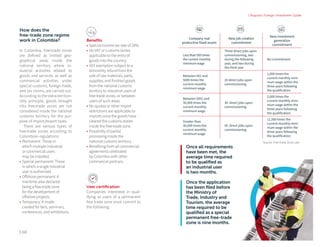
In Colombia, free-trade zones
are defined as limited geo-
graphical areas inside the
national territory where in-
dustrial activities related to
goods and services, as well as
commercial activities under
special customs, foreign trade,
and tax norms, are carried out.
According to the extra-territori-
ality principle, goods brought
into free-trade zones are not
considered inside the national
customs territory for the pur-
pose of import/export taxes.
There are various types of
free-trade zones according to
Colombian regulations:
•	Permanent: Those in
which multiple industrial
or commercial users
may be installed.
•	Special permanent: Those
in which a single industrial
user is authorized.
•	Offshore permanent: A
maritime area declared
being a free-trade zone
for the development of
offshore projects.
•	Temporary: A mode
created for fairs, seminars,
conferences, and exhibitions.
Benefits
•	Special income tax rate of 20%.
•	No VAT or customs duties
applicable to the entry of
goods into the country.
•	VAT exemption subject to a
bimonthly refund from the
sale of raw materials, parts,
supplies, and finished goods
from the national customs
territory to industrial users of
free-trade zones, or between
users of such areas.
•	No quotas or other import
restrictions are applicable to
imports once the goods have
cleared the customs duties
inside the free-trade zone.
•	Possibility of partial
processing inside the
national customs territory.
•	Benefiting from all commercial
agreements celebrated
by Colombia with other
commercial partners.
User certification
Companies interested in qual-
ifying as users of a permanent
free trade zone must commit to
the following:
Company real
productive fixed assets
New job creation
commitment
New investment
generation
commitment
Less than 500 times
the current monthly
minimum wage
Three direct jobs upon
commissioning, two
during the following
year, and two during
the third year
No commitment
Between 501 and
5000 times the
current monthly
minimum wage
20 direct jobs upon
commissioning
1,000 times the
current monthly mini-
mum wage within the
three years following
the qualification
Between 5001 and
30,000 times the
current monthly
minimum wage
30 direct jobs upon
commissioning
5,000 times the
current monthly mini-
mum wage within the
three years following
the qualification
Greater than
30,000 times the
current monthly
minimum wage
50 direct jobs upon
commissioning
11,500 times the
current monthly mini-
mum wage within the
three years following
the qualification
Once all requirements
have been met, the
average time required
to be qualified as
an industrial user
is two months.
Once the application
has been filed before
the Ministry of
Trade, Industry and
Tourism, the average
time required to be
qualified as a special
permanent free-trade
zone is nine months.
| 70 71 |
| Bogota's Foreign Investment Guide
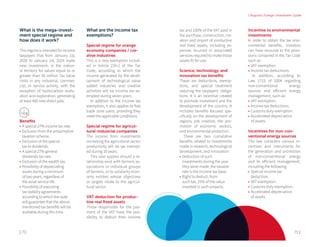
What is the mega-invest-
ment special regime and 	
how does it work?
Thisregimeisintendedforincome
taxpayers that from January 1st,
2020 to January 1st, 2024 make
new investments in the nation-
al territory for values equal to or
greater than 30 million Tax Value
Units in any industrial, commer-
cial, or service activity, with the
exception of hydrocarbon evalu-
ation and exploration, generating
at least 400 new direct jobs.
Benefits 	
•	A special 27% income tax rate.
•	Exclusion from the presumptive
taxation scheme.
•	Exclusion of the special
tax to dividends.
•	A special 27% general
dividends tax rate.
•	Exclusion of the wealth tax.
•	Possibility of depreciating
assets during a minimum
of two years, regardless of
the asset service life.
•	Possibility of executing
tax stability agreements
according to which the state
will guarantee that the above-
mentioned tax benefits will be
available during this time.
What are the income tax
exemptions?
Special regime for orange
economy companies / cre-
ative industries
This is a new exemption includ-
ed in Article 235-2 of the Tax
Code, according to which the
income generated by the devel-
opment of technological value
added industries and creative
activities will be income tax ex-
empted during seven years.
In addition to the income tax
exemption, it also applies to free
trade zone users, providing they
meet the applicable conditions.
Special regime for agricul-
tural-industrial companies
The income from investments
increasing the agricultural sector
productivity will be tax exempt-
ed during 10 years.
This also applies should a re-
lationship exist with farmers as-
sociations or individual groups
of farmers, or to solidarity econ-
omy entities whose objectives
or targets relate to the agricul-
tural sector.
VAT deduction for produc-
tive real fixed assets
Those responsible for the pay-
ment of the VAT have the pos-
sibility to deduct their income
tax and 100% of the VAT paid in
the purchase, construction, cre-
ation and import of productive
real fixed assets, including ex-
penses incurred in associated
services required to make those
assets fit for use.
Science, technology, and
innovation tax benefits
These are deductions, exemp-
tions, and special treatment
reducing the taxpayers' obliga-
tions. It is an incentive created
to promote investment and the
development of the country. It
includes benefits focused spe-
cifically on the development of
regions, job creation, the pro-
motion of economic sectors,
and environmental protection.
There are two cumulative
benefits related to investments
made in research, technological
development, and innovation:
•	Deduction of such
investments during the year
they were made, the taxable
rate is the income tax base.
•	Right to deduct, from
such tax, 25% of the value
invested in such projects.
Incentive to environmental
investments
In order to obtain the tax envi-
ronmental benefits, investors
can have recourse to the provi-
sions contained in the Tax Code
such as:
•	VAT exemption.
•	Income tax deductions.
In addition, according to
Law 1715 of 2004 regarding
non-conventional energy
sources and efficient energy
management, such as:
•	VAT exemption.
•	Income tax deductions.
•	Customs duty exemption.
•	Accelerated depreciation
of assets.
Incentives for non-con-
ventional energy sources
The law considers various in-
centives and instruments for
the generation and promotion
of non-conventional energy
and its efficient management,
including the following:
•	Special income tax
deduction.
•	VAT exemption.
•	Customs duty exemption.
•	Accelerated depreciation
of assets.
| Bogota's Foreign Investment Guide
Which are the incen-
tives for job creation?
200% income tax 		
deduction for employees
with disabilities
Title III of Law 1429 of 2010
establishes that companies
employing persons that are dis-
abled, displaced or in the pro-
cess of reintegrating into soci-
ety will be able to access family
compensation funds.
Additionally, Law 361 of 1997
contemplates a deduction on
companies' income tax equiv-
alent to 200% of the salary
and social security payments
disbursed for persons with a
degree of disability equal to a
loss of at least 25% of their work
abilities, during the period for
which they applied.
What are the incentives for
the import/export of goods
and/or services?
VAT reimbursement for service
exports
Applies to services provided in the
country and exclusively used abroad
bycompaniesorpersonswithnobusi-
nessesoractivitiesinColombia.These
services are VAT exempted and have a
bimonthlyrefundright.
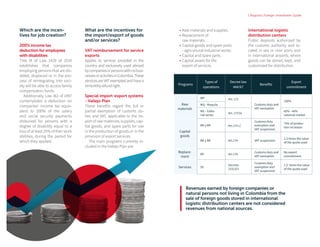
Special import-export systems
- Vallejo Plan
These benefits regard the full or
partial exemption of customs du-
ties and VAT, applicable to the im-
port of raw materials, supplies, cap-
ital goods, and spare parts for use
in the production of goods or in the
provision of export services.
The main programs currently in-
cluded in the Vallejo Plan are:
•	Raw materials and supplies.
•	Replacement of
raw materials.
•	Capital goods and spare parts
- agricultural-industrial sector.
•	Capital and spare parts.
•	Capital assets for the
export of services.
Revenues earned by foreign companies or
natural persons not living in Colombia from the
sale of foreign goods stored in international
logistic distribuition centers are not considered
revenues from national sources.
Programs
Types of
operations
Decree law
444/67
Benefits
Export
commitment
Raw
materials
MP Art. 172
Customs duty and
VAT exemption
100%
MQ - Maquila
MX – Edito-
rial sector
Art. 173 b)
60% - 40%
national market
Capital
goods
BR y RR Art.173 c)
Customs duty
exemption and
VAT suspension
70% of produc-
tion increases
BK y RR Art.174 VAT suspension
1.5 times the value
of the quota used
Replace-
ment
RP Art.179
Customs duty and
VAT exemption
No export
commitment
Services SS
Decreto
2331/01
Customs duty
exemption and
VAT suspension
1.5 times the value
of the quota used
International logistic 	
distribution centers
Public deposits authorized by
the customs authority and lo-
cated in sea or river ports and
in international airports, where
goods can be stored, kept, and
customized for distribution.
More information
on this topic

Chapter 6: How is intellectual proprty protected in Colombia

  • 1.
  • 2.
    * Source: Free-trade ZoneLaw | 68 | Bogota's Foreign Investment Guide How does the free-trade zone regime work in Colombia? In Colombia, free-trade zones are defined as limited geo- graphical areas inside the national territory where in- dustrial activities related to goods and services, as well as commercial activities under special customs, foreign trade, and tax norms, are carried out. According to the extra-territori- ality principle, goods brought into free-trade zones are not considered inside the national customs territory for the pur- pose of import/export taxes. There are various types of free-trade zones according to Colombian regulations: • Permanent: Those in which multiple industrial or commercial users may be installed. • Special permanent: Those in which a single industrial user is authorized. • Offshore permanent: A maritime area declared being a free-trade zone for the development of offshore projects. • Temporary: A mode created for fairs, seminars, conferences, and exhibitions. Benefits • Special income tax rate of 20%. • No VAT or customs duties applicable to the entry of goods into the country. • VAT exemption subject to a bimonthly refund from the sale of raw materials, parts, supplies, and finished goods from the national customs territory to industrial users of free-trade zones, or between users of such areas. • No quotas or other import restrictions are applicable to imports once the goods have cleared the customs duties inside the free-trade zone. • Possibility of partial processing inside the national customs territory. • Benefiting from all commercial agreements celebrated by Colombia with other commercial partners. User certification Companies interested in qual- ifying as users of a permanent free trade zone must commit to the following: Company real productive fixed assets New job creation commitment New investment generation commitment Less than 500 times the current monthly minimum wage Three direct jobs upon commissioning, two during the following year, and two during the third year No commitment Between 501 and 5000 times the current monthly minimum wage 20 direct jobs upon commissioning 1,000 times the current monthly mini- mum wage within the three years following the qualification Between 5001 and 30,000 times the current monthly minimum wage 30 direct jobs upon commissioning 5,000 times the current monthly mini- mum wage within the three years following the qualification Greater than 30,000 times the current monthly minimum wage 50 direct jobs upon commissioning 11,500 times the current monthly mini- mum wage within the three years following the qualification Once all requirements have been met, the average time required to be qualified as an industrial user is two months. Once the application has been filed before the Ministry of Trade, Industry and Tourism, the average time required to be qualified as a special permanent free-trade zone is nine months.
  • 3.
    | 70 71| | Bogota's Foreign Investment Guide What is the mega-invest- ment special regime and how does it work? Thisregimeisintendedforincome taxpayers that from January 1st, 2020 to January 1st, 2024 make new investments in the nation- al territory for values equal to or greater than 30 million Tax Value Units in any industrial, commer- cial, or service activity, with the exception of hydrocarbon evalu- ation and exploration, generating at least 400 new direct jobs. Benefits • A special 27% income tax rate. • Exclusion from the presumptive taxation scheme. • Exclusion of the special tax to dividends. • A special 27% general dividends tax rate. • Exclusion of the wealth tax. • Possibility of depreciating assets during a minimum of two years, regardless of the asset service life. • Possibility of executing tax stability agreements according to which the state will guarantee that the above- mentioned tax benefits will be available during this time. What are the income tax exemptions? Special regime for orange economy companies / cre- ative industries This is a new exemption includ- ed in Article 235-2 of the Tax Code, according to which the income generated by the devel- opment of technological value added industries and creative activities will be income tax ex- empted during seven years. In addition to the income tax exemption, it also applies to free trade zone users, providing they meet the applicable conditions. Special regime for agricul- tural-industrial companies The income from investments increasing the agricultural sector productivity will be tax exempt- ed during 10 years. This also applies should a re- lationship exist with farmers as- sociations or individual groups of farmers, or to solidarity econ- omy entities whose objectives or targets relate to the agricul- tural sector. VAT deduction for produc- tive real fixed assets Those responsible for the pay- ment of the VAT have the pos- sibility to deduct their income tax and 100% of the VAT paid in the purchase, construction, cre- ation and import of productive real fixed assets, including ex- penses incurred in associated services required to make those assets fit for use. Science, technology, and innovation tax benefits These are deductions, exemp- tions, and special treatment reducing the taxpayers' obliga- tions. It is an incentive created to promote investment and the development of the country. It includes benefits focused spe- cifically on the development of regions, job creation, the pro- motion of economic sectors, and environmental protection. There are two cumulative benefits related to investments made in research, technological development, and innovation: • Deduction of such investments during the year they were made, the taxable rate is the income tax base. • Right to deduct, from such tax, 25% of the value invested in such projects. Incentive to environmental investments In order to obtain the tax envi- ronmental benefits, investors can have recourse to the provi- sions contained in the Tax Code such as: • VAT exemption. • Income tax deductions. In addition, according to Law 1715 of 2004 regarding non-conventional energy sources and efficient energy management, such as: • VAT exemption. • Income tax deductions. • Customs duty exemption. • Accelerated depreciation of assets. Incentives for non-con- ventional energy sources The law considers various in- centives and instruments for the generation and promotion of non-conventional energy and its efficient management, including the following: • Special income tax deduction. • VAT exemption. • Customs duty exemption. • Accelerated depreciation of assets.
  • 4.
    | Bogota's ForeignInvestment Guide Which are the incen- tives for job creation? 200% income tax deduction for employees with disabilities Title III of Law 1429 of 2010 establishes that companies employing persons that are dis- abled, displaced or in the pro- cess of reintegrating into soci- ety will be able to access family compensation funds. Additionally, Law 361 of 1997 contemplates a deduction on companies' income tax equiv- alent to 200% of the salary and social security payments disbursed for persons with a degree of disability equal to a loss of at least 25% of their work abilities, during the period for which they applied. What are the incentives for the import/export of goods and/or services? VAT reimbursement for service exports Applies to services provided in the country and exclusively used abroad bycompaniesorpersonswithnobusi- nessesoractivitiesinColombia.These services are VAT exempted and have a bimonthlyrefundright. Special import-export systems - Vallejo Plan These benefits regard the full or partial exemption of customs du- ties and VAT, applicable to the im- port of raw materials, supplies, cap- ital goods, and spare parts for use in the production of goods or in the provision of export services. The main programs currently in- cluded in the Vallejo Plan are: • Raw materials and supplies. • Replacement of raw materials. • Capital goods and spare parts - agricultural-industrial sector. • Capital and spare parts. • Capital assets for the export of services. Revenues earned by foreign companies or natural persons not living in Colombia from the sale of foreign goods stored in international logistic distribuition centers are not considered revenues from national sources. Programs Types of operations Decree law 444/67 Benefits Export commitment Raw materials MP Art. 172 Customs duty and VAT exemption 100% MQ - Maquila MX – Edito- rial sector Art. 173 b) 60% - 40% national market Capital goods BR y RR Art.173 c) Customs duty exemption and VAT suspension 70% of produc- tion increases BK y RR Art.174 VAT suspension 1.5 times the value of the quota used Replace- ment RP Art.179 Customs duty and VAT exemption No export commitment Services SS Decreto 2331/01 Customs duty exemption and VAT suspension 1.5 times the value of the quota used International logistic distribution centers Public deposits authorized by the customs authority and lo- cated in sea or river ports and in international airports, where goods can be stored, kept, and customized for distribution.
  • 5.