Chapter 5 Part 1 p 97-112Designs for Problem Solving
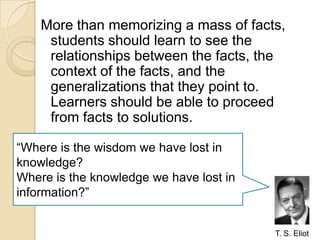
More than memorizing a mass of facts, students should learn to see the relationships between the facts, the context of the facts, and the generalizations that they point to. Learners should be able to proceed from facts to solutions.“Where is the wisdom we have lost in knowledge?Where is the knowledge we have lost in information?”T. S. Eliot
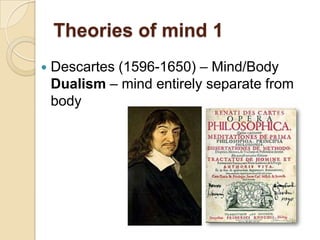
Theories of mind 1Descartes (1596-1650) – Mind/Body Dualism – mind entirely separate from body
Theories of mind 2Watson (1878-1958) and others – Behaviorism – the infamous “black box” White RatB. F. SkinnerJohn B. Watson
Theories of mind 3Modern theory – Cognitive Science – integrates concepts from psychology, biology, anthropology, computerscience, linguistics, etc.A Multifaceted Model
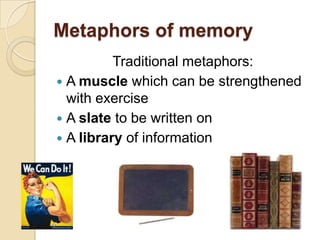
Metaphors of memoryTraditional metaphors:A muscle which can be strengthened with exerciseA slate to be written onA library of information
Metaphors of memory part II:More recently:Memory as a pattern of concepts in a network.Not just facts, but the network of relationships between them which are activated when part of the network is accessed. This model is partly derived from computing.
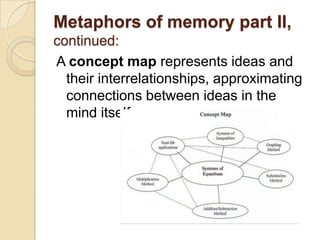
Metaphors of memory part II, continued:A concept map represents ideas and their interrelationships, approximating connections between ideas in the mind itself.
Extending informationGeneralizing via induction –  discovering new knowledge by relating it to the patterns of preexisting knowledge.All A observed are B.This is A.It is probably B.Not 100 percent certain.
HypermediaNorton & Wiburg posit that hypermedia is analogous to inductive thinking.Non-linear.Many seemingly unrelated concepts.
Rearranging InformationDeduction – cracking the implications out of existing knowledge.  What we usually think of when we say ‘logic’:If A, then BATherefore BConclusions are certain but do not produce new knowledge.
Rearranging InformationcontinuedSpreadsheets (such as Excel) can be used educationally to teach logical manipulation of data.
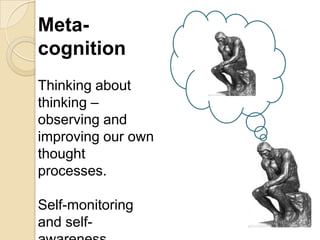
Meta-cognitionThinking about thinking – observing and improving our own thought processes.Self-monitoring and self-awareness.

Chapter 5 97 112-4

  • 1.
    Chapter 5 Part1 p 97-112Designs for Problem Solving
  • 2.
    More than memorizinga mass of facts, students should learn to see the relationships between the facts, the context of the facts, and the generalizations that they point to. Learners should be able to proceed from facts to solutions.“Where is the wisdom we have lost in knowledge?Where is the knowledge we have lost in information?”T. S. Eliot
  • 3.
    Theories of mind1Descartes (1596-1650) – Mind/Body Dualism – mind entirely separate from body
  • 4.
    Theories of mind2Watson (1878-1958) and others – Behaviorism – the infamous “black box” White RatB. F. SkinnerJohn B. Watson
  • 5.
    Theories of mind3Modern theory – Cognitive Science – integrates concepts from psychology, biology, anthropology, computerscience, linguistics, etc.A Multifaceted Model
  • 6.
    Metaphors of memoryTraditionalmetaphors:A muscle which can be strengthened with exerciseA slate to be written onA library of information
  • 7.
    Metaphors of memorypart II:More recently:Memory as a pattern of concepts in a network.Not just facts, but the network of relationships between them which are activated when part of the network is accessed. This model is partly derived from computing.
  • 8.
    Metaphors of memorypart II, continued:A concept map represents ideas and their interrelationships, approximating connections between ideas in the mind itself.
  • 9.
    Extending informationGeneralizing viainduction – discovering new knowledge by relating it to the patterns of preexisting knowledge.All A observed are B.This is A.It is probably B.Not 100 percent certain.
  • 10.
    HypermediaNorton & Wiburgposit that hypermedia is analogous to inductive thinking.Non-linear.Many seemingly unrelated concepts.
  • 11.
    Rearranging InformationDeduction –cracking the implications out of existing knowledge. What we usually think of when we say ‘logic’:If A, then BATherefore BConclusions are certain but do not produce new knowledge.
  • 12.
    Rearranging InformationcontinuedSpreadsheets (suchas Excel) can be used educationally to teach logical manipulation of data.
  • 13.
    Meta-cognitionThinking about thinking– observing and improving our own thought processes.Self-monitoring and self-awareness.