CHAPTER 5
SCHILLING 2017
Timing of Entry
By LINDA MAYA SARI HARAHAP
Timing of Entry
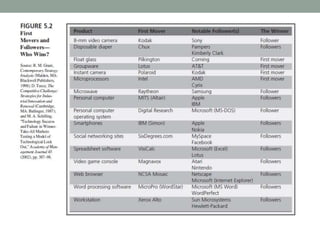
Entrants are often divided into three categories:
• first movers (or pioneers), which are the first to sell in a
new product or service category;
• early followers (also called early leaders), which are
early to the market but not first; and
• late entrants, which enter the market when or after the
product begins to penetrate the mass market.
FIRST-MOVER ADVANTAGES
• Brand Loyalty and Technological Leadership
The company that introduces a new technology may
earn a long-lasting reputation as a leader in that technology
domain. Such a reputation can help sustain the company’s
image, brand loyalty, and market share even after
competitors have introduced comparable products.
FIRST-MOVER ADVANTAGES
• Preemption of Scarce Assets
Firms that enter the market early can preemptively
capture scarce resources such as key locations,
government permits, patents, access to distribution
channels, and relationships with suppliers.
FIRST-MOVER ADVANTAGES
• Exploiting Buyer Switching Costs
Once buyers have adopted a good, they often face
costs to switch to another good. For example, the initial
cost of the good is itself a switching cost, as is the cost of
complements purchased for the good. Additionally, if a
product is complex, buyers must spend time becoming
familiar with its operation; this time investment becomes a
switching cost that deters the buyer from switching to a
different product
FIRST-MOVER ADVANTAGES
• Reaping Increasing Returns Advantages
In an industry with pressures encouraging adoption
of a dominant design, the timing of a firm’s investment in
new technology development may be particularly critical to
its likelihood of success
FIRST-MOVER DISADVANTAGES
• Research and Development Expenses
Developing a new technology often entails
significant research and development expenses, and the
first to develop and introduce a technology typically bears
the brunt of this expense. By the time a firm has
successfully developed a new technology, it may have
borne not only the expense of that technology but also the
expense of exploring technological paths that did not yield
a commercially viable product
FIRST-MOVER DISADVANTAGES
• Undeveloped Supply and Distribution Channels
When a firm introduces a new-to-the-world
technology, often no appropriate suppliers or distributors
exist. The firm may face the daunting task of developing
and producing its own supplies and distribution service, or
assisting in the development of supplier and developer
markets
FIRST-MOVER DISADVANTAGES
Immature Enabling Technologies and Complements
When firms develop technologies, they often rely on
other producers of enabling technologies. For instance,
the opening vignette demonstrated that even though
producers of personal digital assistants (PDAs) had created
palm-size devices with significant computing power, the
potential of these devices would be delivered only if battery
and modem technologies were further developed.
FIRST-MOVER DISADVANTAGES
Uncertainty of Customer Requirements
A first mover to the market may face considerable
uncertainty about what produc features customers will
ultimately desire and how much they will be willing to pay
for them. For a very new product technology, market
research may be of little help.
FACTORS INFLUENCING OPTIMAL
TIMING OF ENTRY
1. How certain are customer preferences?
2. How much improvement does the innovation provide
over previous solutions?
3. Does the innovation require enabling technologies, and
are these technologies sufficiently mature?
FACTORS INFLUENCING OPTIMAL
TIMING OF ENTRY
4. Do complementary goods influence the value of the
innovation, and are they sufficiently available?
5. How high is the threat of competitive entry?
6. Is the industry likely to experience increasing returns to
adoption?
FACTORS INFLUENCING OPTIMAL
TIMING OF ENTRY
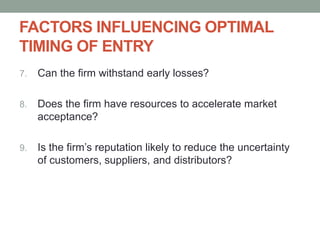
7. Can the firm withstand early losses?
8. Does the firm have resources to accelerate market
acceptance?
9. Is the firm’s reputation likely to reduce the uncertainty
of customers, suppliers, and distributors?
STRATEGIES TO IMPROVE TIMING
OPTIONS
As should now be clear, managing the
timing of entry into the market is a complex
matter. If the technology has a clear advantage to
consumers, entering the market early may give
the entrant a path-dependent advantage that is
nearly impossible for competitors to overcome. If,
on the other hand, a firm enters a market very
early and the advantages of the technology are
not very clear to consumers, there is a strong
possibility that the technology will receive a tepid
welcome
STRATEGIES TO IMPROVE TIMING
OPTIONS
Confounding this risk is the fact that watchful
competitors may be able to use the firm’s failure to
their advantage, refining the technology the firm
has introduced to the market and making any
corrections necessary to improve the technology’s
market acceptance. The later entrant may be able
to enter at a lower cost because it can capitalize
on the research and development of the early firm,
and use knowledge of the market gained from
observing the early entrant’s experience.

Chapter 5

  • 1.
    CHAPTER 5 SCHILLING 2017 Timingof Entry By LINDA MAYA SARI HARAHAP
  • 2.
    Timing of Entry Entrantsare often divided into three categories: • first movers (or pioneers), which are the first to sell in a new product or service category; • early followers (also called early leaders), which are early to the market but not first; and • late entrants, which enter the market when or after the product begins to penetrate the mass market.
  • 3.
    FIRST-MOVER ADVANTAGES • BrandLoyalty and Technological Leadership The company that introduces a new technology may earn a long-lasting reputation as a leader in that technology domain. Such a reputation can help sustain the company’s image, brand loyalty, and market share even after competitors have introduced comparable products.
  • 4.
    FIRST-MOVER ADVANTAGES • Preemptionof Scarce Assets Firms that enter the market early can preemptively capture scarce resources such as key locations, government permits, patents, access to distribution channels, and relationships with suppliers.
  • 5.
    FIRST-MOVER ADVANTAGES • ExploitingBuyer Switching Costs Once buyers have adopted a good, they often face costs to switch to another good. For example, the initial cost of the good is itself a switching cost, as is the cost of complements purchased for the good. Additionally, if a product is complex, buyers must spend time becoming familiar with its operation; this time investment becomes a switching cost that deters the buyer from switching to a different product
  • 6.
    FIRST-MOVER ADVANTAGES • ReapingIncreasing Returns Advantages In an industry with pressures encouraging adoption of a dominant design, the timing of a firm’s investment in new technology development may be particularly critical to its likelihood of success
  • 7.
    FIRST-MOVER DISADVANTAGES • Researchand Development Expenses Developing a new technology often entails significant research and development expenses, and the first to develop and introduce a technology typically bears the brunt of this expense. By the time a firm has successfully developed a new technology, it may have borne not only the expense of that technology but also the expense of exploring technological paths that did not yield a commercially viable product
  • 8.
    FIRST-MOVER DISADVANTAGES • UndevelopedSupply and Distribution Channels When a firm introduces a new-to-the-world technology, often no appropriate suppliers or distributors exist. The firm may face the daunting task of developing and producing its own supplies and distribution service, or assisting in the development of supplier and developer markets
  • 9.
    FIRST-MOVER DISADVANTAGES Immature EnablingTechnologies and Complements When firms develop technologies, they often rely on other producers of enabling technologies. For instance, the opening vignette demonstrated that even though producers of personal digital assistants (PDAs) had created palm-size devices with significant computing power, the potential of these devices would be delivered only if battery and modem technologies were further developed.
  • 10.
    FIRST-MOVER DISADVANTAGES Uncertainty ofCustomer Requirements A first mover to the market may face considerable uncertainty about what produc features customers will ultimately desire and how much they will be willing to pay for them. For a very new product technology, market research may be of little help.
  • 12.
    FACTORS INFLUENCING OPTIMAL TIMINGOF ENTRY 1. How certain are customer preferences? 2. How much improvement does the innovation provide over previous solutions? 3. Does the innovation require enabling technologies, and are these technologies sufficiently mature?
  • 13.
    FACTORS INFLUENCING OPTIMAL TIMINGOF ENTRY 4. Do complementary goods influence the value of the innovation, and are they sufficiently available? 5. How high is the threat of competitive entry? 6. Is the industry likely to experience increasing returns to adoption?
  • 14.
    FACTORS INFLUENCING OPTIMAL TIMINGOF ENTRY 7. Can the firm withstand early losses? 8. Does the firm have resources to accelerate market acceptance? 9. Is the firm’s reputation likely to reduce the uncertainty of customers, suppliers, and distributors?
  • 15.
    STRATEGIES TO IMPROVETIMING OPTIONS As should now be clear, managing the timing of entry into the market is a complex matter. If the technology has a clear advantage to consumers, entering the market early may give the entrant a path-dependent advantage that is nearly impossible for competitors to overcome. If, on the other hand, a firm enters a market very early and the advantages of the technology are not very clear to consumers, there is a strong possibility that the technology will receive a tepid welcome
  • 16.
    STRATEGIES TO IMPROVETIMING OPTIONS Confounding this risk is the fact that watchful competitors may be able to use the firm’s failure to their advantage, refining the technology the firm has introduced to the market and making any corrections necessary to improve the technology’s market acceptance. The later entrant may be able to enter at a lower cost because it can capitalize on the research and development of the early firm, and use knowledge of the market gained from observing the early entrant’s experience.