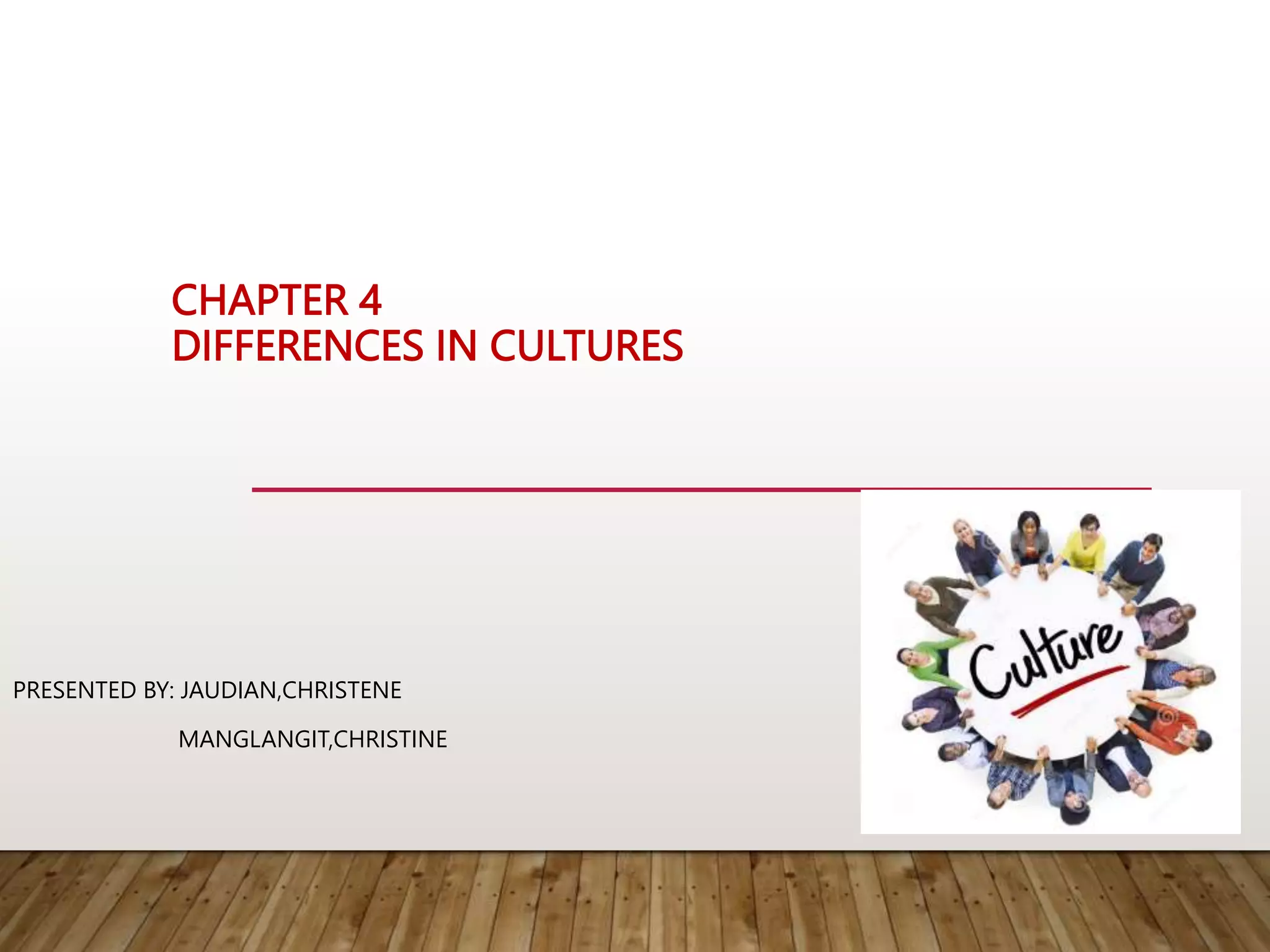
CHAPTER 4
DIFFERENCES IN CULTURES
PRESENTED BY: JAUDIAN,CHRISTENE
MANGLANGIT,CHRISTINE
INTRODUCTION
What is Cross-cultural Literacy?
●Cross-Cultural Literacy–is an understanding of how cultural differences across and w/in
nations can affect the way in which business is practiced.
Example: Case- McDonald’s found that to succeed in India,they have to play by the Indian Rules.
●A relationship may exist between culture and the cost doing in business in a country or
region.
WHAT IS CULTURE?
■"A system of values and norms that are shared among of a group
of people that when taken together constitute a design for."-
Hofstede,Normenwith,and Weber
■Values: abstract ideas/assumptions about what a group believes to be
good,right and desirable.
■Norms: social rules and guidelines that prescribed appropriate behavior
in particular situation.
DIFFERENT TYPES OF NORMS
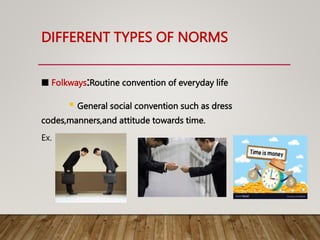
■ Folkways:Routine convention of everyday life
▪︎General social convention such as dress
codes,manners,and attitude towards time.
Ex.
DIFFERENT TYPES OF NORMS
• Mores: a social rules and guidelines that prescribed
appropriate behavior in particular situation.
■Violation can bring serious retribution ,negative
Mores are "taboos".
.e.g. Theft ,adultery, incest and cannibalism
Ex..Drinking alcohol in America
SOCIETY
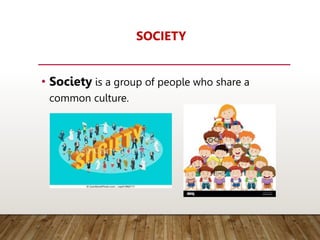
• Society is a group of people who share a
common culture.
HOW ARE CULTURE, SOCIETY AND NATION
STATE RELATED
● The relationship between society and nation
state is not strictly one-to-one
● Nation state are political creation
○ can contain one or more culture
● A culture can embrace several nations
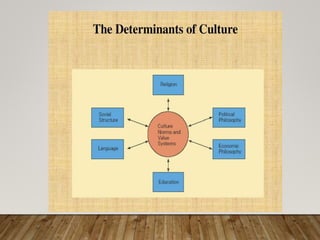
SOCIAL STRUCTURE
• Refers to a society’s basic social organization
■Two dimensions
● The degree to which society is group or individually
oriented
●The degree to which a society stratified into castes or
classes
INDIVIDUAL AND GROUP
• Group is an association of two or more people
who have shared sense of identity and who
interact w/each other in structured way on the
basis of common set of expectations about each
other.
• Groups are common in many Asian societies.
HOW ARE INDIVIDUALS AND GROUP
DIFFERENT?
■ In Western societies,there is a focus on the individual
■individual achievement is common
■ dynamism of the U.S economy
■high level of entrepreneurship
■But ,creates a lack of company loyalty and failure to gain
company specific knowledge.
HOW ARE INDIVIDUAL AND GROUP
DIFFERENT?
• In many Asian societies, the group is primary unit of
social organization
◇discourages job switching between firms
◇encourage lifetime employment system
◇leads to cooperation in solving business problems
●But,might also suppress individual creativity and
initiative
SOCIAL STRATIFICATION?
• Social Stratification means the stratification of society or hierarchical
basis into social categories or social Strata.
• To stratified society we must consider:
》Social Mobility- the extent to which individuals can move out if the
Strata into which they are born.
CASTE AND CLASS SYSTEM
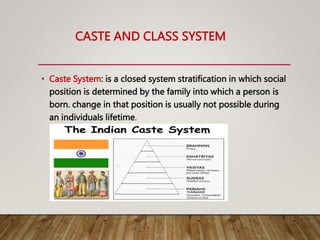
• Caste System: is a closed system stratification in which social
position is determined by the family into which a person is
born. change in that position is usually not possible during
an individuals lifetime.
CASTE AND CLASS SYSTEM
• Class System : This is less rigid of social
stratification in which open stratification that
position a person by birth can be change through
his or her own achievements and/or luck.
SIGNIFICANCE OF STRATIFICATION
● Class consciousness- refers to a condition where
people tend to perceive themselves in terms of
class background and this shapes their relationship
w/in members of other classes.
●If social mobility is high,then people are less class
conscious.
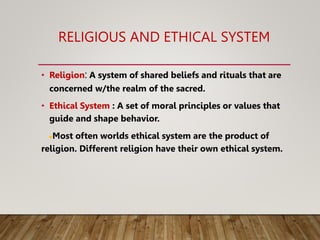
RELIGIOUS AND ETHICAL SYSTEM
• Religion: A system of shared beliefs and rituals that are
concerned w/the realm of the sacred.
• Ethical System : A set of moral principles or values that
guide and shape behavior.
●Most often worlds ethical system are the product of
religion. Different religion have their own ethical system.
chapter 4.pptx
chapter 4.pptx
chapter 4.pptx

chapter 4.pptx

  • 1.
    CHAPTER 4 DIFFERENCES INCULTURES PRESENTED BY: JAUDIAN,CHRISTENE MANGLANGIT,CHRISTINE
  • 2.
    INTRODUCTION What is Cross-culturalLiteracy? ●Cross-Cultural Literacy–is an understanding of how cultural differences across and w/in nations can affect the way in which business is practiced. Example: Case- McDonald’s found that to succeed in India,they have to play by the Indian Rules. ●A relationship may exist between culture and the cost doing in business in a country or region.
  • 3.
    WHAT IS CULTURE? ■"Asystem of values and norms that are shared among of a group of people that when taken together constitute a design for."- Hofstede,Normenwith,and Weber ■Values: abstract ideas/assumptions about what a group believes to be good,right and desirable. ■Norms: social rules and guidelines that prescribed appropriate behavior in particular situation.
  • 4.
    DIFFERENT TYPES OFNORMS ■ Folkways:Routine convention of everyday life ▪︎General social convention such as dress codes,manners,and attitude towards time. Ex.
  • 5.
    DIFFERENT TYPES OFNORMS • Mores: a social rules and guidelines that prescribed appropriate behavior in particular situation. ■Violation can bring serious retribution ,negative Mores are "taboos". .e.g. Theft ,adultery, incest and cannibalism Ex..Drinking alcohol in America
  • 6.
    SOCIETY • Society isa group of people who share a common culture.
  • 7.
    HOW ARE CULTURE,SOCIETY AND NATION STATE RELATED ● The relationship between society and nation state is not strictly one-to-one ● Nation state are political creation ○ can contain one or more culture ● A culture can embrace several nations
  • 9.
    SOCIAL STRUCTURE • Refersto a society’s basic social organization ■Two dimensions ● The degree to which society is group or individually oriented ●The degree to which a society stratified into castes or classes
  • 10.
    INDIVIDUAL AND GROUP •Group is an association of two or more people who have shared sense of identity and who interact w/each other in structured way on the basis of common set of expectations about each other. • Groups are common in many Asian societies.
  • 11.
    HOW ARE INDIVIDUALSAND GROUP DIFFERENT? ■ In Western societies,there is a focus on the individual ■individual achievement is common ■ dynamism of the U.S economy ■high level of entrepreneurship ■But ,creates a lack of company loyalty and failure to gain company specific knowledge.
  • 12.
    HOW ARE INDIVIDUALAND GROUP DIFFERENT? • In many Asian societies, the group is primary unit of social organization ◇discourages job switching between firms ◇encourage lifetime employment system ◇leads to cooperation in solving business problems ●But,might also suppress individual creativity and initiative
  • 13.
    SOCIAL STRATIFICATION? • SocialStratification means the stratification of society or hierarchical basis into social categories or social Strata. • To stratified society we must consider: 》Social Mobility- the extent to which individuals can move out if the Strata into which they are born.
  • 14.
    CASTE AND CLASSSYSTEM • Caste System: is a closed system stratification in which social position is determined by the family into which a person is born. change in that position is usually not possible during an individuals lifetime.
  • 15.
    CASTE AND CLASSSYSTEM • Class System : This is less rigid of social stratification in which open stratification that position a person by birth can be change through his or her own achievements and/or luck.
  • 16.
    SIGNIFICANCE OF STRATIFICATION ●Class consciousness- refers to a condition where people tend to perceive themselves in terms of class background and this shapes their relationship w/in members of other classes. ●If social mobility is high,then people are less class conscious.
  • 17.
    RELIGIOUS AND ETHICALSYSTEM • Religion: A system of shared beliefs and rituals that are concerned w/the realm of the sacred. • Ethical System : A set of moral principles or values that guide and shape behavior. ●Most often worlds ethical system are the product of religion. Different religion have their own ethical system.