4. Problems
Section 4.1 p.237
5 to 28; 33 to 36;
Section 4.2 p.244
1 to 5; 15 to 22;
4. Vector Spaces
LINEAR COMBINATIONS
AND
INDEPENDENCE
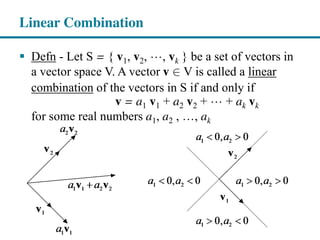
Linear Combination
Defn - Let S = { v1, v2, , vk } be a set of vectors in
a vector space V. A vector v Î∈ V is called a linear
combination of the vectors in S if and only if
v = a1 v1 + a2 v2 + + ak vk
for some real numbers a1, a2 , , ak
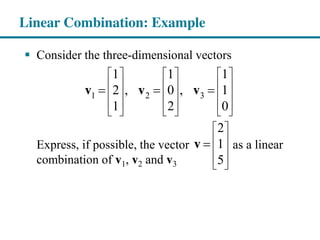
Consider the three-dimensional vectors
Express, if possible, the vector as a linear
combination of v1, v2 and v3
1 2 3
1 1 1
2 , 0 , 1
1 2 0
v v v
2
1
5
v
Linear Combination: Example
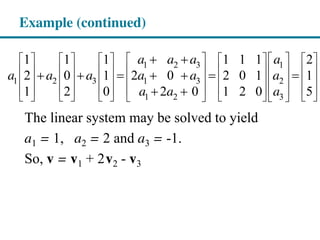
Example (continued)
The linear system may be solved to yield
a1 = 1, a2 = 2 and a3 = -1.
So, v = v1 + 2v2 - v3
1 2 3 1
1 2 3 1 3 2
1 2 3
1 1 1 1 1 1 2
2 0 1 2 0 2 0 1 1
1 2 0 2 0 1 2 0 5
a a a a
a a a a a a
a a a
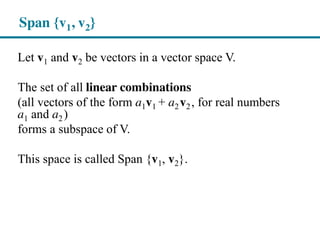
Span {v1, v2}
Let v1 and v2 be vectors in a vector space V.
The set of all linear combinations
(all vectors of the form a1v1 + a2v2, for real numbers
a1 and a2)
forms a subspace of V.
This space is called Span {v1, v2}.
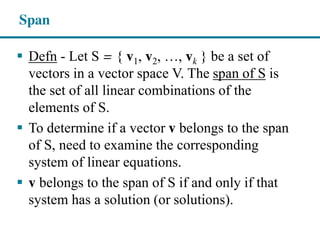
Span
Defn - Let S = { v1, v2, …,  vk } be a set of
vectors in a vector space V. The span of S is
the set of all linear combinations of the
elements of S.
To determine if a vector v belongs to the span
of S, need to examine the corresponding
system of linear equations.
v belongs to the span of S if and only if that
system has a solution (or solutions).
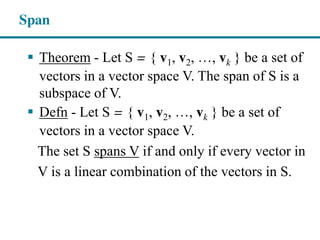
Theorem - Let S = { v1, v2, , vk } be a set of
vectors in a vector space V. The span of S is a
subspace of V.
Defn - Let S = { v1, v2, , vk } be a set of
vectors in a vector space V.
The set S spans V if and only if every vector in
V is a linear combination of the vectors in S.
Span
Are the vectors w and z in Span{v1, v2}
where
v1=[1,0,3] ; v2=[-1,1,-3] ;
and
w=[1,2,3] ; z=[2,3,4] ?
Span
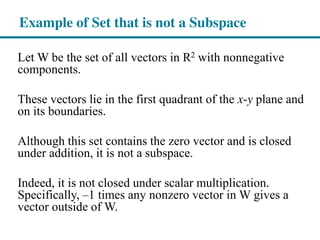
Example of Set that is not a Subspace
Let W be the set of all vectors in R2 with nonnegative
components.
These vectors lie in the first quadrant of the x-y plane and
on its boundaries.
Although this set contains the zero vector and is closed
under addition, it is not a subspace.
Indeed, it is not closed under scalar multiplication.
Specifically, –1 times any nonzero vector in W gives a
vector outside of W.
Example of Set that is not a Subspace
Set of all vectors in R3 of the form: [3t+1, t, -2t]
-- zero vector is not of that form
Set of all vectors in R2 of the form: [t, t*t]
-- sum of such two vectors does not have that form:
Try t=1 and t=2.
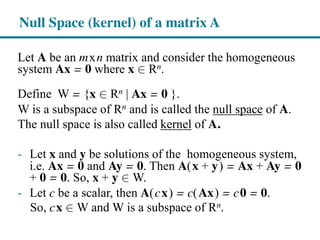
Null Space (kernel) of a matrix A
Let A be an mxn matrix and consider the homogeneous
system Ax = 0 where x Î∈ Rn.
Define W = {x Î∈ Rn | Ax = 0 }.
W is a subspace of Rn and is called the null space of A.
The null space is also called kernel of A.
- Let x and y be solutions of the homogeneous system,
i.e. Ax = 0 and Ay = 0. Then A(x + y) = Ax + Ay = 0
+ 0 = 0. So, x + y Î∈ W.
- Let c be a scalar, then A(cx) = c(Ax) = c0 = 0.
So, cx Î∈ W and W is a subspace of Rn.
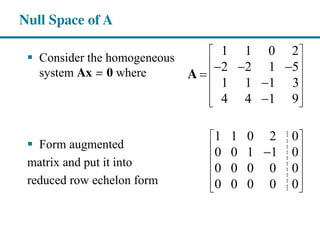
Consider the homogeneous
system Ax = 0 where
Form augmented
matrix and put it into
reduced row echelon form
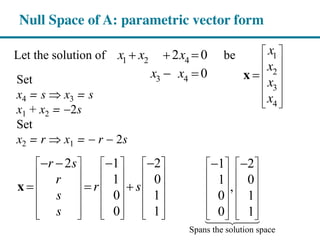
Null Space of A
1 1 0 2
2 2 1 5
1 1 1 3
4 4 1 9
A
1 1 0 2 0
0 0 1 1 0
0 0 0 0 0
0 0 0 0 0
1
2
3
4
x
x
x
x
x
Let the solution of be1 2 4
3 4
2 0
0
x x x
x xSet
x4 = s x3 = s
x1 + x2 = 2s
Set
x2 = r x1 = r 2s
2 1 2
1 0
0 1
0 1
r s
r
r s
s
s
x
Spans the solution space
1 2
1 0
,
0 1
0 1
Null Space of A: parametric vector form
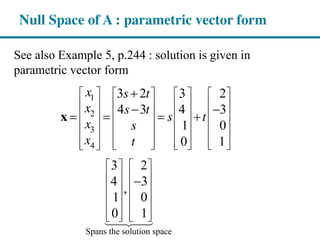
See also Example 5, p.244 : solution is given in
parametric vector form
1
2
3
4
3 2 3 2
4 3 4 3
1 0
0 1
x s t
x s t
s t
x s
x t
x
Spans the solution space
3 2
4 3
,
1 0
0 1
Null Space of A : parametric vector form
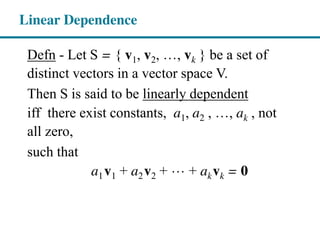
Defn - Let S = { v1, v2, , vk } be a set of
distinct vectors in a vector space V.
Then S is said to be linearly dependent
iff there exist constants, a1, a2 , , ak , not
all zero,
such that
a1v1 + a2v2 + + akvk = 0
Linear Dependence
Let S = { v1, v2, , vk } be a set of distinct
vectors in a vector space V.
Then S is said to be linearly dependent
if and only if the homogeneous system Ax = 0
has infinitely many solutions
where x Î∈ Rk and xi = ai i=1,…k
A = [ v1 v2 vk ]
vi are column vectors of A
Linear Dependence: Matrix form
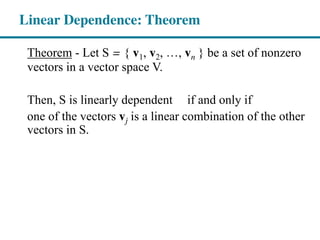
Theorem - Let S = { v1, v2, , vn } be a set of nonzero
vectors in a vector space V.
Then, S is linearly dependent if and only if
one of the vectors vj is a linear combination of the other
vectors in S.
Linear Dependence: Theorem
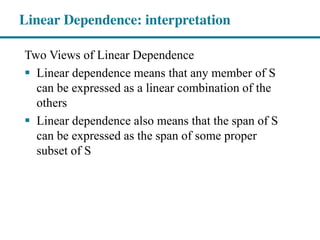
Two Views of Linear Dependence
Linear dependence means that any member of S
can be expressed as a linear combination of the
others
Linear dependence also means that the span of S
can be expressed as the span of some proper
subset of S
Linear Dependence: interpretation
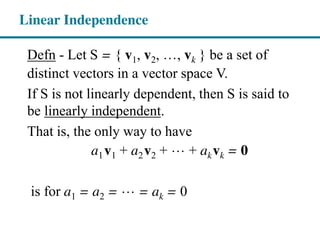
Defn - Let S = { v1, v2, , vk } be a set of
distinct vectors in a vector space V.
If S is not linearly dependent, then S is said to
be linearly independent.
That is, the only way to have
a1v1 + a2v2 + + akvk = 0
is for a1 = a2 = = ak = 0
Linear Independence
Let S = { v1, v2, , vk } be a set of distinct
vectors in a vector space V.
Then S is said to be linearly independent
if and only if the homogeneous system Ax = 0
has a unique solution x = 0
where x Î∈ Rk and xi = ai i=1,…k
A = [ v1 v2 vk ]
vi are column vectors of A
Linear Independence: Matrix form
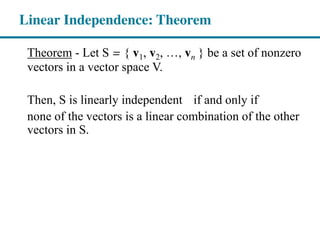
Theorem - Let S = { v1, v2, , vn } be a set of nonzero
vectors in a vector space V.
Then, S is linearly independent if and only if
none of the vectors is a linear combination of the other
vectors in S.
Linear Independence: Theorem
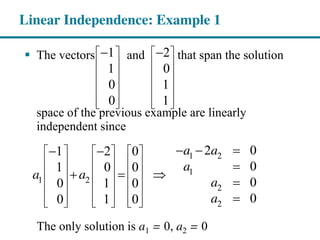
The vectors and that span the solution
space of the previous example are linearly
independent since
1 2
1 0
0 1
0 1
1 2
1
1 2
2
2
2 01 2 0
01 0 0
00 1 0
00 1 0
a a
a
a a
a
a
The only solution is a1 = 0, a2 = 0
Linear Independence: Example 1
Let V be R4 and v1 = [1, 0, 1, 2], v2 = [0, 1, 1, 2]
and v3 = [1, 1, 1, 3]. Determine if S = { v1, v2, v3 }
is linearly independent or linearly dependent
1 3
2 3
1 1 2 2 3 3
1 2 3
1 2 3
0
0
0
2 2 3 0
a a
a a
a a a
a a a
a a a
v v v 0
Subtract second equation from third and get a1 = 0.
The first equation gives a3 = 0, then the second
equation gives a2 = 0. So, the vectors are linearly
independent.
Linear Independence: Example 2
Section 4.3 p.252 : 1 to 22
Problems

Chapter 4: Vector Spaces - Part 2/Slides By Pearson

  • 1.
    4. Problems Section 4.1p.237 5 to 28; 33 to 36; Section 4.2 p.244 1 to 5; 15 to 22;
  • 2.
    4. Vector Spaces LINEARCOMBINATIONS AND INDEPENDENCE
  • 3.
    Linear Combination Defn -Let S = { v1, v2, , vk } be a set of vectors in a vector space V. A vector v Î∈ V is called a linear combination of the vectors in S if and only if v = a1 v1 + a2 v2 + + ak vk for some real numbers a1, a2 , , ak
  • 4.
    Consider the three-dimensionalvectors Express, if possible, the vector as a linear combination of v1, v2 and v3 1 2 3 1 1 1 2 , 0 , 1 1 2 0 v v v 2 1 5 v Linear Combination: Example
  • 5.
    Example (continued) The linearsystem may be solved to yield a1 = 1, a2 = 2 and a3 = -1. So, v = v1 + 2v2 - v3 1 2 3 1 1 2 3 1 3 2 1 2 3 1 1 1 1 1 1 2 2 0 1 2 0 2 0 1 1 1 2 0 2 0 1 2 0 5 a a a a a a a a a a a a a
  • 6.
    Span {v1, v2} Letv1 and v2 be vectors in a vector space V. The set of all linear combinations (all vectors of the form a1v1 + a2v2, for real numbers a1 and a2) forms a subspace of V. This space is called Span {v1, v2}.
  • 7.
    Span Defn - LetS = { v1, v2, …,  vk } be a set of vectors in a vector space V. The span of S is the set of all linear combinations of the elements of S. To determine if a vector v belongs to the span of S, need to examine the corresponding system of linear equations. v belongs to the span of S if and only if that system has a solution (or solutions).
  • 8.
    Theorem - LetS = { v1, v2, , vk } be a set of vectors in a vector space V. The span of S is a subspace of V. Defn - Let S = { v1, v2, , vk } be a set of vectors in a vector space V. The set S spans V if and only if every vector in V is a linear combination of the vectors in S. Span
  • 9.
    Are the vectorsw and z in Span{v1, v2} where v1=[1,0,3] ; v2=[-1,1,-3] ; and w=[1,2,3] ; z=[2,3,4] ? Span
  • 10.
    Example of Setthat is not a Subspace Let W be the set of all vectors in R2 with nonnegative components. These vectors lie in the first quadrant of the x-y plane and on its boundaries. Although this set contains the zero vector and is closed under addition, it is not a subspace. Indeed, it is not closed under scalar multiplication. Specifically, –1 times any nonzero vector in W gives a vector outside of W.
  • 11.
    Example of Setthat is not a Subspace Set of all vectors in R3 of the form: [3t+1, t, -2t] -- zero vector is not of that form Set of all vectors in R2 of the form: [t, t*t] -- sum of such two vectors does not have that form: Try t=1 and t=2.
  • 12.
    Null Space (kernel)of a matrix A Let A be an mxn matrix and consider the homogeneous system Ax = 0 where x Î∈ Rn. Define W = {x Î∈ Rn | Ax = 0 }. W is a subspace of Rn and is called the null space of A. The null space is also called kernel of A. - Let x and y be solutions of the homogeneous system, i.e. Ax = 0 and Ay = 0. Then A(x + y) = Ax + Ay = 0 + 0 = 0. So, x + y Î∈ W. - Let c be a scalar, then A(cx) = c(Ax) = c0 = 0. So, cx Î∈ W and W is a subspace of Rn.
  • 13.
    Consider the homogeneous systemAx = 0 where Form augmented matrix and put it into reduced row echelon form Null Space of A 1 1 0 2 2 2 1 5 1 1 1 3 4 4 1 9 A 1 1 0 2 0 0 0 1 1 0 0 0 0 0 0 0 0 0 0 0
  • 14.
    1 2 3 4 x x x x x Let the solutionof be1 2 4 3 4 2 0 0 x x x x xSet x4 = s x3 = s x1 + x2 = 2s Set x2 = r x1 = r 2s 2 1 2 1 0 0 1 0 1 r s r r s s s x Spans the solution space 1 2 1 0 , 0 1 0 1 Null Space of A: parametric vector form
  • 15.
    See also Example5, p.244 : solution is given in parametric vector form 1 2 3 4 3 2 3 2 4 3 4 3 1 0 0 1 x s t x s t s t x s x t x Spans the solution space 3 2 4 3 , 1 0 0 1 Null Space of A : parametric vector form
  • 16.
    Defn - LetS = { v1, v2, , vk } be a set of distinct vectors in a vector space V. Then S is said to be linearly dependent iff there exist constants, a1, a2 , , ak , not all zero, such that a1v1 + a2v2 + + akvk = 0 Linear Dependence
  • 17.
    Let S ={ v1, v2, , vk } be a set of distinct vectors in a vector space V. Then S is said to be linearly dependent if and only if the homogeneous system Ax = 0 has infinitely many solutions where x Î∈ Rk and xi = ai i=1,…k A = [ v1 v2 vk ] vi are column vectors of A Linear Dependence: Matrix form
  • 18.
    Theorem - LetS = { v1, v2, , vn } be a set of nonzero vectors in a vector space V. Then, S is linearly dependent if and only if one of the vectors vj is a linear combination of the other vectors in S. Linear Dependence: Theorem
  • 19.
    Two Views ofLinear Dependence Linear dependence means that any member of S can be expressed as a linear combination of the others Linear dependence also means that the span of S can be expressed as the span of some proper subset of S Linear Dependence: interpretation
  • 20.
    Defn - LetS = { v1, v2, , vk } be a set of distinct vectors in a vector space V. If S is not linearly dependent, then S is said to be linearly independent. That is, the only way to have a1v1 + a2v2 + + akvk = 0 is for a1 = a2 = = ak = 0 Linear Independence
  • 21.
    Let S ={ v1, v2, , vk } be a set of distinct vectors in a vector space V. Then S is said to be linearly independent if and only if the homogeneous system Ax = 0 has a unique solution x = 0 where x Î∈ Rk and xi = ai i=1,…k A = [ v1 v2 vk ] vi are column vectors of A Linear Independence: Matrix form
  • 22.
    Theorem - LetS = { v1, v2, , vn } be a set of nonzero vectors in a vector space V. Then, S is linearly independent if and only if none of the vectors is a linear combination of the other vectors in S. Linear Independence: Theorem
  • 23.
    The vectors andthat span the solution space of the previous example are linearly independent since 1 2 1 0 0 1 0 1 1 2 1 1 2 2 2 2 01 2 0 01 0 0 00 1 0 00 1 0 a a a a a a a The only solution is a1 = 0, a2 = 0 Linear Independence: Example 1
  • 24.
    Let V beR4 and v1 = [1, 0, 1, 2], v2 = [0, 1, 1, 2] and v3 = [1, 1, 1, 3]. Determine if S = { v1, v2, v3 } is linearly independent or linearly dependent 1 3 2 3 1 1 2 2 3 3 1 2 3 1 2 3 0 0 0 2 2 3 0 a a a a a a a a a a a a a v v v 0 Subtract second equation from third and get a1 = 0. The first equation gives a3 = 0, then the second equation gives a2 = 0. So, the vectors are linearly independent. Linear Independence: Example 2
  • 25.
    Section 4.3 p.252: 1 to 22 Problems