VECTOR SPACES
LINEAR COMBINATION
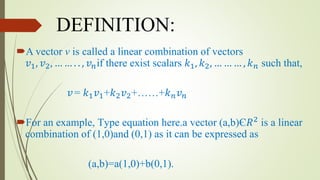
DEFINITION:
A vector v is called a linear combination of vectors
𝑣1, 𝑣2, … … . . , 𝑣 𝑛if there exist scalars 𝑘1, 𝑘2, … … … , 𝑘 𝑛 such that,
𝑣= 𝑘1 𝑣1+𝑘2 𝑣2+……+𝑘 𝑛 𝑣 𝑛
For an example, Type equation here.a vector (a,b)Є𝑅2
is a linear
combination of (1,0)and (0,1) as it can be expressed as
(a,b)=a(1,0)+b(0,1).
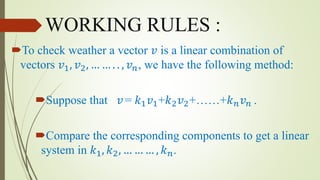
WORKING RULES :
To check weather a vector 𝑣 is a linear combination of
vectors 𝑣1, 𝑣2, … … . . , 𝑣 𝑛, we have the following method:
Suppose that 𝑣= 𝑘1 𝑣1+𝑘2 𝑣2+……+𝑘 𝑛 𝑣 𝑛 .
Compare the corresponding components to get a linear
system in 𝑘1, 𝑘2, … … … , 𝑘 𝑛.
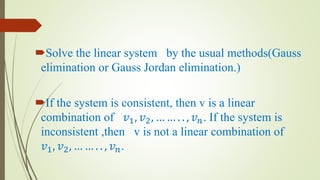
Solve the linear system by the usual methods(Gauss
elimination or Gauss Jordan elimination.)
If the system is consistent, then v is a linear
combination of 𝑣1, 𝑣2, … … . . , 𝑣 𝑛. If the system is
inconsistent ,then v is not a linear combination of
𝑣1, 𝑣2, … … . . , 𝑣 𝑛.
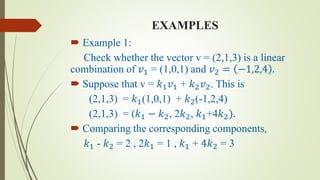
EXAMPLES
 Example 1:
Check whether the vector v = (2,1,3) is a linear
combination of 𝑣1 = (1,0,1) and 𝑣2 = −1,2,4 .
 Suppose that v = 𝑘1 𝑣1 + 𝑘2 𝑣2. This is
(2,1,3) = 𝑘1(1,0,1) + 𝑘2(-1,2,4)
(2,1,3) = (𝑘1 − 𝑘2, 2𝑘2, 𝑘1+4𝑘2).
 Comparing the corresponding components,
𝑘1 - 𝑘2 = 2 , 2𝑘1 = 1 , 𝑘1 + 4𝑘2 = 3
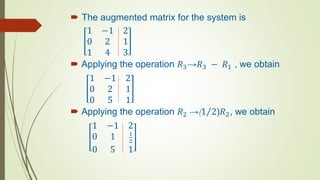
 The augmented matrix for the system is
1 −1 2
0 2 1
1 4 3
 Applying the operation 𝑅3→𝑅3 − 𝑅1 , we obtain
1 −1 2
0 2 1
0 5 1
 Applying the operation 𝑅2 →(1 2)𝑅2, we obtain
1 −1 2
0 1 1
2
0 5 1
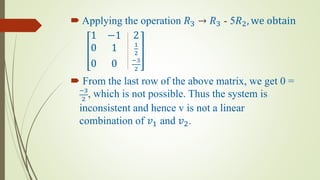
 Applying the operation 𝑅3 → 𝑅3 - 5𝑅2, we obtain
1 −1 2
0 1 1
2
0 0 −3
2
 From the last row of the above matrix, we get 0 =
−3
2
, which is not possible. Thus the system is
inconsistent and hence v is not a linear
combination of 𝑣1 and 𝑣2.
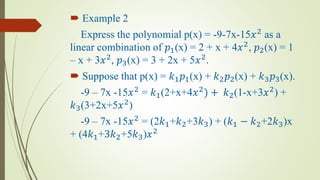
 Example 2
Express the polynomial p(x) = -9-7x-15𝑥2
as a
linear combination of 𝑝1(x) = 2 + x + 4𝑥2
, 𝑝2(x) = 1
– x + 3𝑥2
, 𝑝3(x) = 3 + 2x + 5𝑥2
.
 Suppose that p(x) = 𝑘1 𝑝1(x) + 𝑘2 𝑝2(x) + 𝑘3 𝑝3(x).
-9 – 7x -15𝑥2
= 𝑘1(2+x+4𝑥2
) + 𝑘2(1-x+3𝑥2
) +
𝑘3(3+2x+5𝑥2
)
-9 – 7x -15𝑥2
= (2𝑘1+𝑘2+3𝑘3) + (𝑘1 − 𝑘2+2𝑘3)x
+ (4𝑘1+3𝑘2+5𝑘3)𝑥2
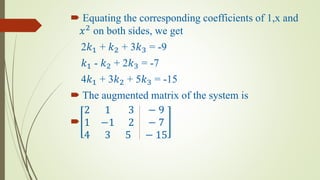
 Equating the corresponding coefficients of 1,x and
𝑥2
on both sides, we get
2𝑘1 + 𝑘2 + 3𝑘3 = -9
𝑘1 - 𝑘2 + 2𝑘3 = -7
4𝑘1 + 3𝑘2 + 5𝑘3 = -15
 The augmented matrix of the system is

2 1 3 − 9
1 −1 2 − 7
4 3 5 − 15
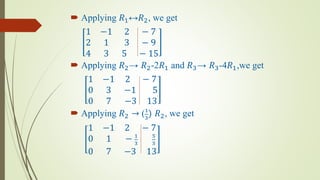
 Applying 𝑅1↔𝑅2, we get
1 −1 2 − 7
2 1 3 − 9
4 3 5 − 15
 Applying 𝑅2→ 𝑅2-2𝑅1 and 𝑅3→ 𝑅3-4𝑅1,we get
1 −1 2 − 7
0 3 −1 5
0 7 −3 13
 Applying 𝑅2 → (1
3
) 𝑅2, we get
1 −1 2 − 7
0 1 − 1
3
5
3
0 7 −3 13
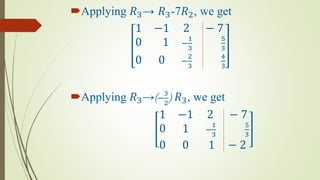
Applying 𝑅3→ 𝑅3-7𝑅2, we get
1 −1 2 − 7
0 1 −
1
3
5
3
0 0 −
2
3
4
3
Applying 𝑅3→(−
3
2
) 𝑅3, we get
1 −1 2 − 7
0 1 −
1
3
5
3
0 0 1 − 2
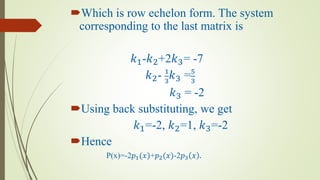
Which is row echelon form. The system
corresponding to the last matrix is
𝑘1-𝑘2+2𝑘3= -7
𝑘2- 1
3
𝑘3 =5
3
𝑘3 = -2
Using back substituting, we get
𝑘1=-2, 𝑘2=1, 𝑘3=-2
Hence
P(x)=-2𝑝1(𝑥)+𝑝2(𝑥)-2𝑝3 𝑥 .
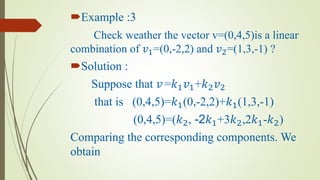
Example :3
Check weather the vector v=(0,4,5)is a linear
combination of 𝑣1=(0,-2,2) and 𝑣2=(1,3,-1) ?
Solution :
Suppose that 𝑣=𝑘1 𝑣1+𝑘2 𝑣2
that is (0,4,5)=𝑘1(0,-2,2)+𝑘1(1,3,-1)
(0,4,5)=(𝑘2, -2𝑘1+3𝑘2,2𝑘1-𝑘2)
Comparing the corresponding components. We
obtain
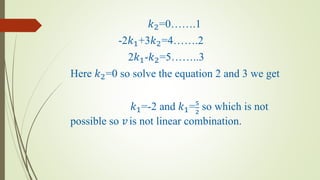
𝑘2=0…….1
-2𝑘1+3𝑘2=4…….2
2𝑘1-𝑘2=5……..3
Here 𝑘2=0 so solve the equation 2 and 3 we get
𝑘1=-2 and 𝑘1=5
2
so which is not
possible so 𝑣is not linear combination.
SPAN
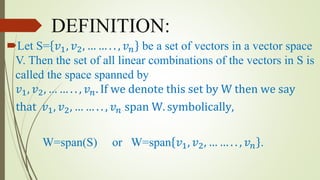
DEFINITION:
Let S= 𝑣1, 𝑣2, … … . . , 𝑣 𝑛 be a set of vectors in a vector space
V. Then the set of all linear combinations of the vectors in S is
called the space spanned by
𝑣1, 𝑣2, … … . . , 𝑣 𝑛. If we denote this set by W then we say
that 𝑣1, 𝑣2, … … . . , 𝑣 𝑛 span W. symbolically,
W=span(S) or W=span 𝑣1, 𝑣2, … … . . , 𝑣 𝑛 .
LINEAR
DEPENDENCE&INDEPENDENCE
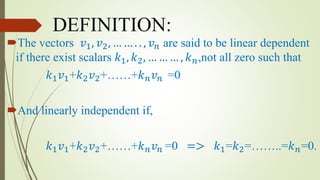
DEFINITION:
The vectors 𝑣1, 𝑣2, … … . . , 𝑣 𝑛 are said to be linear dependent
if there exist scalars 𝑘1, 𝑘2, … … … , 𝑘 𝑛,not all zero such that
𝑘1 𝑣1+𝑘2 𝑣2+……+𝑘 𝑛 𝑣 𝑛 =0
And linearly independent if,
𝑘1 𝑣1+𝑘2 𝑣2+……+𝑘 𝑛 𝑣 𝑛 =0 => 𝑘1=𝑘2=……..=𝑘 𝑛=0.
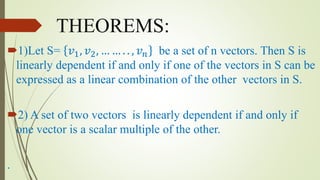
THEOREMS:
1)Let S= 𝑣1, 𝑣2, … … . . , 𝑣 𝑛 be a set of n vectors. Then S is
linearly dependent if and only if one of the vectors in S can be
expressed as a linear combination of the other vectors in S.
2) A set of two vectors is linearly dependent if and only if
one vector is a scalar multiple of the other.
.
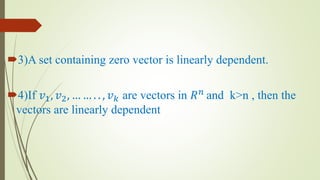
3)A set containing zero vector is linearly dependent.
4)If 𝑣1, 𝑣2, … … . . , 𝑣 𝑘 are vectors in 𝑅 𝑛
and k>n , then the
vectors are linearly dependent
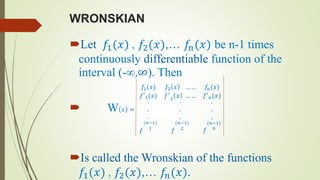
WRONSKIAN
Let 𝑓1(𝑥) , 𝑓2(𝑥),… 𝑓𝑛(𝑥) be n-1 times
continuously differentiable function of the
interval (-∞,∞). Then
 W 𝑥 =
𝑓1(𝑥) 𝑓2 𝑥 … . . 𝑓𝑛(𝑥)
𝑓′1(𝑥) 𝑓′
2
𝑥 … … 𝑓′ 𝑛(𝑥)
.
.
.
𝑓
(𝑛−1)
1
.
.
.
𝑓
(𝑛−1)
2
.
.
.
𝑓
(𝑛−1)
𝑛
Is called the Wronskian of the functions
𝑓1(𝑥) , 𝑓2(𝑥),… 𝑓𝑛(𝑥).
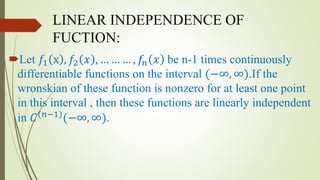
LINEAR INDEPENDENCE OF
FUCTION:
Let 𝑓1 x , 𝑓2 𝑥 , … … … , 𝑓𝑛 𝑥 be n-1 times continuously
differentiable functions on the interval (−∞, ∞).If the
wronskian of these function is nonzero for at least one point
in this interval , then these functions are linearly independent
in 𝐶(𝑛−1)
(−∞, ∞).
EXAMPLES
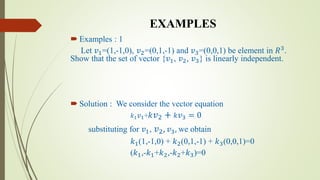
 Examples : 1
Let 𝑣1=(1,-1,0), 𝑣2=(0,1,-1) and 𝑣3=(0,0,1) be element in 𝑅3
.
Show that the set of vector {𝑣1, 𝑣2, 𝑣3} is linearly independent.
 Solution : We consider the vector equation
𝑘1 𝑣1+ 𝑘 𝑣2 + 𝑘 𝑣3 = 0
substituting for 𝑣1, 𝑣2, 𝑣3, we obtain
𝑘1(1,-1,0) + 𝑘2(0,1,-1) + 𝑘3(0,0,1)=0
(𝑘1,-𝑘1+𝑘2,-𝑘2+𝑘3)=0
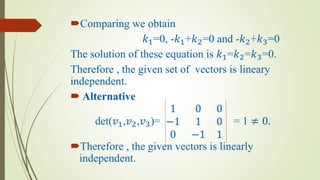
Comparing we obtain
𝑘1=0, -𝑘1+𝑘2=0 and -𝑘2+𝑘3=0
The solution of these equation is 𝑘1=𝑘2=𝑘3=0.
Therefore , the given set of vectors is lineary
independent.
 Alternative
det(𝑣1,𝑣2,𝑣3)=
1 0 0
−1 1 0
0 −1 1
= 1 ≠ 0.
Therefore , the given vectors is linearly
independent.
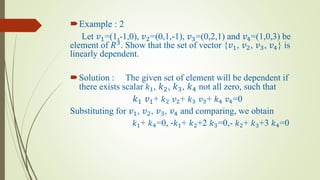
Example : 2
Let 𝑣1=(1,-1,0), 𝑣2=(0,1,-1), 𝑣3=(0,2,1) and 𝑣4=(1,0,3) be
element of 𝑅3. Show that the set of vector {𝑣1, 𝑣2, 𝑣3, 𝑣4} is
linearly dependent.
Solution : The given set of element will be dependent if
there exists scalar 𝑘1, 𝑘2, 𝑘3, 𝑘4 not all zero, such that
𝑘1 𝑣1+ 𝑘2 𝑣2+ 𝑘3 𝑣3+ 𝑘4 𝑣4=0
Substituting for 𝑣1, 𝑣2, 𝑣3, 𝑣4 and comparing, we obtain
𝑘1+ 𝑘4=0, -𝑘1+ 𝑘2+2 𝑘3=0,- 𝑘2+ 𝑘3+3 𝑘4=0
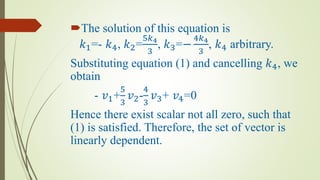
The solution of this equation is
𝑘1=- 𝑘4, 𝑘2=
5𝑘4
3
, 𝑘3=−
4𝑘4
3
, 𝑘4 arbitrary.
Substituting equation (1) and cancelling 𝑘4, we
obtain
- 𝑣1+
5
3
𝑣2-
4
3
𝑣3+ 𝑣4=0
Hence there exist scalar not all zero, such that
(1) is satisfied. Therefore, the set of vector is
linearly dependent.
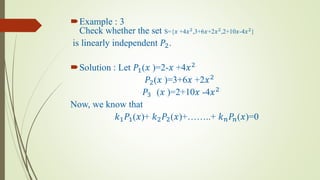
Example : 3
Check whether the set S={𝑥 +4𝑥2
,3+6𝑥+2𝑥2
,2+10𝑥-4𝑥2
}
is linearly independent 𝑃2.
Solution : Let 𝑃1(𝑥 )=2-𝑥 +4𝑥2
𝑃2(𝑥 )=3+6𝑥 +2𝑥2
𝑃3 (𝑥 )=2+10𝑥 -4𝑥2
Now, we know that
𝑘1 𝑃1(𝑥)+ 𝑘2 𝑃2(𝑥)+……..+ 𝑘 𝑛 𝑃𝑛(𝑥)=0
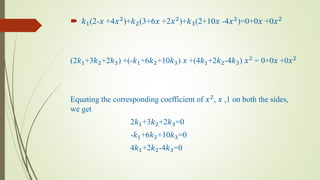
 𝑘1(2-𝑥 +4𝑥2
)+𝑘2(3+6𝑥 +2𝑥2
)+𝑘3(2+10𝑥 -4𝑥2
)=0+0𝑥 +0𝑥2
(2𝑘1+3𝑘2+2𝑘3) +(-𝑘1+6𝑘2+10𝑘3) 𝑥 +(4𝑘1+2𝑘2-4𝑘3) 𝑥2 = 0+0𝑥 +0𝑥2
Equating the corresponding coefficient of 𝑥2, 𝑥 ,1 on both the sides,
we get
2𝑘1+3𝑘2+2𝑘3=0
-𝑘1+6𝑘2+10𝑘3=0
4𝑘1+2𝑘2-4𝑘3=0
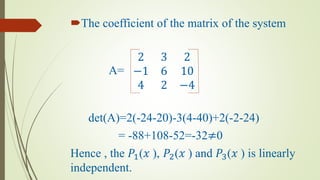
The coefficient of the matrix of the system
A=
2 3 2
−1 6 10
4 2 −4
det(A)=2(-24-20)-3(4-40)+2(-2-24)
= -88+108-52=-32≠0
Hence , the 𝑃1(𝑥 ), 𝑃2(𝑥 ) and 𝑃3(𝑥 ) is linearly
independent.

Calculas

  • 1.
  • 2.
  • 3.
    DEFINITION: A vector vis called a linear combination of vectors 𝑣1, 𝑣2, … … . . , 𝑣 𝑛if there exist scalars 𝑘1, 𝑘2, … … … , 𝑘 𝑛 such that, 𝑣= 𝑘1 𝑣1+𝑘2 𝑣2+……+𝑘 𝑛 𝑣 𝑛 For an example, Type equation here.a vector (a,b)Є𝑅2 is a linear combination of (1,0)and (0,1) as it can be expressed as (a,b)=a(1,0)+b(0,1).
  • 4.
    WORKING RULES : Tocheck weather a vector 𝑣 is a linear combination of vectors 𝑣1, 𝑣2, … … . . , 𝑣 𝑛, we have the following method: Suppose that 𝑣= 𝑘1 𝑣1+𝑘2 𝑣2+……+𝑘 𝑛 𝑣 𝑛 . Compare the corresponding components to get a linear system in 𝑘1, 𝑘2, … … … , 𝑘 𝑛.
  • 5.
    Solve the linearsystem by the usual methods(Gauss elimination or Gauss Jordan elimination.) If the system is consistent, then v is a linear combination of 𝑣1, 𝑣2, … … . . , 𝑣 𝑛. If the system is inconsistent ,then v is not a linear combination of 𝑣1, 𝑣2, … … . . , 𝑣 𝑛.
  • 6.
    EXAMPLES  Example 1: Checkwhether the vector v = (2,1,3) is a linear combination of 𝑣1 = (1,0,1) and 𝑣2 = −1,2,4 .  Suppose that v = 𝑘1 𝑣1 + 𝑘2 𝑣2. This is (2,1,3) = 𝑘1(1,0,1) + 𝑘2(-1,2,4) (2,1,3) = (𝑘1 − 𝑘2, 2𝑘2, 𝑘1+4𝑘2).  Comparing the corresponding components, 𝑘1 - 𝑘2 = 2 , 2𝑘1 = 1 , 𝑘1 + 4𝑘2 = 3
  • 7.
     The augmentedmatrix for the system is 1 −1 2 0 2 1 1 4 3  Applying the operation 𝑅3→𝑅3 − 𝑅1 , we obtain 1 −1 2 0 2 1 0 5 1  Applying the operation 𝑅2 →(1 2)𝑅2, we obtain 1 −1 2 0 1 1 2 0 5 1
  • 8.
     Applying theoperation 𝑅3 → 𝑅3 - 5𝑅2, we obtain 1 −1 2 0 1 1 2 0 0 −3 2  From the last row of the above matrix, we get 0 = −3 2 , which is not possible. Thus the system is inconsistent and hence v is not a linear combination of 𝑣1 and 𝑣2.
  • 9.
     Example 2 Expressthe polynomial p(x) = -9-7x-15𝑥2 as a linear combination of 𝑝1(x) = 2 + x + 4𝑥2 , 𝑝2(x) = 1 – x + 3𝑥2 , 𝑝3(x) = 3 + 2x + 5𝑥2 .  Suppose that p(x) = 𝑘1 𝑝1(x) + 𝑘2 𝑝2(x) + 𝑘3 𝑝3(x). -9 – 7x -15𝑥2 = 𝑘1(2+x+4𝑥2 ) + 𝑘2(1-x+3𝑥2 ) + 𝑘3(3+2x+5𝑥2 ) -9 – 7x -15𝑥2 = (2𝑘1+𝑘2+3𝑘3) + (𝑘1 − 𝑘2+2𝑘3)x + (4𝑘1+3𝑘2+5𝑘3)𝑥2
  • 10.
     Equating thecorresponding coefficients of 1,x and 𝑥2 on both sides, we get 2𝑘1 + 𝑘2 + 3𝑘3 = -9 𝑘1 - 𝑘2 + 2𝑘3 = -7 4𝑘1 + 3𝑘2 + 5𝑘3 = -15  The augmented matrix of the system is  2 1 3 − 9 1 −1 2 − 7 4 3 5 − 15
  • 11.
     Applying 𝑅1↔𝑅2,we get 1 −1 2 − 7 2 1 3 − 9 4 3 5 − 15  Applying 𝑅2→ 𝑅2-2𝑅1 and 𝑅3→ 𝑅3-4𝑅1,we get 1 −1 2 − 7 0 3 −1 5 0 7 −3 13  Applying 𝑅2 → (1 3 ) 𝑅2, we get 1 −1 2 − 7 0 1 − 1 3 5 3 0 7 −3 13
  • 12.
    Applying 𝑅3→ 𝑅3-7𝑅2,we get 1 −1 2 − 7 0 1 − 1 3 5 3 0 0 − 2 3 4 3 Applying 𝑅3→(− 3 2 ) 𝑅3, we get 1 −1 2 − 7 0 1 − 1 3 5 3 0 0 1 − 2
  • 13.
    Which is rowechelon form. The system corresponding to the last matrix is 𝑘1-𝑘2+2𝑘3= -7 𝑘2- 1 3 𝑘3 =5 3 𝑘3 = -2 Using back substituting, we get 𝑘1=-2, 𝑘2=1, 𝑘3=-2 Hence P(x)=-2𝑝1(𝑥)+𝑝2(𝑥)-2𝑝3 𝑥 .
  • 14.
    Example :3 Check weatherthe vector v=(0,4,5)is a linear combination of 𝑣1=(0,-2,2) and 𝑣2=(1,3,-1) ? Solution : Suppose that 𝑣=𝑘1 𝑣1+𝑘2 𝑣2 that is (0,4,5)=𝑘1(0,-2,2)+𝑘1(1,3,-1) (0,4,5)=(𝑘2, -2𝑘1+3𝑘2,2𝑘1-𝑘2) Comparing the corresponding components. We obtain
  • 15.
    𝑘2=0…….1 -2𝑘1+3𝑘2=4…….2 2𝑘1-𝑘2=5……..3 Here 𝑘2=0 sosolve the equation 2 and 3 we get 𝑘1=-2 and 𝑘1=5 2 so which is not possible so 𝑣is not linear combination.
  • 16.
  • 17.
    DEFINITION: Let S= 𝑣1,𝑣2, … … . . , 𝑣 𝑛 be a set of vectors in a vector space V. Then the set of all linear combinations of the vectors in S is called the space spanned by 𝑣1, 𝑣2, … … . . , 𝑣 𝑛. If we denote this set by W then we say that 𝑣1, 𝑣2, … … . . , 𝑣 𝑛 span W. symbolically, W=span(S) or W=span 𝑣1, 𝑣2, … … . . , 𝑣 𝑛 .
  • 18.
  • 19.
    DEFINITION: The vectors 𝑣1,𝑣2, … … . . , 𝑣 𝑛 are said to be linear dependent if there exist scalars 𝑘1, 𝑘2, … … … , 𝑘 𝑛,not all zero such that 𝑘1 𝑣1+𝑘2 𝑣2+……+𝑘 𝑛 𝑣 𝑛 =0 And linearly independent if, 𝑘1 𝑣1+𝑘2 𝑣2+……+𝑘 𝑛 𝑣 𝑛 =0 => 𝑘1=𝑘2=……..=𝑘 𝑛=0.
  • 20.
    THEOREMS: 1)Let S= 𝑣1,𝑣2, … … . . , 𝑣 𝑛 be a set of n vectors. Then S is linearly dependent if and only if one of the vectors in S can be expressed as a linear combination of the other vectors in S. 2) A set of two vectors is linearly dependent if and only if one vector is a scalar multiple of the other. .
  • 21.
    3)A set containingzero vector is linearly dependent. 4)If 𝑣1, 𝑣2, … … . . , 𝑣 𝑘 are vectors in 𝑅 𝑛 and k>n , then the vectors are linearly dependent
  • 22.
    WRONSKIAN Let 𝑓1(𝑥) ,𝑓2(𝑥),… 𝑓𝑛(𝑥) be n-1 times continuously differentiable function of the interval (-∞,∞). Then  W 𝑥 = 𝑓1(𝑥) 𝑓2 𝑥 … . . 𝑓𝑛(𝑥) 𝑓′1(𝑥) 𝑓′ 2 𝑥 … … 𝑓′ 𝑛(𝑥) . . . 𝑓 (𝑛−1) 1 . . . 𝑓 (𝑛−1) 2 . . . 𝑓 (𝑛−1) 𝑛 Is called the Wronskian of the functions 𝑓1(𝑥) , 𝑓2(𝑥),… 𝑓𝑛(𝑥).
  • 23.
    LINEAR INDEPENDENCE OF FUCTION: Let𝑓1 x , 𝑓2 𝑥 , … … … , 𝑓𝑛 𝑥 be n-1 times continuously differentiable functions on the interval (−∞, ∞).If the wronskian of these function is nonzero for at least one point in this interval , then these functions are linearly independent in 𝐶(𝑛−1) (−∞, ∞).
  • 24.
    EXAMPLES  Examples :1 Let 𝑣1=(1,-1,0), 𝑣2=(0,1,-1) and 𝑣3=(0,0,1) be element in 𝑅3 . Show that the set of vector {𝑣1, 𝑣2, 𝑣3} is linearly independent.  Solution : We consider the vector equation 𝑘1 𝑣1+ 𝑘 𝑣2 + 𝑘 𝑣3 = 0 substituting for 𝑣1, 𝑣2, 𝑣3, we obtain 𝑘1(1,-1,0) + 𝑘2(0,1,-1) + 𝑘3(0,0,1)=0 (𝑘1,-𝑘1+𝑘2,-𝑘2+𝑘3)=0
  • 25.
    Comparing we obtain 𝑘1=0,-𝑘1+𝑘2=0 and -𝑘2+𝑘3=0 The solution of these equation is 𝑘1=𝑘2=𝑘3=0. Therefore , the given set of vectors is lineary independent.  Alternative det(𝑣1,𝑣2,𝑣3)= 1 0 0 −1 1 0 0 −1 1 = 1 ≠ 0. Therefore , the given vectors is linearly independent.
  • 26.
    Example : 2 Let𝑣1=(1,-1,0), 𝑣2=(0,1,-1), 𝑣3=(0,2,1) and 𝑣4=(1,0,3) be element of 𝑅3. Show that the set of vector {𝑣1, 𝑣2, 𝑣3, 𝑣4} is linearly dependent. Solution : The given set of element will be dependent if there exists scalar 𝑘1, 𝑘2, 𝑘3, 𝑘4 not all zero, such that 𝑘1 𝑣1+ 𝑘2 𝑣2+ 𝑘3 𝑣3+ 𝑘4 𝑣4=0 Substituting for 𝑣1, 𝑣2, 𝑣3, 𝑣4 and comparing, we obtain 𝑘1+ 𝑘4=0, -𝑘1+ 𝑘2+2 𝑘3=0,- 𝑘2+ 𝑘3+3 𝑘4=0
  • 27.
    The solution ofthis equation is 𝑘1=- 𝑘4, 𝑘2= 5𝑘4 3 , 𝑘3=− 4𝑘4 3 , 𝑘4 arbitrary. Substituting equation (1) and cancelling 𝑘4, we obtain - 𝑣1+ 5 3 𝑣2- 4 3 𝑣3+ 𝑣4=0 Hence there exist scalar not all zero, such that (1) is satisfied. Therefore, the set of vector is linearly dependent.
  • 28.
    Example : 3 Checkwhether the set S={𝑥 +4𝑥2 ,3+6𝑥+2𝑥2 ,2+10𝑥-4𝑥2 } is linearly independent 𝑃2. Solution : Let 𝑃1(𝑥 )=2-𝑥 +4𝑥2 𝑃2(𝑥 )=3+6𝑥 +2𝑥2 𝑃3 (𝑥 )=2+10𝑥 -4𝑥2 Now, we know that 𝑘1 𝑃1(𝑥)+ 𝑘2 𝑃2(𝑥)+……..+ 𝑘 𝑛 𝑃𝑛(𝑥)=0
  • 29.
     𝑘1(2-𝑥 +4𝑥2 )+𝑘2(3+6𝑥+2𝑥2 )+𝑘3(2+10𝑥 -4𝑥2 )=0+0𝑥 +0𝑥2 (2𝑘1+3𝑘2+2𝑘3) +(-𝑘1+6𝑘2+10𝑘3) 𝑥 +(4𝑘1+2𝑘2-4𝑘3) 𝑥2 = 0+0𝑥 +0𝑥2 Equating the corresponding coefficient of 𝑥2, 𝑥 ,1 on both the sides, we get 2𝑘1+3𝑘2+2𝑘3=0 -𝑘1+6𝑘2+10𝑘3=0 4𝑘1+2𝑘2-4𝑘3=0
  • 30.
    The coefficient ofthe matrix of the system A= 2 3 2 −1 6 10 4 2 −4 det(A)=2(-24-20)-3(4-40)+2(-2-24) = -88+108-52=-32≠0 Hence , the 𝑃1(𝑥 ), 𝑃2(𝑥 ) and 𝑃3(𝑥 ) is linearly independent.