1
Chapter 4
Theoretical Framework & Hypothesis Development
Theoretical framework
 Foundation deductive research project!
 Deductive research: moving from the general (a
theory) to the specific (observations).
Theoretical Framework
 A theoretical framework represents your beliefs on how certain
phenomena (or variables or concepts) are related to each other (a
model) and an explanation on why you believe that these variables are
associated to each other (a theory).
Theoretical framework
 Basic steps:
 Identify and label the variables correctly
 State the relationships among the variables: formulate
hypotheses
 Explain how or why you expect these relationships
Variable
 Any concept or construct that varies or changes in value
 Main types of variables:
 Dependent variable
 Independent variable
 Moderating variable
 Mediating variable
(In)dependent variables
 Dependent variable (DV)
 Is of primary interest to the researcher. The goal of the research project is
to understand, predict or explain the variability of this variable.
 Independent variable (IV)
 Influences the DV in either positive or negative way. The variance in the
DV is accounted for by the IV.
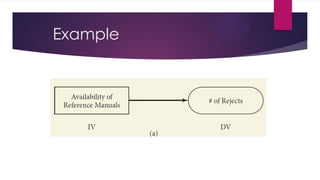
Example
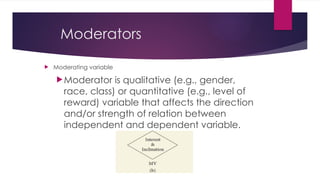
Moderators
 Moderating variable
Moderator is qualitative (e.g., gender,
race, class) or quantitative (e.g., level of
reward) variable that affects the direction
and/or strength of relation between
independent and dependent variable.
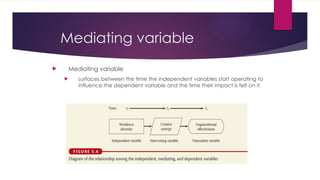
Mediating variable
 Mediating variable
 surfaces between the time the independent variables start operating to
influence the dependent variable and the time their impact is felt on it.
Hypothesis
 A proposition that is empirically testable. It is an empirical statement
concerned with the relationship among variables.
 Good hypothesis:
 Must be adequate for its purpose
 Must be testable
 Must be better than its rivals
 Can be:
 Directional
 Non-directional
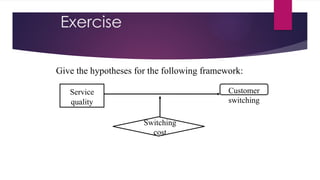
Exercise
Give the hypotheses for the following framework:
Service
quality
Customer
switching
Switching
cost
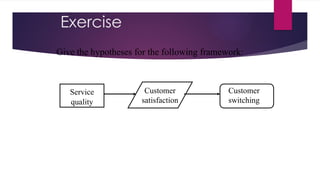
Exercise
Give the hypotheses for the following framework:
Customer
satisfaction
Service
quality
Customer
switching
Argumentation
 The expected relationships / hypotheses are an integration of:
 Exploratory research
 Common sense and logical reasoning

Chapter 4.pptx theoretical framework and hypothesis development

  • 1.
    1 Chapter 4 Theoretical Framework& Hypothesis Development
  • 2.
    Theoretical framework  Foundationdeductive research project!  Deductive research: moving from the general (a theory) to the specific (observations).
  • 3.
    Theoretical Framework  Atheoretical framework represents your beliefs on how certain phenomena (or variables or concepts) are related to each other (a model) and an explanation on why you believe that these variables are associated to each other (a theory).
  • 4.
    Theoretical framework  Basicsteps:  Identify and label the variables correctly  State the relationships among the variables: formulate hypotheses  Explain how or why you expect these relationships
  • 5.
    Variable  Any conceptor construct that varies or changes in value  Main types of variables:  Dependent variable  Independent variable  Moderating variable  Mediating variable
  • 6.
    (In)dependent variables  Dependentvariable (DV)  Is of primary interest to the researcher. The goal of the research project is to understand, predict or explain the variability of this variable.  Independent variable (IV)  Influences the DV in either positive or negative way. The variance in the DV is accounted for by the IV.
  • 7.
  • 8.
    Moderators  Moderating variable Moderatoris qualitative (e.g., gender, race, class) or quantitative (e.g., level of reward) variable that affects the direction and/or strength of relation between independent and dependent variable.
  • 9.
    Mediating variable  Mediatingvariable  surfaces between the time the independent variables start operating to influence the dependent variable and the time their impact is felt on it.
  • 10.
    Hypothesis  A propositionthat is empirically testable. It is an empirical statement concerned with the relationship among variables.  Good hypothesis:  Must be adequate for its purpose  Must be testable  Must be better than its rivals  Can be:  Directional  Non-directional
  • 11.
    Exercise Give the hypothesesfor the following framework: Service quality Customer switching Switching cost
  • 12.
    Exercise Give the hypothesesfor the following framework: Customer satisfaction Service quality Customer switching
  • 13.
    Argumentation  The expectedrelationships / hypotheses are an integration of:  Exploratory research  Common sense and logical reasoning