Definition and Nature of
Planning
Chapter 3
Whenever you see a successful business,
someone once made a courageous decision.
- Peter F. Drucker
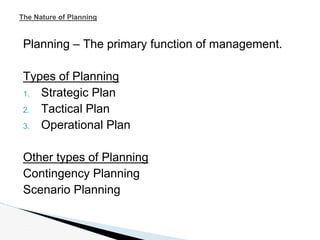
Planning – The primary function of management.
Types of Planning
1. Strategic Plan
2. Tactical Plan
3. Operational Plan
Other types of Planning
Contingency Planning
Scenario Planning
The Nature of Planning
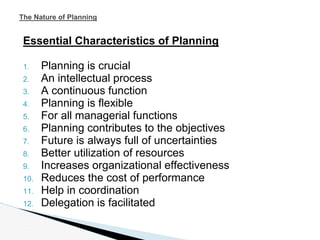
Essential Characteristics of Planning
1. Planning is crucial
2. An intellectual process
3. A continuous function
4. Planning is flexible
5. For all managerial functions
6. Planning contributes to the objectives
7. Future is always full of uncertainties
8. Better utilization of resources
9. Increases organizational effectiveness
10. Reduces the cost of performance
11. Help in coordination
12. Delegation is facilitated
The Nature of Planning
Importance of Planning
1. Planning provides direction
2. Planning reduced risks of uncertainty
3. Planning reduced overlapping and wasteful
activities
4. Planning promotes innovative ideas
5. Planning facilitates decision making
6. Planning establishes standards for controlling
The Nature of Planning
Steps Involved in Planning
1. Defining the current situations
2. Establishing goals and objectives
3. Establishment of planning premises
4. Determining alternative course of action
5. Evaluating all alternatives
6. Choosing a course of action
7. Devising supporting plans
8. Establishing succession of activities
9. Feedback action
The Nature of Planning
Planning Levels
Top Level Management
Middle Level Management
Low Level Management
Types of Plan at Different Management Levels
Gannt Chart
- Developed by an American engineer and
social scientist Henry L. Gannt in 1917.
- It is a planning technique that graphically
documents and presents schedule of a plan and
real progress of a project.
Planning Techniques and Tools and their Application
Critical Path Method
- Developed by DuPont in the 1950s and first
applied in missile-defense construction projects.
- It is a mathematical way of planning and
scheduling for programmed management to ensure
a timeless and minimum use if resources.
Planning Techniques and Tools and their Application
Critical Path Method
Steps in applying the CPM:
1. Identify and list down the mandatory task in order.
2. Construct a diagram illustrating the relation of each
task to the others.
3. Name the critical and non-critical paths among task
4. Find out the estimated completion time for each task
5. Establish or formulate alternatives or backups for the
main critical paths
Decision Trees – a complete graphical visualization
of possible decision under conditions of risk which
permits a manager to make a diagram of outcome
of different alternatives.
Payback Method – This method is used in
evaluating alternatives in purchasing equipment,
furniture and fixtures.
Planning Techniques and Tools and their Application
Chapter 3. Planning.pptx

Chapter 3. Planning.pptx

  • 1.
    Definition and Natureof Planning Chapter 3
  • 2.
    Whenever you seea successful business, someone once made a courageous decision. - Peter F. Drucker
  • 3.
    Planning – Theprimary function of management. Types of Planning 1. Strategic Plan 2. Tactical Plan 3. Operational Plan Other types of Planning Contingency Planning Scenario Planning The Nature of Planning
  • 4.
    Essential Characteristics ofPlanning 1. Planning is crucial 2. An intellectual process 3. A continuous function 4. Planning is flexible 5. For all managerial functions 6. Planning contributes to the objectives 7. Future is always full of uncertainties 8. Better utilization of resources 9. Increases organizational effectiveness 10. Reduces the cost of performance 11. Help in coordination 12. Delegation is facilitated The Nature of Planning
  • 5.
    Importance of Planning 1.Planning provides direction 2. Planning reduced risks of uncertainty 3. Planning reduced overlapping and wasteful activities 4. Planning promotes innovative ideas 5. Planning facilitates decision making 6. Planning establishes standards for controlling The Nature of Planning
  • 6.
    Steps Involved inPlanning 1. Defining the current situations 2. Establishing goals and objectives 3. Establishment of planning premises 4. Determining alternative course of action 5. Evaluating all alternatives 6. Choosing a course of action 7. Devising supporting plans 8. Establishing succession of activities 9. Feedback action The Nature of Planning
  • 7.
    Planning Levels Top LevelManagement Middle Level Management Low Level Management Types of Plan at Different Management Levels
  • 8.
    Gannt Chart - Developedby an American engineer and social scientist Henry L. Gannt in 1917. - It is a planning technique that graphically documents and presents schedule of a plan and real progress of a project. Planning Techniques and Tools and their Application
  • 9.
    Planning Techniques andTools and their Application Critical Path Method - Developed by DuPont in the 1950s and first applied in missile-defense construction projects. - It is a mathematical way of planning and scheduling for programmed management to ensure a timeless and minimum use if resources.
  • 10.
    Planning Techniques andTools and their Application Critical Path Method Steps in applying the CPM: 1. Identify and list down the mandatory task in order. 2. Construct a diagram illustrating the relation of each task to the others. 3. Name the critical and non-critical paths among task 4. Find out the estimated completion time for each task 5. Establish or formulate alternatives or backups for the main critical paths
  • 11.
    Decision Trees –a complete graphical visualization of possible decision under conditions of risk which permits a manager to make a diagram of outcome of different alternatives. Payback Method – This method is used in evaluating alternatives in purchasing equipment, furniture and fixtures. Planning Techniques and Tools and their Application