Prof. Khalid M. Amin
‫منطقي‬ ‫تصميم‬
Feb. 2022
Part # 2
2
3
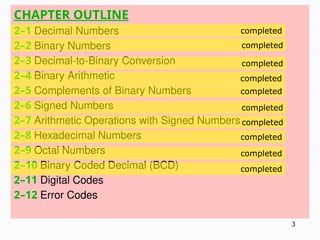
CHAPTER OUTLINE
2–1 Decimal Numbers
2–2 Binary Numbers
2–3 Decimal-to-Binary Conversion
2–4 Binary Arithmetic
2–5 Complements of Binary Numbers
2–6 Signed Numbers
2–7 Arithmetic Operations with Signed Numbers
2–8 Hexadecimal Numbers
2–9 Octal Numbers
2–10 Binary Coded Decimal (BCD)
2–11 Digital Codes
2–12 Error Codes
completed
completed
completed
completed
completed
completed
completed
completed
completed
completed
4
5
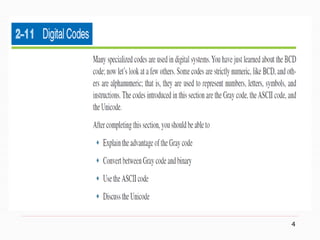
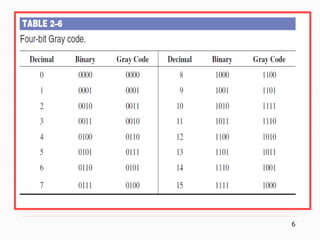
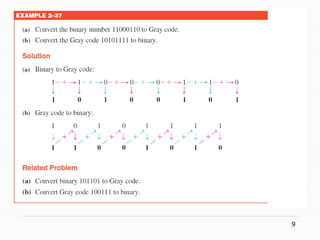
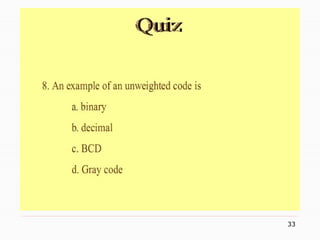
The Gray Code
• The Gray code is unweighted, and is not an
arithmetic code; that is, there are no specific weights
assigned to the bit positions.
• The important feature of the Gray code is that it
exhibits only a single bit change from one code word to
the next in sequence.
• This property is important in many applications.
6
7
8
9
10
11
12
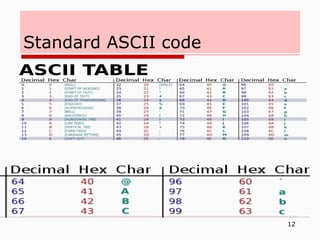
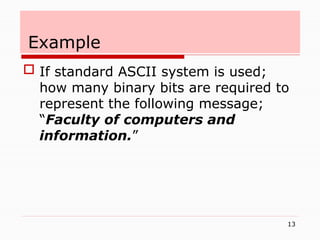
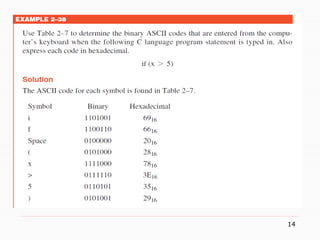
Standard ASCII code
13
Example
 If standard ASCII system is used;
how many binary bits are required to
represent the following message;
“Faculty of computers and
information.”
14
15
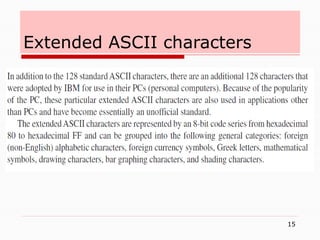
Extended ASCII characters
16
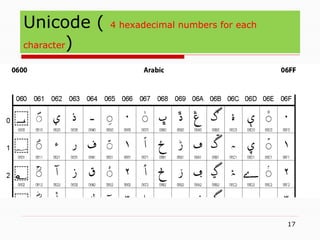
17
Unicode ( 4 hexadecimal numbers for each
character)
18
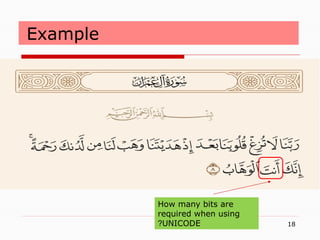
Example
How many bits are
required when using
UNICODE
?
19
20
21
22
23
24
25
26
27
28
29
30
31
32
33
34
35
36
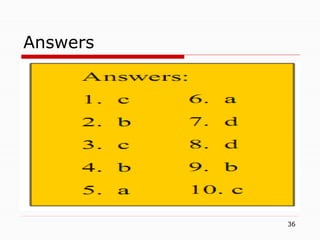
Answers
37
‫الفصل‬ ‫نهاية‬
38

‫واتوب‬ ‫استغفرك‬ ‫انت‬ ‫اال‬ ‫اله‬ ‫ال‬ ‫ان‬ ‫أشهد‬ ‫وبحمدك‬ ‫اللهم‬ ‫سبحانك‬
‫اليك‬

‫خيرا‬ ‫اهلل‬ ‫جزاكم‬

‫المحاضرة‬ ‫نهاية‬ ..............................

Chapter 2 part 2 .pptx