1
What is Software
Engineering?
 Engineering approach to develop
software.
Building Construction Analogy.
 Systematic collection of past
experience:
techniques,
methodologies,
guidelines.
2
Software Crisis
 Software products:
fail to meet user requirements.
frequently crash.
expensive.
difficult to alter, debug, and
enhance.
often delivered late.
use resources non-optimally.
3
Factors contributing to the
software crisis
 Larger problems,
 Lack of adequate training in
software engineering,
 Increasing skill shortage,
 Low productivity improvements.
4
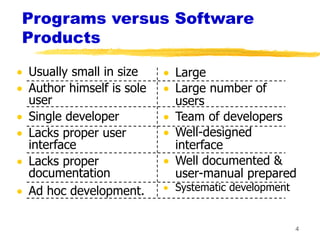
Programs versus Software
Products
 Usually small in size
 Author himself is sole
user
 Single developer
 Lacks proper user
interface
 Lacks proper
documentation
 Ad hoc development.
 Large
 Large number of
users
 Team of developers
 Well-designed
interface
 Well documented &
user-manual prepared
 Systematic development
5
Object-Oriented Design (80s)
 Object-oriented technique:
natural objects (such as employees,
pay-roll-register, etc.) occurring in a
problem are first identified.
 Relationships among objects:
such as composition, reference, and
inheritance are determined.
6
Evolution of Other Software
Engineering Techniques
life cycle models,
specification techniques,
project management techniques,
testing techniques,
debugging techniques,
quality assurance techniques,
software measurement
techniques,
CASE tools, etc.
7
Differences between the exploratory
style and modern software
development practices
 Use of Life Cycle Models
 Software is developed through
several well-defined stages:
requirements analysis and
specification,
design,
coding,
testing, etc.
8
Differences between the exploratory
style and modern software
development practices
 Emphasis has shifted
 from error correction to error
prevention.
 Modern practices emphasize:
detection of errors as close to
their point of introduction as
possible.
9
Differences between the exploratory
style and modern software
development practices (CONT.)
 In exploratory style,
errors are detected only during
testing,
 Now,
 focus is on detecting as many
errors as possible in each
phase of development.
10
Differences between the exploratory
style and modern software
development practices (CONT.)
 During all stages of
development process:
Periodic reviews are being carried
out
 Software testing has become
systematic:
standard testing techniques are
available.
11
Differences between the exploratory
style and modern software
development practices (CONT.)
 Projects are being thoroughly
planned:
 estimation,
 scheduling,
 monitoring mechanisms.
 Use of CASE tools.
12
Life Cycle Model
 A software life cycle model (or
process model):
 a descriptive and diagrammatic model
of software life cycle:
 identifies all the activities required for
product development,
 establishes a precedence ordering among
the different activities,
 Divides life cycle into phases.
13
Why Model Life Cycle ?
 A written description:
 forms a common understanding of
activities among the software
developers.
 helps in identifying inconsistencies,
redundancies in the development
process.
14
Why Model Life Cycle ?
 Processes are tailored for special
projects.
A documented process model
 helps to identify where the
tailoring is to occur.
15
Life Cycle Model (CONT.)
 The development team must
identify a suitable life cycle model:
 and then adhere to it.
 Primary advantage of adhering to a
life cycle model:
helps development of software in a
systematic and disciplined manner.
16
Life Cycle Model (CONT.)
 When a software product is being
developed by a team:
 there must be a precise understanding
among team members as to when to
do what,
 otherwise it would lead to and project
failure.
17
Life Cycle Model (CONT.)
 A life cycle model:
defines entry and exit criteria for
every phase.
A phase is considered to be
complete:
only when all its exit criteria's are
satisfied.
18
Life Cycle Model (CONT.)
 The phase exit criteria for the software
requirements specification phase:
 Software Requirements Specification (SRS)
document is complete, reviewed, and
approved by the customer.
 A phase can start:
 only if its phase-entry criteria have been
satisfied.
19
Life Cycle Model (CONT.)
 It becomes easier for software
project managers:
to monitor the progress of the
project.
20
Life Cycle Model (CONT.)
 Many life cycle models have been
proposed.
 We will confine our attention to a few
important and commonly used models.
 classical waterfall model
 iterative waterfall,
 evolutionary,
 prototyping, and
 spiral model

chapter 1.ppt

  • 1.
    1 What is Software Engineering? Engineering approach to develop software. Building Construction Analogy.  Systematic collection of past experience: techniques, methodologies, guidelines.
  • 2.
    2 Software Crisis  Softwareproducts: fail to meet user requirements. frequently crash. expensive. difficult to alter, debug, and enhance. often delivered late. use resources non-optimally.
  • 3.
    3 Factors contributing tothe software crisis  Larger problems,  Lack of adequate training in software engineering,  Increasing skill shortage,  Low productivity improvements.
  • 4.
    4 Programs versus Software Products Usually small in size  Author himself is sole user  Single developer  Lacks proper user interface  Lacks proper documentation  Ad hoc development.  Large  Large number of users  Team of developers  Well-designed interface  Well documented & user-manual prepared  Systematic development
  • 5.
    5 Object-Oriented Design (80s) Object-oriented technique: natural objects (such as employees, pay-roll-register, etc.) occurring in a problem are first identified.  Relationships among objects: such as composition, reference, and inheritance are determined.
  • 6.
    6 Evolution of OtherSoftware Engineering Techniques life cycle models, specification techniques, project management techniques, testing techniques, debugging techniques, quality assurance techniques, software measurement techniques, CASE tools, etc.
  • 7.
    7 Differences between theexploratory style and modern software development practices  Use of Life Cycle Models  Software is developed through several well-defined stages: requirements analysis and specification, design, coding, testing, etc.
  • 8.
    8 Differences between theexploratory style and modern software development practices  Emphasis has shifted  from error correction to error prevention.  Modern practices emphasize: detection of errors as close to their point of introduction as possible.
  • 9.
    9 Differences between theexploratory style and modern software development practices (CONT.)  In exploratory style, errors are detected only during testing,  Now,  focus is on detecting as many errors as possible in each phase of development.
  • 10.
    10 Differences between theexploratory style and modern software development practices (CONT.)  During all stages of development process: Periodic reviews are being carried out  Software testing has become systematic: standard testing techniques are available.
  • 11.
    11 Differences between theexploratory style and modern software development practices (CONT.)  Projects are being thoroughly planned:  estimation,  scheduling,  monitoring mechanisms.  Use of CASE tools.
  • 12.
    12 Life Cycle Model A software life cycle model (or process model):  a descriptive and diagrammatic model of software life cycle:  identifies all the activities required for product development,  establishes a precedence ordering among the different activities,  Divides life cycle into phases.
  • 13.
    13 Why Model LifeCycle ?  A written description:  forms a common understanding of activities among the software developers.  helps in identifying inconsistencies, redundancies in the development process.
  • 14.
    14 Why Model LifeCycle ?  Processes are tailored for special projects. A documented process model  helps to identify where the tailoring is to occur.
  • 15.
    15 Life Cycle Model(CONT.)  The development team must identify a suitable life cycle model:  and then adhere to it.  Primary advantage of adhering to a life cycle model: helps development of software in a systematic and disciplined manner.
  • 16.
    16 Life Cycle Model(CONT.)  When a software product is being developed by a team:  there must be a precise understanding among team members as to when to do what,  otherwise it would lead to and project failure.
  • 17.
    17 Life Cycle Model(CONT.)  A life cycle model: defines entry and exit criteria for every phase. A phase is considered to be complete: only when all its exit criteria's are satisfied.
  • 18.
    18 Life Cycle Model(CONT.)  The phase exit criteria for the software requirements specification phase:  Software Requirements Specification (SRS) document is complete, reviewed, and approved by the customer.  A phase can start:  only if its phase-entry criteria have been satisfied.
  • 19.
    19 Life Cycle Model(CONT.)  It becomes easier for software project managers: to monitor the progress of the project.
  • 20.
    20 Life Cycle Model(CONT.)  Many life cycle models have been proposed.  We will confine our attention to a few important and commonly used models.  classical waterfall model  iterative waterfall,  evolutionary,  prototyping, and  spiral model