Chapter 14:
Persuasive Speaking
• Lecturer: Mr. Vath Vary
• Email: varyvath@gmail.com
• Tel: 017 471 117
Course:
Public Speaking
Content
• Defining Persuasion
• Speeches on Questions of Fact
• Speeches on Questions of Value
• Speeches on Questions of Policy
• Persuading Different Types of
Audiences
• The Ethics of Persuasive Speaking
• Speech for Review and Analysis
What is Persuasive
Speech?
• Persuasive speech is a
type of speech that
aims to reinforce,
modify, or change
audience members’
beliefs, attitudes,
opinions, values, and
Category Informative Speaking Persuasive Speaking
Purpose To inform, explain, or increase understanding To persuade or influence
audience beliefs or actions
Speaker’s Role Neutral expert
Advocate or promoter of a
specific viewpoint
Position on Topic Remains neutral and unbiased Takes a clear and strong stance
Content Focus Facts, definitions, explanations, history Arguments, evidence, reasoning,
emotional appeals
Audience Reaction Gain knowledge and awareness
Change opinions, attitudes, or
behaviors
Example Describing the history of digital cameras Arguing that traditional cameras
are better
Comparison of Informative and Persuasive Speaking?
Persuasion or Coercion?
 Persuasion relies on language, images,
and other means of communication to
influence people's beliefs, attitudes,
values, or actions.
 Persuasion implies choice, while coercion
involves forcing someone to think a
certain way or making someone feel
compelled to act under pressure or
threat.
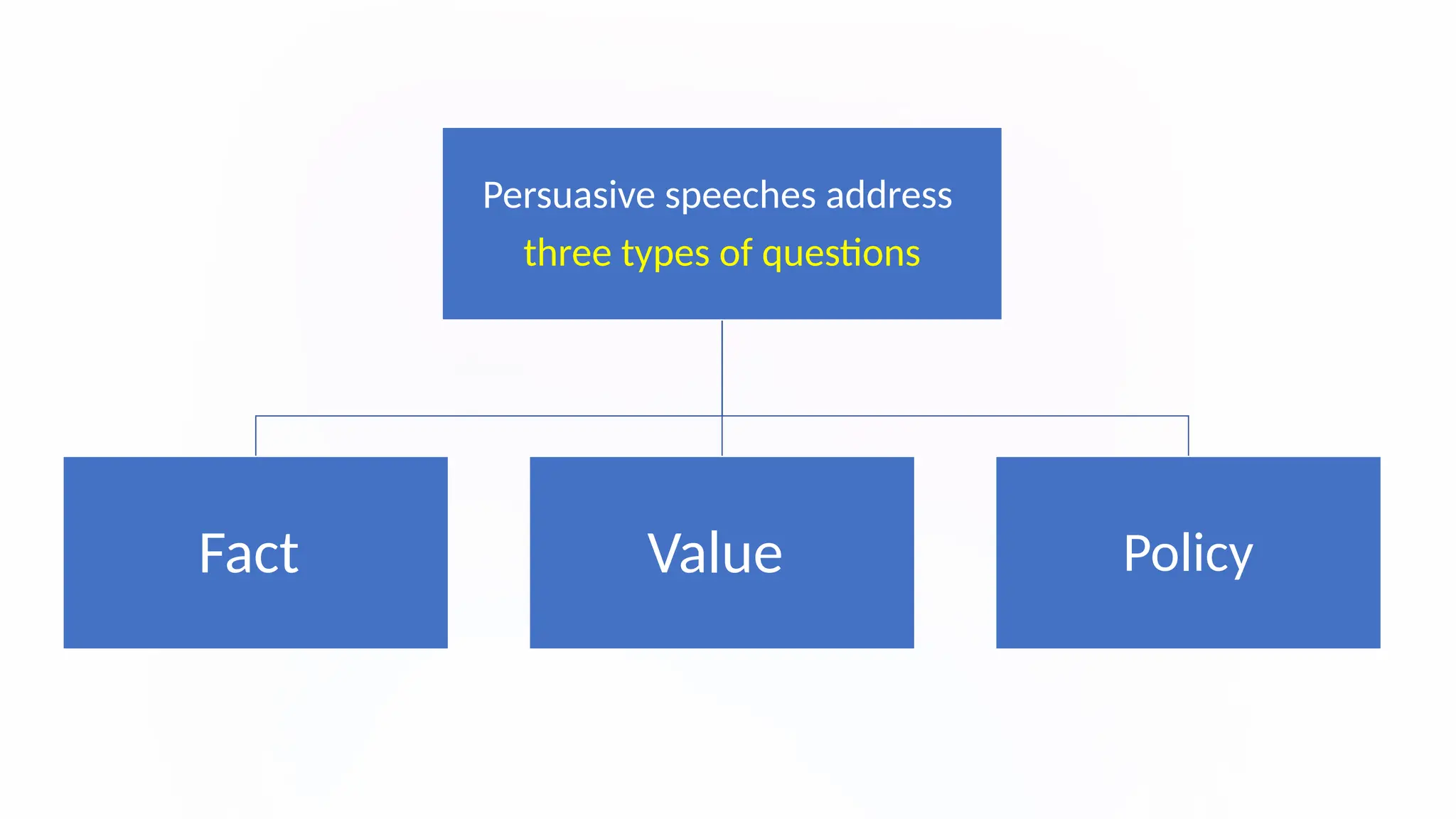
Persuasive speeches address
three types of questions
Fact Value Policy
Speeches on
Questions of
Fact
Speeches on Questions of Fact
• Speeches on questions of fact address whether
something is true or false.
• The speaker tries to persuade the audience that
something did or did not occur, or that one event
caused another.
• Speakers must clearly distinguish between
verifiable facts and inferences, while supporting
their claims with credible evidence such as
statistics, expert testimony, and examples.
• Speeches on questions of fact typically address three
issues:
• What is observed or known, how observations were
made, and whether new observations have changed
previous facts.
• In persuasive speaking, you aim to convince
the audience to think or act a certain way,
especially by proving a claim true or false.
• After defining your purpose and thesis, develop
main points that show what evidence would
convince the audience that your claim is true or
false.
Specific Purposes, Thesis Statements, and Main
Points for Practical Persuasion Speeches
Organizational Patterns for
Speeches on Questions of Fact
• For persuasive speeches on questions of
fact,
• choose an organizational pattern:
chronological, spatial, topical, or
cause-and-effect—
• that aligns with your specific purpose
and thesis to effectively support your
argument.
Chronological Spatial
Topical Cause and Effect
Speeches on
Questions of
Value
Speeches on Questions of Value
 A question of value asks for a subjective
evaluation of something's worth, significance,
quality, or condition.
 These questions address individual opinions
and cultural beliefs rather than proving
something true or false.
 Is something good or bad? Right or wrong?
Beautiful or ugly? Boring or engaging?
 Topics: Can address timeless issues like the
morality of war or current concerns like ethical
uses of social media.
Specific Purposes, Thesis Statements, and Main Points
for Speeches on Questions of Value
• In a speech on a question
of value, your specific
purpose states your
judgment of the topic’s
quality, and your main
points must clearly and
strongly support that
position.
Organizational Patterns for
Speeches On Questions of Value
• In speeches on questions of
value, using a clear
organizational pattern
• chronological,
• spatial, or
• topical
Topical:
Group related aspects of
the value together
Spatial:
Compare values across different
locations or cultures
Chronological:
Show how values have
changed over time
Speeches on
Questions of
Policy
Speeches on Questions
of Policy
• A speech on a question of policy
• advocates a specific course of
action or solution to a problem,
often using the word "should,"
and
• encourages the audience to
support, oppose, or take action on
social, political, or institutional
issues
Specific Purposes, Thesis
Statements, and Main
Points for Speeches on
Questions of Policy
 Speeches on questions of policy
 Often include a clear call to
action, urging the audience to
take specific steps, and
 Should be structured to explain
the need for change, the
benefits, and
 How the proposed solution
addresses the issue.
• Because policy speeches call for change,
they must explain why change is needed and
what action should be taken, often using
effective patterns:
 Problem-Solution: Present a need or problem,
then show how to solve it
 Problem-Cause-Solution: Identify the
problem, its cause, then the solution
 Monroe's Motivated Sequence: Five-step
process to motivate audience response
Organizational Patterns for
Speeches on Questions of
Policy
Problem-Solution Pattern Problem-Cause-Solution
Pattern
Monroe's Motivated Sequence
Persuading
Different
Types of
Audiences
 A negative audience, also called a hostile audience:
An audience that is informed about a speaker’s topic
and holds an unfavorable view of the speaker’s
position.
 A positive audience, also called a sympathetic
audience: An audience that is informed about a
speaker’s topic and has a favorable view of the
speaker’s position.
 The Divided Audience: An audience that is informed
about a speaker’s topic but equally split between
those who favor the speaker’s position and those who
oppose it.
 Uninformed audiences: An audience that is unfamiliar
with a speaker’s topic and has no opinion about it.
 Apathetic audiences: An audience that is informed
about a speaker’s topic but not interested in it.
Persuading Different Types of
Audiences
Ethics in Persuasive Speaking
Ethical public speakers must adhere to the National
Communication Association's standards of ethical
communication, particularly avoiding communication that
degrades individuals or humanity.
1 Present information
and arguments
truthfully and
accurately
2 Endorse freedom of
expression and
tolerance of dissent
3 Consider potential harms to the audience
• How does persuasion differ from
manipulation?
• When does a person cross the line from
persuader to manipulator?
• Manipulation means using dishonest tactics
to take advantage of other people.
• For public speakers, omitting crucial
evidence, presenting inaccurate or false
information, or intentionally
misrepresenting research to your
advantage are examples of manipulation.
• As an ethical speaker, you want to persuade,
not manipulate, your audience.
Persuasion vs.Manipulation?
Speech for
Review and
Analysis
294
• Persuasive speaking uses communication to
influence attitudes, beliefs, values, or actions
and can address questions of fact, value, or
policy—each requiring different organizational
patterns and strategies.
• Effective persuasive speeches are tailored to
audience types (negative, positive, divided,
uninformed, apathetic), and
• Ethical speakers must communicate truthfully,
accurately, and without manipulation,
following professional standards.
Summary

Chapter-14-Persuasive-Speaking (speeches).pptx

  • 1.
    Chapter 14: Persuasive Speaking •Lecturer: Mr. Vath Vary • Email: varyvath@gmail.com • Tel: 017 471 117 Course: Public Speaking
  • 2.
    Content • Defining Persuasion •Speeches on Questions of Fact • Speeches on Questions of Value • Speeches on Questions of Policy • Persuading Different Types of Audiences • The Ethics of Persuasive Speaking • Speech for Review and Analysis
  • 3.
    What is Persuasive Speech? •Persuasive speech is a type of speech that aims to reinforce, modify, or change audience members’ beliefs, attitudes, opinions, values, and
  • 4.
    Category Informative SpeakingPersuasive Speaking Purpose To inform, explain, or increase understanding To persuade or influence audience beliefs or actions Speaker’s Role Neutral expert Advocate or promoter of a specific viewpoint Position on Topic Remains neutral and unbiased Takes a clear and strong stance Content Focus Facts, definitions, explanations, history Arguments, evidence, reasoning, emotional appeals Audience Reaction Gain knowledge and awareness Change opinions, attitudes, or behaviors Example Describing the history of digital cameras Arguing that traditional cameras are better Comparison of Informative and Persuasive Speaking?
  • 5.
    Persuasion or Coercion? Persuasion relies on language, images, and other means of communication to influence people's beliefs, attitudes, values, or actions.  Persuasion implies choice, while coercion involves forcing someone to think a certain way or making someone feel compelled to act under pressure or threat.
  • 6.
    Persuasive speeches address threetypes of questions Fact Value Policy
  • 8.
  • 9.
    Speeches on Questionsof Fact • Speeches on questions of fact address whether something is true or false. • The speaker tries to persuade the audience that something did or did not occur, or that one event caused another. • Speakers must clearly distinguish between verifiable facts and inferences, while supporting their claims with credible evidence such as statistics, expert testimony, and examples. • Speeches on questions of fact typically address three issues: • What is observed or known, how observations were made, and whether new observations have changed previous facts.
  • 10.
    • In persuasivespeaking, you aim to convince the audience to think or act a certain way, especially by proving a claim true or false. • After defining your purpose and thesis, develop main points that show what evidence would convince the audience that your claim is true or false. Specific Purposes, Thesis Statements, and Main Points for Practical Persuasion Speeches
  • 11.
    Organizational Patterns for Speecheson Questions of Fact • For persuasive speeches on questions of fact, • choose an organizational pattern: chronological, spatial, topical, or cause-and-effect— • that aligns with your specific purpose and thesis to effectively support your argument.
  • 12.
  • 13.
  • 14.
  • 15.
    Speeches on Questionsof Value  A question of value asks for a subjective evaluation of something's worth, significance, quality, or condition.  These questions address individual opinions and cultural beliefs rather than proving something true or false.  Is something good or bad? Right or wrong? Beautiful or ugly? Boring or engaging?  Topics: Can address timeless issues like the morality of war or current concerns like ethical uses of social media.
  • 16.
    Specific Purposes, ThesisStatements, and Main Points for Speeches on Questions of Value • In a speech on a question of value, your specific purpose states your judgment of the topic’s quality, and your main points must clearly and strongly support that position.
  • 17.
    Organizational Patterns for SpeechesOn Questions of Value • In speeches on questions of value, using a clear organizational pattern • chronological, • spatial, or • topical
  • 18.
    Topical: Group related aspectsof the value together Spatial: Compare values across different locations or cultures Chronological: Show how values have changed over time
  • 19.
  • 20.
    Speeches on Questions ofPolicy • A speech on a question of policy • advocates a specific course of action or solution to a problem, often using the word "should," and • encourages the audience to support, oppose, or take action on social, political, or institutional issues
  • 21.
    Specific Purposes, Thesis Statements,and Main Points for Speeches on Questions of Policy  Speeches on questions of policy  Often include a clear call to action, urging the audience to take specific steps, and  Should be structured to explain the need for change, the benefits, and  How the proposed solution addresses the issue.
  • 22.
    • Because policyspeeches call for change, they must explain why change is needed and what action should be taken, often using effective patterns:  Problem-Solution: Present a need or problem, then show how to solve it  Problem-Cause-Solution: Identify the problem, its cause, then the solution  Monroe's Motivated Sequence: Five-step process to motivate audience response Organizational Patterns for Speeches on Questions of Policy
  • 23.
  • 24.
  • 25.
  • 26.
  • 27.
     A negativeaudience, also called a hostile audience: An audience that is informed about a speaker’s topic and holds an unfavorable view of the speaker’s position.  A positive audience, also called a sympathetic audience: An audience that is informed about a speaker’s topic and has a favorable view of the speaker’s position.  The Divided Audience: An audience that is informed about a speaker’s topic but equally split between those who favor the speaker’s position and those who oppose it.  Uninformed audiences: An audience that is unfamiliar with a speaker’s topic and has no opinion about it.  Apathetic audiences: An audience that is informed about a speaker’s topic but not interested in it. Persuading Different Types of Audiences
  • 29.
    Ethics in PersuasiveSpeaking Ethical public speakers must adhere to the National Communication Association's standards of ethical communication, particularly avoiding communication that degrades individuals or humanity. 1 Present information and arguments truthfully and accurately 2 Endorse freedom of expression and tolerance of dissent 3 Consider potential harms to the audience
  • 30.
    • How doespersuasion differ from manipulation? • When does a person cross the line from persuader to manipulator? • Manipulation means using dishonest tactics to take advantage of other people. • For public speakers, omitting crucial evidence, presenting inaccurate or false information, or intentionally misrepresenting research to your advantage are examples of manipulation. • As an ethical speaker, you want to persuade, not manipulate, your audience. Persuasion vs.Manipulation?
  • 31.
  • 32.
    • Persuasive speakinguses communication to influence attitudes, beliefs, values, or actions and can address questions of fact, value, or policy—each requiring different organizational patterns and strategies. • Effective persuasive speeches are tailored to audience types (negative, positive, divided, uninformed, apathetic), and • Ethical speakers must communicate truthfully, accurately, and without manipulation, following professional standards. Summary