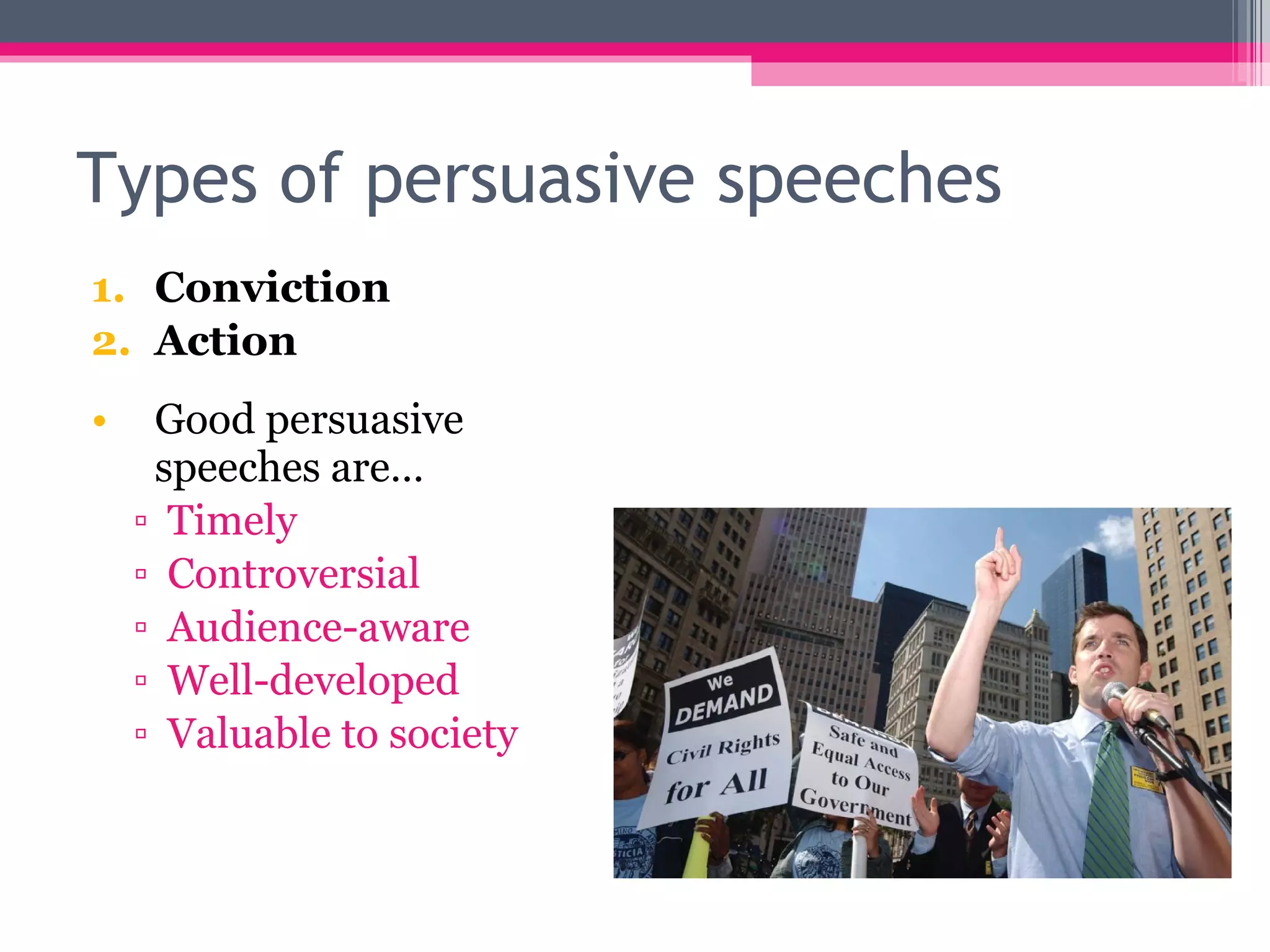
Types of persuasive speeches Conviction Action Good persuasive speeches are… Timely Controversial  Audience-aware Well-developed Valuable to society
Persuasion process Claim Appeals Done? NO!
Persuasion process Things to consider Theory of field-related standards Not all people reach conclusion in the same way, thus they may react differently to the same evidence or psychological appeals Include as many appeals as you can Group norm standards When speaking to a group, you can assume that they will have some similar or overlapping views Individual norm standards Some individuals are more influential than others. If you get  them  on your side, everyone else is in the bag
How do you sell your point of view? Critical thinking Propose plan of action, Set forth criteria, Propose solution Comparative advantage  Propose solution (s)  that are workable, desirable, and practical Monroe’s Motivated Sequence Attention Need Satisfaction Visualization Action Elaboration Likelihood Model If the topic is one that the listener has encountered before, is interested and involved in, and enjoys talking about, he/she is more likely to process the speaker’s arguments Social support If the individual feels that he/she has the support of others and they’re all “in it together,” he/she will be persuaded by a message
Components of the persuasive speech
Components of a persuasive speech Ethos Speaker credibility Logos Logical arguments Pathos Psychological appeals
Speaker credibility (ethos) Competence Wisdom Authority knowledge
Speaker credibility (ethos) Charisma Appealing Concerned Enthusiastic Sincere
Speaker credibility (ethos) Character Reputation Honesty Sensitivity
Logical arguments (logos) Your speech has to “make sense” Clear statement of the purpose of what you are proposing in your speech Reasons you believe or want the audience to believe in what you are proposing Cite credible sources Well-developed arguments that flow Statement of desired outcome, stand or action Absence of false facts, partial information and biased stands
Logical arguments  guide your central idea Proposition of facts  (will) Proposition of value (good, bad) Proposition of policy (should) Inductive argument (evidence, conclusion) Deductive argument (premise, conclusion) Whatever your choice, you need  valid evidence
Logical fallacies Generalizations All Greeks… Faulty analogical reasoning AIDS vs. Bubonic plagues Faulty causal reasoning Something caused something else, no qualification Ignoring the issue Relevant arguments used to obscure the issue Ad hominem arguments Attacks on personal character of the source Ad populum arguments Appeal to people’s prejudices and passions Ad ignorantium arguments Attempt to prove that something is true because it cannot be disproved
Psychological appeals (pathos) Ethnographic theory of human drives Survival Pleasure Security Territoriality Maslow’s Hierarchy  of Needs
Appeals to motivate listeners Adventure Anger Companionship Deference Fear Gender Guilt Happiness Health Hero worship Humor Independence Liking Loyalty Nostalgia Revulsion Safety Savings Sex Sympathy
 
FALL 2009 The Good, the Bad, the ugly
The Ugly
The Bad
The Good
BONUS

Chapter 16: Persuasive Public Speaking

  • 1.
    Types of persuasivespeeches Conviction Action Good persuasive speeches are… Timely Controversial Audience-aware Well-developed Valuable to society
  • 2.
    Persuasion process ClaimAppeals Done? NO!
  • 3.
    Persuasion process Thingsto consider Theory of field-related standards Not all people reach conclusion in the same way, thus they may react differently to the same evidence or psychological appeals Include as many appeals as you can Group norm standards When speaking to a group, you can assume that they will have some similar or overlapping views Individual norm standards Some individuals are more influential than others. If you get them on your side, everyone else is in the bag
  • 4.
    How do yousell your point of view? Critical thinking Propose plan of action, Set forth criteria, Propose solution Comparative advantage Propose solution (s) that are workable, desirable, and practical Monroe’s Motivated Sequence Attention Need Satisfaction Visualization Action Elaboration Likelihood Model If the topic is one that the listener has encountered before, is interested and involved in, and enjoys talking about, he/she is more likely to process the speaker’s arguments Social support If the individual feels that he/she has the support of others and they’re all “in it together,” he/she will be persuaded by a message
  • 5.
    Components of thepersuasive speech
  • 6.
    Components of apersuasive speech Ethos Speaker credibility Logos Logical arguments Pathos Psychological appeals
  • 7.
    Speaker credibility (ethos)Competence Wisdom Authority knowledge
  • 8.
    Speaker credibility (ethos)Charisma Appealing Concerned Enthusiastic Sincere
  • 9.
    Speaker credibility (ethos)Character Reputation Honesty Sensitivity
  • 10.
    Logical arguments (logos)Your speech has to “make sense” Clear statement of the purpose of what you are proposing in your speech Reasons you believe or want the audience to believe in what you are proposing Cite credible sources Well-developed arguments that flow Statement of desired outcome, stand or action Absence of false facts, partial information and biased stands
  • 11.
    Logical arguments guide your central idea Proposition of facts (will) Proposition of value (good, bad) Proposition of policy (should) Inductive argument (evidence, conclusion) Deductive argument (premise, conclusion) Whatever your choice, you need valid evidence
  • 12.
    Logical fallacies GeneralizationsAll Greeks… Faulty analogical reasoning AIDS vs. Bubonic plagues Faulty causal reasoning Something caused something else, no qualification Ignoring the issue Relevant arguments used to obscure the issue Ad hominem arguments Attacks on personal character of the source Ad populum arguments Appeal to people’s prejudices and passions Ad ignorantium arguments Attempt to prove that something is true because it cannot be disproved
  • 13.
    Psychological appeals (pathos)Ethnographic theory of human drives Survival Pleasure Security Territoriality Maslow’s Hierarchy of Needs
  • 14.
    Appeals to motivatelisteners Adventure Anger Companionship Deference Fear Gender Guilt Happiness Health Hero worship Humor Independence Liking Loyalty Nostalgia Revulsion Safety Savings Sex Sympathy
  • 15.
  • 16.
    FALL 2009 TheGood, the Bad, the ugly
  • 17.
  • 18.
  • 19.
  • 20.