Lecturer: Mr. VATH Vary
Contact: varyvath@gmail.com
Chapter 6
Philosophical Roots of Education
Course:
Foundations of Education
Year 4, Semester I
December 01, 2025
Key Philosophical Terminology
Teacher
Challenge
Teachers face daily
pressures: lesson
planning, assessment,
and classroom
management.
Philosophy of
Education
These challenges can
distract from developing a
broader "conceptual
framework" - an intellectual
philosophy of education
that connects daily tasks to
long-term professional
goals and commitments.
Philosophy?
The most general way of
thinking about the
meaning of our lives in
the world and reflect
deeply on what is true or
false, good or evil, right
or wrong, and beautiful
or ugly.
Focus
This chapter explores
5 major philosophies
and 4 theories of
education, examining
how they influence
curriculum, teaching,
and learning.
Philosophy vs. Theory
Whereas philosophies present highly generalized views
of reality, educational theories examine the specific
roles and functions of schools, curriculum, teaching, and
learning.
Special Philosophical Terminology
• Philosophy of education uses four
key terms—metaphysics,
epistemology, axiology, and logic
—each shaping how educators
understand reality, knowledge,
values, and reasoning.
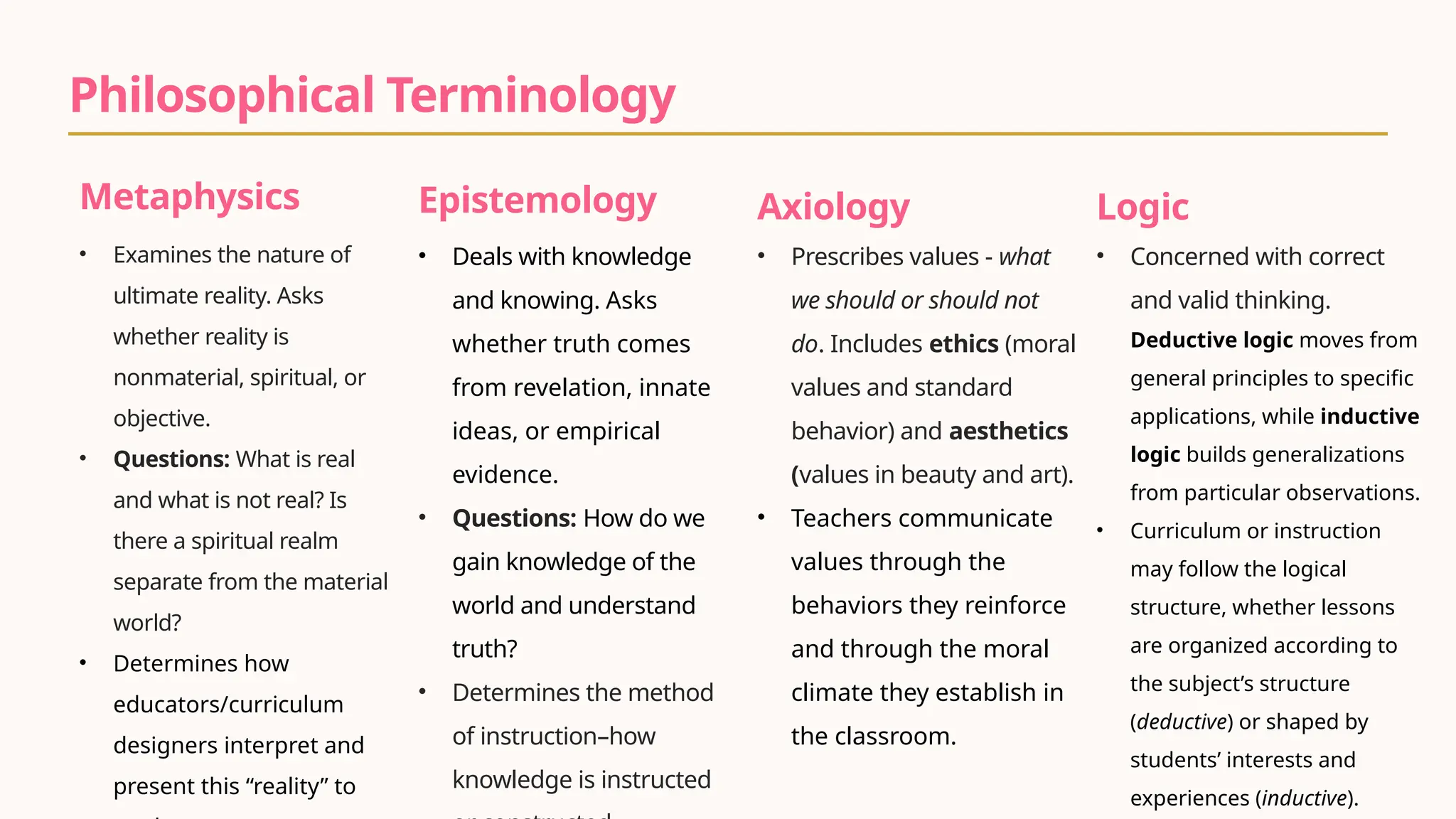
Philosophical Terminology
Metaphysics
• Examines the nature of
ultimate reality. Asks
whether reality is
nonmaterial, spiritual, or
objective.
• Questions: What is real
and what is not real? Is
there a spiritual realm
separate from the material
world?
• Determines how
educators/curriculum
designers interpret and
present this “reality” to
Epistemology
• Deals with knowledge
and knowing. Asks
whether truth comes
from revelation, innate
ideas, or empirical
evidence.
• Questions: How do we
gain knowledge of the
world and understand
truth?
• Determines the method
of instruction–how
knowledge is instructed
Axiology
• Prescribes values - what
we should or should not
do. Includes ethics (moral
values and standard
behavior) and aesthetics
(values in beauty and art).
• Teachers communicate
values through the
behaviors they reinforce
and through the moral
climate they establish in
the classroom.
Logic
• Concerned with correct
and valid thinking.
Deductive logic moves from
general principles to specific
applications, while inductive
logic builds generalizations
from particular observations.
• Curriculum or instruction
may follow the logical
structure, whether lessons
are organized according to
the subject’s structure
(deductive) or shaped by
students’ interests and
experiences (inductive).
Philosophy I: Idealism
Universal, Eternal Truth & The
World of the Mind
1. Idealism
• Idealism, rooted in Plato’s philosophy and later
advanced by thinkers such as Hegel, Emerson, Thoreau,
and Froebel, holds that reality is ultimately spiritual or
nonmaterial, rooted in the Mind of the Absolute.
This worldview is also reflected in Asian traditions such as
Hinduism and Buddhism.
Key Proponents:
 Plato (428–347 BCE): Developed the foundation.
 Georg W. F. Hegel: Focused on the unfolding of ideas
in the mind of the Absolute (God).
 Ralph Waldo Emerson: American Transcendentalism
(finding truth in Nature).
 Friedrich Froebel: Developed kindergarten based on
unfolding the child’s spiritual nature.
Idealism: Key Concepts
Metaphysics (Reality):
● Reality is spiritual or mental and unchanging.
● Macrocosm & Microcosm: Reality is the
universal mind (Macrocosm) of which the
personal mind/spirit (Microcosm) is a part.
Epistemology (Knowing):
● Knowing is the recall of latent (hidden) ideas that
already exist in the Mind of the Absolute.
● Reminiscence: We discover a priori ideas
lodged deep in our minds. The teacher asks
probing questions to stimulate conscious
reflection.
Axiology (Values):
● Values are universal, absolute, and eternal.
Goodness, truth, and beauty are the same
everywhere.
● Values are transmitted through rich sources like
philosophy, theology, history, literature, and art
—especially the classics.
Logic (Reasoning):
● Logic is based on the whole-to-part relationship
between the Absolute and the individual mind.
● Teachers use deductive logic, starting with
general principles/rules and using specific cases
to illustrate them.
Basic Questions and Classroom Implications
• Purpose: Intellectual development; searching for Truth.
• Curriculum: Hierarchical. Philosophy and Theology at the top, followed by History,
Literature, and Math. The "Liberal Arts." Knowledge is the discovery of universal and eternal
ideas already within the mind and engagement with the classics or great works.
• Teacher's Role: A spiritual and intellectual model worthy of imitation for students.
• Method: The Socratic Method. Asking probing questions to stimulate the recall of latent
ideas.
• School’s Role: Schools are intellectual institutions where teachers and students pursue
questions about truth, beauty, and the good life.
Realism: Classroom
Implications
• An idealist teacher might illustrate the power of
ideas and higher ethical law through a unit on
Mohandas Gandhi.
• Students would study Gandhi's biography and
principles of nonviolent protest against injustice.
• An important outcome would be realizing that
Gandhi considered these principles of justice to be
universal truths governing all people.
Philosophy II: Realism
Objective Reality & The Scientific
Method
2. Realism
• Realism, originating with Aristotle, asserts that
reality is objective, external, and independent of
the mind.
Key Proponents:
 Aristotle (384–322 BCE): Student of Plato, developed the
core concepts. Aristotle's Legacy: Humans are rational
animals. We can gain knowledge of the world through our
senses and reason.
 Thomas Aquinas: Combined Aristotle’s natural realism with
Christian doctrine (Thomism).
 Scientific Realists: Assert the scientific method is the best
way to get an accurate description of the world.
Realism: Key Concepts
Metaphysics (Reality):
● Reality is objective and exists
independently of us.
● Reality is an orderly structure.
Epistemology (Knowing):
● Knowing/knowledge consists of
conceptualization based on sensation
and abstraction organized into separate
subject-matter disciplines.
Axiology (Values):
● Values are absolute and eternal, based on
universal natural laws.
● Ethical behavior should be rational, based
on reality.
Logic (Reasoning):
● Logic emphasizes the systematic and
sequential teaching of subjects to
reproduce objective order in students'
minds.
● Favors organized, structured curricula and
instruction.
Realism: Basic Questions and Classroom Implications
• Purpose: To teach knowledge about the objective world. Rationality.
• Curriculum: Organized, separate subject-matter disciplines (Biology, History, Math).
Classification is key.
• Teacher's Role: A subject-matter expert who transmits accurate knowledge of reality.
• Method: Lecture, demonstration, sensory experiences, and experimentation. Content
mastery is most important.
• School’s Role: Schools are academic institutions that provide students with knowledge
about the objective world.
Realism: Classroom Implications
• A high-school physics teacher with a realist
orientation might plan a unit on Newton's
laws of motion by first placing Newton in the
context of scientific history.
• Then, demonstrate the laws in a laboratory
setting.
• Next, discuss the demonstration and frame
the scientific generalization.
• Finally, test students on their understanding
of Newton's laws.
Philosophy III: Pragmatism
Experience, Change & The
Scientific Method
3. Pragmatism
• Pragmatism emphasizes testing the validity of
ideas by acting on them.
 Key Proponents: John Dewey, Charles Peirce, George
Herbert Mead, and William James.
• Peirce stressed the scientific method and probability,
James applied pragmatism to psychology and
education, Mead highlighted learning through
interaction, and Dewey’s experimentalism applied
evolutionary ideas of organism and environment to
education, viewing learning as problem solving through
the scientific method, shaped by the interaction of
organism and environment.
Pragmatism: Key Concepts
Metaphysics (Reality):
● Rejects metaphysics. Beliefs about reality
are based on experience, the interaction
between the organism (person) and the
environment. This interaction causes
growth.
Epistemology (Knowing):
● Knowing results from experiencing and
testing ideas using the scientific method.
● Knowledge (truth or values) is tentative
and socially constructed, and continually
Axiology: Value
● Pragmatic values are situational and
culturally relative. What is valuable is
whatever contributes to personal and
social growth; values that restrict growth
must be reconstructed
Logic: Inductive
● Logic is experimental. We create tentative
assertions and test them.
● If the consequences are desirable, the
assertion is accepted as valid (for now).
Pragmatism: Basic Questions and Classroom Implications
• Purpose: Growth. Education is not preparation for life; it is life.
• Curriculum: Interdisciplinary. Based on solving problems, not isolated subjects.
• Teacher's Role: A guide and facilitator. Not an authoritarian transmitter of
knowledge.
• Method: The Scientific Method applied to social/personal problems. Project-
based learning.
• School's Role: Schools are communities of learners/teachers connected to the
larger society, simplifying, purifying, and balancing (integrating) cultural
experiences for students.
Pragmatism: Classroom
Implications
• A pragmatist approach might involve a college class
examining the use of standardized tests for
national educational standards.
• Students would establish the context of the issue,
define key terms, conduct interdisciplinary
research, consider possible solutions, and take
action, such as writing a position paper to share
their findings.
Philosophy IV: Existentialism
Individual Choice,
Freedom & Authenticity
4. Existentialism
• Existentialism is a philosophy that
examines the way in which humans
define themselves by making
personal choices. An existentialist
education encourages deep personal
reflection on one’s identity,
commitments, and choices.
• Proponents: Jean-Paul Sartre, Soren
Kierkegaard.
Existentialism: Key Concepts & Basic Questions
Key Concepts:
• Jean-Paul Sartre (1905–1980) holds that
existence precedes essence: we are born
into a world we did not choose, yet we
possess the freedom—and responsibility—to
create our own purposes and values. Human
freedom is total, and so is responsibility for
choice.
• The universe is indifferent to human
wishes, leading to angst, or dread (knowing
our destiny is death).
Basic Questions:
• Metaphysics (Reality): Discounts
metaphysics. Reality is subjective. We create
our own essence by making personal choices.
• Epistemology: The individual chooses the
knowledge to appropriate. Personal
knowledge about the human condition and
choices are crucial (more significant than
science alone).
• Axiology (Most Important): Human beings
create their own values through their choices,
rejecting predetermined definitions of the
Existentialism: Basic Questions and Classroom Implications
• Purpose: to awaken our consciousness about our freedom to choose and to create our own sense
of self-awareness that contributes to our authenticity.
• Curriculum: Humanities are key (Art, Literature, Biography, Drama, and Media) because they
portray human choice and encourage self-expression. There are no "correct" answers, only personal
ones.
• Teacher's Role: The teacher cannot specify the goals, but stimulates an intense awareness of
students’ ultimate responsibility, encourages them to examine limits on freedom of choice, and
creates open, self-directed learning environments.
• Method: questioning, dialogue, and choice-making.
• School's Role: Schools should allow open dialogue, where teachers and students discuss their lives,
choices, hopes, and fears.
Existentialism: Classroom Implications
• An existentialist approach might involve a senior high school history class
studying the Holocaust.
• After viewing Schindler's List, the class would probe the moral situation of
Oscar Schindler and the choice he made to save Jewish workers in a
senseless and cruel world.
Philosophy V: Postmodernism
Deconstruction, Power &
Narratives
4. Postmodernism
• Postmodernism contends that the modern period
of history has ended and that we now live in a
postmodern era where universal truths are
rejected.
• It originated in the philosophies of Friedrich
Nietzsche (who dismissed claims of universal truth)
and Martin Heidegger (who asserted that human
beings construct subjective truths from their
experiences).
• Postmodernism influences contemporary
philosophy, education, women’s studies, and
literature, and aligns with constructivism in viewing
Postmodernism: Key Concepts
• Metaphysics (Reality): Rejects metaphysics
as historical constructions used for
socioeconomic domination.
• Epistemology (Knowing): Knowledge is a
human construction, subjective and culturally
biased, expressed through language and texts.
• Foucault argued that what experts
(scientists, educators) pronounce as
"objective truth" is often a disguised
rationale for elites who hold power and
want to use it over others, especially the
poor, minorities, and women.
• Postmodernists analyze education using the
concepts of: Subordination: A powerful elite's
control over disempowered groups (e.g., mandated
standardized testing). Marginalization: The process
of pushing powerless groups to the edges of society
(e.g., teaching an official history that ignores women
and minorities).
• Knowing is constructed using DECONSTRUCTION as
a method to analyze texts (canons, curricula, textbooks)
to reveal them as biased historical and cultural
constructions shaped by political power
relationships, not objective truth.
• Axiology (Values): Emphasizes the values of
marginalized persons and groups.
Postmodernism: Basic Questions and Classroom Implications
Purpose
To raise consciousness about
social inequalities and
empower the marginalized.
Deconstruction of traditional
assumptions, inclusion of
marginalized voices are
emphasized.
School
Schools are contested
arenas in the struggle for
social, political, and
economic domination. The
official curriculum is viewed
as reflecting a society that is
patriarchal, Eurocentric, and
capitalist.
Curriculum
Must move beyond traditional
Western canons—which are
challenged as male-
dominated and European-
centered—to include the
contributions and voices of
underrepresented and
marginalized groups
(Africans, Asians, women, etc.).
Postmodernism: Basic Questions and Classroom Implications
Method
Instruction as "Representation":
Teachers must be conscious of
their powerful roles and critically
examine the nature of their
representations (cultural
expressions using narratives,
stories, images).
Teacher Role
(Empowerment)
Teachers must empower
themselves and students to
challenge the "official" curriculum
and standardized testing by
questioning who benefits from
their use.
Postmodernism: Classroom
Implications
• A postmodernist approach might involve middle-
school social studies students exploring their racial
and ethnic heritages.
• Students would share family stories, invite parents
and grandparents as guest speakers, and create a
multicultural display illustrating the diverse cultures
in their community.
Educational Theories
Applying Philosophy
to the Classroom
Theory I: Essentialism
• Rooted in Idealism and Realism,
Essentialism establishes the school's
primary function as maintaining the
achievements of human civilization by
transmitting them to students as skills
and subjects in a carefully organized
curriculum.
• Key Proponents: William Bagley, Arthur
Bestor, "A Nation at Risk" report.
Essentialism in Practice
Key Questions
● The school’s role: teach students the basic skills
and subjects that prepare them to function
effectively and efficiently in a democratic society.
● Curriculum: The curriculum must emphasize
fundamental skills and subjects, including: Skills:
Literacy (reading/writing) and computation
(arithmetic). Subjects: History, mathematics,
science, languages, and literature. Curriculum
Structure must be sequential (lower-order skills
lead to higher-order ones) and cumulative
(knowledge at lower grades is added to in
succeeding grades).
Implications for Teachers
● Method: Teacher-directed instruction
emphasizing mastery of content and skills.
● Teacher’s role: (1) adhere to a carefully
structured curriculum of basic skills and
subjects; (2) inculcate traditional Western and
American values of patriotism, hard work,
effort, punctuality, respect for authority, and
civility; (3) manage classrooms efficiently,
effectively, and fairly as spaces of discipline
and order; (4) promote students based on
academic achievement, not social
considerations.
Essentialism in the
Classroom
• An essentialist approach in a high school American
history class might involve studying the differences
between Booker T. Washington and W.E.B. Du Bois.
• The teacher would assign readings, lead a discussion
identifying key differences, and guide students to reach
conclusions about the leaders' influences on African
American and U.S. history.
Theory II: Perennialism
• Rooted in Aristotle’s and Aquinas’s realism,
Perennialism asserts that education, like
the truth it conveys, is universal and
authentic in every period of history.
• Education should not be vocational or
specialized, yet be liberal and general, with
its goal is to cultivate the rationality each
person possesses by bringing them in
contact with the truth.
• Key Proponents: Robert Hutchins,
Mortimer Adler, Jacques Maritain.
Perennialism in Practice
The Curriculum
● Perennial Studies: The curriculum should consist of
permanent, or perennial, studies that emphasize the recurrent
themes of human life. Includes cognitive subjects that
cultivate rationality: history, language, mathematics, logic,
literature, the humanities, and science. Religious perennialists
(Maritain) include religion.
● The Classics (Great Books): Truth is portrayed in the classic,
or enduring, works of art, literature, philosophy, and
science.Robert Hutchins recommended discussion of the great
books of Western civilization to stimulate intellectual dialogue
and critical thinking.
● The Paideia Proposal (Mortimer J. Adler): A revival of
perennialism advocating for the same high-quality intellectual
education for all students in core subjects. Paideia, a Greek
Key Questions
● Perennialists assert that all
students in a democratic society
deserve equal access to a
rigorous intellectual education.
● They oppose tracking and
cultural relativism, advocating
universal standards for
knowledge, morality, and
intellectual development.
Perennialism: Implications for Teachers
 School’s Role: To develop students' reasoning powers and engage them with enduring
ideas.
 Teacher's Role: Act as intellectual mentors and models with a solid academic
background, especially in the liberal arts and sciences and the great books.
 Method: Discussion of classic texts, Socratic questioning, emphasis on critical thinking.
 Instruction: Primary Grades: Teach fundamental skills (reading, writing, computation)
and stimulate a desire for learning. Secondary Grades: Emphasize the enduring human
concerns explored in the great works of history, literature, art, and philosophy.
Perennialism in the
Classroom
• A perennialist approach in a middle school literature class
might involve reading and discussing Louisa May Alcott's
Little Women.
• Students would examine the main characters and issues
the March family faces, relating them to enduring themes
in family life today.
• This could spark intergenerational discussions as students
share their impressions with parents and grandparents
who may have also read the book.
Theory III: Progressivism
• Progressivism (rooted in Pragmatism) originated as a
general reform movement in society and education in the
late 19th
and early 20th
centuries.
• Progressivism is broadly divided into: (1) Child-Centered:
Seeks to liberate children from authoritarian schools and
prolong childhood (Marietta Johnson). Closely aligned with
Constructivism: Students learn by actively exploring their
environments and constructing their own conception of
reality based on direct experiences. (2) Social
Reconstructionists: Want to use schools to reform society
by investigating and solving social, political, and economic
problems (George Counts and Harold Rugg).
• Key Proponents: William Kilpatrick, Marietta Johnson, John
Progressivism: Key Concepts & Key Questions
Key Concepts
The Progressive Education Association opposed
• (1) authoritarian teachers, (2) exclusively book-based
instruction, (3) passive memorization of factual information, (4)
the isolation of schools from society, and (5) using physical or
psychological coercion to manage classrooms.
These progressive educators positively affirmed that:
• (1) the child should be free to develop naturally; (2) interest,
motivated by direct experience, is the best stimulus for
learning; (3) the teacher should facilitate learning; (4) close
cooperation needs to be encouraged between the school and
the home; and (5) the progressive school should be a
laboratory for experimentation.
Key Questions
• Progressives view knowledge as an
instrument for accomplishing real
purposes—gained from many sources
such as books, experiences, experts,
libraries, laboratories, and the Internet—
but meaningful only when applied.
• Closely aligned with constructivism, this
view holds that students learn best by
actively exploring their environments and
constructing their own understanding of
reality through direct, hands-on
experiences.
Progressivism - Implications for Teachers
• Curriculum: Based on students' interests and needs, interdisciplinary approach; opposed
authoritarian, rote, book-based education.
• Teacher’s Role: Teacher as facilitator, guiding students through experiences and problem-
solving; teach students how to think, not just what to think.
• Method: Activity-based curriculum, project method, and collaborative learning are key to
effective learning.
• School’s Role: To provide experiences that promote growth and prepare students for life
in a democratic society.
Progressivism: Classroom implications
Kilpatrick’s Project Method
• Three Guiding Principles: (1) genuine
education involves problem solving; (2)
learning is enriched as students
collaboratively research and share information
to formulate and test their hypotheses; (3)
teachers can guide students’ learning without
dominating it.
• Using these principles, Kilpatrick described
four types of projects: (1) implementing a
creative idea or plan; (2) enjoying an aesthetic
experience; (3) solving an intellectual problem;
(4) learning a new skill or area of knowledge.
The Paper Clip Project
• The Whitwell Middle School Holocaust
Project illustrates the method: students
researched the Holocaust, created a
memorial of six million paper clips, and
engaged the community, international
media, and Holocaust survivors.
• Through the project, students developed
critical thinking, social awareness,
collaboration, and practical skills.
Theory IV: Critical Theory
• Roots: postmodernism, existentialism, neo-
Marxism (as developed by Karl Marx),
feminist/multicultural theories, and Paulo
Freire’s liberation pedagogy.
• Critical theory is a highly influential
contemporary theory that advocates for a
rigorous critique of schools and society to
expose exploitative power relationships and
promote equity, fairness, and social justice.
• Key Proponents: Paulo Freire, Henry Giroux,
Peter McLaren.
Critical Theory in Practice
Key Concepts
● Drawing on Marxist ideas, critical theorists
analyze class conflict and alienation in schools,
showing how dominant classes control
knowledge and opportunities to maintain
privilege.
● They identify the “official” curriculum, which
transmits sanctioned knowledge and values, and
the “hidden” curriculum, which enforces social
norms and behaviors, often marginalizing
women, minorities, and the poor.
● Critical consciousness enables students to
recognize oppression, resist domination, and
empower themselves.
Basic Questions
● Knowledge is understood as a tool for addressing
social, political, economic, and educational
inequities.
● Critical theorists encourage students to construct
meaningful knowledge in their local contexts,
connecting personal experiences to larger social
structures.
● Autobiographical and collaborative learning, as
illustrated in Erin Gruwell’s The Freedom Writers
Diary, fosters self-awareness, social critique, and
empowerment among historically marginalized
students.
Critical Theory: Classroom implications
• Hidden Curriculum: The unstated/unspoken norms, values, and behaviors transmitted
through schooling that reinforce social hierarchies (e.g., obedience, competition).
• Curriculum: Who decides what is "true" history? Critical theorists challenge the Eurocentric,
patriarchal nature of standard curricula. Examine power structures, include marginalized
voices, critique official knowledge.
• Teacher’s Role: Teachers act as "transformative intellectuals," helping students critique society
and work toward social justice.
• School’s Role: To raise critical consciousness and work towards social justice.
•
Method: Dialogue, critical analysis, connecting personal experiences to larger social issues.
Critical Theory in the
Classroom
• A critical theory approach might involve high school
students examining how Mexicans living in territories
ceded to the U.S. after the Mexican War were marginalized.
• Students would then discuss how Latinos and other
marginalized groups have made their voices heard
throughout U.S. history.
• They might journal about areas in their own lives where
they feel powerful or marginalized and suggest actions to
make their voices heard constructively.
Constructing Your Philosophy
"To become a reflective practitioner means to think philosophically about education's broad cultural and
ethical implications."
Metaphysics
What is real to you? Facts?
Ideas? Change?
Epistemology
How should students learn?
Transmission? Construction?
Axiology
What values will you model?
Tradition? Democracy?
Freedom?
Questions & Discussion
Thank you for your
attention.
Image Sources
https://www.outputeducation.com/wp-content/uploads/2016/08/philo.jpg
Source: www.outputeducation.com
https://mymodernmet.com/wp/wp-content/uploads/2018/08/school-of-athens-raphael-detail-1.jpg
Source: mymodernmet.com
https://img.freepik.com/free-vector/realistic-microscope-parts-infographic_1284-9505.jpg?semt=ais_hybrid&w=740&q=80
Source: www.freepik.com
https://cdn.britannica.com/23/133723-050-51FCC66F/Studio-portrait-John-Dewey.jpg
Source: www.britannica.com
https://i.etsystatic.com/7172971/r/il/246e6b/2079216610/il_570xN.2079216610_o18i.jpg
Source: www.etsy.com
https://thecrimsonwhite.com/wp-content/uploads/2021/09/Art_Show-489x900.jpg
Source: thecrimsonwhite.com
Image Sources
https://image.slidesharecdn.com/essentialismforfinale-191010195106/75/Essentialism-Philosophical-Foundation-of-Education-9-2048.jpg
Source: www.slideshare.net
https://upload.wikimedia.org/wikipedia/commons/thumb/e/e6/Great_Books.jpg/1200px-Great_Books.jpg
Source: en.wikipedia.org
https://dnycf48t040dh.cloudfront.net/fit-in/840x473/What-is-Progressive-Education.jpeg
Source: www.youngwonks.com
https://groundswellnyc.s3.amazonaws.com/image/1965/sixteen_nine_large.jpg?1505248454
Source: www.groundswell.nyc

CHAPTER 6 Philosophical Roots of Education (05-Dec-25).pptx

  • 1.
    Lecturer: Mr. VATHVary Contact: varyvath@gmail.com Chapter 6 Philosophical Roots of Education Course: Foundations of Education Year 4, Semester I December 01, 2025
  • 2.
    Key Philosophical Terminology Teacher Challenge Teachersface daily pressures: lesson planning, assessment, and classroom management. Philosophy of Education These challenges can distract from developing a broader "conceptual framework" - an intellectual philosophy of education that connects daily tasks to long-term professional goals and commitments. Philosophy? The most general way of thinking about the meaning of our lives in the world and reflect deeply on what is true or false, good or evil, right or wrong, and beautiful or ugly. Focus This chapter explores 5 major philosophies and 4 theories of education, examining how they influence curriculum, teaching, and learning.
  • 3.
    Philosophy vs. Theory Whereasphilosophies present highly generalized views of reality, educational theories examine the specific roles and functions of schools, curriculum, teaching, and learning.
  • 4.
    Special Philosophical Terminology •Philosophy of education uses four key terms—metaphysics, epistemology, axiology, and logic —each shaping how educators understand reality, knowledge, values, and reasoning.
  • 5.
    Philosophical Terminology Metaphysics • Examinesthe nature of ultimate reality. Asks whether reality is nonmaterial, spiritual, or objective. • Questions: What is real and what is not real? Is there a spiritual realm separate from the material world? • Determines how educators/curriculum designers interpret and present this “reality” to Epistemology • Deals with knowledge and knowing. Asks whether truth comes from revelation, innate ideas, or empirical evidence. • Questions: How do we gain knowledge of the world and understand truth? • Determines the method of instruction–how knowledge is instructed Axiology • Prescribes values - what we should or should not do. Includes ethics (moral values and standard behavior) and aesthetics (values in beauty and art). • Teachers communicate values through the behaviors they reinforce and through the moral climate they establish in the classroom. Logic • Concerned with correct and valid thinking. Deductive logic moves from general principles to specific applications, while inductive logic builds generalizations from particular observations. • Curriculum or instruction may follow the logical structure, whether lessons are organized according to the subject’s structure (deductive) or shaped by students’ interests and experiences (inductive).
  • 6.
    Philosophy I: Idealism Universal,Eternal Truth & The World of the Mind
  • 8.
    1. Idealism • Idealism,rooted in Plato’s philosophy and later advanced by thinkers such as Hegel, Emerson, Thoreau, and Froebel, holds that reality is ultimately spiritual or nonmaterial, rooted in the Mind of the Absolute. This worldview is also reflected in Asian traditions such as Hinduism and Buddhism. Key Proponents:  Plato (428–347 BCE): Developed the foundation.  Georg W. F. Hegel: Focused on the unfolding of ideas in the mind of the Absolute (God).  Ralph Waldo Emerson: American Transcendentalism (finding truth in Nature).  Friedrich Froebel: Developed kindergarten based on unfolding the child’s spiritual nature.
  • 9.
    Idealism: Key Concepts Metaphysics(Reality): ● Reality is spiritual or mental and unchanging. ● Macrocosm & Microcosm: Reality is the universal mind (Macrocosm) of which the personal mind/spirit (Microcosm) is a part. Epistemology (Knowing): ● Knowing is the recall of latent (hidden) ideas that already exist in the Mind of the Absolute. ● Reminiscence: We discover a priori ideas lodged deep in our minds. The teacher asks probing questions to stimulate conscious reflection. Axiology (Values): ● Values are universal, absolute, and eternal. Goodness, truth, and beauty are the same everywhere. ● Values are transmitted through rich sources like philosophy, theology, history, literature, and art —especially the classics. Logic (Reasoning): ● Logic is based on the whole-to-part relationship between the Absolute and the individual mind. ● Teachers use deductive logic, starting with general principles/rules and using specific cases to illustrate them.
  • 10.
    Basic Questions andClassroom Implications • Purpose: Intellectual development; searching for Truth. • Curriculum: Hierarchical. Philosophy and Theology at the top, followed by History, Literature, and Math. The "Liberal Arts." Knowledge is the discovery of universal and eternal ideas already within the mind and engagement with the classics or great works. • Teacher's Role: A spiritual and intellectual model worthy of imitation for students. • Method: The Socratic Method. Asking probing questions to stimulate the recall of latent ideas. • School’s Role: Schools are intellectual institutions where teachers and students pursue questions about truth, beauty, and the good life.
  • 11.
    Realism: Classroom Implications • Anidealist teacher might illustrate the power of ideas and higher ethical law through a unit on Mohandas Gandhi. • Students would study Gandhi's biography and principles of nonviolent protest against injustice. • An important outcome would be realizing that Gandhi considered these principles of justice to be universal truths governing all people.
  • 12.
    Philosophy II: Realism ObjectiveReality & The Scientific Method
  • 13.
    2. Realism • Realism,originating with Aristotle, asserts that reality is objective, external, and independent of the mind. Key Proponents:  Aristotle (384–322 BCE): Student of Plato, developed the core concepts. Aristotle's Legacy: Humans are rational animals. We can gain knowledge of the world through our senses and reason.  Thomas Aquinas: Combined Aristotle’s natural realism with Christian doctrine (Thomism).  Scientific Realists: Assert the scientific method is the best way to get an accurate description of the world.
  • 14.
    Realism: Key Concepts Metaphysics(Reality): ● Reality is objective and exists independently of us. ● Reality is an orderly structure. Epistemology (Knowing): ● Knowing/knowledge consists of conceptualization based on sensation and abstraction organized into separate subject-matter disciplines. Axiology (Values): ● Values are absolute and eternal, based on universal natural laws. ● Ethical behavior should be rational, based on reality. Logic (Reasoning): ● Logic emphasizes the systematic and sequential teaching of subjects to reproduce objective order in students' minds. ● Favors organized, structured curricula and instruction.
  • 15.
    Realism: Basic Questionsand Classroom Implications • Purpose: To teach knowledge about the objective world. Rationality. • Curriculum: Organized, separate subject-matter disciplines (Biology, History, Math). Classification is key. • Teacher's Role: A subject-matter expert who transmits accurate knowledge of reality. • Method: Lecture, demonstration, sensory experiences, and experimentation. Content mastery is most important. • School’s Role: Schools are academic institutions that provide students with knowledge about the objective world.
  • 16.
    Realism: Classroom Implications •A high-school physics teacher with a realist orientation might plan a unit on Newton's laws of motion by first placing Newton in the context of scientific history. • Then, demonstrate the laws in a laboratory setting. • Next, discuss the demonstration and frame the scientific generalization. • Finally, test students on their understanding of Newton's laws.
  • 17.
    Philosophy III: Pragmatism Experience,Change & The Scientific Method
  • 18.
    3. Pragmatism • Pragmatismemphasizes testing the validity of ideas by acting on them.  Key Proponents: John Dewey, Charles Peirce, George Herbert Mead, and William James. • Peirce stressed the scientific method and probability, James applied pragmatism to psychology and education, Mead highlighted learning through interaction, and Dewey’s experimentalism applied evolutionary ideas of organism and environment to education, viewing learning as problem solving through the scientific method, shaped by the interaction of organism and environment.
  • 19.
    Pragmatism: Key Concepts Metaphysics(Reality): ● Rejects metaphysics. Beliefs about reality are based on experience, the interaction between the organism (person) and the environment. This interaction causes growth. Epistemology (Knowing): ● Knowing results from experiencing and testing ideas using the scientific method. ● Knowledge (truth or values) is tentative and socially constructed, and continually Axiology: Value ● Pragmatic values are situational and culturally relative. What is valuable is whatever contributes to personal and social growth; values that restrict growth must be reconstructed Logic: Inductive ● Logic is experimental. We create tentative assertions and test them. ● If the consequences are desirable, the assertion is accepted as valid (for now).
  • 20.
    Pragmatism: Basic Questionsand Classroom Implications • Purpose: Growth. Education is not preparation for life; it is life. • Curriculum: Interdisciplinary. Based on solving problems, not isolated subjects. • Teacher's Role: A guide and facilitator. Not an authoritarian transmitter of knowledge. • Method: The Scientific Method applied to social/personal problems. Project- based learning. • School's Role: Schools are communities of learners/teachers connected to the larger society, simplifying, purifying, and balancing (integrating) cultural experiences for students.
  • 21.
    Pragmatism: Classroom Implications • Apragmatist approach might involve a college class examining the use of standardized tests for national educational standards. • Students would establish the context of the issue, define key terms, conduct interdisciplinary research, consider possible solutions, and take action, such as writing a position paper to share their findings.
  • 22.
    Philosophy IV: Existentialism IndividualChoice, Freedom & Authenticity
  • 23.
    4. Existentialism • Existentialismis a philosophy that examines the way in which humans define themselves by making personal choices. An existentialist education encourages deep personal reflection on one’s identity, commitments, and choices. • Proponents: Jean-Paul Sartre, Soren Kierkegaard.
  • 24.
    Existentialism: Key Concepts& Basic Questions Key Concepts: • Jean-Paul Sartre (1905–1980) holds that existence precedes essence: we are born into a world we did not choose, yet we possess the freedom—and responsibility—to create our own purposes and values. Human freedom is total, and so is responsibility for choice. • The universe is indifferent to human wishes, leading to angst, or dread (knowing our destiny is death). Basic Questions: • Metaphysics (Reality): Discounts metaphysics. Reality is subjective. We create our own essence by making personal choices. • Epistemology: The individual chooses the knowledge to appropriate. Personal knowledge about the human condition and choices are crucial (more significant than science alone). • Axiology (Most Important): Human beings create their own values through their choices, rejecting predetermined definitions of the
  • 25.
    Existentialism: Basic Questionsand Classroom Implications • Purpose: to awaken our consciousness about our freedom to choose and to create our own sense of self-awareness that contributes to our authenticity. • Curriculum: Humanities are key (Art, Literature, Biography, Drama, and Media) because they portray human choice and encourage self-expression. There are no "correct" answers, only personal ones. • Teacher's Role: The teacher cannot specify the goals, but stimulates an intense awareness of students’ ultimate responsibility, encourages them to examine limits on freedom of choice, and creates open, self-directed learning environments. • Method: questioning, dialogue, and choice-making. • School's Role: Schools should allow open dialogue, where teachers and students discuss their lives, choices, hopes, and fears.
  • 26.
    Existentialism: Classroom Implications •An existentialist approach might involve a senior high school history class studying the Holocaust. • After viewing Schindler's List, the class would probe the moral situation of Oscar Schindler and the choice he made to save Jewish workers in a senseless and cruel world.
  • 27.
  • 28.
    4. Postmodernism • Postmodernismcontends that the modern period of history has ended and that we now live in a postmodern era where universal truths are rejected. • It originated in the philosophies of Friedrich Nietzsche (who dismissed claims of universal truth) and Martin Heidegger (who asserted that human beings construct subjective truths from their experiences). • Postmodernism influences contemporary philosophy, education, women’s studies, and literature, and aligns with constructivism in viewing
  • 29.
    Postmodernism: Key Concepts •Metaphysics (Reality): Rejects metaphysics as historical constructions used for socioeconomic domination. • Epistemology (Knowing): Knowledge is a human construction, subjective and culturally biased, expressed through language and texts. • Foucault argued that what experts (scientists, educators) pronounce as "objective truth" is often a disguised rationale for elites who hold power and want to use it over others, especially the poor, minorities, and women. • Postmodernists analyze education using the concepts of: Subordination: A powerful elite's control over disempowered groups (e.g., mandated standardized testing). Marginalization: The process of pushing powerless groups to the edges of society (e.g., teaching an official history that ignores women and minorities). • Knowing is constructed using DECONSTRUCTION as a method to analyze texts (canons, curricula, textbooks) to reveal them as biased historical and cultural constructions shaped by political power relationships, not objective truth. • Axiology (Values): Emphasizes the values of marginalized persons and groups.
  • 30.
    Postmodernism: Basic Questionsand Classroom Implications Purpose To raise consciousness about social inequalities and empower the marginalized. Deconstruction of traditional assumptions, inclusion of marginalized voices are emphasized. School Schools are contested arenas in the struggle for social, political, and economic domination. The official curriculum is viewed as reflecting a society that is patriarchal, Eurocentric, and capitalist. Curriculum Must move beyond traditional Western canons—which are challenged as male- dominated and European- centered—to include the contributions and voices of underrepresented and marginalized groups (Africans, Asians, women, etc.).
  • 31.
    Postmodernism: Basic Questionsand Classroom Implications Method Instruction as "Representation": Teachers must be conscious of their powerful roles and critically examine the nature of their representations (cultural expressions using narratives, stories, images). Teacher Role (Empowerment) Teachers must empower themselves and students to challenge the "official" curriculum and standardized testing by questioning who benefits from their use.
  • 32.
    Postmodernism: Classroom Implications • Apostmodernist approach might involve middle- school social studies students exploring their racial and ethnic heritages. • Students would share family stories, invite parents and grandparents as guest speakers, and create a multicultural display illustrating the diverse cultures in their community.
  • 33.
  • 35.
    Theory I: Essentialism •Rooted in Idealism and Realism, Essentialism establishes the school's primary function as maintaining the achievements of human civilization by transmitting them to students as skills and subjects in a carefully organized curriculum. • Key Proponents: William Bagley, Arthur Bestor, "A Nation at Risk" report.
  • 36.
    Essentialism in Practice KeyQuestions ● The school’s role: teach students the basic skills and subjects that prepare them to function effectively and efficiently in a democratic society. ● Curriculum: The curriculum must emphasize fundamental skills and subjects, including: Skills: Literacy (reading/writing) and computation (arithmetic). Subjects: History, mathematics, science, languages, and literature. Curriculum Structure must be sequential (lower-order skills lead to higher-order ones) and cumulative (knowledge at lower grades is added to in succeeding grades). Implications for Teachers ● Method: Teacher-directed instruction emphasizing mastery of content and skills. ● Teacher’s role: (1) adhere to a carefully structured curriculum of basic skills and subjects; (2) inculcate traditional Western and American values of patriotism, hard work, effort, punctuality, respect for authority, and civility; (3) manage classrooms efficiently, effectively, and fairly as spaces of discipline and order; (4) promote students based on academic achievement, not social considerations.
  • 37.
    Essentialism in the Classroom •An essentialist approach in a high school American history class might involve studying the differences between Booker T. Washington and W.E.B. Du Bois. • The teacher would assign readings, lead a discussion identifying key differences, and guide students to reach conclusions about the leaders' influences on African American and U.S. history.
  • 38.
    Theory II: Perennialism •Rooted in Aristotle’s and Aquinas’s realism, Perennialism asserts that education, like the truth it conveys, is universal and authentic in every period of history. • Education should not be vocational or specialized, yet be liberal and general, with its goal is to cultivate the rationality each person possesses by bringing them in contact with the truth. • Key Proponents: Robert Hutchins, Mortimer Adler, Jacques Maritain.
  • 39.
    Perennialism in Practice TheCurriculum ● Perennial Studies: The curriculum should consist of permanent, or perennial, studies that emphasize the recurrent themes of human life. Includes cognitive subjects that cultivate rationality: history, language, mathematics, logic, literature, the humanities, and science. Religious perennialists (Maritain) include religion. ● The Classics (Great Books): Truth is portrayed in the classic, or enduring, works of art, literature, philosophy, and science.Robert Hutchins recommended discussion of the great books of Western civilization to stimulate intellectual dialogue and critical thinking. ● The Paideia Proposal (Mortimer J. Adler): A revival of perennialism advocating for the same high-quality intellectual education for all students in core subjects. Paideia, a Greek Key Questions ● Perennialists assert that all students in a democratic society deserve equal access to a rigorous intellectual education. ● They oppose tracking and cultural relativism, advocating universal standards for knowledge, morality, and intellectual development.
  • 40.
    Perennialism: Implications forTeachers  School’s Role: To develop students' reasoning powers and engage them with enduring ideas.  Teacher's Role: Act as intellectual mentors and models with a solid academic background, especially in the liberal arts and sciences and the great books.  Method: Discussion of classic texts, Socratic questioning, emphasis on critical thinking.  Instruction: Primary Grades: Teach fundamental skills (reading, writing, computation) and stimulate a desire for learning. Secondary Grades: Emphasize the enduring human concerns explored in the great works of history, literature, art, and philosophy.
  • 41.
    Perennialism in the Classroom •A perennialist approach in a middle school literature class might involve reading and discussing Louisa May Alcott's Little Women. • Students would examine the main characters and issues the March family faces, relating them to enduring themes in family life today. • This could spark intergenerational discussions as students share their impressions with parents and grandparents who may have also read the book.
  • 42.
    Theory III: Progressivism •Progressivism (rooted in Pragmatism) originated as a general reform movement in society and education in the late 19th and early 20th centuries. • Progressivism is broadly divided into: (1) Child-Centered: Seeks to liberate children from authoritarian schools and prolong childhood (Marietta Johnson). Closely aligned with Constructivism: Students learn by actively exploring their environments and constructing their own conception of reality based on direct experiences. (2) Social Reconstructionists: Want to use schools to reform society by investigating and solving social, political, and economic problems (George Counts and Harold Rugg). • Key Proponents: William Kilpatrick, Marietta Johnson, John
  • 43.
    Progressivism: Key Concepts& Key Questions Key Concepts The Progressive Education Association opposed • (1) authoritarian teachers, (2) exclusively book-based instruction, (3) passive memorization of factual information, (4) the isolation of schools from society, and (5) using physical or psychological coercion to manage classrooms. These progressive educators positively affirmed that: • (1) the child should be free to develop naturally; (2) interest, motivated by direct experience, is the best stimulus for learning; (3) the teacher should facilitate learning; (4) close cooperation needs to be encouraged between the school and the home; and (5) the progressive school should be a laboratory for experimentation. Key Questions • Progressives view knowledge as an instrument for accomplishing real purposes—gained from many sources such as books, experiences, experts, libraries, laboratories, and the Internet— but meaningful only when applied. • Closely aligned with constructivism, this view holds that students learn best by actively exploring their environments and constructing their own understanding of reality through direct, hands-on experiences.
  • 44.
    Progressivism - Implicationsfor Teachers • Curriculum: Based on students' interests and needs, interdisciplinary approach; opposed authoritarian, rote, book-based education. • Teacher’s Role: Teacher as facilitator, guiding students through experiences and problem- solving; teach students how to think, not just what to think. • Method: Activity-based curriculum, project method, and collaborative learning are key to effective learning. • School’s Role: To provide experiences that promote growth and prepare students for life in a democratic society.
  • 45.
    Progressivism: Classroom implications Kilpatrick’sProject Method • Three Guiding Principles: (1) genuine education involves problem solving; (2) learning is enriched as students collaboratively research and share information to formulate and test their hypotheses; (3) teachers can guide students’ learning without dominating it. • Using these principles, Kilpatrick described four types of projects: (1) implementing a creative idea or plan; (2) enjoying an aesthetic experience; (3) solving an intellectual problem; (4) learning a new skill or area of knowledge. The Paper Clip Project • The Whitwell Middle School Holocaust Project illustrates the method: students researched the Holocaust, created a memorial of six million paper clips, and engaged the community, international media, and Holocaust survivors. • Through the project, students developed critical thinking, social awareness, collaboration, and practical skills.
  • 46.
    Theory IV: CriticalTheory • Roots: postmodernism, existentialism, neo- Marxism (as developed by Karl Marx), feminist/multicultural theories, and Paulo Freire’s liberation pedagogy. • Critical theory is a highly influential contemporary theory that advocates for a rigorous critique of schools and society to expose exploitative power relationships and promote equity, fairness, and social justice. • Key Proponents: Paulo Freire, Henry Giroux, Peter McLaren.
  • 47.
    Critical Theory inPractice Key Concepts ● Drawing on Marxist ideas, critical theorists analyze class conflict and alienation in schools, showing how dominant classes control knowledge and opportunities to maintain privilege. ● They identify the “official” curriculum, which transmits sanctioned knowledge and values, and the “hidden” curriculum, which enforces social norms and behaviors, often marginalizing women, minorities, and the poor. ● Critical consciousness enables students to recognize oppression, resist domination, and empower themselves. Basic Questions ● Knowledge is understood as a tool for addressing social, political, economic, and educational inequities. ● Critical theorists encourage students to construct meaningful knowledge in their local contexts, connecting personal experiences to larger social structures. ● Autobiographical and collaborative learning, as illustrated in Erin Gruwell’s The Freedom Writers Diary, fosters self-awareness, social critique, and empowerment among historically marginalized students.
  • 48.
    Critical Theory: Classroomimplications • Hidden Curriculum: The unstated/unspoken norms, values, and behaviors transmitted through schooling that reinforce social hierarchies (e.g., obedience, competition). • Curriculum: Who decides what is "true" history? Critical theorists challenge the Eurocentric, patriarchal nature of standard curricula. Examine power structures, include marginalized voices, critique official knowledge. • Teacher’s Role: Teachers act as "transformative intellectuals," helping students critique society and work toward social justice. • School’s Role: To raise critical consciousness and work towards social justice. • Method: Dialogue, critical analysis, connecting personal experiences to larger social issues.
  • 49.
    Critical Theory inthe Classroom • A critical theory approach might involve high school students examining how Mexicans living in territories ceded to the U.S. after the Mexican War were marginalized. • Students would then discuss how Latinos and other marginalized groups have made their voices heard throughout U.S. history. • They might journal about areas in their own lives where they feel powerful or marginalized and suggest actions to make their voices heard constructively.
  • 50.
    Constructing Your Philosophy "Tobecome a reflective practitioner means to think philosophically about education's broad cultural and ethical implications." Metaphysics What is real to you? Facts? Ideas? Change? Epistemology How should students learn? Transmission? Construction? Axiology What values will you model? Tradition? Democracy? Freedom?
  • 51.
    Questions & Discussion Thankyou for your attention.
  • 52.
    Image Sources https://www.outputeducation.com/wp-content/uploads/2016/08/philo.jpg Source: www.outputeducation.com https://mymodernmet.com/wp/wp-content/uploads/2018/08/school-of-athens-raphael-detail-1.jpg Source:mymodernmet.com https://img.freepik.com/free-vector/realistic-microscope-parts-infographic_1284-9505.jpg?semt=ais_hybrid&w=740&q=80 Source: www.freepik.com https://cdn.britannica.com/23/133723-050-51FCC66F/Studio-portrait-John-Dewey.jpg Source: www.britannica.com https://i.etsystatic.com/7172971/r/il/246e6b/2079216610/il_570xN.2079216610_o18i.jpg Source: www.etsy.com https://thecrimsonwhite.com/wp-content/uploads/2021/09/Art_Show-489x900.jpg Source: thecrimsonwhite.com
  • 53.
    Image Sources https://image.slidesharecdn.com/essentialismforfinale-191010195106/75/Essentialism-Philosophical-Foundation-of-Education-9-2048.jpg Source: www.slideshare.net https://upload.wikimedia.org/wikipedia/commons/thumb/e/e6/Great_Books.jpg/1200px-Great_Books.jpg Source:en.wikipedia.org https://dnycf48t040dh.cloudfront.net/fit-in/840x473/What-is-Progressive-Education.jpeg Source: www.youngwonks.com https://groundswellnyc.s3.amazonaws.com/image/1965/sixteen_nine_large.jpg?1505248454 Source: www.groundswell.nyc