Chapter 14
Financial Statement Analysis
Who and Why?
 To understand the economics of a firm and
 To help forecast its future profitability and risk
 Managers
 Responsible for day to day operations and long-run performance
 Responsible and accountable for efficiency, effective deployment of
capital, human resource and other resource management
 Owners
 Interested in current and long-term returns on their investments
 Expect growing earnings, dividends
 Affected by how earnings are distributed and how their shares are
valued in the market
 Lenders and creditors
 Concerned about liquidity and cash flow of the company
 Interested in the degree of financial leverage employed
 Others: employees, government, society
Financial Statement Analysis
 Should start with an understanding of
 Global and local macro economic condition
 Industry (past performance, future expectations,
competition etc…)
 Should involve time series analysis,
 Should compare performance with peers,
competitors, industry averages
Tools
 Analytical Analysis
 Vertical Analysis
 Horizontal Analysis
 Ratio Analysis
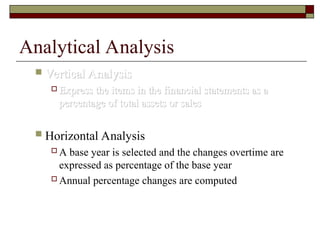
Analytical Analysis
 Vertical Analysis
 Express the items in the financial statements as a
percentage of total assets or sales
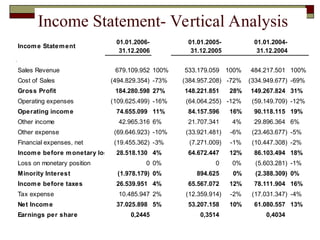
Income Statement- Vertical Analysis
Income Statement
01.01.2006-
31.12.2006
01.01.2005-
31.12.2005
01.01.2004-
31.12.2004
Sales Revenue 679.109.952 100% 533.179.059 100% 484.217.501 100%
Cost of Sales (494.829.354) -73% (384.957.208) -72% (334.949.677) -69%
Gross Profit 184.280.598 27% 148.221.851 28% 149.267.824 31%
Operating expenses (109.625.499) -16% (64.064.255) -12% (59.149.709) -12%
Operating income 74.655.099 11% 84.157.596 16% 90.118.115 19%
Other income 42.965.316 6% 21.707.341 4% 29.896.364 6%
Other expense (69.646.923) -10% (33.921.481) -6% (23.463.677) -5%
Financial expenses, net (19.455.362) -3% (7.271.009) -1% (10.447.308) -2%
Income before monetary loss and taxes
28.518.130 4% 64.672.447 12% 86.103.494 18%
Loss on monetary position 0 0% 0 0% (5.603.281) -1%
Minority Interest (1.978.179) 0% 894.625 0% (2.388.309) 0%
Income before taxes 26.539.951 4% 65.567.072 12% 78.111.904 16%
Tax expense 10.485.947 2% (12.359.914) -2% (17.031.347) -4%
Net Income 37.025.898 5% 53.207.158 10% 61.080.557 13%
Earnings per share 0,2445 0,3514 0,4034
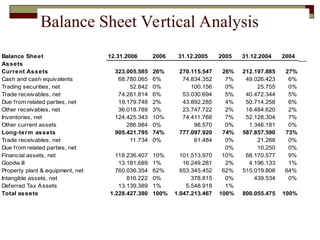
Balance Sheet Vertical Analysis
Balance Sheet 12.31.2006 2006 31.12.2005 2005 31.12.2004 2004
Assets
Current Assets 323.005.585 26% 270.115.547 26% 212.197.885 27%
Cash and cash equivalents 68.780.065 6% 74.834.352 7% 49.026.423 6%
Trading securities, net 52.842 0% 100.156 0% 25.755 0%
Trade receivables, net 74.261.814 6% 53.030.694 5% 40.472.344 5%
Due from related parties, net 19.179.748 2% 43.892.285 4% 50.714.258 6%
Other receivables, net 36.018.789 3% 23.747.722 2% 18.484.620 2%
Inventories, net 124.425.343 10% 74.411.768 7% 52.128.304 7%
Other current assets 286.984 0% 98.570 0% 1.346.181 0%
Long-term assets 905.421.795 74% 777.097.920 74% 587.857.590 73%
Trade receivables, net 11.734 0% 61.484 0% 21.288 0%
Due from related parties, net 0% 10.250 0%
Financial assets, net 118.236.407 10% 101.513.970 10% 68.170.577 9%
Goodw ill 13.181.689 1% 16.249.281 2% 4.196.133 1%
Property plant & equipment, net 760.036.354 62% 653.345.452 62% 515.019.808 64%
Intangible assets, net 816.222 0% 378.815 0% 439.534 0%
Deferred Tax Assets 13.139.389 1% 5.548.918 1%
Total assets 1.228.427.380 100% 1.047.213.467 100% 800.055.475 100%
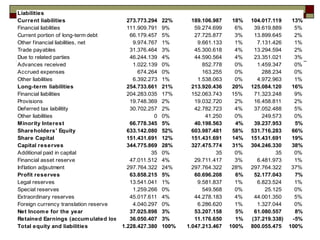
Liabilities
Current liabilities 273.773.294 22% 189.106.987 18% 104.017.119 13%
Financial liabilities 111.909.791 9% 59.274.699 6% 39.619.889 5%
Current portion of long-term debt 66.179.457 5% 27.725.877 3% 13.899.645 2%
Other financial liabilities, net 9.974.767 1% 9.661.133 1% 7.131.426 1%
Trade payables 31.376.464 3% 45.300.618 4% 13.294.594 2%
Due to related parties 46.244.139 4% 44.590.564 4% 23.351.021 3%
Advances received 1.022.139 0% 852.778 0% 1.459.347 0%
Accrued expenses 674.264 0% 163.255 0% 288.234 0%
Other liabilities 6.392.273 1% 1.538.063 0% 4.972.963 1%
Long-term liabilities 254.733.661 21% 213.920.436 20% 125.084.120 16%
Financial liabilities 204.283.035 17% 152.063.743 15% 71.323.248 9%
Provisions 19.748.369 2% 19.032.720 2% 16.458.811 2%
Deferred tax laibilitity 30.702.257 2% 42.782.723 4% 37.052.488 5%
Other liabilities 0 0% 41.250 0% 249.573 0%
Minority Interest 66.778.345 5% 40.198.563 4% 39.237.953 5%
Shareholders' Equity 633.142.080 52% 603.987.481 58% 531.716.283 66%
Share Capital 151.431.691 12% 151.431.691 14% 151.431.691 19%
Capital reserves 344.775.869 28% 327.475.774 31% 304.246.330 38%
Additional paid in capital 35 0% 35 0% 35 0%
Financial asset reserve 47.011.512 4% 29.711.417 3% 6.481.973 1%
Inflation adjsutment 297.764.322 24% 297.764.322 28% 297.764.322 37%
Profit reserves 63.858.215 5% 60.696.208 6% 52.177.043 7%
Legal reserves 13.541.041 1% 9.581.837 1% 6.823.524 1%
Special reserves 1.259.266 0% 549.568 0% 25.125 0%
Extraordinary reserves 45.017.611 4% 44.278.183 4% 44.001.350 5%
Foreign currency translation reserve 4.040.297 0% 6.286.620 1% 1.327.044 0%
Net Income for the year 37.025.898 3% 53.207.158 5% 61.080.557 8%
Retained Earnings (accumulated loss) 36.050.407 3% 11.176.650 1% (37.219.338) -5%
Total equity and liabilities 1.228.427.380 100% 1.047.213.467 100% 800.055.475 100%
Analytical Analysis
 Vertical Analysis
Vertical Analysis
 Express the items in the financial statements as a
Express the items in the financial statements as a
percentage of total assets or sales
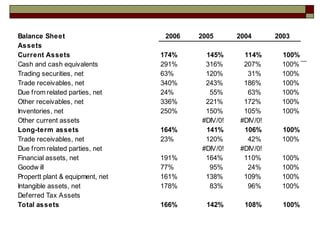
 Horizontal Analysis
 A base year is selected and the changes overtime are
expressed as percentage of the base year
 Annual percentage changes are computed
Balance Sheet 2006 2005 2004 2003
Assets
Current Assets 174% 145% 114% 100%
Cash and cash equivalents 291% 316% 207% 100%
Trading securities, net 63% 120% 31% 100%
Trade receivables, net 340% 243% 186% 100%
Due from related parties, net 24% 55% 63% 100%
Other receivables, net 336% 221% 172% 100%
Inventories, net 250% 150% 105% 100%
Other current assets #DIV/0! #DIV/0!
Long-term assets 164% 141% 106% 100%
Trade receivables, net 23% 120% 42% 100%
Due from related parties, net #DIV/0! #DIV/0!
Financial assets, net 191% 164% 110% 100%
Goodw ill 77% 95% 24% 100%
Propertt plant & equipment, net 161% 138% 109% 100%
Intangible assets, net 178% 83% 96% 100%
Deferred Tax Assets
Total assets 166% 142% 108% 100%
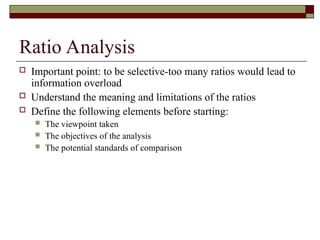
Ratio Analysis
 Important point: to be selective-too many ratios would lead to
information overload
 Understand the meaning and limitations of the ratios
 Define the following elements before starting:
 The viewpoint taken
 The objectives of the analysis
 The potential standards of comparison
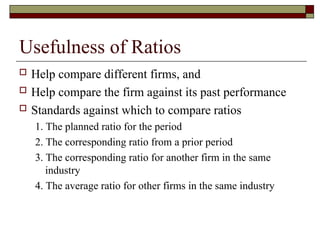
Usefulness of Ratios
 Help compare different firms, and
 Help compare the firm against its past performance
 Standards against which to compare ratios
1. The planned ratio for the period
2. The corresponding ratio from a prior period
3. The corresponding ratio for another firm in the same
industry
4. The average ratio for other firms in the same industry
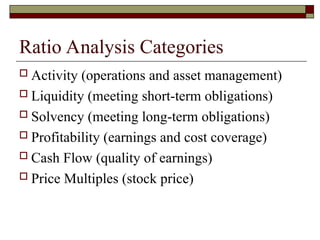
Ratio Analysis Categories
 Activity (operations and asset management)
 Liquidity (meeting short-term obligations)
 Solvency (meeting long-term obligations)
 Profitability (earnings and cost coverage)
 Cash Flow (quality of earnings)
 Price Multiples (stock price)
Activity Ratios
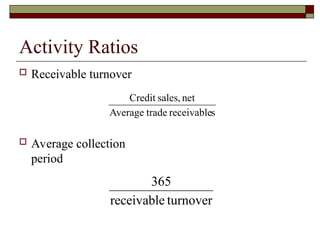
 Receivable turnover
 Average collection
period
s
receivable
trade
Average
net
sales,
Credit
turnover
receivable
365
Activity Ratios
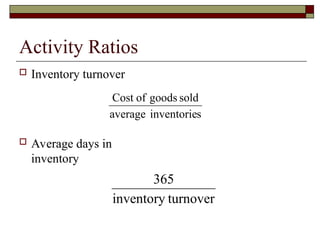
 Inventory turnover
 Average days in
inventory
s
inventorie
average
sold
goods
of
Cost
turnover
inventory
365
Activity Ratios
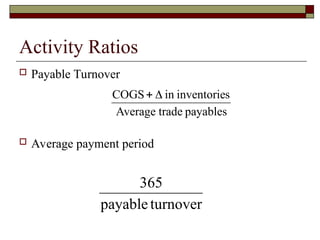
 Payable Turnover
 Average payment period
payables
trade
Average
s
inventorie
in
COGS 

turnover
payable
365
Activity Ratios
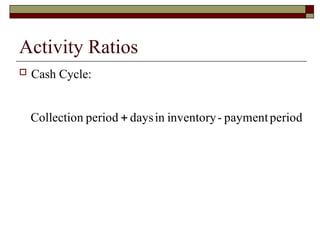
 Cash Cycle:
period
payment
-
inventory
in
days
period
Collection 
Activity Ratios
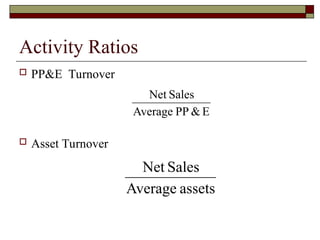
 PP&E Turnover
 Asset Turnover
E
&
PP
Average
Sales
Net
assets
Average
Sales
Net
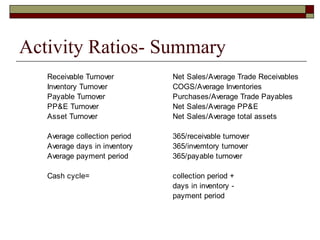
Activity Ratios- Summary
Receivable Turnover Net Sales/Average Trade Receivables
Inventory Turnover COGS/Average Inventories
Payable Turnover Purchases/Average Trade Payables
PP&E Turnover Net Sales/Average PP&E
Asset Turnover Net Sales/Average total assets
Average collection period 365/receivable turnover
Average days in inventory 365/inverntory turnover
Average payment period 365/payable turnover
Cash cycle= collection period +
days in inventory -
payment period
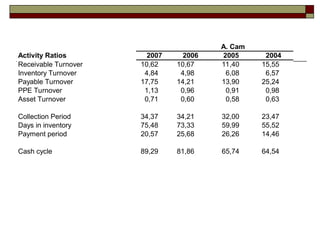
Activity Ratios 2007 2006 2005 2004
Receivable Turnover 10,62 10,67 11,40 15,55
Inventory Turnover 4,84 4,98 6,08 6,57
Payable Turnover 17,75 14,21 13,90 25,24
PPE Turnover 1,13 0,96 0,91 0,98
Asset Turnover 0,71 0,60 0,58 0,63
Collection Period 34,37 34,21 32,00 23,47
Days in inventory 75,48 73,33 59,99 55,52
Payment period 20,57 25,68 26,26 14,46
Cash cycle 89,29 81,86 65,74 64,54
A. Cam
Liquidity Ratios
 Current ratio
 Ability to meet short-term obligations
 [Current assets/current liabilities]
 Quick ratio
 Remove less liquid assets
 Keep cash, liquid investments, A/R
 [(Cash+short-term investments + A/R)/current liabilities]
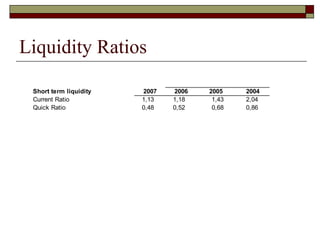
Liquidity Ratios
Short term liquidity 2007 2006 2005 2004
Current Ratio 1,13 1,18 1,43 2,04
Quick Ratio 0,48 0,52 0,68 0,86
Solvency Ratios
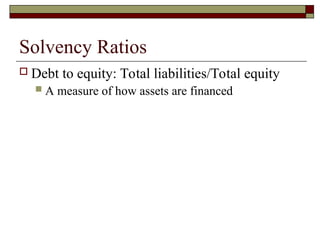
 Debt to assets: Total liabilities/Total assets
 Proportion of assets financed with debt
 Could include interest bearing debt only
[(short term debt + noncurrent debt)/total assets]
 Be aware that assets are recorded at historical
cost, which may be different from current
market value
Solvency Ratios
 Debt to equity: Total liabilities/Total equity
 A measure of how assets are financed
Solvency Ratios
Coverage Ratios
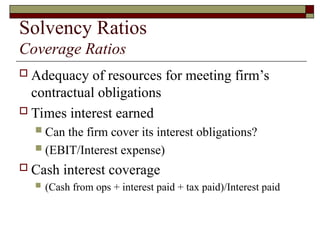
 Adequacy of resources for meeting firm’s
contractual obligations
 Times interest earned
 Can the firm cover its interest obligations?
 (EBIT/Interest expense)
 Cash interest coverage
 (Cash from ops + interest paid + tax paid)/Interest paid
Solvency Ratios
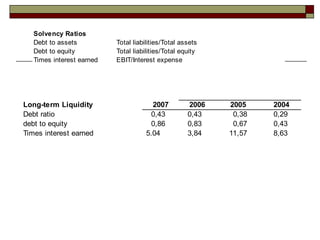
Debt to assets Total liabilities/Total assets
Debt to equity Total liabilities/Total equity
Times interest earned EBIT/Interest expense
Long-term Liquidity 2007 2006 2005 2004
Debt ratio 0,43 0,43 0,38 0,29
debt to equity 0,86 0,83 0,67 0,43
Times interest earned 5.04 3,84 11,57 8,63
Profitability Ratios
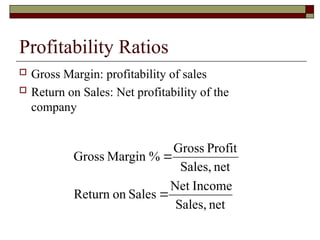
 Gross Margin: profitability of sales
 Return on Sales: Net profitability of the
company
net
Sales,
Income
Net
Sales
on
Return
net
Sales,
Profit
Gross
%
Margin
Gross


Profitability Ratios
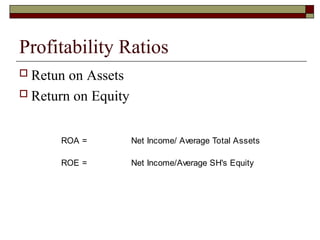
 Retun on Assets
 Return on Equity
ROA = Net Income/ Average Total Assets
ROE = Net Income/Average SH's Equity
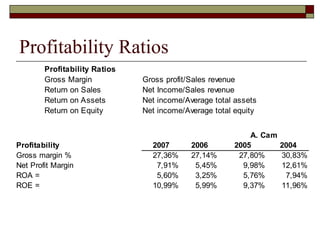
Profitability Ratios
Gross Margin Gross profit/Sales revenue
Return on Sales Net Income/Sales revenue
Return on Assets Net income/Average total assets
Return on Equity Net income/Average total equity
Profitability 2007 2006 2005 2004
Gross margin % 27,36% 27,14% 27,80% 30,83%
Net Profit Margin 7,91% 5,45% 9,98% 12,61%
ROA = 5,60% 3,25% 5,76% 7,94%
ROE = 10,99% 5,99% 9,37% 11,96%
A. Cam
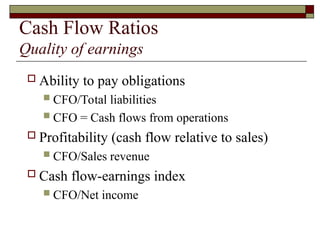
Cash Flow Ratios
Quality of earnings
 Ability to pay obligations
 CFO/Total liabilities
 CFO = Cash flows from operations
 Profitability (cash flow relative to sales)
 CFO/Sales revenue
 Cash flow-earnings index
 CFO/Net income
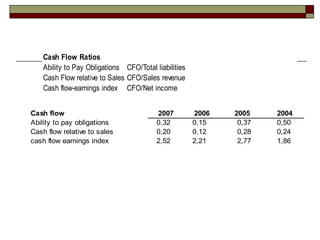
Cash Flow Ratios
Ability to Pay Obligations CFO/Total liabilities
Cash Flow relative to Sales CFO/Sales revenue
Cash flow-earnings index CFO/Net income
Cash flow 2007 2006 2005 2004
Ability to pay obligations 0,32 0,15 0,37 0,50
Cash flow relative to sales 0,20 0,12 0,28 0,24
cash flow earnings index 2,52 2,21 2,77 1,86
Price Multiple Ratios
 Market’s valuation of a firm’s common stock
P/E = Share price/Earnings per share
 Price/book ratio compares stock’s price to the
recorded value of the net assets
[Share price/(Book value of equity/Share outstanding)]
Market Ratios 2007 2006 2005 2004
Price earnings ratio 12,73 46,67 16,93 11,16
price to book value 1,35 1,34 1,49 1,28
Limitation of Ratio Analysis
 Represent the average conditions and influenced by the
accounting methods used
 Based on historical data and do not reflect price level effects
and real economic values
 Changes in many ratios are strongly associated with each other
and interrelationships among/between the ratios should be
examined
 During comparison of ratios over a period of time changes in
operating conditions should be taken into consideration
 During comparison between companies differences among the
companies should be examined
 Use audited financial statements to perform ratio analysis
Analysis of Anadolu Cam
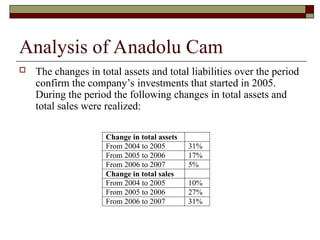
 The changes in total assets and total liabilities over the period
confirm the company’s investments that started in 2005.
During the period the following changes in total assets and
total sales were realized:
Change in total assets
From 2004 to 2005 31%
From 2005 to 2006 17%
From 2006 to 2007 5%
Change in total sales
From 2004 to 2005 10%
From 2005 to 2006 27%
From 2006 to 2007 31%
 After the realization of investments, profitability of the company showed
a decline which caused fluctuations in net income.
 The growth in total sales lagged behind the growth in total assets which is
generally expected in times of investments. The efficiency of assets
should be investigated by the help of turnover ratios in the ratio analysis.
 The proportion of total current assets to current liabilities has been
changing in favor of current liabilities which require further analysis for
short term liquidity.
 Long-term assets are mainly funded by shareholders’ equity and long-
term liabilities which is preferable for long-term solvency. However, the
composition of long-term funds is changing over the years in favor of the
liabilities.
 The composition of total assets didn’t change a lot over the years
presented, although there are slight changes within the composition of
current assets. This requires further investigation in ratio analysis.
Activity Ratios
 All activity ratios for operating items have been decreasing. Both
accounts receivable and inventory turnover ratios decreased considerably
after 2005 (after the investment): This may be a result of higher working
capital requirements of the new investment, or a general trend in the
industry. Furthermore, accounts payable turnover increased in 2007
although no improvements are observed for receivables and inventories.
These are expected to increase the need of working capital requirements
of the company. In other words, the increase in cash cycle to 89 days
requires additional funding for the company. When the increase in
financial liabilities from 2005 to 2006 is considered (90%), one can
conclude that the company financed the working capital investments by
short term financial liabilities.
 The decreases in turnover rates for accounts receivable and inventories
and the increase in the accounts payable turnover is a future threat for the
short term liquidity of the company.
Activity Ratios
 The performance in the PPE and total asset
turnover is as expected. After the investments
PPE turnover together with the total asset
turnover declined (for 2005 and 2006). Such
turnover rates improved in 2007 when the
investments were completed.
Short term Liquidity
 Short-term liquidity ratios of the company had been decreasing since
2005. This may be a result of making investments. Both the current and
the quick ratios are below the rule of thumb ratios of 2 and 1,
respectively.
 There is a considerable difference between the current and the quick ratio.
This is normally an indication of inventory dependence. When one checks
the level of inventories and the increase in inventories, it seems that
inventory account has been growing. As the inventory turnover of the
company is decreasing over the years, we can conclude that short term
liquidity of the company is alarming. As of the last reporting date, it
seems that the company may not be able to pay its current liabilities with
its most quick assets. In addition, because of the decreases in inventory,
current assets may also not be sufficient to meet the current liabilities.
Long-term Solvency
 Both the debt ratio and the debt to equity ratio are at the acceptable levels. Under normal
conditions debt ratio of 50% is deemed to be optimal for the financial risk of the company.
 The debt ratio started to increase in 2005 after the investments. This means that the company
financed its investments by using liabilities. Since these liabilities are long-term, they
shouldn’t adversely affect the risk. Also, by using liability funding the company is expected
to enjoy financial leverage. As of the end of the last reporting period, the company doesn’t
seem to have a long-term solvency problem. It has a healthy financial structure.
 Times interest earned is used by creditors to assess the ability to make interest payments
from the earnings of the company. Until 2006, interest coverage performance of the
company was very successful. However, starting with 2006, both the short term and long
term financial liabilities increased, and so the financial expenses. In addition in 2006, as will
be explained in the profitability analysis, operating income of the company declined
significantly. All the above mentioned factors caused times interest earned ratio to decline.
However, we should also note that the ratio recovered in 2007 as a result of recovery in
profitability. Although it would better to have a higher coverage ratio, we believe the current
performance of the company does not raise a red flag at the moment.
Profitability
 To assess the company’s performance in terms of profitability we should also use the ratios of a similar
company as we should for the activity ratios.
 Over the years the company’s profitability declined until 2007. Especially in 2006 both the operating
margin and the net profit margin had declined significantly. One of the reasons of such decrease could be
the increase in fixed costs of the company after making the investment. When one analyses the income
statement and the related notes to the financial statements there are three important reasons for the
decreasing profits of 2006:
 Within the operating expenses, selling expenses increased a lot, which may be due to marketing efforts after the
capacity increase. These expenses declined in the following year.
 Secondly, the company had approximately YTL19.000 of losses from sale of property, plant and equipment. In 2006
after the new investment, the company might have disposed of old equipment. Losses on sales of PPE are not
continuing expenses therefore; they are not expected to adversely affect profitability in the future.
 The third reason of the decrease in profitability in 2006 is the 170% increase in the financial expenses as a result of
the increase in the borrowings during the same period. Financial expenses continue to increase in 2007, however, as
total sales also increased, percent of financial expenses within sales is constant.
 The company’s ROE and ROA had sharp decreases in 2006. Such a sharp decrease in that year had two
reasons: First because of the reasons explained above, net income decreased. Second is the growth in
assets and shareholders’ equity. The decrease in ROA is sharper because of the increase in the assets.
Both ratios recovered back in 2007, although they didn’t reach their previous levels.
 In summary, although the company’s profitability ratios declined after the investment, improvements had
started in 2007. If the sales of the company continue to increase, profitability performance of the
company doesn’t raise any red flags.
Cash Flow Performance
 The company had been generating positive operating
cash flows for the last four years, and the cash flow
index is more than 2 over the same period. Therefore
there doesn’t seem to be a earnings quality problem.
 During 2006 the company had positive cash flows
from operating and financing activities. Investments
were mostly financed by liabilities. In 2007 cash
flows from financing activities was also negative.
The company started to pay back the liabilities. It
also continued to pay dividends, although not as
much as the previous year.
Market Ratios
 Price earnings ratio of the company was
considerably high in 2006, which was probably due
to lower earnings at that year. It declined in 2007 for
two reasons: First the earnings increased, second
share price declined. We should check the PE ratios
and the market performance of other companies as
well to comment on the decrease of the share price.
 However, the fact that the company increased its
share capital by issuing free shares from the inflation
adjustment might have caused the share price to
decrease.
Conclusion
 Except for the short term liquidity, the company’s financial position and
performance is satisfactory. However before making any concluding remarks, we
should also compare the results of this analysis with industry averages and/or a
similar company.
 Future success of the company is dependent on the continuing increase in the
growth of sales revenues. 2009 is a period for which growth in the economy and
in many other industries is not very promising, therefore the company may face
difficulties in increasing its sales. And if the sales do not increase as expected the
company’s future earnings may be at stake. Furthermore, the company’s short
term liquidity is currently dependent on sustainable short term bank loans. If
banks call back the loans and/or don’t give additional loans, the company may not
be able to pay back its liabilities.
 One more point to be considered is the group within which the company operates.
It’s a part of Şişecam which is owned by İşbank. Its shareholders are currently
very powerful in the market. Furthermore, the company is the largest in its area.
One adverse point about the future of the company, is the fact that its second
market is Russia, where the economy is not going very well.
Recommendations
 It is not advisable to provide a short term loan for the company.
However, from the perspective of a current short term creditor, calling
back the loan also doesn’t seem to be a good choice, as loans may not be
ultimately paid back if called early. For a new creditor it wouldn’t be
wise to give a new short term loan.
 The company’s financial structure is sound. It generates profits and
operating cash flows. Therefore, a long-term loan may be provided.
 As an investor, ignoring the current market conditions, Anadolu Cam
may be a good investment alternative. The company is profitable and
paying dividends. Furthermore, its PE ratio has declined in the previous
year. It can be expected to increase in the future. However, if the stock
market is expected to decline due to general economic conditions,
investing in a stock may not be a good idea from a short-term
perspective. If the investor has long-term investment goals, Anadolu
Cam shares may be purchased.

Chapter 14-511 (1).ppt financial statments

  • 1.
  • 2.
    Who and Why? To understand the economics of a firm and  To help forecast its future profitability and risk  Managers  Responsible for day to day operations and long-run performance  Responsible and accountable for efficiency, effective deployment of capital, human resource and other resource management  Owners  Interested in current and long-term returns on their investments  Expect growing earnings, dividends  Affected by how earnings are distributed and how their shares are valued in the market  Lenders and creditors  Concerned about liquidity and cash flow of the company  Interested in the degree of financial leverage employed  Others: employees, government, society
  • 3.
    Financial Statement Analysis Should start with an understanding of  Global and local macro economic condition  Industry (past performance, future expectations, competition etc…)  Should involve time series analysis,  Should compare performance with peers, competitors, industry averages
  • 4.
    Tools  Analytical Analysis Vertical Analysis  Horizontal Analysis  Ratio Analysis
  • 5.
    Analytical Analysis  VerticalAnalysis  Express the items in the financial statements as a percentage of total assets or sales
  • 6.
    Income Statement- VerticalAnalysis Income Statement 01.01.2006- 31.12.2006 01.01.2005- 31.12.2005 01.01.2004- 31.12.2004 Sales Revenue 679.109.952 100% 533.179.059 100% 484.217.501 100% Cost of Sales (494.829.354) -73% (384.957.208) -72% (334.949.677) -69% Gross Profit 184.280.598 27% 148.221.851 28% 149.267.824 31% Operating expenses (109.625.499) -16% (64.064.255) -12% (59.149.709) -12% Operating income 74.655.099 11% 84.157.596 16% 90.118.115 19% Other income 42.965.316 6% 21.707.341 4% 29.896.364 6% Other expense (69.646.923) -10% (33.921.481) -6% (23.463.677) -5% Financial expenses, net (19.455.362) -3% (7.271.009) -1% (10.447.308) -2% Income before monetary loss and taxes 28.518.130 4% 64.672.447 12% 86.103.494 18% Loss on monetary position 0 0% 0 0% (5.603.281) -1% Minority Interest (1.978.179) 0% 894.625 0% (2.388.309) 0% Income before taxes 26.539.951 4% 65.567.072 12% 78.111.904 16% Tax expense 10.485.947 2% (12.359.914) -2% (17.031.347) -4% Net Income 37.025.898 5% 53.207.158 10% 61.080.557 13% Earnings per share 0,2445 0,3514 0,4034
  • 7.
    Balance Sheet VerticalAnalysis Balance Sheet 12.31.2006 2006 31.12.2005 2005 31.12.2004 2004 Assets Current Assets 323.005.585 26% 270.115.547 26% 212.197.885 27% Cash and cash equivalents 68.780.065 6% 74.834.352 7% 49.026.423 6% Trading securities, net 52.842 0% 100.156 0% 25.755 0% Trade receivables, net 74.261.814 6% 53.030.694 5% 40.472.344 5% Due from related parties, net 19.179.748 2% 43.892.285 4% 50.714.258 6% Other receivables, net 36.018.789 3% 23.747.722 2% 18.484.620 2% Inventories, net 124.425.343 10% 74.411.768 7% 52.128.304 7% Other current assets 286.984 0% 98.570 0% 1.346.181 0% Long-term assets 905.421.795 74% 777.097.920 74% 587.857.590 73% Trade receivables, net 11.734 0% 61.484 0% 21.288 0% Due from related parties, net 0% 10.250 0% Financial assets, net 118.236.407 10% 101.513.970 10% 68.170.577 9% Goodw ill 13.181.689 1% 16.249.281 2% 4.196.133 1% Property plant & equipment, net 760.036.354 62% 653.345.452 62% 515.019.808 64% Intangible assets, net 816.222 0% 378.815 0% 439.534 0% Deferred Tax Assets 13.139.389 1% 5.548.918 1% Total assets 1.228.427.380 100% 1.047.213.467 100% 800.055.475 100%
  • 8.
    Liabilities Current liabilities 273.773.29422% 189.106.987 18% 104.017.119 13% Financial liabilities 111.909.791 9% 59.274.699 6% 39.619.889 5% Current portion of long-term debt 66.179.457 5% 27.725.877 3% 13.899.645 2% Other financial liabilities, net 9.974.767 1% 9.661.133 1% 7.131.426 1% Trade payables 31.376.464 3% 45.300.618 4% 13.294.594 2% Due to related parties 46.244.139 4% 44.590.564 4% 23.351.021 3% Advances received 1.022.139 0% 852.778 0% 1.459.347 0% Accrued expenses 674.264 0% 163.255 0% 288.234 0% Other liabilities 6.392.273 1% 1.538.063 0% 4.972.963 1% Long-term liabilities 254.733.661 21% 213.920.436 20% 125.084.120 16% Financial liabilities 204.283.035 17% 152.063.743 15% 71.323.248 9% Provisions 19.748.369 2% 19.032.720 2% 16.458.811 2% Deferred tax laibilitity 30.702.257 2% 42.782.723 4% 37.052.488 5% Other liabilities 0 0% 41.250 0% 249.573 0% Minority Interest 66.778.345 5% 40.198.563 4% 39.237.953 5% Shareholders' Equity 633.142.080 52% 603.987.481 58% 531.716.283 66% Share Capital 151.431.691 12% 151.431.691 14% 151.431.691 19% Capital reserves 344.775.869 28% 327.475.774 31% 304.246.330 38% Additional paid in capital 35 0% 35 0% 35 0% Financial asset reserve 47.011.512 4% 29.711.417 3% 6.481.973 1% Inflation adjsutment 297.764.322 24% 297.764.322 28% 297.764.322 37% Profit reserves 63.858.215 5% 60.696.208 6% 52.177.043 7% Legal reserves 13.541.041 1% 9.581.837 1% 6.823.524 1% Special reserves 1.259.266 0% 549.568 0% 25.125 0% Extraordinary reserves 45.017.611 4% 44.278.183 4% 44.001.350 5% Foreign currency translation reserve 4.040.297 0% 6.286.620 1% 1.327.044 0% Net Income for the year 37.025.898 3% 53.207.158 5% 61.080.557 8% Retained Earnings (accumulated loss) 36.050.407 3% 11.176.650 1% (37.219.338) -5% Total equity and liabilities 1.228.427.380 100% 1.047.213.467 100% 800.055.475 100%
  • 9.
    Analytical Analysis  VerticalAnalysis Vertical Analysis  Express the items in the financial statements as a Express the items in the financial statements as a percentage of total assets or sales percentage of total assets or sales  Horizontal Analysis  A base year is selected and the changes overtime are expressed as percentage of the base year  Annual percentage changes are computed
  • 10.
    Balance Sheet 20062005 2004 2003 Assets Current Assets 174% 145% 114% 100% Cash and cash equivalents 291% 316% 207% 100% Trading securities, net 63% 120% 31% 100% Trade receivables, net 340% 243% 186% 100% Due from related parties, net 24% 55% 63% 100% Other receivables, net 336% 221% 172% 100% Inventories, net 250% 150% 105% 100% Other current assets #DIV/0! #DIV/0! Long-term assets 164% 141% 106% 100% Trade receivables, net 23% 120% 42% 100% Due from related parties, net #DIV/0! #DIV/0! Financial assets, net 191% 164% 110% 100% Goodw ill 77% 95% 24% 100% Propertt plant & equipment, net 161% 138% 109% 100% Intangible assets, net 178% 83% 96% 100% Deferred Tax Assets Total assets 166% 142% 108% 100%
  • 11.
    Ratio Analysis  Importantpoint: to be selective-too many ratios would lead to information overload  Understand the meaning and limitations of the ratios  Define the following elements before starting:  The viewpoint taken  The objectives of the analysis  The potential standards of comparison
  • 12.
    Usefulness of Ratios Help compare different firms, and  Help compare the firm against its past performance  Standards against which to compare ratios 1. The planned ratio for the period 2. The corresponding ratio from a prior period 3. The corresponding ratio for another firm in the same industry 4. The average ratio for other firms in the same industry
  • 13.
    Ratio Analysis Categories Activity (operations and asset management)  Liquidity (meeting short-term obligations)  Solvency (meeting long-term obligations)  Profitability (earnings and cost coverage)  Cash Flow (quality of earnings)  Price Multiples (stock price)
  • 14.
    Activity Ratios  Receivableturnover  Average collection period s receivable trade Average net sales, Credit turnover receivable 365
  • 15.
    Activity Ratios  Inventoryturnover  Average days in inventory s inventorie average sold goods of Cost turnover inventory 365
  • 16.
    Activity Ratios  PayableTurnover  Average payment period payables trade Average s inventorie in COGS   turnover payable 365
  • 17.
    Activity Ratios  CashCycle: period payment - inventory in days period Collection 
  • 18.
    Activity Ratios  PP&ETurnover  Asset Turnover E & PP Average Sales Net assets Average Sales Net
  • 19.
    Activity Ratios- Summary ReceivableTurnover Net Sales/Average Trade Receivables Inventory Turnover COGS/Average Inventories Payable Turnover Purchases/Average Trade Payables PP&E Turnover Net Sales/Average PP&E Asset Turnover Net Sales/Average total assets Average collection period 365/receivable turnover Average days in inventory 365/inverntory turnover Average payment period 365/payable turnover Cash cycle= collection period + days in inventory - payment period
  • 20.
    Activity Ratios 20072006 2005 2004 Receivable Turnover 10,62 10,67 11,40 15,55 Inventory Turnover 4,84 4,98 6,08 6,57 Payable Turnover 17,75 14,21 13,90 25,24 PPE Turnover 1,13 0,96 0,91 0,98 Asset Turnover 0,71 0,60 0,58 0,63 Collection Period 34,37 34,21 32,00 23,47 Days in inventory 75,48 73,33 59,99 55,52 Payment period 20,57 25,68 26,26 14,46 Cash cycle 89,29 81,86 65,74 64,54 A. Cam
  • 21.
    Liquidity Ratios  Currentratio  Ability to meet short-term obligations  [Current assets/current liabilities]  Quick ratio  Remove less liquid assets  Keep cash, liquid investments, A/R  [(Cash+short-term investments + A/R)/current liabilities]
  • 22.
    Liquidity Ratios Short termliquidity 2007 2006 2005 2004 Current Ratio 1,13 1,18 1,43 2,04 Quick Ratio 0,48 0,52 0,68 0,86
  • 23.
    Solvency Ratios  Debtto assets: Total liabilities/Total assets  Proportion of assets financed with debt  Could include interest bearing debt only [(short term debt + noncurrent debt)/total assets]  Be aware that assets are recorded at historical cost, which may be different from current market value
  • 24.
    Solvency Ratios  Debtto equity: Total liabilities/Total equity  A measure of how assets are financed
  • 25.
    Solvency Ratios Coverage Ratios Adequacy of resources for meeting firm’s contractual obligations  Times interest earned  Can the firm cover its interest obligations?  (EBIT/Interest expense)  Cash interest coverage  (Cash from ops + interest paid + tax paid)/Interest paid
  • 26.
    Solvency Ratios Debt toassets Total liabilities/Total assets Debt to equity Total liabilities/Total equity Times interest earned EBIT/Interest expense Long-term Liquidity 2007 2006 2005 2004 Debt ratio 0,43 0,43 0,38 0,29 debt to equity 0,86 0,83 0,67 0,43 Times interest earned 5.04 3,84 11,57 8,63
  • 27.
    Profitability Ratios  GrossMargin: profitability of sales  Return on Sales: Net profitability of the company net Sales, Income Net Sales on Return net Sales, Profit Gross % Margin Gross  
  • 28.
    Profitability Ratios  Retunon Assets  Return on Equity ROA = Net Income/ Average Total Assets ROE = Net Income/Average SH's Equity
  • 29.
    Profitability Ratios Profitability Ratios GrossMargin Gross profit/Sales revenue Return on Sales Net Income/Sales revenue Return on Assets Net income/Average total assets Return on Equity Net income/Average total equity Profitability 2007 2006 2005 2004 Gross margin % 27,36% 27,14% 27,80% 30,83% Net Profit Margin 7,91% 5,45% 9,98% 12,61% ROA = 5,60% 3,25% 5,76% 7,94% ROE = 10,99% 5,99% 9,37% 11,96% A. Cam
  • 30.
    Cash Flow Ratios Qualityof earnings  Ability to pay obligations  CFO/Total liabilities  CFO = Cash flows from operations  Profitability (cash flow relative to sales)  CFO/Sales revenue  Cash flow-earnings index  CFO/Net income
  • 31.
    Cash Flow Ratios Abilityto Pay Obligations CFO/Total liabilities Cash Flow relative to Sales CFO/Sales revenue Cash flow-earnings index CFO/Net income Cash flow 2007 2006 2005 2004 Ability to pay obligations 0,32 0,15 0,37 0,50 Cash flow relative to sales 0,20 0,12 0,28 0,24 cash flow earnings index 2,52 2,21 2,77 1,86
  • 32.
    Price Multiple Ratios Market’s valuation of a firm’s common stock P/E = Share price/Earnings per share  Price/book ratio compares stock’s price to the recorded value of the net assets [Share price/(Book value of equity/Share outstanding)] Market Ratios 2007 2006 2005 2004 Price earnings ratio 12,73 46,67 16,93 11,16 price to book value 1,35 1,34 1,49 1,28
  • 33.
    Limitation of RatioAnalysis  Represent the average conditions and influenced by the accounting methods used  Based on historical data and do not reflect price level effects and real economic values  Changes in many ratios are strongly associated with each other and interrelationships among/between the ratios should be examined  During comparison of ratios over a period of time changes in operating conditions should be taken into consideration  During comparison between companies differences among the companies should be examined  Use audited financial statements to perform ratio analysis
  • 34.
    Analysis of AnadoluCam  The changes in total assets and total liabilities over the period confirm the company’s investments that started in 2005. During the period the following changes in total assets and total sales were realized: Change in total assets From 2004 to 2005 31% From 2005 to 2006 17% From 2006 to 2007 5% Change in total sales From 2004 to 2005 10% From 2005 to 2006 27% From 2006 to 2007 31%
  • 35.
     After therealization of investments, profitability of the company showed a decline which caused fluctuations in net income.  The growth in total sales lagged behind the growth in total assets which is generally expected in times of investments. The efficiency of assets should be investigated by the help of turnover ratios in the ratio analysis.  The proportion of total current assets to current liabilities has been changing in favor of current liabilities which require further analysis for short term liquidity.  Long-term assets are mainly funded by shareholders’ equity and long- term liabilities which is preferable for long-term solvency. However, the composition of long-term funds is changing over the years in favor of the liabilities.  The composition of total assets didn’t change a lot over the years presented, although there are slight changes within the composition of current assets. This requires further investigation in ratio analysis.
  • 36.
    Activity Ratios  Allactivity ratios for operating items have been decreasing. Both accounts receivable and inventory turnover ratios decreased considerably after 2005 (after the investment): This may be a result of higher working capital requirements of the new investment, or a general trend in the industry. Furthermore, accounts payable turnover increased in 2007 although no improvements are observed for receivables and inventories. These are expected to increase the need of working capital requirements of the company. In other words, the increase in cash cycle to 89 days requires additional funding for the company. When the increase in financial liabilities from 2005 to 2006 is considered (90%), one can conclude that the company financed the working capital investments by short term financial liabilities.  The decreases in turnover rates for accounts receivable and inventories and the increase in the accounts payable turnover is a future threat for the short term liquidity of the company.
  • 37.
    Activity Ratios  Theperformance in the PPE and total asset turnover is as expected. After the investments PPE turnover together with the total asset turnover declined (for 2005 and 2006). Such turnover rates improved in 2007 when the investments were completed.
  • 38.
    Short term Liquidity Short-term liquidity ratios of the company had been decreasing since 2005. This may be a result of making investments. Both the current and the quick ratios are below the rule of thumb ratios of 2 and 1, respectively.  There is a considerable difference between the current and the quick ratio. This is normally an indication of inventory dependence. When one checks the level of inventories and the increase in inventories, it seems that inventory account has been growing. As the inventory turnover of the company is decreasing over the years, we can conclude that short term liquidity of the company is alarming. As of the last reporting date, it seems that the company may not be able to pay its current liabilities with its most quick assets. In addition, because of the decreases in inventory, current assets may also not be sufficient to meet the current liabilities.
  • 39.
    Long-term Solvency  Boththe debt ratio and the debt to equity ratio are at the acceptable levels. Under normal conditions debt ratio of 50% is deemed to be optimal for the financial risk of the company.  The debt ratio started to increase in 2005 after the investments. This means that the company financed its investments by using liabilities. Since these liabilities are long-term, they shouldn’t adversely affect the risk. Also, by using liability funding the company is expected to enjoy financial leverage. As of the end of the last reporting period, the company doesn’t seem to have a long-term solvency problem. It has a healthy financial structure.  Times interest earned is used by creditors to assess the ability to make interest payments from the earnings of the company. Until 2006, interest coverage performance of the company was very successful. However, starting with 2006, both the short term and long term financial liabilities increased, and so the financial expenses. In addition in 2006, as will be explained in the profitability analysis, operating income of the company declined significantly. All the above mentioned factors caused times interest earned ratio to decline. However, we should also note that the ratio recovered in 2007 as a result of recovery in profitability. Although it would better to have a higher coverage ratio, we believe the current performance of the company does not raise a red flag at the moment.
  • 40.
    Profitability  To assessthe company’s performance in terms of profitability we should also use the ratios of a similar company as we should for the activity ratios.  Over the years the company’s profitability declined until 2007. Especially in 2006 both the operating margin and the net profit margin had declined significantly. One of the reasons of such decrease could be the increase in fixed costs of the company after making the investment. When one analyses the income statement and the related notes to the financial statements there are three important reasons for the decreasing profits of 2006:  Within the operating expenses, selling expenses increased a lot, which may be due to marketing efforts after the capacity increase. These expenses declined in the following year.  Secondly, the company had approximately YTL19.000 of losses from sale of property, plant and equipment. In 2006 after the new investment, the company might have disposed of old equipment. Losses on sales of PPE are not continuing expenses therefore; they are not expected to adversely affect profitability in the future.  The third reason of the decrease in profitability in 2006 is the 170% increase in the financial expenses as a result of the increase in the borrowings during the same period. Financial expenses continue to increase in 2007, however, as total sales also increased, percent of financial expenses within sales is constant.  The company’s ROE and ROA had sharp decreases in 2006. Such a sharp decrease in that year had two reasons: First because of the reasons explained above, net income decreased. Second is the growth in assets and shareholders’ equity. The decrease in ROA is sharper because of the increase in the assets. Both ratios recovered back in 2007, although they didn’t reach their previous levels.  In summary, although the company’s profitability ratios declined after the investment, improvements had started in 2007. If the sales of the company continue to increase, profitability performance of the company doesn’t raise any red flags.
  • 41.
    Cash Flow Performance The company had been generating positive operating cash flows for the last four years, and the cash flow index is more than 2 over the same period. Therefore there doesn’t seem to be a earnings quality problem.  During 2006 the company had positive cash flows from operating and financing activities. Investments were mostly financed by liabilities. In 2007 cash flows from financing activities was also negative. The company started to pay back the liabilities. It also continued to pay dividends, although not as much as the previous year.
  • 42.
    Market Ratios  Priceearnings ratio of the company was considerably high in 2006, which was probably due to lower earnings at that year. It declined in 2007 for two reasons: First the earnings increased, second share price declined. We should check the PE ratios and the market performance of other companies as well to comment on the decrease of the share price.  However, the fact that the company increased its share capital by issuing free shares from the inflation adjustment might have caused the share price to decrease.
  • 43.
    Conclusion  Except forthe short term liquidity, the company’s financial position and performance is satisfactory. However before making any concluding remarks, we should also compare the results of this analysis with industry averages and/or a similar company.  Future success of the company is dependent on the continuing increase in the growth of sales revenues. 2009 is a period for which growth in the economy and in many other industries is not very promising, therefore the company may face difficulties in increasing its sales. And if the sales do not increase as expected the company’s future earnings may be at stake. Furthermore, the company’s short term liquidity is currently dependent on sustainable short term bank loans. If banks call back the loans and/or don’t give additional loans, the company may not be able to pay back its liabilities.  One more point to be considered is the group within which the company operates. It’s a part of Şişecam which is owned by İşbank. Its shareholders are currently very powerful in the market. Furthermore, the company is the largest in its area. One adverse point about the future of the company, is the fact that its second market is Russia, where the economy is not going very well.
  • 44.
    Recommendations  It isnot advisable to provide a short term loan for the company. However, from the perspective of a current short term creditor, calling back the loan also doesn’t seem to be a good choice, as loans may not be ultimately paid back if called early. For a new creditor it wouldn’t be wise to give a new short term loan.  The company’s financial structure is sound. It generates profits and operating cash flows. Therefore, a long-term loan may be provided.  As an investor, ignoring the current market conditions, Anadolu Cam may be a good investment alternative. The company is profitable and paying dividends. Furthermore, its PE ratio has declined in the previous year. It can be expected to increase in the future. However, if the stock market is expected to decline due to general economic conditions, investing in a stock may not be a good idea from a short-term perspective. If the investor has long-term investment goals, Anadolu Cam shares may be purchased.