1
An Assignment on UNIT I
ELEMENTS OF DIFFUSION
Course No: EXT.503
Course Title:
Diffusion and Adoption of Innovations (2+1)
SUBMITTED TO
Dr. J. B. Patel
Associate Professor
Department of Extension Education
B A College of Agriculture
AAU, Anand-388 110
SUBMITTED BY
Haseena Bibi (04-2599-2015)
M.Sc. (Agri.) Extn. Edu.
2nd Semester 2
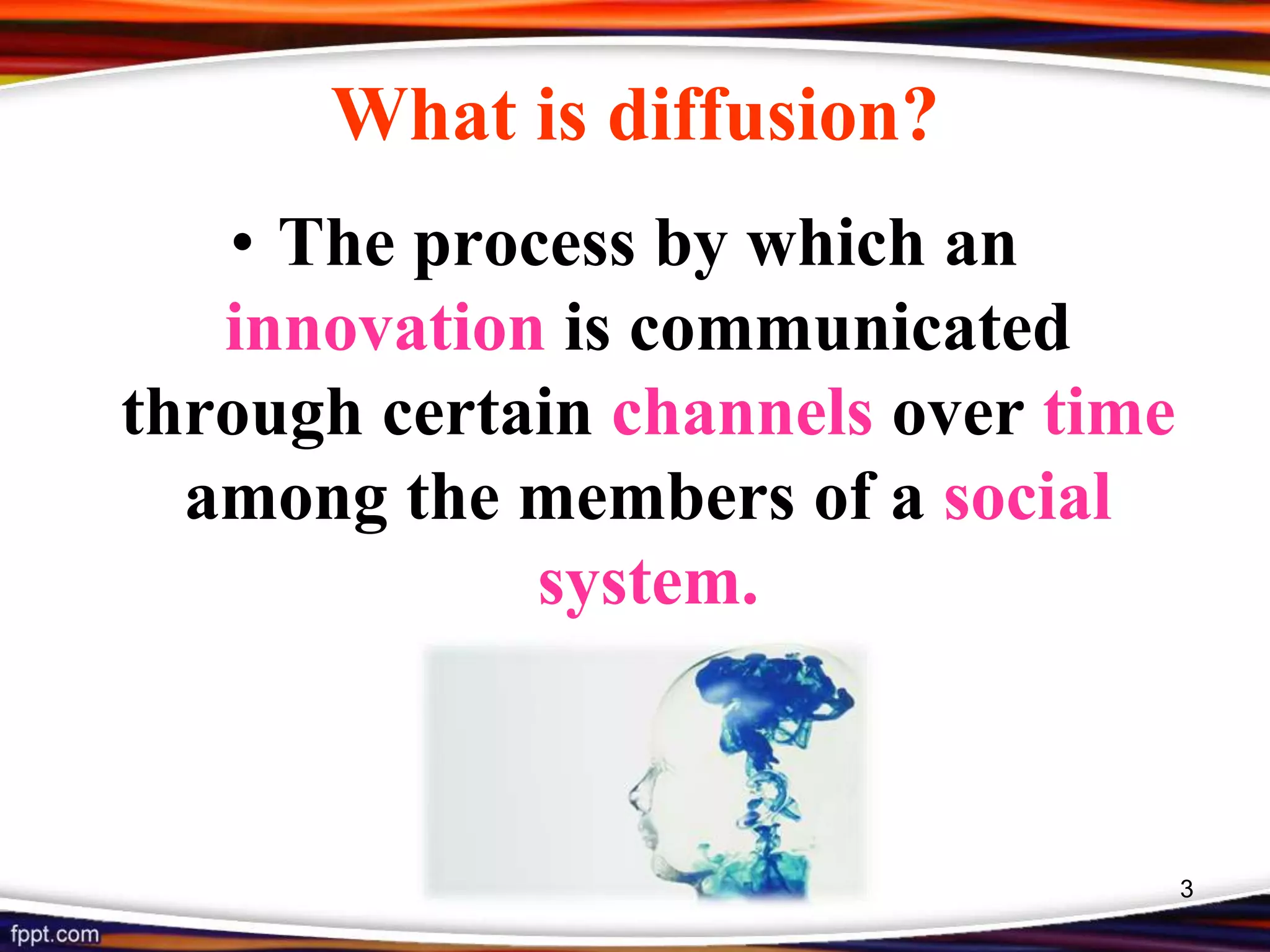
What is diffusion?
• The process by which an
innovation is communicated
through certain channels over time
among the members of a social
system.
3
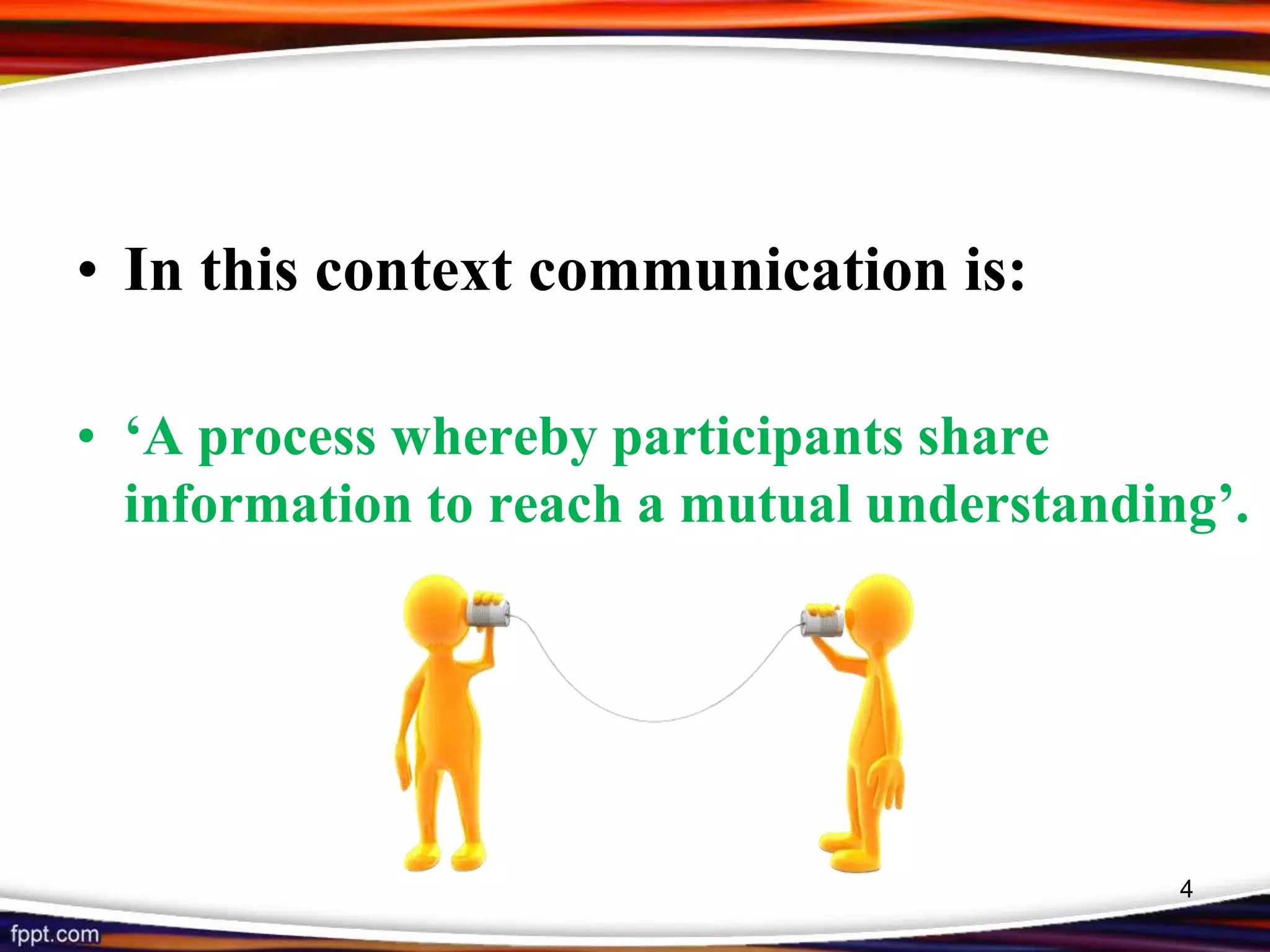
• In this context communication is:
• ‘A process whereby participants share
information to reach a mutual understanding’.
4
• Diffusion is a special type of communication
in which the messages are about a new idea.
• The newness of the idea gives diffusion its
special character – it ensures that a degree
of uncertainty is involved in diffusion.
5
• Uncertainty – the degree to which a range
of alternatives are perceived with regard to
the occurrence of an event.
• Uncertainty implies lack of predictability
and therefore of information.
6
• To put this in a nutshell - for Rogers, “Diffusion of
innovations" means
• The dissemination of uncertainty-reducing
information embodied in products or processes
through a social system.
7
The Process of the diffusion of
Innovations
• Diffusion is a process where an innovation is
communicated through certain channels over
time among members of a social system
8
9
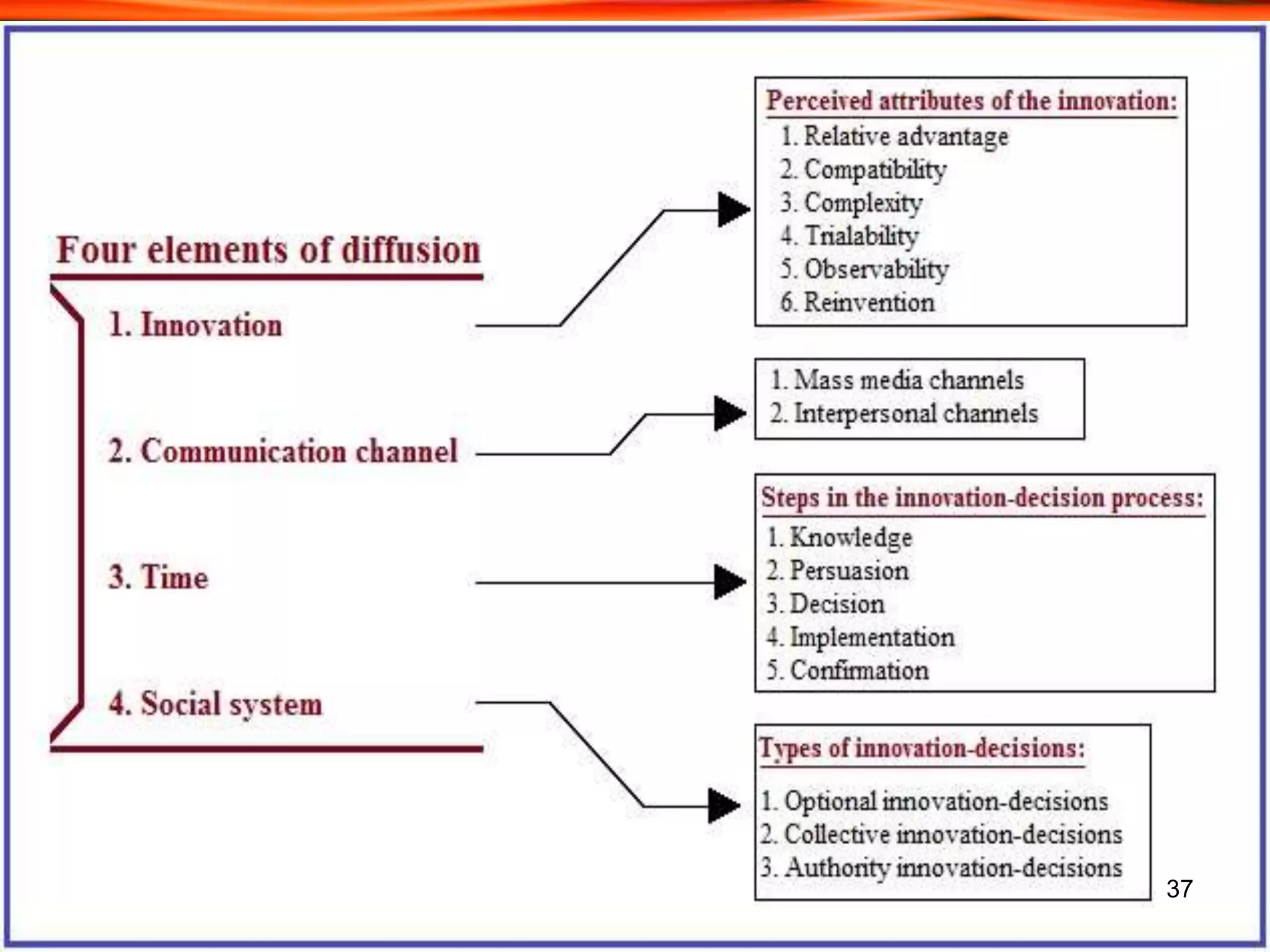
Four Elements in Diffusion of
Innovations:
• Diffusion is a process where:
1) an innovation
2) is communicated through certain channels
3) over time
4) among members of a social system
10
The Innovation
• An idea, practice or object that is perceived as
new by an individual or other unit of adoption.
11
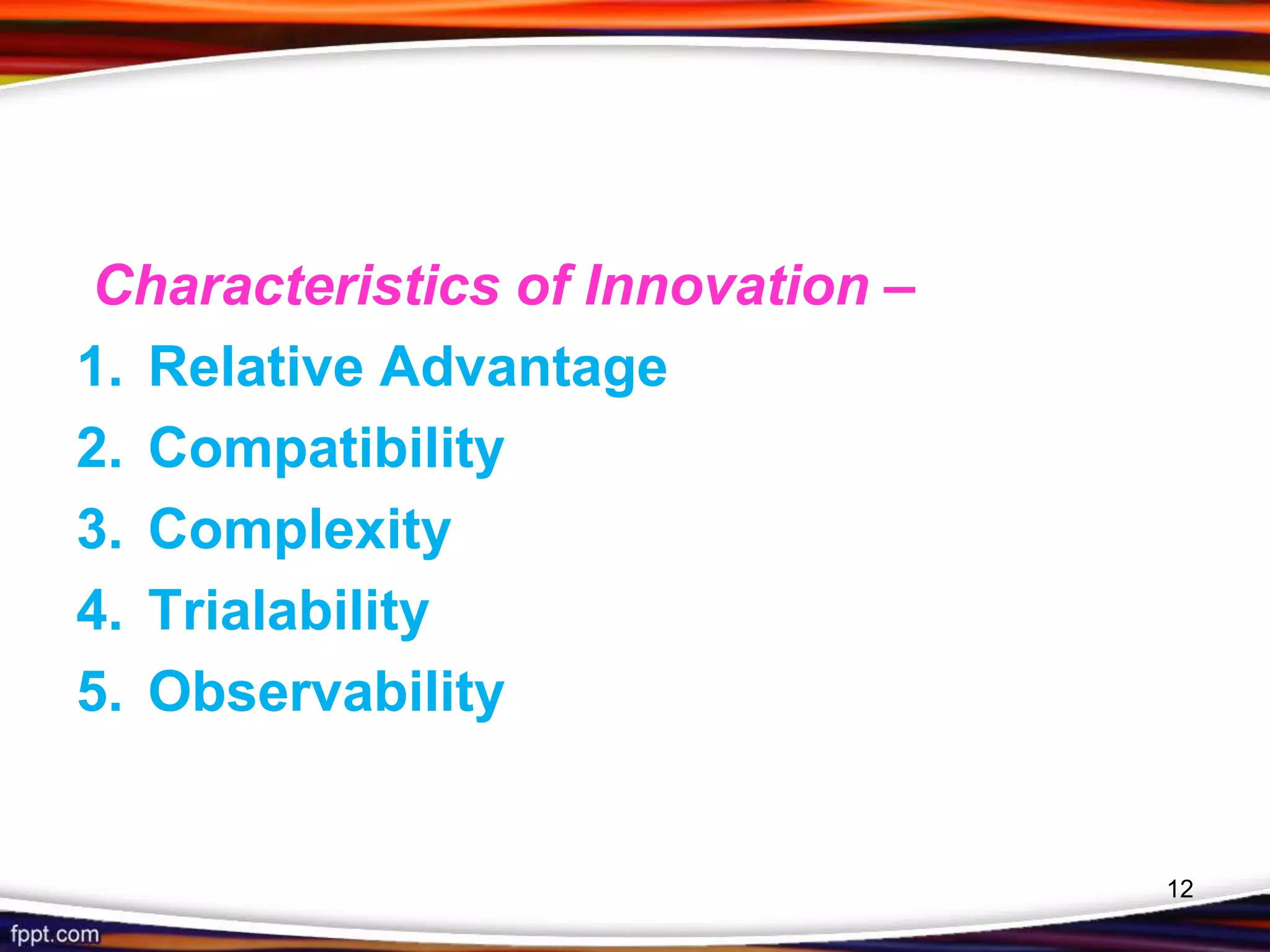
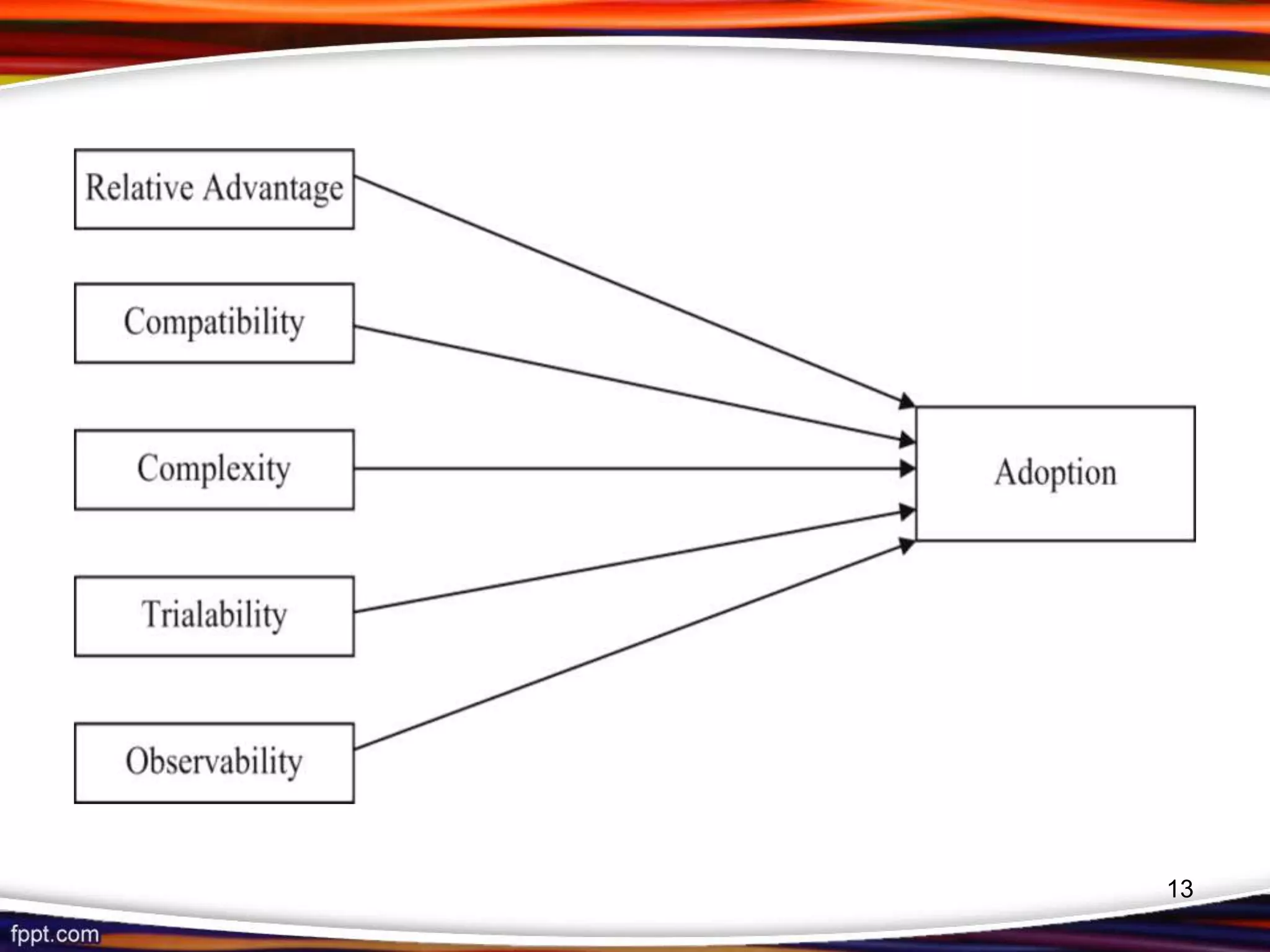
Characteristics of Innovation –
1. Relative Advantage
2. Compatibility
3. Complexity
4. Trialability
5. Observability
12
13
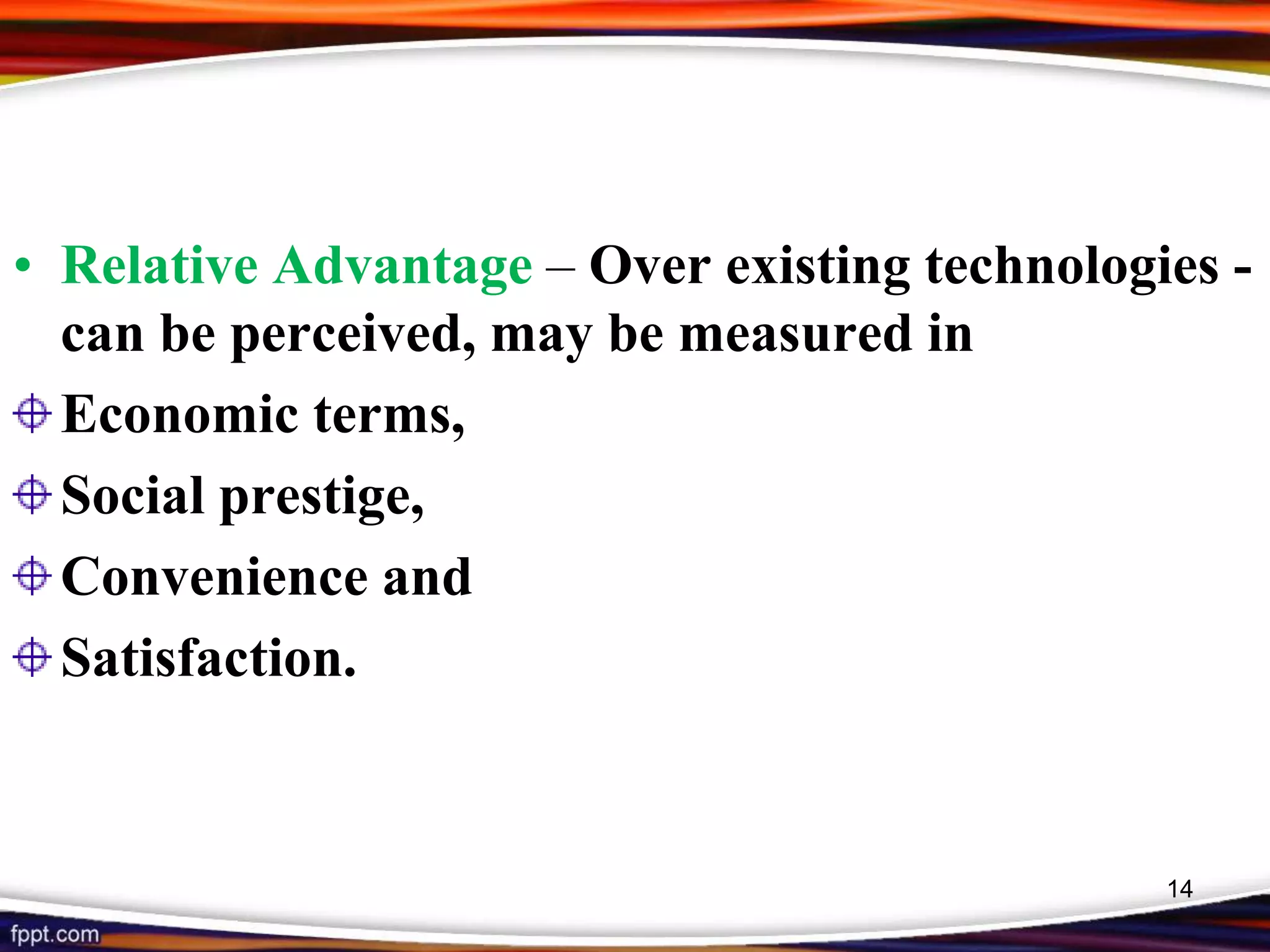
• Relative Advantage – Over existing technologies -
can be perceived, may be measured in
Economic terms,
Social prestige,
Convenience and
Satisfaction.
14
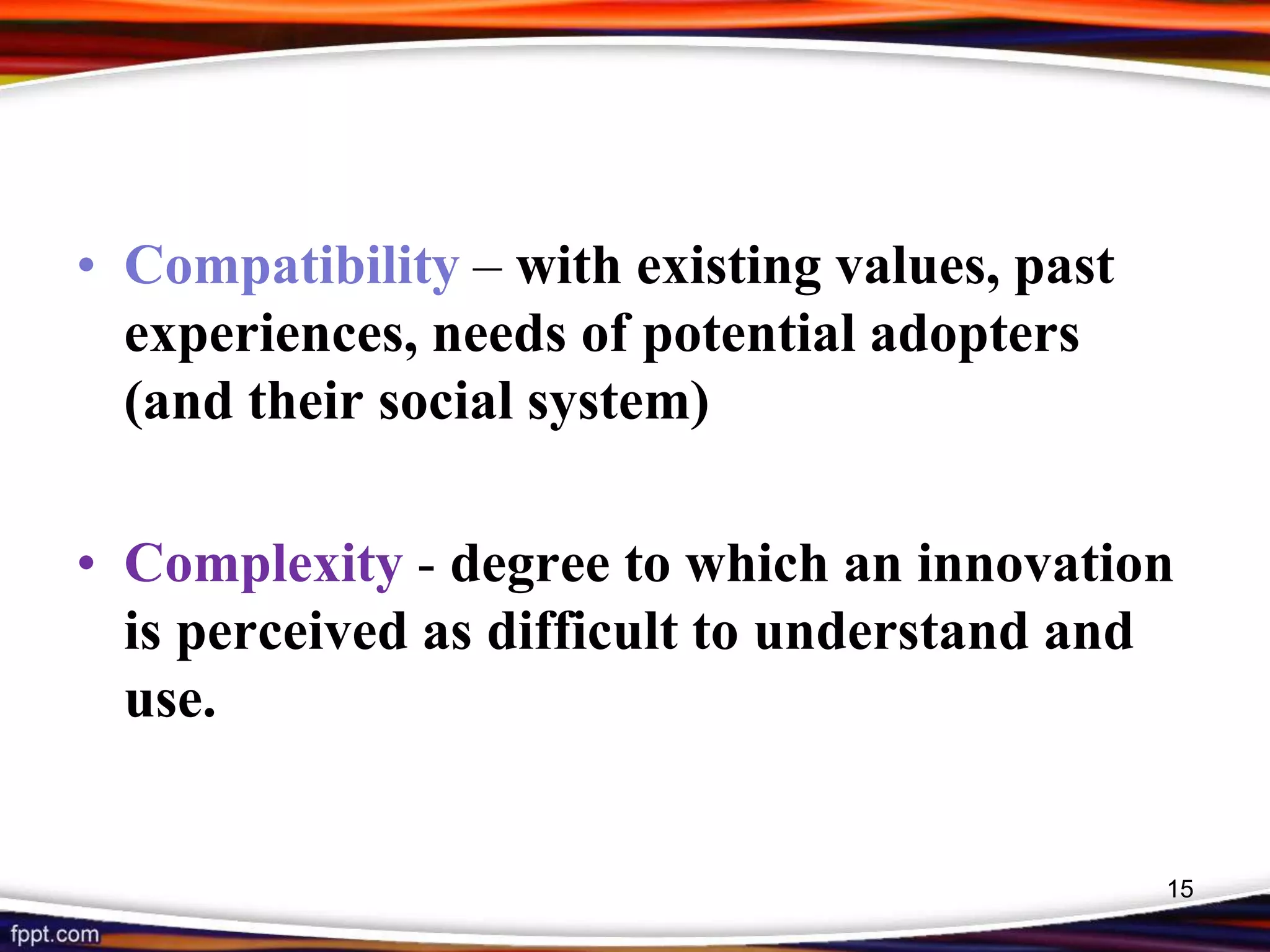
• Compatibility – with existing values, past
experiences, needs of potential adopters
(and their social system)
• Complexity - degree to which an innovation
is perceived as difficult to understand and
use.
15
• Trialability – degree to which an innovation
may be experimented with on a limited
basis. A trialable innovation represented
less uncertainty to a potential adopter.
• Observability – Degree to which the results
of an innovation are visible to others.
16
.
Communications Channels
• The means by which messages get from one
individual to another.
• The nature of the information-exchange
relation determines the conditions under
which a source will/will not transmit the
innovation to the receiver and the effect of
the transfer.
17
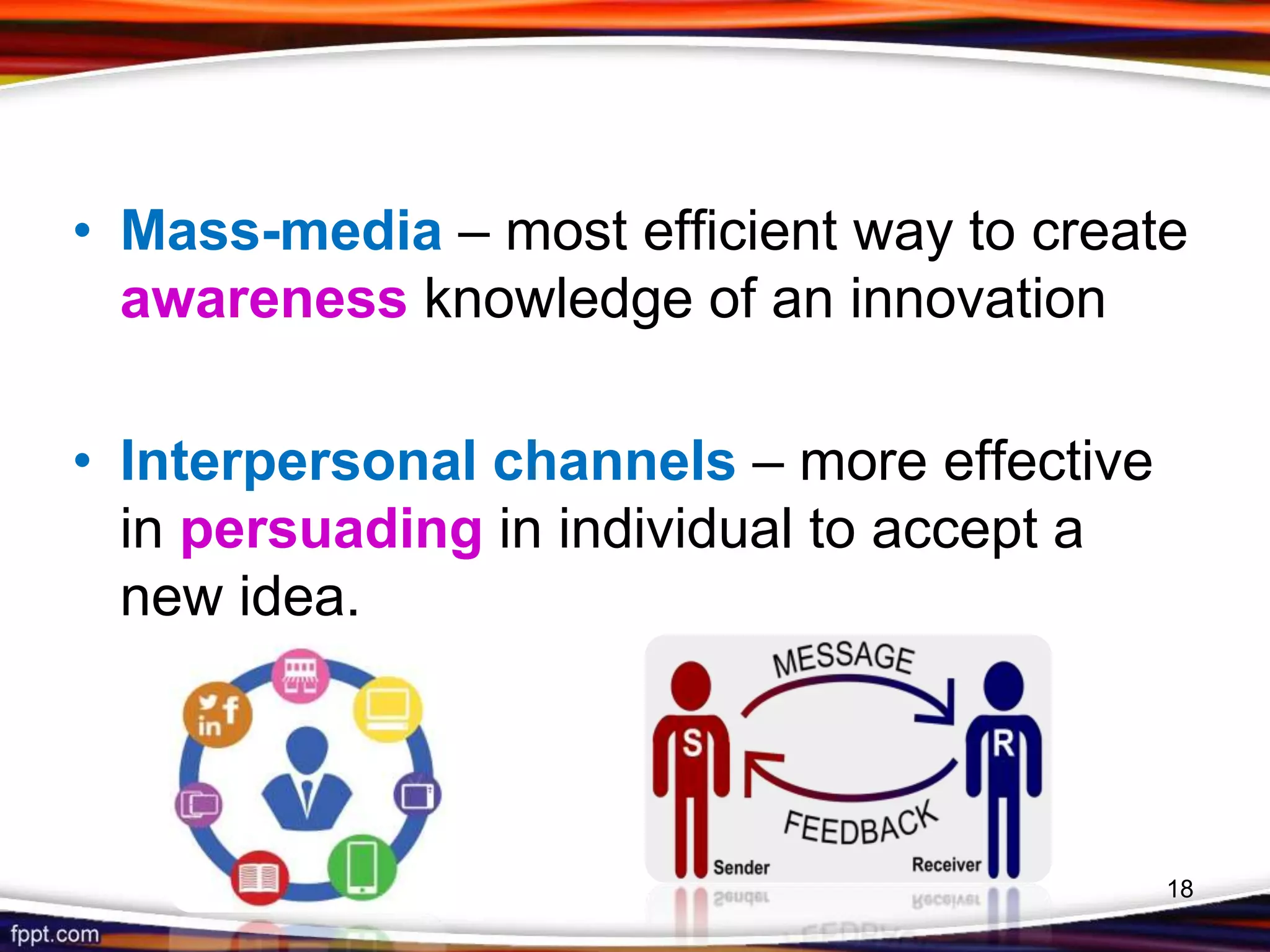
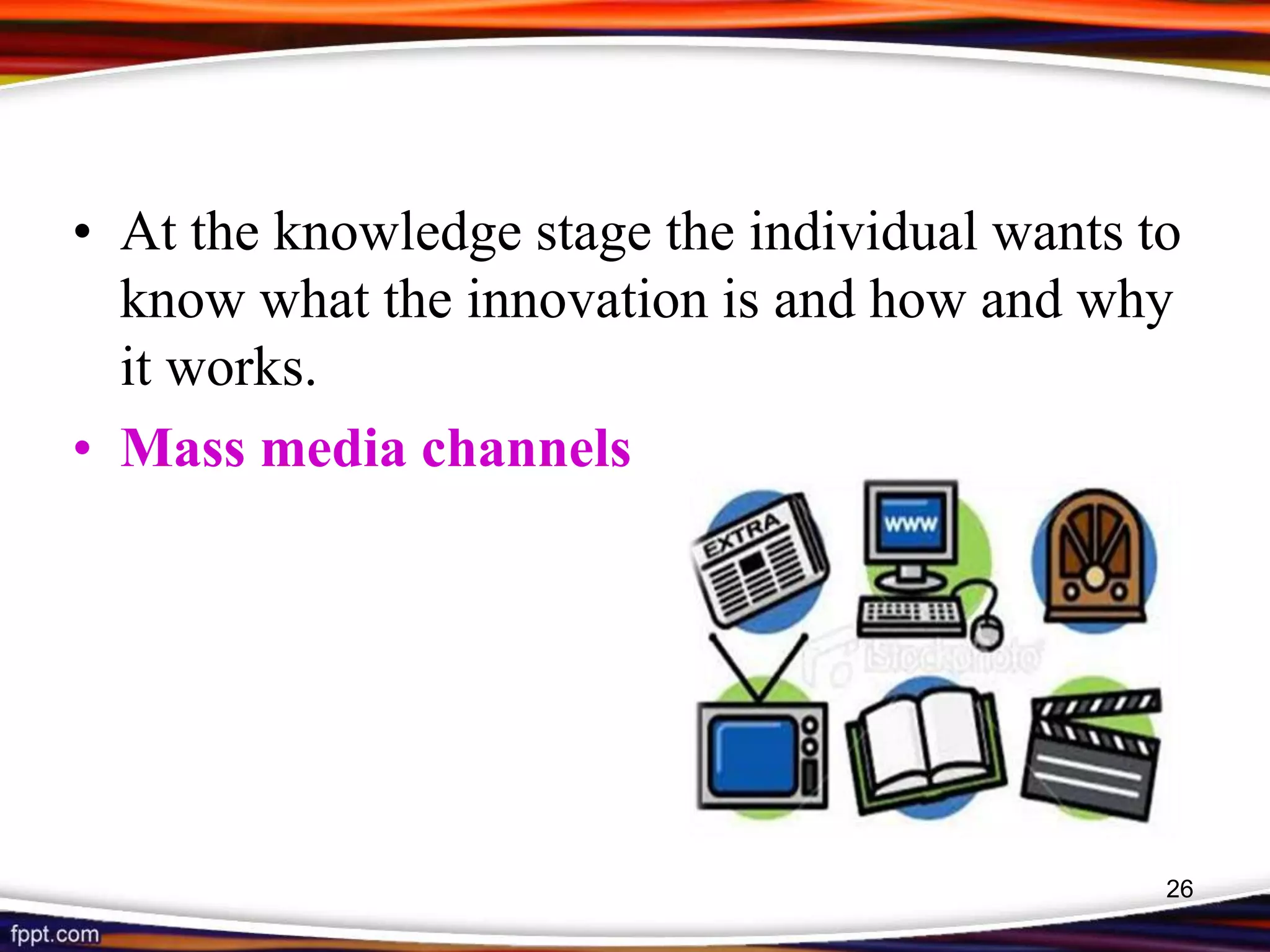
• Mass-media – most efficient way to create
awareness knowledge of an innovation
• Interpersonal channels – more effective
in persuading in individual to accept a
new idea.
18
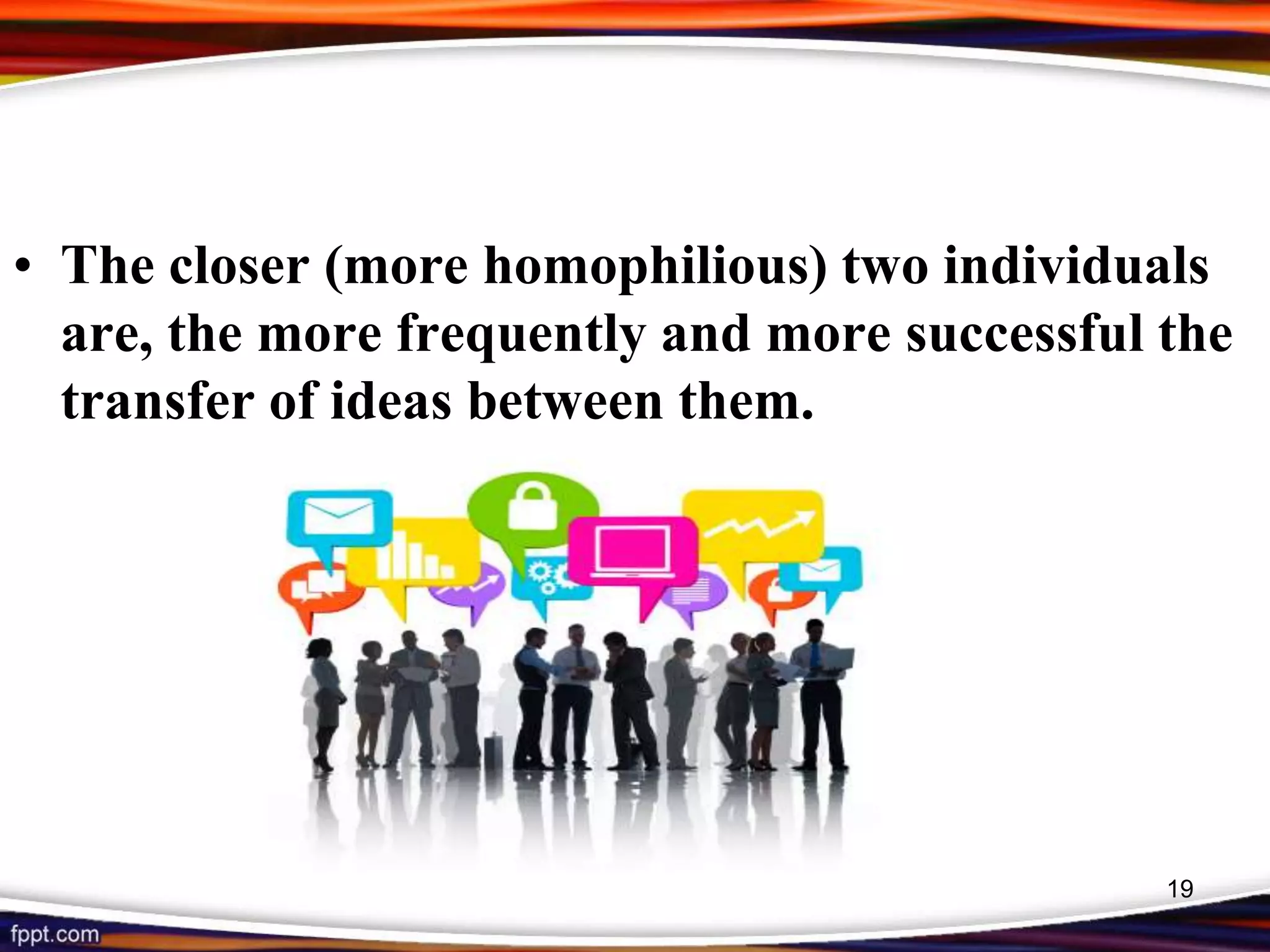
• The closer (more homophilious) two individuals
are, the more frequently and more successful the
transfer of ideas between them.
19
Time
• Time - third element in the diffusion
process. Involved in:
– the innovation-decision process
– the innovativeness of an individual
– an innovation’s rate of adoption in a system
20
THE INNOVATION-DECISION PROCESS
• THE INNOVATION-DECISION PROCESS -
the process through which an individual passes
from first knowledge of an innovation to forming
an attitude toward the innovation, to a decision to
adopt or reject it.
21
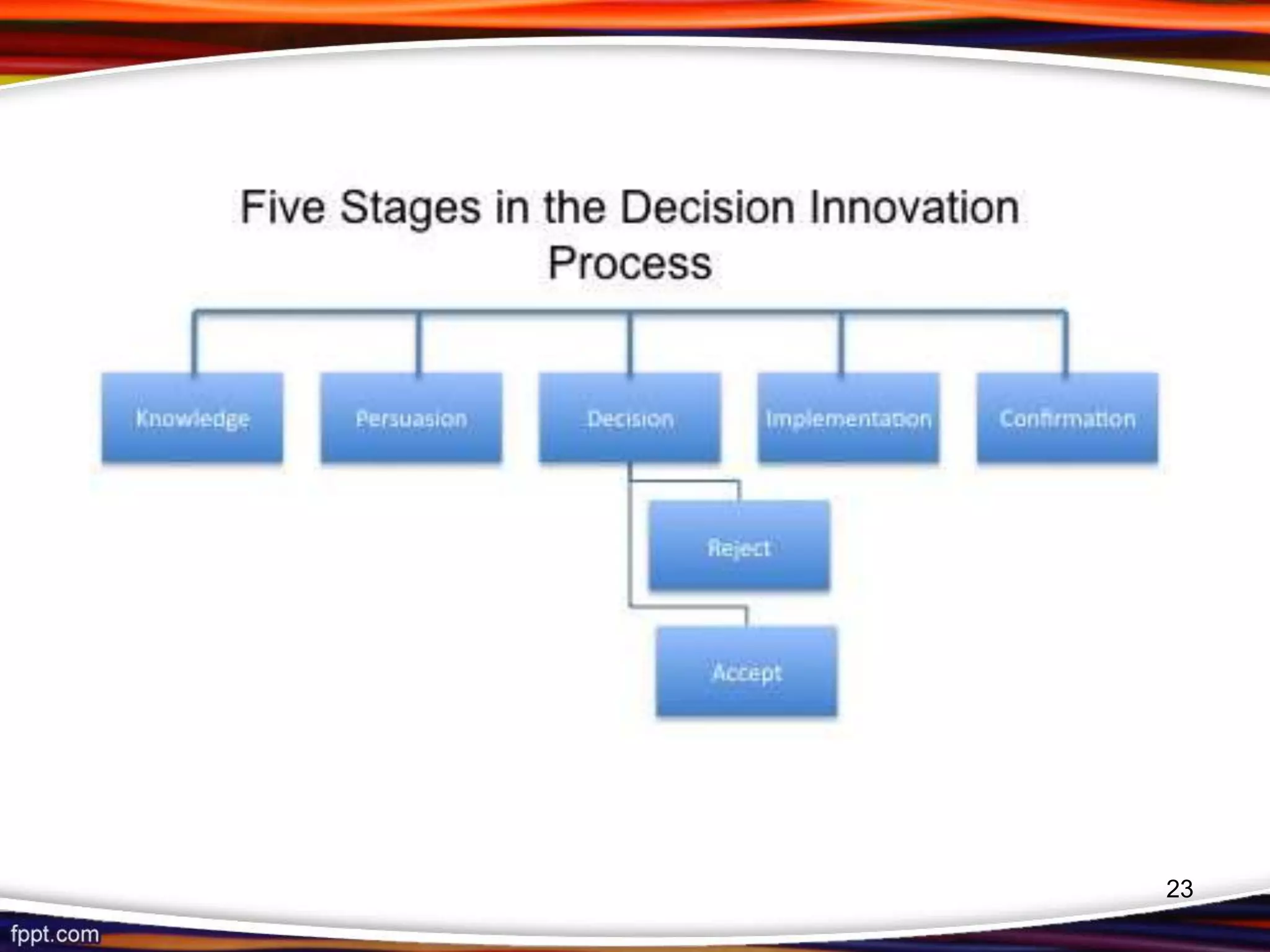
• Five stages in the innovation-decision
process:
(1) Knowledge,
(2) Persuasion,
(3) Decision,
(4) Implementation, and
(5) Confirmation.
22
23
• Knowledge occurs when an individual (or other decision-
making unit) learns of the innovation’s existence and gains
some understanding of how it functions.
• Persuasion occurs when an individual (or other decision-
making unit) forms a favourable or unfavourable attitude
toward the innovation.
• Decision occurs when an individual (or other decision-
making unit) engages in activities that lead to a choice to
adopt or reject the innovation.
24
• Implementation occurs when an individual (or other
decision-making unit) puts an innovation into use. Re-
invention is especially likely to occur at the implementation
stage.
• Confirmation occurs when an individual (or other
decision-making unit) seeks reinforcement of an
innovation-decision that has already been made, but the
individual may reverse this previous decision if exposed to
conflicting innovation.
25
• At the knowledge stage the individual wants to
know what the innovation is and how and why
it works.
• Mass media channels
26
• At the persuasion stage the individual wants
to know the innovation’s advantages and
disadvantages in his or her own situation.
• Interpersonal networks
27
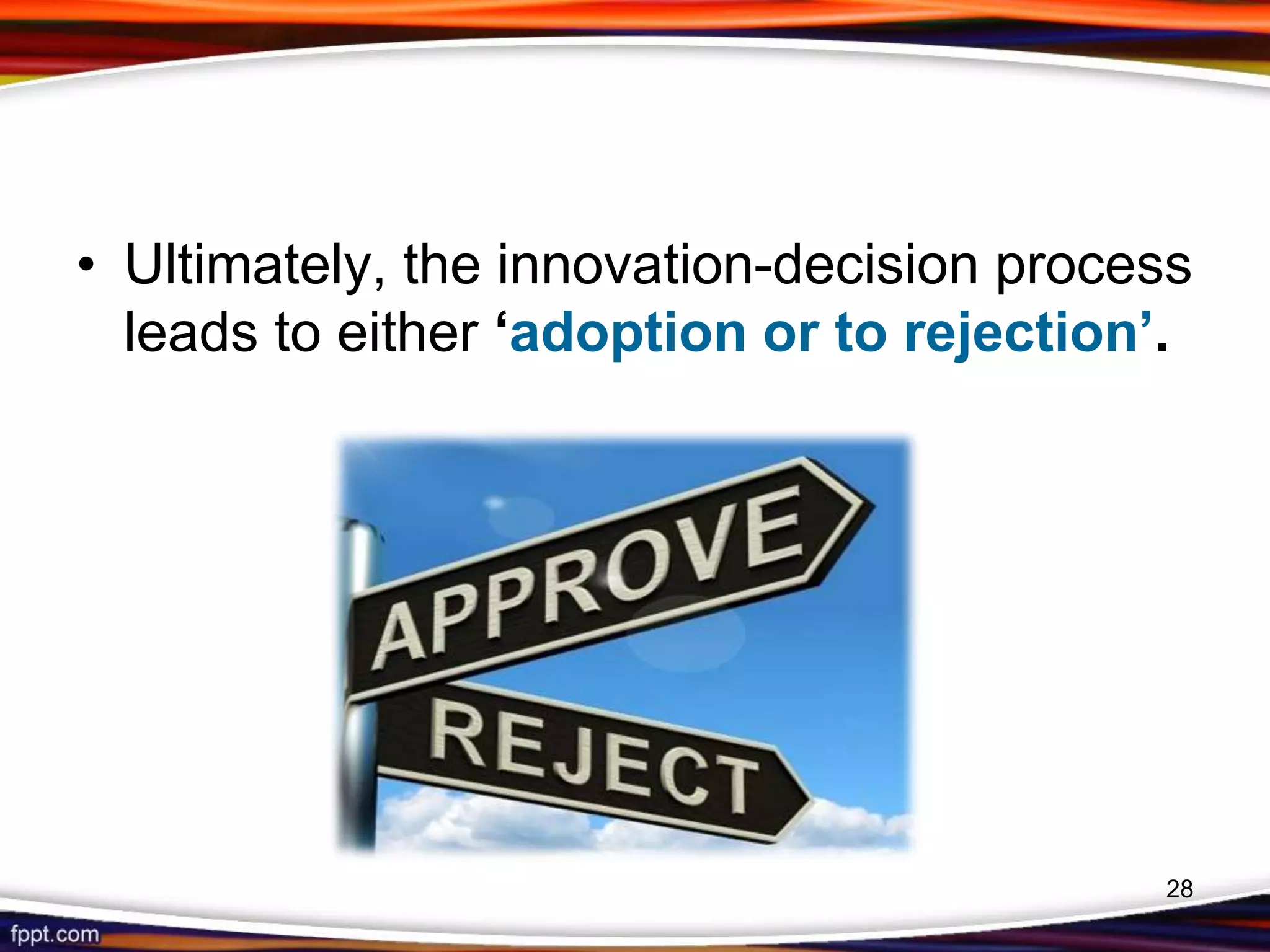
• Ultimately, the innovation-decision process
leads to either ‘adoption or to rejection’.
28
INNOVATIVENESS AND
ADOPTER CATEGORIES
• “Innovativeness” - the degree to which an
individual or other unit of adoption is
relatively earlier in adopting new ideas than
the other members of a system.
29
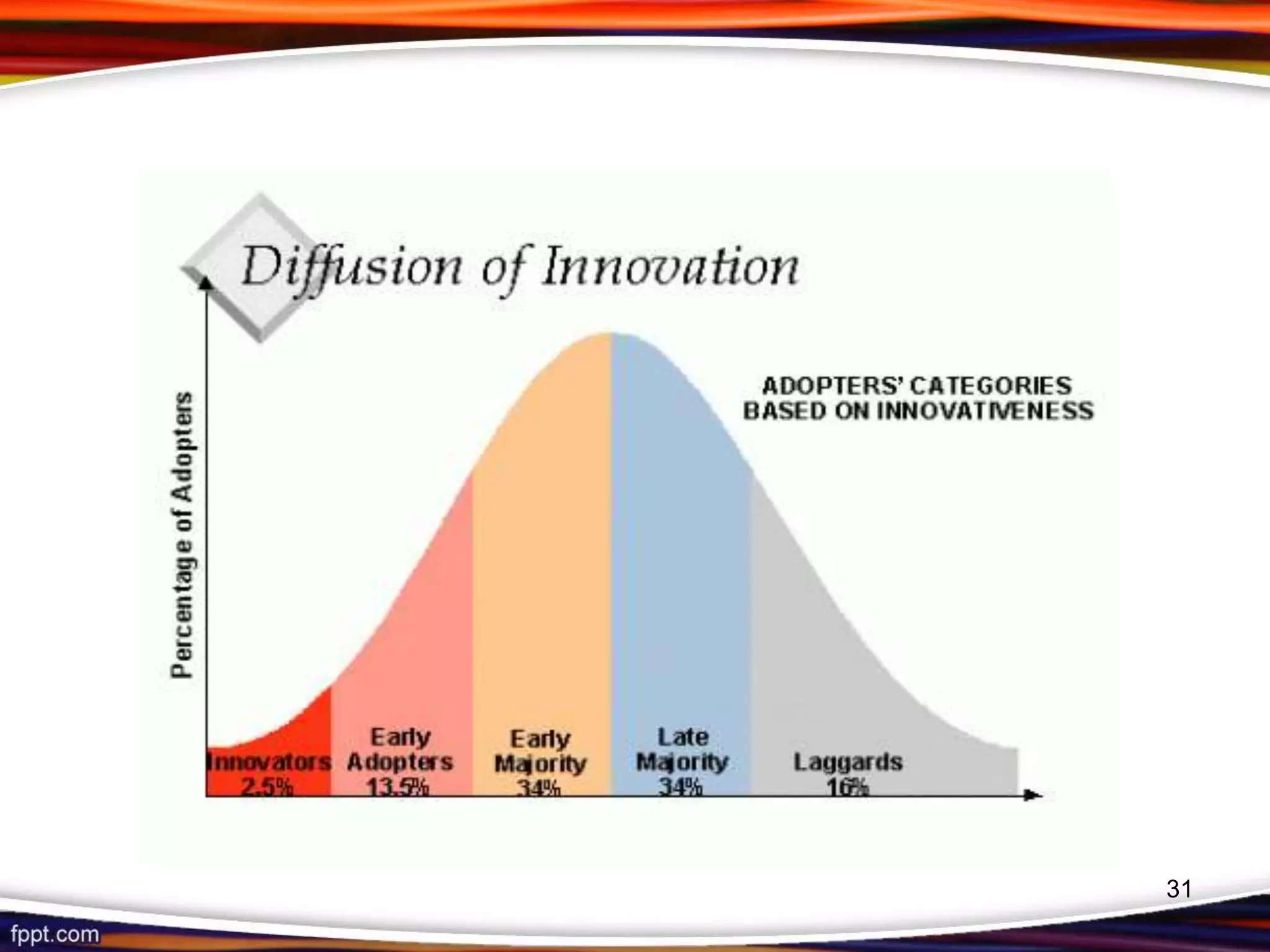
• The adopter categories
(1) Innovators,
(2) Early adopters,
(3) Early majority,
(4) Late majority, and
(5) Laggards.
30
31
RATE OF ADOPTION
• Rate of adoption - the relative speed with
which an innovation is adopted by members
of a social system.
• When the number of individuals adopting a
new idea is plotted on a cumulative
frequency basis over time, the resulting
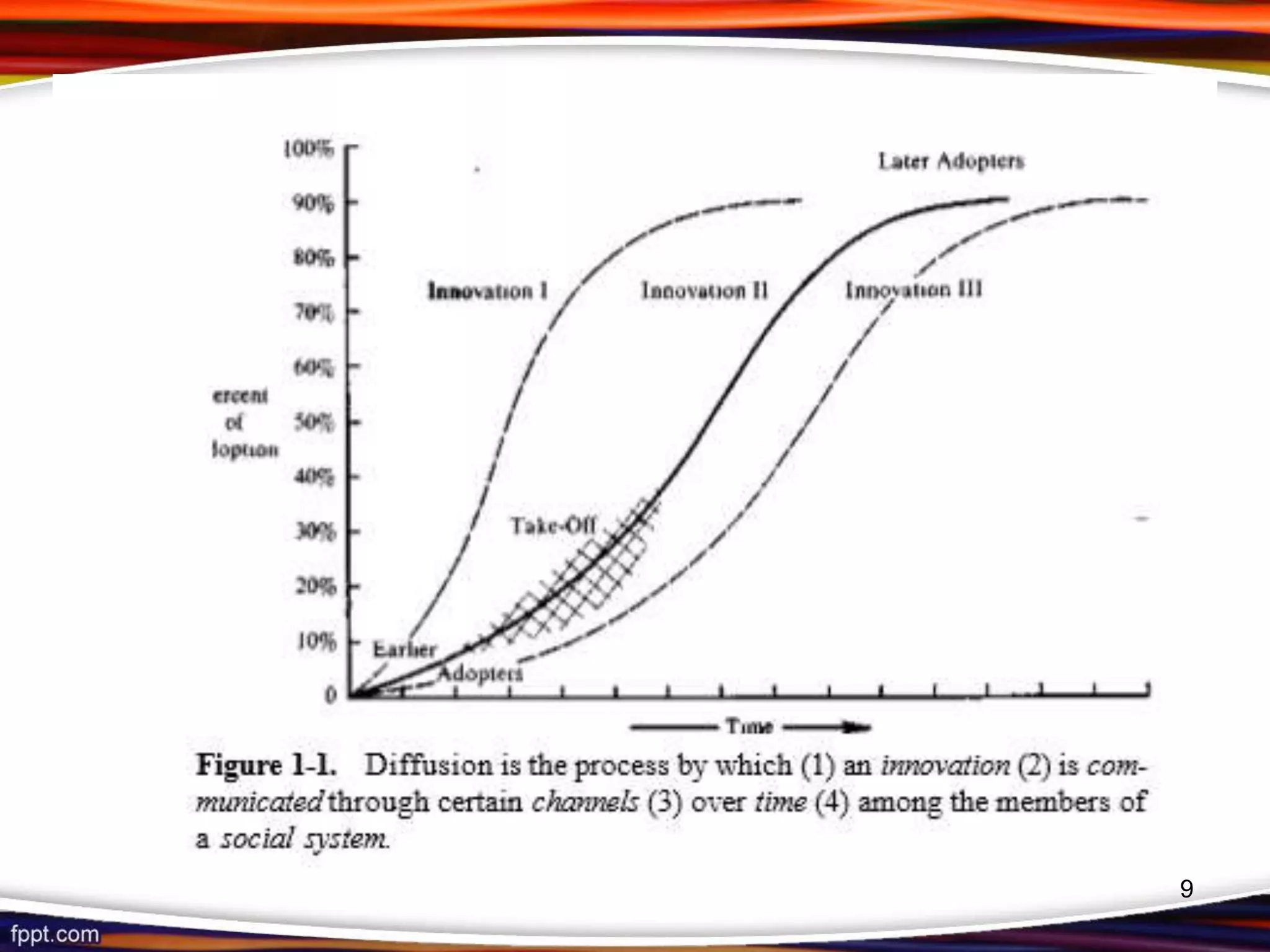
distribution is an “S-shaped curve.”
32
• Most innovations have an S-shaped rate of adoption.
• But there is variation in the slope of the “S” from innovation to
innovation;
• Some new ideas diffuse relatively rapidly and the S-curve is quite
steep.
• Other innovations have a slower rate of adoption, and the S-curve
is more gradual, with a slope that is relatively lazy.
33
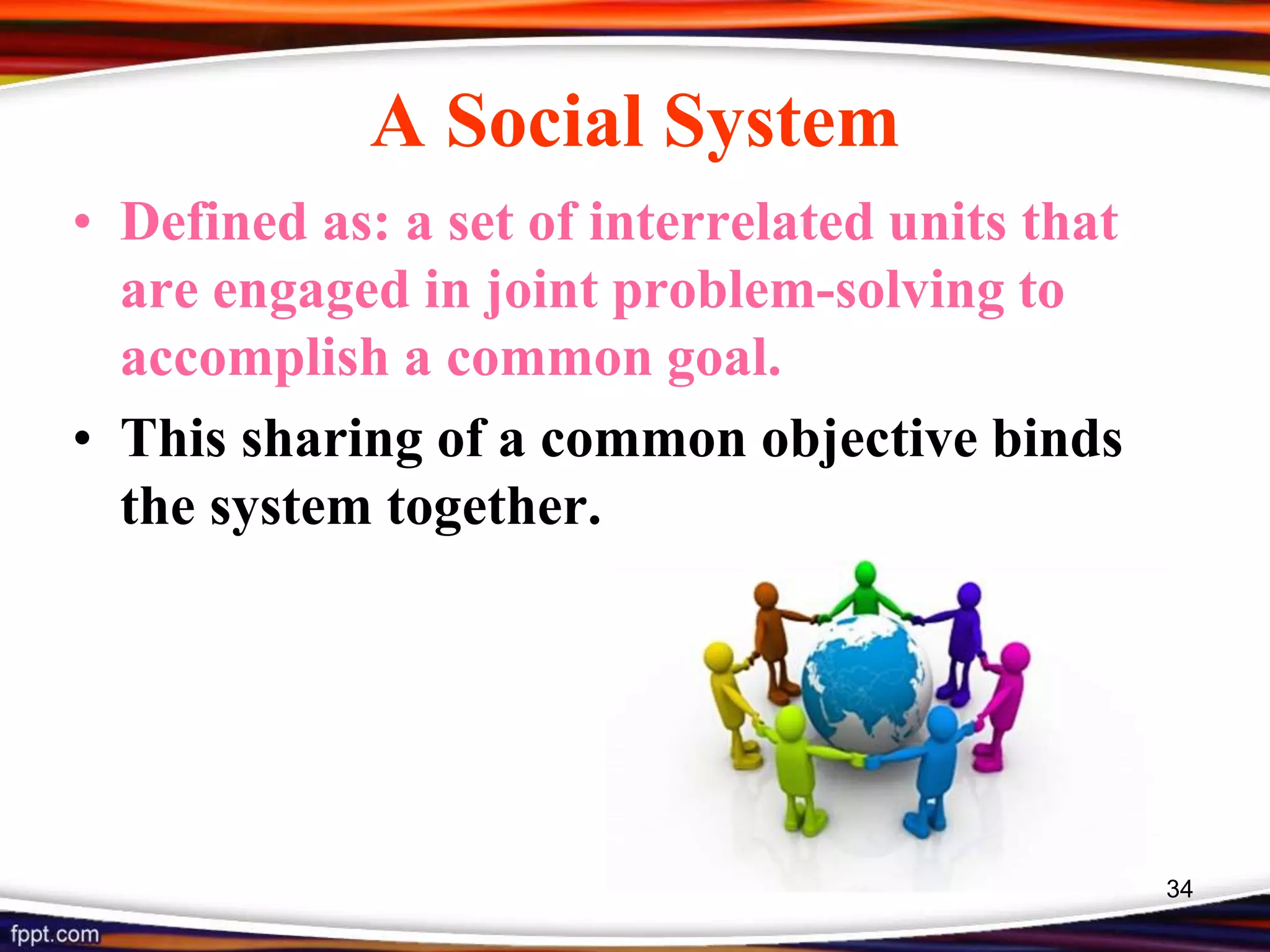
A Social System
• Defined as: a set of interrelated units that
are engaged in joint problem-solving to
accomplish a common goal.
• This sharing of a common objective binds
the system together.
34
• The social structure of the system affects the
innovation’s diffusion in several ways. Here
we deal with:
– how the system’s social structure affects
diffusion,
– the effect of norms on diffusion,
– the roles of opinion leaders
35
Social Structure
• To the extent that the units in a social
system are not all identical in their
behaviour, structure exists in the system.
• Structure - the patterned arrangements of
the units in a system.
36
37
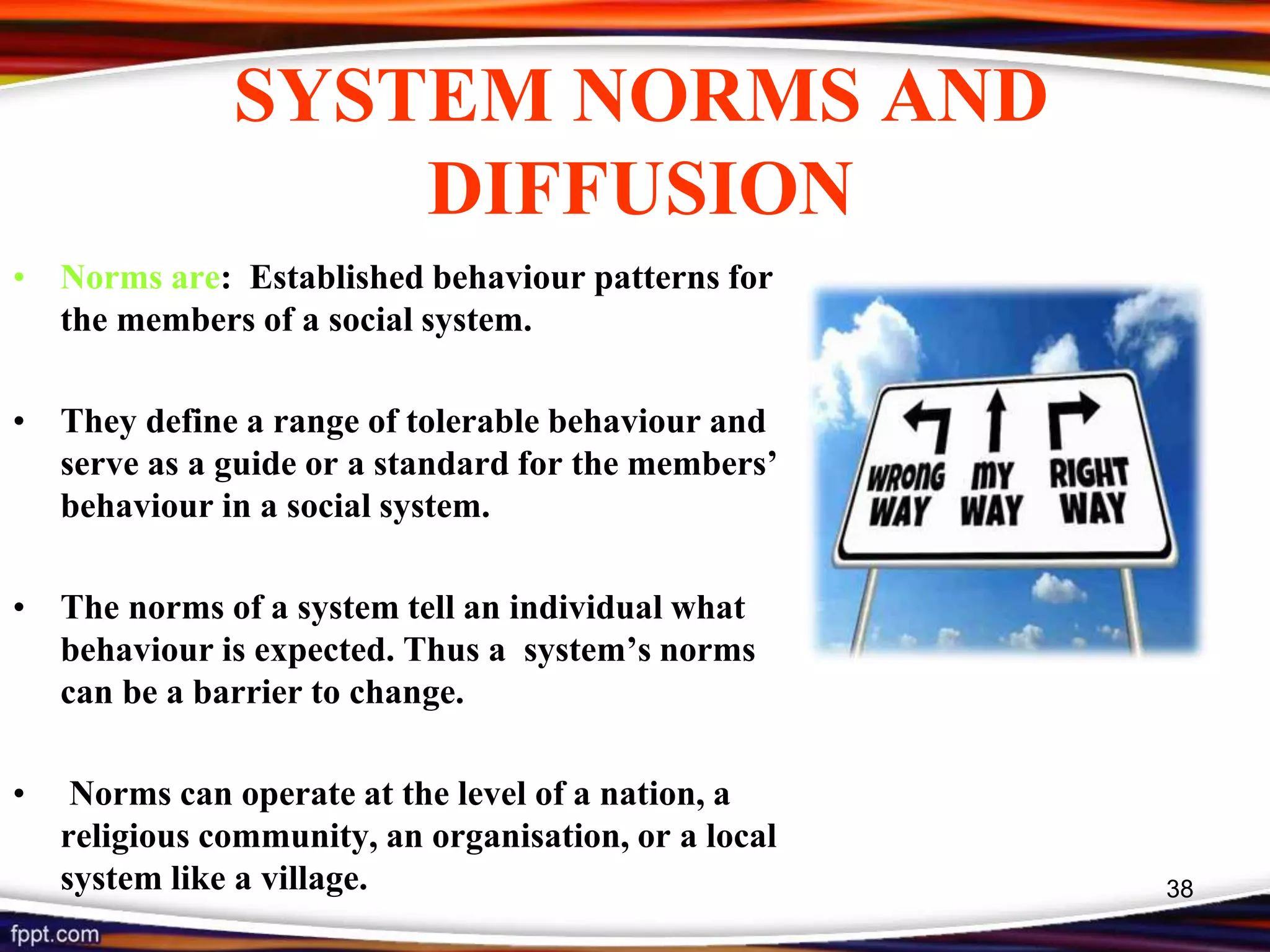
SYSTEM NORMS AND
DIFFUSION
• Norms are: Established behaviour patterns for
the members of a social system.
• They define a range of tolerable behaviour and
serve as a guide or a standard for the members’
behaviour in a social system.
• The norms of a system tell an individual what
behaviour is expected. Thus a system’s norms
can be a barrier to change.
• Norms can operate at the level of a nation, a
religious community, an organisation, or a local
system like a village. 38
OPINION LEADERS
• Some members of the system function as opinion
leaders.
• They provide information and advice about
innovations to many in the system.
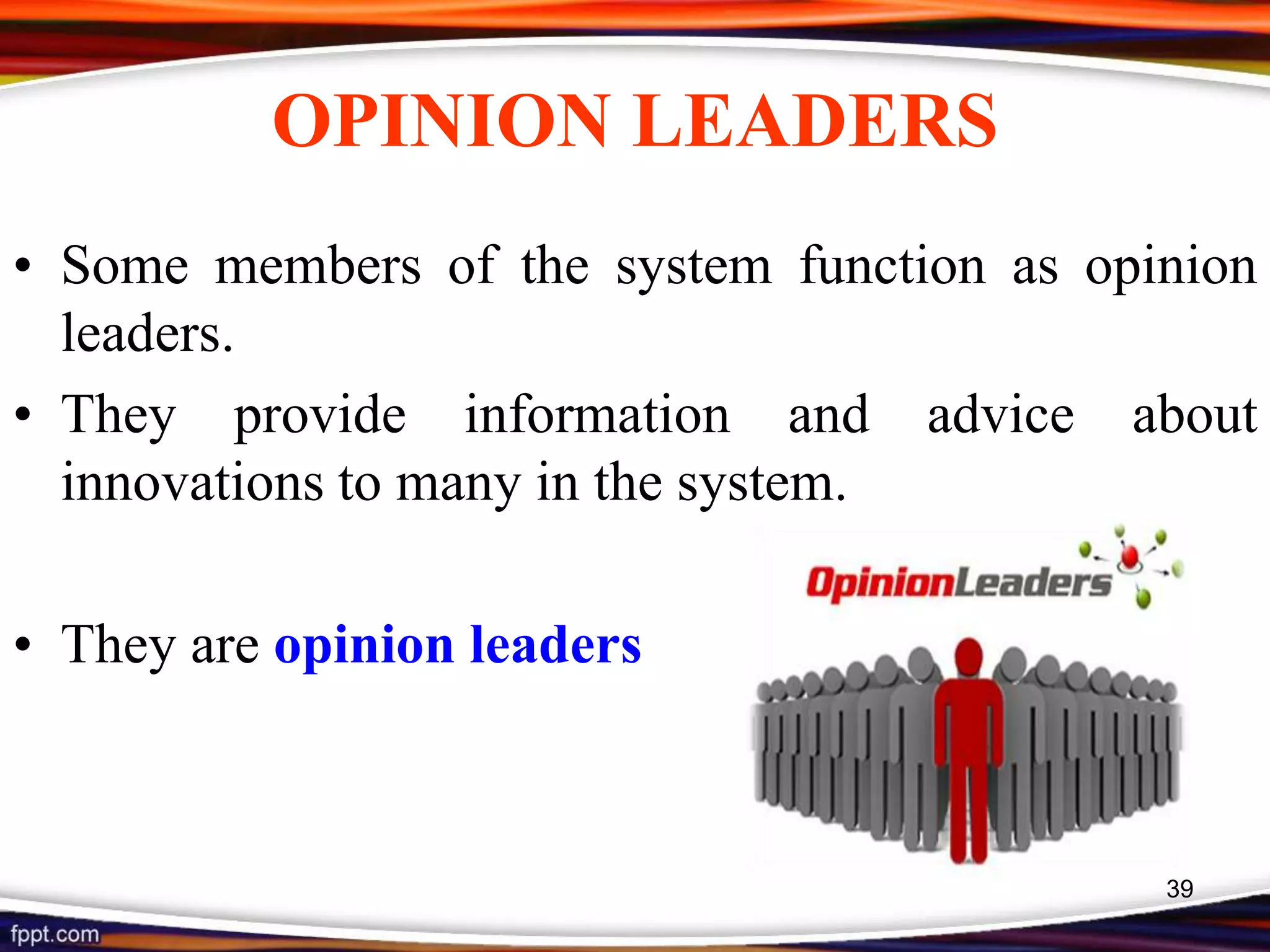
• They are opinion leaders
39
• Opinion leadership is: the degree to which an individual is
able to influence other individuals’ attitudes/behaviour.
• This leadership is not a function of the individual’s formal
position.
• Opinion leadership is earned and maintained by the
individual’s
– technical competence,
– social accessibility, and
– conformity to the system’s norms.
40
41

Elements of Diffusion

  • 1.
  • 2.
    An Assignment onUNIT I ELEMENTS OF DIFFUSION Course No: EXT.503 Course Title: Diffusion and Adoption of Innovations (2+1) SUBMITTED TO Dr. J. B. Patel Associate Professor Department of Extension Education B A College of Agriculture AAU, Anand-388 110 SUBMITTED BY Haseena Bibi (04-2599-2015) M.Sc. (Agri.) Extn. Edu. 2nd Semester 2
  • 3.
    What is diffusion? •The process by which an innovation is communicated through certain channels over time among the members of a social system. 3
  • 4.
    • In thiscontext communication is: • ‘A process whereby participants share information to reach a mutual understanding’. 4
  • 5.
    • Diffusion isa special type of communication in which the messages are about a new idea. • The newness of the idea gives diffusion its special character – it ensures that a degree of uncertainty is involved in diffusion. 5
  • 6.
    • Uncertainty –the degree to which a range of alternatives are perceived with regard to the occurrence of an event. • Uncertainty implies lack of predictability and therefore of information. 6
  • 7.
    • To putthis in a nutshell - for Rogers, “Diffusion of innovations" means • The dissemination of uncertainty-reducing information embodied in products or processes through a social system. 7
  • 8.
    The Process ofthe diffusion of Innovations • Diffusion is a process where an innovation is communicated through certain channels over time among members of a social system 8
  • 9.
  • 10.
    Four Elements inDiffusion of Innovations: • Diffusion is a process where: 1) an innovation 2) is communicated through certain channels 3) over time 4) among members of a social system 10
  • 11.
    The Innovation • Anidea, practice or object that is perceived as new by an individual or other unit of adoption. 11
  • 12.
    Characteristics of Innovation– 1. Relative Advantage 2. Compatibility 3. Complexity 4. Trialability 5. Observability 12
  • 13.
  • 14.
    • Relative Advantage– Over existing technologies - can be perceived, may be measured in Economic terms, Social prestige, Convenience and Satisfaction. 14
  • 15.
    • Compatibility –with existing values, past experiences, needs of potential adopters (and their social system) • Complexity - degree to which an innovation is perceived as difficult to understand and use. 15
  • 16.
    • Trialability –degree to which an innovation may be experimented with on a limited basis. A trialable innovation represented less uncertainty to a potential adopter. • Observability – Degree to which the results of an innovation are visible to others. 16
  • 17.
    . Communications Channels • Themeans by which messages get from one individual to another. • The nature of the information-exchange relation determines the conditions under which a source will/will not transmit the innovation to the receiver and the effect of the transfer. 17
  • 18.
    • Mass-media –most efficient way to create awareness knowledge of an innovation • Interpersonal channels – more effective in persuading in individual to accept a new idea. 18
  • 19.
    • The closer(more homophilious) two individuals are, the more frequently and more successful the transfer of ideas between them. 19
  • 20.
    Time • Time -third element in the diffusion process. Involved in: – the innovation-decision process – the innovativeness of an individual – an innovation’s rate of adoption in a system 20
  • 21.
    THE INNOVATION-DECISION PROCESS •THE INNOVATION-DECISION PROCESS - the process through which an individual passes from first knowledge of an innovation to forming an attitude toward the innovation, to a decision to adopt or reject it. 21
  • 22.
    • Five stagesin the innovation-decision process: (1) Knowledge, (2) Persuasion, (3) Decision, (4) Implementation, and (5) Confirmation. 22
  • 23.
  • 24.
    • Knowledge occurswhen an individual (or other decision- making unit) learns of the innovation’s existence and gains some understanding of how it functions. • Persuasion occurs when an individual (or other decision- making unit) forms a favourable or unfavourable attitude toward the innovation. • Decision occurs when an individual (or other decision- making unit) engages in activities that lead to a choice to adopt or reject the innovation. 24
  • 25.
    • Implementation occurswhen an individual (or other decision-making unit) puts an innovation into use. Re- invention is especially likely to occur at the implementation stage. • Confirmation occurs when an individual (or other decision-making unit) seeks reinforcement of an innovation-decision that has already been made, but the individual may reverse this previous decision if exposed to conflicting innovation. 25
  • 26.
    • At theknowledge stage the individual wants to know what the innovation is and how and why it works. • Mass media channels 26
  • 27.
    • At thepersuasion stage the individual wants to know the innovation’s advantages and disadvantages in his or her own situation. • Interpersonal networks 27
  • 28.
    • Ultimately, theinnovation-decision process leads to either ‘adoption or to rejection’. 28
  • 29.
    INNOVATIVENESS AND ADOPTER CATEGORIES •“Innovativeness” - the degree to which an individual or other unit of adoption is relatively earlier in adopting new ideas than the other members of a system. 29
  • 30.
    • The adoptercategories (1) Innovators, (2) Early adopters, (3) Early majority, (4) Late majority, and (5) Laggards. 30
  • 31.
  • 32.
    RATE OF ADOPTION •Rate of adoption - the relative speed with which an innovation is adopted by members of a social system. • When the number of individuals adopting a new idea is plotted on a cumulative frequency basis over time, the resulting distribution is an “S-shaped curve.” 32
  • 33.
    • Most innovationshave an S-shaped rate of adoption. • But there is variation in the slope of the “S” from innovation to innovation; • Some new ideas diffuse relatively rapidly and the S-curve is quite steep. • Other innovations have a slower rate of adoption, and the S-curve is more gradual, with a slope that is relatively lazy. 33
  • 34.
    A Social System •Defined as: a set of interrelated units that are engaged in joint problem-solving to accomplish a common goal. • This sharing of a common objective binds the system together. 34
  • 35.
    • The socialstructure of the system affects the innovation’s diffusion in several ways. Here we deal with: – how the system’s social structure affects diffusion, – the effect of norms on diffusion, – the roles of opinion leaders 35
  • 36.
    Social Structure • Tothe extent that the units in a social system are not all identical in their behaviour, structure exists in the system. • Structure - the patterned arrangements of the units in a system. 36
  • 37.
  • 38.
    SYSTEM NORMS AND DIFFUSION •Norms are: Established behaviour patterns for the members of a social system. • They define a range of tolerable behaviour and serve as a guide or a standard for the members’ behaviour in a social system. • The norms of a system tell an individual what behaviour is expected. Thus a system’s norms can be a barrier to change. • Norms can operate at the level of a nation, a religious community, an organisation, or a local system like a village. 38
  • 39.
    OPINION LEADERS • Somemembers of the system function as opinion leaders. • They provide information and advice about innovations to many in the system. • They are opinion leaders 39
  • 40.
    • Opinion leadershipis: the degree to which an individual is able to influence other individuals’ attitudes/behaviour. • This leadership is not a function of the individual’s formal position. • Opinion leadership is earned and maintained by the individual’s – technical competence, – social accessibility, and – conformity to the system’s norms. 40
  • 41.