Copyright © Terry Felke-Morris
WEB DEVELOPMENT & DESIGN
FOUNDATIONS WITH HTML5
Chapter 10
Key Concepts
1Copyright © Terry Felke-Morris
Copyright © Terry Felke-Morris
LEARNING OUTCOMES
In this chapter, you will learn how to ...
 Describe the skills, functions, and job roles needed for a successful
web project development
 Utilize the stages in the standard System Development Life Cycle
 Identify other common system development methodologies
 Apply the System Development Life Cycle to web development
projects
 Describe the activities in the Conceptualization,Analysis, Design,
Production,Testing, Launch, Maintenance, and Evaluation stages of
a website project. Compare the goals of the website to the results
as part of the Evaluation phase
 Find the right web host provider for your website
 Choose a domain name for your website
2
Copyright © Terry Felke-Morris
SKILLS AND FUNCTIONS NEEDED FOR A
SUCCESSFUL LARGE-SCALE PROJECT
 Project Manager
 Information Architect
 Marketing Representative
 Copy Writer & Editor
 Content Manager
 Graphic Designer
 Database Administrator
 Network Administrator
 Web Developer / Web Designer
3
Copyright © Terry Felke-Morris
SKILLS AND FUNCTIONS NEEDED FOR A
SUCCESSFUL SMALL PROJECT
 The skills and functions are essentially the
same as on a large project
 Each person may wear many “hats” and
juggle their job roles
 Example: The web designer may also be the
graphic designer.
 Some job roles may be outsourced
 Most Common:
An external web site provider is used so there is
less (if any) need for a Network Administrator.
4
Copyright © Terry Felke-Morris
PROJECT STAFFING CRITERIA
Finding the right people to work on a project is crucial
◦ Consider:
 work experience
 Portfolio
 formal education
 industry certifications
Alternative:
Outsource all or portions of the project to a web
design/development firm
5
Copyright © Terry Felke-Morris
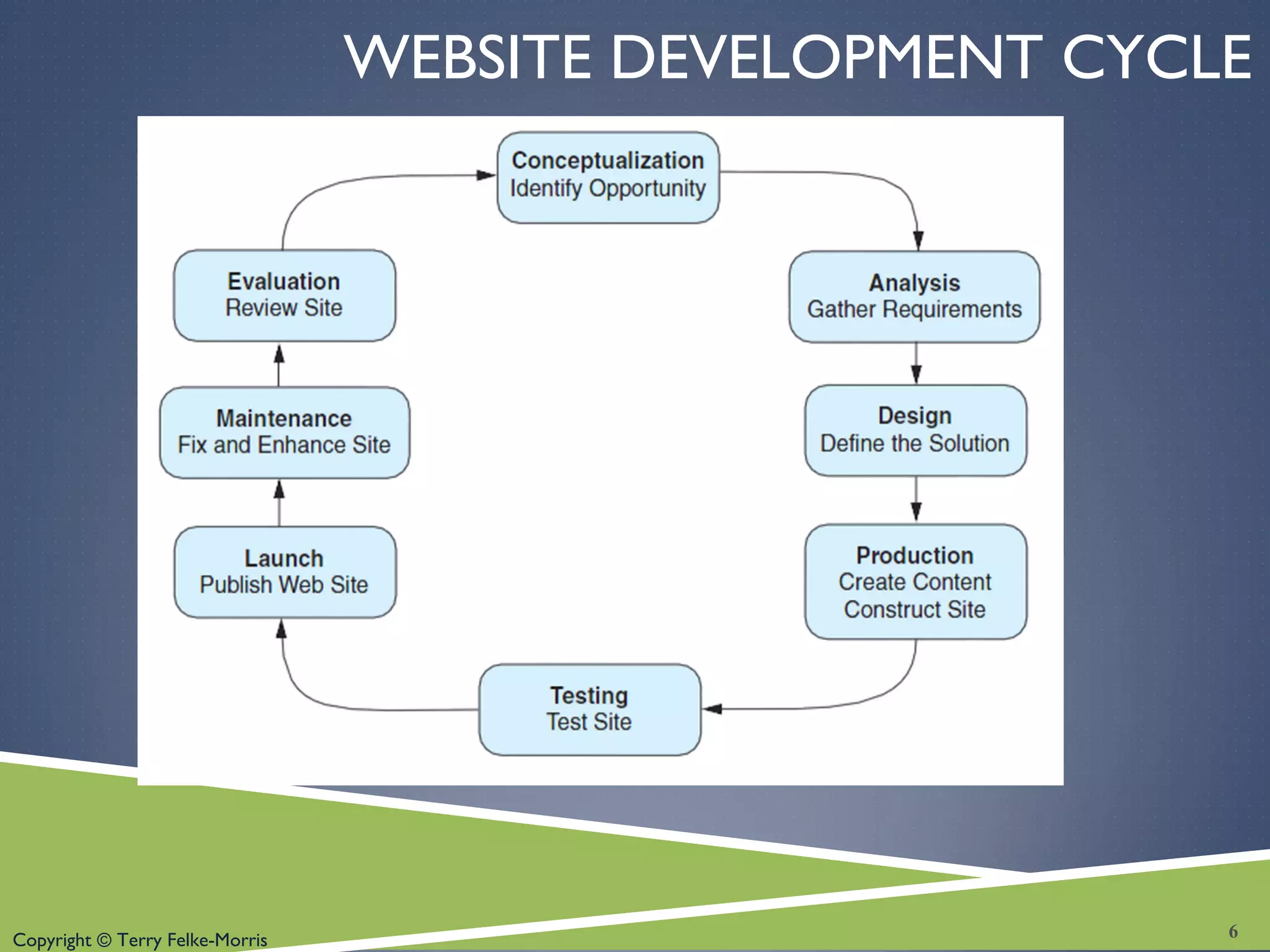
WEBSITE DEVELOPMENT CYCLE
6
Copyright © Terry Felke-Morris
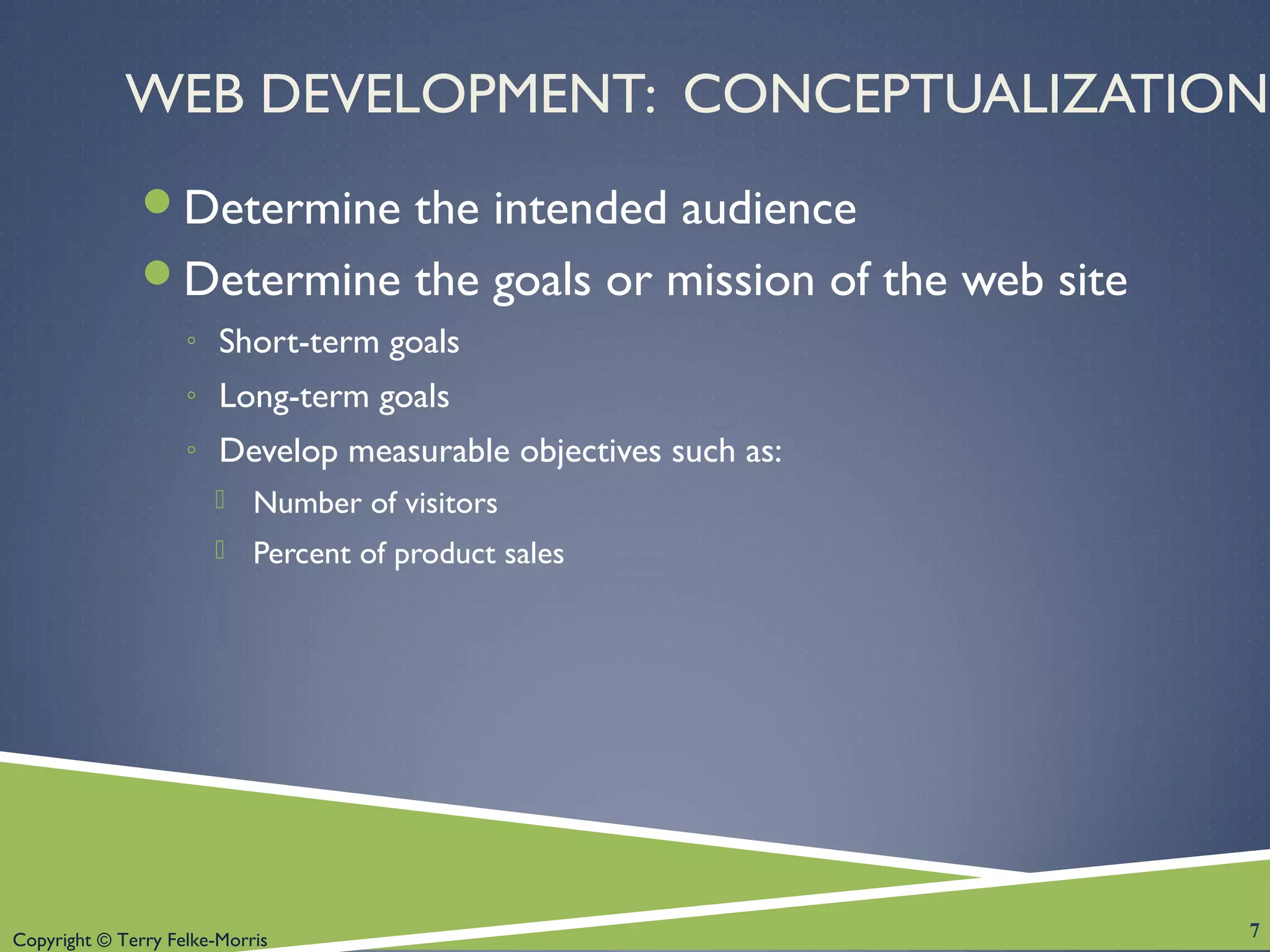
WEB DEVELOPMENT: CONCEPTUALIZATION
Determine the intended audience
Determine the goals or mission of the web site
◦ Short-term goals
◦ Long-term goals
◦ Develop measurable objectives such as:
 Number of visitors
 Percent of product sales
7
Copyright © Terry Felke-Morris
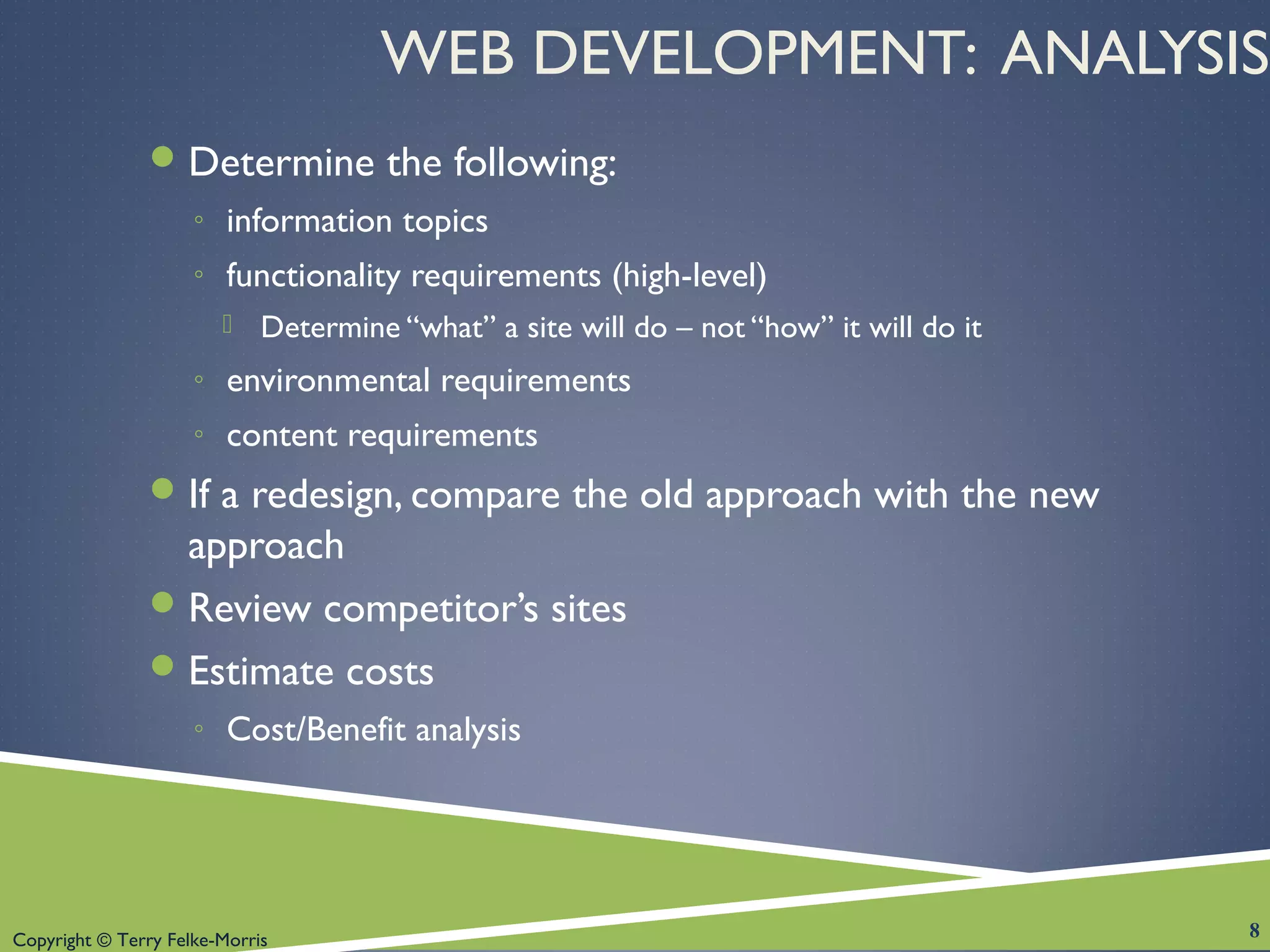
WEB DEVELOPMENT: ANALYSIS
Determine the following:
◦ information topics
◦ functionality requirements (high-level)
 Determine “what” a site will do – not “how” it will do it
◦ environmental requirements
◦ content requirements
If a redesign, compare the old approach with the new
approach
Review competitor’s sites
Estimate costs
◦ Cost/Benefit analysis
8
Copyright © Terry Felke-Morris
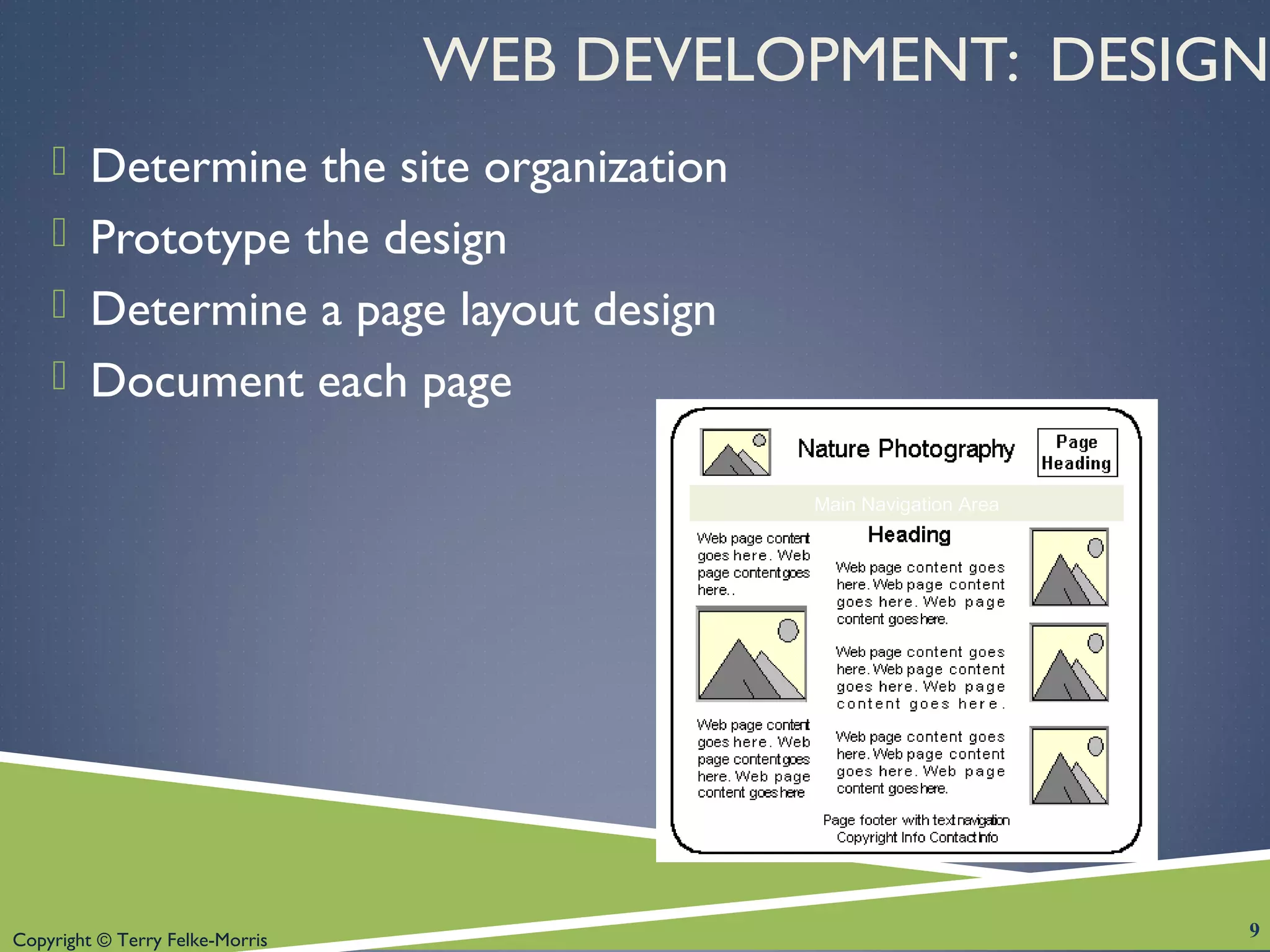
WEB DEVELOPMENT: DESIGN
 Determine the site organization
 Prototype the design
 Determine a page layout design
 Document each page
9
Main Navigation Area
Copyright © Terry Felke-Morris
WEB DEVELOPMENT: PRODUCTION
 Choose a web authoring tool
 Organize your site files
 Develop and individually test
components
 Add content
10
Copyright © Terry Felke-Morris
WEB DEVELOPMENT: TESTING
 Test on different web browsers and browser versions
 Test with different screen resolutions
 Test using different bandwidths
 Test from another location
 Test,Test,Test
11
Copyright © Terry Felke-Morris
WEB DEVELOPMENT: TYPES OF TESTING
 Automated Testing Tools andValidation
 Automated Testing (Link checkers, etc.)
 W3C XHTML and CSS validation tests
 Usability Testing
 Testing how actual web page visitors use a web
site
 Can be done at almost any stage of development
 Early –- use paper and sketches of pages
 Design – use prototype
 Production &Testing – use actual pages
12
Copyright © Terry Felke-Morris
WEB DEVELOPMENT: APPROVAL & LAUNCH
 User or Client Testing
 Client will test site before giving official approval for site launch
 Approval & Launch
 Obtain sign-off form or email from client
 Upload files to web server
 Create backup copies of files
 MAKE SUREYOUTESTTHE WEB SITE AGAIN!
13
Copyright © Terry Felke-Morris
WEB DEVELOPMENT: MAINTENANCE
 Maintenance – the never-ending task…
 Enhancements to site
 Fixes to site
 New areas added to site
 A new opportunity or issue is identified and
another loop through the development process
begins.
14
Copyright © Terry Felke-Morris
WEB DEVELOPMENT: EVALUATION
 Re-visit the goals, objectives, and mission of
the web site
 Determine how closely they are being met
 Develop a plan to better meet the goals,
objectives and mission
15
Copyright © Terry Felke-Morris
CHECKPOINT
1. Describe the role of the project
manager.
2. Explain why so many different roles
are needed on a large-scale web
project.
3. List three different techniques used to
test a website. Describe each
technique in one or two sentences.
16
Copyright © Terry Felke-Morris
DOMAIN NAMES
 Establishes a web presence for your business
or organization
 New Business
 choose domain name while selecting company name
 Established Business
 choose a domain name that relates to your established business
presence
17
Copyright © Terry Felke-Morris
CHOOSING A DOMAIN NAME
Describe your business
Be brief, if possible
Avoid hyphens
TLD (top level domain name)
◦ .com, .net, .biz, .us, .mobi and others
◦ .org for non-profits
Brainstorm potential keywords
Avoid trademarked words or phrases
Know the territory (use Google!)
Verify Availability
18
Copyright © Terry Felke-Morris
REGISTERING A DOMAIN NAME
There are many domain name registrars, including
◦ http://register.com
◦ http://networksolutions.com
◦ http://godaddy.com
Visit Registrar, choose name, pay with credit card
or Paypal
Private registration – additional fee but personal
information is kept private and out of the WHOIS
database
19
Copyright © Terry Felke-Morris
WEB HOSTING
 Some organizations administer a web server in-
house and host their own website.
 Many companies use a web host provider.
 A good web hosting service will provide a robust, reliable home
for your website.
 A poor web hosting service will be the source of problems and
complaints.
 Do not use free web hosting for a commercial website.
20
Copyright © Terry Felke-Morris
TYPES OF WEB HOSTING(1)
 Hosting Needs: Small to Medium Website
 Virtual Hosting
 The web host provider's server is divided into a number of virtual
domains and multiple websites are set up on the same computer.
 Consider:
 Future growth and scalability of web host
 Operating System
 Types of server-side processing supported
 Bandwidth of Internet connection
 Both local and national web host providers
 Guaranteed uptime – service level agreement (SLA)
 Technical support
21
Copyright © Terry Felke-Morris
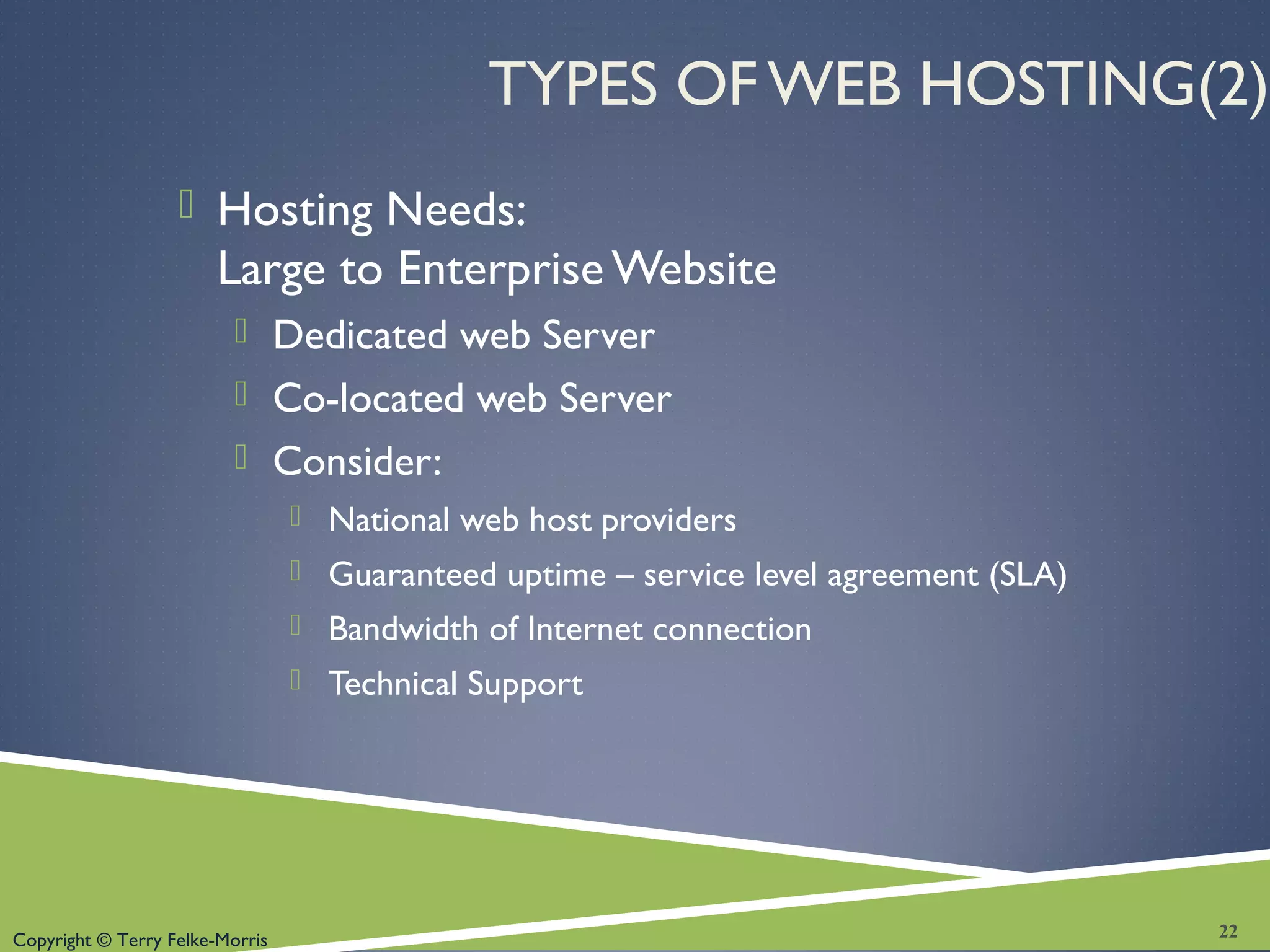
TYPES OF WEB HOSTING(2)
 Hosting Needs:
Large to Enterprise Website
 Dedicated web Server
 Co-located web Server
 Consider:
 National web host providers
 Guaranteed uptime – service level agreement (SLA)
 Bandwidth of Internet connection
 Technical Support
22
Copyright © Terry Felke-Morris
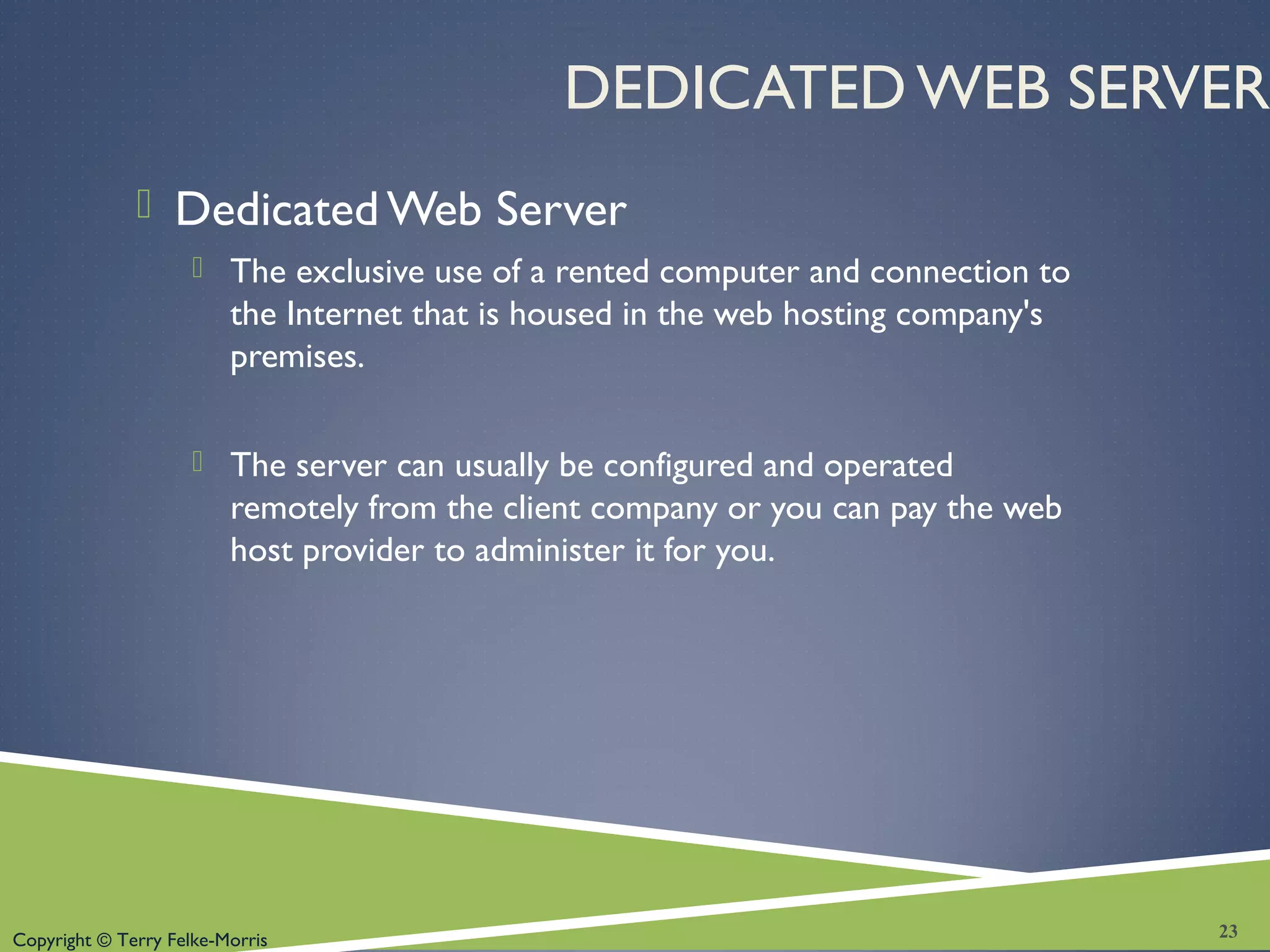
DEDICATED WEB SERVER
 Dedicated Web Server
 The exclusive use of a rented computer and connection to
the Internet that is housed in the web hosting company's
premises.
 The server can usually be configured and operated
remotely from the client company or you can pay the web
host provider to administer it for you.
23
Copyright © Terry Felke-Morris
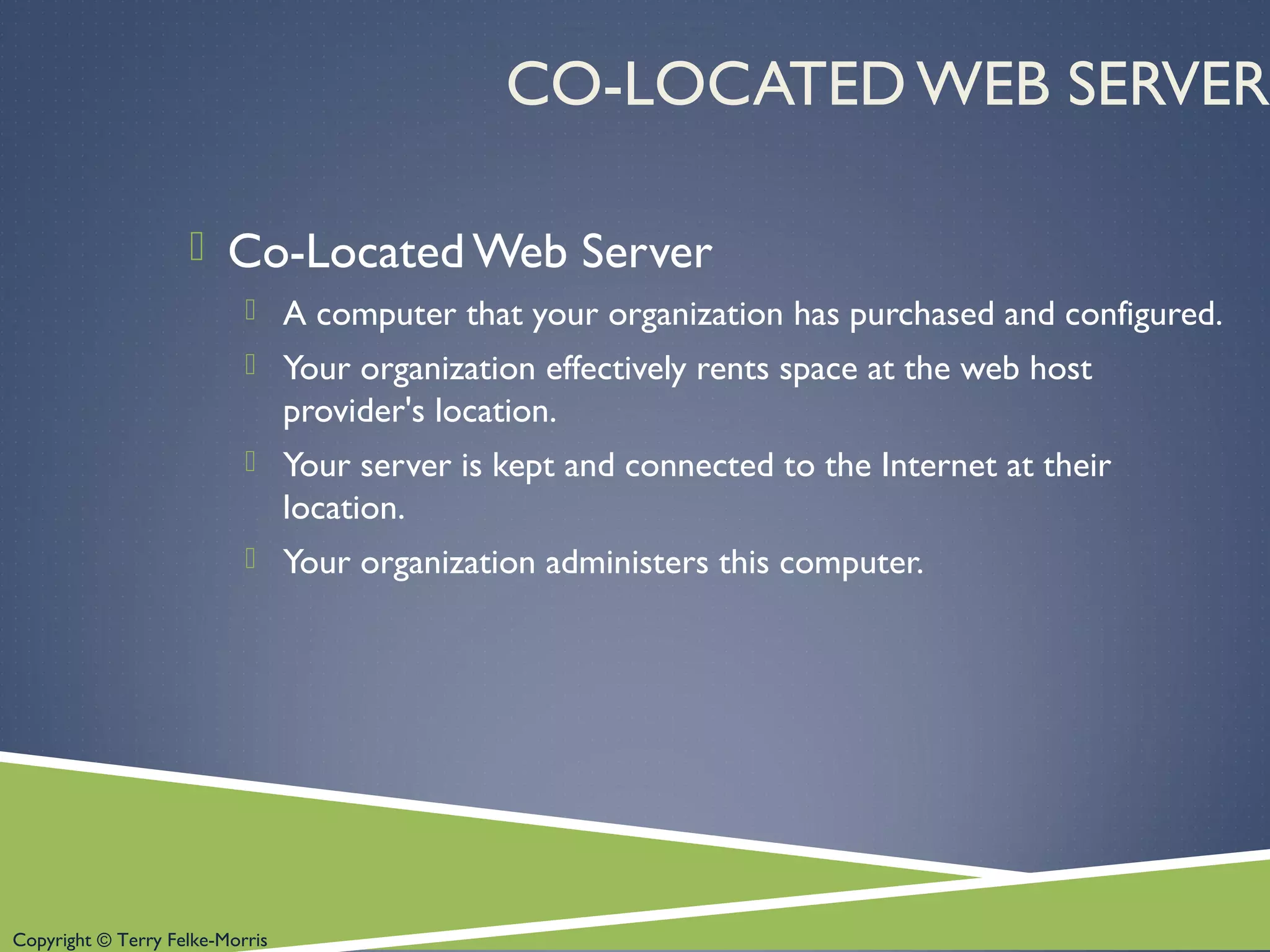
CO-LOCATED WEB SERVER
 Co-Located Web Server
 A computer that your organization has purchased and configured.
 Your organization effectively rents space at the web host
provider's location.
 Your server is kept and connected to the Internet at their
location.
 Your organization administers this computer.
Copyright © Terry Felke-Morris
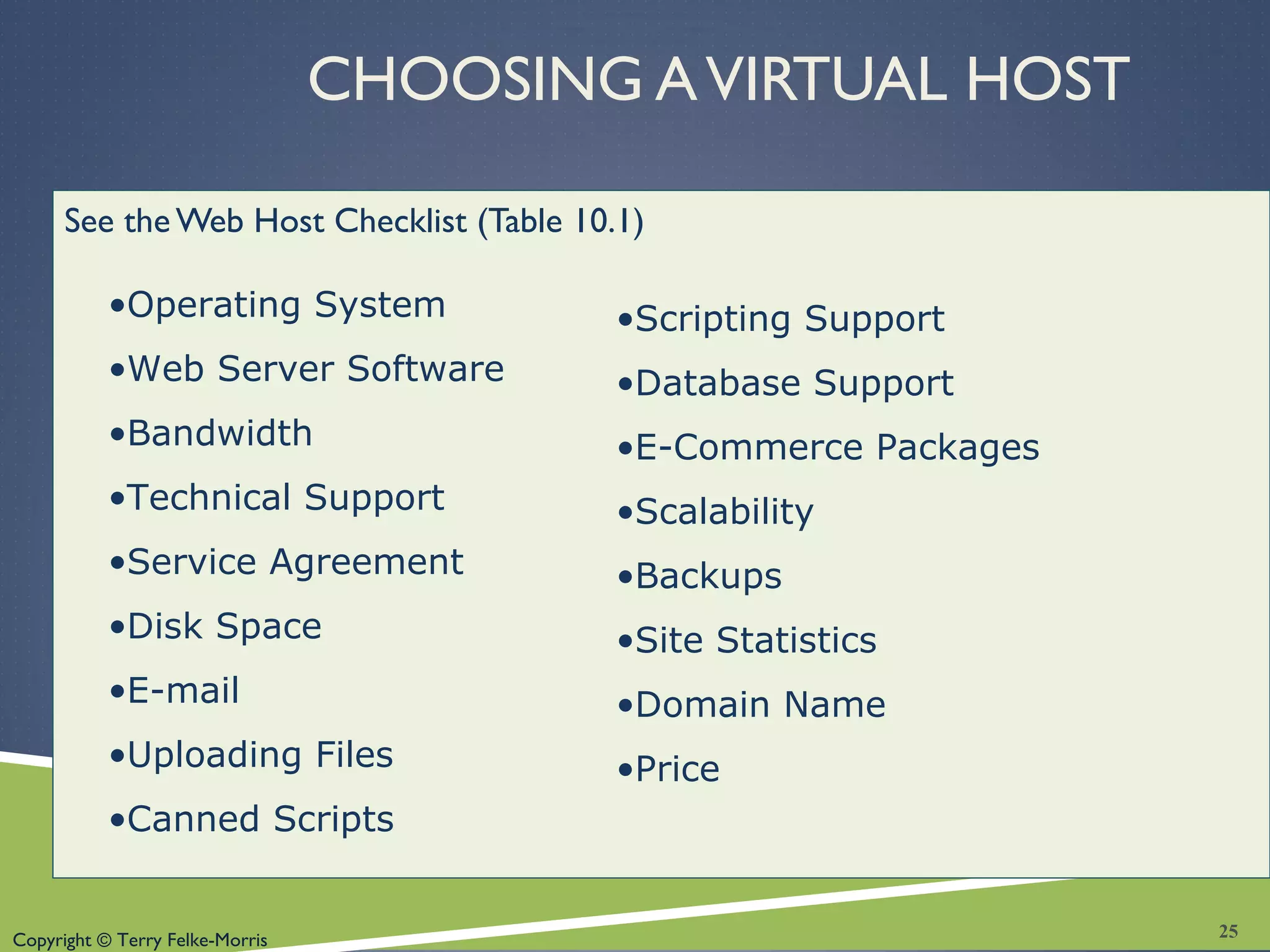
CHOOSING AVIRTUAL HOST
See theWeb Host Checklist (Table 10.1)
•Operating System
•Web Server Software
•Bandwidth
•Technical Support
•Service Agreement
•Disk Space
•E-mail
•Uploading Files
•Canned Scripts
•Scripting Support
•Database Support
•E-Commerce Packages
•Scalability
•Backups
•Site Statistics
•Domain Name
•Price
25
Copyright © Terry Felke-Morris
CHECKPOINT 10.2
1. Describe the type of web host that would
meet the needs of a small company for
their initial web presence.
2. Describe the difference between a
dedicated web server and a co-located
web server.
3. Explain why price is not the most
important consideration when choosing a
web host.
26
Copyright © Terry Felke-Morris
SUMMARY
This chapter introduced you to the system
development life cycle and its application to web
development projects.
The job roles related to website development
were also discussed.
An introduction to selecting a domain name and
a web host was provided.
27

Chapter 10 - Web Design

  • 1.
    Copyright © TerryFelke-Morris WEB DEVELOPMENT & DESIGN FOUNDATIONS WITH HTML5 Chapter 10 Key Concepts 1Copyright © Terry Felke-Morris
  • 2.
    Copyright © TerryFelke-Morris LEARNING OUTCOMES In this chapter, you will learn how to ...  Describe the skills, functions, and job roles needed for a successful web project development  Utilize the stages in the standard System Development Life Cycle  Identify other common system development methodologies  Apply the System Development Life Cycle to web development projects  Describe the activities in the Conceptualization,Analysis, Design, Production,Testing, Launch, Maintenance, and Evaluation stages of a website project. Compare the goals of the website to the results as part of the Evaluation phase  Find the right web host provider for your website  Choose a domain name for your website 2
  • 3.
    Copyright © TerryFelke-Morris SKILLS AND FUNCTIONS NEEDED FOR A SUCCESSFUL LARGE-SCALE PROJECT  Project Manager  Information Architect  Marketing Representative  Copy Writer & Editor  Content Manager  Graphic Designer  Database Administrator  Network Administrator  Web Developer / Web Designer 3
  • 4.
    Copyright © TerryFelke-Morris SKILLS AND FUNCTIONS NEEDED FOR A SUCCESSFUL SMALL PROJECT  The skills and functions are essentially the same as on a large project  Each person may wear many “hats” and juggle their job roles  Example: The web designer may also be the graphic designer.  Some job roles may be outsourced  Most Common: An external web site provider is used so there is less (if any) need for a Network Administrator. 4
  • 5.
    Copyright © TerryFelke-Morris PROJECT STAFFING CRITERIA Finding the right people to work on a project is crucial ◦ Consider:  work experience  Portfolio  formal education  industry certifications Alternative: Outsource all or portions of the project to a web design/development firm 5
  • 6.
    Copyright © TerryFelke-Morris WEBSITE DEVELOPMENT CYCLE 6
  • 7.
    Copyright © TerryFelke-Morris WEB DEVELOPMENT: CONCEPTUALIZATION Determine the intended audience Determine the goals or mission of the web site ◦ Short-term goals ◦ Long-term goals ◦ Develop measurable objectives such as:  Number of visitors  Percent of product sales 7
  • 8.
    Copyright © TerryFelke-Morris WEB DEVELOPMENT: ANALYSIS Determine the following: ◦ information topics ◦ functionality requirements (high-level)  Determine “what” a site will do – not “how” it will do it ◦ environmental requirements ◦ content requirements If a redesign, compare the old approach with the new approach Review competitor’s sites Estimate costs ◦ Cost/Benefit analysis 8
  • 9.
    Copyright © TerryFelke-Morris WEB DEVELOPMENT: DESIGN  Determine the site organization  Prototype the design  Determine a page layout design  Document each page 9 Main Navigation Area
  • 10.
    Copyright © TerryFelke-Morris WEB DEVELOPMENT: PRODUCTION  Choose a web authoring tool  Organize your site files  Develop and individually test components  Add content 10
  • 11.
    Copyright © TerryFelke-Morris WEB DEVELOPMENT: TESTING  Test on different web browsers and browser versions  Test with different screen resolutions  Test using different bandwidths  Test from another location  Test,Test,Test 11
  • 12.
    Copyright © TerryFelke-Morris WEB DEVELOPMENT: TYPES OF TESTING  Automated Testing Tools andValidation  Automated Testing (Link checkers, etc.)  W3C XHTML and CSS validation tests  Usability Testing  Testing how actual web page visitors use a web site  Can be done at almost any stage of development  Early –- use paper and sketches of pages  Design – use prototype  Production &Testing – use actual pages 12
  • 13.
    Copyright © TerryFelke-Morris WEB DEVELOPMENT: APPROVAL & LAUNCH  User or Client Testing  Client will test site before giving official approval for site launch  Approval & Launch  Obtain sign-off form or email from client  Upload files to web server  Create backup copies of files  MAKE SUREYOUTESTTHE WEB SITE AGAIN! 13
  • 14.
    Copyright © TerryFelke-Morris WEB DEVELOPMENT: MAINTENANCE  Maintenance – the never-ending task…  Enhancements to site  Fixes to site  New areas added to site  A new opportunity or issue is identified and another loop through the development process begins. 14
  • 15.
    Copyright © TerryFelke-Morris WEB DEVELOPMENT: EVALUATION  Re-visit the goals, objectives, and mission of the web site  Determine how closely they are being met  Develop a plan to better meet the goals, objectives and mission 15
  • 16.
    Copyright © TerryFelke-Morris CHECKPOINT 1. Describe the role of the project manager. 2. Explain why so many different roles are needed on a large-scale web project. 3. List three different techniques used to test a website. Describe each technique in one or two sentences. 16
  • 17.
    Copyright © TerryFelke-Morris DOMAIN NAMES  Establishes a web presence for your business or organization  New Business  choose domain name while selecting company name  Established Business  choose a domain name that relates to your established business presence 17
  • 18.
    Copyright © TerryFelke-Morris CHOOSING A DOMAIN NAME Describe your business Be brief, if possible Avoid hyphens TLD (top level domain name) ◦ .com, .net, .biz, .us, .mobi and others ◦ .org for non-profits Brainstorm potential keywords Avoid trademarked words or phrases Know the territory (use Google!) Verify Availability 18
  • 19.
    Copyright © TerryFelke-Morris REGISTERING A DOMAIN NAME There are many domain name registrars, including ◦ http://register.com ◦ http://networksolutions.com ◦ http://godaddy.com Visit Registrar, choose name, pay with credit card or Paypal Private registration – additional fee but personal information is kept private and out of the WHOIS database 19
  • 20.
    Copyright © TerryFelke-Morris WEB HOSTING  Some organizations administer a web server in- house and host their own website.  Many companies use a web host provider.  A good web hosting service will provide a robust, reliable home for your website.  A poor web hosting service will be the source of problems and complaints.  Do not use free web hosting for a commercial website. 20
  • 21.
    Copyright © TerryFelke-Morris TYPES OF WEB HOSTING(1)  Hosting Needs: Small to Medium Website  Virtual Hosting  The web host provider's server is divided into a number of virtual domains and multiple websites are set up on the same computer.  Consider:  Future growth and scalability of web host  Operating System  Types of server-side processing supported  Bandwidth of Internet connection  Both local and national web host providers  Guaranteed uptime – service level agreement (SLA)  Technical support 21
  • 22.
    Copyright © TerryFelke-Morris TYPES OF WEB HOSTING(2)  Hosting Needs: Large to Enterprise Website  Dedicated web Server  Co-located web Server  Consider:  National web host providers  Guaranteed uptime – service level agreement (SLA)  Bandwidth of Internet connection  Technical Support 22
  • 23.
    Copyright © TerryFelke-Morris DEDICATED WEB SERVER  Dedicated Web Server  The exclusive use of a rented computer and connection to the Internet that is housed in the web hosting company's premises.  The server can usually be configured and operated remotely from the client company or you can pay the web host provider to administer it for you. 23
  • 24.
    Copyright © TerryFelke-Morris CO-LOCATED WEB SERVER  Co-Located Web Server  A computer that your organization has purchased and configured.  Your organization effectively rents space at the web host provider's location.  Your server is kept and connected to the Internet at their location.  Your organization administers this computer.
  • 25.
    Copyright © TerryFelke-Morris CHOOSING AVIRTUAL HOST See theWeb Host Checklist (Table 10.1) •Operating System •Web Server Software •Bandwidth •Technical Support •Service Agreement •Disk Space •E-mail •Uploading Files •Canned Scripts •Scripting Support •Database Support •E-Commerce Packages •Scalability •Backups •Site Statistics •Domain Name •Price 25
  • 26.
    Copyright © TerryFelke-Morris CHECKPOINT 10.2 1. Describe the type of web host that would meet the needs of a small company for their initial web presence. 2. Describe the difference between a dedicated web server and a co-located web server. 3. Explain why price is not the most important consideration when choosing a web host. 26
  • 27.
    Copyright © TerryFelke-Morris SUMMARY This chapter introduced you to the system development life cycle and its application to web development projects. The job roles related to website development were also discussed. An introduction to selecting a domain name and a web host was provided. 27