Chapter 1.
The Multidisciplinary Nature
of Environmental Studies
• The word environment is derived from the French word
“environ” meaning surroundings. Hence, everything
surrounding us is called environment.
• Every organism is surrounded by materials and forces that
constitute its environment.
• The natural environment encompasses all living and non-
living things.
• This environment encompasses the interaction of all living
species, climate, weather, and natural resources that affect
human survival and economic activity
Definition
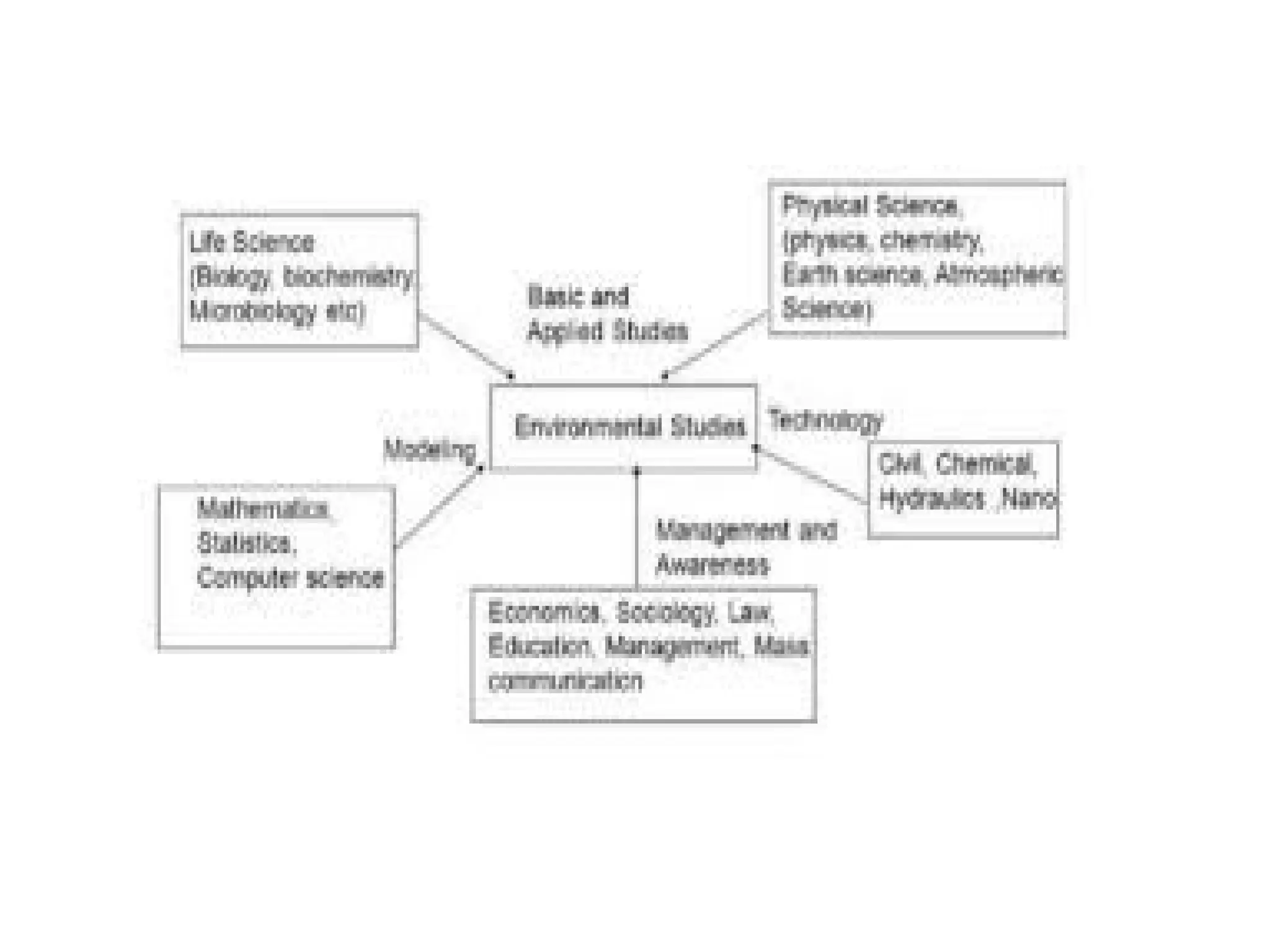
• Environmental studies is multi-disciplinary because it
comprises various branches of studies like chemistry,
physics, medical science, life science, agriculture and
public health.
• It is the science of physical phenomena in the
environment.
• Environmental studies deals with every issue that affects
an organism.
• It is an applied science as its seeks practical answers to
making human civilization sustainable on the earth’s
finite resources.
• The environment is constituted by the interacting systems of
physical, biological and cultural elements inter-related in
various ways, individually as well as collectively.
• These elements are
(1) Physical Elements Space, landforms, water bodies, climate,
soils, rocks and minerals. They determine the variable character
of the human habitat, its opportunities as well as limitations
(2) Biological Elements Plants, animals, microorganisms and
human beings constitute the biosphere.
(3) Cultural Elements Economic, social and political elements are
essentially manmade features, which constitute the cultural
milieu.
Scope and Importance
• Environment Studies enlighten us about the importance of
protection and conservation of our environment.
• At present, a great number of environment issues have grown
in size and complexity day by day, threatening the survival of
mankind on earth.
• We live in landscapes that have been heavily modified by
human beings, in villages, towns or cities.
• But even those of us who live in cities get our food supply
from surrounding villages and these in turn are dependent on
natural landscapes such as forests, grasslands, rivers,
seashores, for resources such as water for agriculture, fuel
wood, fodder, and fish.
• Thus, our daily lives are linked with our surroundings and
inevitably affects them. We use water to drink and for other
day-to-day activities.
• We breathe air, we use resources from which food is made and
we depend on the community of living plants and animals
which form a web of life, of which we are also a part.
• Everything around us forms our environment and our lives
depend on sustaining its vital systems.
The scope of environmental studies
The scope of environmental studies include:
1. Developing an awareness and sensitivity to the environment
and its related problems.
2. Motivating people for active participation in environmental
protection.
3. Developing skills to find solutions to environmental problems.
4. The necessity for conservation of natural resources.
Needs for Public awareness
• Increasing population, urbanization and poverty have exerted
pressure on the natural resources and led to degradation of the
environment.
• To prevent the environment from further degradation, the
Supreme Court has ordered and initiated environmental
protection awareness through government and non-
government agencies.
• Environmental pollution cannot be prevented by laws alone.
• Public participation is equally important with regards to
environmental protection.
• Environmental Education (EE) is a process of learning by
giving an 2 overall perspective of knowledge and awareness of
the environment.
• It sensitizes the society about environmental issues and
challenges interested individuals to develop skills and
expertise, thereby providing appropriate solutions.
• Climate change, loss of biodiversity, declining fisheries, ozone
layer depletion, illegal trade of endangered species,
destruction of habitats, land degradation, depleting ground
water supplies, introduction of alien species, environmental
pollution, solid waste disposal, storm water and sewage
disposal pose a serious threat to ecosystems in forest, rural,
urban and marine ecosystems.
• Both formal and informal education on the environment will
give the interested individual the knowledge, values, skills and
tools needed to face the environmental challenges on a local
and global level.
Role of information technology in environment and
human health
• Information technology (IT) plays a crucial role in both
environmental sustainability and human health.
• It facilitates data collection, analysis, and sharing to monitor and
manage environmental changes, predict natural disasters, and
improve healthcare delivery
• IT also enables remote monitoring, precision agriculture, and
smart city initiatives, all of which contribute to a healthier
environment and improved well-being.
Role of IT in Environmental Sustainability:
• Monitoring and Prediction:
IT systems, including remote sensing and geographic information
systems (GIS), are used to monitor environmental changes like
deforestation, pollution levels, and climate patterns.
These systems help predict natural disasters like floods, droughts,
and volcanic eruptions, allowing for timely warnings and
mitigation efforts.
• Data Management:
IT facilitates the collection, storage, and analysis of vast amounts
of environmental data, including air and water quality, soil
contamination, and biodiversity.
This data is crucial for understanding environmental issues and
developing targeted solutions.
• Resource Management:
IT enables efficient management of resources like water and
energy.
Smart grids, precision agriculture, and waste management
systems leverage IT to optimize resource utilization and
minimize waste.
• Environmental Awareness:
Online platforms and digital media powered by IT help
raise public awareness about environmental issues and
promote sustainable practices.
Role of IT in Human Health:
• Healthcare Delivery:
IT improves healthcare access and quality through
telemedicine, remote patient monitoring, and electronic
health records (EHRs).
These technologies allow for timely diagnosis and
treatment, especially in remote areas or during
emergencies.
• Disease Management:
IT supports disease surveillance, outbreak management, and
personalized medicine through data analysis and genetic
research.
Bioinformatics and gene sequencing rely heavily on IT for
advancements in understanding and treating diseases.
• Patient Engagement:
IT empowers patients with access to health information,
enabling them to make informed decisions about their health
and participate actively in their care.
Online platforms provide access to health information, diet
plans, and medication information.

Chapter 1.pptx the multidisciplinary nature of environmental studies

  • 1.
    Chapter 1. The MultidisciplinaryNature of Environmental Studies
  • 3.
    • The wordenvironment is derived from the French word “environ” meaning surroundings. Hence, everything surrounding us is called environment. • Every organism is surrounded by materials and forces that constitute its environment. • The natural environment encompasses all living and non- living things. • This environment encompasses the interaction of all living species, climate, weather, and natural resources that affect human survival and economic activity
  • 5.
    Definition • Environmental studiesis multi-disciplinary because it comprises various branches of studies like chemistry, physics, medical science, life science, agriculture and public health. • It is the science of physical phenomena in the environment. • Environmental studies deals with every issue that affects an organism. • It is an applied science as its seeks practical answers to making human civilization sustainable on the earth’s finite resources.
  • 6.
    • The environmentis constituted by the interacting systems of physical, biological and cultural elements inter-related in various ways, individually as well as collectively. • These elements are (1) Physical Elements Space, landforms, water bodies, climate, soils, rocks and minerals. They determine the variable character of the human habitat, its opportunities as well as limitations (2) Biological Elements Plants, animals, microorganisms and human beings constitute the biosphere. (3) Cultural Elements Economic, social and political elements are essentially manmade features, which constitute the cultural milieu.
  • 7.
    Scope and Importance •Environment Studies enlighten us about the importance of protection and conservation of our environment. • At present, a great number of environment issues have grown in size and complexity day by day, threatening the survival of mankind on earth.
  • 8.
    • We livein landscapes that have been heavily modified by human beings, in villages, towns or cities. • But even those of us who live in cities get our food supply from surrounding villages and these in turn are dependent on natural landscapes such as forests, grasslands, rivers, seashores, for resources such as water for agriculture, fuel wood, fodder, and fish. • Thus, our daily lives are linked with our surroundings and inevitably affects them. We use water to drink and for other day-to-day activities. • We breathe air, we use resources from which food is made and we depend on the community of living plants and animals which form a web of life, of which we are also a part. • Everything around us forms our environment and our lives depend on sustaining its vital systems.
  • 9.
    The scope ofenvironmental studies The scope of environmental studies include: 1. Developing an awareness and sensitivity to the environment and its related problems. 2. Motivating people for active participation in environmental protection. 3. Developing skills to find solutions to environmental problems. 4. The necessity for conservation of natural resources.
  • 10.
    Needs for Publicawareness • Increasing population, urbanization and poverty have exerted pressure on the natural resources and led to degradation of the environment. • To prevent the environment from further degradation, the Supreme Court has ordered and initiated environmental protection awareness through government and non- government agencies. • Environmental pollution cannot be prevented by laws alone. • Public participation is equally important with regards to environmental protection. • Environmental Education (EE) is a process of learning by giving an 2 overall perspective of knowledge and awareness of the environment.
  • 11.
    • It sensitizesthe society about environmental issues and challenges interested individuals to develop skills and expertise, thereby providing appropriate solutions. • Climate change, loss of biodiversity, declining fisheries, ozone layer depletion, illegal trade of endangered species, destruction of habitats, land degradation, depleting ground water supplies, introduction of alien species, environmental pollution, solid waste disposal, storm water and sewage disposal pose a serious threat to ecosystems in forest, rural, urban and marine ecosystems. • Both formal and informal education on the environment will give the interested individual the knowledge, values, skills and tools needed to face the environmental challenges on a local and global level.
  • 12.
    Role of informationtechnology in environment and human health • Information technology (IT) plays a crucial role in both environmental sustainability and human health. • It facilitates data collection, analysis, and sharing to monitor and manage environmental changes, predict natural disasters, and improve healthcare delivery • IT also enables remote monitoring, precision agriculture, and smart city initiatives, all of which contribute to a healthier environment and improved well-being.
  • 13.
    Role of ITin Environmental Sustainability: • Monitoring and Prediction: IT systems, including remote sensing and geographic information systems (GIS), are used to monitor environmental changes like deforestation, pollution levels, and climate patterns. These systems help predict natural disasters like floods, droughts, and volcanic eruptions, allowing for timely warnings and mitigation efforts.
  • 14.
    • Data Management: ITfacilitates the collection, storage, and analysis of vast amounts of environmental data, including air and water quality, soil contamination, and biodiversity. This data is crucial for understanding environmental issues and developing targeted solutions. • Resource Management: IT enables efficient management of resources like water and energy. Smart grids, precision agriculture, and waste management systems leverage IT to optimize resource utilization and minimize waste.
  • 15.
    • Environmental Awareness: Onlineplatforms and digital media powered by IT help raise public awareness about environmental issues and promote sustainable practices.
  • 16.
    Role of ITin Human Health: • Healthcare Delivery: IT improves healthcare access and quality through telemedicine, remote patient monitoring, and electronic health records (EHRs). These technologies allow for timely diagnosis and treatment, especially in remote areas or during emergencies.
  • 17.
    • Disease Management: ITsupports disease surveillance, outbreak management, and personalized medicine through data analysis and genetic research. Bioinformatics and gene sequencing rely heavily on IT for advancements in understanding and treating diseases. • Patient Engagement: IT empowers patients with access to health information, enabling them to make informed decisions about their health and participate actively in their care. Online platforms provide access to health information, diet plans, and medication information.