Justice and Science
Chapter 1
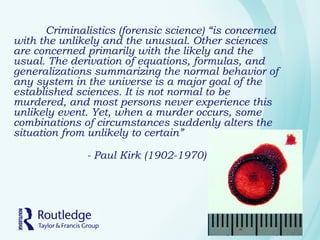
Criminalistics (forensic science) “is concerned
with the unlikely and the unusual. Other sciences
are concerned primarily with the likely and the
usual. The derivation of equations, formulas, and
generalizations summarizing the normal behavior of
any system in the universe is a major goal of the
established sciences. It is not normal to be
murdered, and most persons never experience this
unlikely event. Yet, when a murder occurs, some
combinations of circumstances suddenly alters the
situation from unlikely to certain”
- Paul Kirk (1902-1970)
Chapter 1: Justice and Science
• 1.1 The Role of Forensic Science
• 1.2 Forensic Science and Competing Stories
• 1.3 Science
• 1.4 The Recent Past of Forensic Science
• 1.5 The Odd Couple
• 1.6 Types of Legal Proceedings
• 1.7 Ethics
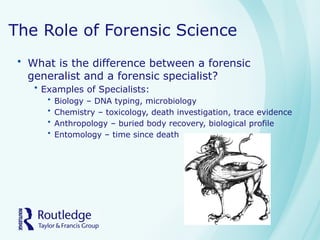
The Role of Forensic Science
• What is the difference between a forensic
generalist and a forensic specialist?
• Examples of Specialists:
• Biology – DNA typing, microbiology
• Chemistry – toxicology, death investigation, trace evidence
• Anthropology – buried body recovery, biological profile
• Entomology – time since death
Myths of Forensic Science
• “Forensic scientists solve cases.”
• They are part of the larger investigation.
• “Forensic science and criminology are the same
thing.”
• Criminology focuses on the social and human aspects of
crime; forensic science applies the sciences to the law,
requiring an understanding of a science subject.
The Scientific Process of Data
• Reproducibility – anyone who repeats the
experiments should obtain comparable results.
• Falsifiable – if scientific findings are incorrect,
they are clearly stated as false.
• Peer Review – data and methods should be
clearly stated so that others can evaluate it.
Bias in Forensic Science
• How to Prevent it:
• Avoid contextual information about the case or suspect.
• Practice sequential unmasking of information regarding
the investigation.
• A Forensic Scientist’s primary responsibility is to
perform scientific analyses and report their
results regardless of how the results might help
or hurt their agency.
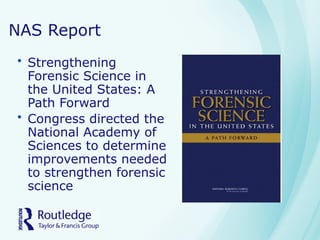
NAS Report
• Strengthening
Forensic Science in
the United States: A
Path Forward
• Congress directed the
National Academy of
Sciences to determine
improvements needed
to strengthen forensic
science
Accreditation and Certification
What is the difference
between accreditation
and certification?
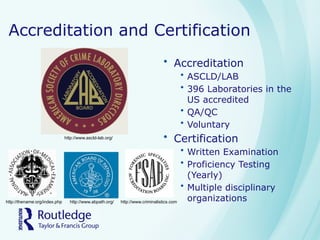
Accreditation and Certification
• Accreditation
• ASCLD/LAB
• 396 Laboratories in the
US accredited
• QA/QC
• Voluntary
• Certification
• Written Examination
• Proficiency Testing
(Yearly)
• Multiple disciplinary
organizations
http://www.ascld-lab.org/
http://thename.org/index.php http://www.abpath.org/ http://www.criminalistics.com
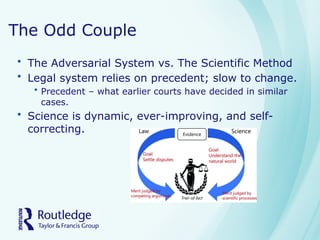
The Odd Couple
• The Adversarial System vs. The Scientific Method
• Legal system relies on precedent; slow to change.
• Precedent – what earlier courts have decided in similar
cases.
• Science is dynamic, ever-improving, and self-
correcting.
Legal Proceedings
• Civil Cases – individuals
• Patent Infringement
• Preponderance of evidence (51%)
• Criminal Cases – government and individual
• Violation of criminal laws
• Felony/Misdemeanor
• Guilty beyond a reasonable doubt (99%)
• Jurisdictions
• Different legal rules and procedures
Legal Proceedings: Roles
• Trier/Finder-of-fact
• Prosecution/Plaintiff
• Prosecution: Bears the burden of proving a defendant
guilty beyond reasonable doubt
• Plaintiff: Prove case by preponderance of the evidence
• Defendant
• Forensic scientists can testify on either side.
Forensic Scientist’s Day in Court
• Analysis->Report->Subpoena
• Voir Dire
• Voir dire
• Background, training, experience
• Direct Examination
• Lay foundation for the admissibility of the evidence in
question
• Cross Examination
• Discredit witness or evidence
• Re-direct/Re-cross
Ethics
• No one code of ethics
• The American Academy of Forensic Sciences
• Difference of opinion ≠ Unethical
• Present and defend
• Bias
• Prosecutorial bias
• Report results as they are
• North Carolina versus Michael Peterson
Chapter 1 Summary
• Forensic science roots are deep
• 19th
century mostly in Europe
• Development by “Generalists”
• Modern Forensic Laboratory
• 20th
century
• Public or Private Laboratories/Consultants
• Interaction with legal systems varies
• Importance in accreditation and
certifications
• Ethical codes

Chapter 1.pptx For h=justice and science

  • 1.
  • 2.
    Criminalistics (forensic science)“is concerned with the unlikely and the unusual. Other sciences are concerned primarily with the likely and the usual. The derivation of equations, formulas, and generalizations summarizing the normal behavior of any system in the universe is a major goal of the established sciences. It is not normal to be murdered, and most persons never experience this unlikely event. Yet, when a murder occurs, some combinations of circumstances suddenly alters the situation from unlikely to certain” - Paul Kirk (1902-1970)
  • 3.
    Chapter 1: Justiceand Science • 1.1 The Role of Forensic Science • 1.2 Forensic Science and Competing Stories • 1.3 Science • 1.4 The Recent Past of Forensic Science • 1.5 The Odd Couple • 1.6 Types of Legal Proceedings • 1.7 Ethics
  • 4.
    The Role ofForensic Science • What is the difference between a forensic generalist and a forensic specialist? • Examples of Specialists: • Biology – DNA typing, microbiology • Chemistry – toxicology, death investigation, trace evidence • Anthropology – buried body recovery, biological profile • Entomology – time since death
  • 5.
    Myths of ForensicScience • “Forensic scientists solve cases.” • They are part of the larger investigation. • “Forensic science and criminology are the same thing.” • Criminology focuses on the social and human aspects of crime; forensic science applies the sciences to the law, requiring an understanding of a science subject.
  • 6.
    The Scientific Processof Data • Reproducibility – anyone who repeats the experiments should obtain comparable results. • Falsifiable – if scientific findings are incorrect, they are clearly stated as false. • Peer Review – data and methods should be clearly stated so that others can evaluate it.
  • 7.
    Bias in ForensicScience • How to Prevent it: • Avoid contextual information about the case or suspect. • Practice sequential unmasking of information regarding the investigation. • A Forensic Scientist’s primary responsibility is to perform scientific analyses and report their results regardless of how the results might help or hurt their agency.
  • 8.
    NAS Report • Strengthening ForensicScience in the United States: A Path Forward • Congress directed the National Academy of Sciences to determine improvements needed to strengthen forensic science
  • 9.
    Accreditation and Certification Whatis the difference between accreditation and certification?
  • 10.
    Accreditation and Certification •Accreditation • ASCLD/LAB • 396 Laboratories in the US accredited • QA/QC • Voluntary • Certification • Written Examination • Proficiency Testing (Yearly) • Multiple disciplinary organizations http://www.ascld-lab.org/ http://thename.org/index.php http://www.abpath.org/ http://www.criminalistics.com
  • 11.
    The Odd Couple •The Adversarial System vs. The Scientific Method • Legal system relies on precedent; slow to change. • Precedent – what earlier courts have decided in similar cases. • Science is dynamic, ever-improving, and self- correcting.
  • 12.
    Legal Proceedings • CivilCases – individuals • Patent Infringement • Preponderance of evidence (51%) • Criminal Cases – government and individual • Violation of criminal laws • Felony/Misdemeanor • Guilty beyond a reasonable doubt (99%) • Jurisdictions • Different legal rules and procedures
  • 13.
    Legal Proceedings: Roles •Trier/Finder-of-fact • Prosecution/Plaintiff • Prosecution: Bears the burden of proving a defendant guilty beyond reasonable doubt • Plaintiff: Prove case by preponderance of the evidence • Defendant • Forensic scientists can testify on either side.
  • 14.
    Forensic Scientist’s Dayin Court • Analysis->Report->Subpoena • Voir Dire • Voir dire • Background, training, experience • Direct Examination • Lay foundation for the admissibility of the evidence in question • Cross Examination • Discredit witness or evidence • Re-direct/Re-cross
  • 15.
    Ethics • No onecode of ethics • The American Academy of Forensic Sciences • Difference of opinion ≠ Unethical • Present and defend • Bias • Prosecutorial bias • Report results as they are • North Carolina versus Michael Peterson
  • 16.
    Chapter 1 Summary •Forensic science roots are deep • 19th century mostly in Europe • Development by “Generalists” • Modern Forensic Laboratory • 20th century • Public or Private Laboratories/Consultants • Interaction with legal systems varies • Importance in accreditation and certifications • Ethical codes

Editor's Notes

  • #9 Maybe move to after the accreditation/cert slide