Introducing Network
              Design Concepts


              Designing and Supporting Computer Networks – Chapter 1


Version 4.0      © 2006 Cisco Systems, Inc. All rights reserved.   Cisco Public   1
Objectives
   Explain how a hierarchical network design creates a stable,
    reliable, scalable network
   Explain what factors need to be considered when the Core Layer
    of a network is designed and implemented
   Explain which factors need to be considered when the
    Distribution Layer of a network is designed and implemented
   Explain which factors need to be considered when the Access
    Layer of a network is designed and implemented
   Describe the benefits and security implications of creating server
    farms
   Describe the considerations of an implementation of a wireless
    network design
   Describe the factors that affect the implementation of VPNs,
    including how remote workers can be supported


    © 2006 Cisco Systems, Inc. All rights reserved.   Cisco Public       2
Explain How a Hierarchical Network Design
   Creates a Stable, Reliable, Scalable Network
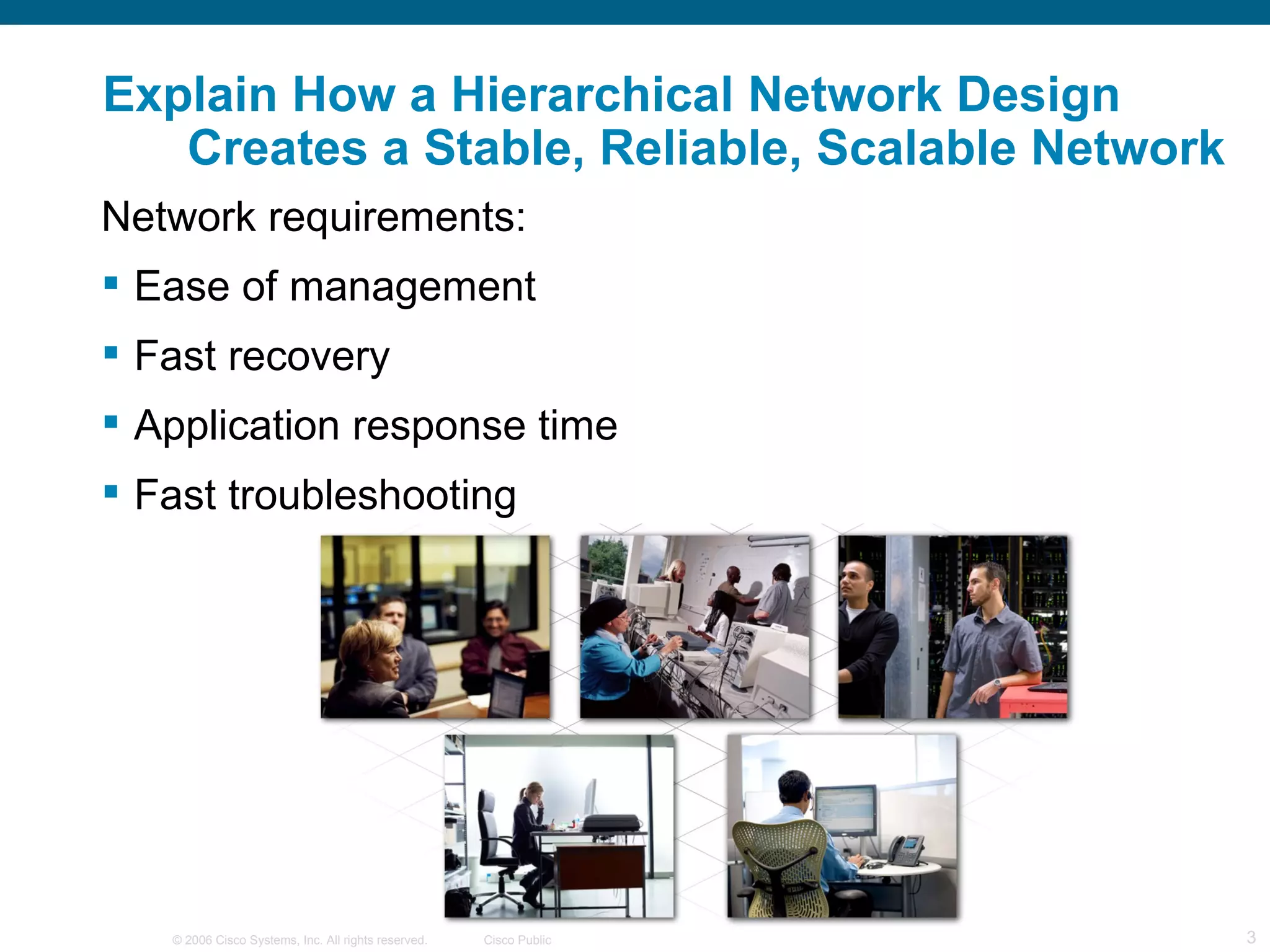
Network requirements:
 Ease of management
 Fast recovery
 Application response time
 Fast troubleshooting


   © 2006 Cisco Systems, Inc. All rights reserved.   Cisco Public   3
Explain How a Hierarchical Network Design
   Creates a Stable, Reliable, Scalable Network
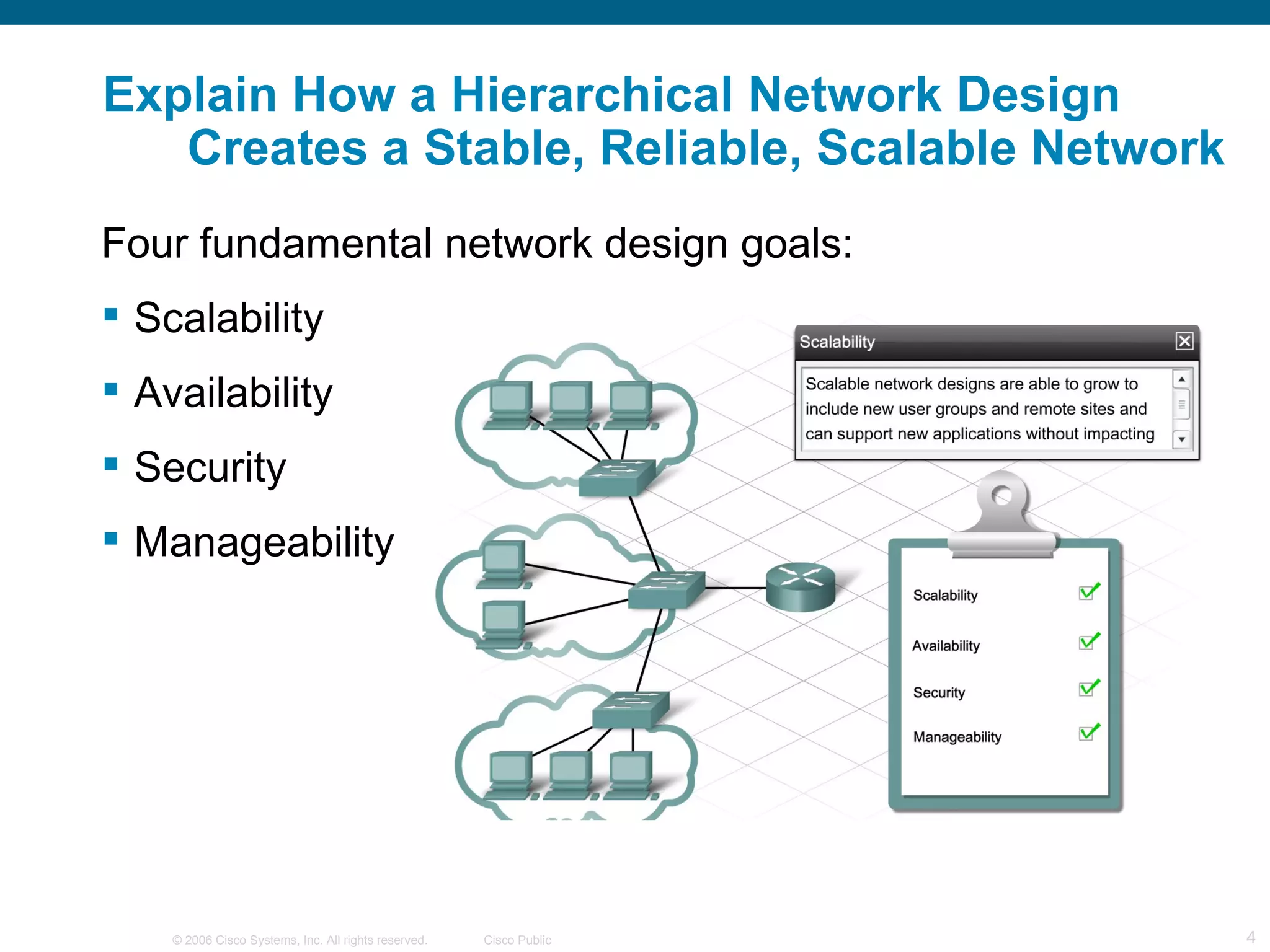
Four fundamental network design goals:
 Scalability
 Availability
 Security
 Manageability


    © 2006 Cisco Systems, Inc. All rights reserved.   Cisco Public   4
Explain How a Hierarchical Network Design
Creates a Stable, Reliable, Scalable Network
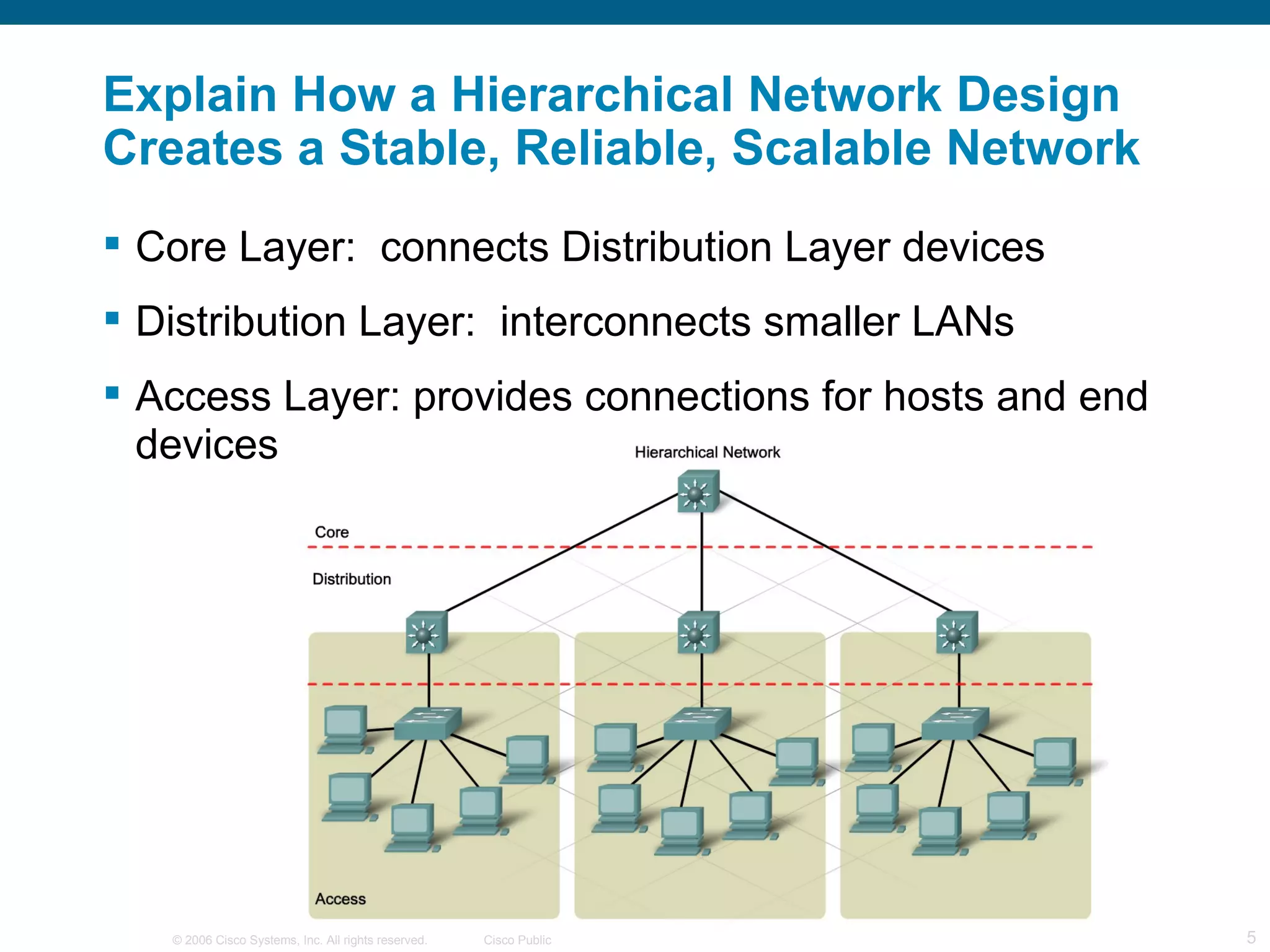
 Core Layer: connects Distribution Layer devices
 Distribution Layer: interconnects smaller LANs
 Access Layer: provides connections for hosts and end
  devices


   © 2006 Cisco Systems, Inc. All rights reserved.   Cisco Public   5
Explain How a Hierarchical Network Design
Creates a Stable, Reliable, Scalable Network
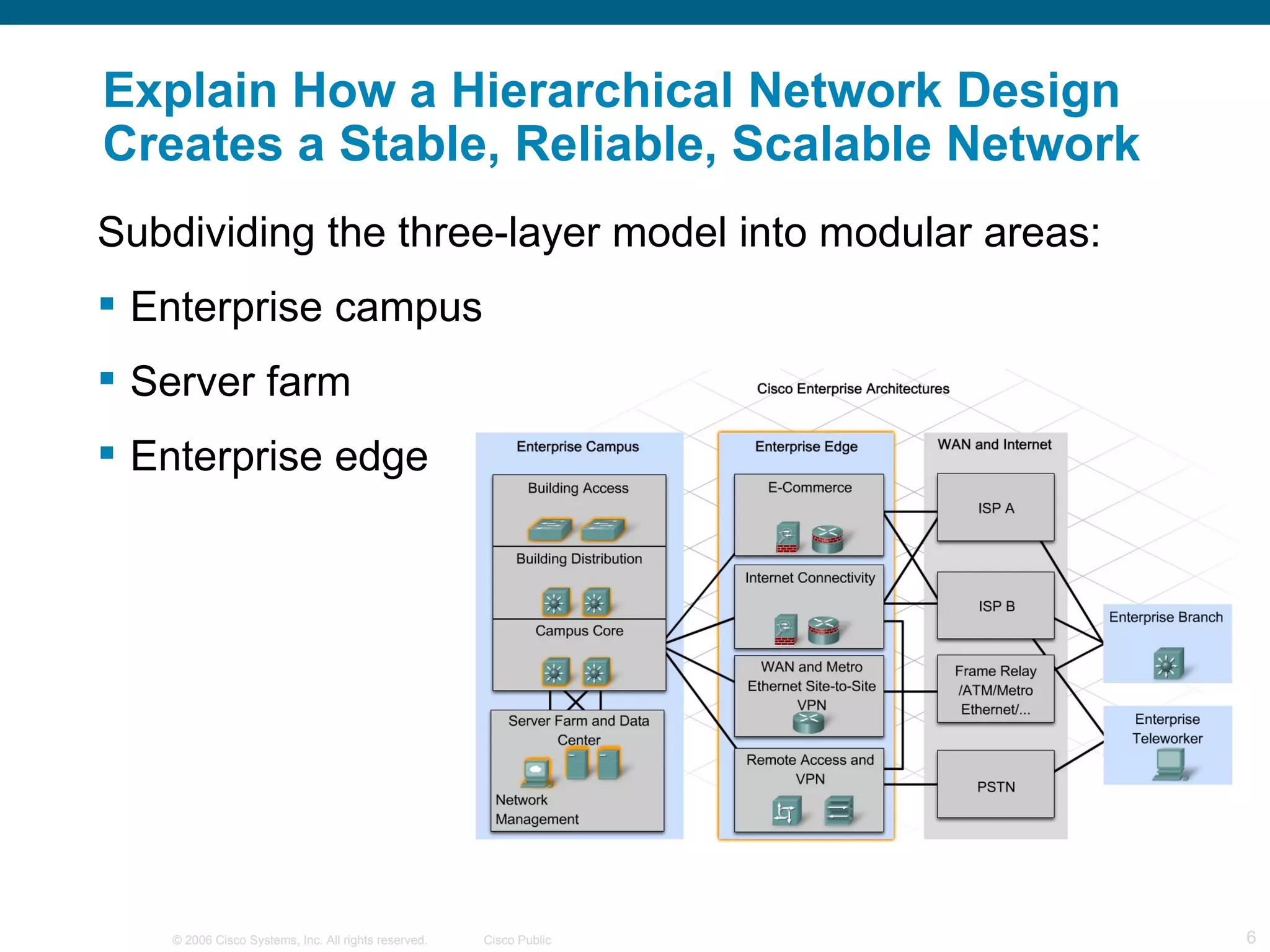
Subdividing the three-layer model into modular areas:
 Enterprise campus
 Server farm
 Enterprise edge


   © 2006 Cisco Systems, Inc. All rights reserved.   Cisco Public   6
Explain How a Hierarchical Network Design
   Creates a Stable, Reliable, Scalable Network
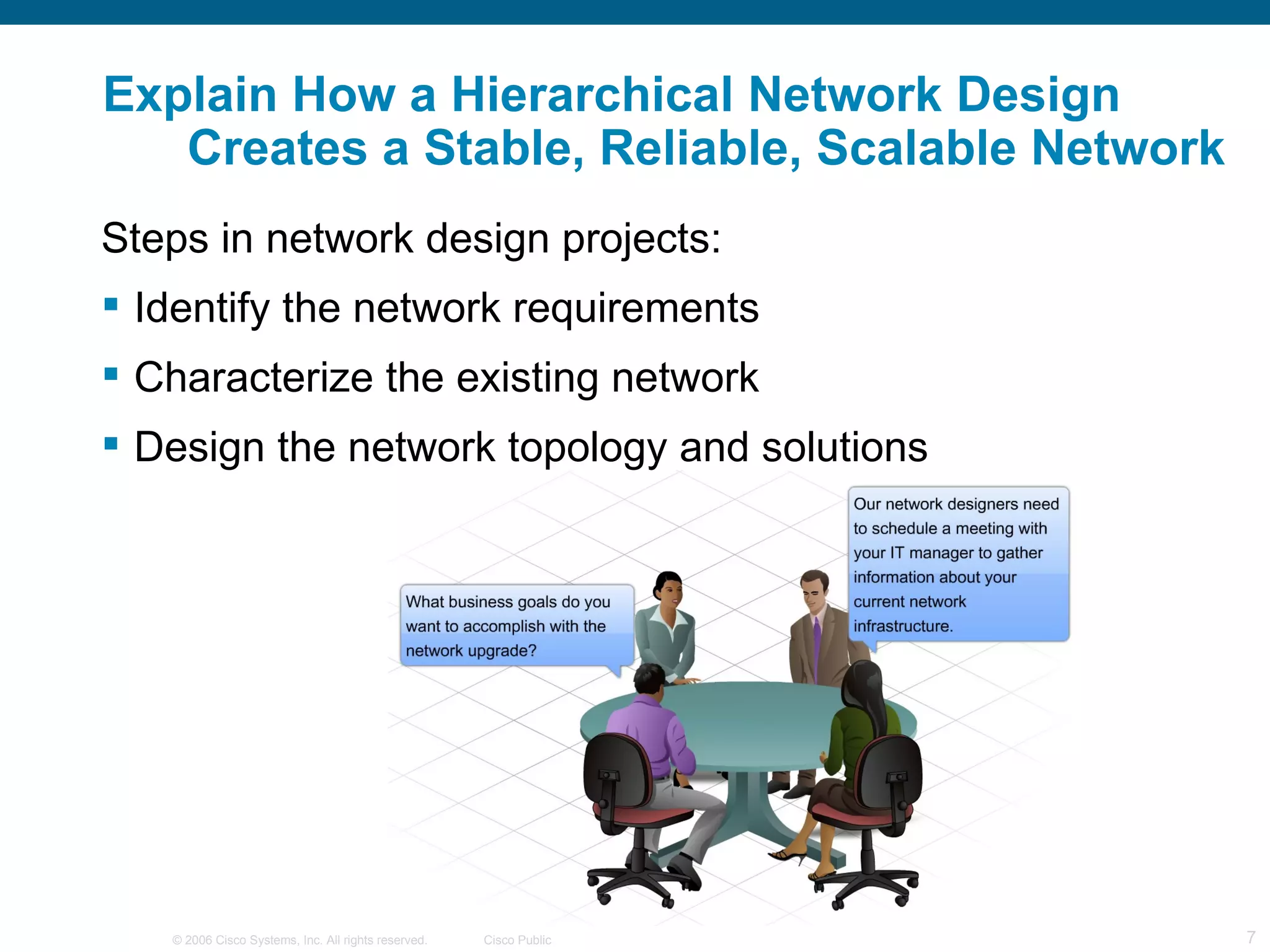
Steps in network design projects:
 Identify the network requirements
 Characterize the existing network
 Design the network topology and solutions


   © 2006 Cisco Systems, Inc. All rights reserved.   Cisco Public   7
Explain what Factors Need to be Considered
   when Designing the Network Core Layer
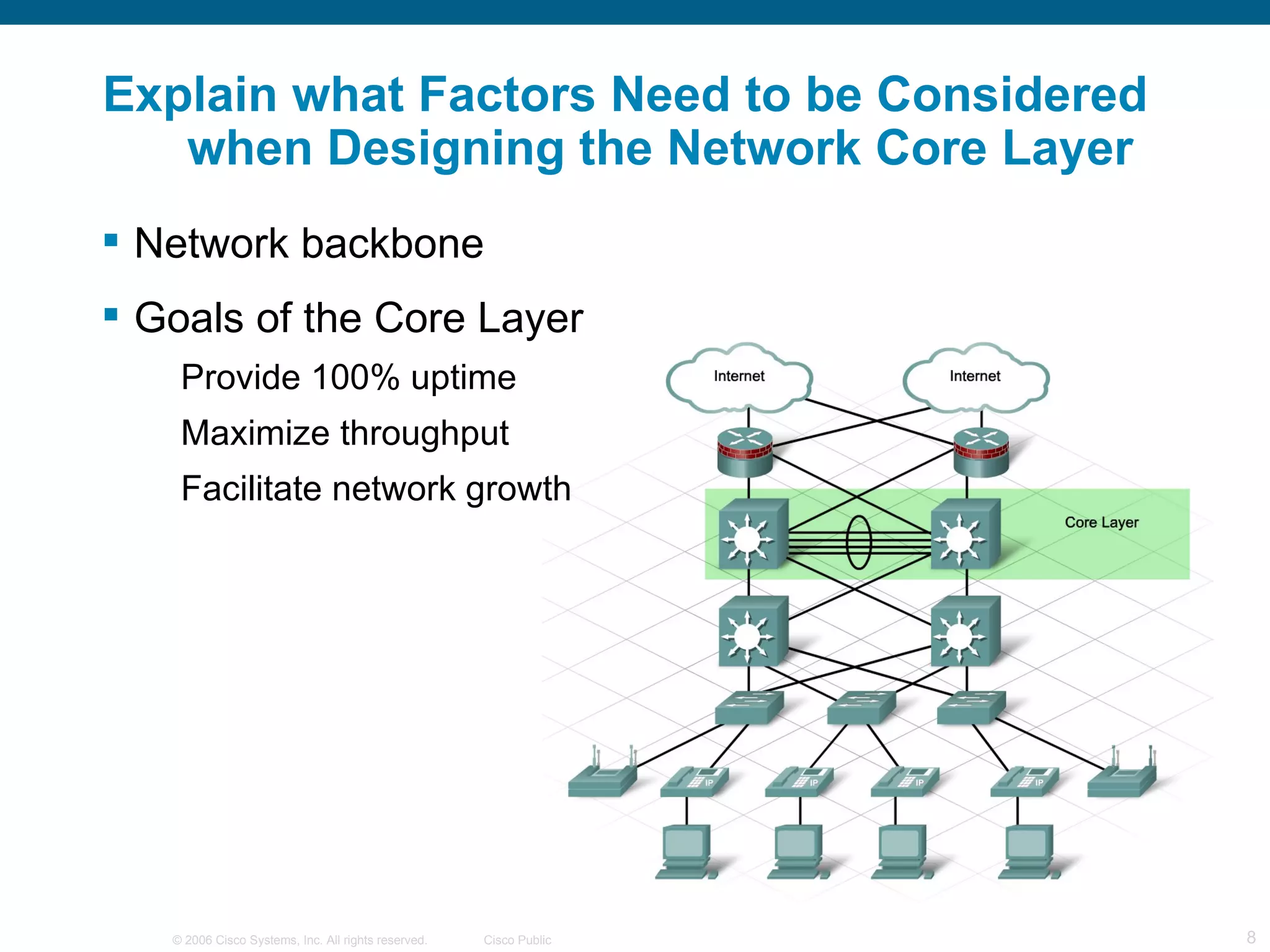
 Network backbone
 Goals of the Core Layer
    Provide 100% uptime
    Maximize throughput
    Facilitate network growth


   © 2006 Cisco Systems, Inc. All rights reserved.   Cisco Public   8
Explain what Factors Need to be Considered
   when Designing the Network Core Layer
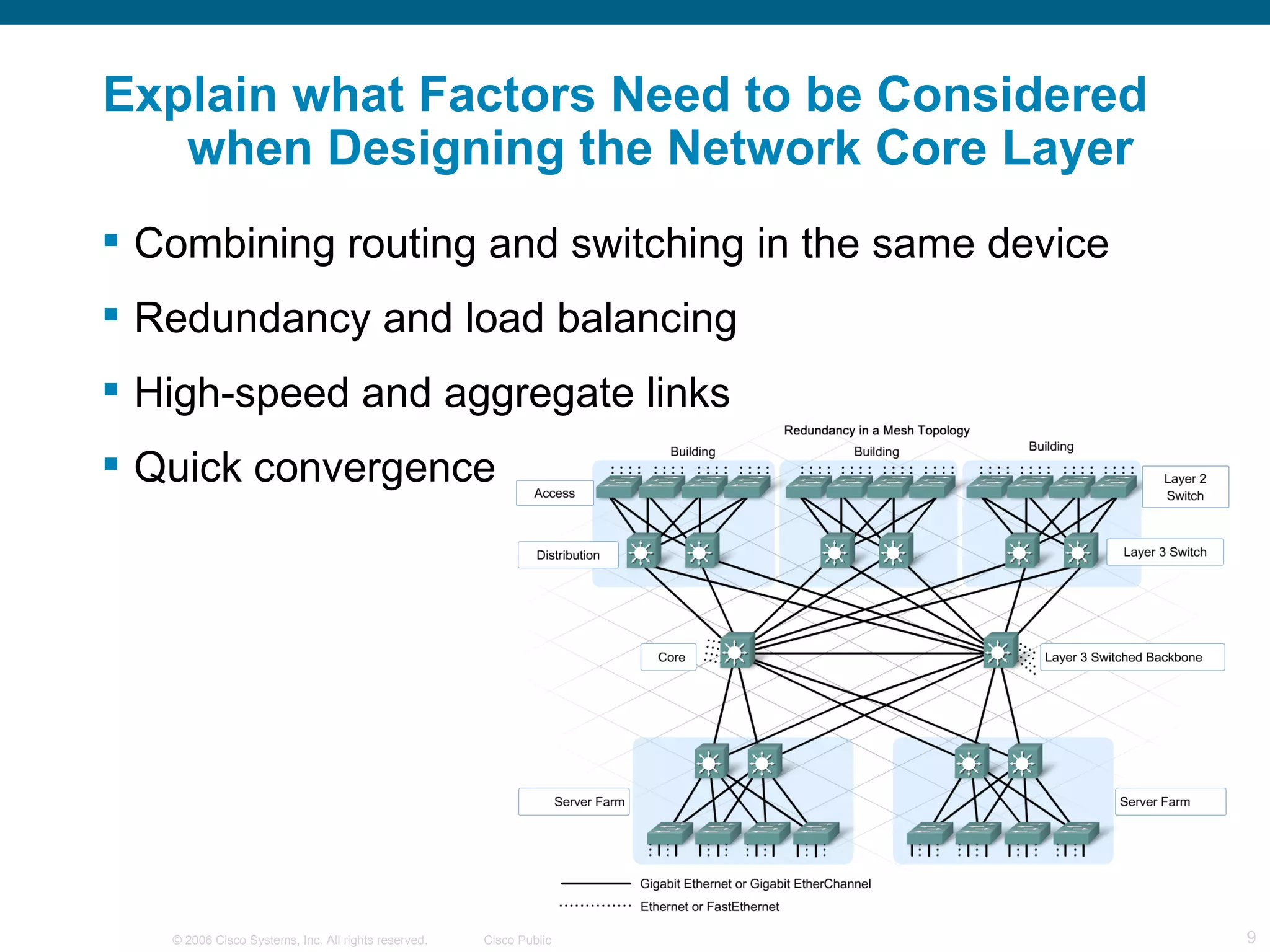
 Combining routing and switching in the same device
 Redundancy and load balancing
 High-speed and aggregate links
 Quick convergence


   © 2006 Cisco Systems, Inc. All rights reserved.   Cisco Public   9
Explain what Factors Need to be Considered
   when Designing the Network Core Layer
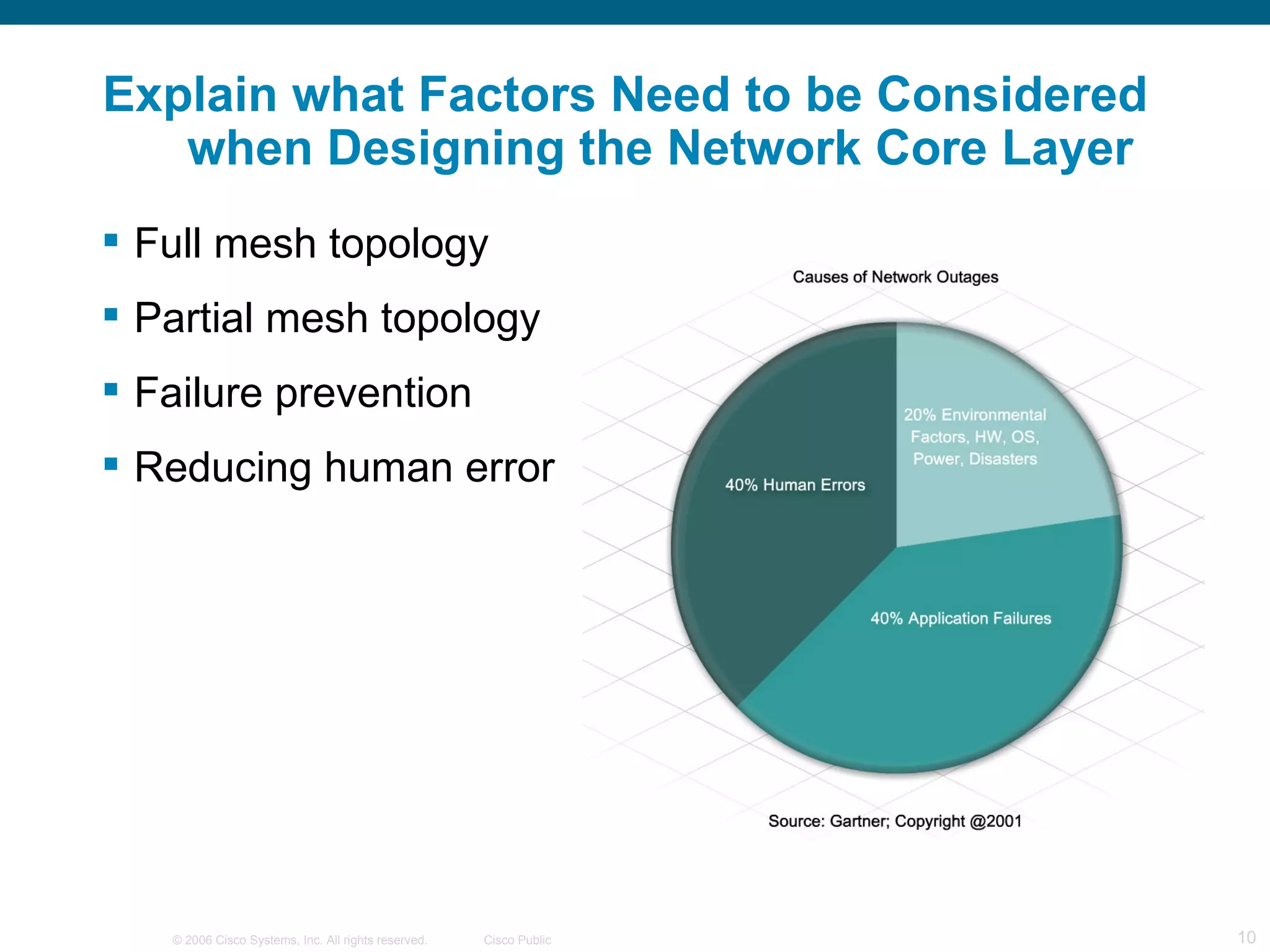
 Full mesh topology
 Partial mesh topology
 Failure prevention
 Reducing human error


   © 2006 Cisco Systems, Inc. All rights reserved.   Cisco Public   10
Explain which Factors Need to be Considered when
   Designing the Distribution Layer of a Network
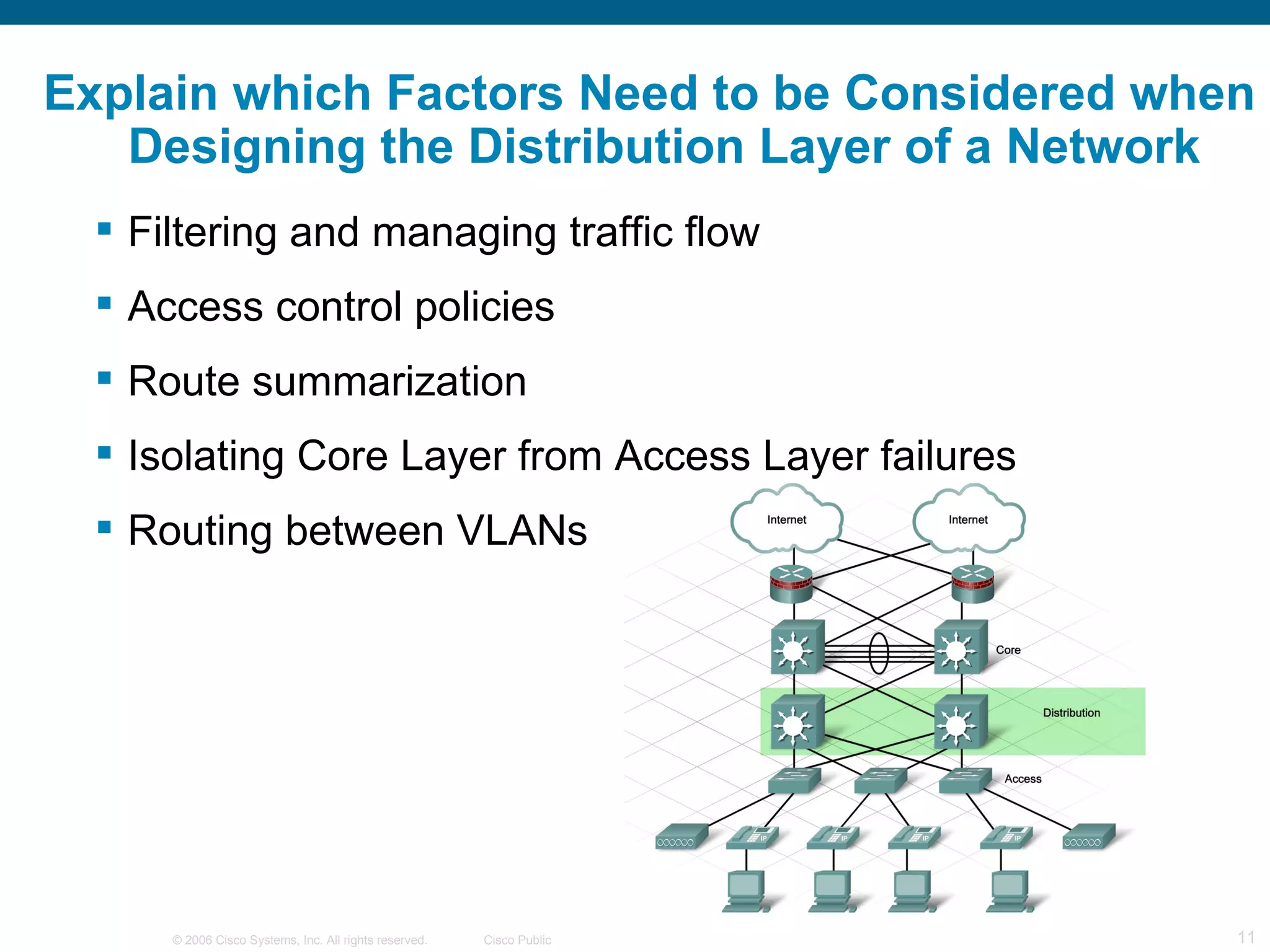
   Filtering and managing traffic flow
   Access control policies
   Route summarization
   Isolating Core Layer from Access Layer failures
   Routing between VLANs


      © 2006 Cisco Systems, Inc. All rights reserved.   Cisco Public   11
Explain which Factors Need to be Considered when
   Designing the Distribution Layer of a Network

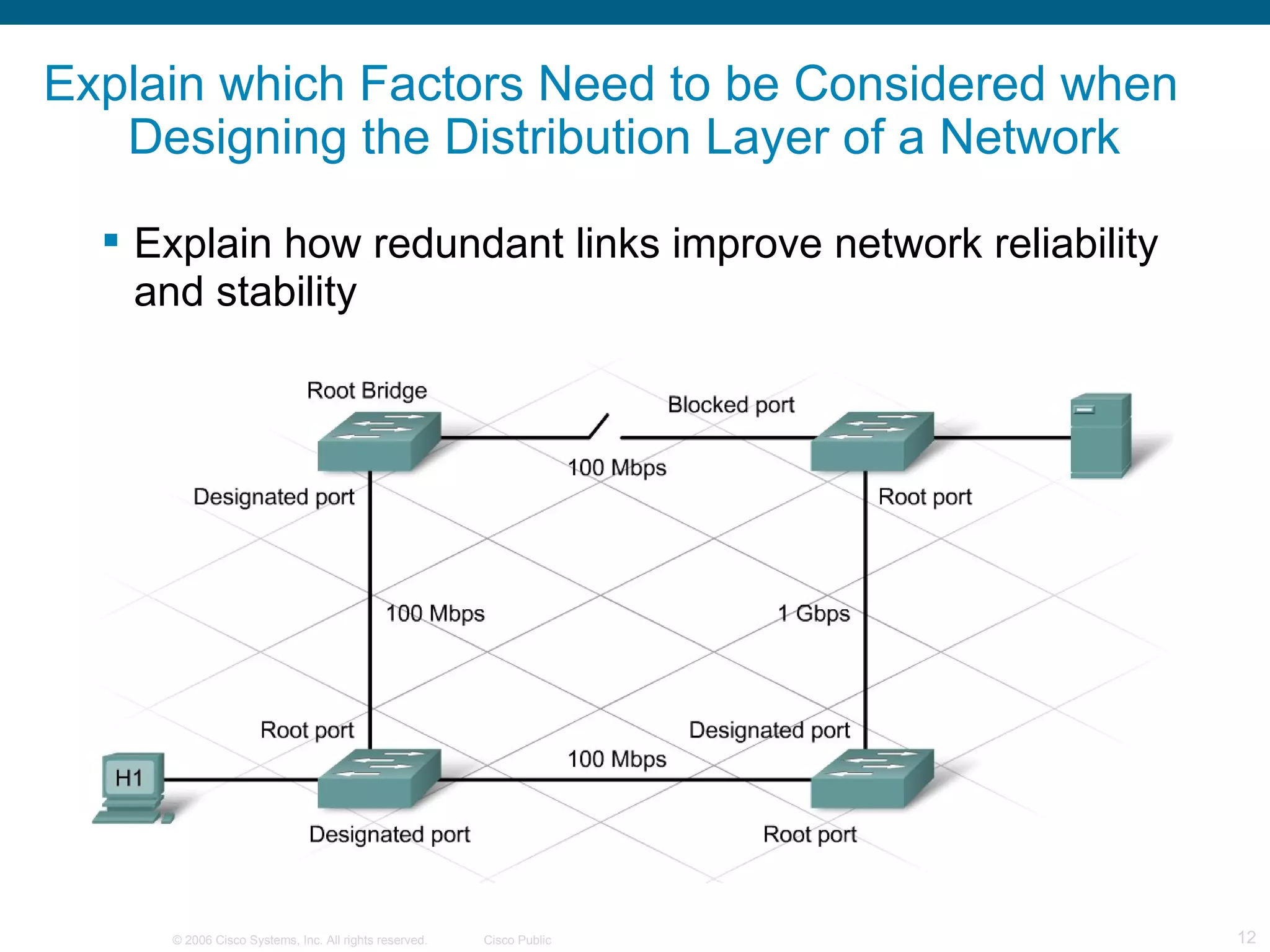
   Explain how redundant links improve network reliability
    and stability


     © 2006 Cisco Systems, Inc. All rights reserved.   Cisco Public   12
Explain which Factors Need to be Considered when
   Designing the Distribution Layer of a Network
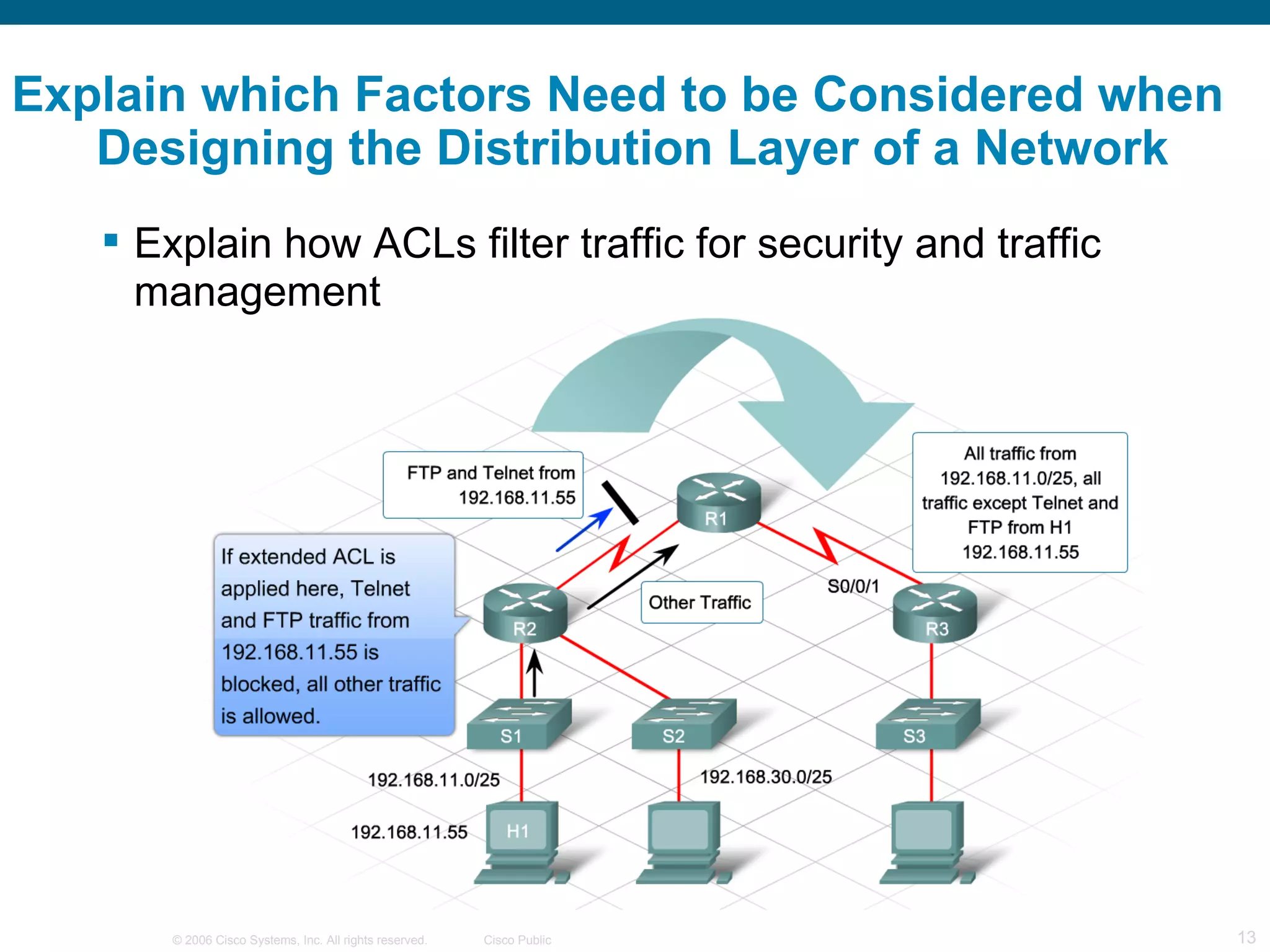
    Explain how ACLs filter traffic for security and traffic
     management


       © 2006 Cisco Systems, Inc. All rights reserved.   Cisco Public   13
Explain which Factors Need to be Considered when
   Designing the Distribution Layer of a Network
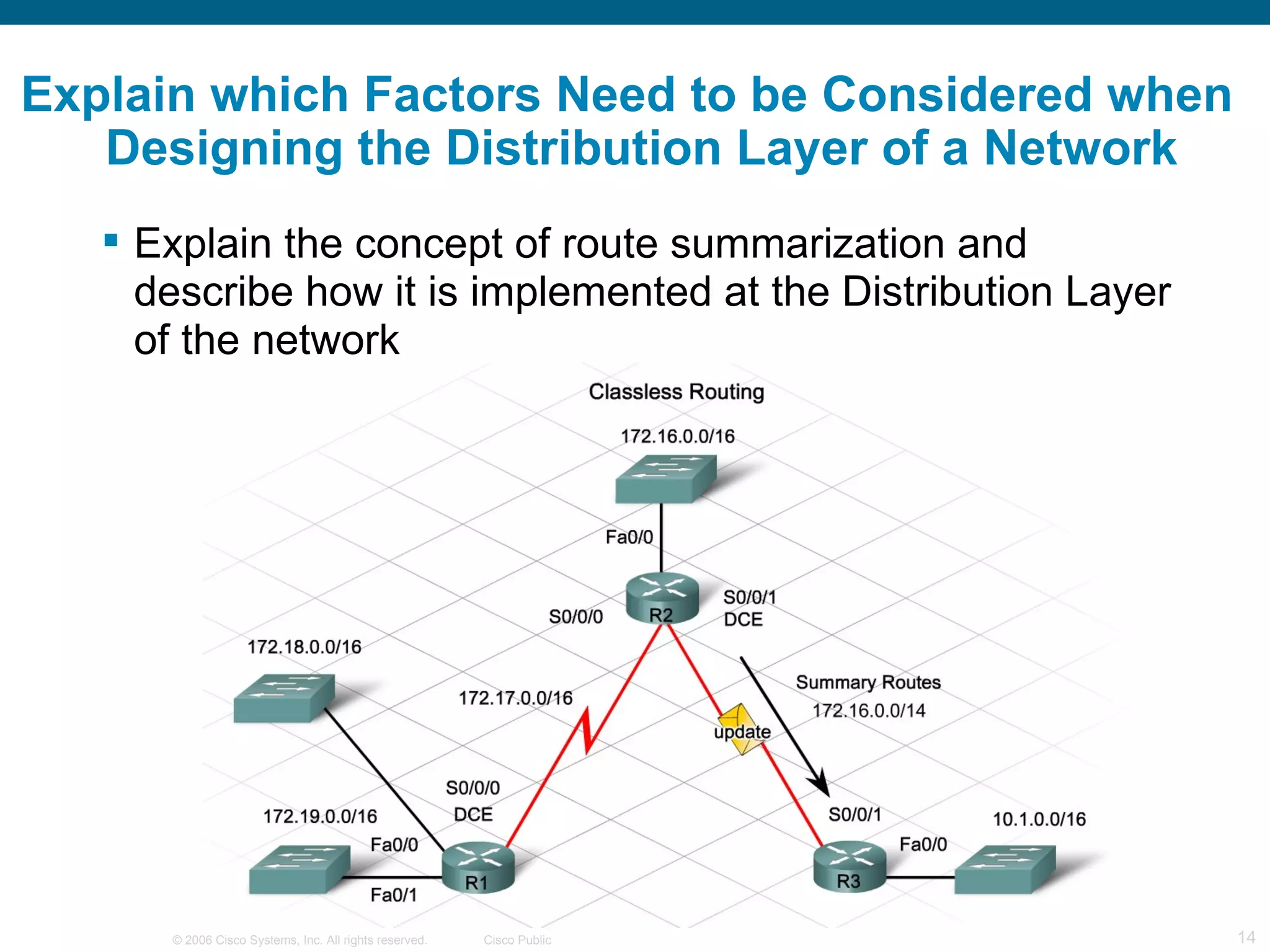
    Explain the concept of route summarization and
     describe how it is implemented at the Distribution Layer
     of the network


      © 2006 Cisco Systems, Inc. All rights reserved.   Cisco Public   14
Explain which Factors Need to be Considered
   when Designing the Access Layer of a Network
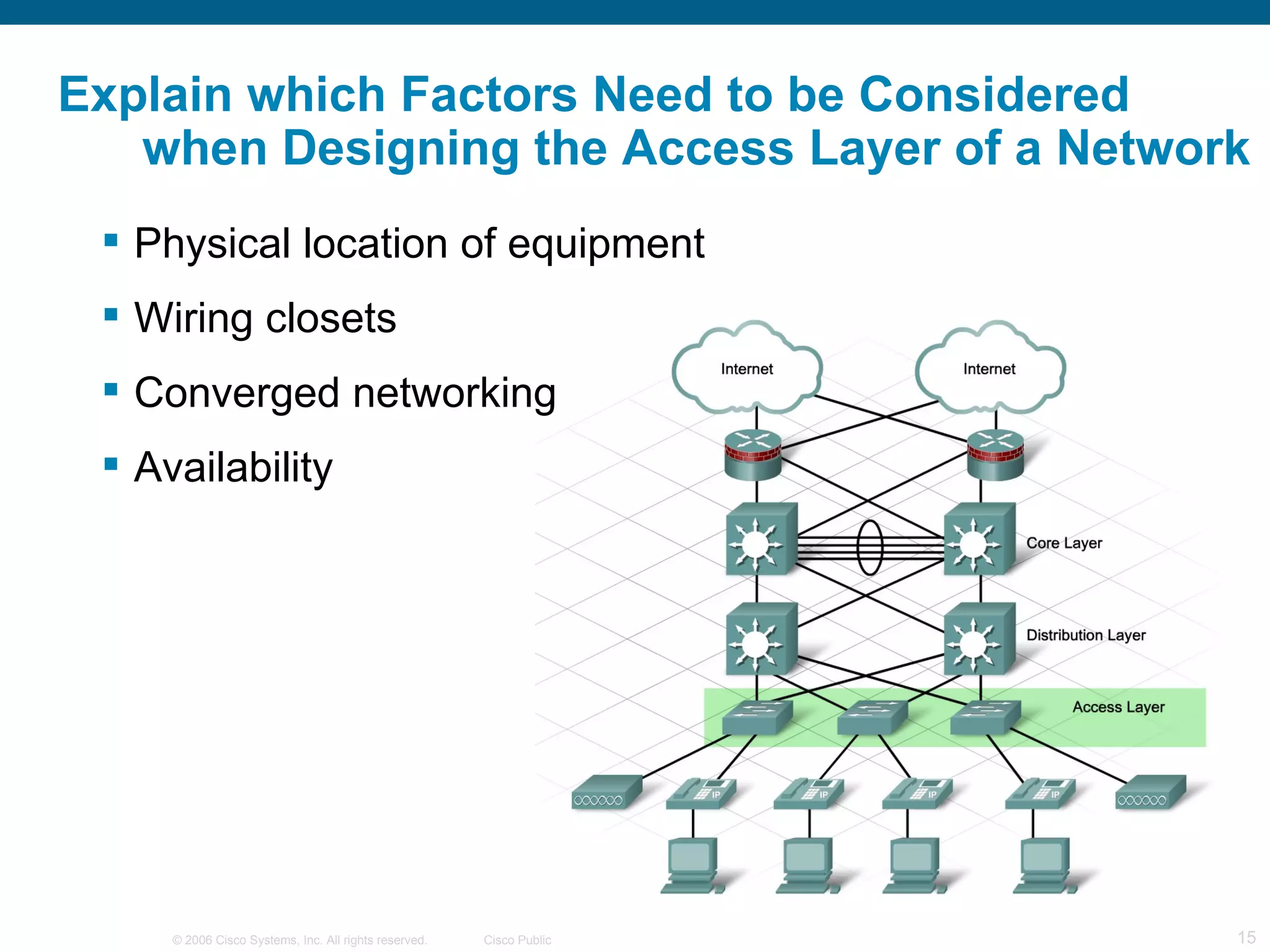
  Physical location of equipment
  Wiring closets
  Converged networking
  Availability


     © 2006 Cisco Systems, Inc. All rights reserved.   Cisco Public   15
Explain which Factors Need to be Considered
when Designing the Access Layer of a Network

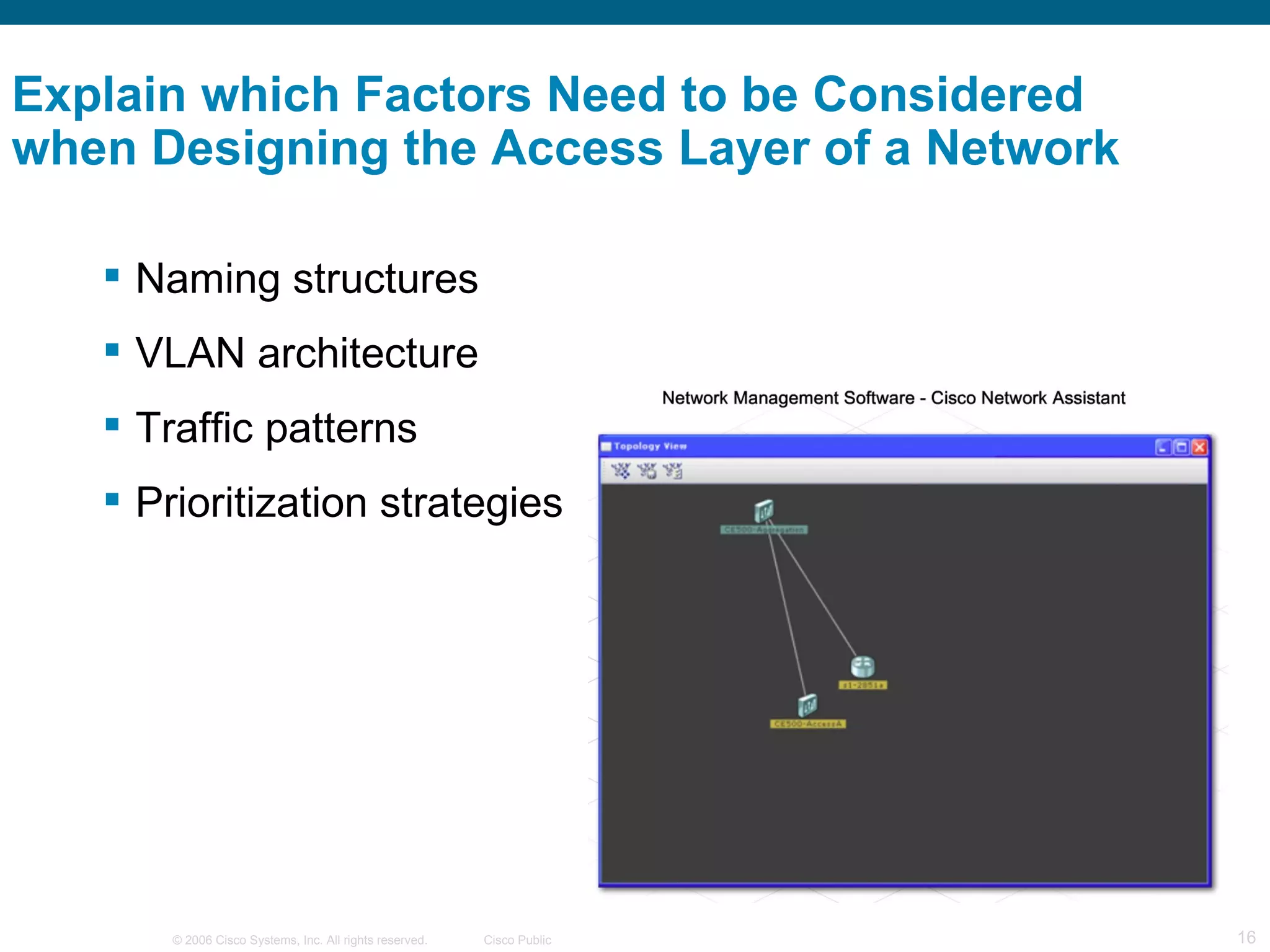
    Naming structures
    VLAN architecture
    Traffic patterns
    Prioritization strategies


       © 2006 Cisco Systems, Inc. All rights reserved.   Cisco Public   16
Explain which Factors Need to be Considered
when Designing the Access Layer of a Network

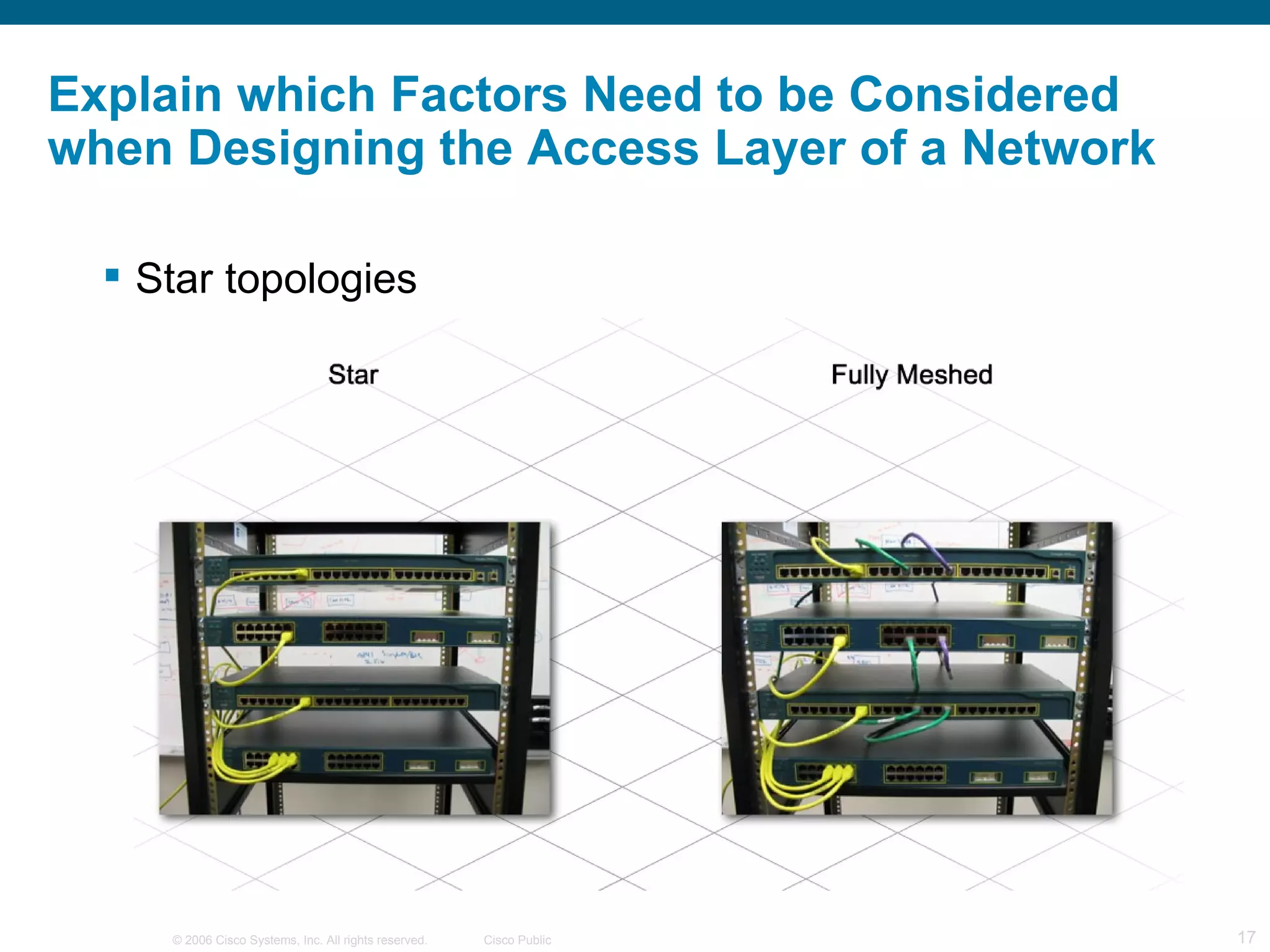
   Star topologies


     © 2006 Cisco Systems, Inc. All rights reserved.   Cisco Public   17
Explain which Factors Need to be Considered
   when Designing the Access Layer of a Network
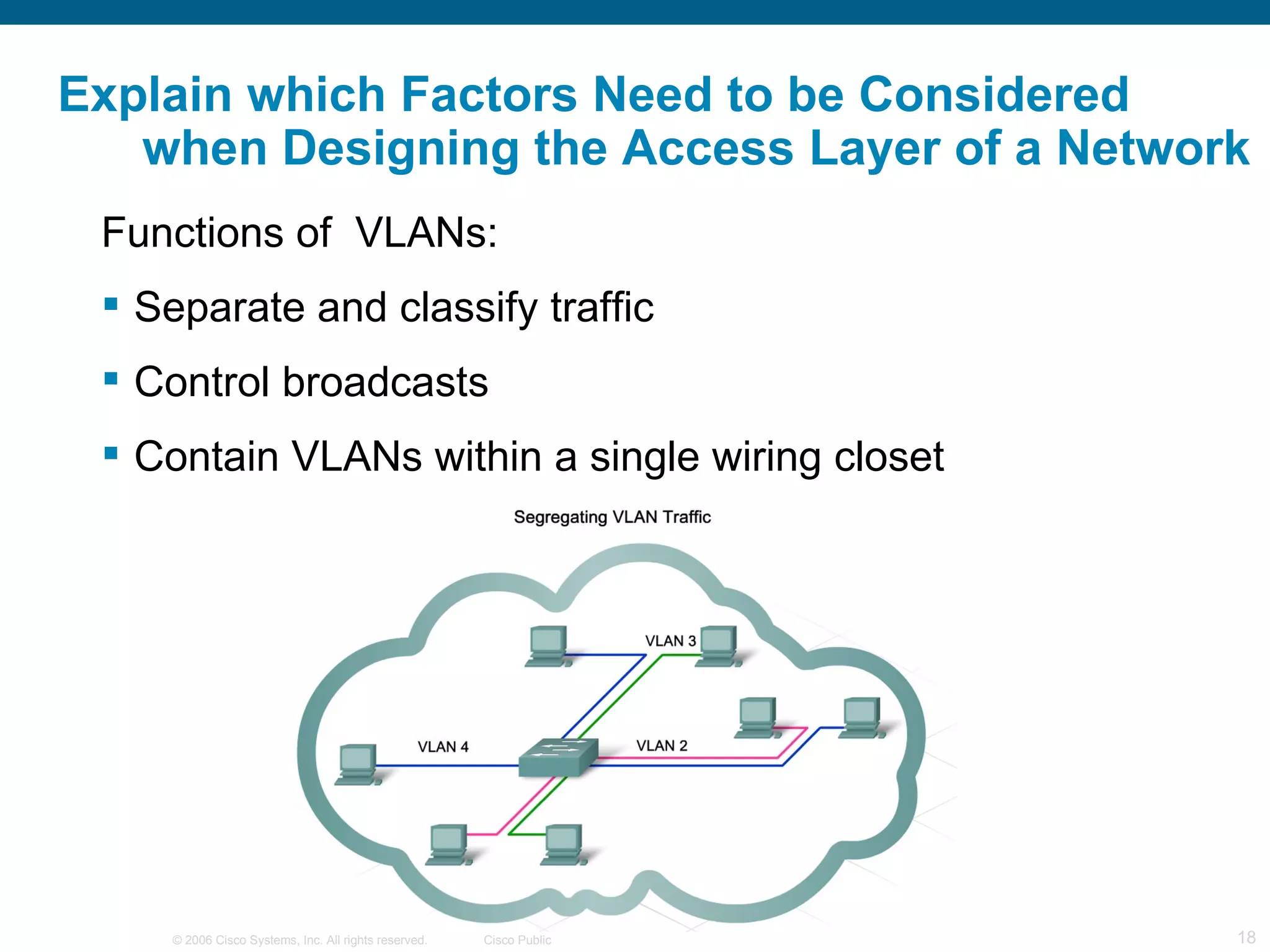
 Functions of VLANs:
  Separate and classify traffic
  Control broadcasts
  Contain VLANs within a single wiring closet


     © 2006 Cisco Systems, Inc. All rights reserved.   Cisco Public   18
Explain which Factors Need to be Considered
   when Designing the Access Layer of a Network
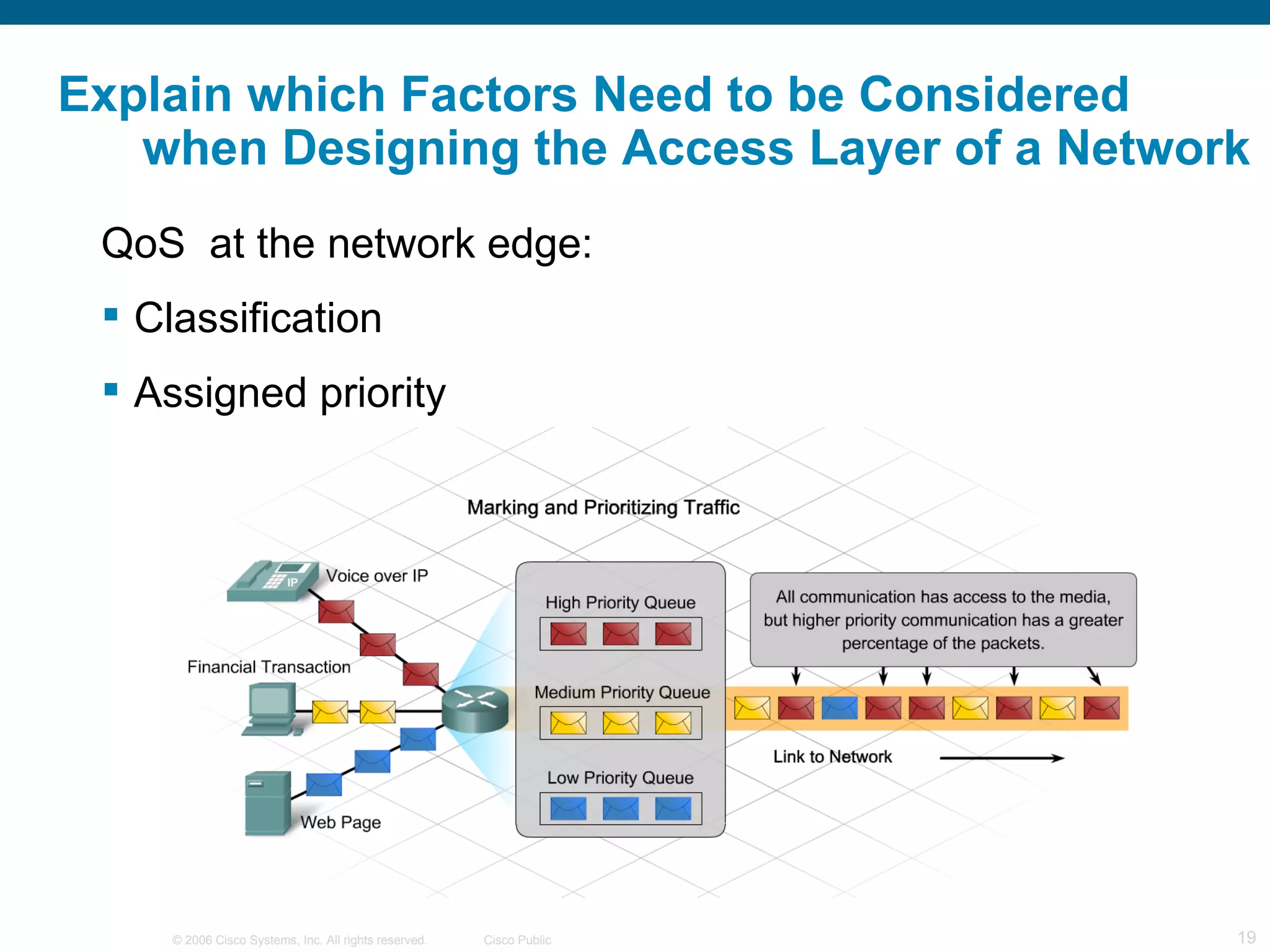
 QoS at the network edge:
  Classification
  Assigned priority


     © 2006 Cisco Systems, Inc. All rights reserved.   Cisco Public   19
Explain which Factors Need to be Considered
   when Designing the Access Layer of a Network
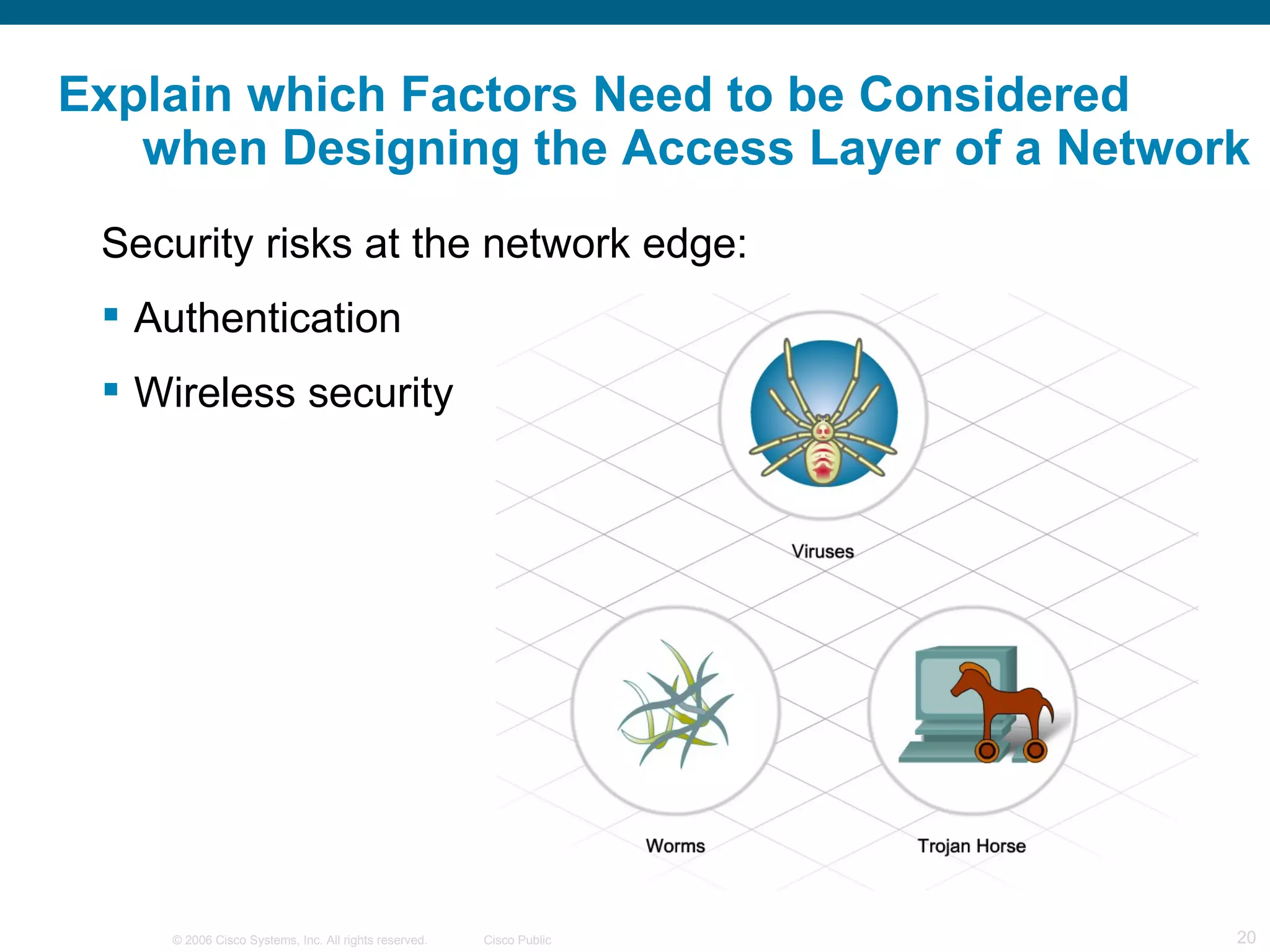
 Security risks at the network edge:
  Authentication
  Wireless security


    © 2006 Cisco Systems, Inc. All rights reserved.   Cisco Public   20
Explain which Factors Need to be Considered
   when Designing the Access Layer of a Network
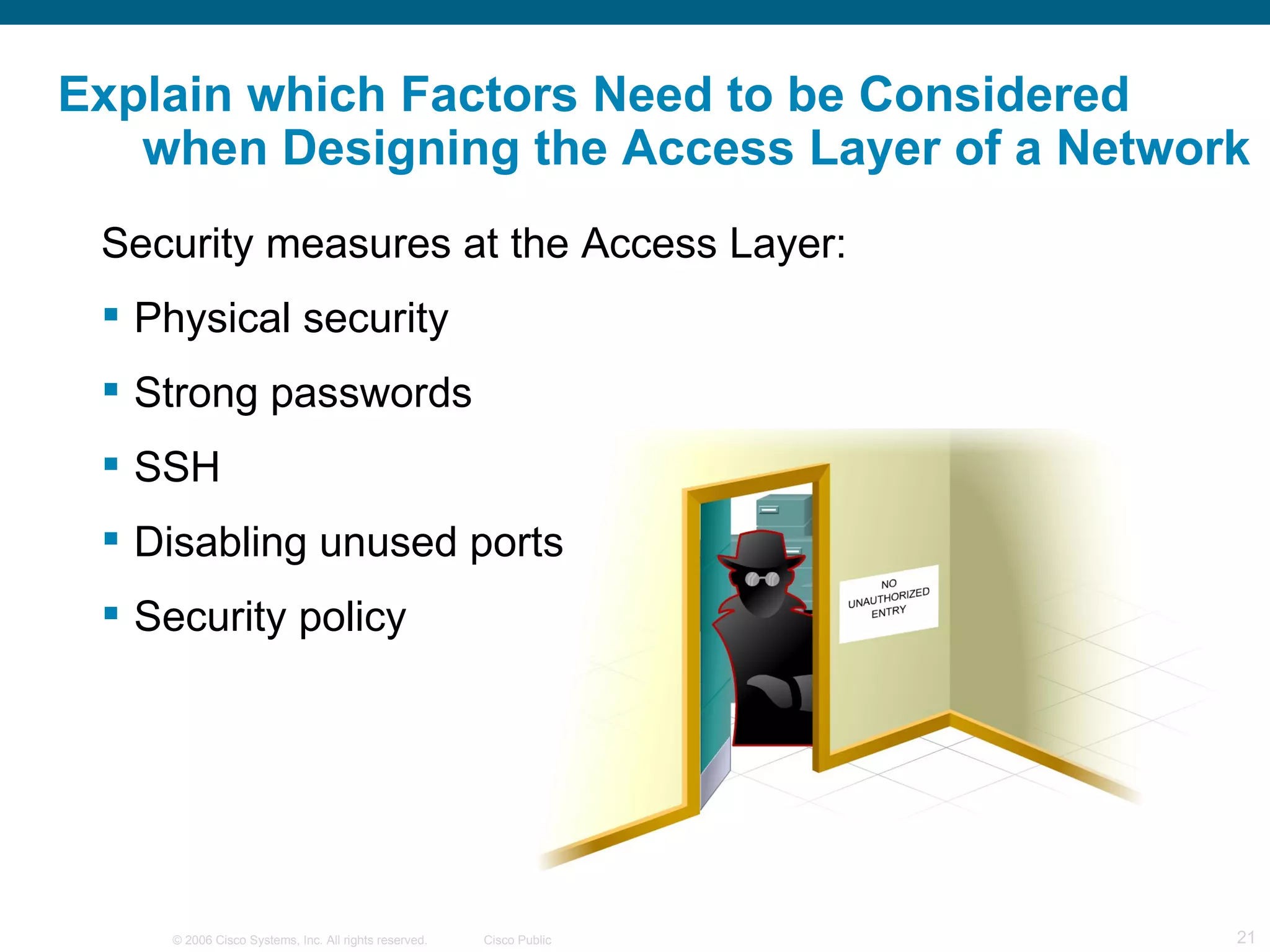
 Security measures at the Access Layer:
  Physical security
  Strong passwords
  SSH
  Disabling unused ports
  Security policy


    © 2006 Cisco Systems, Inc. All rights reserved.   Cisco Public   21
Describe the Benefits and Security
  Implications of Creating Server Farms
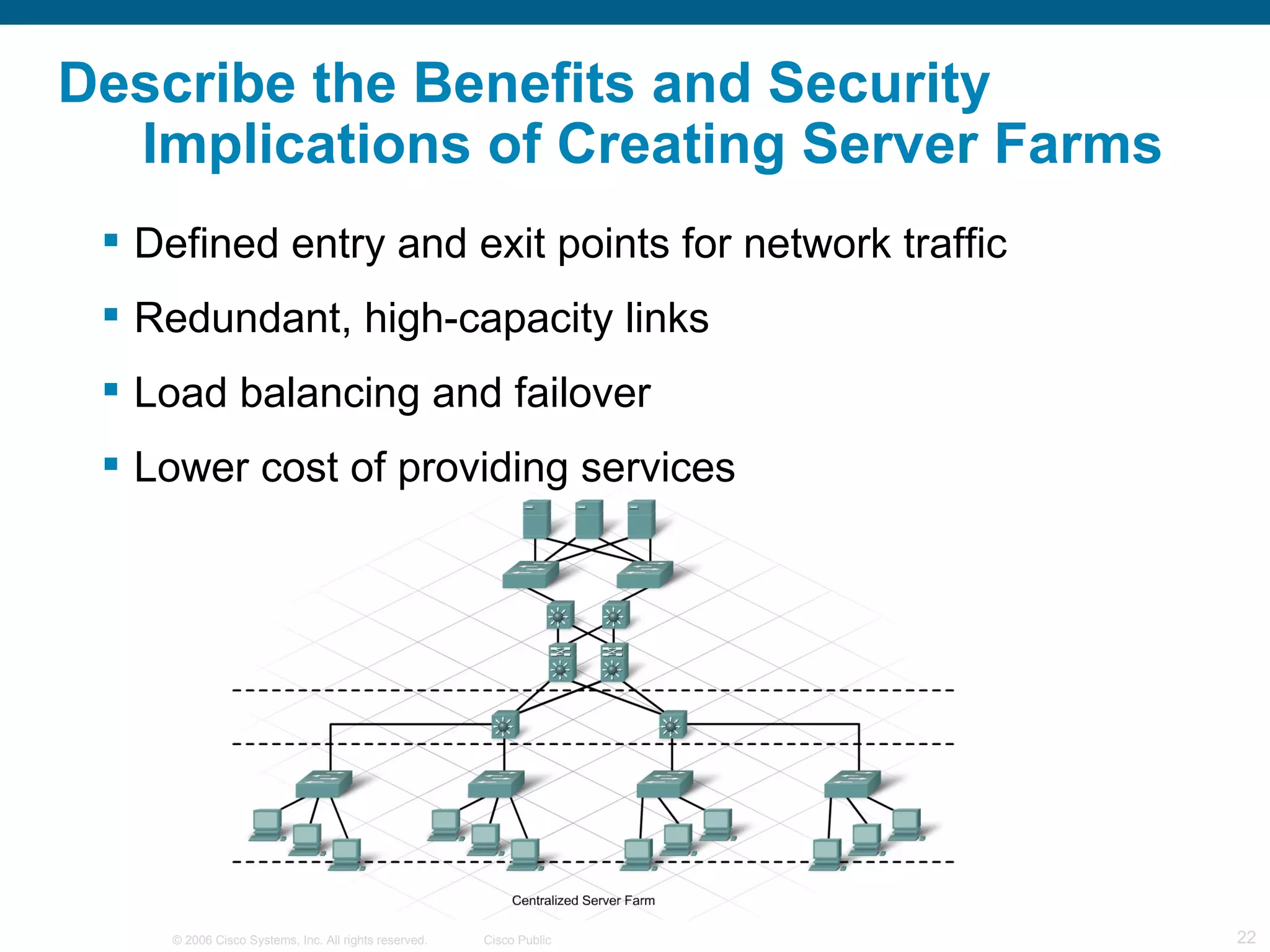
  Defined entry and exit points for network traffic
  Redundant, high-capacity links
  Load balancing and failover
  Lower cost of providing services


     © 2006 Cisco Systems, Inc. All rights reserved.   Cisco Public   22
Describe the Benefits and Security
  Implications of Creating Server Farms
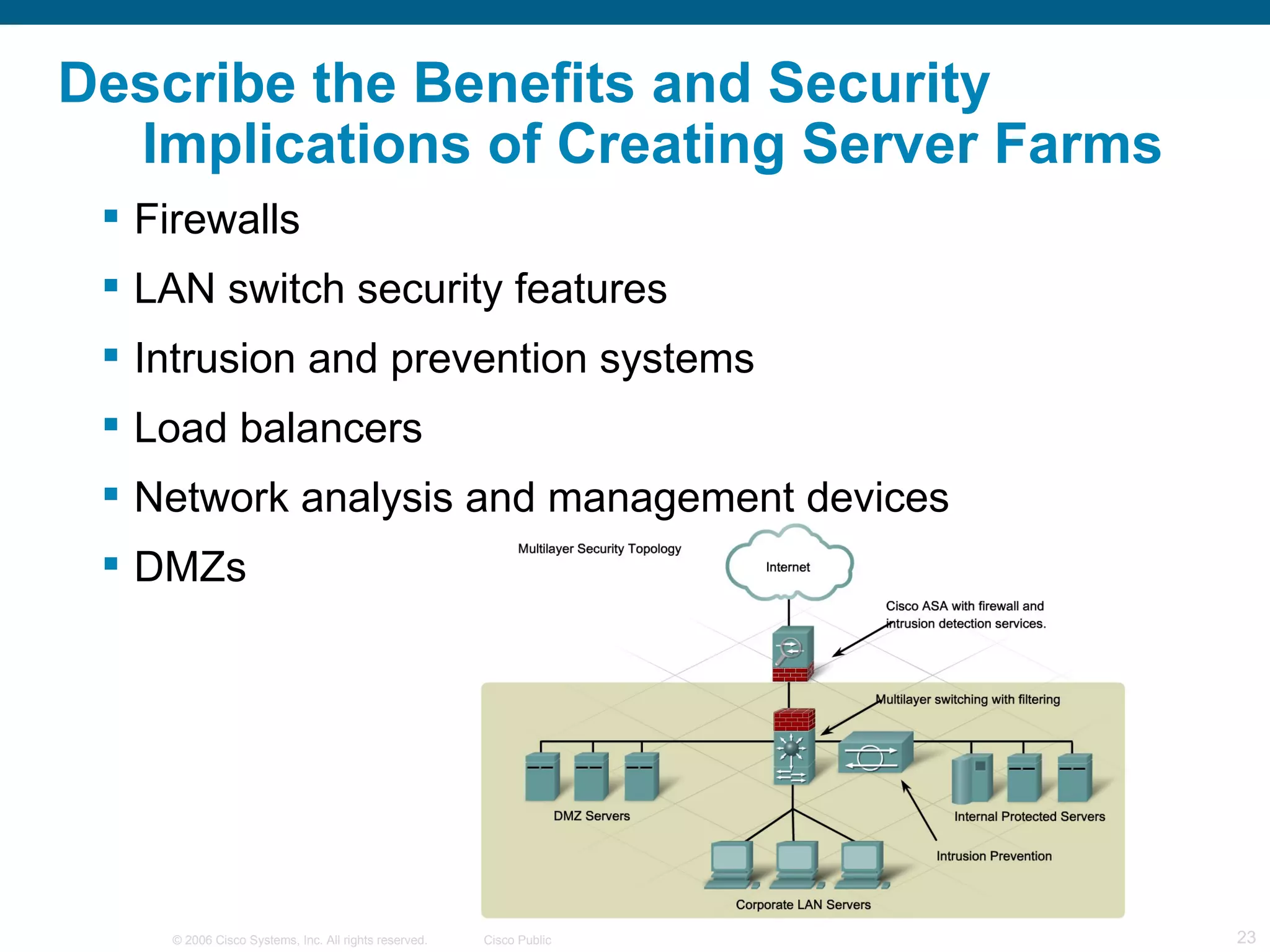
  Firewalls
  LAN switch security features
  Intrusion and prevention systems
  Load balancers
  Network analysis and management devices
  DMZs


    © 2006 Cisco Systems, Inc. All rights reserved.   Cisco Public   23
Describe the Benefits and Security
  Implications of Creating Server Farms
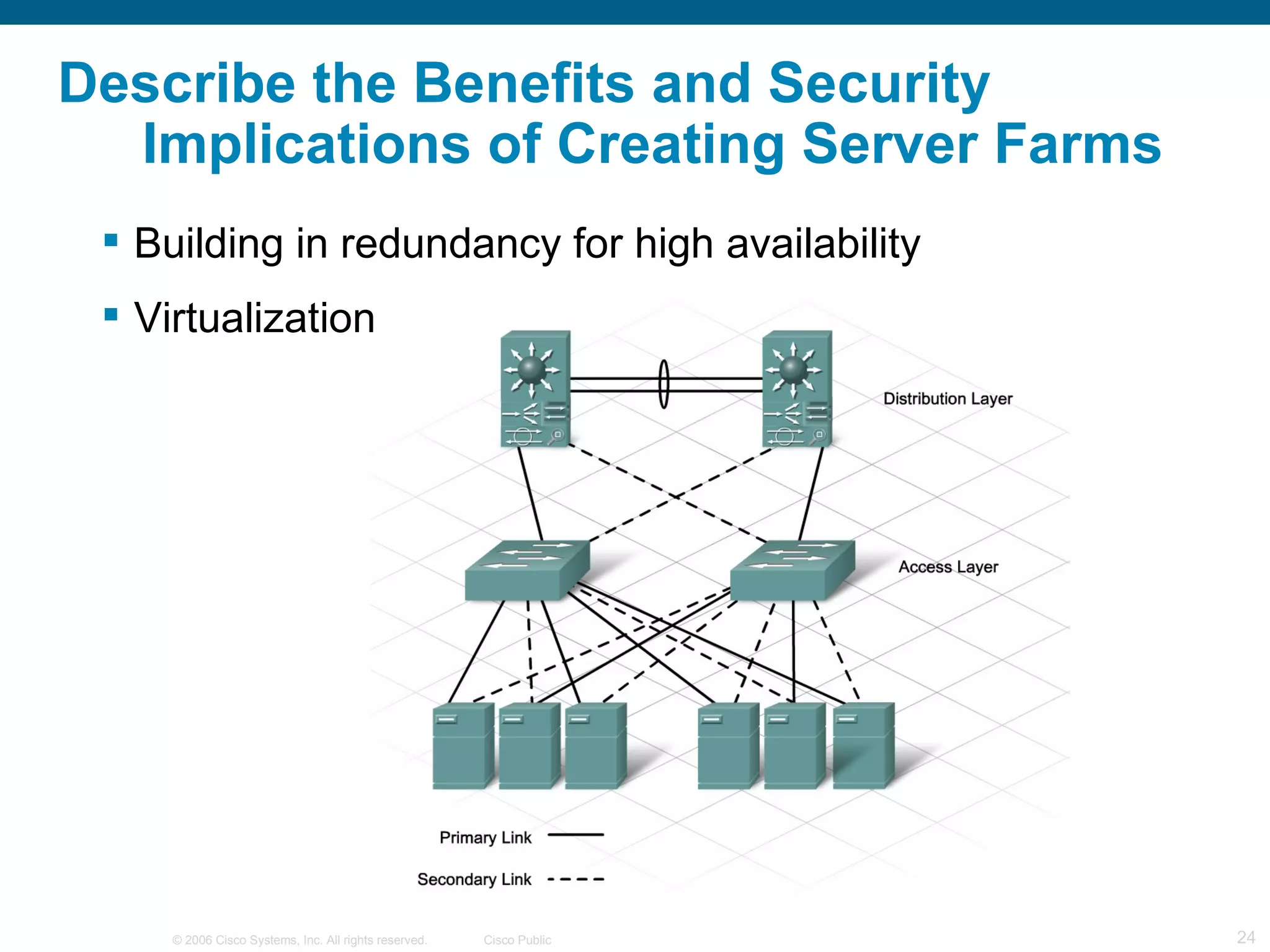
  Building in redundancy for high availability
  Virtualization


     © 2006 Cisco Systems, Inc. All rights reserved.   Cisco Public   24
Describe the Considerations of an Implementation
   of a Wireless Network Design

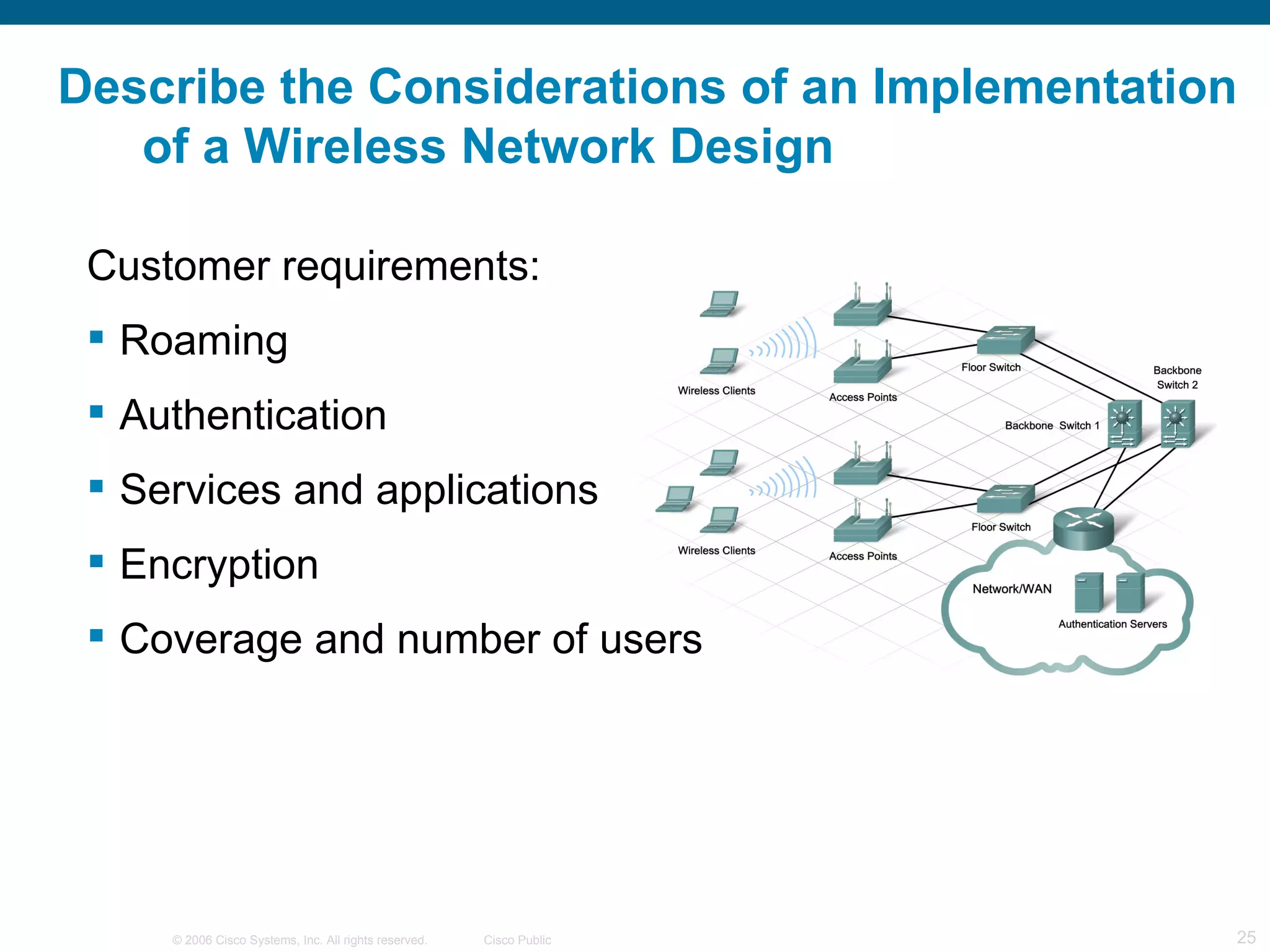
 Customer requirements:
  Roaming
  Authentication
  Services and applications
  Encryption
  Coverage and number of users


     © 2006 Cisco Systems, Inc. All rights reserved.   Cisco Public   25
Describe the Considerations of an Implementation
   of a Wireless Network Design
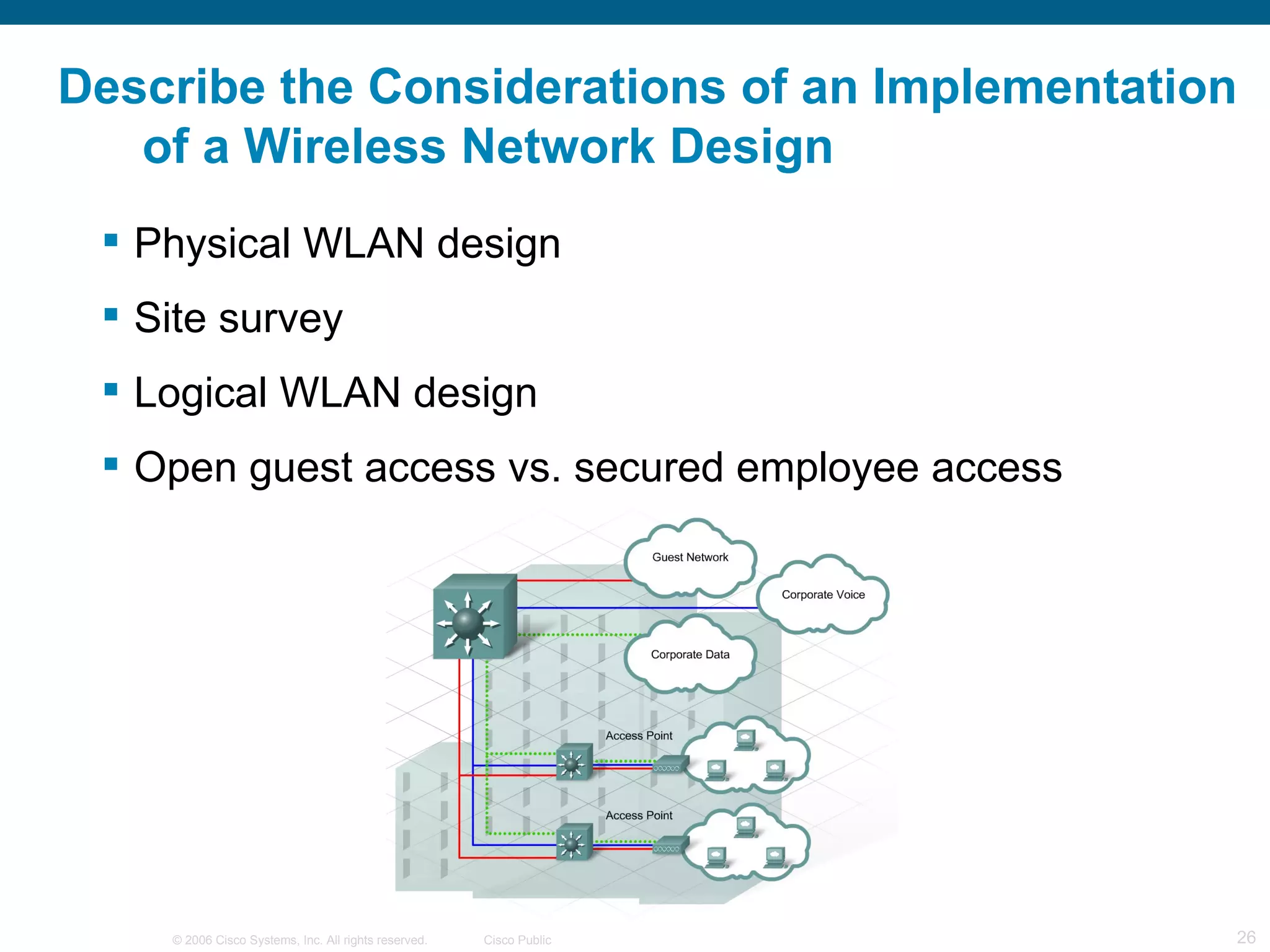
  Physical WLAN design
  Site survey
  Logical WLAN design
  Open guest access vs. secured employee access


    © 2006 Cisco Systems, Inc. All rights reserved.   Cisco Public   26
Describe the Factors that Affect the
  Implementation of VPNs
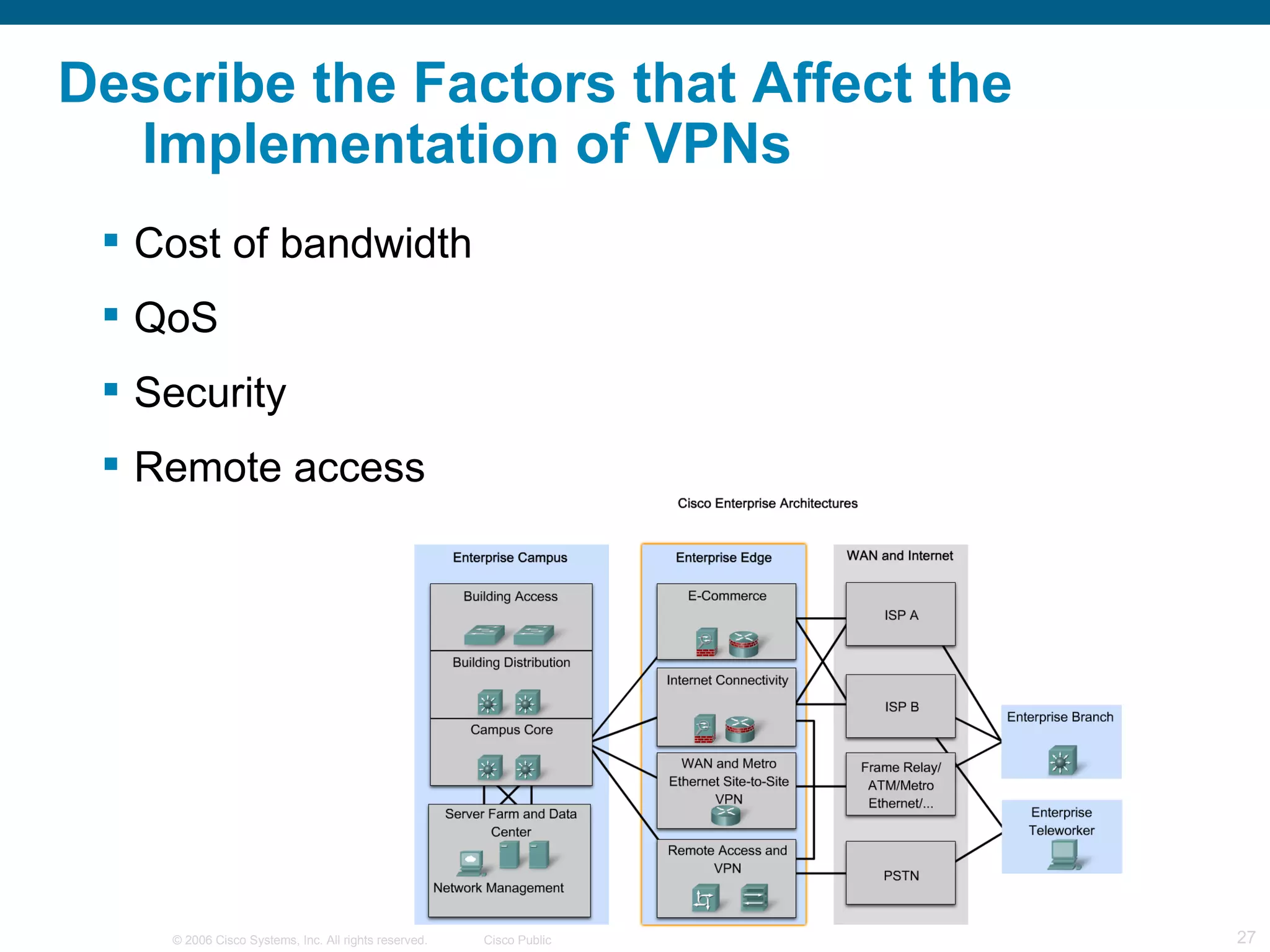
  Cost of bandwidth
  QoS
  Security
  Remote access


    © 2006 Cisco Systems, Inc. All rights reserved.   Cisco Public   27
Describe the Factors that Affect the
  Implementation of VPNs
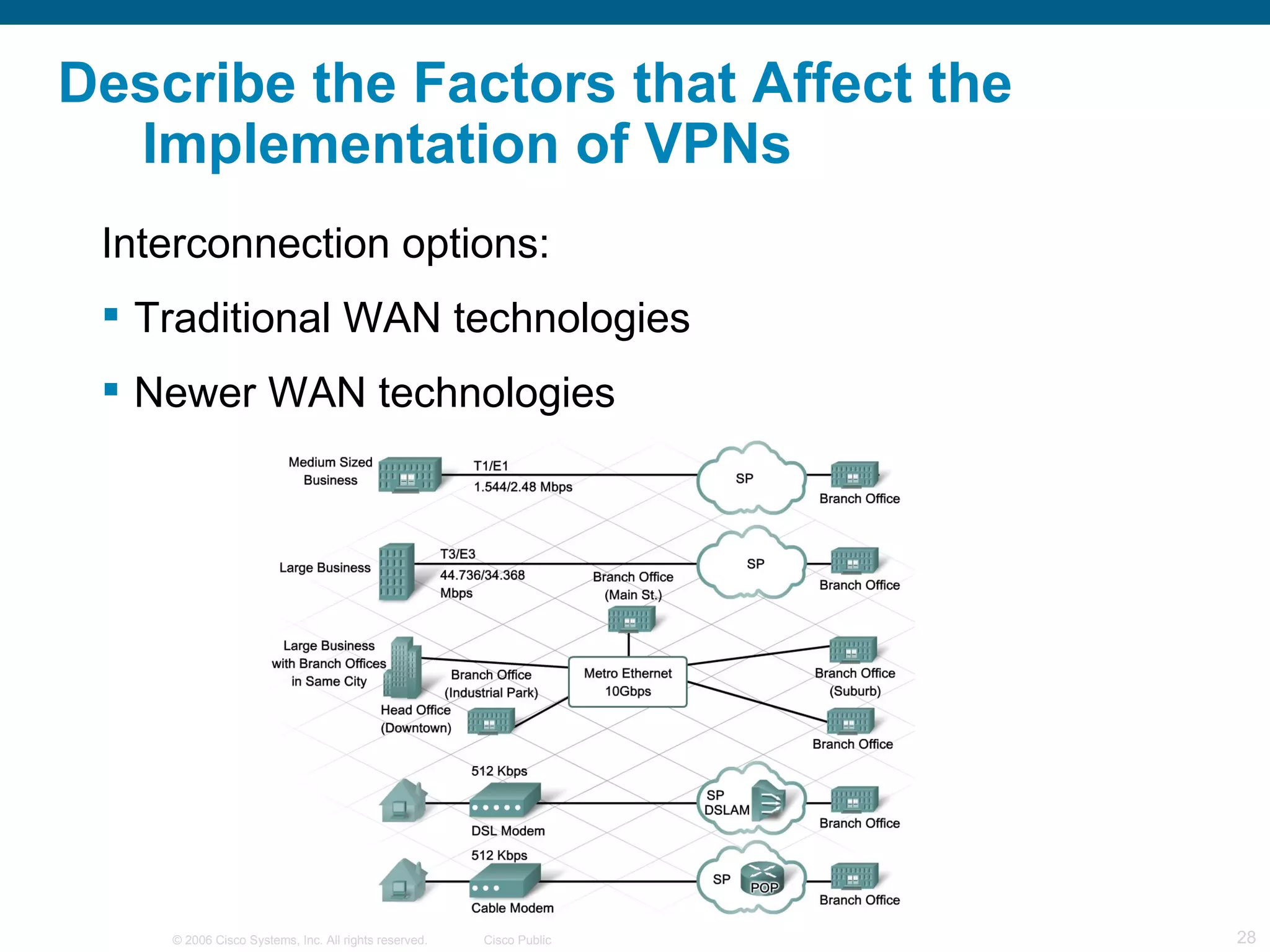
 Interconnection options:
  Traditional WAN technologies
  Newer WAN technologies


    © 2006 Cisco Systems, Inc. All rights reserved.   Cisco Public   28
Describe the Factors that Affect the
  Implementation of VPNs
  Explain ways to provide redundant connectivity to
   remote sites


    © 2006 Cisco Systems, Inc. All rights reserved.   Cisco Public   29
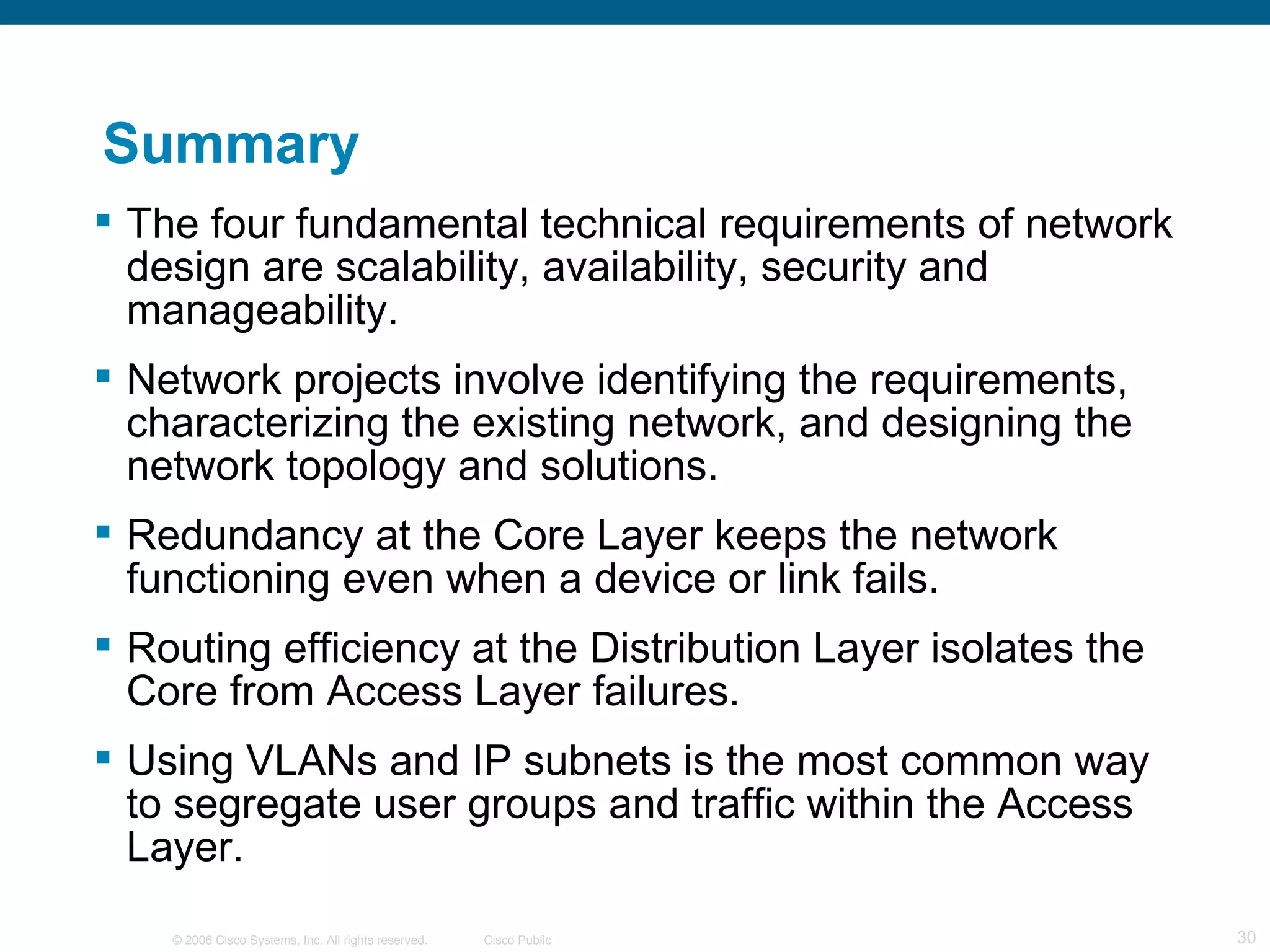
Summary
 The four fundamental technical requirements of network
  design are scalability, availability, security and
  manageability.
 Network projects involve identifying the requirements,
  characterizing the existing network, and designing the
  network topology and solutions.
 Redundancy at the Core Layer keeps the network
  functioning even when a device or link fails.
 Routing efficiency at the Distribution Layer isolates the
  Core from Access Layer failures.
 Using VLANs and IP subnets is the most common way
  to segregate user groups and traffic within the Access
  Layer.
    © 2006 Cisco Systems, Inc. All rights reserved.   Cisco Public   30
© 2006 Cisco Systems, Inc. All rights reserved.   Cisco Public   31

Chapter 1 overview

  • 1.
    Introducing Network Design Concepts Designing and Supporting Computer Networks – Chapter 1 Version 4.0 © 2006 Cisco Systems, Inc. All rights reserved. Cisco Public 1
  • 2.
    Objectives  Explain how a hierarchical network design creates a stable, reliable, scalable network  Explain what factors need to be considered when the Core Layer of a network is designed and implemented  Explain which factors need to be considered when the Distribution Layer of a network is designed and implemented  Explain which factors need to be considered when the Access Layer of a network is designed and implemented  Describe the benefits and security implications of creating server farms  Describe the considerations of an implementation of a wireless network design  Describe the factors that affect the implementation of VPNs, including how remote workers can be supported © 2006 Cisco Systems, Inc. All rights reserved. Cisco Public 2
  • 3.
    Explain How aHierarchical Network Design Creates a Stable, Reliable, Scalable Network Network requirements:  Ease of management  Fast recovery  Application response time  Fast troubleshooting © 2006 Cisco Systems, Inc. All rights reserved. Cisco Public 3
  • 4.
    Explain How aHierarchical Network Design Creates a Stable, Reliable, Scalable Network Four fundamental network design goals:  Scalability  Availability  Security  Manageability © 2006 Cisco Systems, Inc. All rights reserved. Cisco Public 4
  • 5.
    Explain How aHierarchical Network Design Creates a Stable, Reliable, Scalable Network  Core Layer: connects Distribution Layer devices  Distribution Layer: interconnects smaller LANs  Access Layer: provides connections for hosts and end devices © 2006 Cisco Systems, Inc. All rights reserved. Cisco Public 5
  • 6.
    Explain How aHierarchical Network Design Creates a Stable, Reliable, Scalable Network Subdividing the three-layer model into modular areas:  Enterprise campus  Server farm  Enterprise edge © 2006 Cisco Systems, Inc. All rights reserved. Cisco Public 6
  • 7.
    Explain How aHierarchical Network Design Creates a Stable, Reliable, Scalable Network Steps in network design projects:  Identify the network requirements  Characterize the existing network  Design the network topology and solutions © 2006 Cisco Systems, Inc. All rights reserved. Cisco Public 7
  • 8.
    Explain what FactorsNeed to be Considered when Designing the Network Core Layer  Network backbone  Goals of the Core Layer Provide 100% uptime Maximize throughput Facilitate network growth © 2006 Cisco Systems, Inc. All rights reserved. Cisco Public 8
  • 9.
    Explain what FactorsNeed to be Considered when Designing the Network Core Layer  Combining routing and switching in the same device  Redundancy and load balancing  High-speed and aggregate links  Quick convergence © 2006 Cisco Systems, Inc. All rights reserved. Cisco Public 9
  • 10.
    Explain what FactorsNeed to be Considered when Designing the Network Core Layer  Full mesh topology  Partial mesh topology  Failure prevention  Reducing human error © 2006 Cisco Systems, Inc. All rights reserved. Cisco Public 10
  • 11.
    Explain which FactorsNeed to be Considered when Designing the Distribution Layer of a Network  Filtering and managing traffic flow  Access control policies  Route summarization  Isolating Core Layer from Access Layer failures  Routing between VLANs © 2006 Cisco Systems, Inc. All rights reserved. Cisco Public 11
  • 12.
    Explain which FactorsNeed to be Considered when Designing the Distribution Layer of a Network  Explain how redundant links improve network reliability and stability © 2006 Cisco Systems, Inc. All rights reserved. Cisco Public 12
  • 13.
    Explain which FactorsNeed to be Considered when Designing the Distribution Layer of a Network  Explain how ACLs filter traffic for security and traffic management © 2006 Cisco Systems, Inc. All rights reserved. Cisco Public 13
  • 14.
    Explain which FactorsNeed to be Considered when Designing the Distribution Layer of a Network  Explain the concept of route summarization and describe how it is implemented at the Distribution Layer of the network © 2006 Cisco Systems, Inc. All rights reserved. Cisco Public 14
  • 15.
    Explain which FactorsNeed to be Considered when Designing the Access Layer of a Network  Physical location of equipment  Wiring closets  Converged networking  Availability © 2006 Cisco Systems, Inc. All rights reserved. Cisco Public 15
  • 16.
    Explain which FactorsNeed to be Considered when Designing the Access Layer of a Network  Naming structures  VLAN architecture  Traffic patterns  Prioritization strategies © 2006 Cisco Systems, Inc. All rights reserved. Cisco Public 16
  • 17.
    Explain which FactorsNeed to be Considered when Designing the Access Layer of a Network  Star topologies © 2006 Cisco Systems, Inc. All rights reserved. Cisco Public 17
  • 18.
    Explain which FactorsNeed to be Considered when Designing the Access Layer of a Network Functions of VLANs:  Separate and classify traffic  Control broadcasts  Contain VLANs within a single wiring closet © 2006 Cisco Systems, Inc. All rights reserved. Cisco Public 18
  • 19.
    Explain which FactorsNeed to be Considered when Designing the Access Layer of a Network QoS at the network edge:  Classification  Assigned priority © 2006 Cisco Systems, Inc. All rights reserved. Cisco Public 19
  • 20.
    Explain which FactorsNeed to be Considered when Designing the Access Layer of a Network Security risks at the network edge:  Authentication  Wireless security © 2006 Cisco Systems, Inc. All rights reserved. Cisco Public 20
  • 21.
    Explain which FactorsNeed to be Considered when Designing the Access Layer of a Network Security measures at the Access Layer:  Physical security  Strong passwords  SSH  Disabling unused ports  Security policy © 2006 Cisco Systems, Inc. All rights reserved. Cisco Public 21
  • 22.
    Describe the Benefitsand Security Implications of Creating Server Farms  Defined entry and exit points for network traffic  Redundant, high-capacity links  Load balancing and failover  Lower cost of providing services © 2006 Cisco Systems, Inc. All rights reserved. Cisco Public 22
  • 23.
    Describe the Benefitsand Security Implications of Creating Server Farms  Firewalls  LAN switch security features  Intrusion and prevention systems  Load balancers  Network analysis and management devices  DMZs © 2006 Cisco Systems, Inc. All rights reserved. Cisco Public 23
  • 24.
    Describe the Benefitsand Security Implications of Creating Server Farms  Building in redundancy for high availability  Virtualization © 2006 Cisco Systems, Inc. All rights reserved. Cisco Public 24
  • 25.
    Describe the Considerationsof an Implementation of a Wireless Network Design Customer requirements:  Roaming  Authentication  Services and applications  Encryption  Coverage and number of users © 2006 Cisco Systems, Inc. All rights reserved. Cisco Public 25
  • 26.
    Describe the Considerationsof an Implementation of a Wireless Network Design  Physical WLAN design  Site survey  Logical WLAN design  Open guest access vs. secured employee access © 2006 Cisco Systems, Inc. All rights reserved. Cisco Public 26
  • 27.
    Describe the Factorsthat Affect the Implementation of VPNs  Cost of bandwidth  QoS  Security  Remote access © 2006 Cisco Systems, Inc. All rights reserved. Cisco Public 27
  • 28.
    Describe the Factorsthat Affect the Implementation of VPNs Interconnection options:  Traditional WAN technologies  Newer WAN technologies © 2006 Cisco Systems, Inc. All rights reserved. Cisco Public 28
  • 29.
    Describe the Factorsthat Affect the Implementation of VPNs  Explain ways to provide redundant connectivity to remote sites © 2006 Cisco Systems, Inc. All rights reserved. Cisco Public 29
  • 30.
    Summary  The fourfundamental technical requirements of network design are scalability, availability, security and manageability.  Network projects involve identifying the requirements, characterizing the existing network, and designing the network topology and solutions.  Redundancy at the Core Layer keeps the network functioning even when a device or link fails.  Routing efficiency at the Distribution Layer isolates the Core from Access Layer failures.  Using VLANs and IP subnets is the most common way to segregate user groups and traffic within the Access Layer. © 2006 Cisco Systems, Inc. All rights reserved. Cisco Public 30
  • 31.
    © 2006 CiscoSystems, Inc. All rights reserved. Cisco Public 31