
Prototyping the Campus
                Network


              Designing and Supporting Computer Networks – Chapter 7


Version 4.0      © 2006 Cisco Systems, Inc. All rights reserved.   Cisco Public   1
Objectives
   Describe the purpose for and procedures to build a
    prototype of the network design
   Create test plans to perform simulated or prototype
    test of important design elements
   Perform proof-of-concept tests on LAN design
    elements
   Identify risks and weaknesses in the design based on
    the proof-of-concept test conclusions


    © 2006 Cisco Systems, Inc. All rights reserved.   Cisco Public   2
Describe the Purpose for and Procedures
  to Build a Prototype of the Network
  Design
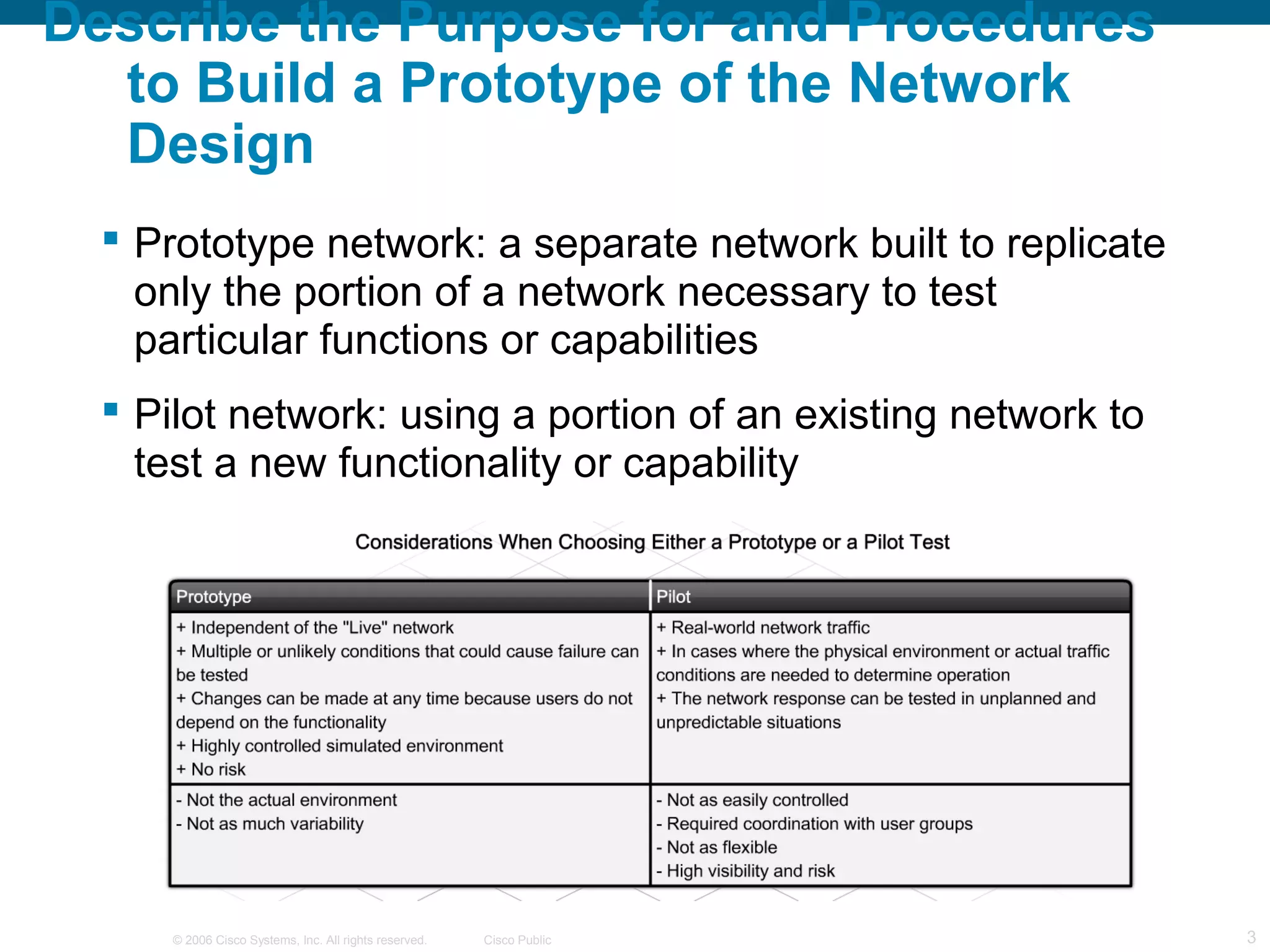
   Prototype network: a separate network built to replicate
    only the portion of a network necessary to test
    particular functions or capabilities
   Pilot network: using a portion of an existing network to
    test a new functionality or capability


     © 2006 Cisco Systems, Inc. All rights reserved.   Cisco Public   3
Describe the Purpose for and Procedures
  to Build a Prototype of the Network
  Design
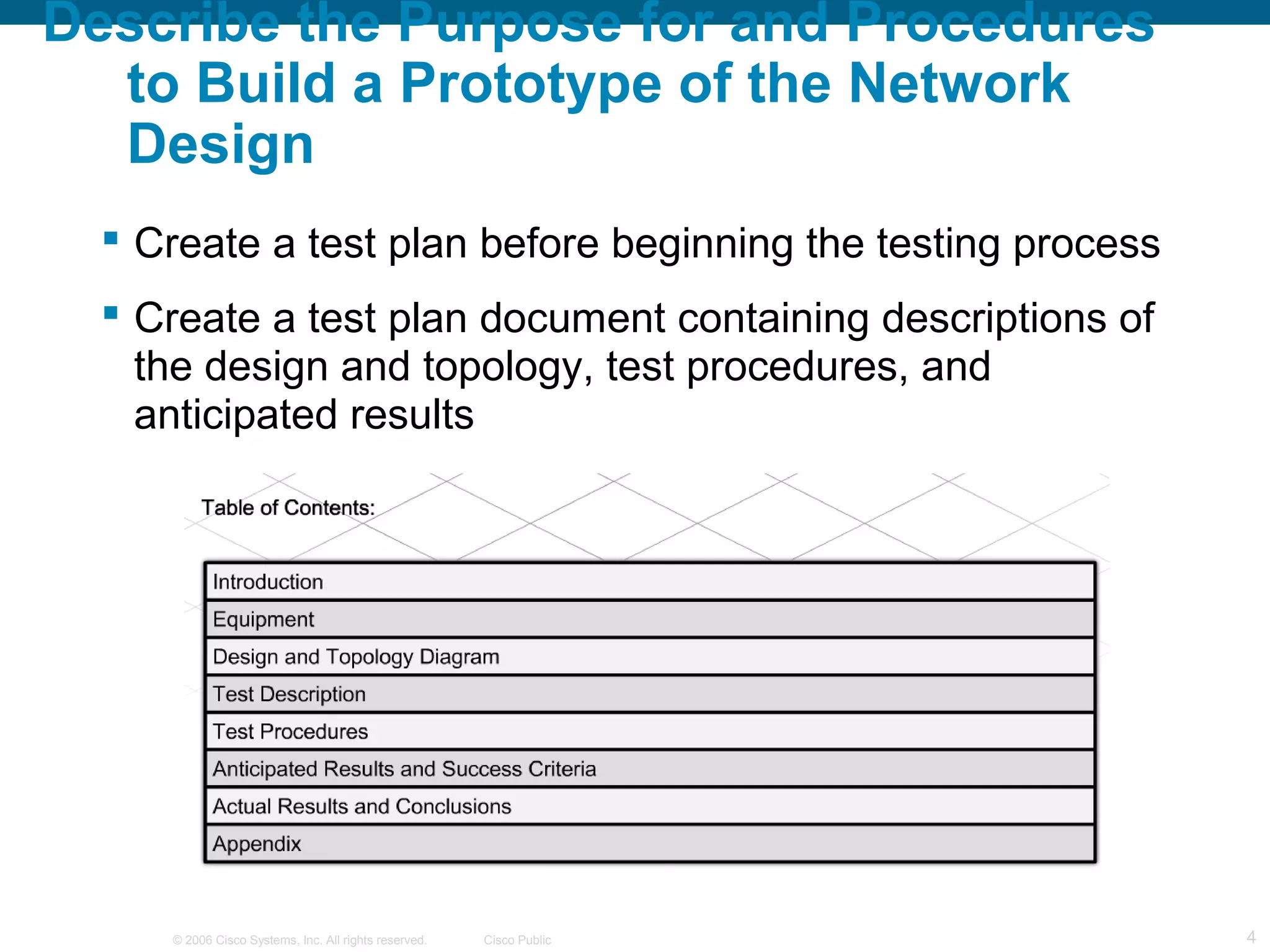
   Create a test plan before beginning the testing process
   Create a test plan document containing descriptions of
    the design and topology, test procedures, and
    anticipated results


     © 2006 Cisco Systems, Inc. All rights reserved.   Cisco Public   4
Describe the Purpose for and Procedures
  to Build a Prototype of the Network
  Design
 Methods to verify that a design meets the identified
  business criteria:
  Prototyping
  Basic connectivity tests
  Functionality testing
  Checklists


      © 2006 Cisco Systems, Inc. All rights reserved.   Cisco Public   5
Describe the Purpose for and Procedures
  to Build a Prototype of the Network
  Design
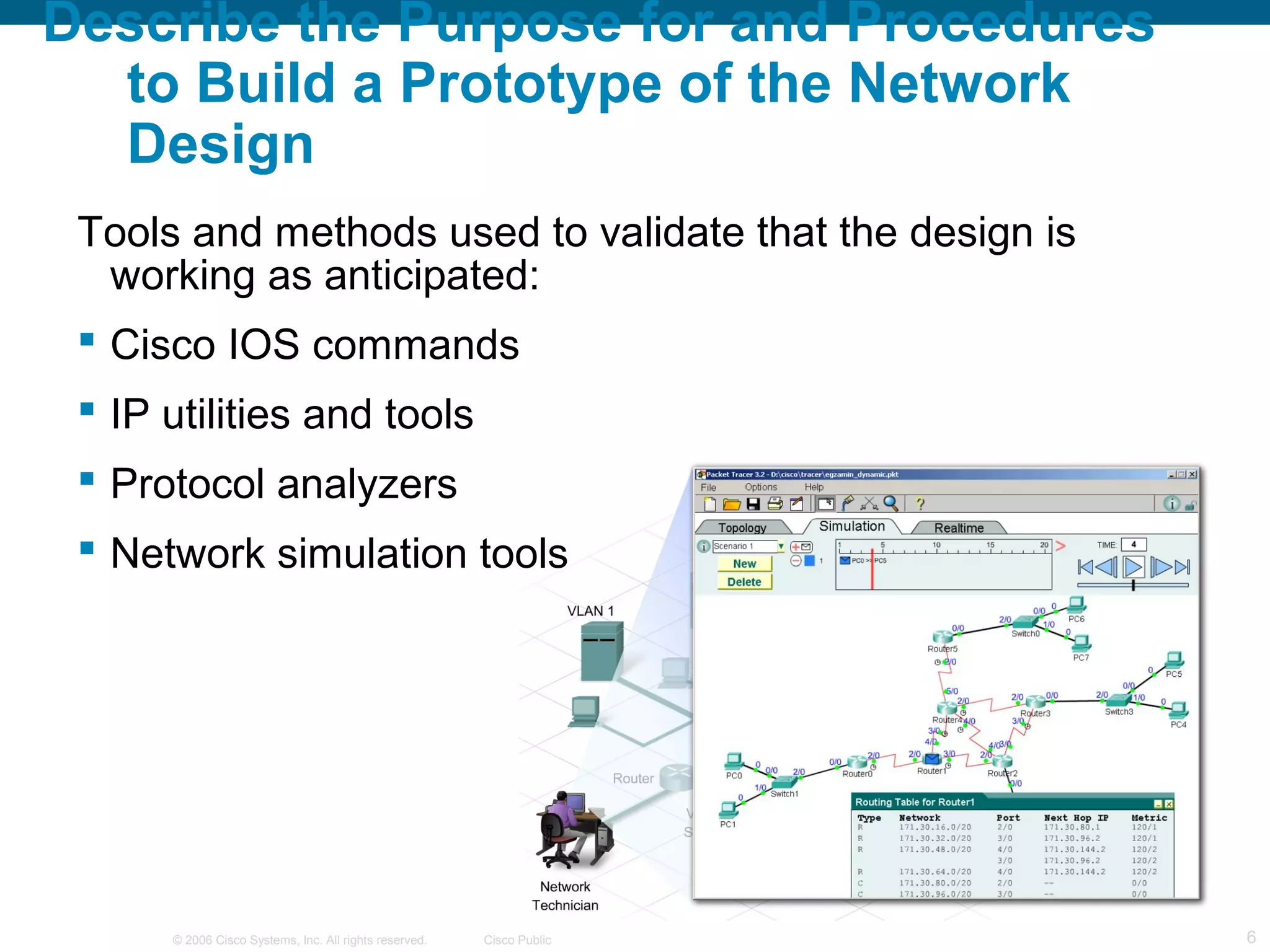
 Tools and methods used to validate that the design is
  working as anticipated:
  Cisco IOS commands
  IP utilities and tools
  Protocol analyzers
  Network simulation tools


      © 2006 Cisco Systems, Inc. All rights reserved.   Cisco Public   6
Describe the Purpose for and Procedures
  to Build a Prototype of the Network
  Design
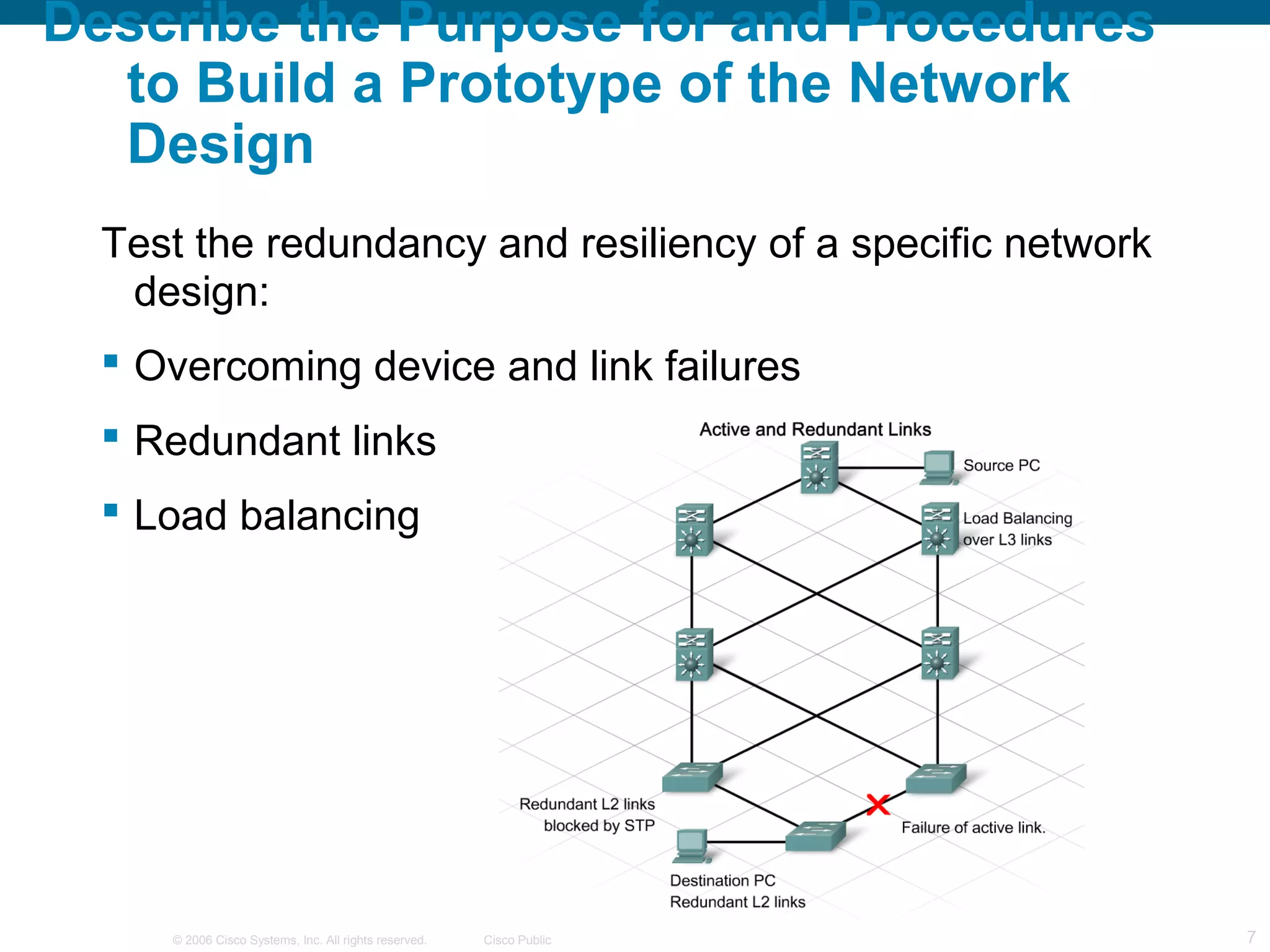
  Test the redundancy and resiliency of a specific network
   design:
   Overcoming device and link failures
   Redundant links
   Load balancing


     © 2006 Cisco Systems, Inc. All rights reserved.   Cisco Public   7
Describe the Purpose for and Procedures
  to Build a Prototype of the Network
  Design
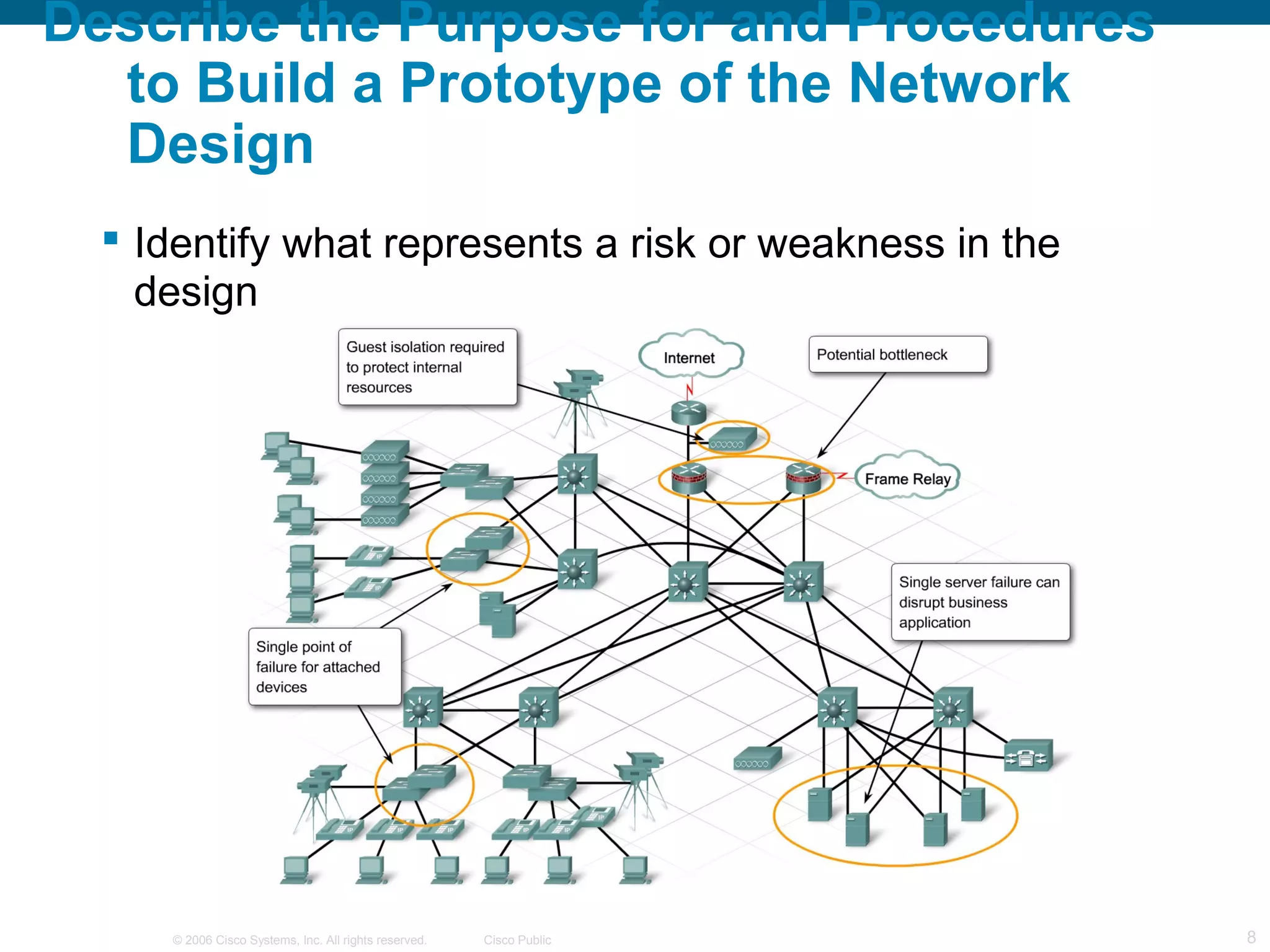
   Identify what represents a risk or weakness in the
    design


     © 2006 Cisco Systems, Inc. All rights reserved.   Cisco Public   8
Prototype the Hierarchical Network, Routing
   Protocol, and IP Addressing Model
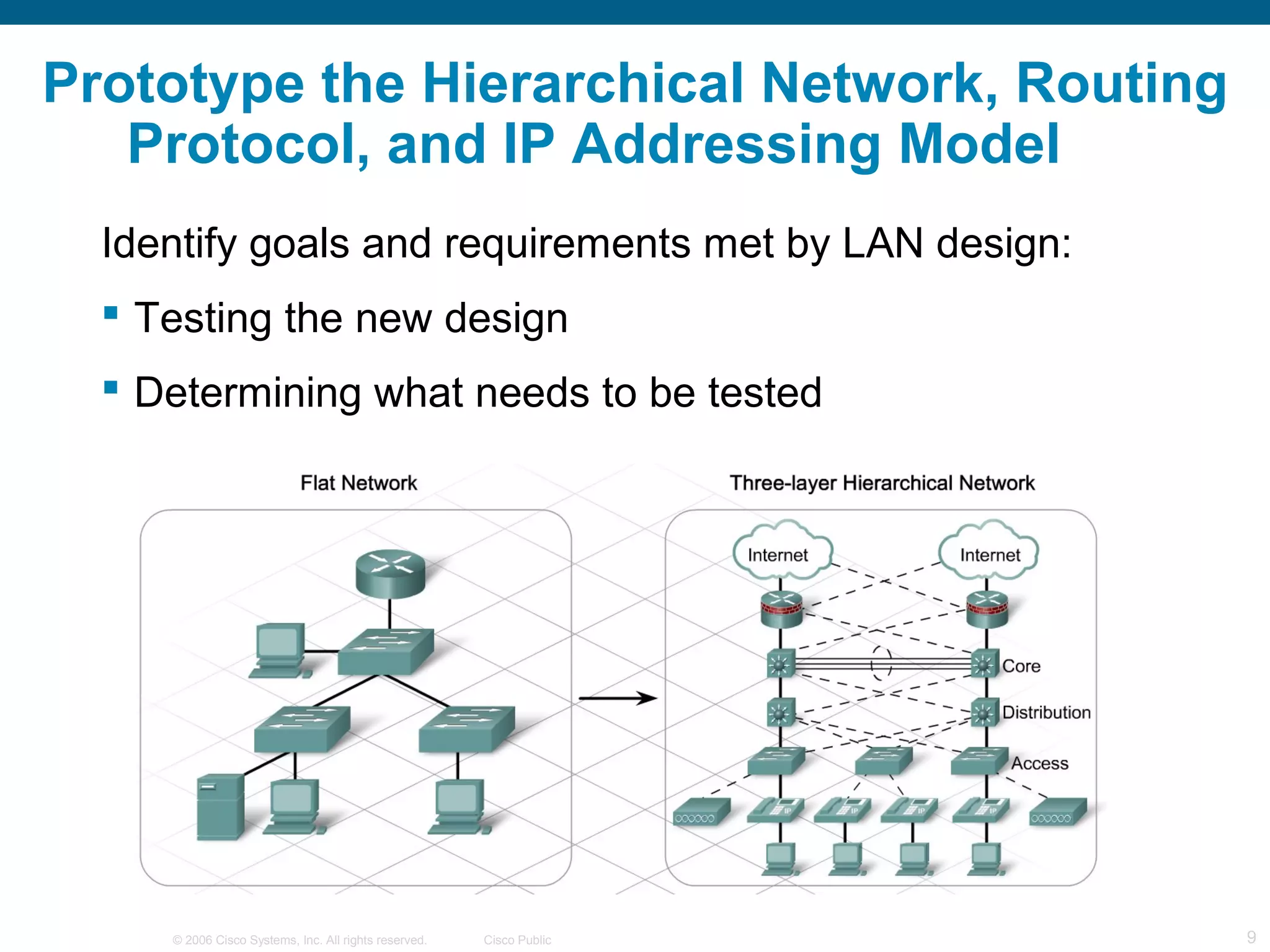
  Identify goals and requirements met by LAN design:
   Testing the new design
   Determining what needs to be tested


     © 2006 Cisco Systems, Inc. All rights reserved.   Cisco Public   9
Prototype the Hierarchical Network, Routing
   Protocol, and IP Addressing Model
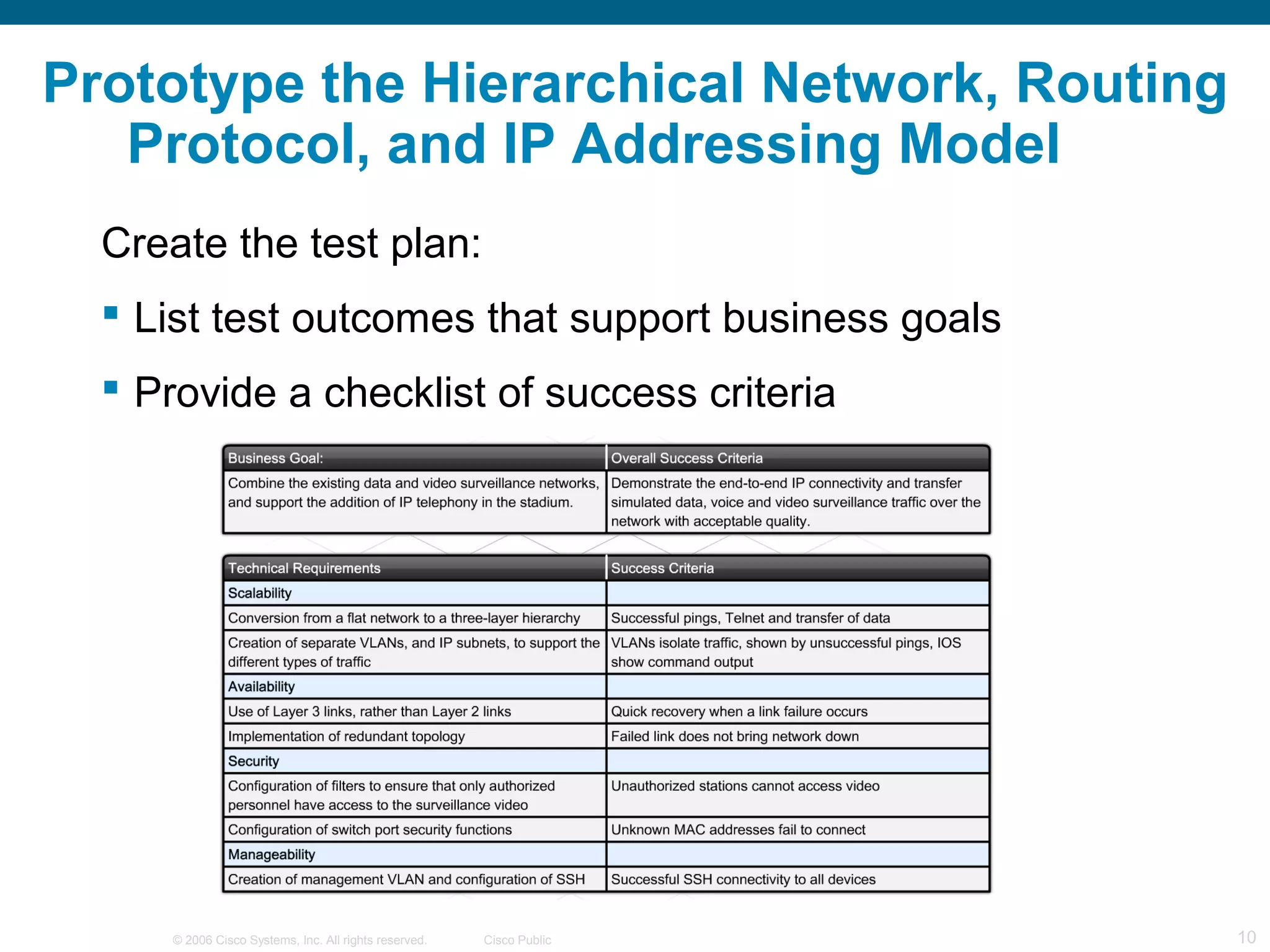
  Create the test plan:
   List test outcomes that support business goals
   Provide a checklist of success criteria


      © 2006 Cisco Systems, Inc. All rights reserved.   Cisco Public   10
Prototype the Hierarchical Network, Routing
   Protocol, and IP Addressing Model
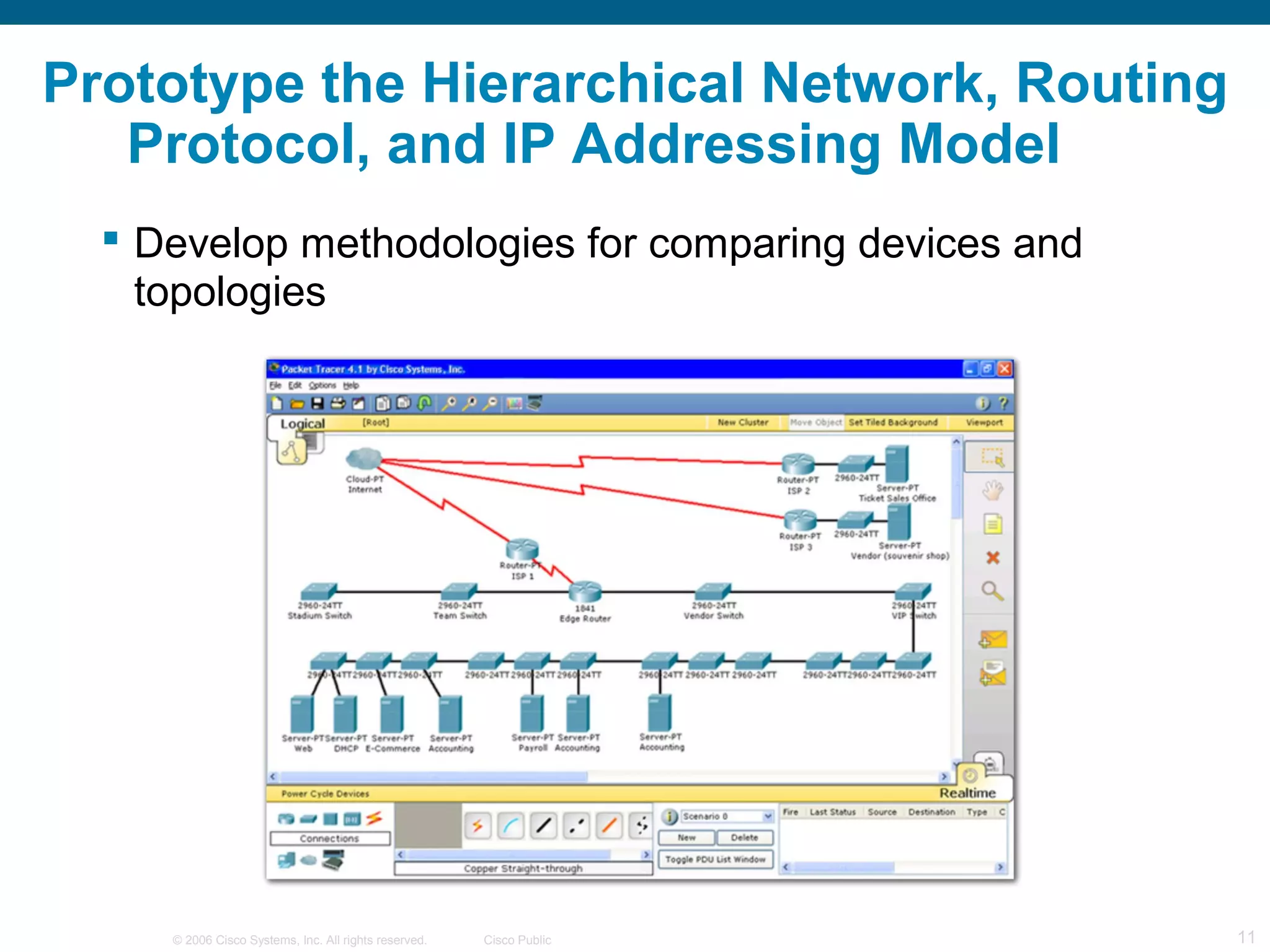
   Develop methodologies for comparing devices and
    topologies


     © 2006 Cisco Systems, Inc. All rights reserved.   Cisco Public   11
Prototype the Hierarchical Network, Routing
   Protocol, and IP Addressing Model
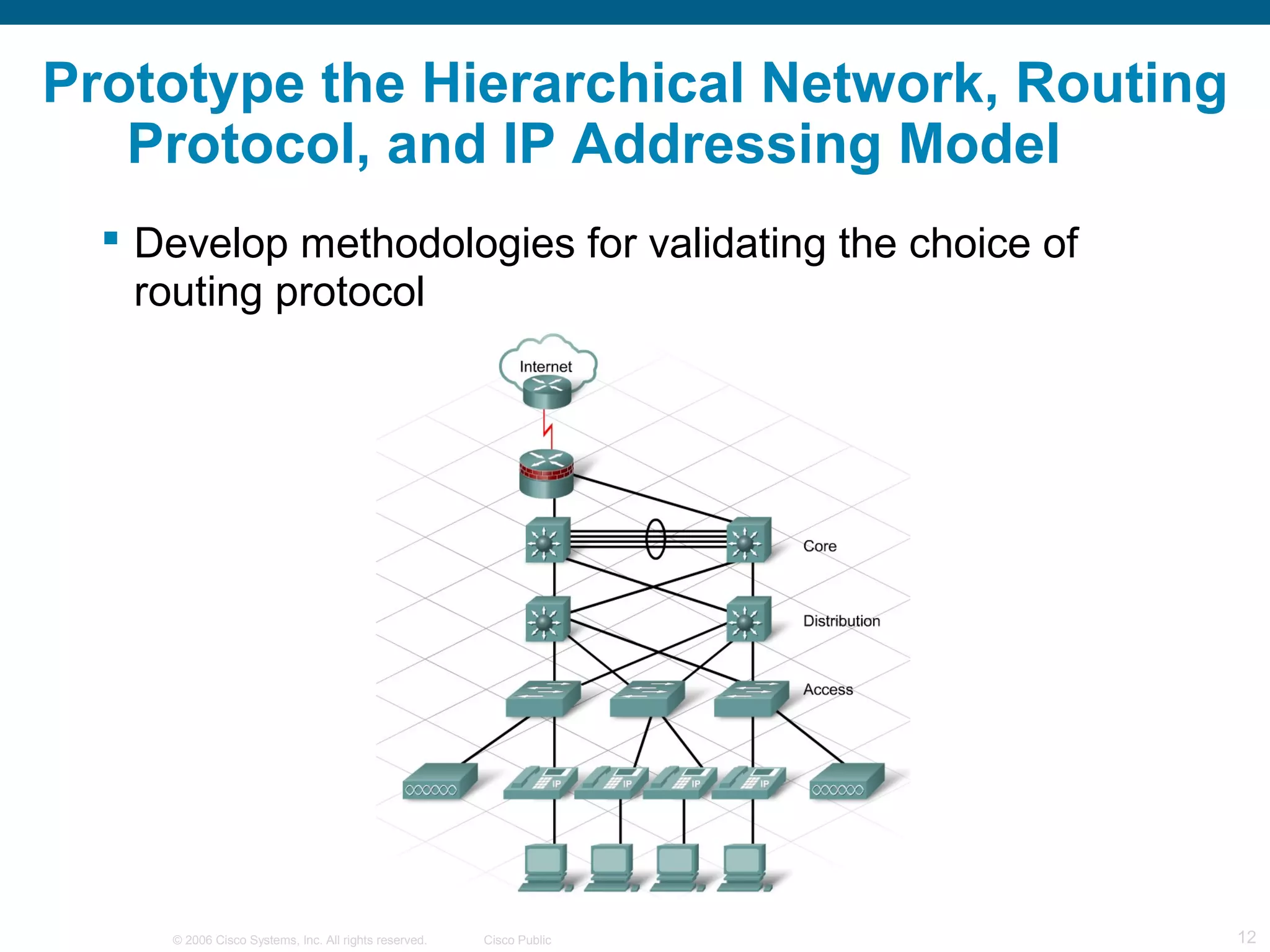
   Develop methodologies for validating the choice of
    routing protocol


     © 2006 Cisco Systems, Inc. All rights reserved.   Cisco Public   12
Prototype the Hierarchical Network, Routing
   Protocol, and IP Addressing Model
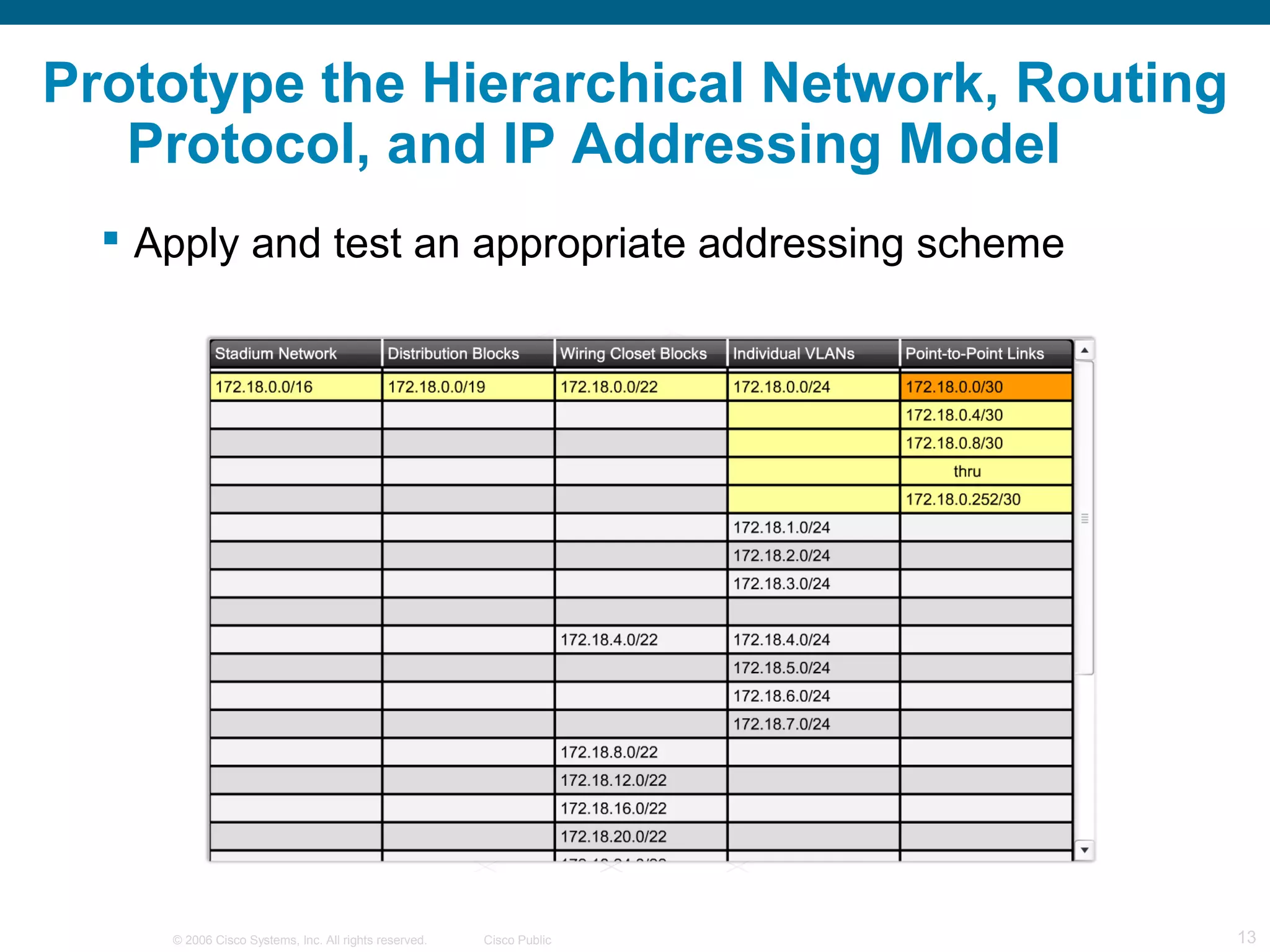
   Apply and test an appropriate addressing scheme


     © 2006 Cisco Systems, Inc. All rights reserved.   Cisco Public   13
Prototype the Hierarchical Network, Routing
   Protocol, and IP Addressing Model
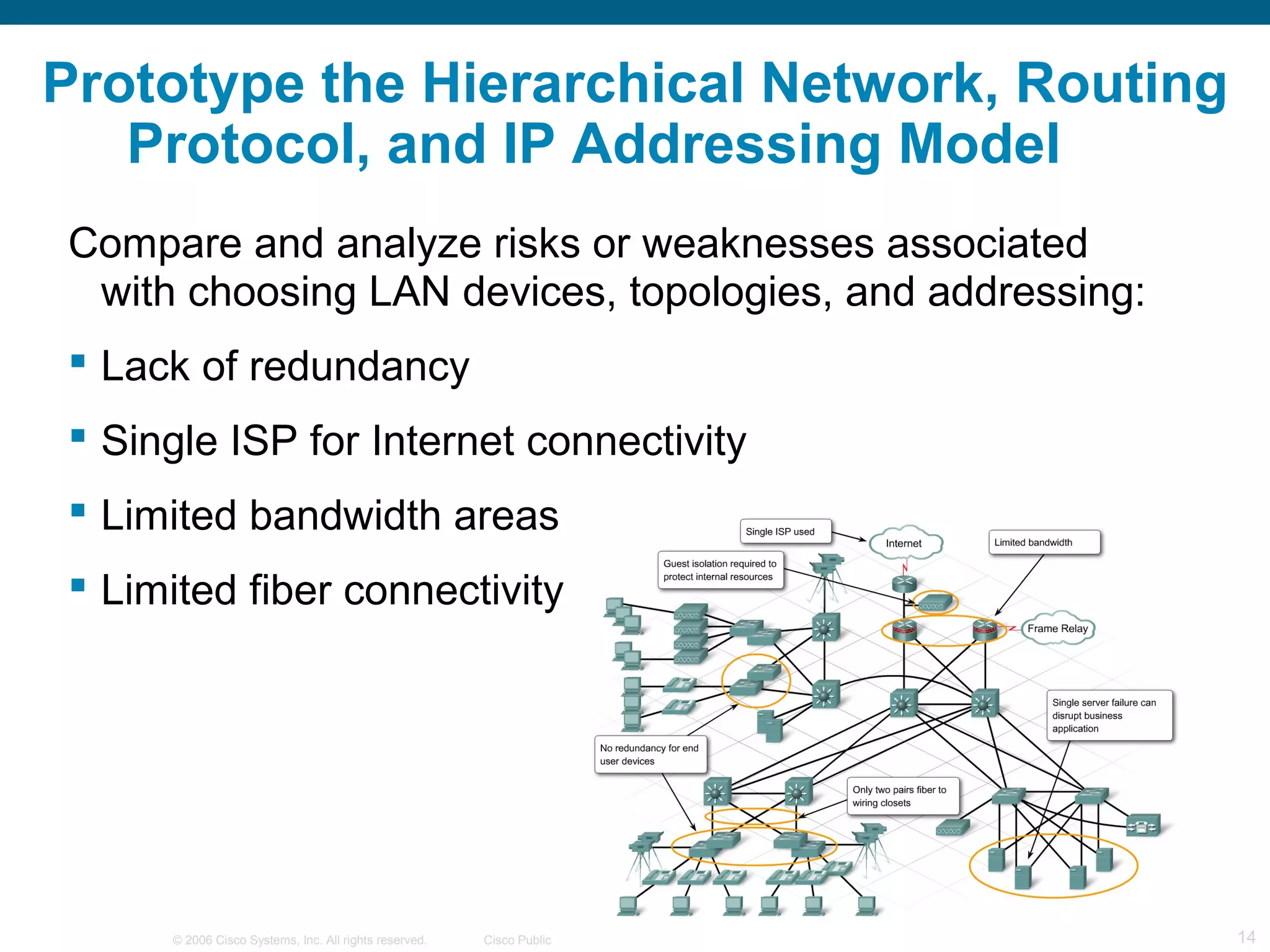
Compare and analyze risks or weaknesses associated
 with choosing LAN devices, topologies, and addressing:
 Lack of redundancy
 Single ISP for Internet connectivity
 Limited bandwidth areas
 Limited fiber connectivity


     © 2006 Cisco Systems, Inc. All rights reserved.   Cisco Public   14
Prototype the Server Farm, Including
   Security and High Availability
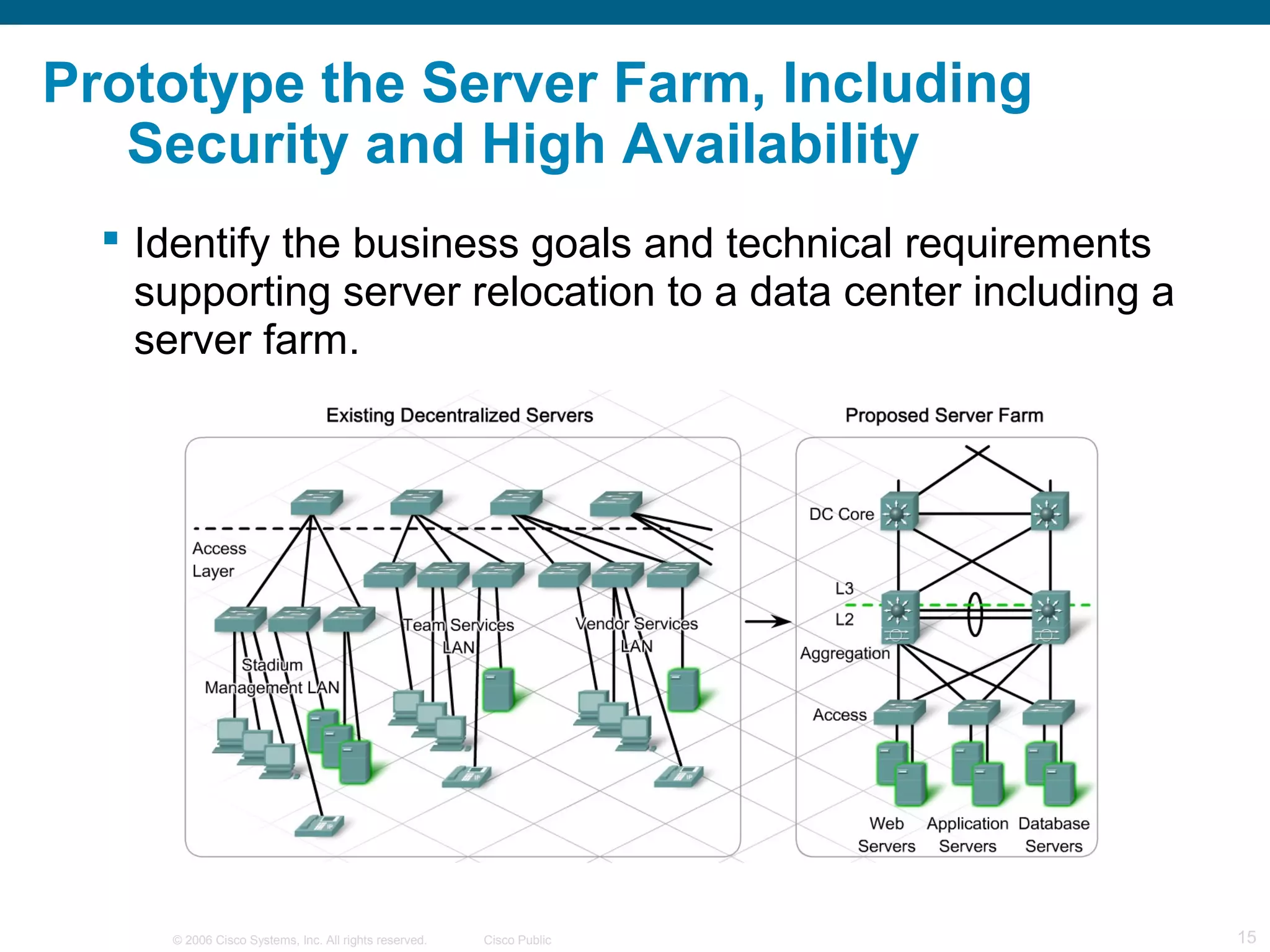
   Identify the business goals and technical requirements
    supporting server relocation to a data center including a
    server farm.


     © 2006 Cisco Systems, Inc. All rights reserved.   Cisco Public   15
Prototype the Server Farm, Including
   Security and High Availability
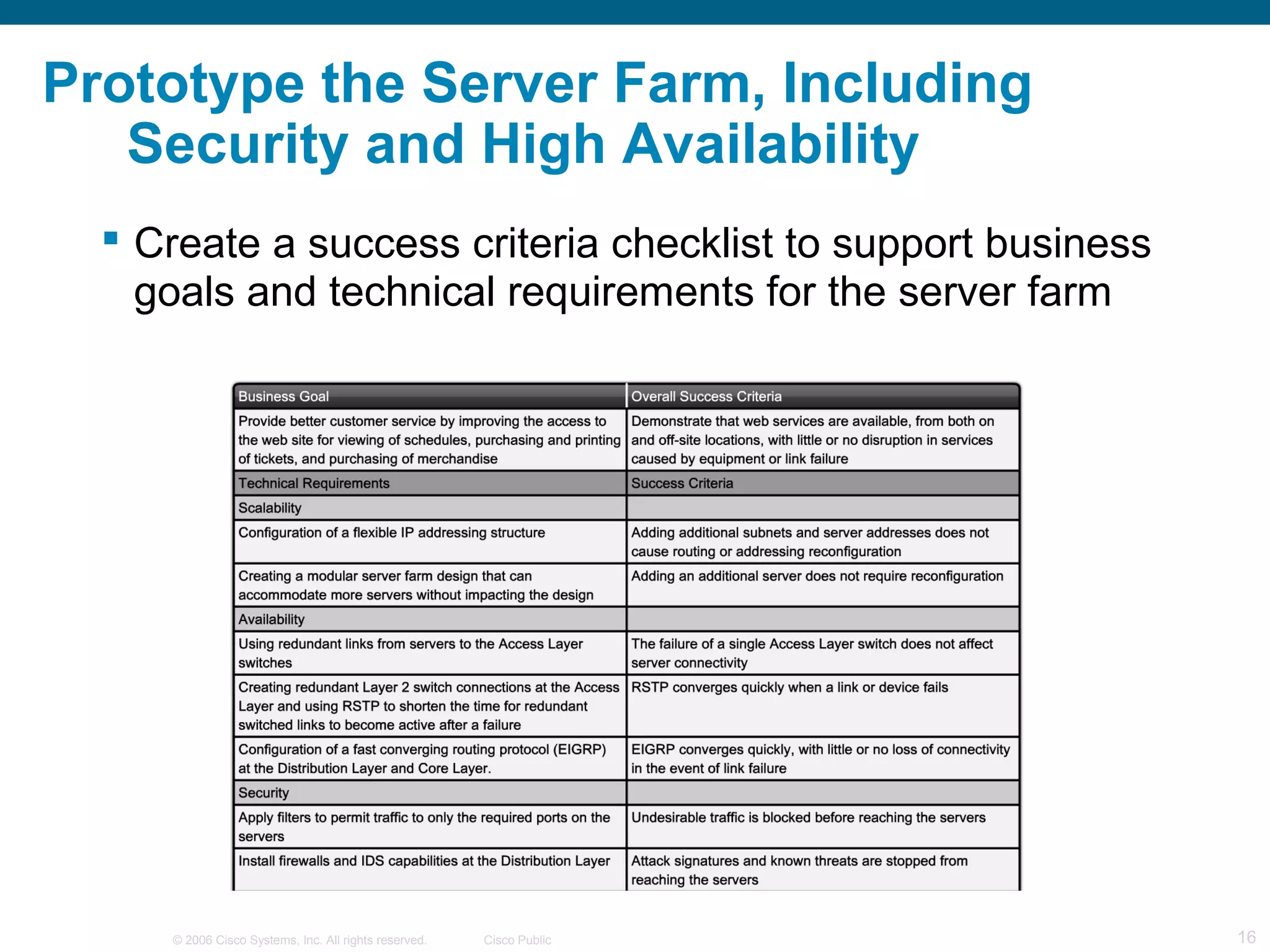
   Create a success criteria checklist to support business
    goals and technical requirements for the server farm


     © 2006 Cisco Systems, Inc. All rights reserved.   Cisco Public   16
Prototype the Server Farm, Including
   Security and High Availability

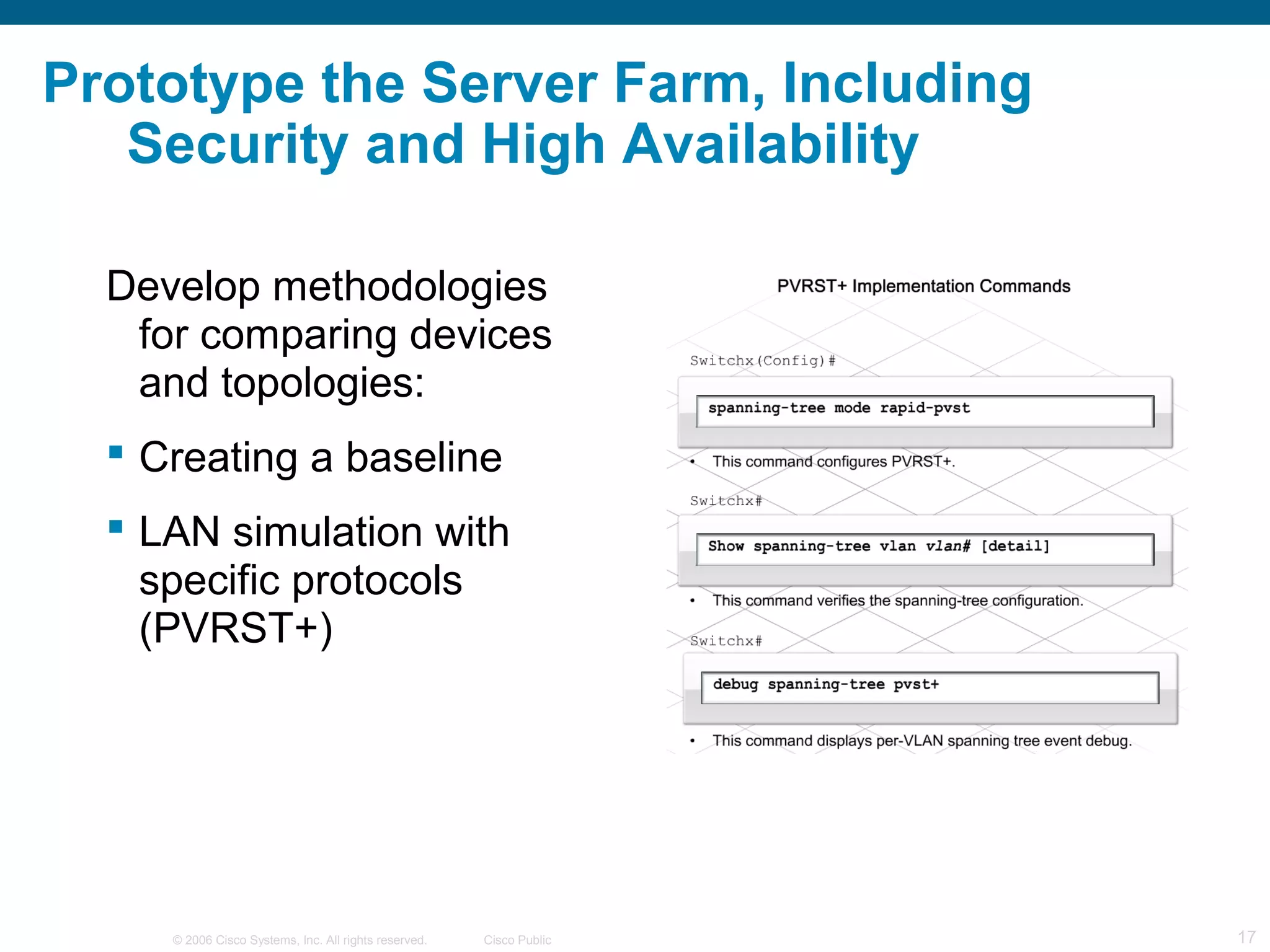
  Develop methodologies
   for comparing devices
   and topologies:
   Creating a baseline
   LAN simulation with
    specific protocols
    (PVRST+)


     © 2006 Cisco Systems, Inc. All rights reserved.   Cisco Public   17
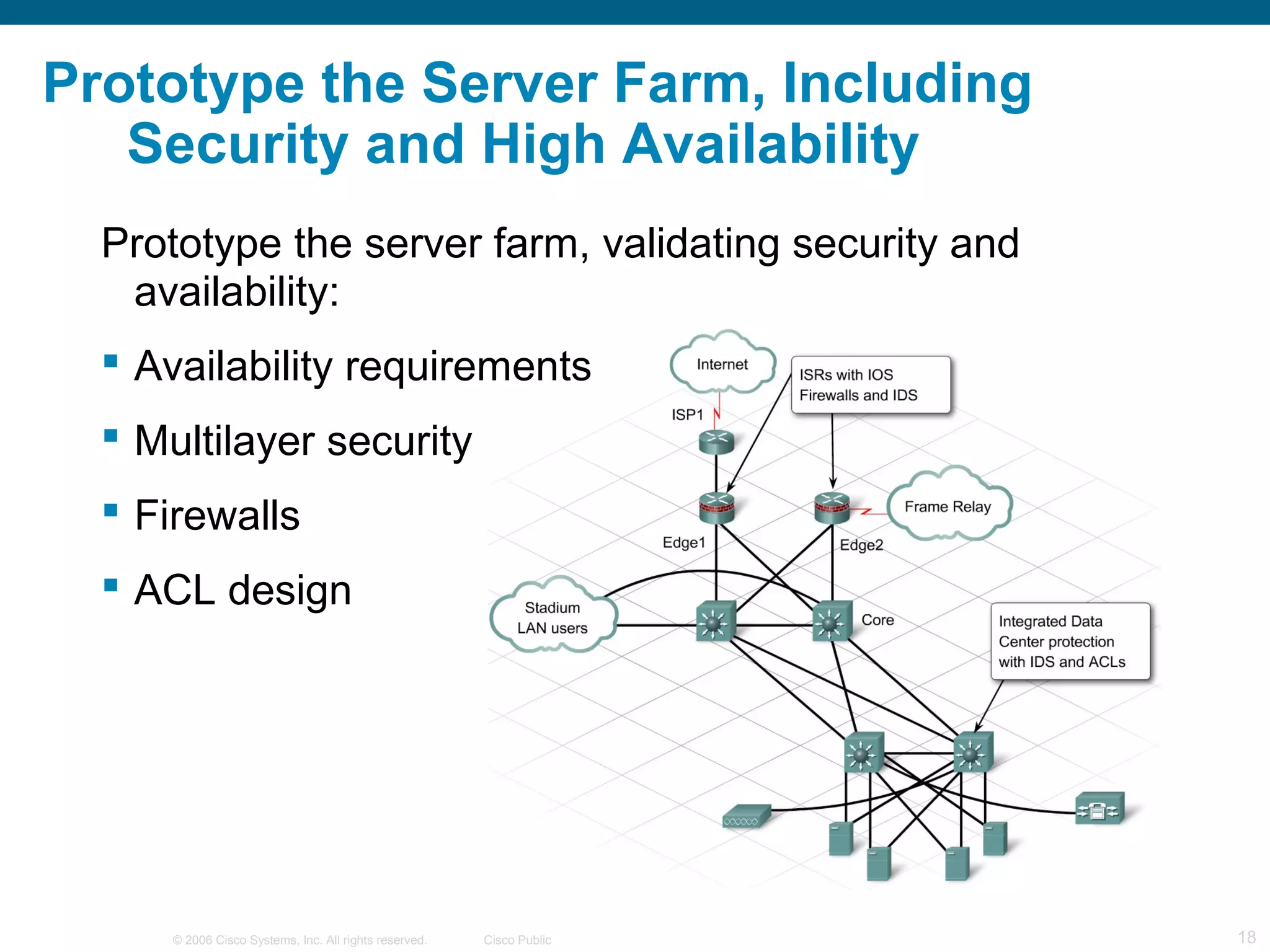
Prototype the Server Farm, Including
   Security and High Availability
  Prototype the server farm, validating security and
   availability:
   Availability requirements
   Multilayer security
   Firewalls
   ACL design


      © 2006 Cisco Systems, Inc. All rights reserved.   Cisco Public   18
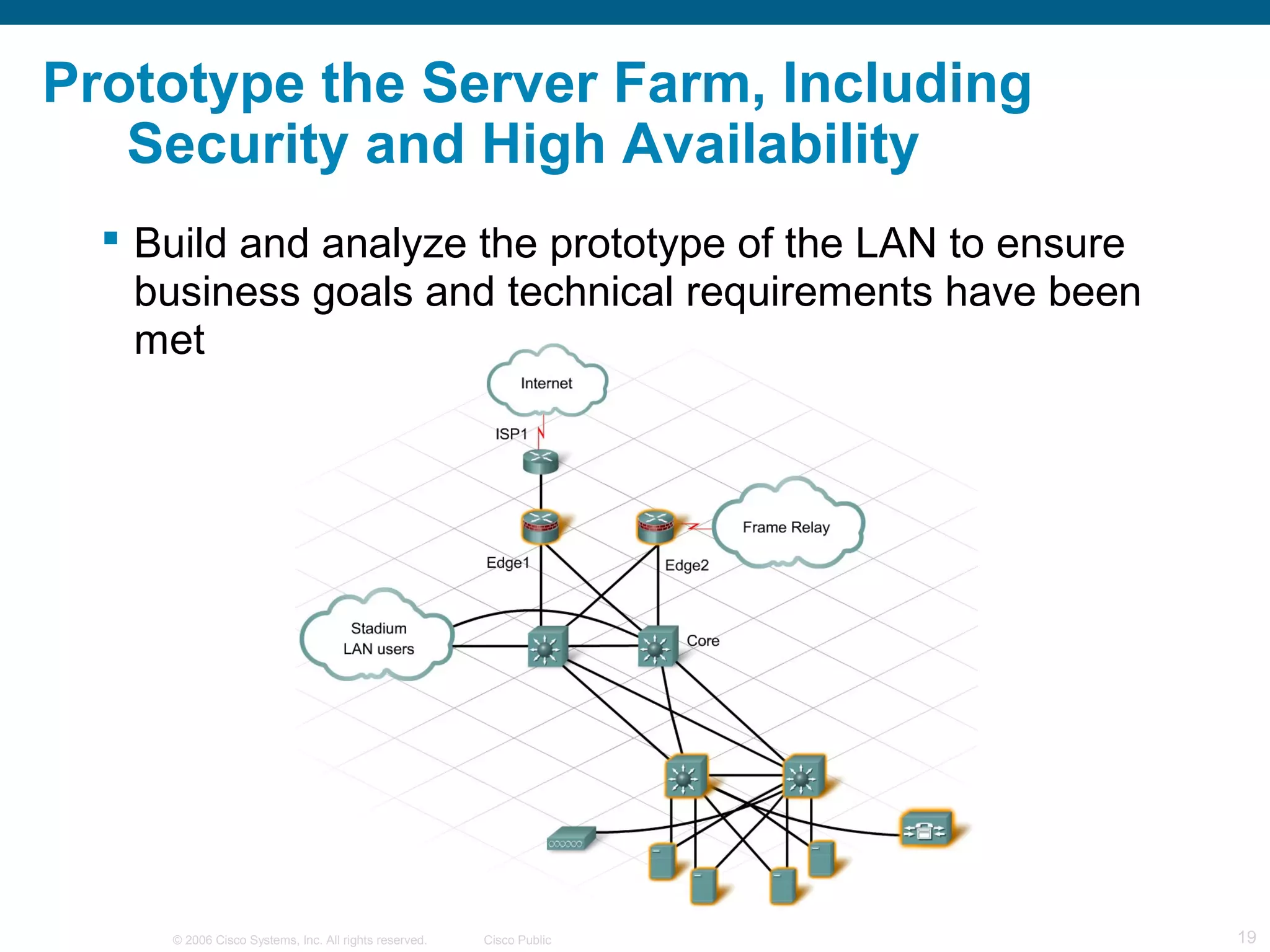
Prototype the Server Farm, Including
   Security and High Availability
   Build and analyze the prototype of the LAN to ensure
    business goals and technical requirements have been
    met


     © 2006 Cisco Systems, Inc. All rights reserved.   Cisco Public   19
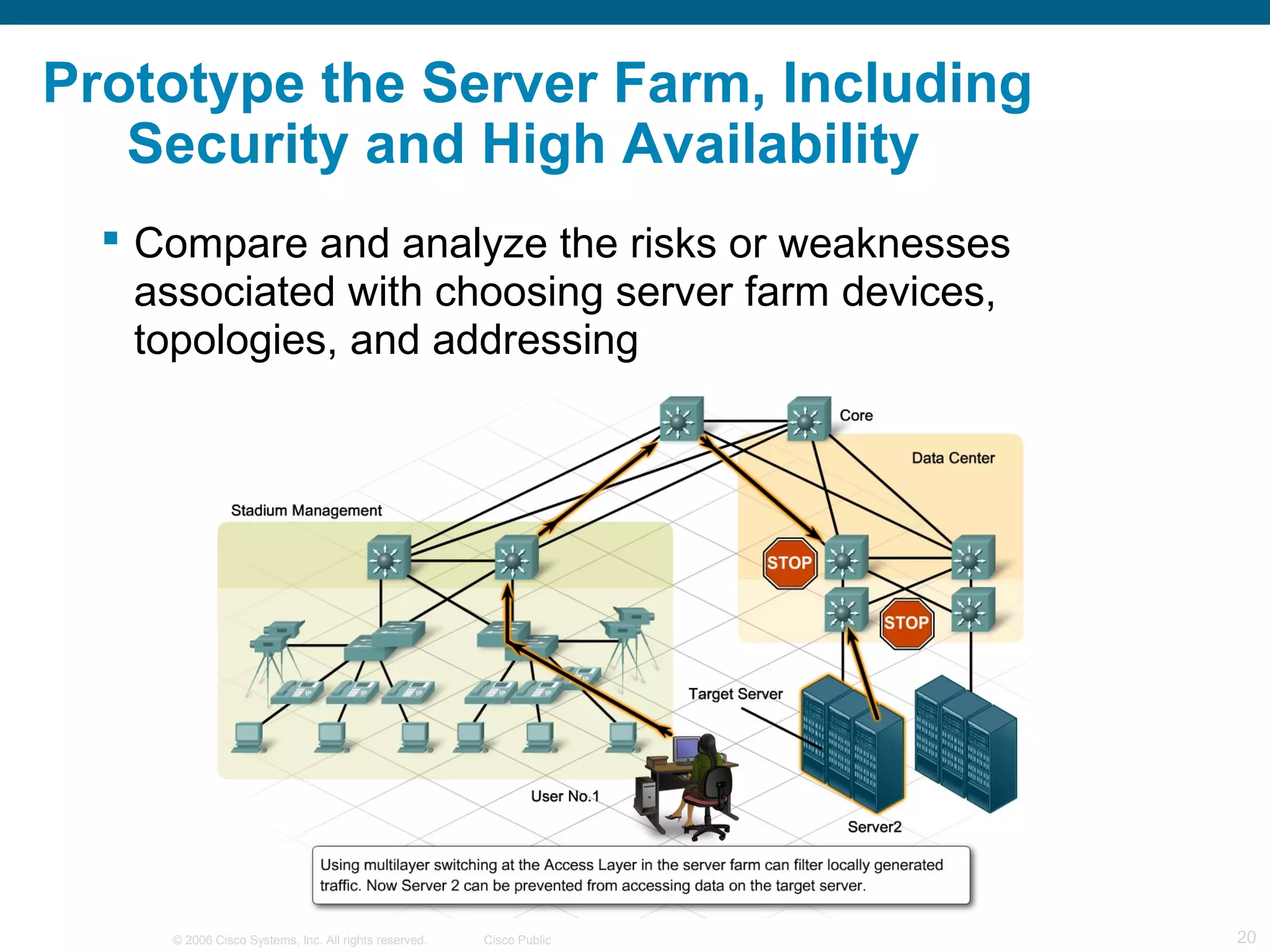
Prototype the Server Farm, Including
   Security and High Availability
   Compare and analyze the risks or weaknesses
    associated with choosing server farm devices,
    topologies, and addressing


     © 2006 Cisco Systems, Inc. All rights reserved.   Cisco Public   20
Summary
 The decision to create a prototype or pilot network
  depends on the type of testing required and the
  potential disruption to the existing network.
 Before beginning any testing, a test plan should be
  developed.
 Prototypes and simulations can be used to identify risks
  and areas of weakness in the network design.


    © 2006 Cisco Systems, Inc. All rights reserved.   Cisco Public   21
© 2006 Cisco Systems, Inc. All rights reserved.   Cisco Public   22

CCNA Discovery 4 - Chapter 7

  • 1.
    Prototyping the Campus Network Designing and Supporting Computer Networks – Chapter 7 Version 4.0 © 2006 Cisco Systems, Inc. All rights reserved. Cisco Public 1
  • 2.
    Objectives  Describe the purpose for and procedures to build a prototype of the network design  Create test plans to perform simulated or prototype test of important design elements  Perform proof-of-concept tests on LAN design elements  Identify risks and weaknesses in the design based on the proof-of-concept test conclusions © 2006 Cisco Systems, Inc. All rights reserved. Cisco Public 2
  • 3.
    Describe the Purposefor and Procedures to Build a Prototype of the Network Design  Prototype network: a separate network built to replicate only the portion of a network necessary to test particular functions or capabilities  Pilot network: using a portion of an existing network to test a new functionality or capability © 2006 Cisco Systems, Inc. All rights reserved. Cisco Public 3
  • 4.
    Describe the Purposefor and Procedures to Build a Prototype of the Network Design  Create a test plan before beginning the testing process  Create a test plan document containing descriptions of the design and topology, test procedures, and anticipated results © 2006 Cisco Systems, Inc. All rights reserved. Cisco Public 4
  • 5.
    Describe the Purposefor and Procedures to Build a Prototype of the Network Design Methods to verify that a design meets the identified business criteria:  Prototyping  Basic connectivity tests  Functionality testing  Checklists © 2006 Cisco Systems, Inc. All rights reserved. Cisco Public 5
  • 6.
    Describe the Purposefor and Procedures to Build a Prototype of the Network Design Tools and methods used to validate that the design is working as anticipated:  Cisco IOS commands  IP utilities and tools  Protocol analyzers  Network simulation tools © 2006 Cisco Systems, Inc. All rights reserved. Cisco Public 6
  • 7.
    Describe the Purposefor and Procedures to Build a Prototype of the Network Design Test the redundancy and resiliency of a specific network design:  Overcoming device and link failures  Redundant links  Load balancing © 2006 Cisco Systems, Inc. All rights reserved. Cisco Public 7
  • 8.
    Describe the Purposefor and Procedures to Build a Prototype of the Network Design  Identify what represents a risk or weakness in the design © 2006 Cisco Systems, Inc. All rights reserved. Cisco Public 8
  • 9.
    Prototype the HierarchicalNetwork, Routing Protocol, and IP Addressing Model Identify goals and requirements met by LAN design:  Testing the new design  Determining what needs to be tested © 2006 Cisco Systems, Inc. All rights reserved. Cisco Public 9
  • 10.
    Prototype the HierarchicalNetwork, Routing Protocol, and IP Addressing Model Create the test plan:  List test outcomes that support business goals  Provide a checklist of success criteria © 2006 Cisco Systems, Inc. All rights reserved. Cisco Public 10
  • 11.
    Prototype the HierarchicalNetwork, Routing Protocol, and IP Addressing Model  Develop methodologies for comparing devices and topologies © 2006 Cisco Systems, Inc. All rights reserved. Cisco Public 11
  • 12.
    Prototype the HierarchicalNetwork, Routing Protocol, and IP Addressing Model  Develop methodologies for validating the choice of routing protocol © 2006 Cisco Systems, Inc. All rights reserved. Cisco Public 12
  • 13.
    Prototype the HierarchicalNetwork, Routing Protocol, and IP Addressing Model  Apply and test an appropriate addressing scheme © 2006 Cisco Systems, Inc. All rights reserved. Cisco Public 13
  • 14.
    Prototype the HierarchicalNetwork, Routing Protocol, and IP Addressing Model Compare and analyze risks or weaknesses associated with choosing LAN devices, topologies, and addressing:  Lack of redundancy  Single ISP for Internet connectivity  Limited bandwidth areas  Limited fiber connectivity © 2006 Cisco Systems, Inc. All rights reserved. Cisco Public 14
  • 15.
    Prototype the ServerFarm, Including Security and High Availability  Identify the business goals and technical requirements supporting server relocation to a data center including a server farm. © 2006 Cisco Systems, Inc. All rights reserved. Cisco Public 15
  • 16.
    Prototype the ServerFarm, Including Security and High Availability  Create a success criteria checklist to support business goals and technical requirements for the server farm © 2006 Cisco Systems, Inc. All rights reserved. Cisco Public 16
  • 17.
    Prototype the ServerFarm, Including Security and High Availability Develop methodologies for comparing devices and topologies:  Creating a baseline  LAN simulation with specific protocols (PVRST+) © 2006 Cisco Systems, Inc. All rights reserved. Cisco Public 17
  • 18.
    Prototype the ServerFarm, Including Security and High Availability Prototype the server farm, validating security and availability:  Availability requirements  Multilayer security  Firewalls  ACL design © 2006 Cisco Systems, Inc. All rights reserved. Cisco Public 18
  • 19.
    Prototype the ServerFarm, Including Security and High Availability  Build and analyze the prototype of the LAN to ensure business goals and technical requirements have been met © 2006 Cisco Systems, Inc. All rights reserved. Cisco Public 19
  • 20.
    Prototype the ServerFarm, Including Security and High Availability  Compare and analyze the risks or weaknesses associated with choosing server farm devices, topologies, and addressing © 2006 Cisco Systems, Inc. All rights reserved. Cisco Public 20
  • 21.
    Summary  The decisionto create a prototype or pilot network depends on the type of testing required and the potential disruption to the existing network.  Before beginning any testing, a test plan should be developed.  Prototypes and simulations can be used to identify risks and areas of weakness in the network design. © 2006 Cisco Systems, Inc. All rights reserved. Cisco Public 21
  • 22.
    © 2006 CiscoSystems, Inc. All rights reserved. Cisco Public 22