Chapter 1
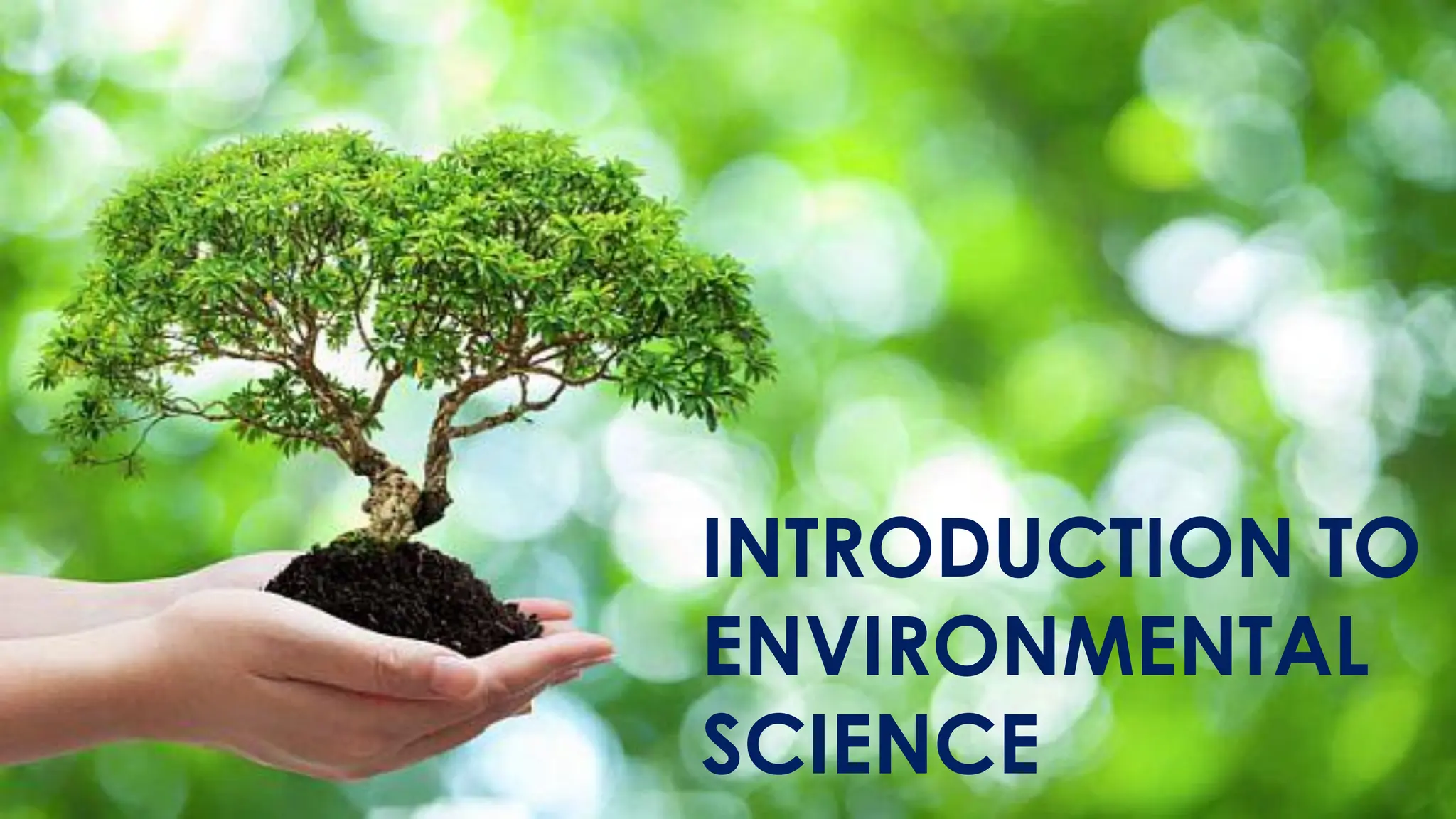
INTRODUCTION TO
ENVIRONMENTAL
SCIENCE
TOPIC OUTLINE
LESSON 1: ENVIRONMENTAL SCIENCE AS A FIELD OF
STUDY
LESSON 2 : ENVIRONMENTAL ETHICS
LESSON 3: ENVIRONMENTAL PRINCIPLES
LESSON 4: ENVIRONMENTAL ORGANIZATIONS IN THE
PHILIPPINES
Introduction
Environmental sciences is a vast and
multidisciplinary science. This module provides an
overview of the basic concepts and principles in
environmental science and its interrelatedness to
other disciplines, with emphasis on human impact
in the environment (biodiversity and other
resources) and climate change mitigation and
adaptation. Moreover, this course aims to
inculcate desirable attitudes of students towards
their environment.
Lesson 1: Environmental Science as a
Field of Study
LEARNING OBJECTIVES:
At the end of the lesson, students should be able to:
1. Define environmental science and its related disciplines.
2. Appreciate the importance of environmental science by
showing concern about the environment.
Environmental vs Environmental Science
 ENVIRONMENT
 As a broad term, encompasses all that surround us or everything
around us.
 It includes the living (biotic) organisms like plants and animals and
the nonliving (abiotic) things like air, water and energy with which
interact in a complex web of relationships that connect us to one
another and to the world we live in.
 ENVIRONMENTAL SCIENCE
 It is an interdisciplinary study that uses information and ideas from
the physical sciences (such as biology, chemistry, and geology),
the social sciences (such as economics and political science) and
the humanities (such as history and ethics) to learn how nature
works, how we interact with our environment, and how we can
deal with environmental problems.
COMPONENTS OF ENVIRONMENTAL SCIENCE:
 Environmental science is by nature interdisciplinary, it involves
several components such as the study of biology, physics,
earth sciences, chemistry and social sciences. Other
components that are being covered in studying
environmental science are given below:
 Atmospheric Sciences
 A broad field that deals with the study of atmosphere, its
processes, and the effects other systems have on the
atmosphere, and the effects of the atmosphere on other
systems.
COMPONENTS OF ENVIRONMENTAL SCIENCE:
 Ecology
 It came from a Greek words oikos meaning “house or a
place to live in”.
 The scientific study of the relationships between organisms
and their environment. This involves the diversity, distribution,
amount (biomass), number (population) of organisms, as well
as competition between them within and among
ecosystems.
COMPONENTS OF ENVIRONMENTAL SCIENCE:
 Environmental Chemistry
 A scientific discipline that is focus on the chemical changes
in the environment. The principal areas covered in the study
are soil contamination and water pollution. The topics of
analysis includes chemical degradation in the environment,
multi-phase transport of, and chemical effects in the
environment.
 Geosciences
 A scientific study on the earth’s crust that includes
environmental geology, environmental soil science and
volcanic phenomena and in some classifications cover
hydrology like oceanography.
IMPORTANCE OF THE STUDY OF
ENVIRONMENTAL SCIENCE
 To realize that environmental problems are global.
 To understand the impacts of development on the
environment.
 To discover sustainable ways of living.
 To utilize the natural resources efficiently.
 To shed light on contemporary concepts such as how to
conserve biodiversity.
 To learn and create awareness about environmental
problems at local, national and international levels.
Lesson 2: Environmental Ethics
LEARNING OBJECTIVE:
At the end of the lesson, students should be able to:
1. Identify and discuss the different environmental ethics.
THE ENVIRONMENTAL ETHICS
 ETHICS
 -is the branch of philosophy that is derived from the logical
application of human values
 -it helps us determine which forms of conduct are morally acceptable
and unacceptable
 -it plays a role in any types of human activities that involve intelligent
judgement and voluntary action
 ENVIRONMENTAL ETHICS
 -A field of applied ethics that considers the moral basis of
environmental responsibility.
 -Human beliefs about what is right and wrong with how we treat the
environment.
THREE ETHICAL PERSPECTIVES
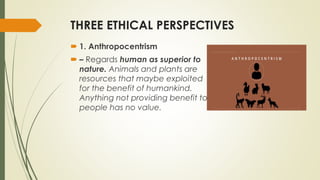
 1. Anthropocentrism
 – Regards human as superior to
nature. Animals and plants are
resources that maybe exploited
for the benefit of humankind.
Anything not providing benefit to
people has no value.
THREE ETHICAL PERSPECTIVES
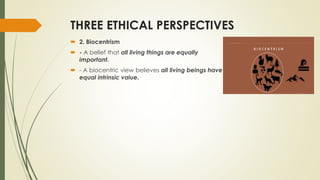
 2. Biocentrism
 - A belief that all living things are equally
important.
 - A biocentric view believes all living beings have
equal intrinsic value.
THREE ETHICAL PERSPECTIVES
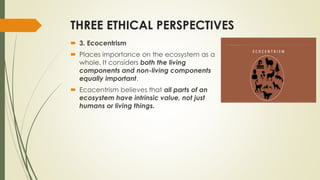
 3. Ecocentrism
 Places importance on the ecosystem as a
whole. It considers both the living
components and non-living components
equally important.
 Ecocentrism believes that all parts of an
ecosystem have intrinsic value, not just
humans or living things.
Lesson 3. Environmental Principles
Learning Objective:
At the end of the lesson, students should be able to:
1. Describe the principles of Environmental Science.
Environmental Principles
Environmental Education – as defined by the Asian
Development Bank, is the process by which people
develop awareness, concern and knowledge of
the environment and its diverse values, processes,
and learn to use this understanding to preserve,
conserve and utilize the environment in a
sustainable manner for the benefit of present and
future generations.
Environmental Principles
Interdependence/interrelatedness – living things are
interdependent with one another and with their
environment. Both biotic and abiotic components
are equally important in the ecosystem because the
absence of one affects the functions and existence
of the others and of the whole ecosystem.
Environmental Principles
Diversity and Stability – it is believed that a diverse
community is a stable community. Because
several species keep other species in check,
preventing any species from overpopulating the
habitat.
Change - change is basic to nature. Ecosystem
change over time and space. Any change in the
community affects the different organisms within it.
Sometimes results in the environmental crises that
the world faces today.
Environmental Principles
Balance of Nature – Ecosystem are capable of
self-maintenance and self regulations.
Finiteness of Resources – means that there are
limitations and boundaries to utilization. Extraction
of resources should be anchored on the concepts
of sustainable development and wise utilization.
Environmental Principles
Pollution – is a undesirable accumulations of
substances resulting in diminished quality and utility
of resources.
Stewardship – means efficient management by
maintaining a balance between population
growth and resource use.
Sustainability – actions that address the needs of
the present without compromising the needs of
the future generations to meet their own needs.
Lesson 4. ENVIRONMENTAL ORGANIZATION
IN THE PHILIPPINES
Learning Objective:
At the end of the lesson, students should be able to:
1. Identify the different environmental organization in the
Philippines.
Environmental Organizations in the Philippines
1. ABS-CBN Bantay Kalikasan
- committed to undertake and catalyze initiatives by maximizing
media resources to help ensure an actively protected, adequately
rehabilitated, and sustainably developed environment.
- Its current objectives are as follows:
 Develop and implement strategic environmental projects.
 Raise public consciousness on environmental issues and concerns.
 Provide a venue for publicizing and addressing environmental
issues, problems and similar concerns.
 Urge the effective enforcement of relevant environmental policies
and laws.
Continuation……
 Bantay Kalikasan’s areas of focus include: the
reforestation of the La Mesa Watershed, the rehabilitation
and restoration of the La Mesa Ecopark, the Bantay
Baterya drive to recover and recycle unaccounted used
lead acid batteries, the Bantay Langis campaign to
recover and treat used oil, the H2Hope program for the
protection of water resources, and the Pasig River
Rehabilitation Project.
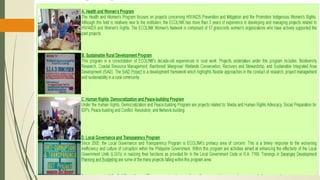
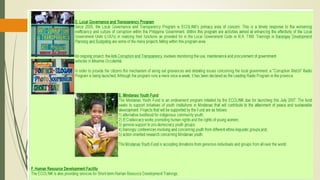
2. Center for Environmental Concerns-Philippines (CEC-Phils)
- A non-government organization founded through
initiatives of organizations representing fisherfolk, farmers,
indigenous peoples, women, urban poor and professional
sectors.
- The center is based in Quezon City, Metro Manila.
- CEC-Philippines closely works with communities and
organizations nationwide, supporting their initiatives to
nurture their ecosystems, defend their common access to
natural resources, and eventually improve their living and
working conditions in the context of a balanced and
healthy environment.
- At the national level, CEC advocates for people-oriented,
patriotic, sustainable, and scientific policies and programs
for the protection of the Philippine environment
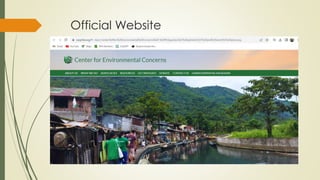
Official Website
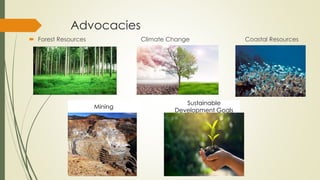
Advocacies
 Forest Resources Climate Change Coastal Resources
Mining
Sustainable
Development Goals
3. ECOLINK Women’s Network ( The Environmental
Cooperation and Linkages Inc.)
 An alliance of 17 women’s organizations in Mindanao,
mostly grassroots-based and composed of members of
the cultural minorities.
 Its mission is to promote an atmosphere of equality in the
society where a woman enjoys utmost political,
economic and cultural liberty.
 The most respected women’s organizations in the
southern Philippines engaged in many programs
encompassing women’s economic, political, and social
freedoms.
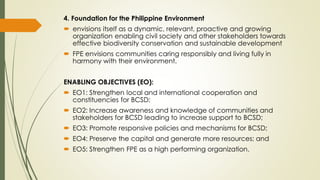
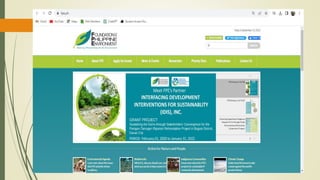
4. Foundation for the Philippine Environment
 envisions itself as a dynamic, relevant, proactive and growing
organization enabling civil society and other stakeholders towards
effective biodiversity conservation and sustainable development
 FPE envisions communities caring responsibly and living fully in
harmony with their environment.
ENABLING OBJECTIVES (EO):
 EO1: Strengthen local and international cooperation and
constituencies for BCSD;
 EO2: Increase awareness and knowledge of communities and
stakeholders for BCSD leading to increase support to BCSD;
 EO3: Promote responsive policies and mechanisms for BCSD;
 EO4: Preserve the capital and generate more resources; and
 EO5: Strengthen FPE as a high performing organization.
5. Global Environment and Nature Ecosystems Society
(Phil.) Foundation (GENESYS), Inc.
 -Formally established in mid-1999 as a non-profit, non-
government organization whose primary purpose is to
manage and implement environment restoration and
prevention projects through the coordination and
pooling of resources among various sectors, groups and
individuals.
6. Haribon Foundation
 The name Haribon was coined from Haring Ibon or the
Philippine Eagle.
 It was named so because the existence of the king of birds
is a perfect barometer of the state of our forest.
 Haribon is the Philippines pioneer environmental
organization.
 Hatched in 1972, the organization, and the individuals it
trained and nurtured were instrumental in the formation of
other environmental organizations in the country.
7. The Philippine Tropical Forest Conservation Foundation
Inc. (PTFCF)
 The PTFCF was established under two bilateral
agreements between the governments of the United
States (US) of America and the Republic of the
Philippines (RP) under the US Tropical Forest
Conservation Act.
8. Philippine Ocean Heritage
 It was created to address the dire need to protect and
conserve the marine environment of the Philippines.
 Their mission is to share the wonders of the underwater
world through this websites and raise awareness of
marine conservation issues.
9. Rain Forestation Information Portal
 It was created by the Environmental Leadership & Training
Initiative (ELTI), in cooperation with the other members of
the Rain Forest Restoration Initiative (RFRI).
 It is a network of organizations and individuals from the
academe, peoples’ organizations, non- government
organizations and business sector engaged in
environmental conservation, research and development.
 Together, working to advance and promote
Rainforestation as a strategy to rehabilitate degraded
landscapes and restore key ecosystem services and
functions while providing forest-dependent communities
with an alternative source of livelihood.
10. Society for the Conservation of Philippine Wetlands
Incorporated
 established on February 6,1998 after the Forum on the
National Wetland Action Plan whose primary goal is to
promote the wise use of wetlands in the Philippines
11. Tanggol Kalikasan (Defense of Nature)
 a non-stock, non-profit and non-governmental organization
involved in public interest environmental lawyering in the
Philippines
 incorporated as a fully independent organization in January
2001 after thirteen years as their environmental law office of
Haribon Foundation
 works with the national and international partners and
networks and has its main office in Quezon City ; it also
maintains an area office in Lucena City
12. World Wide Fund (WWF)
 Philippines is a national organization of the WWF network
 also known as Kabang Kalikasan ng Pilipinas Foundation
Inc., a non-stock, non-profit organizations registered with
the Securities and Exchange Commission (SEC) and with
the Philippine Council for NGO Certification (PCNC)
 WWF-Philippines implements conservation and
development projects in 11 provinces and at least 28
towns; from the far north in the Babuyan Islands, to the
southernmost tip, the Turtle Islands in Tawi-Tawi
 WWF advocates for appropriate environmental policies,
engage corporations for sustainable business and conducts
environmental education activities in Metro Manila and
other key cities and towns
13. Partnerships in Environmental Management for the Seas of
East Asia (PEMSEA)
 continues in its quest on the vision and mission of the
Sustainable Development Strategy for the Seas of East Asia
(SDS-SEA), bringing the region closer to achieving the
targets set under the Haikou Partnership Agreement and the
Manila Declaration
 through stronger partnerships, networking and
collaboration, PEMSEA is broadening its portfolio of services
and stepping up its efforts to bring about governance and
management changes in the Seas of East Asia region.
Chapter 1. Introduction to Environmental Science.pdf

  • 1.
  • 2.
    TOPIC OUTLINE LESSON 1:ENVIRONMENTAL SCIENCE AS A FIELD OF STUDY LESSON 2 : ENVIRONMENTAL ETHICS LESSON 3: ENVIRONMENTAL PRINCIPLES LESSON 4: ENVIRONMENTAL ORGANIZATIONS IN THE PHILIPPINES
  • 3.
    Introduction Environmental sciences isa vast and multidisciplinary science. This module provides an overview of the basic concepts and principles in environmental science and its interrelatedness to other disciplines, with emphasis on human impact in the environment (biodiversity and other resources) and climate change mitigation and adaptation. Moreover, this course aims to inculcate desirable attitudes of students towards their environment.

  • 4.
    Lesson 1: EnvironmentalScience as a Field of Study LEARNING OBJECTIVES: At the end of the lesson, students should be able to: 1. Define environmental science and its related disciplines. 2. Appreciate the importance of environmental science by showing concern about the environment.
  • 5.
    Environmental vs EnvironmentalScience  ENVIRONMENT  As a broad term, encompasses all that surround us or everything around us.  It includes the living (biotic) organisms like plants and animals and the nonliving (abiotic) things like air, water and energy with which interact in a complex web of relationships that connect us to one another and to the world we live in.  ENVIRONMENTAL SCIENCE  It is an interdisciplinary study that uses information and ideas from the physical sciences (such as biology, chemistry, and geology), the social sciences (such as economics and political science) and the humanities (such as history and ethics) to learn how nature works, how we interact with our environment, and how we can deal with environmental problems.
  • 6.
    COMPONENTS OF ENVIRONMENTALSCIENCE:  Environmental science is by nature interdisciplinary, it involves several components such as the study of biology, physics, earth sciences, chemistry and social sciences. Other components that are being covered in studying environmental science are given below:  Atmospheric Sciences  A broad field that deals with the study of atmosphere, its processes, and the effects other systems have on the atmosphere, and the effects of the atmosphere on other systems.
  • 7.
    COMPONENTS OF ENVIRONMENTALSCIENCE:  Ecology  It came from a Greek words oikos meaning “house or a place to live in”.  The scientific study of the relationships between organisms and their environment. This involves the diversity, distribution, amount (biomass), number (population) of organisms, as well as competition between them within and among ecosystems.
  • 8.
    COMPONENTS OF ENVIRONMENTALSCIENCE:  Environmental Chemistry  A scientific discipline that is focus on the chemical changes in the environment. The principal areas covered in the study are soil contamination and water pollution. The topics of analysis includes chemical degradation in the environment, multi-phase transport of, and chemical effects in the environment.  Geosciences  A scientific study on the earth’s crust that includes environmental geology, environmental soil science and volcanic phenomena and in some classifications cover hydrology like oceanography.

  • 9.
    IMPORTANCE OF THESTUDY OF ENVIRONMENTAL SCIENCE  To realize that environmental problems are global.  To understand the impacts of development on the environment.  To discover sustainable ways of living.  To utilize the natural resources efficiently.  To shed light on contemporary concepts such as how to conserve biodiversity.  To learn and create awareness about environmental problems at local, national and international levels.
  • 10.
    Lesson 2: EnvironmentalEthics LEARNING OBJECTIVE: At the end of the lesson, students should be able to: 1. Identify and discuss the different environmental ethics.
  • 11.
    THE ENVIRONMENTAL ETHICS ETHICS  -is the branch of philosophy that is derived from the logical application of human values  -it helps us determine which forms of conduct are morally acceptable and unacceptable  -it plays a role in any types of human activities that involve intelligent judgement and voluntary action  ENVIRONMENTAL ETHICS  -A field of applied ethics that considers the moral basis of environmental responsibility.  -Human beliefs about what is right and wrong with how we treat the environment.
  • 12.
    THREE ETHICAL PERSPECTIVES 1. Anthropocentrism  – Regards human as superior to nature. Animals and plants are resources that maybe exploited for the benefit of humankind. Anything not providing benefit to people has no value.
  • 13.
    THREE ETHICAL PERSPECTIVES 2. Biocentrism  - A belief that all living things are equally important.  - A biocentric view believes all living beings have equal intrinsic value.
  • 14.
    THREE ETHICAL PERSPECTIVES 3. Ecocentrism  Places importance on the ecosystem as a whole. It considers both the living components and non-living components equally important.  Ecocentrism believes that all parts of an ecosystem have intrinsic value, not just humans or living things.
  • 15.
    Lesson 3. EnvironmentalPrinciples Learning Objective: At the end of the lesson, students should be able to: 1. Describe the principles of Environmental Science.
  • 16.
    Environmental Principles Environmental Education– as defined by the Asian Development Bank, is the process by which people develop awareness, concern and knowledge of the environment and its diverse values, processes, and learn to use this understanding to preserve, conserve and utilize the environment in a sustainable manner for the benefit of present and future generations.
  • 17.
    Environmental Principles Interdependence/interrelatedness –living things are interdependent with one another and with their environment. Both biotic and abiotic components are equally important in the ecosystem because the absence of one affects the functions and existence of the others and of the whole ecosystem.
  • 18.
    Environmental Principles Diversity andStability – it is believed that a diverse community is a stable community. Because several species keep other species in check, preventing any species from overpopulating the habitat. Change - change is basic to nature. Ecosystem change over time and space. Any change in the community affects the different organisms within it. Sometimes results in the environmental crises that the world faces today.
  • 19.
    Environmental Principles Balance ofNature – Ecosystem are capable of self-maintenance and self regulations. Finiteness of Resources – means that there are limitations and boundaries to utilization. Extraction of resources should be anchored on the concepts of sustainable development and wise utilization.
  • 20.
    Environmental Principles Pollution –is a undesirable accumulations of substances resulting in diminished quality and utility of resources. Stewardship – means efficient management by maintaining a balance between population growth and resource use. Sustainability – actions that address the needs of the present without compromising the needs of the future generations to meet their own needs.
  • 21.
    Lesson 4. ENVIRONMENTALORGANIZATION IN THE PHILIPPINES Learning Objective: At the end of the lesson, students should be able to: 1. Identify the different environmental organization in the Philippines.
  • 22.
    Environmental Organizations inthe Philippines 1. ABS-CBN Bantay Kalikasan - committed to undertake and catalyze initiatives by maximizing media resources to help ensure an actively protected, adequately rehabilitated, and sustainably developed environment. - Its current objectives are as follows:  Develop and implement strategic environmental projects.  Raise public consciousness on environmental issues and concerns.  Provide a venue for publicizing and addressing environmental issues, problems and similar concerns.  Urge the effective enforcement of relevant environmental policies and laws.
  • 23.
    Continuation……  Bantay Kalikasan’sareas of focus include: the reforestation of the La Mesa Watershed, the rehabilitation and restoration of the La Mesa Ecopark, the Bantay Baterya drive to recover and recycle unaccounted used lead acid batteries, the Bantay Langis campaign to recover and treat used oil, the H2Hope program for the protection of water resources, and the Pasig River Rehabilitation Project.
  • 24.
    2. Center forEnvironmental Concerns-Philippines (CEC-Phils) - A non-government organization founded through initiatives of organizations representing fisherfolk, farmers, indigenous peoples, women, urban poor and professional sectors. - The center is based in Quezon City, Metro Manila. - CEC-Philippines closely works with communities and organizations nationwide, supporting their initiatives to nurture their ecosystems, defend their common access to natural resources, and eventually improve their living and working conditions in the context of a balanced and healthy environment. - At the national level, CEC advocates for people-oriented, patriotic, sustainable, and scientific policies and programs for the protection of the Philippine environment
  • 25.
  • 26.
    Advocacies  Forest ResourcesClimate Change Coastal Resources Mining Sustainable Development Goals
  • 27.
    3. ECOLINK Women’sNetwork ( The Environmental Cooperation and Linkages Inc.)  An alliance of 17 women’s organizations in Mindanao, mostly grassroots-based and composed of members of the cultural minorities.  Its mission is to promote an atmosphere of equality in the society where a woman enjoys utmost political, economic and cultural liberty.  The most respected women’s organizations in the southern Philippines engaged in many programs encompassing women’s economic, political, and social freedoms.
  • 30.
    4. Foundation forthe Philippine Environment  envisions itself as a dynamic, relevant, proactive and growing organization enabling civil society and other stakeholders towards effective biodiversity conservation and sustainable development  FPE envisions communities caring responsibly and living fully in harmony with their environment. ENABLING OBJECTIVES (EO):  EO1: Strengthen local and international cooperation and constituencies for BCSD;  EO2: Increase awareness and knowledge of communities and stakeholders for BCSD leading to increase support to BCSD;  EO3: Promote responsive policies and mechanisms for BCSD;  EO4: Preserve the capital and generate more resources; and  EO5: Strengthen FPE as a high performing organization.
  • 33.
    5. Global Environmentand Nature Ecosystems Society (Phil.) Foundation (GENESYS), Inc.  -Formally established in mid-1999 as a non-profit, non- government organization whose primary purpose is to manage and implement environment restoration and prevention projects through the coordination and pooling of resources among various sectors, groups and individuals.
  • 34.
    6. Haribon Foundation The name Haribon was coined from Haring Ibon or the Philippine Eagle.  It was named so because the existence of the king of birds is a perfect barometer of the state of our forest.  Haribon is the Philippines pioneer environmental organization.  Hatched in 1972, the organization, and the individuals it trained and nurtured were instrumental in the formation of other environmental organizations in the country.
  • 37.
    7. The PhilippineTropical Forest Conservation Foundation Inc. (PTFCF)  The PTFCF was established under two bilateral agreements between the governments of the United States (US) of America and the Republic of the Philippines (RP) under the US Tropical Forest Conservation Act.
  • 38.
    8. Philippine OceanHeritage  It was created to address the dire need to protect and conserve the marine environment of the Philippines.  Their mission is to share the wonders of the underwater world through this websites and raise awareness of marine conservation issues.
  • 39.
    9. Rain ForestationInformation Portal  It was created by the Environmental Leadership & Training Initiative (ELTI), in cooperation with the other members of the Rain Forest Restoration Initiative (RFRI).  It is a network of organizations and individuals from the academe, peoples’ organizations, non- government organizations and business sector engaged in environmental conservation, research and development.  Together, working to advance and promote Rainforestation as a strategy to rehabilitate degraded landscapes and restore key ecosystem services and functions while providing forest-dependent communities with an alternative source of livelihood.
  • 40.
    10. Society forthe Conservation of Philippine Wetlands Incorporated  established on February 6,1998 after the Forum on the National Wetland Action Plan whose primary goal is to promote the wise use of wetlands in the Philippines
  • 41.
    11. Tanggol Kalikasan(Defense of Nature)  a non-stock, non-profit and non-governmental organization involved in public interest environmental lawyering in the Philippines  incorporated as a fully independent organization in January 2001 after thirteen years as their environmental law office of Haribon Foundation  works with the national and international partners and networks and has its main office in Quezon City ; it also maintains an area office in Lucena City
  • 42.
    12. World WideFund (WWF)  Philippines is a national organization of the WWF network  also known as Kabang Kalikasan ng Pilipinas Foundation Inc., a non-stock, non-profit organizations registered with the Securities and Exchange Commission (SEC) and with the Philippine Council for NGO Certification (PCNC)  WWF-Philippines implements conservation and development projects in 11 provinces and at least 28 towns; from the far north in the Babuyan Islands, to the southernmost tip, the Turtle Islands in Tawi-Tawi  WWF advocates for appropriate environmental policies, engage corporations for sustainable business and conducts environmental education activities in Metro Manila and other key cities and towns
  • 43.
    13. Partnerships inEnvironmental Management for the Seas of East Asia (PEMSEA)  continues in its quest on the vision and mission of the Sustainable Development Strategy for the Seas of East Asia (SDS-SEA), bringing the region closer to achieving the targets set under the Haikou Partnership Agreement and the Manila Declaration  through stronger partnerships, networking and collaboration, PEMSEA is broadening its portfolio of services and stepping up its efforts to bring about governance and management changes in the Seas of East Asia region.