Chapman- Kolmogrov Equation In
Computer Oriented Statistical
Mathematics
SlideMake.com
Introduction to the Chapman-Kolmogorov Equation
The Chapman-Kolmogorov Equation is
fundamental in the theory of stochastic
processes.
It describes the relationship between
transition probabilities over different
time intervals.
This equation is essential in various
applications, including finance, biology,
and computer science.
Historical Background
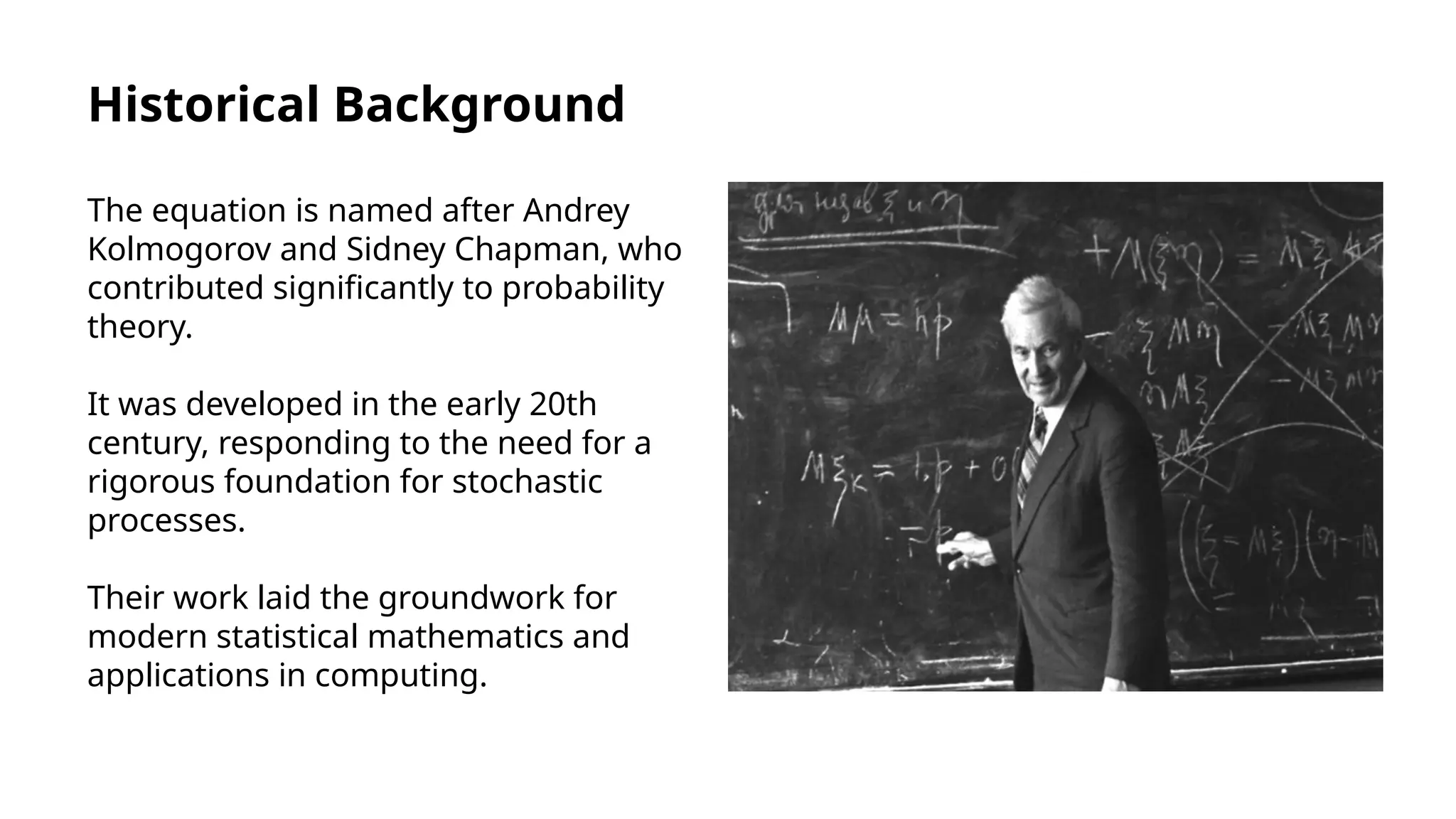
The equation is named after Andrey
Kolmogorov and Sidney Chapman, who
contributed significantly to probability
theory.
It was developed in the early 20th
century, responding to the need for a
rigorous foundation for stochastic
processes.
Their work laid the groundwork for
modern statistical mathematics and
applications in computing.
Basic Concepts of Stochastic Processes
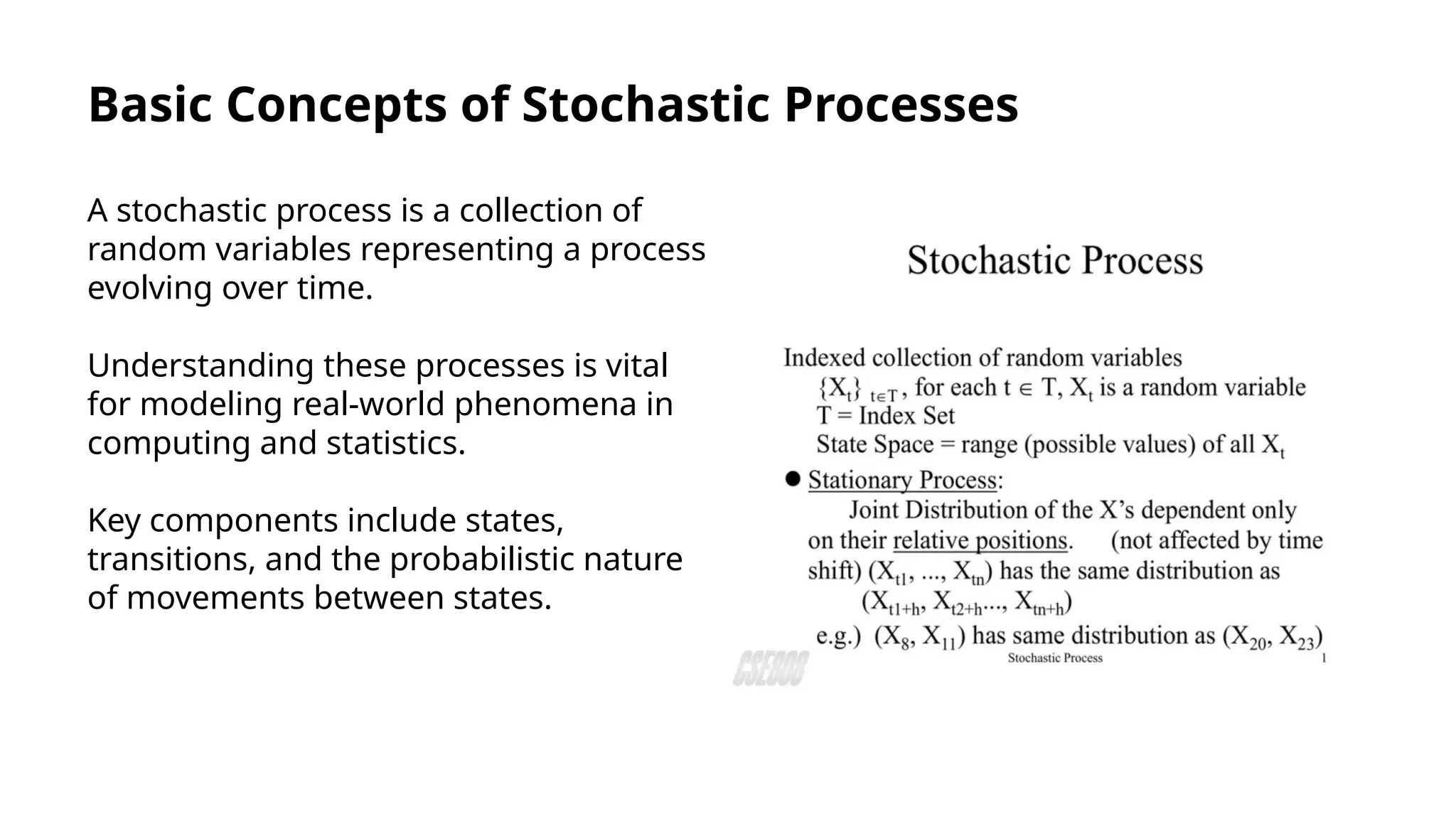
A stochastic process is a collection of
random variables representing a process
evolving over time.
Understanding these processes is vital
for modeling real-world phenomena in
computing and statistics.
Key components include states,
transitions, and the probabilistic nature
of movements between states.
Transition Probabilities
Transition probabilities express the
likelihood of moving from one state to
another in a stochastic process.
They are used to describe Markov chains,
which are a type of stochastic process
with memoryless properties.
The Chapman-Kolmogorov Equation
connects these probabilities across
different time intervals.
The Chapman-Kolmogorov Equation
The equation states that the probability
of transitioning from state i to state j
over time t+s is the sum of transitioning
through intermediate states.
Mathematically, it can be expressed as
P(i, j, t+s) = Σ P(i, k, t)
P(k, j, s) for all possible intermediate
states k.
Markov Chains Overview
Markov chains are foundational in
understanding the Chapman-
Kolmogorov Equation.
They are characterized by the Markov
property, meaning future states depend
only on the current state, not the past.
This simplification allows for easier
computation of probabilities and
transitions in many applications.
Applications in Computer Science
The Chapman-Kolmogorov Equation is
used in algorithm design and
performance analysis of systems.
It plays a role in modeling network traffic
and queuing systems in computer
networks.
Additionally, it's applied in machine
learning for state estimation and
prediction tasks.
Numerical Methods for Solving the Equation
Various numerical methods can be
employed to solve the Chapman-
Kolmogorov Equation.
Techniques such as Monte Carlo
simulations and discretization methods
are commonly used.
These methods allow for approximating
solutions in complex systems where
analytical solutions are difficult.
Connection to Bayesian Inference
The Chapman-Kolmogorov Equation
underpins some Bayesian methods in
statistical inference.
It aids in the development of hidden
Markov models (HMMs), widely used in
various fields.
Bayesian networks rely on similar
principles of transitioning probabilities
between states.
Hidden Markov Models (HMMs)
HMMs are a statistical model where the
system being modeled is assumed to be
a Markov process with hidden states.
The Chapman-Kolmogorov Equation is
critical for calculating state transitions in
HMMs.
Applications of HMMs include speech
recognition, bioinformatics, and financial
modeling.
Time Series Analysis
Time series analysis often utilizes the
principles of the Chapman-Kolmogorov
Equation.
It helps in modeling and forecasting
future values based on past observations
in stochastic systems.
The equation assists in establishing
relationships between different time
intervals in the data.
Limitations and Assumptions
The Chapman-Kolmogorov Equation
relies on certain assumptions, such as
the Markov property.
These assumptions may not hold in all
real-world applications, potentially
leading to inaccuracies.
Understanding the limitations is crucial
for appropriately applying the equation
in practice.
Challenges in Computation
Computational challenges arise in high-
dimensional systems where the number
of states is large.
Evaluating transition probabilities can
become complex, requiring efficient
algorithms.
Researchers are developing advanced
computational techniques to address
these challenges.
Real-World Example: Weather Modeling
The Chapman-Kolmogorov Equation can
be applied to model weather patterns
over time.
Transition probabilities can represent the
likelihood of weather changes from one
day to the next.
This modeling aids in forecasting and
understanding climate dynamics.
Case Study: Stock Price Prediction
Stock price movements can be modeled
using stochastic processes where the
Chapman-Kolmogorov Equation applies.
Transition probabilities help predict
future stock prices based on current
market conditions.
This approach is widely used in
quantitative finance and algorithmic
trading.
Software Implementation
Various programming languages, such
as Python and R, offer libraries for
implementing the Chapman-Kolmogorov
Equation.
These libraries facilitate simulations and
probabilistic modeling for researchers
and practitioners.
Efficient implementation can lead to
better insights and decisions based on
stochastic models.
Conclusion: Importance of the Equation
The Chapman-Kolmogorov Equation is
pivotal in understanding and modeling
stochastic processes.
Its applications span across numerous
fields, demonstrating its versatility and
relevance.
Mastery of this equation enhances
analytical capabilities in computer-
oriented statistical mathematics.
Future Directions in Research
Ongoing research focuses on refining
methods for solving the Chapman-
Kolmogorov Equation in complex
systems.
There is also interest in developing new
applications in emerging fields like
artificial intelligence.
Future advancements may lead to more
efficient algorithms and deeper insights
into stochastic phenomena.
Further Reading and Resources
Recommended texts include "Markov
Chains: From Theory to Implementation
and Experimentation".
Online courses and tutorials are
available for practical applications of
stochastic processes.
Research papers provide insights into
recent developments and applications of
the Chapman-Kolmogorov Equation.
Questions and Discussion
This slide invites questions and
encourages discussion about the
Chapman-Kolmogorov Equation.
Participants are encouraged to share
their experiences and applications of the
equation.
Open dialogue can enhance
understanding and foster collaborative
learning in the field.
Feel free to modify any part of the slides
to better fit your needs or preferences!

Chapman- Kolmogrov Equation In Computer Oriented Statistical Mathematics.pptx

  • 1.
    Chapman- Kolmogrov EquationIn Computer Oriented Statistical Mathematics SlideMake.com
  • 2.
    Introduction to theChapman-Kolmogorov Equation The Chapman-Kolmogorov Equation is fundamental in the theory of stochastic processes. It describes the relationship between transition probabilities over different time intervals. This equation is essential in various applications, including finance, biology, and computer science.
  • 3.
    Historical Background The equationis named after Andrey Kolmogorov and Sidney Chapman, who contributed significantly to probability theory. It was developed in the early 20th century, responding to the need for a rigorous foundation for stochastic processes. Their work laid the groundwork for modern statistical mathematics and applications in computing.
  • 4.
    Basic Concepts ofStochastic Processes A stochastic process is a collection of random variables representing a process evolving over time. Understanding these processes is vital for modeling real-world phenomena in computing and statistics. Key components include states, transitions, and the probabilistic nature of movements between states.
  • 5.
    Transition Probabilities Transition probabilitiesexpress the likelihood of moving from one state to another in a stochastic process. They are used to describe Markov chains, which are a type of stochastic process with memoryless properties. The Chapman-Kolmogorov Equation connects these probabilities across different time intervals.
  • 6.
    The Chapman-Kolmogorov Equation Theequation states that the probability of transitioning from state i to state j over time t+s is the sum of transitioning through intermediate states. Mathematically, it can be expressed as P(i, j, t+s) = Σ P(i, k, t) P(k, j, s) for all possible intermediate states k.
  • 7.
    Markov Chains Overview Markovchains are foundational in understanding the Chapman- Kolmogorov Equation. They are characterized by the Markov property, meaning future states depend only on the current state, not the past. This simplification allows for easier computation of probabilities and transitions in many applications.
  • 8.
    Applications in ComputerScience The Chapman-Kolmogorov Equation is used in algorithm design and performance analysis of systems. It plays a role in modeling network traffic and queuing systems in computer networks. Additionally, it's applied in machine learning for state estimation and prediction tasks.
  • 9.
    Numerical Methods forSolving the Equation Various numerical methods can be employed to solve the Chapman- Kolmogorov Equation. Techniques such as Monte Carlo simulations and discretization methods are commonly used. These methods allow for approximating solutions in complex systems where analytical solutions are difficult.
  • 10.
    Connection to BayesianInference The Chapman-Kolmogorov Equation underpins some Bayesian methods in statistical inference. It aids in the development of hidden Markov models (HMMs), widely used in various fields. Bayesian networks rely on similar principles of transitioning probabilities between states.
  • 11.
    Hidden Markov Models(HMMs) HMMs are a statistical model where the system being modeled is assumed to be a Markov process with hidden states. The Chapman-Kolmogorov Equation is critical for calculating state transitions in HMMs. Applications of HMMs include speech recognition, bioinformatics, and financial modeling.
  • 12.
    Time Series Analysis Timeseries analysis often utilizes the principles of the Chapman-Kolmogorov Equation. It helps in modeling and forecasting future values based on past observations in stochastic systems. The equation assists in establishing relationships between different time intervals in the data.
  • 13.
    Limitations and Assumptions TheChapman-Kolmogorov Equation relies on certain assumptions, such as the Markov property. These assumptions may not hold in all real-world applications, potentially leading to inaccuracies. Understanding the limitations is crucial for appropriately applying the equation in practice.
  • 14.
    Challenges in Computation Computationalchallenges arise in high- dimensional systems where the number of states is large. Evaluating transition probabilities can become complex, requiring efficient algorithms. Researchers are developing advanced computational techniques to address these challenges.
  • 15.
    Real-World Example: WeatherModeling The Chapman-Kolmogorov Equation can be applied to model weather patterns over time. Transition probabilities can represent the likelihood of weather changes from one day to the next. This modeling aids in forecasting and understanding climate dynamics.
  • 16.
    Case Study: StockPrice Prediction Stock price movements can be modeled using stochastic processes where the Chapman-Kolmogorov Equation applies. Transition probabilities help predict future stock prices based on current market conditions. This approach is widely used in quantitative finance and algorithmic trading.
  • 17.
    Software Implementation Various programminglanguages, such as Python and R, offer libraries for implementing the Chapman-Kolmogorov Equation. These libraries facilitate simulations and probabilistic modeling for researchers and practitioners. Efficient implementation can lead to better insights and decisions based on stochastic models.
  • 18.
    Conclusion: Importance ofthe Equation The Chapman-Kolmogorov Equation is pivotal in understanding and modeling stochastic processes. Its applications span across numerous fields, demonstrating its versatility and relevance. Mastery of this equation enhances analytical capabilities in computer- oriented statistical mathematics.
  • 19.
    Future Directions inResearch Ongoing research focuses on refining methods for solving the Chapman- Kolmogorov Equation in complex systems. There is also interest in developing new applications in emerging fields like artificial intelligence. Future advancements may lead to more efficient algorithms and deeper insights into stochastic phenomena.
  • 20.
    Further Reading andResources Recommended texts include "Markov Chains: From Theory to Implementation and Experimentation". Online courses and tutorials are available for practical applications of stochastic processes. Research papers provide insights into recent developments and applications of the Chapman-Kolmogorov Equation.
  • 21.
    Questions and Discussion Thisslide invites questions and encourages discussion about the Chapman-Kolmogorov Equation. Participants are encouraged to share their experiences and applications of the equation. Open dialogue can enhance understanding and foster collaborative learning in the field. Feel free to modify any part of the slides to better fit your needs or preferences!

Editor's Notes

  • #2 Image source: https://kenanmemorialstadiumparking.com
  • #3 Image source: https://russkiymir.ru
  • #4 Image source: https://s2.studylib.net
  • #5 Image source: https://www.researchgate.net
  • #6 Image source: https://kenanmemorialstadiumparking.com
  • #7 Image source: https://image.slideserve.com
  • #8 Image source: https://www.techloyce.com
  • #9 Image source: https://s2.studylib.net
  • #10 Image source: https://data-flair.training
  • #11 Image source: https://i.ytimg.com
  • #12 Image source: https://d3caycb064h6u1.cloudfront.net
  • #13 Image source: https://image.slidesharecdn.com
  • #14 Image source: https://slideplayer.com
  • #15 Image source: https://climate.mit.edu
  • #16 Image source: https://miro.medium.com
  • #17 Image source: https://www.slidemake.com
  • #18 Image source: https://kenanmemorialstadiumparking.com
  • #19 Image source: https://www.researchgate.net
  • #20 Image source: https://verificationexcellence.in
  • #21 Image source: https://powerslides.com