9- 1
Copyright © 2012 Pearson Education, Inc.
Publishing as Prentice Hall
i t ’s good and
good for you
New-Product Development
9- 2
Copyright © 2012 Pearson Education, Inc.
Publishing as Prentice Hall
New-Product Development Strategy
Acquisition refers to the buying of a whole
company, a patent, or a license to produce
someone else’s product
New product development refers to original
products, product improvements, product
modifications, and new brands developed
from the firm’s own research and
development
Two ways to obtain new products
9- 3
Copyright © 2012 Pearson Education, Inc.
Publishing as Prentice Hall
Copyright © 2009 Pearson Education South Asia Pt
e Ltd
Reasons for new product failure
• Overestimation of market size
• Poor design
• Incorrect positioning
• Wrong timing
• Priced too high
• Ineffective promotion
• Management influence
• High development costs
• Competition
New-Product Development Strategy
9- 4
Copyright © 2012 Pearson Education, Inc.
Publishing as Prentice Hall
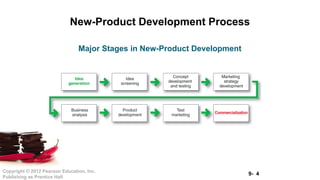
New-Product Development Process
Major Stages in New-Product Development
9- 5
Copyright © 2012 Pearson Education, Inc.
Publishing as Prentice Hall
New-Product Development Process
Idea generation is the systematic search for new-product
ideas
Sources of new-product ideas
• Internal
• External
Idea Generation
9- 6
Copyright © 2012 Pearson Education, Inc.
Publishing as Prentice Hall
New-Product Development Process
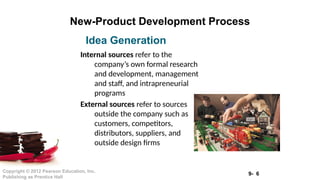
Internal sources refer to the
company’s own formal research
and development, management
and staff, and intrapreneurial
programs
External sources refer to sources
outside the company such as
customers, competitors,
distributors, suppliers, and
outside design firms
Idea Generation
9- 7
Copyright © 2012 Pearson Education, Inc.
Publishing as Prentice Hall
New-Product Development Process
Inviting broad communities of people—
customers, employees, independent
scientists and researchers, and even the
public at large—into the new-product
innovation process.
Crowdsourcing
9- 8
Copyright © 2012 Pearson Education, Inc.
Publishing as Prentice Hall
• Work in groups of 3-5 students.
• Think of activities a company can generate ideas from
customers and competitors
Activity 1:
9- 9
Copyright © 2012 Pearson Education, Inc.
Publishing as Prentice Hall
1. The company can analyze customer questions and complaints to find new products that
better solve consumer problems.
2. Company engineers or salespeople can meet with and work alongside customers to get
suggestions and ideas.
3. The company can conduct surveys or focus groups to learn about consumer needs and
wants.
4. Consumers often create new products and uses on their own, and companies can benefit
by putting them on the market.
5. Some companies even give customers the tools and resources to design their own
products.
6. Companies watch competitors’ ads to get clues about their new products.
7. They buy competing new products, take them apart to see how they work,
analyze their sales, and decide whether they should bring out a new
product of their own.
9- 10
Copyright © 2012 Pearson Education, Inc.
Publishing as Prentice Hall
New-Product Development Process
• Identify good ideas and drop poor ideas
• R-W-W Screening Framework:
– Is it real?
– Can we win?
– Is it worth doing?
Idea Screening
9- 11
Copyright © 2012 Pearson Education, Inc.
Publishing as Prentice Hall
Section
Break
Insert the title of your subtitle Here
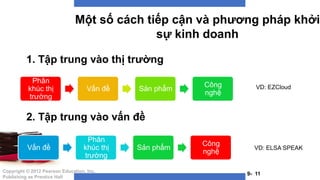
Một số cách tiếp cận và phương pháp khởi
sự kinh doanh
1. Tập trung vào thị trường
Phân
khúc thị
trường
Vấn đề Sản phẩm
Công
nghệ
Vấn đề
Phân
khúc thị
trường
Sản phẩm
Công
nghệ
2. Tập trung vào vấn đề
VD: EZCloud
VD: ELSA SPEAK
9- 12
Copyright © 2012 Pearson Education, Inc.
Publishing as Prentice Hall
Section
Break
Insert the title of your subtitle Here
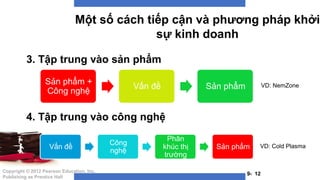
Một số cách tiếp cận và phương pháp khởi
sự kinh doanh
3. Tập trung vào sản phẩm
Sản phẩm +
Công nghệ
Vấn đề Sản phẩm
Vấn đề
Công
nghệ
Phân
khúc thị
trường
Sản phẩm
4. Tập trung vào công nghệ
VD: NemZone
VD: Cold Plasma
9- 13
Copyright © 2012 Pearson Education, Inc.
Publishing as Prentice Hall
New-Product Development Process
Product idea is an idea for a possible product
that the company can see itself offering to
the market
Product concept is a detailed version of the
idea stated in meaningful consumer terms
Product image is the way consumers
perceive an actual or potential product
Concept Development and Testing
9- 14
Copyright © 2012 Pearson Education, Inc.
Publishing as Prentice Hall
“Engineering design” can
be defined as:
A systemic process in which
designs are generated,
evaluated, and specified for
devices, systems or processes
that attain user objectives and
needs (criteria) while satisfying a
set of constraints.
(from Engineering Design: A Project-Based Introduction, by
Design Phase
9- 15
Copyright © 2012 Pearson Education, Inc.
Publishing as Prentice Hall
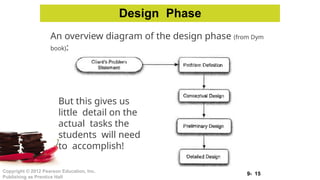
An overview diagram of the design phase (from Dym
book):
Design Phase
But this gives us
little detail on the
actual tasks the
students will need
to accomplish!
9- 16
Copyright © 2012 Pearson Education, Inc.
Publishing as Prentice Hall
If the student project is funded by a
company or individual, a brief problem
statement is usually provided.
I want a machine that will . . . . .
I want a software application that
. . . . . . I have an idea for
. . . . . .
Client Problem Statement
9- 17
Copyright © 2012 Pearson Education, Inc.
Publishing as Prentice Hall
More in-depth discussion with the client or
potential users of the product are critical tasks
BEFORE conceptual design is done.
A key goal in this phase is to establish design
“criteria and constraints.” Then they should be
validated by the customer.
Criteria: What are these?
Constraints: What are these?
Problem Definition
9- 18
Copyright © 2012 Pearson Education, Inc.
Publishing as Prentice Hall
•Criteria/Objectives: Design elements assigned a
value of compliance and/or weighting of importance. A
design might not meet a criteria but still be a valid solution.
Constraints: Design elements we have
to
have in the design and receive a
yes/no evaluation. A design that
does not meet constraints is not
acceptable.
Problem Definition
9- 19
Copyright © 2012 Pearson Education, Inc.
Publishing as Prentice Hall
Ideate
4
6
Tôi cần cảm thấy an toàn
và tự tin khi sử dụng nhà
vệ sinh ở nhà.
- Giúp Fanny cảm thấy an toàn và tự tin
- Đảm bảo Fanny không trượt
- Nhà vệ sinh của Fanny phải an toàn, không dễ
trượt
Nhu cầu khách hàng
Our Design Criteria
Problem statement (Tuyên
bố vấn đề): Làm thế nào
chúng ta có thể giúp người
cao tuổi được an toàn trong
môi trường gia đình của họ?
Đây là
Frail Fanny
9- 20
Copyright © 2012 Pearson Education, Inc.
Publishing as Prentice Hall
Problem Definition
Which of the following are Constraints?
• The maximum weight of the device is
200 grams.
• Size of the device is important, so the
smaller the device, the better.
• Total cost cannot exceed 4,000,000 VND
• A lower cost is better and the target cost is
between 2,000,000 VND and 3,000,000
VND.
9- 21
Copyright © 2012 Pearson Education, Inc.
Publishing as Prentice Hall
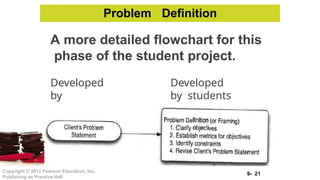
A more detailed flowchart for this
phase of the student project.
Developed
by
teacher/clien
t
Developed
by students
Problem Definition
9- 22
Copyright © 2012 Pearson Education, Inc.
Publishing as Prentice Hall
•The conceptual design phase is very open ended and can be
quite abstract.
•But, we should drive students to create multiple
conceptual designs, ideally at least three.
•We don’t want students to “marry their first design!”
Conceptual Design Phase
9- 23
Copyright © 2012 Pearson Education, Inc.
Publishing as Prentice Hall
Design: Novice vs. Expert Designers
A novice:
• Perceives the design task as a well-structured
problem
• Immediately engage in problem-solving activity –
“Fire, Ready, Aim”
• Works with a few ideas; does not explore
alternatives
• Does not critically evaluate their design decisions
An expert:
• Delays design decisions to understand and frame
the problem, as well as research and gather
information
• Generates different ideas before detailing one
9- 24
Copyright © 2012 Pearson Education, Inc.
Publishing as Prentice Hall
Steps that the student team should accomplish
during the conceptual design phase are shown
below.
1. Establish necessary functions of solution
2. Establish functional specifications (what must
the function be able to do)
3. Use functional decomposition to generate
design space options
4. Use decision tools to reduce design space
options
5. Generate design alternatives
6. Apply criteria and constraints to
Conceptual Design Phase
9- 25
Copyright © 2012 Pearson Education, Inc.
Publishing as Prentice Hall
• Tìm những nguồn thông tin bên trong và ngoài DN để hình
thành ý tưởng SP (Có minh chứng)
• Trình bày 3 ý tưởng SP mới, làm rõ các problem statement,
criteria, và constraint cho mỗi ý tưởng.
• Chọn doanh nghiệp hay start-up?
Lưu ý: SP cần có tính mới (innovative) và khả năng
thực thi để tạo được lợi thế cạnh tranh
Homework
9- 26
Copyright © 2012 Pearson Education, Inc.
Publishing as Prentice Hall
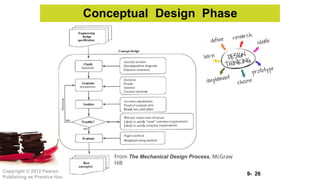
Conceptual Design Phase
From The Mechanical Design Process, McGraw
Hill
9- 27
Copyright © 2012 Pearson Education, Inc.
Publishing as Prentice Hall
Once students rank or reconfigure
design concept alternatives to select
three best alternatives, what is next?
Preliminary design!
1. Identify principal attributes of each chosen
design alternative
2. Apply rules of thumb, physical relationships,
CAD modeling and simulation, cost estimates,
and manufacturing feasibility
Conceptual Design Phase
9- 28
Copyright © 2012 Pearson Education, Inc.
Publishing as Prentice Hall
Using the preliminary design results, each
of three design alternatives are reevaluated
using the criteria and constraints.
Best to have a customer design review at
this point.
Goal is to select the design alternative that
will be taken into final design.
Design Decision
9- 29
Copyright © 2012 Pearson Education, Inc.
Publishing as Prentice Hall
Students should develop a detailed final
design of the selected design alternative.
Tools the students should use are:
1. Design codes and standards
2. Engineering Handbooks
3. Local regulations, laws and conventions
4. Supplier information (for components)
5. CAD or other engineering software (PCB
design, etc.) to create engineering
drawings and documentation of design
Final Design
9- 30
Copyright © 2012 Pearson Education, Inc.
Publishing as Prentice Hall
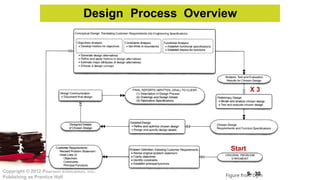
Design Process Overview
Figure from Dym
Start
X 3
9- 31
Copyright © 2012 Pearson Education, Inc.
Publishing as Prentice Hall
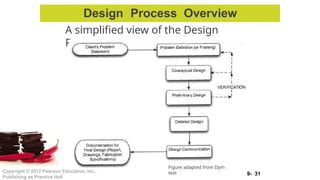
A simplified view of the Design
Process
Design Process Overview
Figure adapted from Dym
text
9- 32
Copyright © 2012 Pearson Education, Inc.
Publishing as Prentice Hall
• In groups of 3-5, students should come up with one idea for
a new product.
• Each group can choose a category including kitchen
products, office supplies, laptop accessories, dessert
products, bathroom accessories, children’s toys, baby
products, etc.
Activity 2
9- 33
Copyright © 2012 Pearson Education, Inc.
Publishing as Prentice Hall
New-Product Development Process
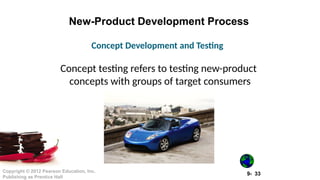
Concept testing refers to testing new-product
concepts with groups of target consumers
Concept Development and Testing
9- 34
Copyright © 2012 Pearson Education, Inc.
Publishing as Prentice Hall
New-Product Development Process
• Marketing strategy development refers to
the initial marketing strategy for
introducing the product to the market
• Marketing strategy statement includes:
– Description of the target market
– Value proposition
– Sales and profit goals
Marketing Strategy Development
9- 35
Copyright © 2012 Pearson Education, Inc.
Publishing as Prentice Hall
New-Product Development Process
Business analysis involves a review of the sales, costs, and
profit projections to find out whether they satisfy the
company’s objectives
Marketing Strategy Development
9- 36
Copyright © 2012 Pearson Education, Inc.
Publishing as Prentice Hall
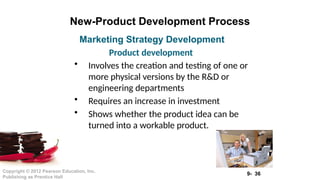
New-Product Development Process
• Involves the creation and testing of one or
more physical versions by the R&D or
engineering departments
• Requires an increase in investment
• Shows whether the product idea can be
turned into a workable product.
Marketing Strategy Development
Product development

Chap1_PBL2 product development for business students.pptx

  • 1.
    9- 1 Copyright ©2012 Pearson Education, Inc. Publishing as Prentice Hall i t ’s good and good for you New-Product Development
  • 2.
    9- 2 Copyright ©2012 Pearson Education, Inc. Publishing as Prentice Hall New-Product Development Strategy Acquisition refers to the buying of a whole company, a patent, or a license to produce someone else’s product New product development refers to original products, product improvements, product modifications, and new brands developed from the firm’s own research and development Two ways to obtain new products
  • 3.
    9- 3 Copyright ©2012 Pearson Education, Inc. Publishing as Prentice Hall Copyright © 2009 Pearson Education South Asia Pt e Ltd Reasons for new product failure • Overestimation of market size • Poor design • Incorrect positioning • Wrong timing • Priced too high • Ineffective promotion • Management influence • High development costs • Competition New-Product Development Strategy
  • 4.
    9- 4 Copyright ©2012 Pearson Education, Inc. Publishing as Prentice Hall New-Product Development Process Major Stages in New-Product Development
  • 5.
    9- 5 Copyright ©2012 Pearson Education, Inc. Publishing as Prentice Hall New-Product Development Process Idea generation is the systematic search for new-product ideas Sources of new-product ideas • Internal • External Idea Generation
  • 6.
    9- 6 Copyright ©2012 Pearson Education, Inc. Publishing as Prentice Hall New-Product Development Process Internal sources refer to the company’s own formal research and development, management and staff, and intrapreneurial programs External sources refer to sources outside the company such as customers, competitors, distributors, suppliers, and outside design firms Idea Generation
  • 7.
    9- 7 Copyright ©2012 Pearson Education, Inc. Publishing as Prentice Hall New-Product Development Process Inviting broad communities of people— customers, employees, independent scientists and researchers, and even the public at large—into the new-product innovation process. Crowdsourcing
  • 8.
    9- 8 Copyright ©2012 Pearson Education, Inc. Publishing as Prentice Hall • Work in groups of 3-5 students. • Think of activities a company can generate ideas from customers and competitors Activity 1:
  • 9.
    9- 9 Copyright ©2012 Pearson Education, Inc. Publishing as Prentice Hall 1. The company can analyze customer questions and complaints to find new products that better solve consumer problems. 2. Company engineers or salespeople can meet with and work alongside customers to get suggestions and ideas. 3. The company can conduct surveys or focus groups to learn about consumer needs and wants. 4. Consumers often create new products and uses on their own, and companies can benefit by putting them on the market. 5. Some companies even give customers the tools and resources to design their own products. 6. Companies watch competitors’ ads to get clues about their new products. 7. They buy competing new products, take them apart to see how they work, analyze their sales, and decide whether they should bring out a new product of their own.
  • 10.
    9- 10 Copyright ©2012 Pearson Education, Inc. Publishing as Prentice Hall New-Product Development Process • Identify good ideas and drop poor ideas • R-W-W Screening Framework: – Is it real? – Can we win? – Is it worth doing? Idea Screening
  • 11.
    9- 11 Copyright ©2012 Pearson Education, Inc. Publishing as Prentice Hall Section Break Insert the title of your subtitle Here Một số cách tiếp cận và phương pháp khởi sự kinh doanh 1. Tập trung vào thị trường Phân khúc thị trường Vấn đề Sản phẩm Công nghệ Vấn đề Phân khúc thị trường Sản phẩm Công nghệ 2. Tập trung vào vấn đề VD: EZCloud VD: ELSA SPEAK
  • 12.
    9- 12 Copyright ©2012 Pearson Education, Inc. Publishing as Prentice Hall Section Break Insert the title of your subtitle Here Một số cách tiếp cận và phương pháp khởi sự kinh doanh 3. Tập trung vào sản phẩm Sản phẩm + Công nghệ Vấn đề Sản phẩm Vấn đề Công nghệ Phân khúc thị trường Sản phẩm 4. Tập trung vào công nghệ VD: NemZone VD: Cold Plasma
  • 13.
    9- 13 Copyright ©2012 Pearson Education, Inc. Publishing as Prentice Hall New-Product Development Process Product idea is an idea for a possible product that the company can see itself offering to the market Product concept is a detailed version of the idea stated in meaningful consumer terms Product image is the way consumers perceive an actual or potential product Concept Development and Testing
  • 14.
    9- 14 Copyright ©2012 Pearson Education, Inc. Publishing as Prentice Hall “Engineering design” can be defined as: A systemic process in which designs are generated, evaluated, and specified for devices, systems or processes that attain user objectives and needs (criteria) while satisfying a set of constraints. (from Engineering Design: A Project-Based Introduction, by Design Phase
  • 15.
    9- 15 Copyright ©2012 Pearson Education, Inc. Publishing as Prentice Hall An overview diagram of the design phase (from Dym book): Design Phase But this gives us little detail on the actual tasks the students will need to accomplish!
  • 16.
    9- 16 Copyright ©2012 Pearson Education, Inc. Publishing as Prentice Hall If the student project is funded by a company or individual, a brief problem statement is usually provided. I want a machine that will . . . . . I want a software application that . . . . . . I have an idea for . . . . . . Client Problem Statement
  • 17.
    9- 17 Copyright ©2012 Pearson Education, Inc. Publishing as Prentice Hall More in-depth discussion with the client or potential users of the product are critical tasks BEFORE conceptual design is done. A key goal in this phase is to establish design “criteria and constraints.” Then they should be validated by the customer. Criteria: What are these? Constraints: What are these? Problem Definition
  • 18.
    9- 18 Copyright ©2012 Pearson Education, Inc. Publishing as Prentice Hall •Criteria/Objectives: Design elements assigned a value of compliance and/or weighting of importance. A design might not meet a criteria but still be a valid solution. Constraints: Design elements we have to have in the design and receive a yes/no evaluation. A design that does not meet constraints is not acceptable. Problem Definition
  • 19.
    9- 19 Copyright ©2012 Pearson Education, Inc. Publishing as Prentice Hall Ideate 4 6 Tôi cần cảm thấy an toàn và tự tin khi sử dụng nhà vệ sinh ở nhà. - Giúp Fanny cảm thấy an toàn và tự tin - Đảm bảo Fanny không trượt - Nhà vệ sinh của Fanny phải an toàn, không dễ trượt Nhu cầu khách hàng Our Design Criteria Problem statement (Tuyên bố vấn đề): Làm thế nào chúng ta có thể giúp người cao tuổi được an toàn trong môi trường gia đình của họ? Đây là Frail Fanny
  • 20.
    9- 20 Copyright ©2012 Pearson Education, Inc. Publishing as Prentice Hall Problem Definition Which of the following are Constraints? • The maximum weight of the device is 200 grams. • Size of the device is important, so the smaller the device, the better. • Total cost cannot exceed 4,000,000 VND • A lower cost is better and the target cost is between 2,000,000 VND and 3,000,000 VND.
  • 21.
    9- 21 Copyright ©2012 Pearson Education, Inc. Publishing as Prentice Hall A more detailed flowchart for this phase of the student project. Developed by teacher/clien t Developed by students Problem Definition
  • 22.
    9- 22 Copyright ©2012 Pearson Education, Inc. Publishing as Prentice Hall •The conceptual design phase is very open ended and can be quite abstract. •But, we should drive students to create multiple conceptual designs, ideally at least three. •We don’t want students to “marry their first design!” Conceptual Design Phase
  • 23.
    9- 23 Copyright ©2012 Pearson Education, Inc. Publishing as Prentice Hall Design: Novice vs. Expert Designers A novice: • Perceives the design task as a well-structured problem • Immediately engage in problem-solving activity – “Fire, Ready, Aim” • Works with a few ideas; does not explore alternatives • Does not critically evaluate their design decisions An expert: • Delays design decisions to understand and frame the problem, as well as research and gather information • Generates different ideas before detailing one
  • 24.
    9- 24 Copyright ©2012 Pearson Education, Inc. Publishing as Prentice Hall Steps that the student team should accomplish during the conceptual design phase are shown below. 1. Establish necessary functions of solution 2. Establish functional specifications (what must the function be able to do) 3. Use functional decomposition to generate design space options 4. Use decision tools to reduce design space options 5. Generate design alternatives 6. Apply criteria and constraints to Conceptual Design Phase
  • 25.
    9- 25 Copyright ©2012 Pearson Education, Inc. Publishing as Prentice Hall • Tìm những nguồn thông tin bên trong và ngoài DN để hình thành ý tưởng SP (Có minh chứng) • Trình bày 3 ý tưởng SP mới, làm rõ các problem statement, criteria, và constraint cho mỗi ý tưởng. • Chọn doanh nghiệp hay start-up? Lưu ý: SP cần có tính mới (innovative) và khả năng thực thi để tạo được lợi thế cạnh tranh Homework
  • 26.
    9- 26 Copyright ©2012 Pearson Education, Inc. Publishing as Prentice Hall Conceptual Design Phase From The Mechanical Design Process, McGraw Hill
  • 27.
    9- 27 Copyright ©2012 Pearson Education, Inc. Publishing as Prentice Hall Once students rank or reconfigure design concept alternatives to select three best alternatives, what is next? Preliminary design! 1. Identify principal attributes of each chosen design alternative 2. Apply rules of thumb, physical relationships, CAD modeling and simulation, cost estimates, and manufacturing feasibility Conceptual Design Phase
  • 28.
    9- 28 Copyright ©2012 Pearson Education, Inc. Publishing as Prentice Hall Using the preliminary design results, each of three design alternatives are reevaluated using the criteria and constraints. Best to have a customer design review at this point. Goal is to select the design alternative that will be taken into final design. Design Decision
  • 29.
    9- 29 Copyright ©2012 Pearson Education, Inc. Publishing as Prentice Hall Students should develop a detailed final design of the selected design alternative. Tools the students should use are: 1. Design codes and standards 2. Engineering Handbooks 3. Local regulations, laws and conventions 4. Supplier information (for components) 5. CAD or other engineering software (PCB design, etc.) to create engineering drawings and documentation of design Final Design
  • 30.
    9- 30 Copyright ©2012 Pearson Education, Inc. Publishing as Prentice Hall Design Process Overview Figure from Dym Start X 3
  • 31.
    9- 31 Copyright ©2012 Pearson Education, Inc. Publishing as Prentice Hall A simplified view of the Design Process Design Process Overview Figure adapted from Dym text
  • 32.
    9- 32 Copyright ©2012 Pearson Education, Inc. Publishing as Prentice Hall • In groups of 3-5, students should come up with one idea for a new product. • Each group can choose a category including kitchen products, office supplies, laptop accessories, dessert products, bathroom accessories, children’s toys, baby products, etc. Activity 2
  • 33.
    9- 33 Copyright ©2012 Pearson Education, Inc. Publishing as Prentice Hall New-Product Development Process Concept testing refers to testing new-product concepts with groups of target consumers Concept Development and Testing
  • 34.
    9- 34 Copyright ©2012 Pearson Education, Inc. Publishing as Prentice Hall New-Product Development Process • Marketing strategy development refers to the initial marketing strategy for introducing the product to the market • Marketing strategy statement includes: – Description of the target market – Value proposition – Sales and profit goals Marketing Strategy Development
  • 35.
    9- 35 Copyright ©2012 Pearson Education, Inc. Publishing as Prentice Hall New-Product Development Process Business analysis involves a review of the sales, costs, and profit projections to find out whether they satisfy the company’s objectives Marketing Strategy Development
  • 36.
    9- 36 Copyright ©2012 Pearson Education, Inc. Publishing as Prentice Hall New-Product Development Process • Involves the creation and testing of one or more physical versions by the R&D or engineering departments • Requires an increase in investment • Shows whether the product idea can be turned into a workable product. Marketing Strategy Development Product development

Editor's Notes

  • #2 Note to Instructor New products are important—to both customers and the marketers who serve them. For companies, new products are a key source of growth. For customers, they bring new solutions and variety to their lives. Yet, innovation can be very expensive and very risky. New products face tough odds. According to one estimate, 90 percent of all new products in America fail. Each year, companies lose an estimated $20 billion to $30 billion on failed food products alone.
  • #4 New-product development starts with good new-product ideas—lots of them. For example, Cisco’s recent I-Prize “crowdsourcing” challenge attracted 1,200 ideas from 2,500 innovators in 104 countries. The remaining steps reduce the number of ideas and develop only the best ones into profitable products. Of the 1,200 ideas from Cisco’s I-Prize challenge, only a handful were developed.
  • #5 Note to Instructor Discussion Question In groups of four come up with one idea for a new product. It might be helpful if you assign each group a category including kitchen products, office supplies, laptop accessories, dessert products, bathroom accessories, children’s toys, baby products, etc. Students will realize this is very difficult.
  • #6 Note to Instructor It is not difficult to find examples of companies that are running contests where they ask consumers to send in ideas for new products. Dorito’s recently asked consumers to come up with a new flavor and new advertising. The Classic Mini Cooper brand was running Mini Mania’s the “Awesome New Product” Idea Contest. The grand prize winner received a 25 percent off promo code! Two second place winners will receive 15 percent off promo codes.
  • #33 Note to Instructor This Web link ties to a concept testing survey at Questionpro. It is helpful to point out to students that there are many online Web survey sites, which offer free surveys for market research. In this example, they supply a template for concept testing.
  • #36 Note to Instructor Many companies use their employees for product testing. Students might have worked at various consumer packaged goods companies, perhaps Quaker Oats, where they had to test cereal every day at lunch. The text gives the example: At Gillette, almost everyone gets involved in new-product testing. Every working day at Gillette, 200 volunteers from various departments come to work unshaven, troop to the second floor of the company’s gritty South Boston plant, and enter small booths with a sink and mirror. There they take instructions from technicians on the other side of a small window as to which razor, shaving cream, or aftershave to use. The volunteers evaluate razors for sharpness of blade, smoothness of glide, and ease of handling. In a nearby shower room, women perform the same ritual on their legs, underarms, and what the company delicately refers to as the “bikini area.” “We bleed so you’ll get a good shave at home,” says one Gillette employee.