Chapter 15
International Portfolio
Investments
McGraw-Hill/Irwin Copyright © 2011 by the McGraw-Hill Companies, Inc. All rights reserved.
Learning Objectives
A. Discuss benefits of international
investments and demonstrate the effect of
correlations.
B. Define home bias and discuss why it
occurs.
C. Graphically analyze international
diversification benefits.
D. Analyze effects of currency risk in
international investments.
15-2
A1. Why Invest Internationally?
 Can increase profits or returns:
 Growing economies
 Capital Starved, so returns bid up
 Inefficient Markets
 Currency Play
 Can Reduce Risk: low correlation between
national markets produce diversification
15-3
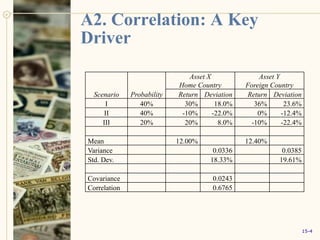
A2. Correlation: A Key
Driver
Scenario Probability
Asset X
Home Country
Asset Y
Foreign Country
Return Deviation Return Deviation
I 40% 30% 18.0% 36% 23.6%
II 40% -10% -22.0% 0% -12.4%
III 20% 20% 8.0% -10% -22.4%
Mean 12.00% 12.40%
Variance 0.0336 0.0385
Std. Dev. 18.33% 19.61%
Covariance 0.0243
Correlation 0.6765
15-4
A3. Example of Diversification
             
03018
.
0
%
61
.
19
%
33
.
18
6765
.
0
%
50
%
50
2
%
61
.
19
%
50
%
33
.
18
%
50
2
2
2
2
2
2
1
2
1
2
2
2
2
2
1
2
1
2






 



 CORR
w
w
w
w
p
%
37
.
17
03018
.
0 

p

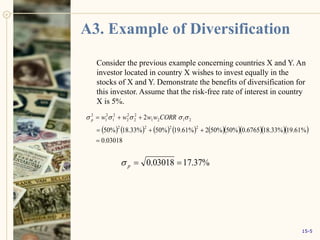
Consider the previous example concerning countries X and Y. An
investor located in country X wishes to invest equally in the
stocks of X and Y. Demonstrate the benefits of diversification for
this investor. Assume that the risk-free rate of interest in country
X is 5%.
15-5
B1. Barriers to Diversification
 Takes time for investors to learn how to
diversify internationally
 Withholding taxes
 High transaction costs
 Government regulations restricting foreign
ownership of assets
 Limits on currency transactions
 Cost of acquiring information
15-6
B2. Home Bias
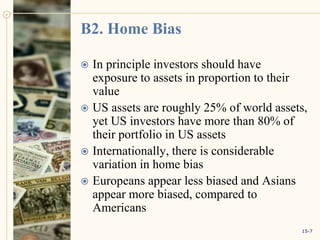
 In principle investors should have
exposure to assets in proportion to their
value
 US assets are roughly 25% of world assets,
yet US investors have more than 80% of
their portfolio in US assets
 Internationally, there is considerable
variation in home bias
 Europeans appear less biased and Asians
appear more biased, compared to
Americans
15-7
C. Graph of Diversification
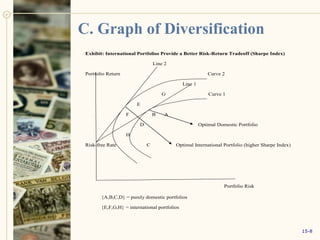
Exhibit: International Portfolios Provide a Better Risk-Return Tradeoff (Sharpe Index)
Line 2
Portfolio Return Curve 2
Line 1
G Curve 1
E
F B A
D Optimal Domestic Portfolio
H
Risk-free Rate C Optimal International Portfolio (higher Sharpe Index)
Portfolio Risk
{A,B,C,D} = purely domestic portfolios
{E,F,G,H} = international portfolios
15-8
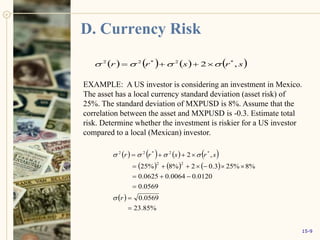
D. Currency Risk
       
s
r
s
r
r ,
2 *
2
*
2
2



 



EXAMPLE: A US investor is considering an investment in Mexico.
The asset has a local currency standard deviation (asset risk) of
25%. The standard deviation of MXPUSD is 8%. Assume that the
correlation between the asset and MXPUSD is -0.3. Estimate total
risk. Determine whether the investment is riskier for a US investor
compared to a local (Mexican) investor.
       
     
 
%
85
.
23
0569
.
0
0569
.
0
0120
.
0
0064
.
0
0625
.
0
%
8
%
25
3
.
0
2
%
8
%
25
,
2
2
2
*
2
*
2
2

















r
s
r
s
r
r





15-9

Chap015.ppt

  • 1.
    Chapter 15 International Portfolio Investments McGraw-Hill/IrwinCopyright © 2011 by the McGraw-Hill Companies, Inc. All rights reserved.
  • 2.
    Learning Objectives A. Discussbenefits of international investments and demonstrate the effect of correlations. B. Define home bias and discuss why it occurs. C. Graphically analyze international diversification benefits. D. Analyze effects of currency risk in international investments. 15-2
  • 3.
    A1. Why InvestInternationally?  Can increase profits or returns:  Growing economies  Capital Starved, so returns bid up  Inefficient Markets  Currency Play  Can Reduce Risk: low correlation between national markets produce diversification 15-3
  • 4.
    A2. Correlation: AKey Driver Scenario Probability Asset X Home Country Asset Y Foreign Country Return Deviation Return Deviation I 40% 30% 18.0% 36% 23.6% II 40% -10% -22.0% 0% -12.4% III 20% 20% 8.0% -10% -22.4% Mean 12.00% 12.40% Variance 0.0336 0.0385 Std. Dev. 18.33% 19.61% Covariance 0.0243 Correlation 0.6765 15-4
  • 5.
    A3. Example ofDiversification               03018 . 0 % 61 . 19 % 33 . 18 6765 . 0 % 50 % 50 2 % 61 . 19 % 50 % 33 . 18 % 50 2 2 2 2 2 2 1 2 1 2 2 2 2 2 1 2 1 2             CORR w w w w p % 37 . 17 03018 . 0   p  Consider the previous example concerning countries X and Y. An investor located in country X wishes to invest equally in the stocks of X and Y. Demonstrate the benefits of diversification for this investor. Assume that the risk-free rate of interest in country X is 5%. 15-5
  • 6.
    B1. Barriers toDiversification  Takes time for investors to learn how to diversify internationally  Withholding taxes  High transaction costs  Government regulations restricting foreign ownership of assets  Limits on currency transactions  Cost of acquiring information 15-6
  • 7.
    B2. Home Bias In principle investors should have exposure to assets in proportion to their value  US assets are roughly 25% of world assets, yet US investors have more than 80% of their portfolio in US assets  Internationally, there is considerable variation in home bias  Europeans appear less biased and Asians appear more biased, compared to Americans 15-7
  • 8.
    C. Graph ofDiversification Exhibit: International Portfolios Provide a Better Risk-Return Tradeoff (Sharpe Index) Line 2 Portfolio Return Curve 2 Line 1 G Curve 1 E F B A D Optimal Domestic Portfolio H Risk-free Rate C Optimal International Portfolio (higher Sharpe Index) Portfolio Risk {A,B,C,D} = purely domestic portfolios {E,F,G,H} = international portfolios 15-8
  • 9.
    D. Currency Risk        s r s r r , 2 * 2 * 2 2         EXAMPLE: A US investor is considering an investment in Mexico. The asset has a local currency standard deviation (asset risk) of 25%. The standard deviation of MXPUSD is 8%. Assume that the correlation between the asset and MXPUSD is -0.3. Estimate total risk. Determine whether the investment is riskier for a US investor compared to a local (Mexican) investor.                 % 85 . 23 0569 . 0 0569 . 0 0120 . 0 0064 . 0 0625 . 0 % 8 % 25 3 . 0 2 % 8 % 25 , 2 2 2 * 2 * 2 2                  r s r s r r      15-9