Testing tools and
measurement
(12 Marks)
Test Automation
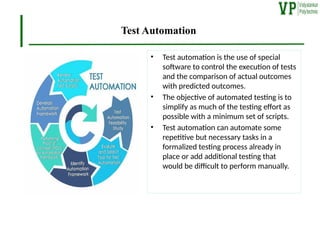
• Test automation is the use of special
software to control the execution of tests
and the comparison of actual outcomes
with predicted outcomes.
• The objective of automated testing is to
simplify as much of the testing effort as
possible with a minimum set of scripts.
• Test automation can automate some
repetitive but necessary tasks in a
formalized testing process already in
place or add additional testing that
would be difficult to perform manually.
Types of test automation
Static automation tools:
• These tools do not involve actual input and output. Rather, they take a symbolic
approach to testing, i.e. they do not test the actual execution of the software.
• e.g. Static analyzers(examine program systematically and automatically)
• Code Inspectors(Inspect programs automatically to make sure they adhere to
minimum quality standards)
• Standard enforcers(Imposes simple rules on the developers) .
Types of test automation
Dynamic automation tools:
• These tools test the software system with live data.
• e.g. Coverage Analyzer (Measure the extent of coverage)
• Test Generators (To set up test inputs)
• Output comparators (It is used to check predicted and actual output)
Limitation of manual testing
• Limitations of Manual Testing are as given below:
i. Manual testing is slow and costly.
ii. It is very labor intensive; it takes a long time to complete tests.
iii. Manual tests don’t scale well. As the complexity of the software increases the
complexity of the testing problem grows exponentially. This leads to an
increase in total time devoted to testing as well as total cost of testing.
Limitation of manual testing
IV. One tester may approach and perform a certain test differently from another,
resulting in different results on the same test, because the tests are not being
performed identically.
V. GUI objects size difference and color combinations are not easy to find in
manual testing.
VI. Not suitable for large scale projects and time bound projects
NEED of automated testing
i. An automated testing tool can playback pre-recorded and predefined actions,
compare the results to the expected behavior and report the success or failure
of these to a test engineer.
ii. Once automated tests are created, they can easily be repeated, and they can
be extended to perform tasks impossible with manual testing.
iii. Automated Software Testing Saves Time and Money.
NEED of automated testing
iv. Software tests must be repeated often during development cycles to ensure
quality.
v. Every time source code is modified software tests should be repeated.
vi. For each release of the software it may be tested on all supported operating
systems and hardware configurations.
vii. Manually repeating these tests is costly and time consuming
NEED of automated testing
viii. Once created, automated tests can be run repeatedly at no additional cost and
they are much faster than manual tests.
ix. Testing Improves Accuracy , Even the most conscientious tester will make
mistakes during monotonous manual testing.
x. Automated tests perform the same steps precisely every time they are
executed and never forget to record detailed results.
NEED of automated testing
xi. They can even be run on multiple computers with different configurations.
xii. Automated software testing can look inside an application and see memory
contents, data tables, file contents, and internal program states to determine if
the product is behaving as expected.
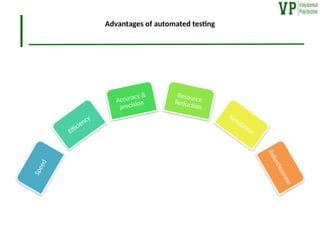
Advantages of automated testing
S
p
e
e
d
Efficiency
Accuracy &
precision
Resource
Reduction
Simulation
R
e
l
e
n
t
l
e
s
s
n
e
s
s
Advantages of automated testing
1. Speed.
• The automation tools tests the software under tests with the very faster speed.
• There‘s a vast difference between the speed of user entering the data and the
automated tools generating and entering the data required for the testing of
the software.
• Speed of these software also completes the work faster.
Advantages of automated testing
2. Efficiency.
• While testers are busy running test cases, testers can't be doing anything else.
• If the tester have a test tool that reduces the time it takes for him to run his
tests, he has more time for test planning and thinking up new tests
Advantages of automated testing
3. Accuracy and Precision.
• After trying a few hundred cases, tester‘s attention span will wane, and he may
start to make mistakes.
• A test tool will perform the same test and check the results perfectly, each
time.
Advantages of automated testing
4. Resource Reduction.
• Sometimes it can be physically impossible to perform a certain test case.
• The number of people or the amount of equipment required to create the test
condition could be prohibitive.
• A test tool can be used to simulate the real world and greatly reduce the
physical resources necessary to perform the testing.
Advantages of automated testing
Simulation .
• Test tools are often used to replace hardware or software that would normally
interface to your product.
• This "fake" device or application can then be used to drive or respond to your
software in ways that you choose and ways that might otherwise be difficult to
achieve.
Advantages of automated testing
6. Relentlessness.
• Test tools and automation never tire or give up.
• They can keep going and going and on and on without any problem; whereas
the tester gets tired to test again and again.
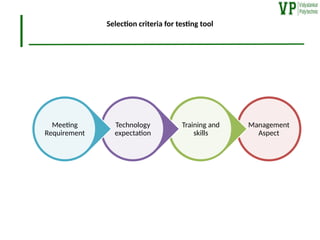
Selection criteria for testing tool
Management
Aspect
Training and
skills
Technology
expectation
Meeting
Requirement
Selection criteria for testing tool
1. Meeting requirements
• There are plenty of tools available in the market but rarely do they meet all the
requirements of a given product or a given organization.
• Evaluating different tools for different requirements involve significant effort,
money, and time.
• The tool must match its intended use.
• Wrong selection of a tool can lead to problems like lower efficiency and
effectiveness of testing may be lost.
Selection criteria for testing tool
2. Technology expectations:
• Test tools in general may not allow test developers to extends/modify the
functionality of the framework.
• So extending the functionality requires going back to the tool vendor and
involves additional cost and effort.
• Different phases of a life cycle have different quality-factor requirements. Tools
required at each stage may differ significantly.
Selection criteria for testing tool
3. Training/skills:
• While test tools require plenty of training, very few vendors provide the
training to the required level.
• Organization level training is needed to deploy the test tools.
• As the user of the test suite are not only the test team but also the
development team and other areas like configuration management.
• If the testers do not have proper training and skill, then they may not be able to
work effectively.
Selection criteria for testing tool
4. Management aspects:
• A test tool increases the system requirement and requires the hardware and
software to be upgraded.
• This increases the cost of the already- expensive test tool.
• Select affordable tools. Cost and benefits of various tools must be compared
before making final decision.
Disadvantages of using testing tools.
Disadvantages of using testing tools:
 It is more expensive to automate. Initial investments are bigger than manual
testing.
 You cannot automate everything; some tests still must be done manually.
 You cannot rely on testing tools always.
Metrics Classification
Metrics can also be used to gauge the size and complexity of software and hence are employed in
project management and cost estimation.
1. Product Metrics: Product metrics are measures of software product at any stage of its
development, from requirements to installed system.
• Product metrics help software engineers to better understand the attributes of models and
assess the quality of the software.
• They help software engineers to gain insight into the design and construction of the software.
• Focus on specific attributes of software engineering work products resulting from analysis,
design, coding, and testing.
• Provide a systematic way to assess quality based on a set of clearly defined rules.
• Provide an “on-the-spot” rather than “after-the-fact” insight into the software development.
Metrics Classification
2. Process Metrics: Process metrics are measures of the software development process such as
the overall development time, type of methodology used or the average level of experience of the
programming staff.
• Process quality: Activities related to the production of software, tasks or milestones.
• Process metrics are collected across all projects and over long periods time .
• They are used for making strategic decisions.
• The intent is to provide a set of process indicators that lead to long-term software process
improvement.
• The only way to know how/where to improve any process is to:
• Measure specific attributes of the process.
• Develop a set of meaningful metrics based on these attributes.
• Use the metrics to provide indicators that will lead to a strategy for improvement.
Metrics Classification
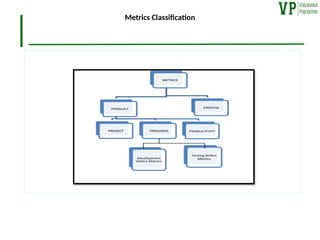
Project Metrics: A set of metrics that indicates how the project is planned
and executed.
Progress Metrics: A set of metrics that tracks how the different activities
of the project are progressing.
Metrics Classification
Progress Metrics is classified as
1. Test defect metrics 2. Development defect metrics
1. Test defect metrics: help the testing team in analysis of product quality and
testing
2. Development defect metrics: help the development team in analysis of
development activities.
o Productivity: A set of metrics that considers various productivity numbers that can
be collected and used for planning and tracking testing activities.
29
Thank You
Supriya Kadam
Department of Computer Engineering (NBA Accredited)
Vidyalankar Polytechnic
Vidyalankar College Marg, Wadala(E), Mumbai 400 037
E-mail: supriya.angne@vpt.edu.in
30

Chap 5 Testing tools and measurement.pptx

  • 1.
  • 2.
    Test Automation • Testautomation is the use of special software to control the execution of tests and the comparison of actual outcomes with predicted outcomes. • The objective of automated testing is to simplify as much of the testing effort as possible with a minimum set of scripts. • Test automation can automate some repetitive but necessary tasks in a formalized testing process already in place or add additional testing that would be difficult to perform manually.
  • 3.
    Types of testautomation Static automation tools: • These tools do not involve actual input and output. Rather, they take a symbolic approach to testing, i.e. they do not test the actual execution of the software. • e.g. Static analyzers(examine program systematically and automatically) • Code Inspectors(Inspect programs automatically to make sure they adhere to minimum quality standards) • Standard enforcers(Imposes simple rules on the developers) .
  • 4.
    Types of testautomation Dynamic automation tools: • These tools test the software system with live data. • e.g. Coverage Analyzer (Measure the extent of coverage) • Test Generators (To set up test inputs) • Output comparators (It is used to check predicted and actual output)
  • 5.
    Limitation of manualtesting • Limitations of Manual Testing are as given below: i. Manual testing is slow and costly. ii. It is very labor intensive; it takes a long time to complete tests. iii. Manual tests don’t scale well. As the complexity of the software increases the complexity of the testing problem grows exponentially. This leads to an increase in total time devoted to testing as well as total cost of testing.
  • 6.
    Limitation of manualtesting IV. One tester may approach and perform a certain test differently from another, resulting in different results on the same test, because the tests are not being performed identically. V. GUI objects size difference and color combinations are not easy to find in manual testing. VI. Not suitable for large scale projects and time bound projects
  • 7.
    NEED of automatedtesting i. An automated testing tool can playback pre-recorded and predefined actions, compare the results to the expected behavior and report the success or failure of these to a test engineer. ii. Once automated tests are created, they can easily be repeated, and they can be extended to perform tasks impossible with manual testing. iii. Automated Software Testing Saves Time and Money.
  • 8.
    NEED of automatedtesting iv. Software tests must be repeated often during development cycles to ensure quality. v. Every time source code is modified software tests should be repeated. vi. For each release of the software it may be tested on all supported operating systems and hardware configurations. vii. Manually repeating these tests is costly and time consuming
  • 9.
    NEED of automatedtesting viii. Once created, automated tests can be run repeatedly at no additional cost and they are much faster than manual tests. ix. Testing Improves Accuracy , Even the most conscientious tester will make mistakes during monotonous manual testing. x. Automated tests perform the same steps precisely every time they are executed and never forget to record detailed results.
  • 10.
    NEED of automatedtesting xi. They can even be run on multiple computers with different configurations. xii. Automated software testing can look inside an application and see memory contents, data tables, file contents, and internal program states to determine if the product is behaving as expected.
  • 11.
    Advantages of automatedtesting S p e e d Efficiency Accuracy & precision Resource Reduction Simulation R e l e n t l e s s n e s s
  • 12.
    Advantages of automatedtesting 1. Speed. • The automation tools tests the software under tests with the very faster speed. • There‘s a vast difference between the speed of user entering the data and the automated tools generating and entering the data required for the testing of the software. • Speed of these software also completes the work faster.
  • 13.
    Advantages of automatedtesting 2. Efficiency. • While testers are busy running test cases, testers can't be doing anything else. • If the tester have a test tool that reduces the time it takes for him to run his tests, he has more time for test planning and thinking up new tests
  • 14.
    Advantages of automatedtesting 3. Accuracy and Precision. • After trying a few hundred cases, tester‘s attention span will wane, and he may start to make mistakes. • A test tool will perform the same test and check the results perfectly, each time.
  • 15.
    Advantages of automatedtesting 4. Resource Reduction. • Sometimes it can be physically impossible to perform a certain test case. • The number of people or the amount of equipment required to create the test condition could be prohibitive. • A test tool can be used to simulate the real world and greatly reduce the physical resources necessary to perform the testing.
  • 16.
    Advantages of automatedtesting Simulation . • Test tools are often used to replace hardware or software that would normally interface to your product. • This "fake" device or application can then be used to drive or respond to your software in ways that you choose and ways that might otherwise be difficult to achieve.
  • 17.
    Advantages of automatedtesting 6. Relentlessness. • Test tools and automation never tire or give up. • They can keep going and going and on and on without any problem; whereas the tester gets tired to test again and again.
  • 18.
    Selection criteria fortesting tool Management Aspect Training and skills Technology expectation Meeting Requirement
  • 19.
    Selection criteria fortesting tool 1. Meeting requirements • There are plenty of tools available in the market but rarely do they meet all the requirements of a given product or a given organization. • Evaluating different tools for different requirements involve significant effort, money, and time. • The tool must match its intended use. • Wrong selection of a tool can lead to problems like lower efficiency and effectiveness of testing may be lost.
  • 20.
    Selection criteria fortesting tool 2. Technology expectations: • Test tools in general may not allow test developers to extends/modify the functionality of the framework. • So extending the functionality requires going back to the tool vendor and involves additional cost and effort. • Different phases of a life cycle have different quality-factor requirements. Tools required at each stage may differ significantly.
  • 21.
    Selection criteria fortesting tool 3. Training/skills: • While test tools require plenty of training, very few vendors provide the training to the required level. • Organization level training is needed to deploy the test tools. • As the user of the test suite are not only the test team but also the development team and other areas like configuration management. • If the testers do not have proper training and skill, then they may not be able to work effectively.
  • 22.
    Selection criteria fortesting tool 4. Management aspects: • A test tool increases the system requirement and requires the hardware and software to be upgraded. • This increases the cost of the already- expensive test tool. • Select affordable tools. Cost and benefits of various tools must be compared before making final decision.
  • 23.
    Disadvantages of usingtesting tools. Disadvantages of using testing tools:  It is more expensive to automate. Initial investments are bigger than manual testing.  You cannot automate everything; some tests still must be done manually.  You cannot rely on testing tools always.
  • 24.
  • 25.
    Metrics can alsobe used to gauge the size and complexity of software and hence are employed in project management and cost estimation. 1. Product Metrics: Product metrics are measures of software product at any stage of its development, from requirements to installed system. • Product metrics help software engineers to better understand the attributes of models and assess the quality of the software. • They help software engineers to gain insight into the design and construction of the software. • Focus on specific attributes of software engineering work products resulting from analysis, design, coding, and testing. • Provide a systematic way to assess quality based on a set of clearly defined rules. • Provide an “on-the-spot” rather than “after-the-fact” insight into the software development. Metrics Classification
  • 26.
    Metrics Classification 2. ProcessMetrics: Process metrics are measures of the software development process such as the overall development time, type of methodology used or the average level of experience of the programming staff. • Process quality: Activities related to the production of software, tasks or milestones. • Process metrics are collected across all projects and over long periods time . • They are used for making strategic decisions. • The intent is to provide a set of process indicators that lead to long-term software process improvement. • The only way to know how/where to improve any process is to: • Measure specific attributes of the process. • Develop a set of meaningful metrics based on these attributes. • Use the metrics to provide indicators that will lead to a strategy for improvement.
  • 27.
    Metrics Classification Project Metrics:A set of metrics that indicates how the project is planned and executed. Progress Metrics: A set of metrics that tracks how the different activities of the project are progressing.
  • 28.
    Metrics Classification Progress Metricsis classified as 1. Test defect metrics 2. Development defect metrics 1. Test defect metrics: help the testing team in analysis of product quality and testing 2. Development defect metrics: help the development team in analysis of development activities. o Productivity: A set of metrics that considers various productivity numbers that can be collected and used for planning and tracking testing activities.
  • 29.
    29 Thank You Supriya Kadam Departmentof Computer Engineering (NBA Accredited) Vidyalankar Polytechnic Vidyalankar College Marg, Wadala(E), Mumbai 400 037 E-mail: supriya.angne@vpt.edu.in
  • 30.