CHANGING CONCEPT OF
NORMAL OCCLUSION
CONTENTS
• Introduction
• Fictional period
• Hypothetical period
• Factual period
• Andrews six keys to optimal occlusion
• Roth’s Functional keys to occlusion
• Factors & forces that determine tooth
position
• Compensating curves
• Centric occlusion
• Centric relation
• Eccentric occlusion
• Functional occlusion
• Mutually protected occlusion
• Non-functional occlusion
• Methods to record centric relation
• Conclusion
• References
INTRODUCTION
• The development of concept of occlusion can be traced through fiction and
hypothesis to fact.
• The fictional approach was a convenient arrangement of a series of observation and
thoughts more or less logically arranged.
• The hypothetical approach was based on provisional acceptance of certain logical
entities.
• Fact is a truth known by actual experience or observation.
• Both the fictional and hypothetical approach are necessary preludes to the
establishment of fact.
Fictional
period
Hypothetical
period
Factual
period
Prior to 1900 1900-1930 1930 to present
FICTIONAL PERIOD
•Pioneers like Fuller, Clark and Imrie talked of “Antagonism”, “Meeting” or
“Gliding” of teeth.
•The creation of normal standard, a basis on which to compare departures from
normal was lacking.
•But this served as a working hypothesis or subsequently became established fact
after definitive research
Asbell BM- A Brief History of Orthodontics; AJODO 1998
• Eugene Talbot published his book on “Irregularities of the teeth and their treatment”
in 1903.
• The Talbot concept of normal occlusion was that it was a historical event, passed
in the decline of the species and normality was possible only with atavism or
throwback to our primitive ancestors
HYPOTHETICAL PERIOD
Edward H. Angle
• Channelised orthodontic thinking on occlusion and brought the real concept out of
fiction.
• In 1907, Angle summarised his views as ‘occlusion shall be defined as the normal
relation of the occlusal inclined planes of the teeth when the jaws are closed.’
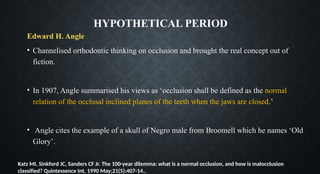
• Angle cites the example of a skull of Negro male from Broomell which he names ‘Old
Glory’.
Katz MI, Sinkford JC, Sanders CF Jr. The 100-year dilemma: what is a normal occlusion, and how is malocclusion
classified? Quintessence Int. 1990 May;21(5):407-14..
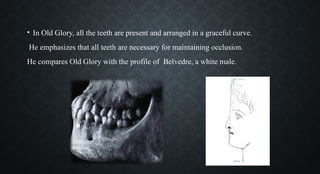
• In Old Glory, all the teeth are present and arranged in a graceful curve.
He emphasizes that all teeth are necessary for maintaining occlusion.
He compares Old Glory with the profile of Belvedre, a white male.
• Angle furnished his ‘key to occlusion’ and emphasizes the first permanent molars
especially the upper first permanent molar and considers them to be most constant in
taking normal position.
• From the hypothesis of constancy of first molar and the ‘line of occlusion’, Angle
developed the concept that all teeth should be present if normal occlusion is to be
achieved.
Mathew Cryer and Calvin Case
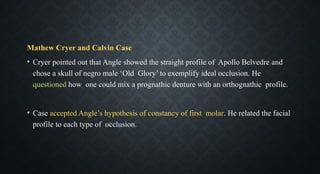
• Cryer pointed out that Angle showed the straight profile of Apollo Belvedre and
chose a skull of negro male ‘Old Glory’ to exemplify ideal occlusion. He
questioned how one could mix a prognathic denture with an orthognathic profile.
• Case accepted Angle’s hypothesis of constancy of first molar. He related the facial
profile to each type of occlusion.
• Case proposed the concept of apical base.
• He was aware of the role of nose and chin and their influence on profile.
• Case proposed the concept of normal and ideal occlusion.
•The idea that teeth should be present to obtain normal facial contour was losing
ground.
•In 1908 Bennett proposed that the condylar movement was primarily rotatory on
opening from occlusion to rest position and later on after passing this point became
translatory.
Van Loon
• In 1915 Van Loon published criticism of Angle's classification.
• He oriented casts of teeth into plaster facial masks so that the true relationship of
the teeth to the soft tissue of the face could be evaluated.
Dewey
• Considered first molar as an organ of mastication, and they are very necessary in
producing normal occlusion
• But did not consider it as a basis of classification, as they are as liable as any other teeth
to assume an abnormal position under certain conditions.
• Dewey recommended that classification be based on the anteroposterior relation of
the arches as a whole rather than only the first molars.
Friel
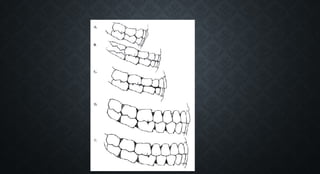
• In 1927 --published his stages of occlusion from 3 years of age to old age.
• Demonstrated --numerous changes in the primary dentition, which Angle did not
address, but also the variability of first molar position in a normal occlusion as it
undergoes its metamorphosis from the transitional mixed dentition to the worn teeth
of old age
• Friel--thus illustrated the difficulty of trying to force Angle's static ideal on a
changing mechanism.
Lischer and Paul Simon
• They broadened the concept of occlusion by relating the teeth to the rest of the face and
cranium.
• They related teeth in occlusal contact to cranial and facial planes.
• Though the concept of orbital plane as basis for determining antero-posterior position of
dentition did not stand up, it introduced the idea of facial ramification of malocclusion
outside the dental area.
Atkinson
• Defended Angle’s hypothesis of--a relationship between the maxillary first molar and the
cranium.
• But he showed that these relationships change with age and among different racial types.
Milo Hellman
• Hellman showed the racial variation in so called normal occlusion through
anthropological studies.
• Hellman and others studied the prognathism of the human dentition in relation to a
cranial base
FACTUAL PERIOD
• In 1930 Holly Broadbent and Hans Planer introduced an accurate technique of
roentgenographic cephalometry.
• Dividing line b/w static and dynamic occlusion.
• With the advanced study techniques, the factual period become functional period.
• By then, 3 components of occlusion are set up:
1. Interdigitation of teeth
2. Status of controlling musculature
3. TMJ integrity
• The goal of modern orthodontics according to Proffit is “the creation of best
possible occlusal relationship within the framework of acceptable facial aesthetics
and stability of result”.
• The position of the teeth within the jaws and the mode of occlusion are determined
by developmental processes that interact on the teeth and their associated
structures during the period of formation, growth and post natal modification.
ANDREWS SIX KEYS TO OPTIMAL OCCLUSION
1. MOLAR RELATION
2. CROWN ANGULATION
3. CROWN INCLINATION
4. ABSENCE OF ROTATIONS
5. TIGHT CONTACTS
6. OCCLUSAL PLANE
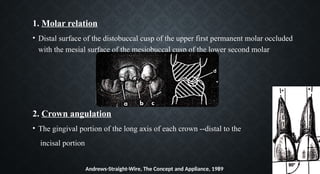
1. Molar relation
• Distal surface of the distobuccal cusp of the upper first permanent molar occluded
with the mesial surface of the mesiobuccal cusp of the lower second molar
2. Crown angulation
• The gingival portion of the long axis of each crown --distal to the
incisal portion
Andrews-Straight-Wire, The Concept and Appliance, 1989
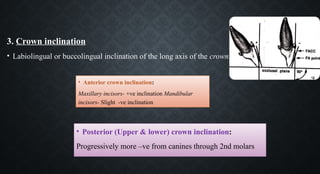
• Anterior crown inclination:
Maxillary incisors- +ve inclination Mandibular
incisors- Slight -ve inclination
3. Crown inclination
• Labiolingual or buccolingual inclination of the long axis of the crown.
• Posterior (Upper & lower) crown inclination:
Progressively more –ve from canines through 2nd molars
4. Absence of rotations
5. Tight contacts
6. Occlusal plane
• Depth of curve of spee-- from flat to slightly concave
ROTH’S FUNCTIONAL KEYS TO OCCLUSION
• Centric occlusion should coincide with centric relation
• In protrusion, the incisors should disocclude the posterior teeth
• In lateral excursions of the mandible, the canine should guide the working side while
all the other teeth on that side and the opposite are disoccluded
• When the teeth are in centric occlusion, there should be even bilateral contacts in the
buccal segments.
Roth RH (1981). Functional occlusion for the orthodontist. J Cli Orthod, 15: 32-51
• Graber stressed that modern concepts of normal occlusion require three main areas :
1. Occlusal position (or) tooth contact position
- Masticatory habits, tooth inclination and malposition, shape of teeth, premature
contact, faulty restoration, tooth loss, the condition of periodontium affect the
occlusal positions
2. Postural resting position
3. TMJ
Graber
• A fourth element could be added:
anteroposterior development of the maxilla and mandible
• Each of these elements must be healthy, individually and in combination, for
optimal function and comfort.
FACTORS & FORCES THAT DETERMINE TOOTH
POSITION
• The alignment of the dentition in the dental arches occur as a result of complex
multidirectional forces acting on the teeth during and after eruption.
• Equilibrium position of opposing forces that are given by lips and cheeks from
outer side and tongue from inner side determine the (stable) position of the teeth .
• Hence the labiolingual and buccolingual forces are equal. This is called “neutral
position.”
Okeson, J. P. (2019). Management of temporomandibular disorders and occlusion
• Proximal and occlusal contacts are important in maintaining tooth alignment and
arch integrity.
• Mastication causing buccolingual and vertical movement of teeth results in wear of
proximal contacts.
• Mesial drifting force helps to keep teeth in contact.
CENTRIC CUSPS
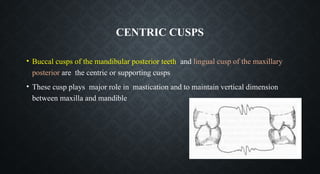
• Buccal cusps of the mandibular posterior teeth and lingual cusp of the maxillary
posterior are the centric or supporting cusps
• These cusp plays major role in mastication and to maintain vertical dimension
between maxilla and mandible
NON-CENTRIC CUSPS
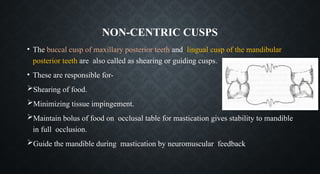
• The buccal cusp of maxillary posterior teeth and lingual cusp of the mandibular
posterior teeth are also called as shearing or guiding cusps.
• These are responsible for-
Shearing of food.
Minimizing tissue impingement.
Maintain bolus of food on occlusal table for mastication gives stability to mandible
in full occlusion.
Guide the mandible during mastication by neuromuscular feedback
CURVE OF SPEE
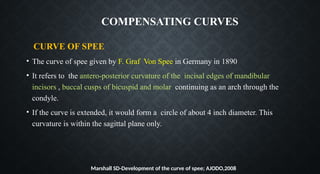
• The curve of spee given by F. Graf Von Spee in Germany in 1890
• It refers to the antero-posterior curvature of the incisal edges of mandibular
incisors , buccal cusps of bicuspid and molar continuing as an arch through the
condyle.
• If the curve is extended, it would form a circle of about 4 inch diameter. This
curvature is within the sagittal plane only.
Marshall SD-Development of the curve of spee; AJODO,2008
COMPENSATING CURVES
MEASUREMENT OF CURVE OF SPEE
• The maximum depth of the curve of Spee was measured as the maximum of the
perpendicular distances between the buccal cusp tips of the mandibular teeth and a
measurement plane described by the central incisors and the distal cusp tip of the
most posterior tooth in the mandibular arch.
• On average, the curve of Spee initially develops as a result of mandibular permanent first
molar and incisor eruption.
• The curve of Spee maintains this depth until the mandibular permanent second molars erupt
above the occlusal plane, when it again deepens.
• During the adolescent dentition stage, the curve depth decreases slightly and then remains
relatively stable into early adulthood.
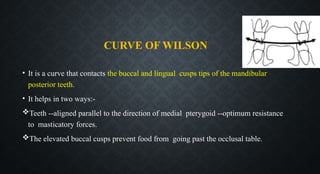
CURVE OF WILSON
• It is a curve that contacts the buccal and lingual cusps tips of the mandibular
posterior teeth.
• It helps in two ways:-
Teeth --aligned parallel to the direction of medial pterygoid --optimum resistance
to masticatory forces.
The elevated buccal cusps prevent food from going past the occlusal table.
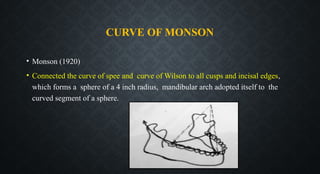
CURVE OF MONSON
• Monson (1920)
• Connected the curve of spee and curve of Wilson to all cusps and incisal edges,
which forms a sphere of a 4 inch radius, mandibular arch adopted itself to the
curved segment of a sphere.
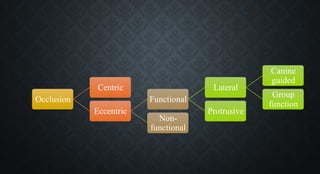
Occlusion
Centric
Eccentric
Functional
Lateral
Canine
guided
Group
function
Protrusive
Non-
functional
CENTRIC OCCLUSION
• According to Peter Dawson(1974) : Centric occlusion refers to the relationship of the
mandible to the maxilla when the teeth are in maximum occlusal contact, irrespective
of the position or alignment of the condyle-disk assemblies. This is also referred as
acquired position of the mandible or maximum intercuspal position( MIP)
Peter E. Dawson. Evaluation, Diagnosis, and Treatment of Occlusal Problems, 2nd ed.. Mosby
CENTRIC RELATION
• Centric relation --- “the maxillomandibular relationship in which condyles
articulates with the thinnest avascular portion of their respective discs with the
complex in the anterosuperior position against the slope of articular eminence. This
position is independent of tooth contact.”
Rinchuse, D. J., & Kandasamy, S. (2006). Centric relation. The Journal of the American Dental Association, 137(4), 494–501.
The Importance of centric relation in orthodontics:
• In orthodontics, diagnosis and treatment planning should be performed by the
evaluation of a malocclusion with the mandible in centric relation (CR), i.e. the
natural musculoskeletal position of the condyle in the fossa, in order to obtain the
true maxillary - mandibular skeletal and dental relations in the three planes of
space.
• If this is overlooked an incorrect diagnosis and treatment plan of the actual
malocclusion, along with its unfavourable consequences may result.
• During every appointment a patient has to be monitored in CR so that the
mechanotherapy is guided to accomplish the final ideal static and functional occlusion
with the mandible in position.
• If this is disregarded, several prematurity that may later cause traumatic occlusion or
craniomandibular disorders may result.
ECCENTRIC OCCLUSION
• Refers to contact of teeth that occurs during movement of mandible.
• Functional occlusion
• Non-functional occlusion
FUNCTIONAL OCCLUSION
• Functional occlusion is defined as an arrangement of teeth which will provide the
highest efficiency during all excursive movements of the mandible which are
necessary during function
Types:-
• Lateral
• Protrusive
LATERAL FUNCTIONAL OCCLUSION
• It includes tooth contacts that occur on canines and posterior teeth on the side
towards which the mandible moves.
• 2 types:
Canine guidance/ Canine protected occlusion
Group function
CANINE GUIDANCE
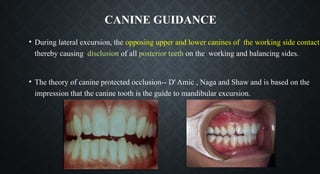
• During lateral excursion, the opposing upper and lower canines of the working side contact
thereby causing disclusion of all posterior teeth on the working and balancing sides.
• The theory of canine protected occlusion-- D' Amic , Naga and Shaw and is based on the
impression that the canine tooth is the guide to mandibular excursion.
CANINE GUIDANCE
• The establishment of canine guidance is aimed in the orthodontic completion due to several
factors:
• The strategic positioning of the canine in the arch, with compact bone --better tolerates the
occlusal forces than the medullary bone of the posterior teeth; activates less muscles when
the canine teeth are in contact than when posterior teeth contact each other.
• So, when canine- in contact-- dissipate the horizontal forces, while promoting the
disocclusion of the posterior teeth
Oltramari , Conti, Navarro, Almeida, Almeida Pedrin, Ferreira, Fernando. (2007). Importance of occlusion aspects in the
completion of orthodontic treatment. Brazilian dental journal. 18. 78-82.
GROUP FUNCTION
• During lateral movement, the buccal cusps of the posterior teeth on the working
side are in contact.
• There is no contact on the non-working side.
Clark JR, Evans RD. Functional occlusion: I. A review. J Orthod. 2001 Mar;28(1):76-81
PROTRUSIVE FUNCTIONAL OCCLUSION
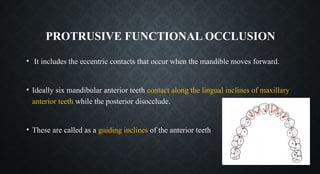
• It includes the eccentric contacts that occur when the mandible moves forward.
• Ideally six mandibular anterior teeth contact along the lingual inclines of maxillary
anterior teeth while the posterior disocclude.
• These are called as a guiding inclines of the anterior teeth
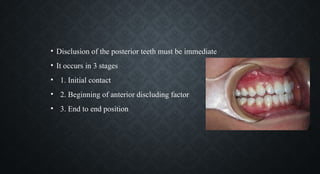
• Disclusion of the posterior teeth must be immediate
• It occurs in 3 stages
• 1. Initial contact
• 2. Beginning of anterior discluding factor
• 3. End to end position
• For proper disclusion there must be proper overjet and overbite– so that there is
free mandibular movement
• If the patient presents an increased overjet (more than 3 mm), a longer period is
necessary for the anterior teeth to contact, which results in anterior guidance at the
expense of the posterior teeth
• During completion of the orthodontic treatment--important to establish an overjet and
overbite of 2 mm, --facilitates the achievement of the anterior guidance.
• Mandibular second molars --must be included in the orthodontic treatment to avoid
interferences during the protrusive movement.
Oltramari , Conti, Navarro, Almeida, Almeida Pedrin, Ferreira, Fernando. (2007). Importance of occlusion aspects in the
completion of orthodontic treatment. Brazilian dental journal. 18. 78-82.
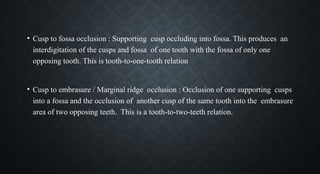
• Cusp to fossa occlusion : Supporting cusp occluding into fossa. This produces an
interdigitation of the cusps and fossa of one tooth with the fossa of only one
opposing tooth. This is tooth-to-one-tooth relation
• Cusp to embrasure / Marginal ridge occlusion : Occlusion of one supporting cusps
into a fossa and the occlusion of another cusp of the same tooth into the embrasure
area of two opposing teeth. This is a tooth-to-two-teeth relation.
• An occlusal scheme in which the posterior teeth prevent excessive contact of
anterior teeth in maximum intercuspation and the anterior teeth disengage the
posterior teeth in all mandibular excursive movement
• Canine protected occlusion is a form of mutually protected articulation
MUTUALLY PROTECTED OCCLUSION
NON-FUNCTIONAL OCCLUSION
• They are tooth contacts that occur in the segment away from which the mandible
moves. For example if the mandible is moved to the left side, contact occur on
right side.
METHODS TO RECORD CENTRIC RELATION
• Phillip Ptaff was the first to describe his technique for bite recording, he called
it taking bite.
• In 1955 Shanahart described a technique he called swallowing or free closure.
Moreno JA, Romero LL, Camacho CG, Canseco Jiménez JF, Cuairán Ruidíaz V. Assessment of two techniques for the recording of
mandibular central relationship: gothic arch versus power centric relation. Revista Odontológica Mexicana. 2015;19(1):27-32.
• McCollum used the technique of chin point guidance.
• The mandible is retruded using thumb
• Dawson recommended the bilateral manipulation technique. This technique stressed
the importance of guiding the lower jaw in an upper direction, placing the operator's
fingers into the gonial angles while thumbs applied pressure to the chin in order to
facilitate condylar positioning in centric relation.
• Articulators
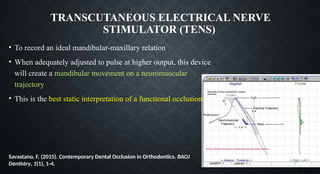
TRANSCUTANEOUS ELECTRICAL NERVE
STIMULATOR (TENS)
• To record an ideal mandibular-maxillary relation
• When adequately adjusted to pulse at higher output, this device
will create a mandibular movement on a neuromuscular
trajectory
• This is the best static interpretation of a functional occlusion
Savastano, F. (2015). Contemporary Dental Occlusion in Orthodontics. BAOJ
Dentistry, 1(1), 1-4.
CONCLUSION
• Defining and achieving a final dental occlusion for patients is the key factor which
forms the basis of our treatment plan.
• Normal occlusion is not a rigid or static relationship.
• Normal interdigitation in deciduous and mixed dentition is abnormal in permanent
dentition and vice versa.
• Successful orthodontic treatment involves many disciplines, not all of which are always
within our control.
• Achieving the final desired occlusion is the purpose of attending to the six keys to
normal occlusion.
REFERENCES
• Asbell MB. A brief history of orthodontics. American Journal of Orthodontics and
Dentofacial Orthopedics. 1990 Aug 1;98(2):176-83.
• Andrews: Straight-Wire, The Concept and Appliance, 1989
• Katz MI, Sinkford JC, Sanders CF Jr. The 100-year dilemma: what is a normal occlusion,
and how is malocclusion classified? Quintessence Int. 1990 May;21(5):407-14.
• Roth RH (1981). Functional occlusion for the orthodontist. J Cli Orthod, 15: 32-51
• Palaskar JN, Murali R, Bansal S. Centric relation definition: a historical and contemporary
prosthodontic perspective. The Journal of Indian Prosthodontic Society. 2013 Sep
1;13(3):149-54.
• Marshall SD, Caspersen M, Hardinger RR, Franciscus RG, Aquilino SA, Southard TE.
Development of the curve of Spee. American Journal of Orthodontics and Dentofacial
Orthopedics. 2008 Sep 1;134(3):344-52.
REFERENCES
• Howat, A. P., Capp, N. J., & Barrett, N. V. J. (1991). Color Atlas of Occlusion &
Malocclusion. Mosby
• Oltramari , Conti, Navarro, Almeida, Almeida Pedrin, Ferreira, Fernando. (2007).
Importance of occlusion aspects in the completion of orthodontic treatment.
Brazilian dental journal. 18. 78-82.
• Clark, J. R., & Evans, R. D. (2014). Functional occlusion: I. A review. Journal of
orthodontics.
• Okeson, J. P. (2019). Management of temporomandibular disorders and occlusion
• Dawson, P. E. (2007). Functional occlusion: from TMJ to smile design. Elsevier
Health Sciences.
REFERENCES
• Batra P, Duggal R, Parkash H. Functional Occlusion in Orthodontics. Journal of
Indian Orthodontic Society. 2005;39(2):80-90
• Hassan R, Rahimah AK. Occlusion, malocclusion and method of measurements-an
overview. Archives of orofacial sciences. 2007;2:3-9.
• Moreno JA, Romero LL, Camacho CG, Canseco Jiménez JF, Cuairán Ruidíaz V.
Assessment of two techniques for the recording of mandibular central relationship:
gothic arch versus power centric relation. Revista Odontológica Mexicana.
2015;19(1):27-32.
• Savastano, F. (2015). Contemporary Dental Occlusion in Orthodontics. BAOJ
Dentistry, 1(1), 1-4.
CLINICAL IMPLICATIONS
Normal versus ideal occlusion
Normal occlusion implies more than a range
of anatomically acceptable values.
 It also indicates physiological adaptability and the
absence of recognizable pathological
manifestations. 63
CLINICAL IMPLICATIONS
Ideal occlusion is a state in which no neuromuscular
adaptation is needed because no occlusal interferences are present
• The concept of an ideal occlusion refers both to an esthetic and physiological
ideal
• It is a hypothetical formula which does not and cannot exist in man
64
CLINICAL IMPLICATIONS
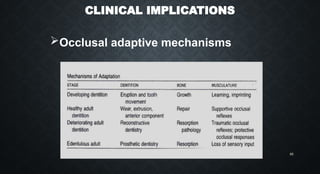
Occlusal adaptive mechanisms
65

CHANGING CONCEPT OF NORMAL OCCLUSION.pptx

  • 1.
  • 2.
    CONTENTS • Introduction • Fictionalperiod • Hypothetical period • Factual period • Andrews six keys to optimal occlusion • Roth’s Functional keys to occlusion • Factors & forces that determine tooth position • Compensating curves • Compensating curves • Centric occlusion • Centric relation • Eccentric occlusion • Functional occlusion • Mutually protected occlusion • Non-functional occlusion • Methods to record centric relation • Conclusion • References
  • 3.
    INTRODUCTION • The developmentof concept of occlusion can be traced through fiction and hypothesis to fact. • The fictional approach was a convenient arrangement of a series of observation and thoughts more or less logically arranged. • The hypothetical approach was based on provisional acceptance of certain logical entities. • Fact is a truth known by actual experience or observation. • Both the fictional and hypothetical approach are necessary preludes to the establishment of fact.
  • 4.
  • 5.
    FICTIONAL PERIOD •Pioneers likeFuller, Clark and Imrie talked of “Antagonism”, “Meeting” or “Gliding” of teeth. •The creation of normal standard, a basis on which to compare departures from normal was lacking. •But this served as a working hypothesis or subsequently became established fact after definitive research Asbell BM- A Brief History of Orthodontics; AJODO 1998
  • 6.
    • Eugene Talbotpublished his book on “Irregularities of the teeth and their treatment” in 1903. • The Talbot concept of normal occlusion was that it was a historical event, passed in the decline of the species and normality was possible only with atavism or throwback to our primitive ancestors
  • 7.
    HYPOTHETICAL PERIOD Edward H.Angle • Channelised orthodontic thinking on occlusion and brought the real concept out of fiction. • In 1907, Angle summarised his views as ‘occlusion shall be defined as the normal relation of the occlusal inclined planes of the teeth when the jaws are closed.’ • Angle cites the example of a skull of Negro male from Broomell which he names ‘Old Glory’. Katz MI, Sinkford JC, Sanders CF Jr. The 100-year dilemma: what is a normal occlusion, and how is malocclusion classified? Quintessence Int. 1990 May;21(5):407-14..
  • 8.
    • In OldGlory, all the teeth are present and arranged in a graceful curve. He emphasizes that all teeth are necessary for maintaining occlusion. He compares Old Glory with the profile of Belvedre, a white male.
  • 9.
    • Angle furnishedhis ‘key to occlusion’ and emphasizes the first permanent molars especially the upper first permanent molar and considers them to be most constant in taking normal position. • From the hypothesis of constancy of first molar and the ‘line of occlusion’, Angle developed the concept that all teeth should be present if normal occlusion is to be achieved.
  • 10.
    Mathew Cryer andCalvin Case • Cryer pointed out that Angle showed the straight profile of Apollo Belvedre and chose a skull of negro male ‘Old Glory’ to exemplify ideal occlusion. He questioned how one could mix a prognathic denture with an orthognathic profile. • Case accepted Angle’s hypothesis of constancy of first molar. He related the facial profile to each type of occlusion.
  • 11.
    • Case proposedthe concept of apical base. • He was aware of the role of nose and chin and their influence on profile. • Case proposed the concept of normal and ideal occlusion. •The idea that teeth should be present to obtain normal facial contour was losing ground. •In 1908 Bennett proposed that the condylar movement was primarily rotatory on opening from occlusion to rest position and later on after passing this point became translatory.
  • 12.
    Van Loon • In1915 Van Loon published criticism of Angle's classification. • He oriented casts of teeth into plaster facial masks so that the true relationship of the teeth to the soft tissue of the face could be evaluated.
  • 13.
    Dewey • Considered firstmolar as an organ of mastication, and they are very necessary in producing normal occlusion • But did not consider it as a basis of classification, as they are as liable as any other teeth to assume an abnormal position under certain conditions. • Dewey recommended that classification be based on the anteroposterior relation of the arches as a whole rather than only the first molars.
  • 14.
    Friel • In 1927--published his stages of occlusion from 3 years of age to old age. • Demonstrated --numerous changes in the primary dentition, which Angle did not address, but also the variability of first molar position in a normal occlusion as it undergoes its metamorphosis from the transitional mixed dentition to the worn teeth of old age • Friel--thus illustrated the difficulty of trying to force Angle's static ideal on a changing mechanism.
  • 16.
    Lischer and PaulSimon • They broadened the concept of occlusion by relating the teeth to the rest of the face and cranium. • They related teeth in occlusal contact to cranial and facial planes. • Though the concept of orbital plane as basis for determining antero-posterior position of dentition did not stand up, it introduced the idea of facial ramification of malocclusion outside the dental area.
  • 17.
    Atkinson • Defended Angle’shypothesis of--a relationship between the maxillary first molar and the cranium. • But he showed that these relationships change with age and among different racial types.
  • 18.
    Milo Hellman • Hellmanshowed the racial variation in so called normal occlusion through anthropological studies. • Hellman and others studied the prognathism of the human dentition in relation to a cranial base
  • 19.
    FACTUAL PERIOD • In1930 Holly Broadbent and Hans Planer introduced an accurate technique of roentgenographic cephalometry. • Dividing line b/w static and dynamic occlusion. • With the advanced study techniques, the factual period become functional period. • By then, 3 components of occlusion are set up: 1. Interdigitation of teeth 2. Status of controlling musculature 3. TMJ integrity
  • 20.
    • The goalof modern orthodontics according to Proffit is “the creation of best possible occlusal relationship within the framework of acceptable facial aesthetics and stability of result”. • The position of the teeth within the jaws and the mode of occlusion are determined by developmental processes that interact on the teeth and their associated structures during the period of formation, growth and post natal modification.
  • 21.
    ANDREWS SIX KEYSTO OPTIMAL OCCLUSION 1. MOLAR RELATION 2. CROWN ANGULATION 3. CROWN INCLINATION 4. ABSENCE OF ROTATIONS 5. TIGHT CONTACTS 6. OCCLUSAL PLANE
  • 22.
    1. Molar relation •Distal surface of the distobuccal cusp of the upper first permanent molar occluded with the mesial surface of the mesiobuccal cusp of the lower second molar 2. Crown angulation • The gingival portion of the long axis of each crown --distal to the incisal portion Andrews-Straight-Wire, The Concept and Appliance, 1989
  • 23.
    • Anterior crowninclination: Maxillary incisors- +ve inclination Mandibular incisors- Slight -ve inclination 3. Crown inclination • Labiolingual or buccolingual inclination of the long axis of the crown. • Posterior (Upper & lower) crown inclination: Progressively more –ve from canines through 2nd molars
  • 24.
    4. Absence ofrotations 5. Tight contacts 6. Occlusal plane • Depth of curve of spee-- from flat to slightly concave
  • 25.
    ROTH’S FUNCTIONAL KEYSTO OCCLUSION • Centric occlusion should coincide with centric relation • In protrusion, the incisors should disocclude the posterior teeth • In lateral excursions of the mandible, the canine should guide the working side while all the other teeth on that side and the opposite are disoccluded • When the teeth are in centric occlusion, there should be even bilateral contacts in the buccal segments. Roth RH (1981). Functional occlusion for the orthodontist. J Cli Orthod, 15: 32-51
  • 26.
    • Graber stressedthat modern concepts of normal occlusion require three main areas : 1. Occlusal position (or) tooth contact position - Masticatory habits, tooth inclination and malposition, shape of teeth, premature contact, faulty restoration, tooth loss, the condition of periodontium affect the occlusal positions 2. Postural resting position 3. TMJ Graber
  • 27.
    • A fourthelement could be added: anteroposterior development of the maxilla and mandible • Each of these elements must be healthy, individually and in combination, for optimal function and comfort.
  • 28.
    FACTORS & FORCESTHAT DETERMINE TOOTH POSITION • The alignment of the dentition in the dental arches occur as a result of complex multidirectional forces acting on the teeth during and after eruption. • Equilibrium position of opposing forces that are given by lips and cheeks from outer side and tongue from inner side determine the (stable) position of the teeth . • Hence the labiolingual and buccolingual forces are equal. This is called “neutral position.” Okeson, J. P. (2019). Management of temporomandibular disorders and occlusion
  • 29.
    • Proximal andocclusal contacts are important in maintaining tooth alignment and arch integrity. • Mastication causing buccolingual and vertical movement of teeth results in wear of proximal contacts. • Mesial drifting force helps to keep teeth in contact.
  • 30.
    CENTRIC CUSPS • Buccalcusps of the mandibular posterior teeth and lingual cusp of the maxillary posterior are the centric or supporting cusps • These cusp plays major role in mastication and to maintain vertical dimension between maxilla and mandible
  • 31.
    NON-CENTRIC CUSPS • Thebuccal cusp of maxillary posterior teeth and lingual cusp of the mandibular posterior teeth are also called as shearing or guiding cusps. • These are responsible for- Shearing of food. Minimizing tissue impingement. Maintain bolus of food on occlusal table for mastication gives stability to mandible in full occlusion. Guide the mandible during mastication by neuromuscular feedback
  • 32.
    CURVE OF SPEE •The curve of spee given by F. Graf Von Spee in Germany in 1890 • It refers to the antero-posterior curvature of the incisal edges of mandibular incisors , buccal cusps of bicuspid and molar continuing as an arch through the condyle. • If the curve is extended, it would form a circle of about 4 inch diameter. This curvature is within the sagittal plane only. Marshall SD-Development of the curve of spee; AJODO,2008 COMPENSATING CURVES
  • 33.
    MEASUREMENT OF CURVEOF SPEE • The maximum depth of the curve of Spee was measured as the maximum of the perpendicular distances between the buccal cusp tips of the mandibular teeth and a measurement plane described by the central incisors and the distal cusp tip of the most posterior tooth in the mandibular arch.
  • 34.
    • On average,the curve of Spee initially develops as a result of mandibular permanent first molar and incisor eruption. • The curve of Spee maintains this depth until the mandibular permanent second molars erupt above the occlusal plane, when it again deepens. • During the adolescent dentition stage, the curve depth decreases slightly and then remains relatively stable into early adulthood.
  • 35.
    CURVE OF WILSON •It is a curve that contacts the buccal and lingual cusps tips of the mandibular posterior teeth. • It helps in two ways:- Teeth --aligned parallel to the direction of medial pterygoid --optimum resistance to masticatory forces. The elevated buccal cusps prevent food from going past the occlusal table.
  • 36.
    CURVE OF MONSON •Monson (1920) • Connected the curve of spee and curve of Wilson to all cusps and incisal edges, which forms a sphere of a 4 inch radius, mandibular arch adopted itself to the curved segment of a sphere.
  • 37.
  • 38.
    CENTRIC OCCLUSION • Accordingto Peter Dawson(1974) : Centric occlusion refers to the relationship of the mandible to the maxilla when the teeth are in maximum occlusal contact, irrespective of the position or alignment of the condyle-disk assemblies. This is also referred as acquired position of the mandible or maximum intercuspal position( MIP) Peter E. Dawson. Evaluation, Diagnosis, and Treatment of Occlusal Problems, 2nd ed.. Mosby
  • 39.
    CENTRIC RELATION • Centricrelation --- “the maxillomandibular relationship in which condyles articulates with the thinnest avascular portion of their respective discs with the complex in the anterosuperior position against the slope of articular eminence. This position is independent of tooth contact.” Rinchuse, D. J., & Kandasamy, S. (2006). Centric relation. The Journal of the American Dental Association, 137(4), 494–501.
  • 40.
    The Importance ofcentric relation in orthodontics: • In orthodontics, diagnosis and treatment planning should be performed by the evaluation of a malocclusion with the mandible in centric relation (CR), i.e. the natural musculoskeletal position of the condyle in the fossa, in order to obtain the true maxillary - mandibular skeletal and dental relations in the three planes of space.
  • 41.
    • If thisis overlooked an incorrect diagnosis and treatment plan of the actual malocclusion, along with its unfavourable consequences may result. • During every appointment a patient has to be monitored in CR so that the mechanotherapy is guided to accomplish the final ideal static and functional occlusion with the mandible in position. • If this is disregarded, several prematurity that may later cause traumatic occlusion or craniomandibular disorders may result.
  • 42.
    ECCENTRIC OCCLUSION • Refersto contact of teeth that occurs during movement of mandible. • Functional occlusion • Non-functional occlusion
  • 43.
    FUNCTIONAL OCCLUSION • Functionalocclusion is defined as an arrangement of teeth which will provide the highest efficiency during all excursive movements of the mandible which are necessary during function Types:- • Lateral • Protrusive
  • 44.
    LATERAL FUNCTIONAL OCCLUSION •It includes tooth contacts that occur on canines and posterior teeth on the side towards which the mandible moves. • 2 types: Canine guidance/ Canine protected occlusion Group function
  • 45.
    CANINE GUIDANCE • Duringlateral excursion, the opposing upper and lower canines of the working side contact thereby causing disclusion of all posterior teeth on the working and balancing sides. • The theory of canine protected occlusion-- D' Amic , Naga and Shaw and is based on the impression that the canine tooth is the guide to mandibular excursion.
  • 46.
    CANINE GUIDANCE • Theestablishment of canine guidance is aimed in the orthodontic completion due to several factors: • The strategic positioning of the canine in the arch, with compact bone --better tolerates the occlusal forces than the medullary bone of the posterior teeth; activates less muscles when the canine teeth are in contact than when posterior teeth contact each other. • So, when canine- in contact-- dissipate the horizontal forces, while promoting the disocclusion of the posterior teeth Oltramari , Conti, Navarro, Almeida, Almeida Pedrin, Ferreira, Fernando. (2007). Importance of occlusion aspects in the completion of orthodontic treatment. Brazilian dental journal. 18. 78-82.
  • 47.
    GROUP FUNCTION • Duringlateral movement, the buccal cusps of the posterior teeth on the working side are in contact. • There is no contact on the non-working side. Clark JR, Evans RD. Functional occlusion: I. A review. J Orthod. 2001 Mar;28(1):76-81
  • 48.
    PROTRUSIVE FUNCTIONAL OCCLUSION •It includes the eccentric contacts that occur when the mandible moves forward. • Ideally six mandibular anterior teeth contact along the lingual inclines of maxillary anterior teeth while the posterior disocclude. • These are called as a guiding inclines of the anterior teeth
  • 49.
    • Disclusion ofthe posterior teeth must be immediate • It occurs in 3 stages • 1. Initial contact • 2. Beginning of anterior discluding factor • 3. End to end position
  • 50.
    • For properdisclusion there must be proper overjet and overbite– so that there is free mandibular movement • If the patient presents an increased overjet (more than 3 mm), a longer period is necessary for the anterior teeth to contact, which results in anterior guidance at the expense of the posterior teeth
  • 51.
    • During completionof the orthodontic treatment--important to establish an overjet and overbite of 2 mm, --facilitates the achievement of the anterior guidance. • Mandibular second molars --must be included in the orthodontic treatment to avoid interferences during the protrusive movement. Oltramari , Conti, Navarro, Almeida, Almeida Pedrin, Ferreira, Fernando. (2007). Importance of occlusion aspects in the completion of orthodontic treatment. Brazilian dental journal. 18. 78-82.
  • 52.
    • Cusp tofossa occlusion : Supporting cusp occluding into fossa. This produces an interdigitation of the cusps and fossa of one tooth with the fossa of only one opposing tooth. This is tooth-to-one-tooth relation • Cusp to embrasure / Marginal ridge occlusion : Occlusion of one supporting cusps into a fossa and the occlusion of another cusp of the same tooth into the embrasure area of two opposing teeth. This is a tooth-to-two-teeth relation.
  • 53.
    • An occlusalscheme in which the posterior teeth prevent excessive contact of anterior teeth in maximum intercuspation and the anterior teeth disengage the posterior teeth in all mandibular excursive movement • Canine protected occlusion is a form of mutually protected articulation MUTUALLY PROTECTED OCCLUSION
  • 54.
    NON-FUNCTIONAL OCCLUSION • Theyare tooth contacts that occur in the segment away from which the mandible moves. For example if the mandible is moved to the left side, contact occur on right side.
  • 55.
    METHODS TO RECORDCENTRIC RELATION
  • 56.
    • Phillip Ptaffwas the first to describe his technique for bite recording, he called it taking bite. • In 1955 Shanahart described a technique he called swallowing or free closure. Moreno JA, Romero LL, Camacho CG, Canseco Jiménez JF, Cuairán Ruidíaz V. Assessment of two techniques for the recording of mandibular central relationship: gothic arch versus power centric relation. Revista Odontológica Mexicana. 2015;19(1):27-32.
  • 57.
    • McCollum usedthe technique of chin point guidance. • The mandible is retruded using thumb • Dawson recommended the bilateral manipulation technique. This technique stressed the importance of guiding the lower jaw in an upper direction, placing the operator's fingers into the gonial angles while thumbs applied pressure to the chin in order to facilitate condylar positioning in centric relation. • Articulators
  • 58.
    TRANSCUTANEOUS ELECTRICAL NERVE STIMULATOR(TENS) • To record an ideal mandibular-maxillary relation • When adequately adjusted to pulse at higher output, this device will create a mandibular movement on a neuromuscular trajectory • This is the best static interpretation of a functional occlusion Savastano, F. (2015). Contemporary Dental Occlusion in Orthodontics. BAOJ Dentistry, 1(1), 1-4.
  • 59.
    CONCLUSION • Defining andachieving a final dental occlusion for patients is the key factor which forms the basis of our treatment plan. • Normal occlusion is not a rigid or static relationship. • Normal interdigitation in deciduous and mixed dentition is abnormal in permanent dentition and vice versa. • Successful orthodontic treatment involves many disciplines, not all of which are always within our control. • Achieving the final desired occlusion is the purpose of attending to the six keys to normal occlusion.
  • 60.
    REFERENCES • Asbell MB.A brief history of orthodontics. American Journal of Orthodontics and Dentofacial Orthopedics. 1990 Aug 1;98(2):176-83. • Andrews: Straight-Wire, The Concept and Appliance, 1989 • Katz MI, Sinkford JC, Sanders CF Jr. The 100-year dilemma: what is a normal occlusion, and how is malocclusion classified? Quintessence Int. 1990 May;21(5):407-14. • Roth RH (1981). Functional occlusion for the orthodontist. J Cli Orthod, 15: 32-51 • Palaskar JN, Murali R, Bansal S. Centric relation definition: a historical and contemporary prosthodontic perspective. The Journal of Indian Prosthodontic Society. 2013 Sep 1;13(3):149-54. • Marshall SD, Caspersen M, Hardinger RR, Franciscus RG, Aquilino SA, Southard TE. Development of the curve of Spee. American Journal of Orthodontics and Dentofacial Orthopedics. 2008 Sep 1;134(3):344-52.
  • 61.
    REFERENCES • Howat, A.P., Capp, N. J., & Barrett, N. V. J. (1991). Color Atlas of Occlusion & Malocclusion. Mosby • Oltramari , Conti, Navarro, Almeida, Almeida Pedrin, Ferreira, Fernando. (2007). Importance of occlusion aspects in the completion of orthodontic treatment. Brazilian dental journal. 18. 78-82. • Clark, J. R., & Evans, R. D. (2014). Functional occlusion: I. A review. Journal of orthodontics. • Okeson, J. P. (2019). Management of temporomandibular disorders and occlusion • Dawson, P. E. (2007). Functional occlusion: from TMJ to smile design. Elsevier Health Sciences.
  • 62.
    REFERENCES • Batra P,Duggal R, Parkash H. Functional Occlusion in Orthodontics. Journal of Indian Orthodontic Society. 2005;39(2):80-90 • Hassan R, Rahimah AK. Occlusion, malocclusion and method of measurements-an overview. Archives of orofacial sciences. 2007;2:3-9. • Moreno JA, Romero LL, Camacho CG, Canseco Jiménez JF, Cuairán Ruidíaz V. Assessment of two techniques for the recording of mandibular central relationship: gothic arch versus power centric relation. Revista Odontológica Mexicana. 2015;19(1):27-32. • Savastano, F. (2015). Contemporary Dental Occlusion in Orthodontics. BAOJ Dentistry, 1(1), 1-4.
  • 63.
    CLINICAL IMPLICATIONS Normal versusideal occlusion Normal occlusion implies more than a range of anatomically acceptable values.  It also indicates physiological adaptability and the absence of recognizable pathological manifestations. 63
  • 64.
    CLINICAL IMPLICATIONS Ideal occlusionis a state in which no neuromuscular adaptation is needed because no occlusal interferences are present • The concept of an ideal occlusion refers both to an esthetic and physiological ideal • It is a hypothetical formula which does not and cannot exist in man 64
  • 65.

Editor's Notes

  • #6 Traits lost thru evolution from previous generations Atavism-Reappearance of traits of an ancestor (that was absent in a few previous generations), in a subsequent generation
  • #10 Exemplify—to show as an eg.
  • #15 At 3yrs-deciduous max 2nd M-occ Bucc grv of mand 2nd dec M 5 n hlf yrs-mand moved forward-bucc grv medial to trianglr ridge of max 2nd dec M 8yrs-lower arch forwards in relation to the U arch— Point of cusp of U 1st perm M-distal to buccal groov Young Adult,, old age-buccal grv-medial to mB cusp incisor edge to edge
  • #16 Stand up-remain valid Ramification-branching Here- facial ramification of maolcc—prognathic mand, retro mand etc Simons law of C-Orbital plane-infraorbital margin-distal 3rd of C Dentition away-protraction Closer-retraction
  • #17 Stand up-remain valid Ramification-branching Here- facial ramification of maolcc—prognathic mand, retro mand etc Simons law of C-Orbital plane-infraorbital margin-distal 3rd of C Dentition away-protraction Closer-retraction
  • #18 Milo hellman-proposed the term facial divergence
  • #24 7th key—by bennett n mc laughlin(1993)-there shud b no tooth-size discrepancies.
  • #37 Based on mandibular position
  • #39 Most Ant-sup position in glenoid fossa
  • #46 posterior crowns are wider and possess cuspal projections  meeting together when one bites down preventing wear on the posterior teeth posterior teeth protect the anterior teeth by providing a stable VD of occlusion Posterior teeth prevent excessive contact of the anterior teeth in maximum intercuspation. Anterior teeth disengage the posterior teeth in all mandibular excursive movements. Hence it is also called “mutually protected occ”