Changes affecting
    Limited Recourse
Borrowing Arrangements
       Aaron Dunn
          B.Bus (Acc), CPA, SSA
        SMSF Specialist AdviserTM


           20 July 2010
Today’s Session

• Where we’ve come from...
• Proposed changes to Corporations Law
• Limited Recourse Borrowing Arrangements
  – Section 67A & 67B
  – Comparison of changes
• Questions
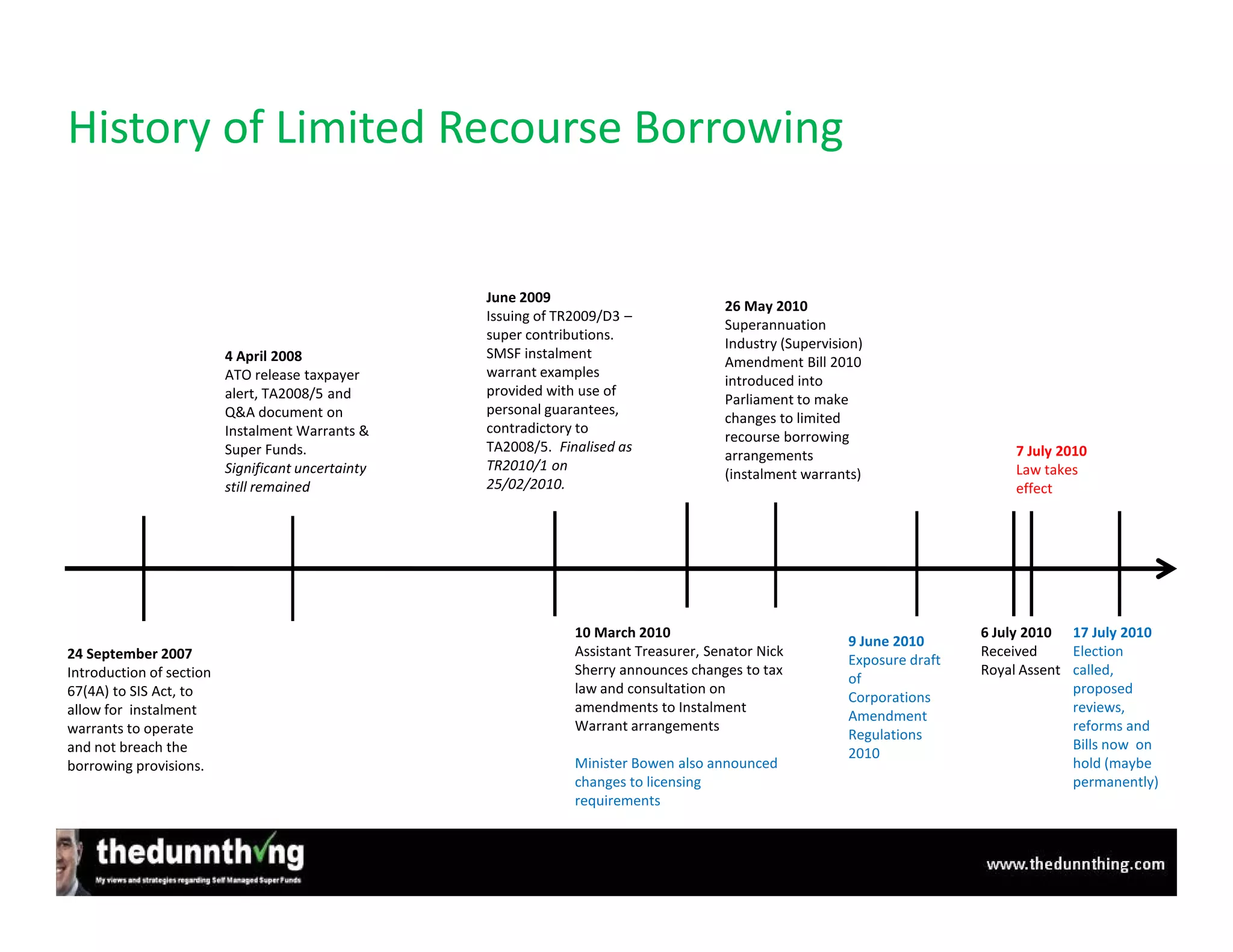
History of Limited Recourse Borrowing


                                                    June 2009
                                                                                        26 May 2010
                                                    Issuing of TR2009/D3 –
                                                                                        Superannuation
                                                    super contributions.
                                                                                        Industry (Supervision)
                          4 April 2008              SMSF instalment
                                                                                        Amendment Bill 2010
                          ATO release taxpayer      warrant examples
                                                                                        introduced into
                          alert, TA2008/5 and       provided with use of
                                                                                        Parliament to make
                          Q&A document on           personal guarantees,
                                                                                        changes to limited
                          Instalment Warrants &     contradictory to
                                                                                        recourse borrowing
                          Super Funds.              TA2008/5. Finalised as                                                      7 July 2010
                                                                                        arrangements
                          Significant uncertainty   TR2010/1 on                                                                 Law takes
                                                                                        (instalment warrants)
                          still remained            25/02/2010.                                                                 effect


                                                                 10 March 2010                                              6 July 2010 17 July 2010
                                                                                                           9 June 2010
24 September 2007                                                Assistant Treasurer, Senator Nick                          Received     Election
                                                                                                           Exposure draft
Introduction of section                                          Sherry announces changes to tax                            Royal Assent called,
                                                                                                           of
67(4A) to SIS Act, to                                            law and consultation on                                                 proposed
                                                                                                           Corporations
allow for instalment                                             amendments to Instalment                                                reviews,
                                                                                                           Amendment
warrants to operate                                              Warrant arrangements                                                    reforms and
                                                                                                           Regulations
and not breach the                                                                                                                       Bills now on
                                                                                                           2010
borrowing provisions.                                            Minister Bowen also announced                                           hold (maybe
                                                                 changes to licensing                                                    permanently)
                                                                 requirements
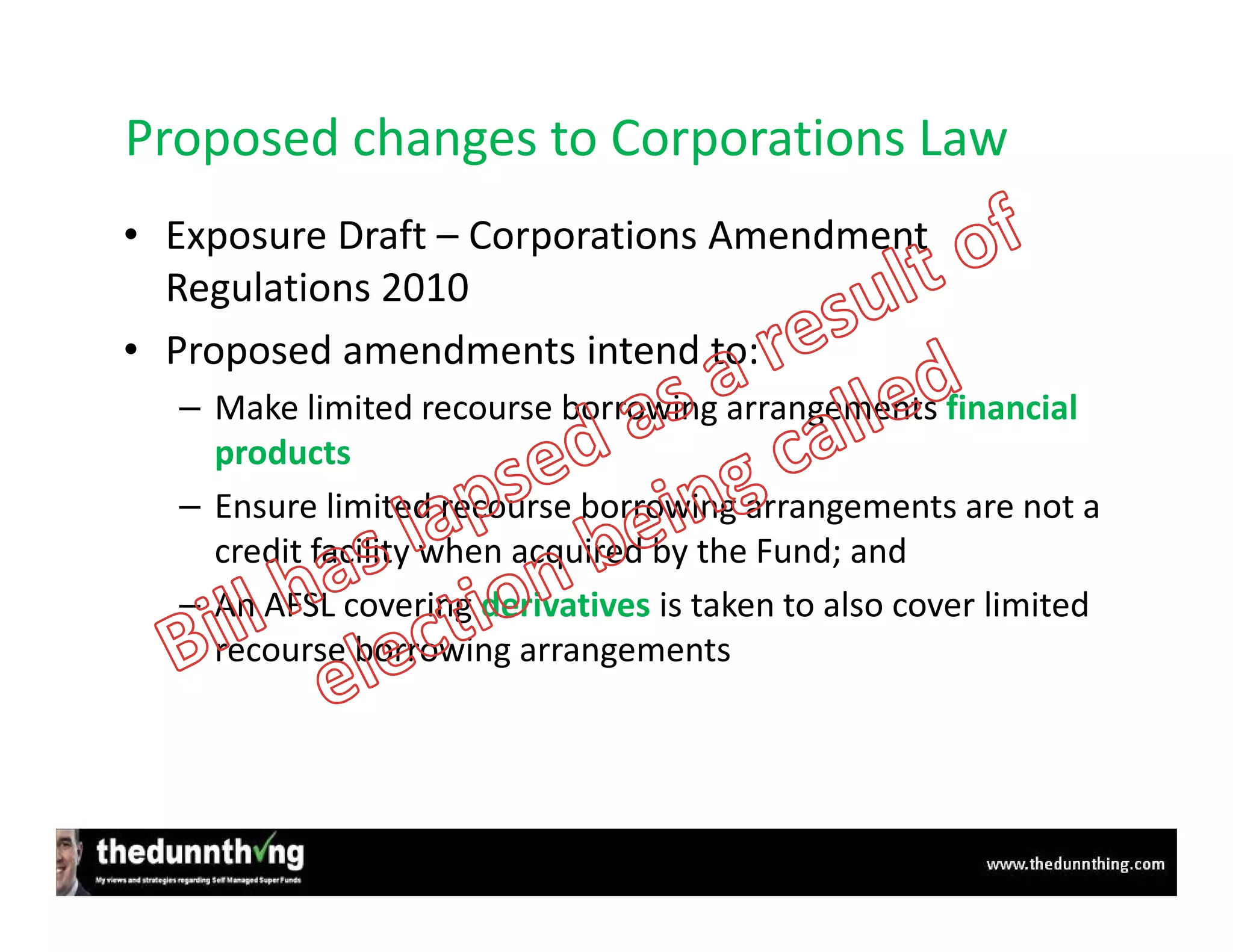
Proposed changes to Corporations Law
• Exposure Draft – Corporations Amendment
  Regulations 2010
• Proposed amendments intend to:
  – Make limited recourse borrowing arrangements financial
    products
  – Ensure limited recourse borrowing arrangements are not a
    credit facility when acquired by the Fund; and
  – An AFSL covering derivatives is taken to also cover limited
    recourse borrowing arrangements
Proposed changes to Corporations Law
• Draft Regulations released 9 June 2010. Submissions were
  able to be made up to 28 June 2010
• Issues/Concerns:
   – No distinction between ‘traditional’ instalment warrants and limited recourse
     loans (e.g. Property transaction). Are property based arrangements really
     sophisticated?
   – Issue on broad terminology of an ‘arrangement’ in accordance with section
     67(4A) (will now be s.67A).
       • When is it a financial product? Could there be more than one product issued (i.e. When
         property is purchased b/w buyer & agent, then again when bank agrees to loan?)
       • Who is responsible for issuing the PDS?
   – What authorisation is required for those who do not hold a derivatives
     licence?
       • Do you create a ‘carve-out’ for limited recourse borrowing arrangements?
       • Many derivatives licence holders would have little or no understanding of superannuation law
         requirements
Superannuation law
 changes to Limited
Recourse Borrowing
   Arrangements
The new arrangements
•   Royal Assent received 6 July 2010
•   Effective 7 July 2010
•   Repealed section 67(4A)
•   Introduced section 67A & 67B
•   New terminology
    – Limited Recourse Borrowing Arrangements
       • no longer defined as Instalment Warrants within the Act
The definition hasn’t changed
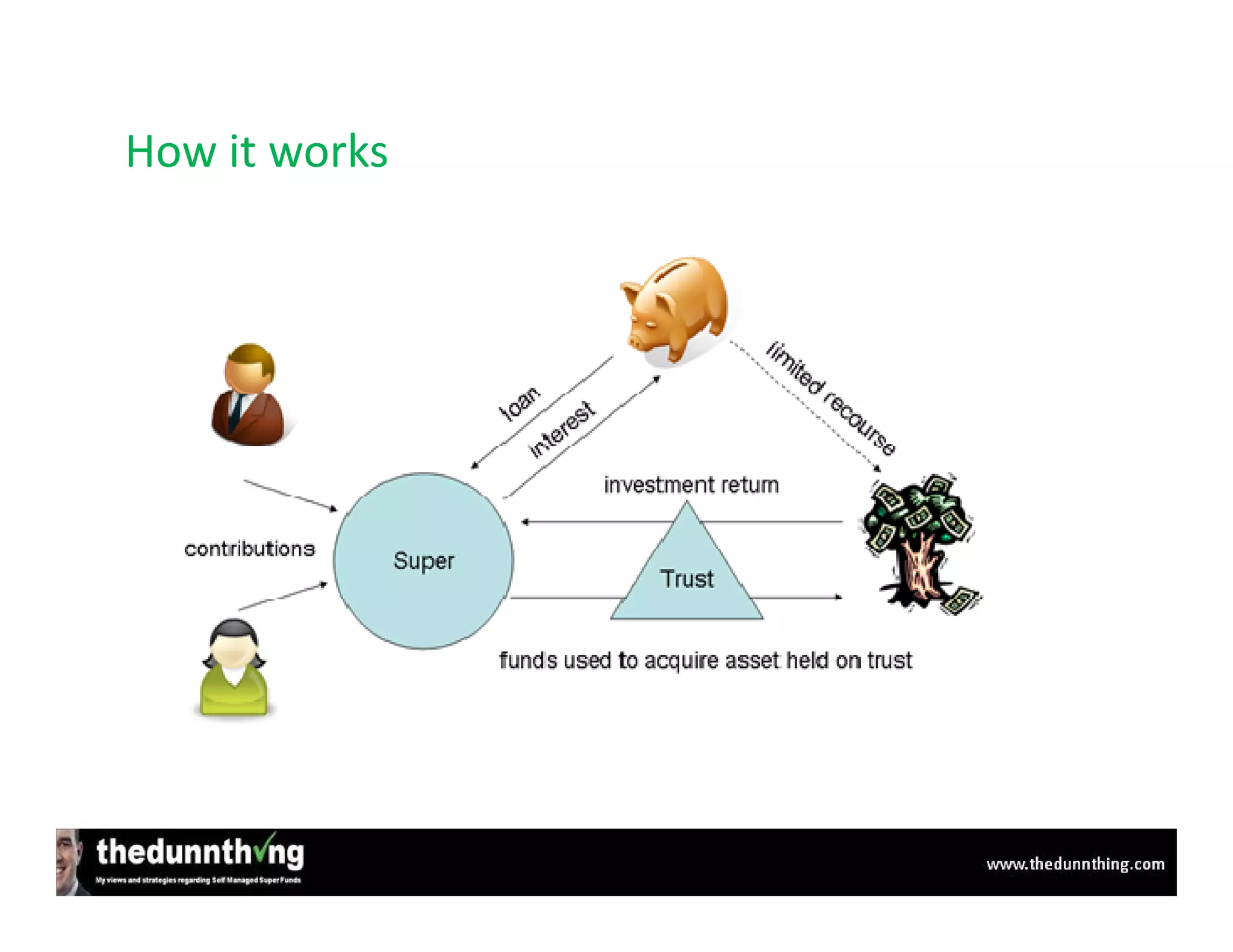
• The borrowings must be for the acquisition of an
  asset
• The asset must be held on trust
• The acquired asset is the only asset that the lender
  has recourse against in the event of default (limited
  recourse borrowing)
• When the borrowing is fully repaid, the asset must
  transfer to the SMSF
   – Can become an IHA issue where no transferred
            There is no revamp of the requirements from s.67(4A)
                  i.e. these preconditions must still all exist
How it works
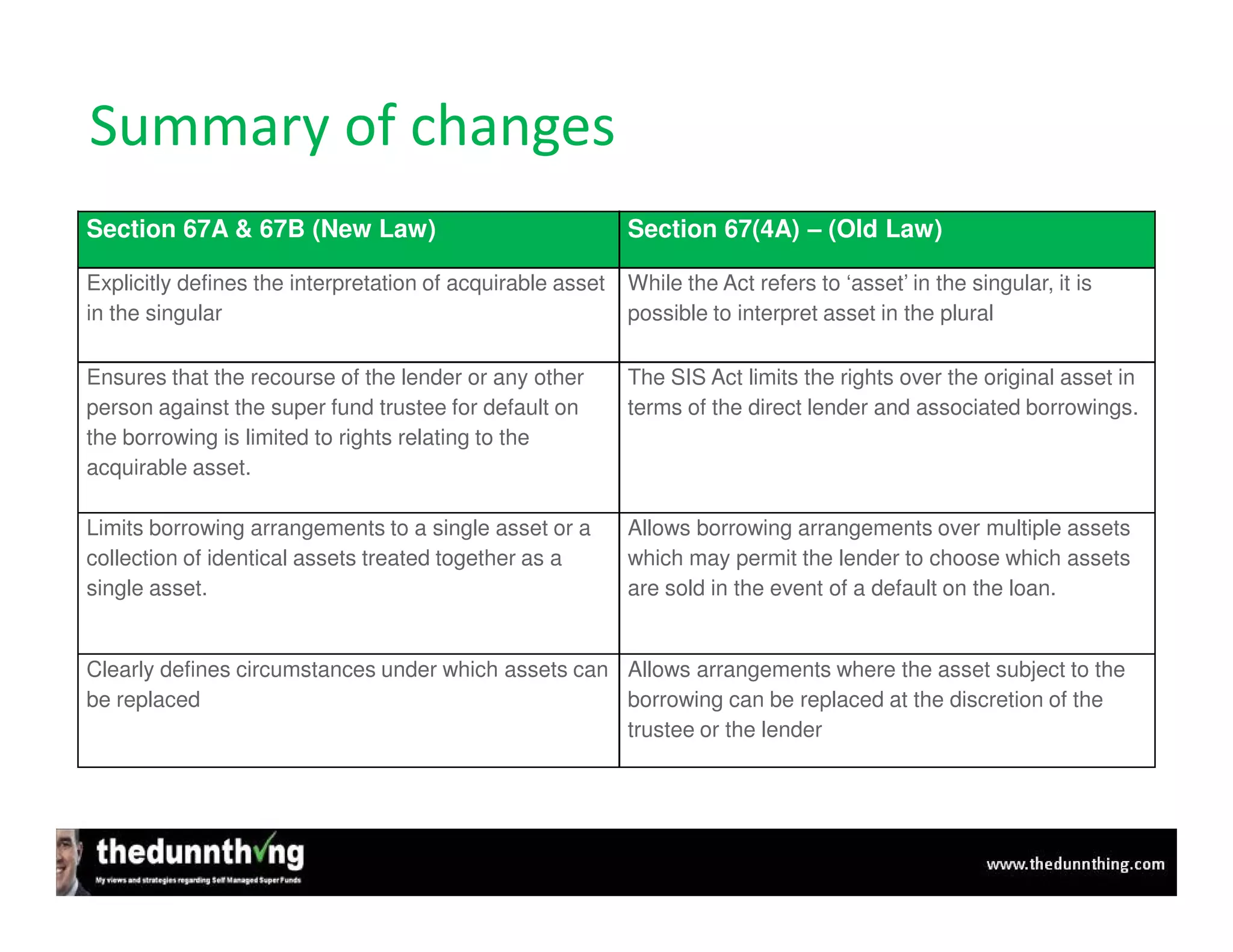
Summary of changes
Section 67A & 67B (New Law)                                 Section 67(4A) – (Old Law)

Explicitly defines the interpretation of acquirable asset   While the Act refers to ‘asset’ in the singular, it is
in the singular                                             possible to interpret asset in the plural

Ensures that the recourse of the lender or any other        The SIS Act limits the rights over the original asset in
person against the super fund trustee for default on        terms of the direct lender and associated borrowings.
the borrowing is limited to rights relating to the
acquirable asset.

Limits borrowing arrangements to a single asset or a        Allows borrowing arrangements over multiple assets
collection of identical assets treated together as a        which may permit the lender to choose which assets
single asset.                                               are sold in the event of a default on the loan.


Clearly defines circumstances under which assets can Allows arrangements where the asset subject to the
be replaced                                          borrowing can be replaced at the discretion of the
                                                     trustee or the lender
‘Acquirable’ Asset
• Defined as a ‘single asset’ or a ‘collection of identical
  assets’
   – Replaces concept of “original asset” within s.67(4A)
• EM defines single acquirable asset to include:
   – A parcel of identical shares in a single company or units in
     a unit trust that have the same market value. For example,
     #10,000 BHP shares.
       • Note - any collection of assets must be bought and sold as a
         collection; there can be no partial sell-down, DRP, etc.
   – The land and house/building for any real property
     acquisition.
       • Furnishings/Non-fixtures not included. Would require separate
         borrowing.
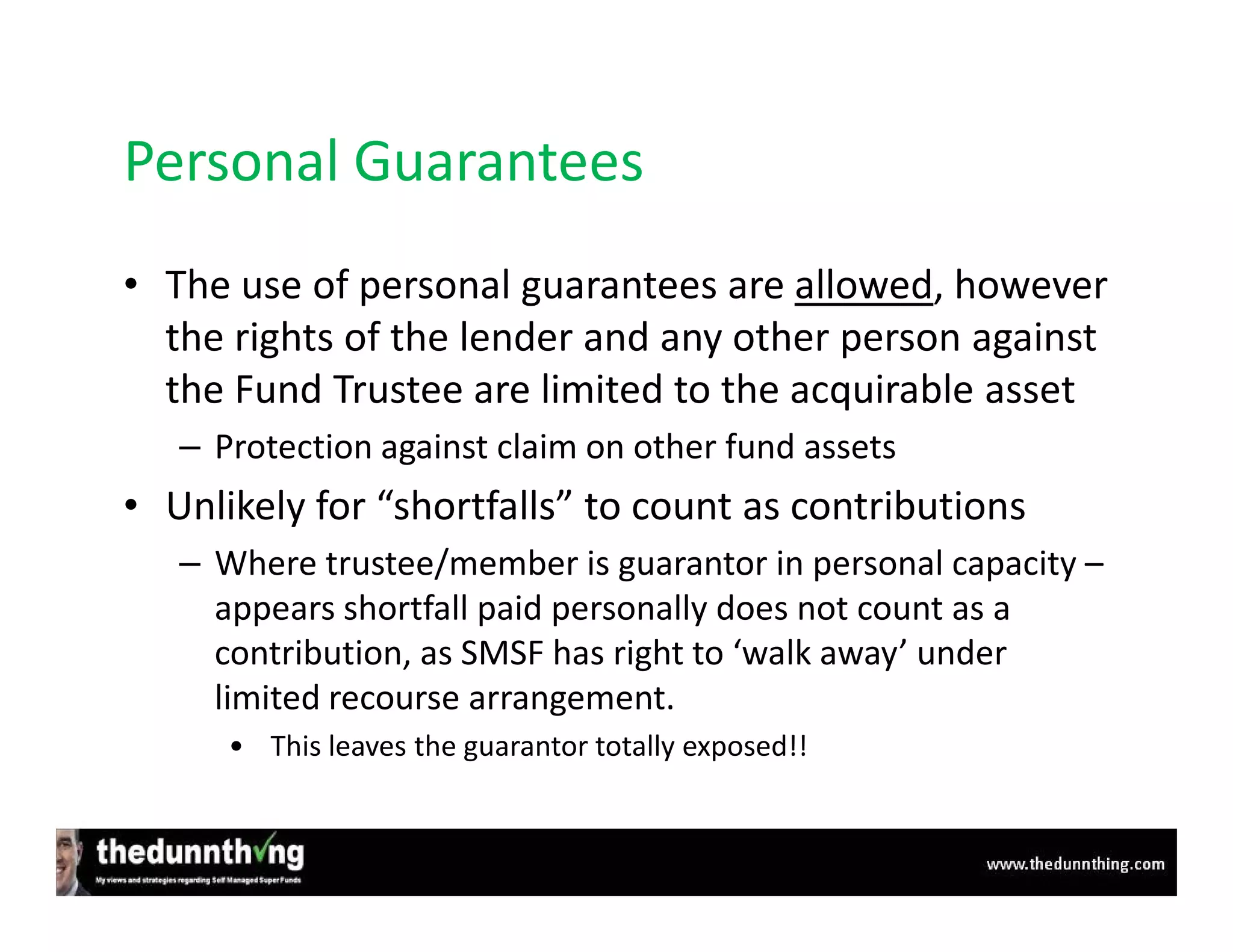
Personal Guarantees
• The use of personal guarantees are allowed, however
  the rights of the lender and any other person against
  the Fund Trustee are limited to the acquirable asset
   – Protection against claim on other fund assets
• Unlikely for “shortfalls” to count as contributions
   – Where trustee/member is guarantor in personal capacity –
     appears shortfall paid personally does not count as a
     contribution, as SMSF has right to ‘walk away’ under
     limited recourse arrangement.
      • This leaves the guarantor totally exposed!!
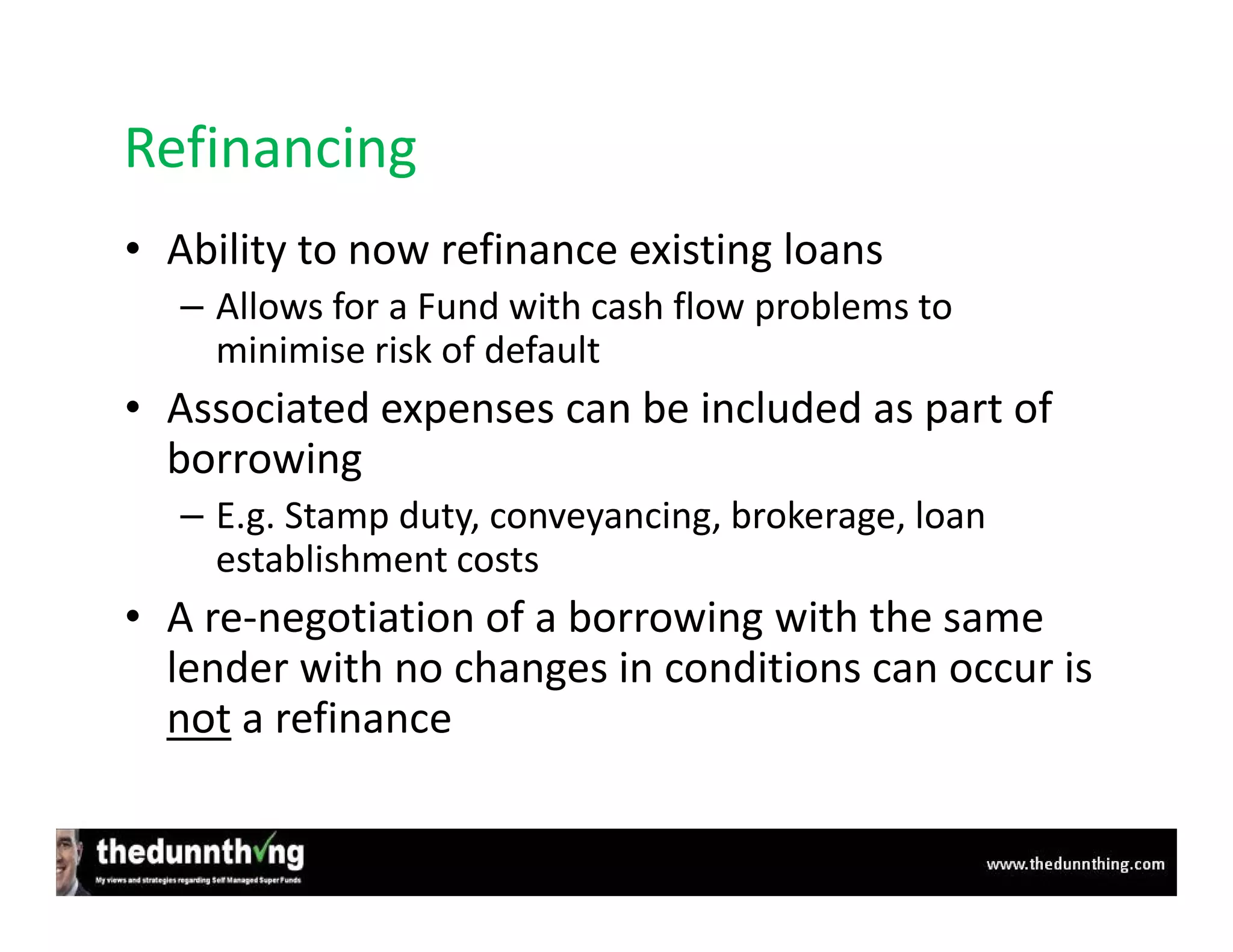
Refinancing
• Ability to now refinance existing loans
   – Allows for a Fund with cash flow problems to
     minimise risk of default
• Associated expenses can be included as part of
  borrowing
   – E.g. Stamp duty, conveyancing, brokerage, loan
     establishment costs
• A re-negotiation of a borrowing with the same
  lender with no changes in conditions can occur is
  not a refinance
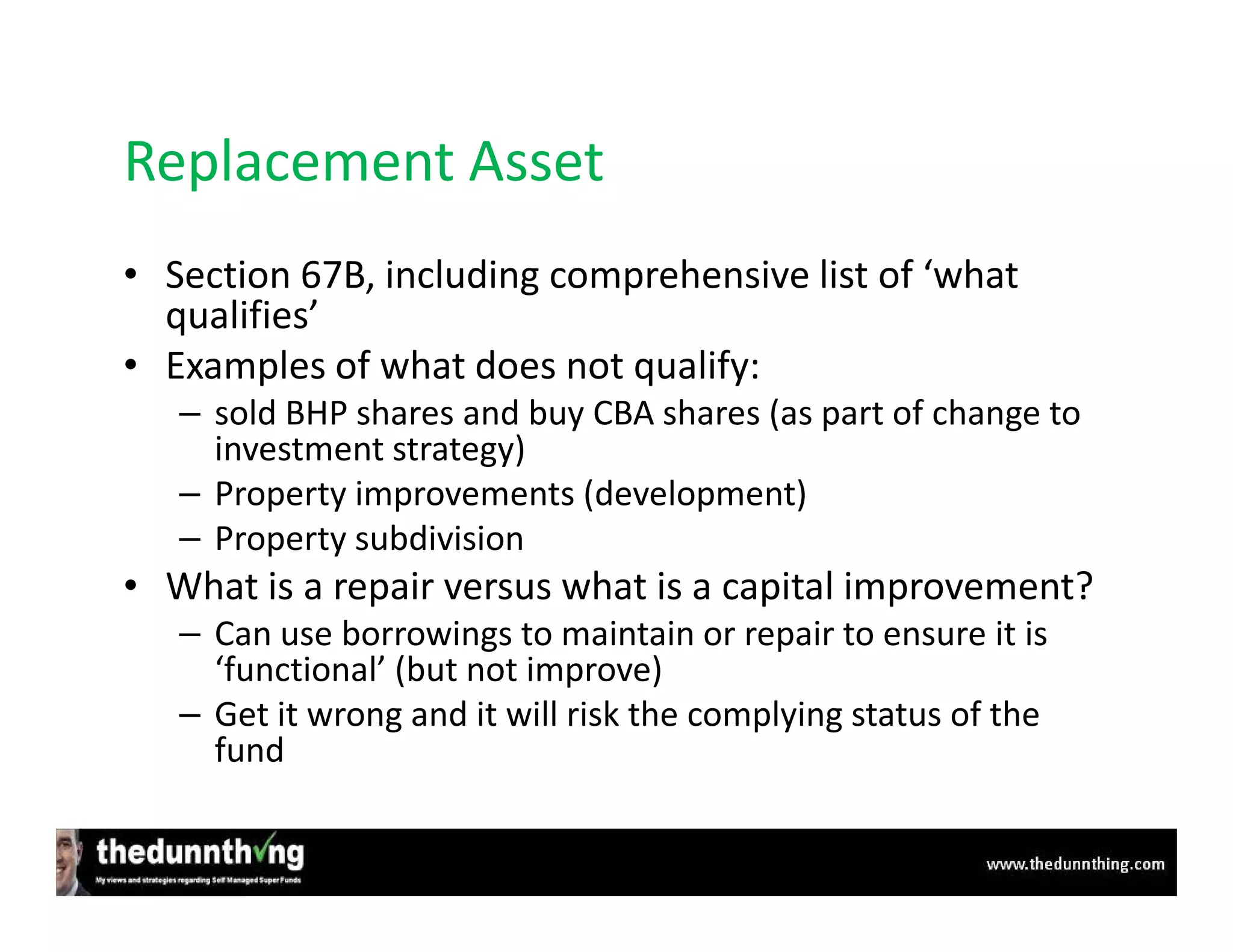
Replacement Asset
• Section 67B, including comprehensive list of ‘what
  qualifies’
• Examples of what does not qualify:
   – sold BHP shares and buy CBA shares (as part of change to
     investment strategy)
   – Property improvements (development)
   – Property subdivision
• What is a repair versus what is a capital improvement?
   – Can use borrowings to maintain or repair to ensure it is
     ‘functional’ (but not improve)
   – Get it wrong and it will risk the complying status of the
     fund
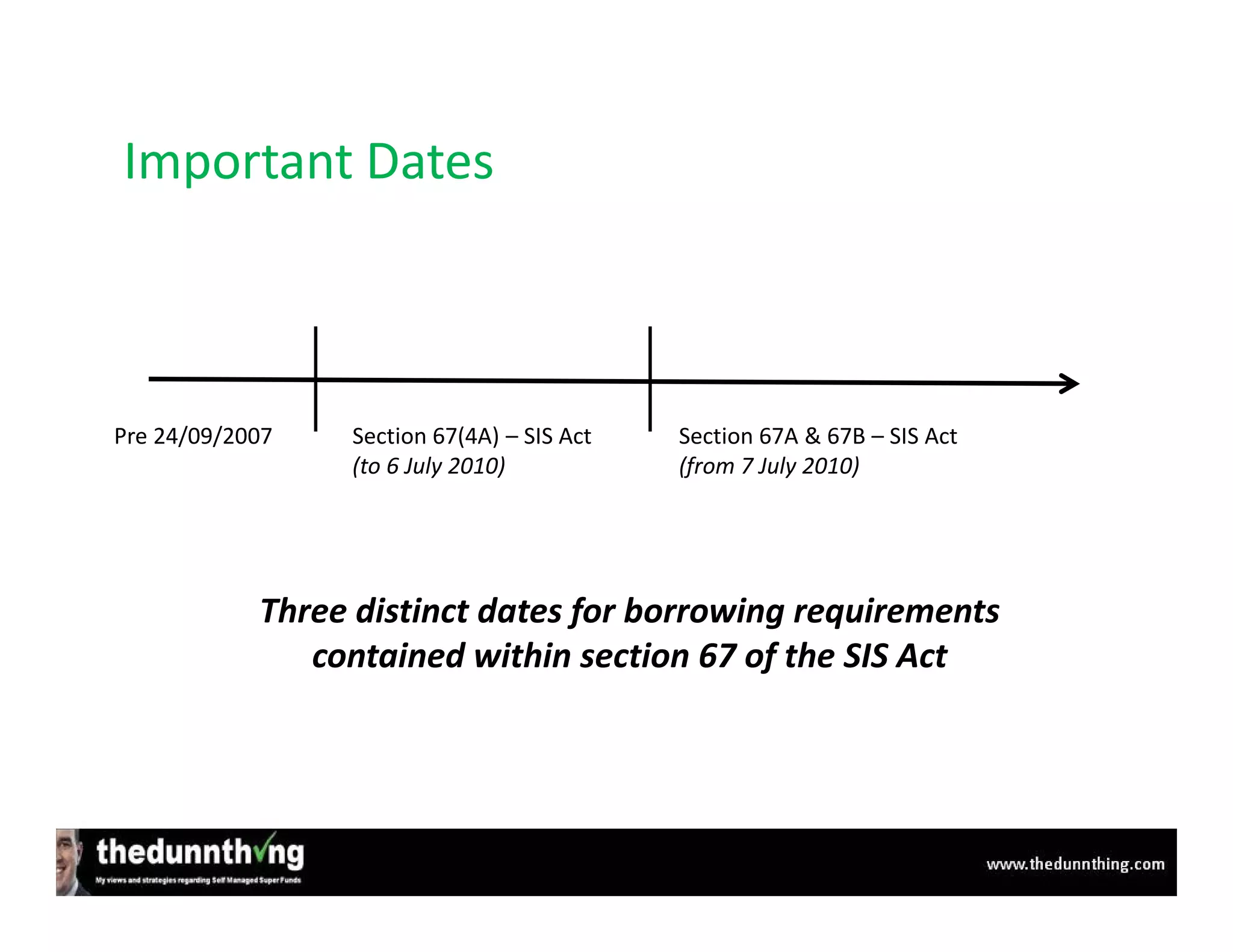
Important Dates


Pre 24/09/2007   Section 67(4A) – SIS Act   Section 67A & 67B – SIS Act
                 (to 6 July 2010)           (from 7 July 2010)


            Three distinct dates for borrowing requirements
               contained within section 67 of the SIS Act
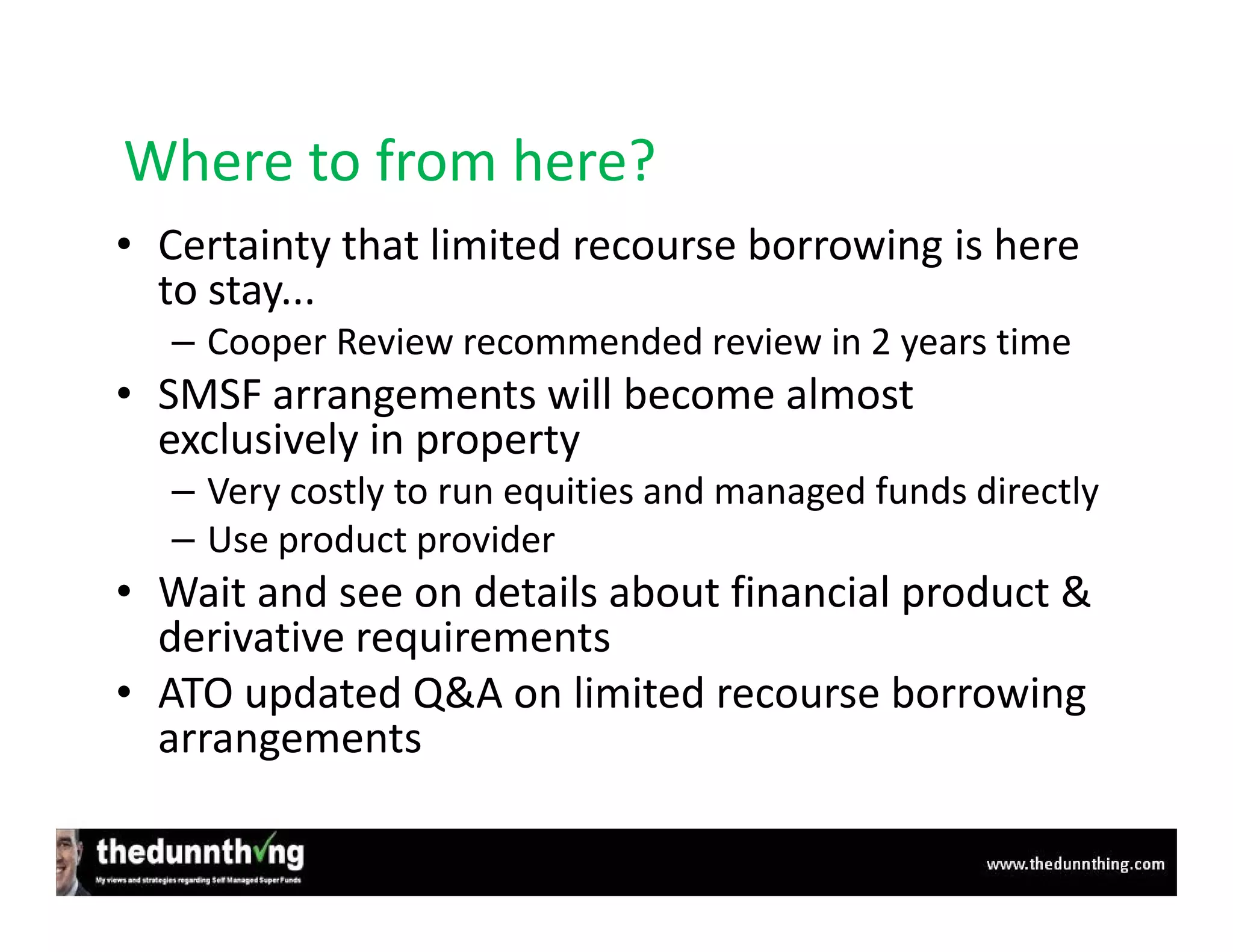
Where to from here?
• Certainty that limited recourse borrowing is here
  to stay...
  – Cooper Review recommended review in 2 years time
• SMSF arrangements will become almost
  exclusively in property
  – Very costly to run equities and managed funds directly
  – Use product provider
• Wait and see on details about financial product &
  derivative requirements
• ATO updated Q&A on limited recourse borrowing
  arrangements
Thank-you

Changes to S

  • 1.
    Changes affecting Limited Recourse Borrowing Arrangements Aaron Dunn B.Bus (Acc), CPA, SSA SMSF Specialist AdviserTM 20 July 2010
  • 2.
    Today’s Session • Wherewe’ve come from... • Proposed changes to Corporations Law • Limited Recourse Borrowing Arrangements – Section 67A & 67B – Comparison of changes • Questions
  • 3.
    History of LimitedRecourse Borrowing June 2009 26 May 2010 Issuing of TR2009/D3 – Superannuation super contributions. Industry (Supervision) 4 April 2008 SMSF instalment Amendment Bill 2010 ATO release taxpayer warrant examples introduced into alert, TA2008/5 and provided with use of Parliament to make Q&A document on personal guarantees, changes to limited Instalment Warrants & contradictory to recourse borrowing Super Funds. TA2008/5. Finalised as 7 July 2010 arrangements Significant uncertainty TR2010/1 on Law takes (instalment warrants) still remained 25/02/2010. effect 10 March 2010 6 July 2010 17 July 2010 9 June 2010 24 September 2007 Assistant Treasurer, Senator Nick Received Election Exposure draft Introduction of section Sherry announces changes to tax Royal Assent called, of 67(4A) to SIS Act, to law and consultation on proposed Corporations allow for instalment amendments to Instalment reviews, Amendment warrants to operate Warrant arrangements reforms and Regulations and not breach the Bills now on 2010 borrowing provisions. Minister Bowen also announced hold (maybe changes to licensing permanently) requirements
  • 4.
    Proposed changes toCorporations Law • Exposure Draft – Corporations Amendment Regulations 2010 • Proposed amendments intend to: – Make limited recourse borrowing arrangements financial products – Ensure limited recourse borrowing arrangements are not a credit facility when acquired by the Fund; and – An AFSL covering derivatives is taken to also cover limited recourse borrowing arrangements
  • 5.
    Proposed changes toCorporations Law • Draft Regulations released 9 June 2010. Submissions were able to be made up to 28 June 2010 • Issues/Concerns: – No distinction between ‘traditional’ instalment warrants and limited recourse loans (e.g. Property transaction). Are property based arrangements really sophisticated? – Issue on broad terminology of an ‘arrangement’ in accordance with section 67(4A) (will now be s.67A). • When is it a financial product? Could there be more than one product issued (i.e. When property is purchased b/w buyer & agent, then again when bank agrees to loan?) • Who is responsible for issuing the PDS? – What authorisation is required for those who do not hold a derivatives licence? • Do you create a ‘carve-out’ for limited recourse borrowing arrangements? • Many derivatives licence holders would have little or no understanding of superannuation law requirements
  • 6.
    Superannuation law changesto Limited Recourse Borrowing Arrangements
  • 7.
    The new arrangements • Royal Assent received 6 July 2010 • Effective 7 July 2010 • Repealed section 67(4A) • Introduced section 67A & 67B • New terminology – Limited Recourse Borrowing Arrangements • no longer defined as Instalment Warrants within the Act
  • 8.
    The definition hasn’tchanged • The borrowings must be for the acquisition of an asset • The asset must be held on trust • The acquired asset is the only asset that the lender has recourse against in the event of default (limited recourse borrowing) • When the borrowing is fully repaid, the asset must transfer to the SMSF – Can become an IHA issue where no transferred There is no revamp of the requirements from s.67(4A) i.e. these preconditions must still all exist
  • 9.
  • 10.
    Summary of changes Section67A & 67B (New Law) Section 67(4A) – (Old Law) Explicitly defines the interpretation of acquirable asset While the Act refers to ‘asset’ in the singular, it is in the singular possible to interpret asset in the plural Ensures that the recourse of the lender or any other The SIS Act limits the rights over the original asset in person against the super fund trustee for default on terms of the direct lender and associated borrowings. the borrowing is limited to rights relating to the acquirable asset. Limits borrowing arrangements to a single asset or a Allows borrowing arrangements over multiple assets collection of identical assets treated together as a which may permit the lender to choose which assets single asset. are sold in the event of a default on the loan. Clearly defines circumstances under which assets can Allows arrangements where the asset subject to the be replaced borrowing can be replaced at the discretion of the trustee or the lender
  • 11.
    ‘Acquirable’ Asset • Definedas a ‘single asset’ or a ‘collection of identical assets’ – Replaces concept of “original asset” within s.67(4A) • EM defines single acquirable asset to include: – A parcel of identical shares in a single company or units in a unit trust that have the same market value. For example, #10,000 BHP shares. • Note - any collection of assets must be bought and sold as a collection; there can be no partial sell-down, DRP, etc. – The land and house/building for any real property acquisition. • Furnishings/Non-fixtures not included. Would require separate borrowing.
  • 12.
    Personal Guarantees • Theuse of personal guarantees are allowed, however the rights of the lender and any other person against the Fund Trustee are limited to the acquirable asset – Protection against claim on other fund assets • Unlikely for “shortfalls” to count as contributions – Where trustee/member is guarantor in personal capacity – appears shortfall paid personally does not count as a contribution, as SMSF has right to ‘walk away’ under limited recourse arrangement. • This leaves the guarantor totally exposed!!
  • 13.
    Refinancing • Ability tonow refinance existing loans – Allows for a Fund with cash flow problems to minimise risk of default • Associated expenses can be included as part of borrowing – E.g. Stamp duty, conveyancing, brokerage, loan establishment costs • A re-negotiation of a borrowing with the same lender with no changes in conditions can occur is not a refinance
  • 14.
    Replacement Asset • Section67B, including comprehensive list of ‘what qualifies’ • Examples of what does not qualify: – sold BHP shares and buy CBA shares (as part of change to investment strategy) – Property improvements (development) – Property subdivision • What is a repair versus what is a capital improvement? – Can use borrowings to maintain or repair to ensure it is ‘functional’ (but not improve) – Get it wrong and it will risk the complying status of the fund
  • 15.
    Important Dates Pre 24/09/2007 Section 67(4A) – SIS Act Section 67A & 67B – SIS Act (to 6 July 2010) (from 7 July 2010) Three distinct dates for borrowing requirements contained within section 67 of the SIS Act
  • 16.
    Where to fromhere? • Certainty that limited recourse borrowing is here to stay... – Cooper Review recommended review in 2 years time • SMSF arrangements will become almost exclusively in property – Very costly to run equities and managed funds directly – Use product provider • Wait and see on details about financial product & derivative requirements • ATO updated Q&A on limited recourse borrowing arrangements
  • 17.