DISCUSSION TOPICS
• Change Initiative Stats – Success & Failure Factors
• Lewin’s Change Management Model
• Lewin’s Golden Rules for Change
• The Three Stage Model
• The Importance of Each Stage
• Practical Steps for Using the Model
• Criticisms of the Model
• Additional Guidance for Managing Change
• Change Communication Awareness
• Resistance to Change
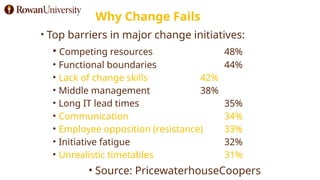
Why Change Fails
• Top barriers in major change initiatives:
• Competing resources 48%
• Functional boundaries 44%
• Lack of change skills 42%
• Middle management 38%
• Long IT lead times 35%
• Communication 34%
• Employee opposition (resistance) 33%
• Initiative fatigue 32%
• Unrealistic timetables 31%
• Source: PricewaterhouseCoopers
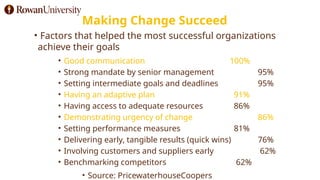
Making Change Succeed
• Factors that helped the most successful organizations
achieve their goals
• Good communication 100%
• Strong mandate by senior management 95%
• Setting intermediate goals and deadlines 95%
• Having an adaptive plan 91%
• Having access to adequate resources 86%
• Demonstrating urgency of change 86%
• Setting performance measures 81%
• Delivering early, tangible results (quick wins) 76%
• Involving customers and suppliers early 62%
• Benchmarking competitors 62%
• Source: PricewaterhouseCoopers
Lewin’s Change Management Model
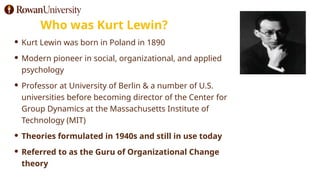
Who was Kurt Lewin?
 Kurt Lewin was born in Poland in 1890
 Modern pioneer in social, organizational, and applied
psychology
 Professor at University of Berlin & a number of U.S.
universities before becoming director of the Center for
Group Dynamics at the Massachusetts Institute of
Technology (MIT)
 Theories formulated in 1940s and still in use today
 Referred to as the Guru of Organizational Change
theory
Lewin’s Golden Rules for Change
• Kurt Lewin’s change theory identified several golden rules on how
change should be implemented:
1. Change should only be implemented for good reason.
2. Change is most effective when done gradually.
3. Change should be planned and not sporadic or sudden.
4. Strive to include individuals who may be affected by the change
as much as possible in planning for the change.
Lewin: "Motivation for change must be generated
before change can occur.”
Kurt Lewin’s Three stage model:
Approaches to Managing Organizational Change
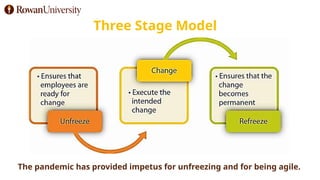
Three Stage Model
• One of the cornerstone models for
understanding organizational change was
developed by Lewin back in the 1940s, and
is still effective in the modern era
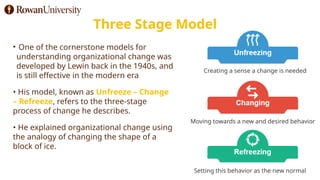
• His model, known as Unfreeze – Change
– Refreeze, refers to the three-stage
process of change he describes.
• He explained organizational change using
the analogy of changing the shape of a
block of ice.
Creating a sense a change is needed
Moving towards a new and desired behavior
Setting this behavior as the new normal
Three Stage Model
The pandemic has provided impetus for unfreezing and for being agile.

Change management, Upload & Share Presentations, Documents & Infographics.pptx

  • 1.
    DISCUSSION TOPICS • ChangeInitiative Stats – Success & Failure Factors • Lewin’s Change Management Model • Lewin’s Golden Rules for Change • The Three Stage Model • The Importance of Each Stage • Practical Steps for Using the Model • Criticisms of the Model • Additional Guidance for Managing Change • Change Communication Awareness • Resistance to Change
  • 2.
    Why Change Fails •Top barriers in major change initiatives: • Competing resources 48% • Functional boundaries 44% • Lack of change skills 42% • Middle management 38% • Long IT lead times 35% • Communication 34% • Employee opposition (resistance) 33% • Initiative fatigue 32% • Unrealistic timetables 31% • Source: PricewaterhouseCoopers
  • 3.
    Making Change Succeed •Factors that helped the most successful organizations achieve their goals • Good communication 100% • Strong mandate by senior management 95% • Setting intermediate goals and deadlines 95% • Having an adaptive plan 91% • Having access to adequate resources 86% • Demonstrating urgency of change 86% • Setting performance measures 81% • Delivering early, tangible results (quick wins) 76% • Involving customers and suppliers early 62% • Benchmarking competitors 62% • Source: PricewaterhouseCoopers
  • 4.
  • 5.
    Who was KurtLewin?  Kurt Lewin was born in Poland in 1890  Modern pioneer in social, organizational, and applied psychology  Professor at University of Berlin & a number of U.S. universities before becoming director of the Center for Group Dynamics at the Massachusetts Institute of Technology (MIT)  Theories formulated in 1940s and still in use today  Referred to as the Guru of Organizational Change theory
  • 6.
    Lewin’s Golden Rulesfor Change • Kurt Lewin’s change theory identified several golden rules on how change should be implemented: 1. Change should only be implemented for good reason. 2. Change is most effective when done gradually. 3. Change should be planned and not sporadic or sudden. 4. Strive to include individuals who may be affected by the change as much as possible in planning for the change. Lewin: "Motivation for change must be generated before change can occur.”
  • 7.
    Kurt Lewin’s Threestage model: Approaches to Managing Organizational Change
  • 8.
    Three Stage Model •One of the cornerstone models for understanding organizational change was developed by Lewin back in the 1940s, and is still effective in the modern era • His model, known as Unfreeze – Change – Refreeze, refers to the three-stage process of change he describes. • He explained organizational change using the analogy of changing the shape of a block of ice. Creating a sense a change is needed Moving towards a new and desired behavior Setting this behavior as the new normal
  • 9.
    Three Stage Model Thepandemic has provided impetus for unfreezing and for being agile.

Editor's Notes

  • #2 Lack of change skills – Speaks to the importance of University leadership guiding the process throughout Communication – Like many other initiatives, change initiatives require clear, strategized communication to avoid failure Employee opposition (resistance) – Shows the importance of reducing resistance through communication and demonstrating the need for change Unrealistic timetables – Ideally, change is gradual and given time to evolve, but there are times where that is not possible. Setting unrealistic timelines can really set back a change initiative
  • #3 Good communication – Clear, concise, timely communication is the # 1 key to successful change Having an adaptive plan – Being flexible and agile is a major component of successful change – there will be curveballs to overcome Demonstrating urgency of change – Involved parties need to be motivated to change and to understand the “why”
  • #6 Before we discuss Lewin’s three stage change model, let’s talk about his Golden Rules for Change…
  • #9 As you take a look at this graphic for the 3 stage model, you may be thinking about Rowan this year. The pandemic has certainly provided the impetus needed to unfreeze, but unfortunately we didn’t have the ideal amount of time to ensure that our employees were ready for the changes. We will need to be agile right now and as time goes on. Now, sometimes you have determined exactly what needs to change and other times you may only have a broad idea of what has to change and it may become more specific while working through the 3 stage model. For example, you may involve others in implementing change, and an employee comes up with a great idea that had not been previously thought of – that can change some of the details of the changes being implemented. Often times if you have determined exactly what has to change, you may have completed surveys, or recognized frequent errors are occurring, or an event happened that was a game-changer, etc. Something caused the decision to make those changes and you have figured it out in advance.