EdF 200
(Methods of
Research)
By: Cherly A. Bedua
Change of Supervisor
Changing
circumstances
and life events
may lead either
you or your
supervisor to
consider ending
the working
relationship.
A supervisor change can be a
welcome or unwelcome change. In
some situations, a new supervisor is
hired, often because the old
supervisor moves on. In other cases,
an employee is having difficulty
getting along with the current
supervisor and wants a different
supervisor.
WHY CHANGE SUPERVISORS
Student changes area of interest:
Sometimes, a student’s research focus
changes or shifts to such an extent that
the supervisor feels he or she no longer
has the appropriate background to
supervise the research. Also, a student
may lose interest completely in his or her
research and wish to change fields
entirely.
WHY CHANGE SUPERVISORS
The key role of a research degree
supervisor is to assist and support a
student throughout their academic
studies.
Ideal supervisors are those who have
expertise in the field surrounding the
student's research. ... Having
a supervisor with expertise in the
methodologies required in their research is
particularly important. Interest in the
Student's Career. Ideal supervisors are likely
to show an interest in the student's career.
BEFORE DOING ANYTHING DRASTIC
Changing supervisors is a big step. It can
be stressful and take time that you might
otherwise spend on your work. Before you take
this step, ask yourself these questions:
1. Have you discussed the problem or conflict
with your supervisor?
2. Have your conversations about the problem
been sufficiently clear that both you and your
supervisor agree on the problem?
BEFORE DOING ANYTHING DRASTIC
3. Have you and your supervisor
attempted to remedy the problem?
4. Have you involved the
supervisory committee members in
your discussions and sought their
advice?
5. Have you followed the
procedures outlined in the Problem
Resolution section?
BEFORE DOING ANYTHING DRASTIC
6. Have you and your supervisor
explored the implications of
changing supervisors?
7. Have you considered whether
there is anyone else in your graduate
program who might have the
knowledge, experience, time and
interest to supervise you?
To discuss both the academic and
financial consequences of a such change,
you should first talk with the people
involved. The supervisory relationship is
built upon responsibilities of both
supervisor and supervisee. In any
professional relationship there must be
an understanding about what each party
expects from the other, including the
modification or dissolution of the
relationship.
When a student is having difficulties, it is all
the more important that the new supervisor is not
only someone with whom the student feels more
comfortable personally but also that the new
supervisor is appropriately placed to supervise
the research. Depending on the student’s stage
within the program, a change of supervisor may
require a change in the topic or plan for the
research. Throughout the process, it is critical to
keep all parties informed of the actions under
way. The process should be completed as quickly
as possible to reduce delays in research progress
and associated worries.
SUPERVISOR ON SABBATICAL LEAVE
There are two types of sabbatical, and each
one has a different impact on the graduate
student/supervisor relationship:
1. Local sabbatical: When a supervisor takes a
sabbatical in his or her own lab (i.e. locally),
graduate students are usually able to spend much
more productive time with the supervisor.
2. Distant sabbatical: When a supervisor takes a
sabbatical away from the university for a
significant period of time, contact between
graduate student and supervisor is dramatically
reduced.
SUPERVISOR ON SABBATICAL LEAVE
Generally, only distant sabbaticals pose
challenges for graduate students and
supervisors. supervisors are responsible for
ensuring their graduate students have
adequate supervision for the sabbatical
period. Supervisors should:
1. Appoint an interim supervisor who is
knowledgeable in the graduate student's
area of research.
SUPERVISOR ON SABBATICAL LEAVE
2. Stay in close contact with the
Supervisory Committee and follow the
progress of the research.
3. Set up regular meeting times through
telephone or web conferencing.
4. Stay in regular contact with the
student through e-mail.
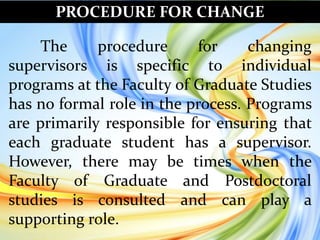
PROCEDURE FOR CHANGE
The procedure for changing
supervisors is specific to individual
programs at the Faculty of Graduate Studies
has no formal role in the process. Programs
are primarily responsible for ensuring that
each graduate student has a supervisor.
However, there may be times when the
Faculty of Graduate and Postdoctoral
studies is consulted and can play a
supporting role.
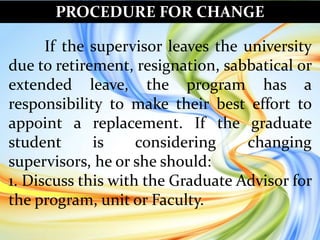
PROCEDURE FOR CHANGE
If the supervisor leaves the university
due to retirement, resignation, sabbatical or
extended leave, the program has a
responsibility to make their best effort to
appoint a replacement. If the graduate
student is considering changing
supervisors, he or she should:
1. Discuss this with the Graduate Advisor for
the program, unit or Faculty.
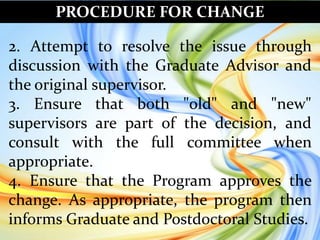
PROCEDURE FOR CHANGE
2. Attempt to resolve the issue through
discussion with the Graduate Advisor and
the original supervisor.
3. Ensure that both "old" and "new"
supervisors are part of the decision, and
consult with the full committee when
appropriate.
4. Ensure that the Program approves the
change. As appropriate, the program then
informs Graduate and Postdoctoral Studies.
Reference
https://www.mcgill.ca/gradsupervision/questions-and-
answers/qa-supervisees/changing-supervisors
https://www.laccd.edu/Departments/PersonnelCommission/
Documents/EmployeeBulletins/07.17%20Encouraging%20Int
egrity%20in%20the%20Workplace%20-%20Supervisory.pdf
https://www.grad.ubc.ca/handbook-graduate-
supervision/ending-relationship
Change in Supervisor.pptx

Change in Supervisor.pptx

  • 1.
  • 2.
    By: Cherly A.Bedua Change of Supervisor
  • 3.
    Changing circumstances and life events maylead either you or your supervisor to consider ending the working relationship.
  • 4.
    A supervisor changecan be a welcome or unwelcome change. In some situations, a new supervisor is hired, often because the old supervisor moves on. In other cases, an employee is having difficulty getting along with the current supervisor and wants a different supervisor. WHY CHANGE SUPERVISORS
  • 5.
    Student changes areaof interest: Sometimes, a student’s research focus changes or shifts to such an extent that the supervisor feels he or she no longer has the appropriate background to supervise the research. Also, a student may lose interest completely in his or her research and wish to change fields entirely. WHY CHANGE SUPERVISORS
  • 6.
    The key roleof a research degree supervisor is to assist and support a student throughout their academic studies. Ideal supervisors are those who have expertise in the field surrounding the student's research. ... Having a supervisor with expertise in the methodologies required in their research is particularly important. Interest in the Student's Career. Ideal supervisors are likely to show an interest in the student's career.
  • 7.
    BEFORE DOING ANYTHINGDRASTIC Changing supervisors is a big step. It can be stressful and take time that you might otherwise spend on your work. Before you take this step, ask yourself these questions: 1. Have you discussed the problem or conflict with your supervisor? 2. Have your conversations about the problem been sufficiently clear that both you and your supervisor agree on the problem?
  • 8.
    BEFORE DOING ANYTHINGDRASTIC 3. Have you and your supervisor attempted to remedy the problem? 4. Have you involved the supervisory committee members in your discussions and sought their advice? 5. Have you followed the procedures outlined in the Problem Resolution section?
  • 9.
    BEFORE DOING ANYTHINGDRASTIC 6. Have you and your supervisor explored the implications of changing supervisors? 7. Have you considered whether there is anyone else in your graduate program who might have the knowledge, experience, time and interest to supervise you?
  • 10.
    To discuss boththe academic and financial consequences of a such change, you should first talk with the people involved. The supervisory relationship is built upon responsibilities of both supervisor and supervisee. In any professional relationship there must be an understanding about what each party expects from the other, including the modification or dissolution of the relationship.
  • 11.
    When a studentis having difficulties, it is all the more important that the new supervisor is not only someone with whom the student feels more comfortable personally but also that the new supervisor is appropriately placed to supervise the research. Depending on the student’s stage within the program, a change of supervisor may require a change in the topic or plan for the research. Throughout the process, it is critical to keep all parties informed of the actions under way. The process should be completed as quickly as possible to reduce delays in research progress and associated worries.
  • 12.
    SUPERVISOR ON SABBATICALLEAVE There are two types of sabbatical, and each one has a different impact on the graduate student/supervisor relationship: 1. Local sabbatical: When a supervisor takes a sabbatical in his or her own lab (i.e. locally), graduate students are usually able to spend much more productive time with the supervisor. 2. Distant sabbatical: When a supervisor takes a sabbatical away from the university for a significant period of time, contact between graduate student and supervisor is dramatically reduced.
  • 13.
    SUPERVISOR ON SABBATICALLEAVE Generally, only distant sabbaticals pose challenges for graduate students and supervisors. supervisors are responsible for ensuring their graduate students have adequate supervision for the sabbatical period. Supervisors should: 1. Appoint an interim supervisor who is knowledgeable in the graduate student's area of research.
  • 14.
    SUPERVISOR ON SABBATICALLEAVE 2. Stay in close contact with the Supervisory Committee and follow the progress of the research. 3. Set up regular meeting times through telephone or web conferencing. 4. Stay in regular contact with the student through e-mail.
  • 15.
    PROCEDURE FOR CHANGE Theprocedure for changing supervisors is specific to individual programs at the Faculty of Graduate Studies has no formal role in the process. Programs are primarily responsible for ensuring that each graduate student has a supervisor. However, there may be times when the Faculty of Graduate and Postdoctoral studies is consulted and can play a supporting role.
  • 16.
    PROCEDURE FOR CHANGE Ifthe supervisor leaves the university due to retirement, resignation, sabbatical or extended leave, the program has a responsibility to make their best effort to appoint a replacement. If the graduate student is considering changing supervisors, he or she should: 1. Discuss this with the Graduate Advisor for the program, unit or Faculty.
  • 17.
    PROCEDURE FOR CHANGE 2.Attempt to resolve the issue through discussion with the Graduate Advisor and the original supervisor. 3. Ensure that both "old" and "new" supervisors are part of the decision, and consult with the full committee when appropriate. 4. Ensure that the Program approves the change. As appropriate, the program then informs Graduate and Postdoctoral Studies.
  • 18.