CANADIAN FORCES COLLEGE / COLLÈGE DES FORCES CANADIENNES
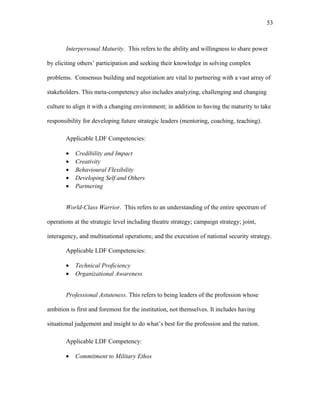
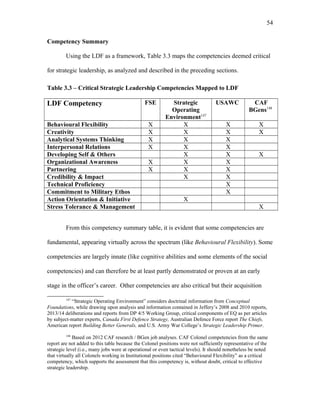
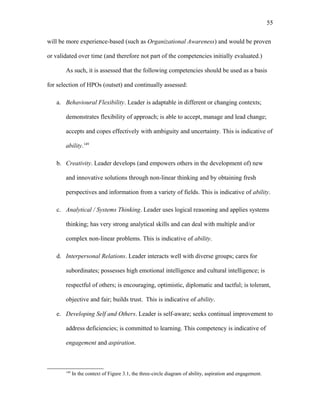
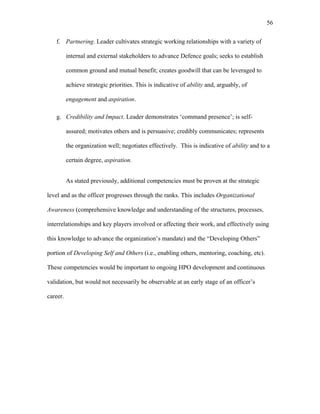
MASTER OF DEFENCE STUDIES
RESEARCH PAPER
RCAF SUCCESSION MANAGEMENT: A STRATEGIC PERSPECTIVE
Lieutenant-Colonel Lynne Chaloux
27 June 2014
This paper was written by a student
attending the Canadian Forces College in
fulfilment of one of the requirements of the
Course of Studies. The paper is a scholastic
document, and thus contains facts and
opinions which the author alone considered
appropriate and correct for the subject. It
does not necessarily reflect the policy or the
opinion of any agency, including the
Government of Canada and the Canadian
Department of National Defence. This
paper may not be released, quoted or copied
except with the express permission of the
Canadian Department of National Defence.
La présente étude a été rédigée par un
stagiaire du Collège des Forces
canadiennes pour satisfaire à l'une des
exigences du cours. L'étude est un
document qui se rapporte au cours et
contient donc des faits et des opinions que
seul l'auteur considère appropriés et
convenables au sujet. Elle ne reflète pas
nécessairement la politique ou l'opinion
d'un organisme quelconque, y compris le
gouvernement du Canada et le ministère de
la Défense nationale du Canada. Il est
défendu de diffuser, de citer ou de
reproduire cette étude sans la permission
expresse du ministère de la Défense
nationale.
TABLE OF CONTENTS
Table of Contents ……………………………...…………………………………..... i
List of Figures …………………………………..………………………………. ii
List of Tables ……………………………………….…………………………... ii
Abstract ………………………………………………………………..…. iii
Introduction ………………………………………………………..………..… 1
Chapter
1. Current RCAF Succession Management: A Précis …………………………..... 4
2. Strategic Leadership ………………………………………………...…………. 17
3. Strategic Competencies Analysis ……………………………………………… 32
4. Evaluation of Aim, Assessment and Validation Processes …….………………. 57
5. Effectiveness of Strategic Leadership Development …………………………... 74
Conclusion …………………………………………………………………... 92
Appendix 1. Leader Development Framework: Meta-Competency Progression …... 100
Appendix 2. Leader Development Framework: Competency Definitions …………. 101
Appendix 3. Secondary Areas of Development Mapped to LDF …………………... 107
Bibliography ……………………………………………………………….… 109
ii
LIST OF FIGURES
Figure 2.1 – Leader Development Framework ………………………………………… 19
Figure 2.2 – Interconnected Domains in Which Senior Leaders Operate ……………... 20
Figure 2.3 – Shifting Emphasis in Leader Competencies Over Time ……………….… 25
Figure 3.1 – Corporate Leadership Council’s Definition of High Potential Employees...32
LIST OF TABLES
Table 2.1 – Differences Between Working in Units and Working in the Bureaucracy… 24
Table 2.2 – Leader Development Framework: Senior Leader Level ……………….….. 27
Table 3.1 – Five LDF Meta-Competencies and CAF Competencies ………………...… 33
Table 3.2 – Emotional Intelligence Mapped to LDF Competencies ……………….….... 46
Table 3.3 – Critical Strategic Leadership Competencies Mapped to LDF …………...… 54
iii
ABSTRACT
This research paper will examine the Royal Canadian Air Force’s succession
management process. Through careful analysis, it will be determined whether the current
process correctly identifies, properly assesses, adequately tracks and suitably develops
the Air Force’s High Potential Officers, and whether it sufficiently prepares these officers
to deal with the challenges and complexities of the strategic environment they will face in
the future.
In doing so, the elements of strategic leadership will be discussed, the operating
environment of the future will be analyzed, and critical strategic leadership competencies
will be determined. The current process will also be dissected to assess its effectiveness
and establish whether there exists room for improvement in meeting the challenges
ahead.
Finally, recommendations will be made to improve RCAF succession
management in several areas including selection of High Potential Officers, continual
validation of their strategic level potential, and enhancement of their long-term
development. Recommendations will also be made for process efficiencies and overall
effectiveness.
RCAF SUCCESSION MANAGEMENT: A STRATEGIC PERSPECTIVE
INTRODUCTION
The Royal Canadian Air Force (RCAF) has had a formal Succession Planning
process in place for well over a decade -- and more informal processes prior to that --
which have been of critical importance in choosing and developing future Air Force
leaders. Its past success in producing effective, high-calibre General Officers to serve the
Canadian Armed Forces (CAF) and the RCAF remains undisputed.1
Nonetheless, as with all things, complacency can breed irrelevance; and so we
cannot simply rest on the laurels of past success and assume that what worked in the past
will continue to work (or work as well) in the future. Continual improvement requires
reflection on our practices and thorough assessment of whether our processes will
continue to deliver what is needed in the coming decade(s). As eloquently stated by John
F. Kennedy, “Time and the world do not stand still. Change is the law of life. And those
who look only to the past or the present are certain to miss the future.”2
We must therefore look toward that future and determine, as objectively as
possible, whether our current succession management system is equipped to generate the
types of strategic leaders we will need going forward.
In order to do so, several areas will be analyzed -- some related to the operating
environment of the future, and others related to effectiveness and efficiency of our
1
This thesis concentrates on officer succession management. Non-commissioned members are not
included in the scope of this paper.
2
John F. Kennedy (Address in Paulskirche, Frankfurt, Germany, June 25, 1963).
current system in order to determine whether there is room for improvement in meeting
the challenges ahead.
Accordingly, it is necessary to ask ourselves, in light of a rapidly changing
strategic environment, will our processes be adequate to keep up? Will the complexity of
the future security environment demand different competencies than those we currently
assess? Are our leaders suitably prepared for increasing Whole of Government (WoG)
integration? Has the strategic environment shifted sufficiently to require changes to meet
the demands and expectations of the Government and its complex bureaucracy? Is the
current system robust, rigorous and objective enough? Is it fair and transparent? Does it
adequately consider and adjust to the evolving socio-cultural landscape as well as to
fiscal pressures? Do we have sufficient checks and balances to ensure we continue to
succession plan only those who prove they have the ability, aspiration and engagement
necessary to reach the highest levels? Does our current development of High Potential
Officers (HPOs) optimize their strengths to deliver their most effective performance at
the strategic level, in a way that will maximize benefit to the organization? Is there
satisfactory balance between operational and institutional needs?
In short, will the system in place today correctly identify, properly assess,
adequately track and suitably develop the types of leaders who are best suited to deal
with the complexities of the future strategic environment, and set them up for success?
Finally, in considering this assessment of the RCAF’s succession management, it
is also important to recognize that “timing is everything.” The CAF is presently
undergoing systematic review and reform in many related areas including personnel
appraisal, professional development writ large, institutional succession management,
2
General / Flag Officer development, and career management. Most (if not all) of these
initiatives will impact RCAF Succession Planning – some potentially significantly.
Rather than reacting iteratively to these changes, it is in the RCAF’s best interests
to assess its holistic needs for the future, get in front of proposed changes and influence
outcomes to ensure end results are compatible with the Air Force’s objectives. As such,
the timing is excellent for such an analysis of succession management, which will help
prepare and position the RCAF to address and adapt to CAF-wide transformation in
multiple related areas.
In producing this analysis and coming to appropriate conclusions and
recommendations, an integrated assessment was derived by the author, drawing upon
several sources. They include (but are not limited to) CAF doctrinal publications; subject-
matter expert opinions and reports; academic research; public service, private sector and
military Human Resources publications and best practices; surveys, interviews and
consultation with current and former strategic leaders; General/Flag Officer Development
Working Group deliberations and presentations; Performance Appraisal Working Group
deliberations and presentations; Allied Forces’ reports and analyses; written input
contained in professional military education research papers related to strategic
leadership, competency development and/or succession planning; as well as the author’s
own professional perspectives gleaned from extensive discussions, consultation and
research on succession management processes, strategic leadership competencies, career
management, and leadership development.
3
CHAPTER 1
CURRENT RCAF SUCCESSION MANAGEMENT: A PRÉCIS
In an effort to provide context and to facilitate understanding of the RCAF’s
current succession management processes, the following is a précis of the information
contained in the most recently published version of Air Command Order (ACO) 1000-7,
Royal Canadian Air Force Personnel Management – Officers, the RCAF’s applicable
guidance document.
RCAF Succession Management currently involves two complementary and
cyclical processes: the Succession Planning and Appointment Processes. These are inter-
linked and must be coordinated since Succession Planning (identifying highest-potential
personnel) informs the Appointment Process (designating personnel to fill key positions
deemed conducive to leadership development and increased / varied experience).3
Common elements of both processes will be described first, followed by more
specifics on both the Succession Planning process and the Appointment process.
Finally, a description of High Potential Officer (HPO) career development will conclude
this chapter.
Objective of RCAF Succession Management
The current process, guided by Air Command Order 1000-7, Air Force Personnel
Management Policy – Officers, identifies the end-state objective of RCAF succession
management as follows:
… to ensure that individuals with the capability to achieve senior
appointments are identified, tracked and provided with developmental
3
Royal Canadian Air Force, ACO 1000-7, Royal Canadian Air Force Personnel Management –
Officers (n.p., modified 22 July 2008), 1-3.
4
opportunities very early in their careers. This will ensure the selection and
guidance of the most appropriate individuals towards senior command.4
Advisory Groups
Both the Succession Planning and Appointment processes involve Advisory
Groups (AGs), which are key groups of senior officers representing functional Air Force
communities for the purposes of succession management (in addition to other
community-related responsibilities).5
To identify HPOs at the rank of Lieutenant-Colonel (LCol) and below (the
succession planning process), as well as to nominate deserving individuals for key
appointments (appointment process), nominations are submitted throughout the year by
section heads, commanding officers, wing commanders, directors, career managers or
occupation advisors to the applicable RCAF AGs. These AGs are chaired by Colonels
(Col) appointed by their respective (1 or 2 Canadian Air) Division Commander to
represent their functional communities, and they assess nominees involved in operations
and training related to employment within their community.6
In so doing, these AGs provide community-specific advice, assess candidates and
make recommendations to personnel boards and senior RCAF commanders through the
Director General Air Personnel & Support (DG Air Pers & Sp), who is charged with
4
Ibid., 2.
5
Separate AGs represent distinct RCAF communities: Fighters, Maritime Air (including Maritime
Patrol and Maritime Helicopter), Air Mobility (Transport as well as Search and Rescue), Tactical Aviation,
Aerospace Control, and Support (representing members of support occupations wearing light blue --
including Aeronautical Engineers, Communications and Electronics Engineers, Logistics, and Construction
Engineers.) In addition, the Training AG represents those involved in the training function, although it is
also generally responsible for personnel not otherwise covered by another AG. An Air Reserve AG
represents all Air Reserve officers, regardless of community.
6
Advisory Groups also continue to represent individuals who may be employed in other pan-CAF
capacities but whose background is affiliated with their community (e.g., the Fighter Community AG
would represent a fighter pilot serving in an institutional position with Chief of Military Personnel.)
5
coordination and oversight of RCAF succession management on behalf of the RCAF
Commander.7
Although AGs are expected to follow direction contained in ACO 1000-7, its
guidance is sufficiently vague to allow a fair degree of leeway in assessing HPOs and
validating their potential over time. Consequently, an informal survey conducted in early
2014 by DG Air Pers & Sp revealed considerable differences in methodology,
approaches and transparency between various AGs with respect to selection, assessment,
and continuous validation of HPOs.8
According to information garnered by DG Air Pers
& Sp, levels of consultation between AGs and their respective HPOs also varies.9
Finally, in order to represent Colonels, a Colonel Advisory Group (CAG) is the
responsibility of DG Air Pers & Sp,10
who collates information on behalf of all RCAF
Colonels and presents it to senior RCAF commanders.11
DG Air Pers & Sp states that
7
ACO 1000-7, Royal Canadian Air Force Personnel Management – Officers, 1, 4, A-1/2; and
BGen Neville Russell, telephone conversation with author, 20 Jan 2014.
8
BGen Neville Russell, email to AG Chairs “RCAF Succession Planning,” 24 January 2014.
Applicable responses: LCol Dave Alexander email to BGen Russell “RCAF Succession Planning –
AMAG,” 4 February 2014; “Air Mobility Personnel Management Planning Milestones,” 3 February 2014;
Col K.G. Whale email to BGen Russell “RCAF Succession Planning,” 4 February 2014; Col A.R. Day
email to BGen Russell “RCAF Succession Planning – Training AG,” 24 January 2014; Col Kevin Horgan
email to BGen Russell “RCAF Succession Planning,” 24 January 2014; Col Sean T. Boyle email to BGen
Russell “RCAF Succession Planning,” 26 January 2014; Col Mark Ross email to BGen Russell “RCAF
Succession Planning,” 5 February 2014; Col Scott Howden email to BGen Russell “RCAF Succession
Planning,” 12 February 2014; Col Michel Brisebois email to BGen Russell “RCAF Succession Planning -
SARCAG,” 5 February 2014; “SARCAG Personnel Advisory Committee (PAC) Guidance APS 2014,” 7
October 2013; AERE Council Guidance: “AERE Succession Management Process,” no 2013-2 Rev 0,
January 2013.
9
BGen Neville Russell, meeting with author, 14 February 2014.
10
Although this is called a “Colonel Advisory Group” -- in actual fact, DG Air Pers & Sp
completes this work independently. (BGen Russell email to author, 22 March 2014).
11
ACO 1000-7, Royal Canadian Air Force Personnel Management – Officers, 9, A1-2.
6
transparency and consultation at the Colonel level is also less than consistent, often being
situationally- or personality-dependent.12
Assessed Criteria
In assessing officers’ potential to reach General Officer (GO) ranks and/or to fill
key appointments, the same selection criteria apply, and these must be evaluated based on
observed performance. Leadership potential to reach GO level is deemed of key
importance. Selected individuals are expected to have demonstrated leadership abilities in
dealing with subordinates, peers and superiors; they must be able to lead in operations,
lead by example, maintain unit cohesion, and act in accordance with the highest degree of
military values.13
Other (stated) evaluated performance attributes include judgement (making sound
decisions in any situation); communication skills (up, down, laterally, publicly, with
media; strong written communication and listening skills); credibility (leadership,
knowledge, experience, expertise, reputation); human resources management (managing
Regular Force, Reserve and civilian employees and effectively allocating personnel
resources); interpersonal relations (working collaboratively with subordinates, peers and
superiors); courage (defending beliefs, standing for a cause, speaking truth to power,
loyally implementing unpopular decisions); knowledge (ability to learn and apply new
knowledge); breadth of experience (in variety and types of employment); ethics and
conduct; dress and deportment; confidence (self-assurance; inspirational); presence
12
BGen Neville Russell, meeting with author, 14 February 2014.
13
ACO 1000-7, Royal Canadian Air Force Personnel Management – Officers, C-1/3.
7
(viewed as unquestionable leader); care of subordinates; and work-life balance
(demonstrating as well as promoting it).14
In addition, as per ACO 1000-7, each HPO should be assessed against the
leadership competencies required of executives in accordance with the Canadian Forces
Performance Appraisal System (CFPAS) – although this list of competencies is not
provided within the ACO itself.15
Referring directly to CFPAS, these include cognitive
capacity, creativity, visioning, action management, organizational awareness, teamwork,
networking, interpersonal relations, communications, stamina/stress resistance, ethics &
values, personality, behavioural flexibility, and self-confidence.16 17
As such, the AGs are expected to (primarily) consider 15 attributes (with
leadership considered most important) as listed in ACO 1000-7, as well as 12 additional18
executive leadership competencies (not itemized or described in the ACO, but in
accordance with CFPAS) – for a grand total of 27 attributes/competencies being assessed
for each officer being considered for succession planning and/or a key appointment.
However, other than a brief description of the 15 attributes in the ACO, no rating scales
or assessment methodology is presented. How (or in some cases, whether) the AGs
14
Ibid., 9-10, Annex C.
15
Ibid., 10.
16
Canadian Forces Performance Appraisal System, sections 7A01 – 7A14.
17
Other than a cursory mention of the requirement to consider CFPAS executive-level
competencies, ACO 1000-7 is unclear regarding whether the applicable potential criteria (as opposed to, or
in addition to, performance criteria) are expected to be considered. It is assumed that only performance
criteria apply.
18
“Communication” and “Interpersonal Relations” are contained in both lists.
8
actually assessed officers against these attributes/competencies was not apparent from an
informal survey of AG Chairs conducted in early 2014 by DG Air Pers & Sp.19
RCAF Succession Planning (Potential Lists and Ranking Lists)
The Succession Planning (SP) process is a longer term approach and is focused on
identifying individuals deemed to have the potential and motivation to achieve senior
appointments within the CAF. Identification can begin as early as the Captain rank but
generally occurs at the Major level, and these members will be “aggressively challenged,
developed and mentored… to ensure that such potential can be realized.”20
In order to identify HPOs at the rank of LCol and below, nominations are
submitted throughout the year as part of a “bottom up approach” via the chain of
command, career managers or occupation advisors to the respective AGs. (With very few
exceptions, Colonels had already been identified at the Major and/or LCol rank levels.)
In assessing nominees for succession planning “Potential lists” (called “O-Lists” in ACO
1000-7), previously described criteria are expected to be evaluated based on observed
performance – with key importance paid to leadership potential to reach GO level.21
In
addition, consideration is given to Years of Service (YOS) remaining, second language
proficiency, post-graduate education, and other qualifications.22
19
BGen Neville Russell, email to AG Chairs “RCAF Succession Planning,” 24 January 2014; and
applicable responses listed in Footnote 8.
20
ACO 1000-7, Royal Canadian Air Force Personnel Management – Officers, 8-9.
21
Ibid., C-1/3.
22
BGen Neville Russell, conversation with author, 24 February 2014.
9
Those individuals who are identified and agree to be succession planned23
are
placed on “O-Lists.” Three separate O-Lists exist for those demonstrating potential and
motivation to reach the GO rank: O1 List for LCols and Colonels (Col) with potential to
reach Lieutenant-General (LGen); O2 List for LCols and Cols with potential for Major-
General (MGen) or Brigadier-General (BGen) ranks;24
and O3 List for Majors25
who
show promise for rapid advancement with potential to GO ranks.
Following their own respective deliberations in evaluating nominees, the AGs
nominate members for consideration to the Air Personnel Management Board – Officers
(APMB (O)). This board sits annually in the February-March timeframe, is chaired by the
Assistant Chief of Air Force and comprises all available Air MGens and BGens, as well
as the key RCAF Command and Division Chief Warrant Officers (CWOs).
At the same time as the APMB(O) confirms the O-Lists of HPOs being
succession planned, they determine rankings of top RCAF personnel based on their
potential for promotion to the next rank. Rankings are done by occupation for LCols,
based on AG recommendations in consultation with applicable branch advisors and
23
HPOs are approached and interviewed by their respective AG chairs and/or their chain of
command.
24
Although the ACO does not reflect this, it was decided by DG Air Pers & Sp on 20 Feb 2014
that 01 and 02 lists would be changed to: “potential to reach at least MGen” for 01 list, and “potential to
reach at least BGen” for the 02 List. This was done because it was felt the 01 List as previously defined
was too limited in scope.
25
Although the ACO does not reflect this, it was decided by DG Air Pers & Sp on 20 Feb 14 that
the 03 List should no longer include Captains. It was felt the Major rank level was the appropriate one to
begin credibly identifying HPOs.
10
chains of command.26
At the Colonel level, rankings are not occupationally based, so all
RCAF Colonels are ranked against each other.27
These rankings are made to “ensure that officers having an appropriate
combination of impressive potential combined with outstanding performance are
identified and challenged in order to compete effectively.”28
In other words, rankings are
used as discriminators to help position HPOs for promotion and/or professional
development opportunities. The “A List” ranks those expected to be promoted within a
year, while the “B List” is for those expected to be promoted in two or three years.29
Because these rankings carry considerable weight in Fall merit boards, the ranking
process takes up the majority of the effort at APMB(O).30
By the end of March, the Chief of Air Force approves the results of the board, and
ranking and potential lists are communicated to supervisors – both within and outside the
RCAF chain of command.31
To do this, DG Air Pers & Sp sends a letter that is ultimately
distributed to succession planned members’ Commanding Officers, which identifies their
26
Although according to results of DG Air Pers & Sp’s informal AG survey, this consultation is
inconsistently applied.
27
DG Air Pers & Sp states there is lack of consultation with the member’s chain of command.
Although it is believed the GOs participating in APMB(O) are familiar enough with the Colonels (in most
cases someone sitting on APMB would have served as a direct supervisor or observed each HPO Colonel
firsthand, in some capacity), the more problematic aspect is the lack of consultation with the chain of
command for Colonels serving in Institutional roles outside the RCAF (in obtaining performance
feedback.)
28
ACO 1000-7, Royal Canadian Air Force Personnel Management – Officers, 14.
29
Although not reflected in currently published ACO, in early 2014, it was decided by DG Air
Pers & Sp to amend these categories to better position RCAF members for merit boards: “A Lists” for
promotion within 1-2 years, and “B Lists” for promotion within 3 years.
30
BGen Neville Russell, email to author, 21 March 2014.
31
ACO 1000-7, Royal Canadian Air Force Personnel Management – Officers, 4, 8-9.
11
subordinates who are succession planned and ranked within the RCAF.32
This
information is requested to be incorporated in the member’s upcoming annual
performance evaluation, and an “Immediate” promotion recommendation is respectfully
requested and expected.33
RCAF Succession Management Process (Appointment Process)
A complementary but separate process takes place for appointments, essentially
representing a short-horizon succession plan designed to select future incumbents for key
appointments within the RCAF – most notably (in essence, exclusively) command billets
at the LCol and Col levels.34
As successful command is virtually a prerequisite for
promotion to Col and BGen, the appointment process for these key positions is vitally
important to the succession planning effort.
Based on upcoming vacancies for key positions, names of candidates are
submitted via the chain of command, career managers or occupational advisors. In
deliberations that occur anytime between April and November, each AG is expected to
assess nominations for LCols and below, based on a set of criteria (same attributes /
competencies as the O-List criteria previously described); as well as screen and confirm
the nominees’ ability, suitability and willingness to hold an appointment. The screening
process for appointments also includes an evaluation of personality traits that could make
a nominee unsuitable for a position.35
A file review is also conducted by personnel staffs
32
Ibid., Annex F.
33
ACO 1000-7, Royal Canadian Air Force Personnel Management – Officers, 15.
34
Command positions are tentatively selected 18 months out and confirmed six months prior to
the active posting season.
35
Although no such traits are actually listed as examples; and if there was evidence of such
negative traits, it is assumed these members would not be succession planned.
12
to ensure there are no areas of concern (potentially reflecting negatively on the CAF) that
should preclude a command appointment.36
Appointments are then considered by the Air Personnel Appointment Board
(APAB(O)) that meets annually in November, chaired by Assistant Chief of Air Force
and including all available RCAF BGens and MGens (same as APMB).37
For Colonels,
DG Air Pers & Sp provides nominees, and he also revises and presents the AGs’ lists to
the APAB(O).
The board then makes its recommendations; LCol appointments are approved by
the Commander RCAF while Col appointments are approved by the Chief of Defence
Staff (CDS); and these are subsequently announced via CAF General messages
(CANFORGEN) -- before the new year and in February, respectively.38
High Potential Officer Career Development
Generally speaking, identification on O-Lists must occur as early as possible to
assure appropriate developmental opportunities and experience, while obtaining the
greatest “return on investment” for the RCAF from its senior leaders.39
In developing its
HPOs, the RCAF applies a “Generalist model,” where members are given opportunities
in diverse areas, without a specific or progressive focus40
in order to expose them to a
36
ACO 1000-7, Royal Canadian Air Force Personnel Management – Officers, 6-7; and BGen
Russell email to author, 21 March 2014.
37
BGen Russell email to author, 21 March 2014.
38
ACO 1000-7, Royal Canadian Air Force Personnel Management – Officers, 4-8; and BGen
Neville Russell, telephone conversation with author, 19 May 2014.
39
ACO 1000-7, Royal Canadian Air Force Personnel Management – Officers, 9-11.
40
Other than their occupational areas of expertise toward the earlier part of their respective
careers.
13
variety of challenges and experiences across multiple domains.41
The theory is that this
will produce a leader who knows a little bit about everything42
and who can potentially
adapt to any circumstance – thus providing maximum flexibility to “the system” for their
future employment.
A validation of each HPO’s continued potential is conducted annually by AGs
and confirmed by APMB(O). In order to prove their merit (and develop their
competencies), HPOs are required to obtain what are colloquially referred to as “ticks in
the box” that are important to career advancement -- including elements such as
operational command, post-secondary (and higher) levels of education, Professional
Development (PD), and proficiency in a second official language. These “ticks in the
box” confirm that an experience, degree or qualification has been earned, although little
attention is paid to the qualitative results of these efforts.43
In accepting to be succession planned, individual members essentially agree to an
unwritten non-binding agreement with RCAF leadership in which they must be willing to
“accept a career path that will prepare them for senior command.”44
These paths are
normally marked by rapid turnover and often involve frequent moves to efficiently obtain
the aforementioned “ticks in the box.”45
Besides these prerequisites, HPOs’ career paths
41
If that happens to be where their career path takes them; although sometimes the experience can
remain very focused in operational areas.
42
In other words, maximal breadth and minimal depth.
43
According to BGen Russell in conversation with the author on 19 February 2014, discussions
leading to rankings are largely subjective with little attention paid to qualitative results. For example,
Developmental Period (DP) 3 and 4 course report content is not considered, Performance Evaluation
Reports (PERs) are not reviewed annually by APMB(O) to confirm continued exceptional performance,
and in some cases officers are ranked for the upcoming year without consultation with their applicable
chain of command.
44
ACO 1000-7, Royal Canadian Air Force Personnel Management – Officers, 11-12.
45
Two years in position would be the average; one year occasionally; and three years by exception
– according to BGen Russell in conversation with author, 27 May 2014.
14
can appear to be relatively ad hoc, as there is no formal or structured attempt to focus
institutional experience in any particular domain46
since the generalist approach is
deemed preferable.
Succession planning begins when individuals are identified and assessed at the
Major rank in an operational position where their AG and/or chain of command has noted
their excellent performance and high potential. HPOs are normally selected as Majors for
Developmental Period (DP) 3 professional development via the residential Joint
Command and Staff Programme (JCSP).47
This career course would be followed by
another operational tour, an operational staff position, or an institutional staff position48
if
the member is not promoted upon graduation. At the rank of LCol, the HPO is expected
to command a unit, followed or preceded by a staff job (sometimes two, depending on
rate of ascent) in some capacity,49
preferably in a demanding position that will test their
abilities and/or develop skills needed for the future. If not already bilingual, HPOs would
get preferential access to year-long second language training at some point prior to
promotion to Colonel.
46
As a result, it is not uncommon for HPO operators to serve their career uniquely within the
operational units or headquarters prior to promotion to Colonel (and even to BGen) without strategic-level
experience or exposure.
47
However, all reservists and some Regular Force HPOs (latter by exception, dependant on
personal circumstances) do the Distance Learning version of JCSP. Also, depending on occupation, some
HPOs do JCSP at the LCol rank, although this is becoming increasingly uncommon.
48
Although this can differ between operators and support personnel – the latter being far more
likely to go to a staff position at the operational or strategic level.
49
Once again, this can be in a tactical or operational headquarters (ranging from Wing Operations
to a staff position at 1 or 2 Canadian Air Divisions or CJOC), or a position at a strategic-level headquarters
(Chief of Air Force staff, or within the DND “Institution.”)
15
HPOs are generally expected to remain at the Colonel rank for approximately five
years, during which time they will likely command a formation for two years (an
operational Wing for operators, or a joint command position for select support
personnel); obtain professional military education through DP 4 for one year;50
and work
in a staff capacity at some level for two years.51
Preferably, this staff position would be
“out of comfort zone” in a domain outside the HPO’s normal area of expertise52
in order
to obtain breadth of experience prior to promotion to BGen. Upon reaching the GO ranks,
HPOs’ succession and career development is no longer managed by the RCAF.
50
DP 4 can be obtained through the National Security Programme at Canadian Forces College, or
through an equivalent foreign service college -- or completely or partially through a “Prior Learning
Assessment and Recognition” (PLAR).
51
This could range from an operational staff position at an Air Division, CJOC or NORAD
Headquarters; or perhaps in an institutional staff position at National Defence Headquarters or as a director
in Chief of Air Force Staff.
52
i.e., where he/she has had little exposure or experience, thereby testing the ability to quickly
adapt.
16
CHAPTER 2
STRATEGIC LEADERSHIP
In order to assess the merits and applicability of the current succession
management process to the future security construct, it is necessary to gain context on
strategic leadership and what it entails.
Leading People vs. Leading the Institution
Canadian Armed Forces leadership doctrine, Leadership in the Canadian Forces:
Conceptual Foundations, identifies and differentiates between the two distinct but
complementary leadership functions: Leading People and Leading the Institution. As per
Conceptual Foundations, “Leading People involves developing individual, team, and unit
capabilities and using those capabilities to execute tasks and missions.”53
Generally
speaking, this function (performing tasks, accomplishing missions, leading troops in
executing operations and implementing policy) is normally performed at the lower-to-
middle and some senior levels.54
As an officer moves from operating at the lower to upper levels of an
organization, task complexity increases due to elements including “scope and complexity
of responsibility, size of the unit led, and the time horizon for planning and action.”55
Consequently, leadership functions tend to shift from Leading People to Leading the
Institution, the latter being “about developing and maintaining the CF’s strategic and
professional capabilities and creating the conditions for operational success.”56
This is the
53
Department of National Defence, A-PA-005-000/AP-004 Leadership in the Canadian Forces:
Conceptual Foundations (Canadian Defence Academy, 2005), 5.
54
Ibid., 4.
55
Ibid.
56
Ibid., 5.
17
predominant function of senior leaders and middle-ranking officers, who are most
involved in oversight on system performance, development of system capabilities, and
who are responsible for major policy, system and organizational changes.57
Institutional Leadership
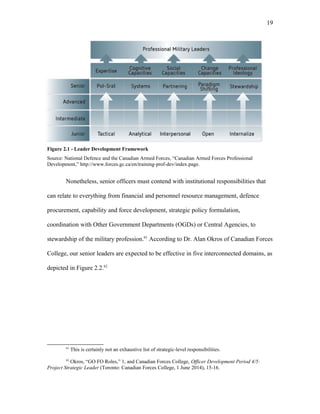
This evolution from a predominantly Leading People emphasis at junior (DPs 1
and 2) and intermediate levels (DP 3) to a predominantly Leading the Institution
commitment at advanced (DP 4) and senior levels (DP 5)58
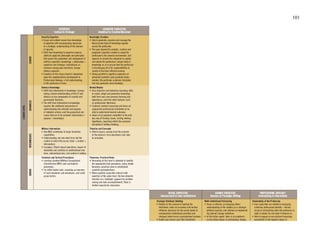
is also reflected in the CAF
Leader Development Framework (LDF), seen at Figure 2.1.59
Even though Leading the Institution is most prevalent for senior officers at the
strategic level, most military officers tend to identify with military operations first and
foremost (since this is indisputably our core business, and the Force Commander role is
the “default” one for which we prepare our leaders).60
57
Ibid., 4.
58
National Defence and the Canadian Armed Forces, “Canadian Armed Forces Professional
Development,” last accessed 14 June 2014, http://www.forces.gc.ca/en/training-prof-dev/index.page.
59
CAF Leader Development Framework is used to identify, define, and professionally enhance
the five elements required of all CAF leaders to meet current and future challenges. It reflects a coherent
conceptual framework based on five Meta-competencies which are further broken down to 17
competencies (as per last draft of Competency Dictionary). In future, it will be used for performance
appraisal, succession management and professional development. The meta-competencies are Expertise,
Cognitive Capacities, Social Capacities, Change Capacities and Professional Ideology. The Expertise meta-
competency is centered on the General System of War and Conflict as described in Leadership in the
Canadian Forces: Leading the Institution. Cognitive Capacities are developed from linear, analytic
thinking to systems thinking in order to cope with complexity. Social Capacities cover a range of
interpersonal qualities and attributes ranging from team building to cultural intelligence and partnering.
Change Capacities include the concepts underpinning the Learning Organization and risk management.
Professional Ideology embraces the concept of the CAF’s Military Ethos. (source: “Canadian Armed
Forces Professional Development,” last accessed 14 June 2014, http://www.forces.gc.ca/en/training-prof-
dev/index.page.)
60
Dr. Alan Okros, “GO FO Roles” (Powerpoint presentation to Officer DP 4/5 Working Group,
Ottawa, Ontario, 11 December 2013), 16.
18
Figure 2.1 - Leader Development Framework
Source: National Defence and the Canadian Armed Forces, “Canadian Armed Forces Professional
Development,” http://www.forces.gc.ca/en/training-prof-dev/index.page.
Nonetheless, senior officers must contend with institutional responsibilities that
can relate to everything from financial and personnel resource management, defence
procurement, capability and force development, strategic policy formulation,
coordination with Other Government Departments (OGDs) or Central Agencies, to
stewardship of the military profession.61
According to Dr. Alan Okros of Canadian Forces
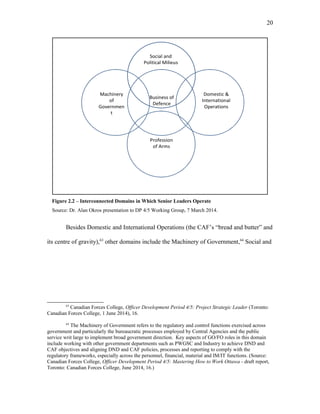
College, our senior leaders are expected to be effective in five interconnected domains, as
depicted in Figure 2.2.62
61
This is certainly not an exhaustive list of strategic-level responsibilities.
62
Okros, “GO FO Roles,” 1, and Canadian Forces College, Officer Development Period 4/5:
Project Strategic Leader (Toronto: Canadian Forces College, 1 June 2014), 15-16.
19
Social and
Political Milieus
Machinery
of
Governmen
t
Profession
of Arms
Domestic &
International
Operations
Business of
Defence
Figure 2.2 – Interconnected Domains in Which Senior Leaders Operate
Source: Dr. Alan Okros presentation to DP 4/5 Working Group, 7 March 2014.
Besides Domestic and International Operations (the CAF’s “bread and butter” and
its centre of gravity),63
other domains include the Machinery of Government,64
Social and
63
Canadian Forces College, Officer Development Period 4/5: Project Strategic Leader (Toronto:
Canadian Forces College, 1 June 2014), 16.
64
The Machinery of Government refers to the regulatory and control functions exercised across
government and particularly the bureaucratic processes employed by Central Agencies and the public
service writ large to implement broad government direction. Key aspects of GO/FO roles in this domain
include working with other government departments such as PWGSC and Industry to achieve DND and
CAF objectives and aligning DND and CAF policies, processes and reporting to comply with the
regulatory frameworks, especially across the personnel, financial, material and IM/IT functions. (Source:
Canadian Forces College, Officer Development Period 4/5: Mastering How to Work Ottawa - draft report,
Toronto: Canadian Forces College, June 2014, 16.)
20
Political Milieus,65
the Profession of Arms,66
and the Business of Defence.67
These latter
four domains relate largely to Leading the Institution, and these are the areas in which
General / Flag Officers (GO/FOs) spend most of their time.68
This work is highly
complex and demanding, with wide-ranging responsibilities in multiple areas.
For example, within and spanning across domains, Dr. Okros identifies several
key activities that must be conducted by senior leaders, including National Security
Strategy formulation, political-military interface, working with and through Central
Agencies, capability development, Force Generation, and Force Employment. These
activities present multiple complex tensions, conflicts and competing issues which must
65
The Social and Political Milieu is the realm of political decision making that shapes direction
from the government of the day. Key aspects of senior roles in this domain include the provision of
apolitical military advice, translation of political direction into strategic military guidance, contributions to
the formulations of national security strategy, inputs to the development of defence policy and liaisons with
international partners and allies. (Source: CFC, Officer Development Period 4/5: Mastering How to Work
Ottawa - draft report, 16.)
66
The Profession of Arms represents the unique facets of the CAF as a profession as articulated in
Duty with Honour, including the requirements to engage in professional self-regulation (including the
creation and updating of the profession’s theory-based body of knowledge) and to develop individual
identity and shared professional culture. Senior leader responsibilities in this domain include maintaining
the profession’s legitimacy in the eyes of the citizenry and upholding the implied social contract between
the profession and its members. (Source: CFC, Officer Development Period 4/5: Mastering How to Work
Ottawa - draft report, 16.)
67
The Business of Defence is the domain in which political direction, bureaucratic controls and
professional requirements are integrated to set the conditions for success in operations. While conducting
operations is the CAF centre of gravity, the Business of Defence is situated in the centre of the diagram
because those engaged in this broad function serve as the ‘buffers’ and filters between the effects of the
other three domains on the conduct of operations. Simply put, Force Commanders can focus on planning
and conducting operations precisely because others are working through government to acquire requisite
resources; developing military strategy to achieve political direction; reporting to government on Defence
and pan-government objectives; developing doctrine, policies and procedures; and socializing new
members into the profession. Thus, how the Defence Business is conducted and what outputs are generated
acts as a mediator between any of the other four domains. (Source: CFC, Officer Development Period 4/5:
Mastering How to Work Ottawa - draft report, 16.)
68
DND, Leadership in the Canadian Forces: Conceptual Foundations, 4, 101, and Michael K.
Jeffery, A Concept for Development Period 5: The Canadian Forces Officer Professional Development
System (Kingston, ON: Canadian Defence Academy, 2008), 6.
21
be skillfully negotiated, communicated, manoeuvred, aligned or resolved by effective
strategic leaders.69
It is also important to note that Leading the Institution is not constrained to those
positions we typically associate within the National Defence Headquarters (NDHQ)
“matrix.” In fact, it is argued that higher-level commanders employed in “typical” Force
Employment / Force Generation (FE/FG) roles at the executive level also have significant
institutional responsibilities and must thus possess superior strategic leadership
competencies.
For example, even though the Commander RCAF is the Air Force’s ultimate
leader in the chain of command and holds important duties related to Leading People, his
attention is arguably most intensely focused on institutional matters due to his strategic
level functions (involving longer term planning horizons, capability development,
strategic Air Force policy formulation and alignment, inter-relationships and
interdependence with NDHQ matrix Institutional leaders, etc.) His position also entails
dealing with complexity and ambiguity while prioritizing and managing an impressive
array of strategic level responsibilities. Among other things, this demands effective
strategic communication, strong analytical capabilities and high-level interpersonal skills
in leading and aligning organizational change while regularly engaging with stakeholders
external to the CAF to advance the RCAF’s interests (including Defence bureaucrats,
ministerial staffs, OGDs, Central Agencies, as well as Parliament itself.)
As such, regardless of whether we are building a general officer for “pure”
NDHQ Institutional responsibilities (outside the Component Command) or for the high-
level command positions within the RCAF in a FE/FG domain, strategic leadership
69
Okros, “GO FO Roles,” 3-14.
22
competencies are a necessity. This is also reflected in Conceptual Foundations, which
urges the development of strategic-level competencies and skills for CAF leaders
demonstrating potential for senior command or senior staff positions.70
As such, this
paper will generally use the term “strategic leadership” as opposed to “Institutional
leadership,” as the latter is essentially a subset of the former.
Strategic vs. Operational Level: Two Different Animals
In determining what is required to operate effectively at the strategic level, it is
imperative to recognize that the strategic function is fundamentally different from the
tactical / operational one.71
As per Conceptual Foundations:
Leadership at the tactical and operational levels is primarily about
accomplishing missions and tasks through direct influence on others. In
higher headquarters, or at the strategic level of the [Canadian Forces] CF,
leadership requires a broader perspective and is uniquely about developing
and maintaining the capabilities that will enable success at the tactical and
operational levels of command, both today and tomorrow… Influence on
organizational performance at this level is typically indirect. The objective
of strategic leadership is to ensure the long-term effectiveness of the CF:
through internal integration and management of organizational systems,
and by positioning the CF favourably in relation to its environment.
Leadership at this level both supports national-strategic interests and is
concerned with acquiring and allocating military-strategic capabilities.
Leadership at this level is also occupied with the professional health of the
CF. In this sense, institutional leadership… encompasses both
organizational and professional functioning.72
In the Australian Defence Force’s (ADF) study of strategic leadership, the table
represented as Table 2.1 was used to demonstrate the major features / differences
between working at the unit level (operational) and working within the Defence
70
DND, Leadership in the Canadian Forces: Conceptual Foundations, 4.
71
Michael K. Jeffery, A Concept for Development Period 5: The Canadian Forces Officer
Professional Development System (Kingston, ON: Canadian Defence Academy, 2008), 9-12.
72
DND, Leadership in the Canadian Forces: Conceptual Foundations, 98.
23
bureaucracy (strategic, institutional).
Table 2.1 – Differences Between Working in Units and Working in the Bureaucracy
Work environment
feature
In units:
“Tightly Focused Professionalism”
In the bureaucracy:
“Dealing with the BIG Issues”
Performance
Criteria
Adherence to well-developed
doctrine and skills
Meeting tangible and usually
measurable objectives
Economic, political and “rational”
criteria are given much weight
Objectives are often somewhat
intangible
Decision Making Decisive
Based on professional judgement,
traditions and doctrine
Strong concern for doing the right
thing by members at all levels
Often protracted
Often based on negotiation and
small-p political factors
People are simply one of many
resources to be managed efficiently
Organization and
Process
Hierarchical but simple
Most members well trained,
experienced and committed
The wheels of process are oiled by
solid professional relationships,
built up by frequent contact
Hierarchical and complex
Many staff unfamiliar with their
functions and don’t expect
continuity
Solid relationships are more
difficult to generate
Source: adapted from The Chiefs: A Study of Strategic Leadership, 30.
The fact that the strategic and operational levels are different animals -- thus
requiring different skill sets -- is not a new phenomenon. Reflecting on his early years in
his strategic-level position as Chief of Staff of the U.S. Army in WWII, General George
C. Marshall73
observed:
It became clear to me [as the Chief of Staff of the Army]… I would have
to learn new tricks that were not taught in the military manuals or on the
battlefield. In this position [as a strategic leader] I am a political soldier
and will have to put my training in rapping-out orders and making snap
decisions on the back burner; and have to learn the arts of persuasion and
guile. I must become an expert in a whole new set of skills.74
73
Marshall was renowned for overseeing the massive expansion of the U.S. Army, being chief
architect of war plans to defeat the Axis powers following the bombing of Pearl Harbour, and being chief
military advisor to president Franklin D. Roosevelt during the Second World War.
74
United States Army War College, Strategic Leadership Primer, 3rd
ed., ed. Stephen J. Gerras
(Carlisle Barracks, PA: United States Army War College, 2010), 1.
24
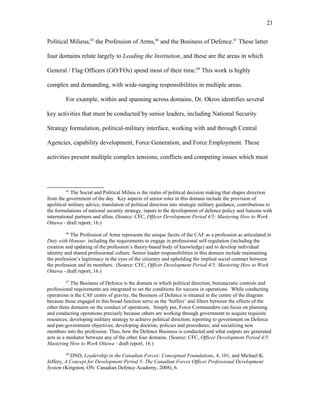
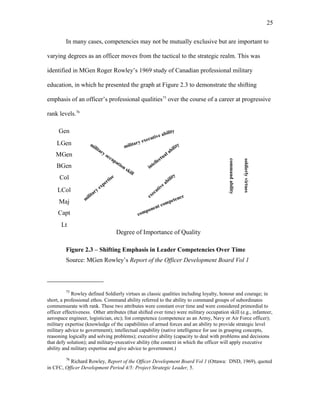
In many cases, competencies may not be mutually exclusive but are important to
varying degrees as an officer moves from the tactical to the strategic realm. This was
identified in MGen Roger Rowley’s 1969 study of Canadian professional military
education, in which he presented the graph at Figure 2.3 to demonstrate the shifting
emphasis of an officer’s professional qualities75
over the course of a career at progressive
rank levels.76
intellectual abilitymilitary executive abilityGen
LGen
MGen
BGen
Col
LCol
Maj
Capt
Lt
executive ability
military occupation skill
component competence
m
ilitary expertise
commandability
soldierlyvirtues
Degree of Importance of Quality
Figure 2.3 – Shifting Emphasis in Leader Competencies Over Time
Source: MGen Rowley’s Report of the Officer Development Board Vol 1
75
Rowley defined Soldierly virtues as classic qualities including loyalty, honour and courage; in
short, a professional ethos. Command ability referred to the ability to command groups of subordinates
commensurate with rank. These two attributes were constant over time and were considered primordial to
officer effectiveness. Other attributes (that shifted over time) were military occupation skill (e.g., infanteer,
aerospace engineer, logistician, etc); list competence (competence as an Army, Navy or Air Force officer);
military expertise (knowledge of the capabilities of armed forces and an ability to provide strategic level
military advice to government); intellectual capability (native intelligence for use in grasping concepts,
reasoning logically and solving problems); executive ability (capacity to deal with problems and decisions
that defy solution); and military-executive ability (the context in which the officer will apply executive
ability and military expertise and give advice to government.)
76
Richard Rowley, Report of the Officer Development Board Vol 1 (Ottawa: DND, 1969), quoted
in CFC, Officer Development Period 4/5: Project Strategic Leader, 5.
25
The U.S. Army’s Strategic Leadership Primer that came many years after
Rowley’s assessment also supports the latter’s assertions. The Primer states that some
competencies are fundamental to all leadership levels (like those described by Rowley as
Command Ability and Soldierly Virtues), but there also exist qualitative differences and
emphasis on other competencies as the officer progresses to the strategic level:
Strategic leader competencies are often no different than the same abilities
required to be a leader at any level. However, some strategic leader
competencies are qualitatively different and new. For instance, strategic
leaders not only need to have the skills required to lead and take care of
their subordinates, they also need to be able to envision long range future
requirements and to apply integrative thinking skills.77
Retired Lieutenant-General Michael Jeffery’s 2008 report on executive leadership
development also stated that these qualitatively different strategic-level competencies
clearly differentiated the operational leader from the strategic one; and as such, one size
does not fit all.78
Canadian leadership doctrine continues to reflect the qualitative competency
transition Rowley’s report described 45 years ago. It cites an increased emphasis and
importance (at senior leadership levels) in being able to handle abstract concepts, in
addition to a having a broader repertoire of social-influence and communication skills in
managing inter- and intra-departmental relationships and leading strategic change.79
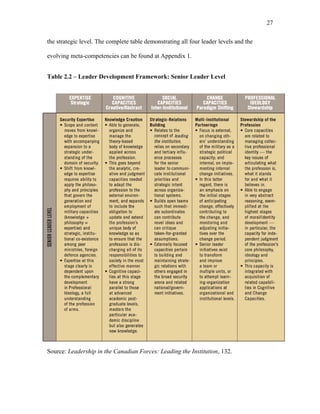
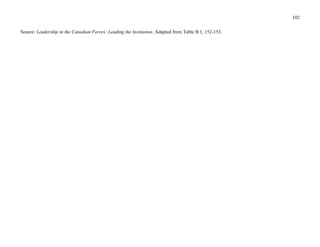
These higher-level competencies are reflected in Table 2.2, which breaks down the LDF
meta-competencies and describes what is expected of senior leaders in their transition to
77
USAWC, Strategic Leadership Primer, 3rd
ed., 28.
78
Jeffery, A Concept for Development Period 5..., 16.
79
Department of National Defence, A-PA-005-000/AP-003 Leadership in the Canadian Forces:
Doctrine (Canadian Defence Academy, 2005), 19.
26
the strategic level. The complete table demonstrating all four leader levels and the
evolving meta-competencies can be found at Appendix 1.
Table 2.2 – Leader Development Framework: Senior Leader Level
Source: Leadership in the Canadian Forces: Leading the Institution, 132.
27
It should therefore be clear that the demonstration of excellence at a lower level
does not necessarily translate to effectiveness at the strategic level.80
For example, a
person can operate brilliantly as a Major at the tactical level by virtue of technical
proficiency (e.g., excellent pilot – with consequent high level of credibility as an
operator), strong leadership (effectively using direct influence to lead a team of
subordinates and achieve mission success), and good analytical skills (e.g., aptly defining
the tactical problem space). However, that same person may not necessarily excel at the
strategic level if his/her cognitive capacities cannot expand to the creative / abstract level
necessary to deal with uncertain situations when information is ambiguous or lacking, or
if his/her social skills do not lend themselves to building strategic relationships with those
outside his/her sphere of influence.81
This is not to understate the importance of tactical or operational leadership
experience or excellence. In fact, successful operational command is a basic testing
ground for Leading People. It is considered a critical experience that is fundamental to
credibility82
and provides an important basis for understanding the challenges and needs
of the ‘clients’ the strategic level aims to ultimately serve. In the military context,
Leading People is a no-fail mission, so only those demonstrating excellence should be
considered for further advancement. As such, operational command is both the litmus test
of Leading People and serves as an integrator with the strategic level.
80
Dr. Alan Okros, Leadership in the Canadian Military Context (Kingston, ON: Canadian Forces
Leadership Institute, 2010), 32-36.
81
Jeffery, A Concept for Development Period 5..., 10.
82
Michael K. Jeffery and Fred Sutherland, The CF Executive Development Programme:
Programme Development Study (Kingston, ON: Canadian Defence Academy, 2010), 10.
28
That said, it is not necessarily an effective predictor of strategic-level excellence,
since not everyone is capable of the competency shift (between operational and strategic
levels) previously described. In fact, this is far from being an easy transition and in many
cases can prove to be counterintuitive. The Australian Defence Force’s (ADF) study of
strategic military leadership, The Chiefs, describes part of the challenge when a
fundamental change in approach is required that can run contrary to learned responses
and previous operational training:
The ADF prides itself on giving its officers good training and experience.
Both by selection and training, it leans towards officers capable of crisp
decision-making and decisive action, attributes essential to success – and
often to survival – in combat at sea, on land or in the air. Ironically,
however, such an orientation can at times be as much a hindrance as a help
at the highest levels. Well-grooved habits can be hard to break when
‘Don’t just stand there, do something’ needs to give way to ‘Don’t just do
something, stand there – and think and engage others in thinking.’83
This argument is supported by Dr. Okros’ work, which contends that certain
competencies or strengths demonstrated in operational command can actually generate
characteristics that may prove to be highly unproductive when shifting to the strategic
level. In fact, he states that success in institutional leadership can actually require the un-
learning of attributes that enabled past operational success. These include (but are not
limited to) misplaced confidence and an inability to recognize the necessity of adopting
new styles in a different environment; an overwhelming focus on getting the job done;
the use of a controlling leadership style when more open and participatory styles would
be more effective; and acting independently when issues impact on the responsibilities of
others – described eloquently as a failure to shift C2 perspective from one of “command
83
Nicholas Jans with Stephen Mugford, Jamie Cullens and Judy Frazer-Jans, The Chiefs: A Study of
Strategic Leadership (n.p.: Australian Defence College, 2013), 111.
29
and control” (in the operational environment) to “consultation and compromise” (in the
strategic environment).84
This complex transition between levels requires the development of new
perspectives and capacities,85
and the associated competency developments represent a
significant developmental undertaking requiring “concurrent intellectual expansions,” as
per Dr. Okros. This includes mental shifting across all three major academic disciplines,
moving from an engineering-based approach at the tactical level (applying known
procedures to address issues), to science-based at the operational level (using structured
analysis to develop plans and update procedures) – and finally to liberal arts-based at the
strategic level (analyzing complex problems to establish guidance).86
At the same time, moving to the strategic realm requires an expansion of “the
focus of mastery”-- from the military arena (at Colonel level) to that of Defence (at
Brigadier-General) to the broader domains of security (at Major-General), before
culminating at the three-star level with mastery of the full spectrum of government
objectives.87
In other words, moving from the tactical to the strategic realm is not a linear,
straightforward, or simple evolution. In fact, only a select few can do it very effectively.
A key aim of selection (in the succession planning process) should therefore be to
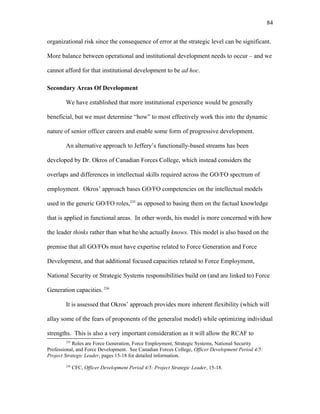
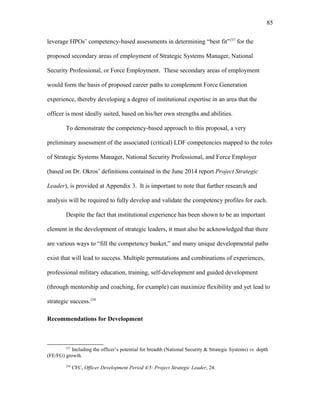
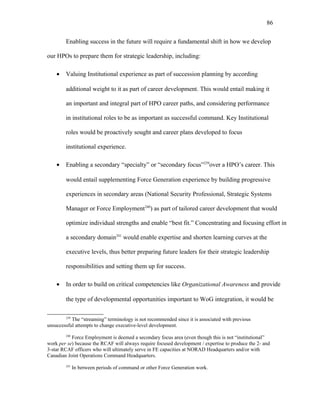
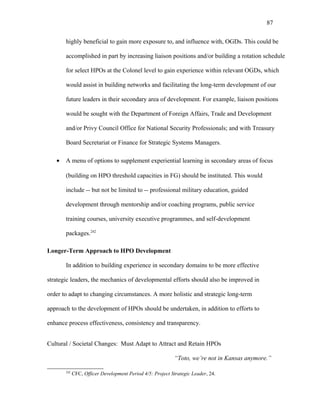
find those “select few” who are most likely able to make that difficult transition. To do
this, however, it is necessary to identify the competencies that are critical to strategic
leadership, and then assess HPOs against the appropriate criteria.
84
Okros, Leadership in the Canadian Military Context, 33-35.
85
Ibid., 32.
86
Ibid., 39.
87
Ibid., 40.
30
In line with this, an assessment of critical strategic leadership competencies will
be made in the following chapter via analysis of the environment in which our future
leaders will operate. This assessment will also consider numerous research reports by
Canadian and Allied Forces regarding strategic military leadership.
31
CHAPTER 3
STRATEGIC COMPETENCIES ANALYSIS
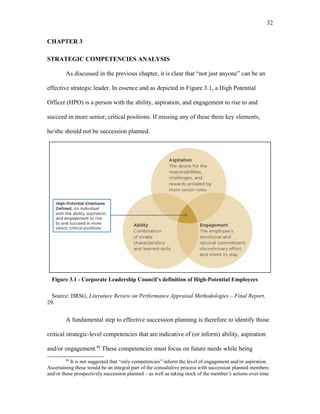
As discussed in the previous chapter, it is clear that “not just anyone” can be an
effective strategic leader. In essence and as depicted in Figure 3.1, a High Potential
Officer (HPO) is a person with the ability, aspiration, and engagement to rise to and
succeed in more senior, critical positions. If missing any of these three key elements,
he/she should not be succession planned.
Figure 3.1 - Corporate Leadership Council’s definition of High-Potential Employees
Source: HRSG, Literature Review on Performance Appraisal Methodologies – Final Report,
29.
A fundamental step to effective succession planning is therefore to identify those
critical strategic-level competencies that are indicative of (or inform) ability, aspiration
and/or engagement.88
These competencies must focus on future needs while being
88
It is not suggested that “only competencies” inform the level of engagement and/or aspiration.
Ascertaining these would be an integral part of the consultative process with succession planned members
and/or those prospectively succession planned – as well as taking stock of the member’s actions over time
32
consistent with the CAF Leader Development Framework (LDF) in order to harmonize
the RCAF’s succession planning with upcoming changes to performance appraisal and
professional development. From these competencies, the RCAF’s succession planning
(selection and validation) criteria should flow.
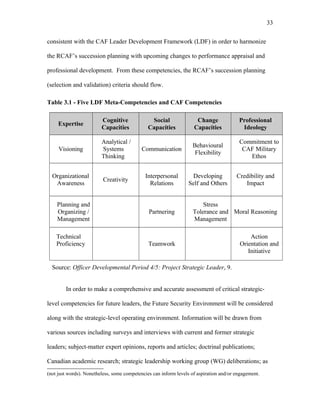
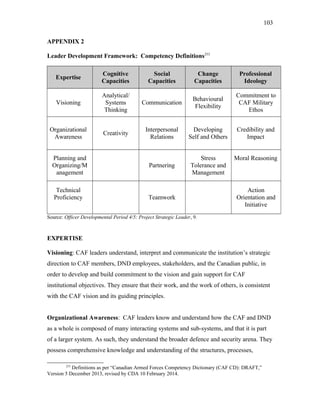
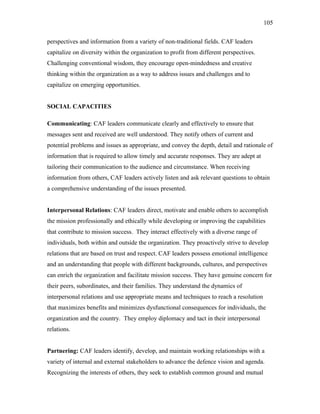
Table 3.1 - Five LDF Meta-Competencies and CAF Competencies
Expertise
Cognitive
Capacities
Social
Capacities
Change
Capacities
Professional
Ideology
Visioning
Analytical /
Systems
Thinking
Communication
Behavioural
Flexibility
Commitment to
CAF Military
Ethos
Organizational
Awareness
Creativity
Interpersonal
Relations
Developing
Self and Others
Credibility and
Impact
Planning and
Organizing /
Management
Partnering
Stress
Tolerance and
Management
Moral Reasoning
Technical
Proficiency Teamwork
Action
Orientation and
Initiative
Source: Officer Developmental Period 4/5: Project Strategic Leader, 9.
In order to make a comprehensive and accurate assessment of critical strategic-
level competencies for future leaders, the Future Security Environment will be considered
along with the strategic-level operating environment. Information will be drawn from
various sources including surveys and interviews with current and former strategic
leaders; subject-matter expert opinions, reports and articles; doctrinal publications;
Canadian academic research; strategic leadership working group (WG) deliberations; as
(not just words). Nonetheless, some competencies can inform levels of aspiration and/or engagement.
33
well as research-based reports from Allies. Resulting information will then be mapped
against competencies identified as part of the LDF, whose broad categories are listed in
Table 3.1. The associated generic competency definitions (as per the most recent
Competency Dictionary sent to CAF members for validation in spring 2014) can be
found at Appendix 2.
Future Security Environment
In the kind of complex changing environment in which the CF will be
operating in the next decade or more, leaders will have to be more
analytical, flexible and creative.
- Leadership in the Canadian Forces: Conceptual Foundations
The United States National Intelligence Council’s December 2012 report, Global
Trends 2030, points to complex trends that will shape the future international
environment and subsequently impact the security domain. These include (but are not
limited to) increasingly empowered individuals with greater access to technologies that
could enable large-scale violence; global power shifts to multipolarity and away from
American hegemony; the potential for increased conflict and regional instability;
instabilities to the global economic order; and shifting demographics (aging, migration
and growing urbanization) that will cause global workforce and resource shortages.89
In addition to these global trends, we will likely be contending with occurrences
that are referred to as “Black Swans” -- very rare and completely unpredictable events
whose impact is extreme.90
The term was introduced in 2007 by Nassim Nicholas Taleb,
89
Office of the Director of National Intelligence, Global Trends 2030: Alternative Worlds
(Washington, DC: U.S. Government Printing Office, December 2012), ii-xii,
http://www.dni.gov/files/documents/GlobalTrends_2030.pdf.
90
Despite their outlier/unpredictable nature, attempts are made to rationalize or explain a Black
Swan after the fact (even though nothing in the past could have convincingly pointed to its possibility.)
34
a scholar of Risk and Applied Probability -- who categorized events like 9/11, World
War I, Hitler’s ascent and the Second World War, and the rise of Islamic fundamentalism
as “Black Swans.” Taleb claims the effect of Black Swans began accelerating during the
industrial revolution -- correlating with an increasingly complicated world -- while
ordinary events (the ones regularly studied and discussed, from which predictions are
made), have become increasingly inconsequential.91
Ironically, despite the fact that Taleb’s Black Swans are (by definition)
unpredictable events -- we can predict that they are virtually certain to figure into the
future. Considering this and as if to underline the precarious instability of the FSE, the
US Army War College’s Strategic Leadership Primer unequivocally stated, “Strategic
leaders must succeed in an environment marked by volatility, uncertainty, complexity,
and ambiguity (VUCA).”92
In line with this, a Chief of Force Development (CFD) Directorate of Capability
Integration assessment in December 2013 noted that in order to contend with the FSE
within the coming decades (up to 2040), strategic leaders will require increased adaptive
skills and an ability to understand “Wicked Problems” which will figure prominently into
the future. 93
These Wicked Problems, which include things like poverty and terrorism,94
are sometimes described as unsolvable issues whose key characteristics include:
91
Nassim Nicholas Taleb, “The Black Swan: The Impact of the Highly Improbable,” New York
Times, 22 April, 2007, http://www.nytimes.com/2007/04/22/books/chapters/0422-1st-tale.html?
pagewanted=1&_r=0.
92
USAWC, Strategic Leadership Primer, 3rd
ed., 11.
93
Colonel Derek Basinger, “Future Security Environment” (Directorate of Capability Integration
presentation to Officer DP4/5 Working Group, Ottawa, Ontario, 11 December 2013).
94
Camillus, “Strategy as a Wicked Problem,” Harvard Business Review, May 1, 2008,
http://hbr.org/2008/05/strategy-as-a-wicked-problem/ar/1.
35
… that they are difficult to define, have many inter-dependencies and
causes, have neither pre-determined solution sets nor clear stopping rules,
involve changing social behaviour, that solving one wicked problem
requires addressing other wicked problems, and that solutions often lead to
unforeseen consequences.95
Contending with these Wicked Problems will require advanced and creative
thinking skills, since the misguided attempt to tackle them using standard processes96
could actually result in aggravating the situation, according to a 2008 Harvard Business
Review article:
A wicked problem has innumerable causes, is tough to describe, and
doesn’t have a right answer… They’re the opposite of hard but ordinary
problems, which people can solve in a finite time period by applying
standard techniques. Not only do conventional processes fail to tackle
wicked problems, but they may exacerbate situations by generating
undesirable consequences.97
The Information Age adds an additional layer of complexity that must be handled
effectively, and as such, CFD points to the requirement for future leaders to be capable of
leading in a rapidly-evolving strategic communications environment that is cyber-
enabled, social media friendly, and fluid.98
Their analysis also asserts that the FSE will
require a deeper understanding of the human terrain and the complexity of the Global
Commons as new regional actors become global, new non-state actors emerge,99
while
95
Okros, Leadership in the Canadian Military Context, 38.
96
Which would be using the engineering or science-based approaches common to tactical or
operational levels, as described by Okros.
97
Camillus, “Strategy as a Wicked Problem,” http://hbr.org/2008/05/strategy-as-a-wicked-
problem/ar/1.
98
Basinger, “Future Security Environment” presentation.
99
Basinger, “Future Security Environment” presentation.
36
older global powers reassert themselves. Indeed, we may be facing nothing short of a
new world order with which to contend.100
Since the reliance on standard processes can sometimes do more harm than good,
previous experience can be of limited assistance in this VUCA environment. It is
important for the strategic leader to have the humility to accept this and to recognize that
conventional techniques may not work, thus encouraging and seeking out fresh
perspectives -- knowing that the whole is bigger than the sum of its parts (Creativity).
It is also clear that strategic leaders facing the complexities of the FSE require
exceptional cognitive capacities to properly assess Wicked Problems, and the intellectual
agility to process information rapidly from multiple sources – while resisting knee-jerk
reactions and instead engaging in careful analysis to foresee longer-term impacts and
second- and third-order effects in a rapidly changing environment (Analytical / Thinking
Skills). Coupled with this would be the flexibility and adaptability required to adjust
course in consequence, all while managing uncertainty (Behavioural Flexibility).
The requirement for this type of adaptive, creative and intellectually agile
leadership was also identified in retired LGen Michael Jeffery’s 2008 report101
and
subsequently validated by the DP 4/5 Working Group in 2014 that assessed strategic
100
The Economist, “Diplomacy and Security After Crimea: The New World Order,” March 22,
2014, http://www.economist.com/news/leaders/21599346-post-soviet-world-order-was-far-perfect-
vladimir-putins-idea-replacing-it.
101
Jeffery, A Concept for Development Period 5…, 9-10.
37
leader development.102
Recent analyses by American103
and Australian104
Allies also point
to the critical nature of these competencies in meeting the complex challenges of the 21st
century.
In terms of military alliances, CFD’s analysis projects that Canada will continue
working with key Allies (U.S., NATO, Five-Eyes and UN).105
Operating effectively
within these groups in future will also require Behavioural Flexibility (adaptability and
flexibility of approach as required with different groups or contexts), and Organizational
Awareness (understanding structures, processes, interrelationships and key players, in
addition to comprehending DND’s role within the larger system – and leveraging this to
effect.) Interpersonal and Partnering competencies will also be in high demand in the
building of strategic relationships with key stakeholders and adeptly exerting indirect
influence.
In short, the increasingly complex FSE will demand the prioritization of certain
competencies that will be essential to future success. HPOs will have to possess superior
cognitive capacities and the intellectual agility necessary to manage Wicked Problems;
they must be highly adaptive in a rapidly changing external environment; and they must
possess the superior social skills necessary to build effective strategic relationships and
influence players they do not control.
102
Brigadier-General J.R. Giguère, “DP 4/5 Review Working Group Brief to Commander CDA,”
Powerpoint Presentation dated 11 April 2014; and DP 4/5 Working Group, “The Competency Gaps –
Annex C to the Jeffery Report: With Additional Gap Analysis from 2014 Working Group,” version 1.6, 24
March 2014.
103
David Barno, Nora Bensahel, Katherine Kidder and Kelley Sayler, Building Better Generals
(Washington, DC: Center for a New American Security, 2013), 5.
104
Jans, The Chiefs: A Study of Strategic Leadership, 17.
105
Basinger, “Future Security Environment” presentation.
38
Critical Competencies:
• Analytical / Systems Thinking
• Creativity
• Behavioural Flexibility
• Organizational Awareness
• Interpersonal Relations
• Partnering
Strategic Operating Environment
From a systems and organizational viewpoint, strategic leaders shape and
influence the operational and tactical levels. Conceptual Foundations explains there are
four general ways in which senior leaders exercise strategic leadership, which ultimately
create the conditions for operational and professional success. These include:
• adapting to the external environment (through strategic planning and the
initiation and implementation of strategic change);
• influencing the external environment (through direct advice and influence,
public affairs activities, strategic partnerships, and professional networking);
• achieving alignment across the organization (through the communication of
strategic intent, the formalization of policy and doctrine, control of activities
and resources, and active performance management); and
• exercising stewardship of the profession (through the strengthening of
professional capabilities and culture.)106
Although stated differently, these are consistent with the main tasks of strategic
leadership according to the U.S. Army’s Strategic Leadership Primer, which include
providing vision; shaping culture; building and shaping joint, inter-agency, multinational
106
DND, Leadership in the Canadian Forces: Conceptual Foundations, 100.
39
and intra-agency relationships; building and shaping national-level relationships;
representing the organization; and leading and managing change.107
In accordance with the complexity of these tasks and as stated in Chapter 2, the
challenges of working at the strategic and operational levels are qualitatively different.
Retired Lieutenant-General Jeffery’s 2008 report bluntly stated, “The skills and aptitudes
required of strategic leaders are far different from those of an operational commander and
in many ways harder to find.”108
As discussed in the previous chapter and consistent with
Rowley’s analysis, although competencies may not necessarily be mutually exclusive
between different functional levels (e.g., a leader must always behave ethically and be
able to lead people effectively), several critical competencies shift as an officer moves
from the tactical to the strategic realm.109
This is also in line with consistent with Jaques’ Stratified Systems Theory, which
states that leaders at the strategic level require “higher levels of cognitive complexity –
the ability to deal with abstract, longer timeframe concepts.” 110 111
According to
Conceptual Foundations, senior leaders have no choice but to be agents of change, and
Analytical / Systems Thinking is fundamental to this role. This is because systems
thinking examines the profound interconnectedness of things and thus considers how the
107
USAWC, Strategic Leadership Primer, 3rd
ed., 48.
108
Jeffery, A Concept for Development Period 5..., 16.
109
Some competencies that may be fundamental at the tactical level play less importance at the
strategic level (like Technical Proficiency), and vice versa (like Analytical/Systems Thinking and
Behavioural Flexibility).
110
Stratified Systems Theory argues there are critical tasks that must be performed by leaders in
effective organizations, and that at each higher organizational level, these tasks become increasingly
complex and qualitatively different. Consequently, strategic-level leaders (being at the upper rungs of the
organization) must have higher cognitive skills to deal with abstract and longer-timeframe concepts.
111
USAWC, Strategic Leadership Primer, 3rd
ed., Appendix 1, 59.
40
discrete parts of a system interact with and affect the whole. This is critical to strategic-
level analysis of complex problems since it can avoid (at least) two kinds of traps --
treating symptoms which may only be masking a festering problem; and/or creating
partial fixes that can eventually result in adverse consequences elsewhere in the system
(i.e., further downstream.)112
LGen Jeffery’s 2008 analysis of executive-level development came to a similar
conclusion regarding the absolute importance of Analytical / Systems Thinking,113
which
was also deemed critical by the U.S. Army (as part of the “mental agility” strategic
leadership meta-competency).114
At the strategic level, however, “50-pound brains” do not reflect the full
competency picture. Social and strategic communication skills are also fundamental in
order to forge strategic partnerships in the increasingly pervasive multi-agency
environment. Consistent with the governments of our closest allies including the United
States,115
the United Kingdom116
and Australia,117
the Government of Canada (GoC) is
progressively geared toward increased coordination, integration, and synergy of effort
between its government departments with the aim of generating greater strategic effects.
The surge of the 3D approach (Diplomacy, Defence, Development) as first described in
112
DND, Leadership in the Canadian Forces: Conceptual Foundations, 105.
113
Jeffery, A Concept for Development Period 5..., 10.
114
USAWC, Strategic Leadership Primer, 3rd
ed., 62-63.
115
United States, Office of the President of the United States, National Security Strategy
(Washington, DC: U.S. Government Printing Office, 2010), 26.
116
United Kingdom, Ministry of Defence, Securing Britain in an Age of Uncertainty: The
Strategic Defence and Security Review (London: The Stationery Office Limited, 2010), 44.
117
Jans, The Chiefs: A Study of Strategic Leadership, 107.
41
the Liberal Government’s 2005 International Policy Statement118
has progressively
expanded under the Conservatives to a Whole of Government (WoG) approach, as
depicted in its most recent defence policy document, the Canada First Defence
Strategy.119
Indicative of a fundamental strategic shift from the past when military leaders
were more apt to “stick to their knitting” of military operations and working in more
relative independence from Other Government Departments (OGDs), today’s strategic
military leaders are increasingly required to integrate and excel within the complex,
ambiguous, horizontally-demanding environment of bureaucracy and government.
Furthermore, all indications are the government’s security agenda will continue to
encourage increased integration amongst its departments.120
As this comprehensive approach (requiring pan-governmental engagement) is also
a reality for many of our closest Allies, it is no surprise that it is also reflected in their
strategic leadership analyses. As per the U.S. report Building Better Generals, “Senior
military officers must be more capable than ever at navigating the complex interagency
and political environments of Washington, as civilian policymakers seek to leverage all
elements of national power.”121
For its part, the Australian report The Chiefs noted the
relative importance of social skills, strategic relationship building and nuanced political
acumen in this environment as it explained “…Getting things done within a complex
118
Government of Canada, Canada’s International Policy Statement: A Role of Pride and
Influence in the World – Defence (Ottawa, 2005), 6, http://publications.gc.ca/collections/Collection/D2-
168-2005E.pdf.
119
Department of National Defence, Canada First Defence Strategy (Ottawa: DND Canada,
2008), 3-4.
120
Basinger, “Future Security Environment” presentation.
121
Barno, Building Better Generals..., 8.
42
bureaucracy requires the ability to influence in the absence of formal authority, through
coalition building, networking, negotiating and the exercise of small ‘p’ political
skills.”122
It is therefore clear that in the WoG context, senior leaders cannot “order” or even
rely on the privileges of their rank to influence stakeholders in this type of multi-agency
environment where partnering, interpersonal and strategic communication skills are
fundamental to success. Simply put, this is an area in which the very decisive operational
commander’s “Bull in a China Shop” approach can be counterproductive. As per the U.S.
Army War College’s Strategic Leadership Primer:
… Tasks must be accomplished collaboratively rather than through
individual effort… Strategic leaders must develop the ability to
collaborate, cooperate, and compromise to influence external agencies.
Outside the organization, when rank and position become less compelling,
leaders must employ tact, persuasion, and sound argumentation.”123
The Australian study further describes the strategic work environment as one
requiring innovative approaches where multiple points of view are considered and
appreciated (reflecting Creativity and Behavioural Flexibility), needing
… leaders who are comfortable with novelty, who are alert to the
possibilities presented by alternatives, can see a problem in terms of its
broad dimensions and context, and can appreciate and take account of the
perspectives of different stakeholders.124
The aforementioned competencies125
are also consistent with Jeffery’s work which
was largely validated by the 2014 DP 4/5 WG.126
In addition, Jeffery stressed the
122
Jans, The Chiefs: A Study of Strategic Leadership, 2.
123
USAWC, Strategic Leadership Primer, 3rd
ed., 12.
124
Jans, The Chiefs: A Study of Strategic Leadership, 31.
125
As well as associated gaps in current GO/FO development.
126
CFC, Officer Development Period 4/5: Project Strategic Leader, 13-14.
43
importance of having a broader perspective and understanding of the strategic
environment in Ottawa in order to operate effectively at the institutional level.127
This
requires the cultural intelligence necessary to understand, respect and value varying
professional perspectives, to decipher and consider interrelationships between key players
-- along with an associated sensitivity to small “p” political realities (Interpersonal,
Behavioural Flexibility, Organizational Awareness). It also demands an ability to work
collaboratively with diverse groups by liaising, persuading and cooperating in order to
create, sustain and leverage strategic partnerships to advance CAF priorities (Partnering).
All that said, as a military force, we don’t just want to create a senior officer who
is a bureaucrat and ‘political operative’ – more precisely, we need to develop the strong
leader who can adapt his/her approach to the applicable circumstance or context. As
reflected by the Chief of the Australian Defence Force in The Chiefs report, “Leaders
must be able to lead but they must also be ready to liaise, persuade and cooperate,
however alien the protagonist or strange the environment.”128
These competencies are
vital within a progressively integrated WoG environment.
In addition, Jeffery’s analysis pointed to the need for excellent change capacities
in the strategic leader – as the obvious change agent and facilitator, but also as a
professional recognizing the need to adapt personally (Behavioural Flexibility,
Developing Self & Others). He noted this requires humility and self-awareness in order
to recognize personal strengths and weaknesses -- in addition to having the openness to
develop compensating strategies to address gaps and mitigate deficiencies.129
These gaps
127
Jeffery, A Concept for Development Period 5..., 8-9.
128
General David Hurley, in The Chiefs: A Study of Strategic Leadership, Foreword.
129
This is reflective of the “developing self” part of “Developing Self and Others.”
44
are somewhat inevitable in such a complex strategic environment and are exacerbated by
the fact that current strategic leadership development favours the Generalist approach,
which does not facilitate institutional expertise.130
Emotional Intelligence
In discussing critical competencies in the context of the strategic operating
environment, we would be remiss to exclude a discussion related to Emotional
Intelligence (EQ), which is highly correlated to successful strategic leadership, being the
“single biggest predictor of performance in the workplace and the strongest driver of
leadership and personal excellence.”131
When we consider its components, we can
intuitively understand why this is so, as EQ comprises Self-Awareness, Self-Regulation,
Motivation, Empathy, and Social Skill (further defined in Table 3.2).132
In addition to EQ being vital to leadership effectiveness in general, extensive
research has found it to be increasingly critical at the highest levels of an organization;
i.e., the higher the relative position of the leader, the more important EQ is to success. In
other words, effective leadership at the top of the pyramid demands more EQ.133
As such,
EQ should be considered in the context of the strategic operating environment, where it
will be required “in spades.” A mapping of EQ to LDF produced the following results.
Table 3.2 – Emotional Intelligence Mapped to LDF Competencies
130
Jeffery, A Concept for Development Period 5..., 11-12.
131
Travis Bradberry and Jean Greaves, Emotional Intelligence 2.0 (San Diego: TalentSmart,
2009), 20-21.
132
Daniel Goleman, “What Makes a Leader?” Harvard Business Review OnPoint: Emotional
Intelligence: The Essential Ingredient to Success (Summer 2014): 24-33.
133
Tomas Chamorro-Premuzic, “Can You Really Improve Your Emotional Intelligence?”
Harvard Business Review OnPoint: Emotional Intelligence: The Essential Ingredient to Success (Summer
2014): 10-12.
45
EQ
Component
Definition Hallmarks
Self-
Awareness
Ability to recognize and understand
own moods, emotions and drives, as
well as their effect on others
[Interpersonal Relations;
Developing Self & Others]
- Self-confidence
[Credibility & Impact]
- Realistic Self-Assessment
[Developing Self & Others]
- Self-Deprecating Sense of Humour
[most closely associated with Interpersonal
Relations, but also part of the humility required
in Developing Self & Others]
Self-
Regulation
Ability to control or redirect disruptive
impulses and moods; propensity to
suspend judgement – to think before
acting [Interpersonal Relations]
- Trustworthiness & Integrity
[Moral Reasoning; Interpersonal Relations]
- Comfort with Ambiguity
[Behavioural Flexibility]
- Openness to Change [Behavioural Flexibility]
Motivation A passion to work for reasons beyond
status or money [most associated with
Commitment to Military Ethos;
Developing Self & Others];
A propensity to pursue goals with
energy and persistence
[Stress Tolerance & Management;
Action Orientation & Initiative]
- Strong Drive to Achieve
[Action Orientation & Initiative]
- Optimism, even in the face of failure
[Stress Tolerance & Management;
Interpersonal Relations]
- Organizational Commitment
[Commitment to Military Ethos]
Empathy Ability to understand other people’s
emotional makeup; skill in treating
people according to their emotional
reactions
[Interpersonal Relations]
- Expertise in Building and retaining talent
[Developing Self & Others]
- Cross-Cultural Sensitivity [Behavioural
Flexibility; Interpersonal Relations]
- Service to Clients and Customers
[most closely related to Interpersonal
Relations; Credibility & Impact; Action
Orientation and Initiative]
Social Skill Proficiency in managing relationships
and building networks
[Interpersonal Relations; Partnering];
Ability to find common ground and
build support [Partnering]
- Effectiveness in Leading Change
[Behavioural Flexibility]
- Persuasiveness [Credibility & Impact]
- Expertise in Building and Leading Teams
[Teamwork; Partnering]
Source: Table adapted from Summer 2014 Harvard Business Review “The Five Components of
Emotional Intelligence at Work,” 31. Mapped LDF competencies [in square brackets], as
assessed by the author.
From this mapping, we can determine that the key competencies relating to EQ
are Interpersonal Relations, Partnering, Credibility & Impact, Developing Self & Others,
Behavioural Flexibility, and Action Orientation & Initiative. Additional competencies of
Moral Reasoning and Commitment to Military Ethos are fundamental and constant (like
46
Rowley’s “Soldierly Virtues.”) As such, their absence would preclude selection for
succession planning – or failure in this area would result in removal from the O-List.
It is therefore assessed that in order to function effectively in the strategic
operating environment, the following competencies must be increasingly sought and
developed in the RCAF’s future strategic leaders:
Critical Competencies:
• Analytical/Systems Thinking
• Creativity
• Behavioural Flexibility
• Organizational Awareness
• Credibility and Impact
• Interpersonal Relations
• Partnering
• Developing Self and Others
• Action Orientation and Initiative
Validated Job-Based Competencies: Colonels and Brigadier-Generals (2012)
From Fall 2010 to Summer 2012,134
a team of researchers working for Director
Military Personnel Strategies and Coordination (DMPSC) collected data (through
interviews and questionnaires) from 140 Colonels / Naval Captains and 37 BGen /
Commodores.135
This analysis resulted in the development of functional job descriptions
for Colonels and BGens, along with the associated core and critical competencies
required within their respective job groupings.136
Under the assumption the functional
134
Colonels were interviewed between Fall 2010 and Summer 2011; BGens from Winter 2012 to
Summer 2013.
135
Director Military Personnel Strategies and Coordination, Succession Management: A Concept
Paper (Ottawa, revised 12 June 2013), Annex E and Annex F.
136
Analysis was also conducted on the minimum amount of job knowledge required to perform these
jobs successfully, as well as determinations of readiness for the positions themselves (how long it took
incumbents before they became proficient; as well as determining previous experiences – like command or
NDHQ experience – that were fundamentally required or useful in preparation for the responsibilities of the
current position.)
47
positions have not deviated tremendously over the past few years, extrapolations of the
identified critical competencies should therefore reflect what is presently required in
executive-level positions at the Colonel and BGen rank levels.
To determine applicability to the RCAF, the functional job descriptions were
analyzed, and Colonel positions that could not be filled by an RCAF incumbent were
removed from consideration for this research paper (e.g., Brigade Commander.) In other
words, all Colonel positions that required an Air Force incumbent or Air Force
experience -- or that could be filled by an Air Force incumbent (“purple” jobs, whether in
the NDHQ “Institution” matrix or in a Joint headquarters) -- were further analyzed for the
purposes of determining executive-level competencies. All BGen level jobs were deemed
applicable to an RCAF incumbent.137
The competency analysis generated interesting results, demonstrating a marked
change in critical competency requirements when moving from the Colonel level
positions to the BGen positions. These differences were indicative of the significant
transition required between these two rank levels.
Colonels
At the Colonel rank level, virtually all job families (and the preponderance of interviewed
Colonels) identified Results Management138
as a critical competency.139
Broadly, this
137
All BGen functional jobs were deemed applicable, even though in some cases (at the time the
DMPSC research was conducted), there may not have been an RCAF-assigned job in the applicable job
family (e.g., Chief of Staff.) However, since the time the report was produced, the RCAF now has an
applicable job or has plans to create one in the designated job family.
138
“Results Management” in the 2012 Competency Dictionary used for the DMPSC analysis was
later renamed “Planning and Organization / Management” in subsequent versions of the CAF Competency
Dictionary, including the most recent version currently undergoing validation.
139
48
relates to planning, organizing and prioritizing; foreseeing future needs – and basically
getting things done. The second most cited competency among Colonels (not far behind
Results Management) was Visioning, which generally refers to translating (in words and
action) strategic direction to the actual work performed at lower levels. As the ultimate
middlemen bridging the strategic level and those “getting the work done,” it is perfectly
logical for this to be critical to Colonels.
The third most cited competency at the Colonel level was Behavioural Flexibility,
which broadly refers to flexibility and adaptability of approach (in different contexts or
settings), as well as managing ambiguity and uncertainty. Interestingly (and tellingly),
this competency was almost universally critical amongst Colonels working at the
Institutional level (i.e., in headquarters staff positions), but it was not cited as critical in
command positions occupied by RCAF officers (like Wing Commanders, Commanding
Officer of the Aerospace Engineering Test Establishment, and Commander Canadian
Forces Aerospace Warfare Centre). As such, those involved in Leading the Institution
(vice Leading People) are required to adapt their behaviours and approaches and adopt
more flexibility. This is completely consistent with the often ambiguous, multi-faceted,
multiple stakeholder environment that characterizes Institutional employment -- where an
adaptation of approach is often required to effectively collaborate and develop strategic
partnerships.
Only Canadian Defence Attaché and Defence Liaison Officer positions did not identify “Results
Management” as a critical competency.
49
To synthesize, the Colonels’ critical competencies reflected requirements for
expertise and “getting the job done” first and foremost; while Behavioural Flexibility was
also vital to those employed in Institutional positions.
Colonel Job-Based Critical Competencies
• Planning and Organizing / Management140
• Visioning
• Behavioural Flexibility141
Brigadier-Generals
As can be expected in strategic leaders, Behavioural Flexibility was key. In fact,
every single group of jobs at the BGen level (including commanders) identified it as a
critical competency. Again, this is completely logical as we consider the transition from
Leading People to Leading the Institution -- the latter necessitating significant adaptive
skills and an ability to deal effectively with diverse groups in different contexts, in an
environment that often encompasses strategic ambiguity.
The next most cited critical competencies amongst the BGens were Change
Management142
and Developing Self and Others – followed by Stress Tolerance and
Creativity. In other words, four of the most often cited critical competencies for BGens
were in the “Change Capacities” meta-competency. Once again, this is logical
considering the importance of the change function at the strategic level and the associated
requirements for flexibility, adaptive leadership styles, cultural intelligence, continuous
140
As per earlier footnote, at the time this research was conducted this competency was called
“Results Management.”
141
This does not include “Change Management” components (2012 version of the LDF
Competency Dictionary had not yet fused “Change Management” with “Behavioural Flexibility.”)
142
As a separate competency from Behavioural Flexibility.
50
learning in a complex and changing environment, and the need to develop innovative
solutions by thinking outside the box and obtaining fresh perspectives – all while
managing significant stress.
BGen Job-Based Critical Competencies
• Behavioural Flexibility143
• Developing Self and Others
• Stress Tolerance and Management
• Creativity
U.S. Army War College: Strategic Leader Meta-Competencies
In its Strategic Leadership Primer, the U.S. Army War College (USAWC)
developed six strategic leadership meta-competencies intended to guide their future
leader development efforts. These were based on literature and research, as well as an
evaluation of their existing (and exhaustive) lists of strategic leader competencies and the
environment of their future force.144
Although not necessarily universally transferable for
our purposes since the U.S. Army’s strategic environment is not synonymous to the
RCAF’s, they nonetheless present a well-considered and research-based evaluation of
strategic military leadership’s critical components, and as such they are quite relevant for
our purposes.
The six meta-competencies145
are summarized, along with their corresponding
LDF competencies as assessed by the author (if and when applicable):
143
BGens cited both “Behavioural Flexibility” and “Change Management” as critical
competencies. This is reflected simply as “Behavioural Flexibility” as per the current LDF definition,
which amalgamated the two components.
144
USAWC, Strategic Leadership Primer, 3rd
ed., 61.
145
Ibid., 61-66.
51
Identity. This refers to the self-awareness146
described by Jeffery, whereby a
strategic leader is able to assess his/her own abilities, strengths and weaknesses, and then
learns how to correct the weaknesses. It also extends over time to include serving as a
catalyst for subordinates’ success.
Applicable LDF Competency:
• Developing Self and Others
Mental Agility. This refers to adaptability and flexibility, and it describes a
predisposition and readiness to recognize changes in the environment and a willingness to
modify in consequence. It also encompasses the cognitive skills necessary to operate in
complexity, ambiguity and uncertainty; comfort making decisions with partial
information; and the analytical and systems thinking required to challenge assumptions,
facilitate constructive dissent, and analyze second- and third-order effects of decisions.
Applicable LDF Competencies:
• Analytical/Systems Thinking
• Creativity
• Behavioural Flexibility
Cross-Cultural Savvy. This refers to the ability to understand and respect the
perspectives of diverse groups of people and organizations, and to work across
organizational, economic, religious, societal, geographical and political boundaries.
Although it has always been desirable, it is deemed even more critical for the future.
Applicable LDF Competencies:
• Interpersonal Relations
• Behavioural Flexibility
146
Although the USAWC describes it as “beyond self-awareness.”
52
Interpersonal Maturity. This refers to the ability and willingness to share power
by eliciting others’ participation and seeking their knowledge in solving complex
problems. Consensus building and negotiation are vital to partnering with a vast array of
stakeholders. This meta-competency also includes analyzing, challenging and changing
culture to align it with a changing environment; in addition to having the maturity to take
responsibility for developing future strategic leaders (mentoring, coaching, teaching).
Applicable LDF Competencies:
• Credibility and Impact
• Creativity
• Behavioural Flexibility
• Developing Self and Others
• Partnering
World-Class Warrior. This refers to an understanding of the entire spectrum of
operations at the strategic level including theatre strategy; campaign strategy; joint,
interagency, and multinational operations; and the execution of national security strategy.
Applicable LDF Competencies:
• Technical Proficiency
• Organizational Awareness
Professional Astuteness. This refers to being leaders of the profession whose
ambition is first and foremost for the institution, not themselves. It includes having
situational judgement and insight to do what’s best for the profession and the nation.
Applicable LDF Competency:
• Commitment to Military Ethos
53
Competency Summary
Using the LDF as a framework, Table 3.3 maps the competencies deemed critical
for strategic leadership, as analyzed and described in the preceding sections.
Table 3.3 – Critical Strategic Leadership Competencies Mapped to LDF
LDF Competency FSE Strategic
Operating
Environment147
USAWC CAF
BGens148
Behavioural Flexibility X X X X
Creativity X X X X
Analytical Systems Thinking X X X
Interpersonal Relations X X X
Developing Self & Others X X X
Organizational Awareness X X X
Partnering X X X
Credibility & Impact X X
Technical Proficiency X
Commitment to Military Ethos X
Action Orientation & Initiative X
Stress Tolerance & Management X
From this competency summary table, it is evident that some competencies are
fundamental, appearing virtually across the spectrum (like Behavioural Flexibility). Some
competencies are largely innate (like cognitive abilities and some elements of the social
competencies) and can therefore be at least partly demonstrated or proven at an early
stage in the officer’s career. Other competencies are also critical but their acquisition
147
“Strategic Operating Environment” considers doctrinal information from Conceptual
Foundations, while drawing upon analysis and information contained in Jeffery’s 2008 and 2010 reports,
2013/14 deliberations and reports from DP 4/5 Working Group, critical components of EQ as per articles
by subject-matter experts, Canada First Defence Strategy, Australian Defence Force report The Chiefs,
American report Building Better Generals, and U.S. Army War College’s Strategic Leadership Primer.
148
Based on 2012 CAF research / BGen job analyses. CAF Colonel competencies from the same
report are not added to this table because the Colonel positions were not sufficiently representative of the
strategic level (i.e., many jobs were at operational or even tactical levels). It should nonetheless be noted
that virtually all Colonels working in Institutional positions cited “Behavioural Flexibility” as a critical
competency, which supports the assessment that this competency is, without doubt, critical to effective
strategic leadership.
54
will be more experience-based (such as Organizational Awareness) and would be proven
or validated over time (and therefore not part of the competencies initially evaluated.)
As such, it is assessed that the following competencies should be used as a basis
for selection of HPOs (outset) and continually assessed:
a. Behavioural Flexibility. Leader is adaptable in different or changing contexts;
demonstrates flexibility of approach; is able to accept, manage and lead change;
accepts and copes effectively with ambiguity and uncertainty. This is indicative of
ability.149
b. Creativity. Leader develops (and empowers others in the development of) new
and innovative solutions through non-linear thinking and by obtaining fresh
perspectives and information from a variety of fields. This is indicative of ability.
c. Analytical / Systems Thinking. Leader uses logical reasoning and applies systems
thinking; has very strong analytical skills and can deal with multiple and/or
complex non-linear problems. This is indicative of ability.
d. Interpersonal Relations. Leader interacts well with diverse groups; cares for
subordinates; possesses high emotional intelligence and cultural intelligence; is
respectful of others; is encouraging, optimistic, diplomatic and tactful; is tolerant,
objective and fair; builds trust. This is indicative of ability.
e. Developing Self and Others. Leader is self-aware; seeks continual improvement to
address deficiencies; is committed to learning. This competency is indicative of
engagement and aspiration.
149
In the context of Figure 3.1, the three-circle diagram of ability, aspiration and engagement.
55
f. Partnering. Leader cultivates strategic working relationships with a variety of
internal and external stakeholders to advance Defence goals; seeks to establish
common ground and mutual benefit; creates goodwill that can be leveraged to
achieve strategic priorities. This is indicative of ability and, arguably, of
engagement and aspiration.
g. Credibility and Impact. Leader demonstrates ‘command presence’; is self-
assured; motivates others and is persuasive; credibly communicates; represents
the organization well; negotiates effectively. This is indicative of ability and to a
certain degree, aspiration.
As stated previously, additional competencies must be proven at the strategic
level and as the officer progresses through the ranks. This includes Organizational
Awareness (comprehensive knowledge and understanding of the structures, processes,
interrelationships and key players involved or affecting their work, and effectively using
this knowledge to advance the organization’s mandate) and the “Developing Others”
portion of Developing Self and Others (i.e., enabling others, mentoring, coaching, etc).
These competencies would be important to ongoing HPO development and continuous
validation, but would not necessarily be observable at an early stage of an officer’s
career.
56
CHAPTER 4
EVALUATION OF AIM, ASSESSMENT AND VALIDATION PROCESSES
Thus far, this paper has presented information relating to the current RCAF
succession planning process; compared the various levels of military leadership;
described the essence of Leading the Institution and its significance to strategic
leadership; and analyzed the critical competencies required of strategic leadership.
This chapter will discuss the aim of succession management; and based on the
requirements for the future, it will also determine whether the current process adequately
identifies and effectively assesses the type of strategic leader the RCAF needs in the
decades ahead. The subsequent chapter will evaluate the efficacy of current development
efforts.
Objective of RCAF Succession Planning
The current process, guided by Air Command Order 1000-7, Air Force Personnel
Management Policy – Officers, identifies the end-state objective of RCAF succession
management as follows:
… to ensure that individuals with the capability to achieve senior
appointments are identified, tracked and provided with developmental
opportunities very early in their careers. This will ensure the selection and
guidance of the most appropriate individuals towards senior command.150
Meanwhile, the unstated objective of the RCAF’s current succession planning
process is to build a General Officer as quickly as possible.151
150
ACO 1000-7, Royal Canadian Air Force Personnel Management – Officers, 2.
151
BGen Neville Russell, conversation with author, 24 February 2014.
57
It is argued, and supported by research and best practices, that the purpose of
succession management should instead be to ensure the organization’s effectiveness by
positioning the right person with the right competencies at the right place (position) at the
right time.152
This does not simply entail identifying and pushing our best people to the
top, with the assumption they will acquire the right competencies as they steadily get the
“ticks in the box” required to advance.
Instead, succession management entails long-term, strategically-focused planning
that begins with an assessment of the high-level positions and a determination of their
required competencies. It entails the selection of HPOs and their systematic preparation
over years to gain the knowledge and experience necessary to perform effectively at the
strategic level.153
Finally, it entails fully leveraging their skills by aligning HPOs’
competencies to those required in strategic positions in order to capitalize on individual
strengths – thereby maximizing their employment to benefit the RCAF / CAF and
achieving the end-state of organizational effectiveness.
In other words, the end-state of succession management should be about the
organization as a whole – not about the individual. The individual is obviously a
fundamental component as a means to that end (we need our best and brightest to be
developed to lead the organization), but “building a general as quickly as possible”
should not be the end in itself. RCAF processes should therefore be realigned in
consequence.
152
DMPSC, Succession Management: A Concept Paper, 2-3,13; and Line St. Pierre, Michael
Vanderpool, Christianne Blanchette, and Francesca Ruscito, CF Succession Management Model:
Functional Job Descriptions and Competency Profiles - draft (Ottawa: Defence R&D Canada, n.d.), 6.
153
Jeffery, A Concept for Development Period 5…, 16.
58
Assessing Strategic-Level Potential
Wrong Level and Wrong Competencies
In its quest to build a GO quickly, the RCAF has instituted a system that can
move an effective officer through the ranks relatively rapidly. The current succession
planning process identifies members as early as the Captain rank154
and assesses their
potential to make it to General Officer. As stated previously, an assessment of potential
based on performance indicators that are important to (and observed at) the tactical or
operational level in the Leading People function (where the initial assessment is almost
invariably made) is not an adequate predictor of potential for strategic-level excellence.155
We cannot assume -- or accurately project -- from an early assessment (regardless of how
outstanding) in a tactical or operational role that an individual possesses the potential to
perform well in a strategic leadership role. It is critical to recognize that the strategic
function is fundamentally different from the operational one, and in many ways requires
different skills and leadership approaches.156
Nonetheless, it is acknowledged that we need to start somewhere and that early
identification is essential to assuring time for appropriate developmental opportunities.157
That said, if we are assessing officers based on their potential for strategic leadership, we
should ensure these HPOs demonstrate the potential to excel at that strategic level – not
154
Although this has very recently been amended to begin at Major level, as decided by BGen
Neville Russell in meeting with author and Air Operations career manager, 14 February 2014.
155
Okros, Leadership in the Canadian Military Context, 32-36.
156
Jeffery, A Concept for Development Period 5…, 9-12.
157
Therefore, identification of HPOs cannot exclude the tactical / operational level since this is
where the majority of young Majors are employed.
59
just operational or tactical ones. However, since we currently use the exact same criteria
to assess strategic-level potential as we do to select appointees for operational command
positions, the attributes being considered are naturally operationally-focused and geared
toward the Leading People function158
(as they should be when picking people for
operational command.)159
However, from the standpoint of effectiveness / validity in projecting strategic-
level potential, this is a fundamental error.160
Rather than choosing HPOs based on critical
competencies required at the strategic level, we are seeking out and then reinforcing
operational competencies that, while effective in operations, are not immediately
transferable to the strategic realm, and in some cases can even be detrimental to it.161
Furthermore, while the current laundry list of attributes may reflect a variety of desirable
leadership traits in general, they do not reflect the full (or even some of the most critical)
competencies required of future strategic leaders, as per the analysis contained in Chapter
3.
Also very importantly and from the standpoint of efficiency, there are simply too
many criteria to realistically or effectively consider when determining which officers
have “the right stuff” for strategic leadership. All considered, the current process
158
As per ACO 1000-7 Annex C, primary criteria include demonstrated leadership abilities in
dealing with subordinates, peers and superiors; ability to lead in operations; lead by example; maintain unit
cohesion; and act in accordance with the highest degree of military values.
159
Critical competencies for operational command will be analyzed in future for the appointment
process in order to align with the LDF. These would include some of those identified for strategic
leadership like “Behavioural Flexibility,” “Credibility & Impact,” and “Interpersonal Skills” – in addition
to others which are believed to be critical to operational command like “Action Orientation & Initiative.”
160
I.e., criteria are based on the wrong leadership function of Leading People, with little
consideration of competencies that are fundamental to effective strategic leadership.
161
Okros, Leadership in the Canadian Military Context, 34-35.
60
requires the evaluation of no less than 27 attributes / competencies for each officer
nominated through his/her chain of command. However, according to the U.S. Army
War College (following their own attempts to analyze and review strategic leadership
competencies),162
“more” is not necessarily “better.” Their experience showed that having
too many competency criteria is actually counterproductive, since this does not facilitate
accurate assessment (when the list suggests the strategic leader must ‘be, know, and do
just about everything’), nor does it enable focused leader development on the most
critical elements.163
It is therefore important to increase fidelity and emphasis on what’s
most important to strategic leadership in order to effectively and efficiently select and
evaluate HPOs. In the case of the RCAF, the current situation is further exacerbated as a
result of less than optimal guidance to assess criteria identified in ACO 1000-7.164
Leap of Faith
It is also suggested that there is too much of a leap of faith made at the outset of
the current process. Potential assessments become less and less reliable as they project
further and further ahead of the current rank. In fact, Potential ratings in the Canadian
Forces Personnel Appraisal System only project to the next rank, as it is clearly indicated
162
A 1998 analysis of strategic leadership skill sets and a review of competencies advocated in
U.S. Army Leadership doctrine revealed 34 and 21 strategic leadership competencies, respectively.
163
USAWC, Strategic Leadership Primer, 3rd
ed., 58-61.
164
ACO 1000-7 provides insufficient detail and/or guidelines to enable objective or consistent
assessment across AGs. An informal survey of AG chairs (conducted by Director General Air Personnel
and Support in January 2014) revealed vastly different methodologies in assessing potential, ranging from
highly prescriptive formulas and weighted criteria to completely subjective evaluations. As for the CFPAS
executive leadership competencies that are also supposed to be assessed, these are not even listed
separately or explained in the ACO; the requirement to consider them appears mentioned ‘almost in
passing,’ and the onus is on the AGs to access the CFPAS reference material themselves and assess the
applicable criteria.
61
that “Evaluations of potential for ranks higher than the next rank are not to be made as
these may be highly unreliable.”165
A more incremental approach is therefore required, whereby potential is initially
projected a maximum of two ranks out, and then strategic-level acumen is further
assessed and taken into account as the officer progresses and has the opportunity to
demonstrate his/her competencies (or lack thereof) at the strategic level.
Validating Potential
Potential for Halo Effect: Lack of Objective and Continuous Validation
To ensure the right people continue to be succession planned (since some will
likely peak earlier than expected), the potential for strategic leadership should be
regularly validated prior to advancement through progressive succession planning levels.
A validation of sorts does exist within the current process. To continue being
succession planned, HPOs are expected to reach certain milestones, perform well in
challenging roles (like command and deployment), and undertake applicable professional
development required for continued progression (second language proficiency, post-
graduate degrees, DP 3 & 4, etc). These represent what are colloquially referred to as
“ticks in the box” that are generally needed for continued promotion. Although used to
validate potential, in reality the process reflects a quantitative review, while little
attention is paid to qualitative results. For example, DP 3 & 4 course report content is not
considered, PERs are not reviewed annually to confirm exceptional performance, and
officers are ranked as part of APMB(O) without formalized review of actual performance
in many cases.166
165
Canadian Forces Personnel Appraisal System, section 706.
166
62
This leads to a scenario whereby once a person is identified as a HPO, a self-
fulfilling prophecy can transpire.167
Assuming continued motivation to progress -- in the
absence of qualitative validation and barring serious performance deficiency (when
excellence should be the standard), the HPO will almost inevitably continue to advance
relatively quickly by virtue of an established reputation (normally in operations) along
with the very efficient system-facilitated opportunities to gain his/her “ticks in the box.”168
The “Halo Effect” is then further enabled as HPOs are formally identified as
being succession planned and continued high rankings are officially encouraged by
RCAF leadership. For example, HPOs’ supervisors are provided written notice to this
effect from the highest levels of the Air Force169
(including the HPO’s ranking within the
RCAF), encouraging high potential ratings and applicable wording in PERs.170
In a self-
fulfilling cycle of sorts, these rankings are used to justify high potential and to inform
PERs, but ironically they are often generated without benefit of consultation with the
HPO’s chain of command regarding the member’s actual performance during the
reporting period.
According to discussion with BGen Russell on 19 February 2014, discussions leading to rankings
are largely subjective in nature. For LCols and below, AG recommendations (made without the benefit of
applying consistent processes to assess individuals and often without chain of command consultation) are
considered and discussed amongst the APMB(O) participants. For Colonels, subjective discussions are
mainly based on APMB(O) knowledge of the HPOs and quantitative data (ticks in the box).
167
ACO 1000-7 (pages 8-9) states that HPOs will be “aggressively challenged, developed and
mentored… to ensure that [their high] potential can be realized.” It is contended that the use of words like
“ensuring” the realization of assessed potential is the wrong approach and reflects part of the problem
leading to the Halo Effect.
168
Milestones must be met expeditiously to reach executive levels with sufficient years of service
(YOS) remaining, so the HPO is literally pushed through the system to gain experience and qualifications
as quickly as possible.
169
Via letter from Director General Air Personnel and Support.
170
ACO 1000-7, Royal Canadian Air Force Personnel Management – Officers, Annex F “Air
Personnel Management Board Results.”
63
As such, more effective checks and balances are required to counter the “Halo
Effect” resulting from a system that is overly subjective and reputation-reliant. Ongoing
validation and qualitative assessment of potential for strategic level leadership is needed
to ensure only those who are best suited for the highest levels will continue to be
succession planned to the top, while others are given opportunities to thrive where they
are most ideally suited. Therefore, a series of “succession gates” are recommended (in
essence, qualitative results of “tests” in which the HPO must demonstrate excellence;
including JCSP, unit command and strategic-level employment); and rating scales should
be introduced for continuous validation of strategic-level competencies.
Emphasis on Operational Experience at Expense of Strategic-Level Experience
There is no question that Leading People is a “No Fail” mission in the military
context. As operational command is a vital test of this leadership function, it remains
fundamental.171
Experience in command is also cited as valuable in exercising strategic
level leadership, and as such it serves as an integrator.172
Indeed, it is advantageous for
personal credibility173
and perspective, and it remains important for gaining a true
appreciation of the second and third-order effects of strategic decisions upon tactical and
operational levels174
(which the strategic level ultimately exists to serve.) As such, it has
been recommended as a succession gate.
171
Jeffery and Sutherland, The CF Executive Development Programme…, 10.
172
DMPSC, Succession Management: A Concept Paper, 2-3,13; and St. Pierre, CF Succession Management
Model…, Annex F, 4/8.
173
Jeffery and Sutherland, The CF Executive Development Programme…, 10.
174
J.R. Ferron, “Developing strategic leaders: an evolutionary process” (National Security Studies
Course Paper, Canadian Forces College, 2005), 10.
64
That said, the fact remains that operational command is fundamentally an exercise
in Leading People175
-- as opposed to strategic leadership that predominantly involves
Leading the Institution. Despite this, the current system’s primary “validation” of an
officer’s continued potential for the strategic level – and the only quasi-non-negotiable
element required for continued progression176
– lies in successful command at the tactical
or operational level (where HPOs have already demonstrated excellence, thereby
reinforcing positive reputations and high evaluation reports.)
However, this is just a symptom of the operational imbalance, which is pervasive
throughout an officer’s career. As previously stated, the strategic and operational worlds
are vastly different – right down to the staff officer levels.177
The culture of “Ops
primacy” and resultant lack of value placed on institutional experience means most HPOs
spend the majority of their time at the operational level. Coupled with a lack of strategic-
level “test”, this can lead to the scenario whereby an anointed officer continues to
progress, even if s/he is not necessarily ideally suited for strategic level leadership (but
thrives in operations.)
Furthermore and as previously discussed, certain competencies or strengths
demonstrated in operations can actually generate characteristics that prove to be highly
unproductive when shifting to the strategic level.178
Okros contends that success in
institutional leadership can actually require the un-learning of “attributes” that enabled
175
That does not adequately test strategic-level competencies.
176
Besides second language proficiency before promotion to Colonel.
177
Okros, Leadership in the Canadian Military Context, 14.
178
Ibid., 33-35.
65
past operational success but are actually detrimental at the strategic level.179
In other
words, it is indeed possible to have “too much of a good thing.”
As such, independent of operational command roles per se, a better balance is
required between institutional and operational staff positions, since (as discussed in
previous chapters) operational expertise has already been attained “in spades.” Since the
object of succession planning is to prepare strategic leaders, it should be essential that
HPOs also prove their competency when operating at that strategic level in order to
continue along the path to General Officer. It therefore requires more emphasis as part of
the overall succession management effort.
To summarize, it is contended that operational command, despite being a test that
must be passed in order to progress, cannot be the litmus test for strategic level potential.
While it represents an important experiential pillar and serves as an integrator to the
strategic level, its success does not predict strategic level competencies per se. It is thus
argued that HPOs must pass the test of command and the test of performing well in a
challenging staff position at the strategic level -- and that the holistic picture be taken into
account in determining potential to reach General Officer. Furthermore, greater emphasis
should be placed on strategic level staff positions (vice operational ones) to obtain a
better balance and develop a degree of institutional expertise to complement operational
expertise. This will be further expanded in the following chapter on HPO Development.
Lack of Holistic Leadership Assessment
179
According to Dr. Okros, these include (but are not limited to) misplaced confidence and an
inability to recognize the necessity of adopting new styles in a different environment; an overwhelming
focus on getting the job done; use of a controlling leadership style when more open and participatory styles
would be more effective; and acting independently when issues impact on the responsibilities of others –
described eloquently as a failure to shift C2 perspective from one of “command and control” (in the
operational environment) to “consultation and compromise” (in strategic environment). Okros, Leadership
in the Canadian Military Context, 34-35.
66
Leadership evaluation in the CAF is top-down (the supervisor assesses the
subordinate), and there is no requirement or formal mechanism to take into account the
views of subordinates, peers, or others. This is an imperfect system for multiple reasons,
including the fact that true measurement of leadership effectiveness requires the
perspectives of all groups who are actually subject to the leader’s influence. As
“leadership can be omni-directional (up, out and across as well as down and in),”180
proper assessment requires multiple views, including those from OGD partners, clients,
and other stakeholders.181
Multi-source assessments would enable that gathering of
perspectives on the HPO from multiple sources (e.g., subordinates, peers, and self).182
Besides producing more credible (holistic) assessments of leadership effectiveness, multi-
source assessments could also assist in identifying transformational as well as toxic
leaders (obviously important when identifying those who will eventually lead the
organization), as well as playing a role in leadership development efforts in general.
Transformational Leaders. As discussed previously in this paper, strategic
leadership cannot simply rely on position power. The most effective leaders possess
transformational leadership qualities183
reflecting high personal power as well as high
position power.184
Transformational leaders “inspire, empower, and stimulate followers to
180
Okros, Leadership in the Canadian Military Context, 49.
181
When applicable to the job, of course.
182
Emrah Eren, Aida Hadziomerovic, and Glen Budgell, Literature Review on Performance
Appraisal Methodologies – Final Report (Ottawa: Human Resources Systems Group, 29 January 2014), 58.
183
Which is a behavioural indicator at the BGen level as part of the Credibility and Impact
competency.
184
Okros, Leadership in the Canadian Military Context, 19.
67
exceed normal levels of performance… [and] focus on and care about followers and their
personal needs and development.”185
This is achieved by acting as a role model,
exhibiting charismatic behaviour that inspires and motivates, demonstrating genuine
concern for subordinates and challenging them intellectually to be innovative and
creative.186
It also involves providing subordinates with mentoring, coaching and
support.187
Feedback on these qualities comes most credibly from subordinates
themselves and to a lesser extent, peers. Furthermore, the supportive and working-for-his-
people-behind-the-scenes leader is often not apt to braggadocio, so he/she may be
overlooked in favour of the avid self-promoter. Multi-rater assessments would be
enlightening in this regard.
Geographic Dispersion. The top-down assessment’s drawbacks can be somewhat
mitigated when supervisors benefit from first-hand observation of their subordinates.
However, the RCAF is a geographically dispersed organization, and as HPOs advance in
rank, it is more and more likely that their supervisors will not be privy to first-hand
observation or even “hearing things unofficially at the mess.” For example, only one
Wing Commander throughout the RCAF is actually geographically co-located with
his/her supervisor, and several squadron commanding officers are nowhere near their
Wing Commanders. It is therefore more difficult to make credible leadership
assessments, while raising the possibility that performance ends up evaluated
(predominantly) based on output / results, without the benefit of context regarding what is
185
Ronald E. Riggio, “Are You a Transformational Leader?” Psychology Today, 24 March 2009,
http://www.psychologytoday.com/blog/cutting-edge-leadership/200903/are-you-transformational-leader.
186
Ibid.
187
Bernard M. Bass, Transformational Leadership: Industry, Military and Educational Impact
(Mahwah, New Jersey: Lawrence Erlbaum Associates, 1998), 5-6.
68
occurring “behind the scenes” in order to achieve those results. Multi-source assessments
would therefore enhance the top-down assessment by providing a more holistic picture of
leader effectiveness from multiple angles, thereby mitigating the “geographic dispersion
factor” and providing a more accurate picture of leadership competencies.
Leadership Development. At the same time, a multi-source assessment could
enable leadership development in areas of deficiency. Because it is inextricably linked to
effective leadership, Emotional Intelligence (EQ)188
is a critical area and becomes
increasingly vital as one moves up the ranks (i.e., most critical at the very top of the
pyramid).189
As such, improving EQ is a worthy goal when developing strategic leaders,
and it has been demonstrated that training can, in fact, improve EQ.190
However, success
in doing so is completely contingent on an accurate baseline assessment -- and according
to a University of Nebraska meta-analysis, self-assessment of EQ is notoriously weak due
to internal biases that enable more positive views (compared to assessment from others) –
which is particularly true for those in managerial positions. Conversely, there is strong
evidence that using reliable and valid assessment methods, including personality tests and
360 feedback, produces the most successful outcomes in improving EQ.191
Multi-source
assessments could therefore prove to be a powerful developmental tool.
188
As described in the preceding chapter’s Table 3.2, the five Components of EQ are: Self-
Awareness, Self-Regulation, Motivation, Empathy, and Social Skill. For further details, see Daniel
Goleman, “What Makes a Leader?” Harvard Business Review OnPoint: Emotional Intelligence: The
Essential Ingredient to Success (Summer 2014): 24-33.
189
Chamorro-Premuzic, “Can You Really Improve Your Emotional Intelligence?” 10-12.
190
Most success is in improving interpersonal skills and stress management.
191
Chamorro-Premuzic, “Can You Really Improve Your Emotional Intelligence?” 10-12.
69
Toxic Leaders. In addition to helping identify and promote the Transformational
leader, multi-source feedback would permit us to root out the polar opposite, the “Toxic
leader” who can destroy morale and undermine the organization in the process. As
described in U.S. Army doctrine:
Toxic leadership is a combination of self-centered attitudes, motivations,
and behaviors that have adverse effects on subordinates, the organization,
and mission performance. This leader lacks concern for others and the
climate of the organization, which leads to short- and long-term negative
effects. The toxic leader operates with an inflated sense of self-worth and
from acute self-interest. Toxic leaders consistently use dysfunctional
behaviors to deceive, intimidate, coerce, or unfairly punish others to get
what they want for themselves. The negative leader completes short-term
requirements by operating at the bottom of the continuum of commitment,
where followers respond to the positional power of their leader to fulfill
requests. This may achieve results in the short term, but ignores the other
leader competency categories of leads and develops. Prolonged use of
negative leadership to influence followers undermines the followers’ will,
initiative, and potential and destroys unit morale.192
One of the reasons the U.S. Army believes it has bred toxic leaders is due to
uniquely top-down performance assessments.193
To counter this, it has recently instituted
a multi-rater assessment in which it will ask subordinates to anonymously evaluate 1,100
battalion and brigade commanders by late 2015.194
According to a 2014 Forbes article,
this is showing promise so far.195
192
U.S. Army Doctrine Publication 6-22, quoted in Daniel Zwerdling, “Army Takes On its Own
Toxic Leaders,” NPR News Investigations, 6 January 2014,
http://www.npr.org/2014/01/06/259422776/army-takes-on-its-own-toxic-leaders.
193
David Sloan Wilson, “Toxic Leaders and the Social Environments that Breed Them,” Forbes,
10 January 2014, http://www.forbes.com/sites/darwinatwork/2014/01/10/toxic-leaders-and-the-social-
environments-that-breed-them/.
194
Daniel Zwerdling, “Army Takes On its Own Toxic Leaders,” NPR News Investigations, 6
January 2014, http://www.npr.org/2014/01/06/259422776/army-takes-on-its-own-toxic-leaders.
195
Wilson, “Toxic Leaders and the Social Environments that Breed Them.”
70
Like every segment of society, the RCAF is not immune to the narcissist or tyrant,
and unfortunately toxic leaders are among us as well. Despite the fact this is likely an
extremely small minority, as the saying goes, “a little goes a long way.” Since toxic
leaders can have such tremendously detrimental effects, instituting multi-source feedback
(for this reason alone) would be a worthwhile endeavour.
As such, it is contended that the more fulsome feedback provided through multi-
source assessments would assist in providing a very useful holistic view of leaders, which
would be beneficial for assessment as well as for developmental purposes. However, it is
fully acknowledged that these assessments require a change in organizational culture196
--
which takes time -- and that there are several associated challenges (including rater
confidentiality, fear of retribution, choice of raters, and acceptance of feedback.)197
Nonetheless, “challenge” should not deter us from moving forward with this important
initiative that would have far-reaching positive effects. Implementation could therefore
be staged to initially serve for developmental purposes -- and once culturally accepted, to
aid in assessment and validation.198
Changes Required to Improve Assessment and Validation
To rectify current deficiencies in assessment and validation, a series of steps is
required:
196
R.A. Jako, Evolution of Multisource Feedback in a Dynamic Environment (2001) in The
Handbook of Multisource Feedback: The Comprehensive Resource for Designing and Implementing MSF
Processes, ed. D.W. Bracken, C.W. Timmreck, and A.H. Church (San Francisco, n.p., n.d.), in Emrah Eren,
Aida Hadziomerovic, and Glen Budgell, Literature Review on Performance Appraisal Methodologies –
Final Report (Ottawa: Human Resources Systems Group, 29 January 2014), 61.
197
Eren, Hadziomerovic, and Budgell, Literature Review on Performance Appraisal…, 61-65.
198
Ibid., 65.
71
• Strategic Leadership Competencies. The critical strategic leadership competencies
assessed in Chapter 3 should be used as a basis for HPO selection and ongoing
validation as part of RCAF succession planning. They should be evaluated as
objectively as possible, at the appropriate levels, as early as practicable.
• Competency Profiles. Individual competency profiles should be introduced, based
on supervisor feedback, PERs, letters of appreciation or recommendation, as well
as tools that are already available to better inform strategic-level competencies
(like DP 3 & 4 course reports, which provide excellent insight into intellectual
capacity, analytical skills, interpersonal skills, communication skills, behavioural
flexibility, engagement, etc). Over time, competency profiles could also be
informed by objectively-based testing (for cognitive capacity, etc) and
psychological / personality profiles.
• ‘Incremental’ Potential Evaluation. A more realistic prediction of potential can be
provided by a more incremental approach (current process makes too much of a
leap of faith in predicting potential up to four rank levels ahead). Initial projection
should not go beyond the Colonel level -- the Wing Commander rank -- which is
an excellent command testing ground that also provides important non-
operational experience that can be an indicator of strategic acumen.199
• Succession Gates. “Succession Gates” should be incorporated as more effective
discriminators (off-ramps) in conducting progressive and objective evaluations of
199
Wing Commander positions include experience in areas heretofore unfamiliar to many
operators, including labour relations, infrastructure projects, environmental issues, large and oftentimes
complex budgets, etc. In essence, these positions provide valuable experiences and challenges in resource
management (human, budgetary, infrastructure, etc), planning & prioritization, community relations, media
engagement, strategic communications, among others – which test behavioural flexibility, creativity and
critical thinking, as well as many of the social skills that are fundamental to strategic leadership.
72
continued potential (before HPO moves up a level.) Examples of succession gates
include strong performance on JCSP, successful unit command, and (of critical
importance) effective performance at the strategic level. NSP should later be used
as a discriminator in determining highest-level potential.
• Continuous Validation. Better checks and balances to counter the Halo Effect
should be instituted via an ongoing systemic assessment of potential based on
strategic-level competencies as the HPO progresses. More objective evaluation
via rating scales should be introduced. At the appropriate levels, other strategic
leadership competencies should be incorporated into this assessment (as per
Chapter 3; those competencies that are not necessarily observable at early stages –
like Organizational Awareness and the latter part of Developing Self & Others.)
• Holistic Leadership Assessment. A system of multi-rater feedback should be
instituted for HPOs following unit command and prior to promotion to Colonel –
to serve for developmental purposes initially; and once culturally accepted, to aid
in leadership assessment and validation.
73
CHAPTER 5
EFFECTIVENESS OF STRATEGIC LEADERSHIP DEVELOPMENT
As previously discussed, Domestic and International Operations are the CAF’s
“bread and butter” and represent the military’s centre of gravity. It has been established
and widely accepted that CAF leaders have mastered this operational domain.200
However, as described by Okros and expanded upon in Chapter 2, there are four other
domains in which strategic leaders must be proficient: the Business of Defence, the
Machinery of Government, the Profession of Arms, and Social and Political Milieus.201
It
has been demonstrated, and documented in leadership doctrine, that GO/FOs spend most
of their time Leading the Institution202
in these four domains, operating at the strategic
level:
While some senior Generals and Flag Officers periodically will be
assigned to force commander roles, most of their time will be devoted to
providing advice on national security matters, planning and leading
change, managing large complex systems, and stewarding the
profession.203
It has also been established that the institutional demands and corresponding
requirement for related expertise are augmenting because of increased emphasis on pan-
government approaches to achieving integrated security solutions, while the “standards to
achieve excellence in Whole of Government contexts are also increasing.”204
200
CFC, Officer Development Period 4/5: Project Strategic Leader, 14.
201
Okros, “GO FO Roles,” 1.
202
DND, Leadership in the Canadian Forces: Conceptual Foundations, 4, 101, and Jeffery, A
Concept for Development Period 5…, 6.
203
DND, Leadership in the Canadian Forces: Conceptual Foundations, 101.
204
CFC, Officer Development Period 4/5: Mastering How to Work Ottawa – draft report, 21.
74
Despite these facts, these institutional areas are exactly where recent analyses and
surveys have indicated GO/FOs feel unprepared,205
are unprepared,206
where they
consequently experience the greatest learning curves,207
and where their performance (and
hence the organization’s) has likely suffered as a result.
This creates excessive risk to the organization. Work at the strategic level is
highly complex and demanding, and the consequence of institutional ineffectiveness,
inefficiency or error is too high and can negatively impact along multiple fronts, not the
least of which is government confidence and expectations.208
In fact, the Government
increasingly expects solid resource management and stewardship -- holding DND
accountable for its decisions and actions and how taxpayer dollars are spent. This is
reflected in the most recent Report on Plans and Priorities, where a priority focus of
Defence activities is “…carrying out the defence mission while ensuring sound financial
management of the Defence budget and stewardship of public resources.”209
However,
navigating the oftentimes incompatible realms of military effectiveness and bureaucratic
efficiency is not an intuitive exercise.
The associated networking and strategic relations-building with a wide array of
government stakeholders also present a challenging dimension for military leaders. They
205
DMPSC, Succession Management: A Concept Paper, Annex F, 2.
206
Canadian Armed Forces Professional Development Study, “Tier 2 – Officer Report,” 13
November 2013, 44.
207
DMPSC, Succession Management: A Concept Paper, Annex F, 3-4.
208
Of course, it goes without saying that the Government of Canada (and the public, for that
matter) expects the CAF to continue delivering operational excellence.
209
Department of National Defence, Report on Plans and Priorities 2013-14: Part III - Estimates
(Ottawa, Canada Communications Group, 2013), 7,
http://publications.gc.ca/collections/collection_2013/dn-nd/D3-25-2013-eng.pdf.
75
are increasingly expected to hold their own in a sea of senior career public servants
(within and external to DND) who have mastered the bureaucratic and “small-p” political
system through years of experience, but who “don’t understand our language” and yet
exert significant influence over our future.210
Despite this challenge and complexity -- or more accurately, because of it --
institutional expertise will become imperative as budgets are further constrained while
the operating environment becomes more complex and administratively-laborious,
further entangled with other government departments (OGDs) and increasingly
susceptible to Central Agency oversight and control. Indeed, bureaucratic oversight is
expanding. For example, the implementation of the 2006 Accountability Act and the
2007 Expenditure Management System (Strategic Review) process resulted in growing
(and complex) accountabilities of the Deputy Minister and to the control mechanisms
employed by Central Agencies (on the government’s behalf). These types of
developments serve to make GO/FO institutional capacities increasingly important.211
Simply put, we cannot afford to be institutional amateurs -- or even to be
perceived as such – lest we risk more centralization of control over our resources and
programs and reduced government support. Unfortunately, as identified in the June 2014
DP 4/5 Working Group report entitled Officer Development Period 4/5: Project Strategic
Leader, DND’s political capital is eroding:212
210
Former DND Deputy Minister Robert Fonberg, remarks to DP 4/5 WG, Toronto, Ontario, 4
March 2014.
211
CFC, Officer Development Period 4/5: Project Strategic Leader, 13.
212
The draft DP 4/5 report used much stronger terminology, stating “GO/FO credibility has waned
and political capital eroded if not almost eliminated.” (Officer Development Period 4/5: Mastering How to
Work Ottawa,14). Perhaps these words are simply too difficult to hear and were removed from the final
report. Regardless, they reflected the views of the speaker in question.
76
… While the last decade saw the CAF achieve success in operations,
implement important reorganization and acquire equipment required for
the Afghanistan mission, the WG heard that the means used to do so had
had long term ‘echoes and repercussions’ which, according to some, have
not been understood or even recognized by senior CAF leaders. The
combination of: tensions across departments; competition for scarce
resources; “clashes in culture”; disconnects between CAF priorities (and
language) versus those of the government; conflicting advice provided by
GO/FOs versus senior [Public Service] managers; and, incomplete or
narrow analyses of complex files have created current circumstances
under which GO/FO credibility may be perceived as waning. As
confirmed to the WG researchers by others directly involved with the
development of the Defence Procurement Strategy, the successes and the
sacrifices of the last decade cannot be counted on to earn the senior CAF
leaders the trust and confidence needed to successfully position the CAF
for success to 2030 and beyond.213
Failure to build expertise in strategic domains (that are the bread and butter of
executive-level leaders) is therefore not only unwise, it is irresponsible. As such, it is
imperative that we reverse this trend. In consequence, the need for better preparation of
the CAF’s “future strategic leaders having to work and function in today’s complex
environment, and in particular in Ottawa” 214
was recognized as a priority area in the
Chief of Defence Staff’s (CDS) most recent guidance to members of the CAF. It is clear
the CDS sees the benefit this would bring to DND / CAF writ large.
Besides benefit to DND in general, generating institutional expertise within the
“light blue” officer corps would also be advantageous to the RCAF itself. Having Air
Force officers employed in key institutional positions would result in central decisions
being taken by the people who best understand the RCAF operating environment, and
who by extension can better consider second and third-order effects to it, while more
213
CFC, Officer Development Period 4/5: Project Strategic Leader, 14-15.
214
Department of National Defence, Chief of Defence Staff Guidance to the Canadian Armed Forces
(Ottawa, 2013), 18.
77
effectively communicating its position to external audiences -- including to government.
The RCAF stands to gain by better positioning its officers within DND, and as such it is
in the Air Force’s best interests to facilitate it.
However, in order to set these senior RCAF officers up for success, they must be
equipped to perform in these challenging jobs, and to perform them well -- without the
benefit of extended time to bridge steep learning curves resulting from a lack of related
experience or unfamiliarity with the strategic level. Unfortunately, our current process
does a disservice to its individual senior leaders by ultimately under-preparing them for
strategic leadership responsibilities.
This begs the question: If encouraging institutional expertise is advantageous to
the RCAF and to the individual officers themselves -- and if it is fundamentally important
to the DND/CAF writ large -- then why are we failing in this area?
Generalist Model
As stated in Chapter 1, the current RCAF succession planning process employs no
systematic approach to institutional development, preferring instead the “generalist
model” in order to maximize flexibility in the future employment of its strategic leaders.
This is done under the belief that by providing a broad base of experience and general
professional development, it is possible to produce a leader who can “do pretty much
anything” – as opposed to being constrained to a particular area. However, this is a
falsehood, effectively doing a disservice to the organization as well as to the individual
him/herself. Realistically, no-one can learn it all, or know it all, or be good at everything.
Economies of scope and optimization of strengths are required.
78
This view was supported by an empirical study of effective leadership succession.
As bluntly stated by John J. Gabarro in his book The Dynamics of Taking Charge: “…
The all-purpose general manager who can be slotted into just about any organization [or]
function… exists only in management textbooks.”215
The United States Army War College’s 2014 report, Senior Officer Talent
Management, is in line with this view and does not mince words regarding the fact that
the generalist approach is no longer adequate when dealing with the complexities of the
modern era:
Today’s ‘generalist’ officer management approach may have been
sufficient during the relative equilibrium of the Cold War era… but it is
unequal to the needs of a volunteer force facing the challenges of a
competitive labor market.. and a complex global threat and operating
environment that changes at breakneck pace. It is an approach requiring
the Army to predict exactly which critical talents senior officers will need
while simultaneously ensuring that each is ‘broad’ enough to possess them
all – an impossible task.216
The report goes on to explain the generalist model results in senior officers
lacking the domain expertise required to contend with the strategic issues for which they
are assigned responsibility, thereby hampering their innovation and creative risk taking
and rendering them unable to lead institutional change.217
Another American report, Building Better Generals, more diplomatically explains
the usual outcome of this generalist approach as it applies to strategic military leadership:
215
John J. Gabarro, The Dynamics of Taking Charge (Boston: Harvard Business School Press,
1987): 68, quoted in Andrew R. Hoehn, Albert A. Robbert, Margaret C. Harrell, Succession Management
for Senior Military Positions: The Rumsfeld Model for Secretary of Defense Involvement (Santa Monica,
CA: RAND, 2011), 11.
216
Michael J. Colarusso and David S. Lyle, Senior Officer Talent Management: Fostering
Institutional Adaptability (Carlisle Barracks, PA: United States Army War College Press, 2014), 11.
217
Ibid., 12-16.
79
The upper echelons of the military are inevitably populated with
operational leaders who are not as well prepared for their complex
management responsibilities. Too often, the U.S. military treats these flag
officers as interchangeable parts, a practice that… produces suboptimal
results.218
The “interchangeable parts” theory inherent to the generalist model assumes a
linear development in which all experiences build on previous ones and all serve to
prepare for strategic leadership. However, as described in Chapter 2 and as stated in
Conceptual Foundations, "Effective institutional leadership is not simply a linear
extrapolation of operational leadership and command.”219
As such, the generalist model /
linear approach and its assumption that operational expertise and/or ad hoc institutional
experience will generate broad-based leaders (who can be effective in any role) is a
concept that may not serve us well into the future -- particularly in the WoG-intensive
strategic environment. As such, a more focused developmental approach is necessary.
Experience-Based Institutional Development
As discussed previously, senior leaders spend most of their time Leading the
Institution. It logically follows, and is supported by Conceptual Foundations, that
strategic-level competencies and skills should be developed in CAF leaders who
demonstrate potential for senior command and staff positions.220
In other words, we
should develop HPOs based on what we expect them to do in the future – which is
strategic leadership -- which relates mostly to Leading the Institution in the FSE and
within the strategic operating environment previously described.
218
Barno, Building Better Generals…,12.
219
DND, Leadership in the Canadian Forces: Conceptual Foundations, 101.
220
Ibid., 4.
80
As per LGen Jeffery’s 2008 and 2010 reports, senior leaders were not adequately
prepared for strategic-level employment outside the more operationally-focused Force
Generation / Force Employment (FG/FE) domains. Jeffery also believed that institutional
expertise would not be sufficiently gained through professional development alone, and
instead he advocated for experience-based learning in the form of focused and
progressive employment.221
While his stream approach to strategic leadership
development222
was not endorsed by Armed Forces Council, it has nonetheless been
assessed that employment experience in the institutional environment could improve
GO/FO effectiveness.223
This was supported by job-based research conducted between 2010-2012 by
Director Military Personnel Strategies and Coordination, in which it was determined that
previous NDHQ (i.e., institutional) experience was critical to performance at the Colonel
and BGen levels. In fact, results showed that 97 percent of BGens and 94.3 percent of
Colonels thought that previous NDHQ experience was deemed necessary to perform well
in their current jobs.224
The research report’s conclusions were unequivocal: “Right now,
the [previous institutional] experience offered does not represent what the Cols/Capt(N)
[and BGen/Cmdre] need to have to perform well in their job.”225
The report also
221
Jeffery and Sutherland, The CF Executive Development Programme…, 29; and Jeffery, A
Concept for Development Period 5…, 16.
222
Jeffery had identified personnel, resource management and acquisition, (defence) policy and
force development as secondary areas of strategic employment that required enhanced development.
223
CFC, Officer Development Period 4/5: Project Strategic Leader, 12, 15.
224
Director Military Personnel Strategies and Coordination, “Results of the Brigadier-
General/Commodore Readiness Questionnaire,” n.d., 6 (Annex F to Succession Management: A Concept
Paper, revised 12 June 2013).
225
Raphaelle Grenier and Major Blanchette, DMPSC, “Results of the Colonels/Captains(N)
Readiness Questionnaire,” 2 December 2011, D-10 (Annex E to Succession Management: A Concept
Paper, revised 12 June 2013); and “Results of the Brigadier-General/Commodore Readiness
Questionnaire,” n.d., 7-8 (Annex F to Succession Management: A Concept Paper, revised 12 June 2013).
81
forcefully advocated that “NDHQ experience should have the same predominance, if not
more, in [Colonels’ and BGens’] development as command experience.”226
Despite this, the RCAF’s succession planning system continues to undervalue
institutional experience.227
If and when it takes place, it is often too late in a career, as
ideally this should occur no later than the LCol level.228
Furthermore, institutional
exposure is not coordinated to provide progressive experiences within an institutional
domain (by concentrating effort in one domain, in between periods of command -- or
Force Generation experience -- over the course of a career, for example). This tends to
breed steep and inefficient learning curves that can eventually lead to sub-optimal
institutional performance at the highest levels, particularly during initial and intermediate
stages in a new position.229 230
As described previously, the current approach is consistent with the “generalist
model,” theoretically providing much-desired flexibility for future employment.
226
Grenier and Blanchette, “Results of the Colonels/Captains(N) Readiness Questionnaire,” D-8
(Annex E to Succession Management: A Concept Paper, revised 12 June 2013); and “Results of the
Brigadier-General/Commodore Readiness Questionnaire,” 5 (Annex F to Succession Management: A
Concept Paper, revised 12 June 2013).
227
Other than a check-in-the-box at Colonel level for being employed “out of comfort zone,” no
concerted or structured institutional experience bears weight as part of the current process. If and when it
occurs, there is no structured alignment to build progressive experiences with the aim of developing
expertise. Furthermore, as described previously in this paper, feedback on actual performance “out of
comfort zone” is not sought prior to ranking boards, so the HPO’s ability to perform at the strategic level is
not well considered as part of overall progression.
228
Jeffery and Sutherland, The CF Executive Development Programme…, 11.
229
DMPSC, Succession Management: A Concept Paper, Annex F, 3-4.
230
It must be stressed that this is not to suggest that a GO cannot necessarily become proficient in
a previously unfamiliar domain, given sufficient time to learn and adapt. Our Canadian experience fully
demonstrates that in most cases, he/she can. However, besides being generally inefficient, the consequence
of extended time required to “get up to speed” can have a deleterious effect over the shorter-term since
consequences of error or ineffectiveness are high.
82
However, time constraints231
and unfocused development do not enable sufficient depth
of understanding to truly benefit the organization. This results in lost opportunities for
more individual expertise within an institutional domain that could otherwise have been
leveraged for future employment and enabled more efficient and effective GO/FO
performance at the strategic level -- where it is too late to learn the ropes, and as per
LGen Jeffery, where it is “essential to hit the ground running.”232
This is also reflected in
the American report Building Better Generals:
Today’s global security environment and business climate mean that
skilled leaders with specialized talent and experience need to arrive on
assignment as masters of their portfolios. Neither steep learning curves on
the battlefield… nor poor business decisions in the Pentagon are
acceptable future outcomes. Yet today’s [generalist model] system in
many ways perpetuates suboptimal performance in both domains.233
From a developmental standpoint, it is therefore argued that while the current
RCAF succession planning process gives justifiable consideration to the importance of
operations, it gives short shrift to focused institutional opportunities that would assist in
preparing officers for strategic leadership at the GO/FO level. In fact, the proof is in the
pudding as analysis by Jeffery, CMP research and surveys, and most recently the DP 4/5
Working Group have all pointed to areas of strategic weakness in GO/FO performance
that is largely attributable to lack of institutional experience and/or focused development
efforts.234
Meanwhile, this insufficient experience and lack of preparation carries
231
This is especially true when tours are of particularly short duration, as is common with
succession planned personnel.
232
Michael K. Jeffery, “CF Executive Development Programme (DP 5),” remarks to DP 4/5
Working Group, Ottawa, 13 Feb 2014.
233
Barno, Building Better Generals..., 11
234
This is not “just” an RCAF deficiency, as it appears there is a lack of institutional focus across
all three environments.
83
organizational risk since the consequence of error at the strategic level can be significant.
More balance between operational and institutional development needs to occur – and we
cannot afford for that institutional development to be ad hoc.
Secondary Areas Of Development
We have established that more institutional experience would be generally
beneficial, but we must determine “how” to most effectively work this into the dynamic
nature of senior officer careers and enable some form of progressive development.
An alternative approach to Jeffery’s functionally-based streams has been
developed by Dr. Okros of Canadian Forces College, which instead considers the
overlaps and differences in intellectual skills required across the GO/FO spectrum of
employment. Okros’ approach bases GO/FO competencies on the intellectual models
used in the generic GO/FO roles,235
as opposed to basing them on the factual knowledge
that is applied in functional areas. In other words, his model is more concerned with how
the leader thinks rather than what he/she actually knows. This model is also based on the
premise that all GO/FOs must have expertise related to Force Generation and Force
Development, and that additional focused capacities related to Force Employment,
National Security or Strategic Systems responsibilities build on (and are linked to) Force
Generation capacities. 236
It is assessed that Okros’ approach provides more inherent flexibility (which will
allay some of the fears of proponents of the generalist model) while optimizing individual
strengths. This is also a very important consideration as it will allow the RCAF to
235
Roles are Force Generation, Force Employment, Strategic Systems, National Security
Professional, and Force Development. See Canadian Forces College, Officer Development Period 4/5:
Project Strategic Leader, pages 15-18 for detailed information.
236
CFC, Officer Development Period 4/5: Project Strategic Leader, 15-18.
84
leverage HPOs’ competency-based assessments in determining “best fit”237
for the
proposed secondary areas of employment of Strategic Systems Manager, National
Security Professional, or Force Employment. These secondary areas of employment
would form the basis of proposed career paths to complement Force Generation
experience, thereby developing a degree of institutional expertise in an area that the
officer is most ideally suited, based on his/her own strengths and abilities.
To demonstrate the competency-based approach to this proposal, a very
preliminary assessment of the associated (critical) LDF competencies mapped to the roles
of Strategic Systems Manager, National Security Professional, and Force Employer
(based on Dr. Okros’ definitions contained in the June 2014 report Project Strategic
Leader), is provided at Appendix 3. It is important to note that further research and
analysis will be required to fully develop and validate the competency profiles for each.
Despite the fact that institutional experience has been shown to be an important
element in the development of strategic leaders, it must also be acknowledged that there
are various ways to “fill the competency basket,” and many unique developmental paths
exist that will lead to success. Multiple permutations and combinations of experiences,
professional military education, training, self-development and guided development
(through mentorship and coaching, for example) can maximize flexibility and yet lead to
strategic success.238
Recommendations for Development
237
Including the officer’s potential for breadth (National Security & Strategic Systems) vs. depth
(FE/FG) growth.
238
CFC, Officer Development Period 4/5: Project Strategic Leader, 24.
85
Enabling success in the future will require a fundamental shift in how we develop
our HPOs to prepare them for strategic leadership, including:
• Valuing Institutional experience as part of succession planning by according
additional weight to it as part of career development. This would entail making it
an important and integral part of HPO career paths, and considering performance
in institutional roles to be as important as successful command. Key Institutional
roles would be proactively sought and career plans developed to focus
institutional experience.
• Enabling a secondary “specialty” or “secondary focus”239
over a HPO’s career. This
would entail supplementing Force Generation experience by building progressive
experiences in secondary areas (National Security Professional, Strategic Systems
Manager or Force Employment240
) as part of tailored career development that would
optimize individual strengths and enable “best fit.” Concentrating and focusing effort in
a secondary domain241
would enable expertise and shorten learning curves at the
executive levels, thus better preparing future leaders for their strategic leadership
responsibilities and setting them up for success.
• In order to build on critical competencies like Organizational Awareness and provide
the type of developmental opportunities important to WoG integration, it would be
239
The “streaming” terminology is not recommended since it is associated with previous
unsuccessful attempts to change executive-level development.
240
Force Employment is deemed a secondary focus area (even though this is not “institutional”
work per se) because the RCAF will always require focused development / expertise to produce the 2- and
3-star RCAF officers who will ultimately serve in FE capacities at NORAD Headquarters and/or with
Canadian Joint Operations Command Headquarters.
241
In between periods of command or other Force Generation work.
86
highly beneficial to gain more exposure to, and influence with, OGDs. This could be
accomplished in part by increasing liaison positions and/or building a rotation schedule
for select HPOs at the Colonel level to gain experience within relevant OGDs, which
would assist in building networks and facilitating the long-term development of our
future leaders in their secondary area of development. For example, liaison positions
would be sought with the Department of Foreign Affairs, Trade and Development
and/or Privy Council Office for National Security Professionals; and with Treasury
Board Secretariat or Finance for Strategic Systems Managers.
• A menu of options to supplement experiential learning in secondary areas of focus
(building on HPO threshold capacities in FG) should be instituted. This would
include -- but not be limited to -- professional military education, guided
development through mentorship and/or coaching programs, public service
training courses, university executive programmes, and self-development
packages.242
Longer-Term Approach to HPO Development
In addition to building experience in secondary domains to be more effective
strategic leaders, the mechanics of developmental efforts should also be improved in
order to adapt to changing circumstances. A more holistic and strategic long-term
approach to the development of HPOs should be undertaken, in addition to efforts to
enhance process effectiveness, consistency and transparency.
Cultural / Societal Changes: Must Adapt to Attract and Retain HPOs
“Toto, we’re not in Kansas anymore.”
242
CFC, Officer Development Period 4/5: Project Strategic Leader, 24.
87
- Dorothy, in Wizard of Oz
The CAF has been slow to adapt to the changing cultural landscape. For economic
and societal reasons, meaningful spousal employment is increasingly sought and valued,
as is stability of schooling and medical care for dependents. In short, geographical
stability for better work-life-family balance can trump willingness or ability to move
frequently and/or with little advance notice. Furthermore, increasing numbers of married
service couples lead to further mobility restrictions.
Succession planning in this context is difficult, considering the requirement for
breadth of experience that necessitates frequent turnovers and postings. However, it is
argued that the RCAF simply cannot afford to ignore these cultural realities. Doing so
will lead to inevitable loss of HPOs in the future, who (increasingly) will not be satisfied
with career advancement at the expense of other priorities.
There is certainly room for improvement. The current process takes a short-term,
ad hoc and inefficient approach to leadership development – looking almost exclusively
through the lens of the next posting without much (if any) consideration for the
subsequent one(s) that can occur very quickly thereafter – with potentially detrimental
effects to family stability and stress. This can lead to the HPO feeling like a commodity
of sorts, who is frequently moved but infrequently consulted regarding priorities, desires
or constraints.
Conversely, a more holistic, longer view and more consultative approach to
HPOs’ career development (including consideration of the multiple paths to success)
would maximize geographic stability, or at the very least provide the member and his/her
family with a better sense of what’s happening next (enabling better planning for spousal
career, children’s education, etc.), leading to more of a feeling of control over destiny and
88
reduced stress levels. In addition, this would enable a more mutually beneficial social
contract with the HPO, generating a longer-term plan that will work for the RCAF, the
member and his/her family. This approach would therefore assist in attracting and
retaining HPOs.
Cost Moves: Must Adapt Succession Planning to Fiscal Constraints
From a purely practical standpoint, the CAF literally cannot afford its current
approach to succession planning, as budgets are cut and cost moves are increasingly
restricted. A 20 percent cut to the 2012/13 cost move budget is only expected to worsen
in future years,243
with subsequent impact expected on succession planning. As per
direction received in February 2014, for example, command billets are the sixth priority
for cost moves, whereas all others (including succession planned members posted to key
positions) are the ninth priority. This will seriously impede flexibility for moving our
HPOs, and relief is not foreseen on the horizon.244
The succession planning process must
therefore adapt to new fiscal constraints by undertaking better holistic long-term planning
to minimize associated cost moves while maximizing developmental opportunities.
Furthermore, the importance of effective selection and continued validation of
each succession planned member’s potential will become even more critical in the future,
as the resources required to enable appropriate developmental experiences and training
opportunities will be further constrained.
Building Expertise
243
BGen Derek Joyce, Director General Military Careers, email to MGen David Millar, Chief of
Military Personnel, 11 March 2014.
244
BGen Neville Russell, Director General Air Personnel and Support, email to author, “Cost
Moves,” 6 February 2014.
89
From an organizational standpoint, longer-term development would enable the
type of focused approach necessary to build expertise and develop critical strategic-level
competencies. This would include mapping a HPO’s knowledge, skills and competencies
against the requirements of his/her future position (short and longer horizon) and then
developing him/her accordingly.
This development would encompass tailored opportunities including job-related
experience, training, coaching and/or mentoring, as well as programs to bridge identified
knowledge, skill or competency gaps for future positions -- aligned with secondary or
even primary (FG) areas of employment.
As previously discussed, a system of multi-rater feedback should also be
instituted for HPOs following unit command and prior to promotion to Colonel – to serve
developmental purposes initially; and once culturally accepted, to aid in assessment and
validation of leadership effectiveness.
Other Process Improvements: Consistency, Transparency and Process Efficiency
An informal survey of Advisory Group processes and methodologies revealed
considerable differences between them. Better guidance and inclusion of best practices
would improve consistency across AGs and potentially assist them in objectively
evaluating and progressively developing HPOs. There is also inconsistency regarding the
degree of consultation with HPOs. While some AGs have an excellent level of
engagement with their HPOs and are transparent with their process, others appear to
operate almost clandestinely. Transparency at the Colonel level is also inconsistent, often
situationally- or personality-dependent.245
Regular consultation should be reinforced to
245
BGen Neville Russell, meeting with author, 14 February 2014.
90
confirm HPOs’ aspirations, take into account any constraints or changes, and provide
members with better long-term planning to enhance stability and sense of control.
This would also help solve another problem, which is that the succession planning
process is not well understood by RCAF members and is often perceived as unfair.246
Renewed internal communication efforts are necessary to increase members’ awareness
and understanding of the process, its criteria, expectations and requirements.
Finally, from the standpoint of synergy, economy of effort and efficiency, the two
separate processes / meetings for succession planning selection/validation/ranking
(APMB) and appointments (APAB) should be conducted simultaneously. As both
processes require individual file reviews and extensive discussions relating to individual
HPOs, it is believed that combining them would enable a longer and more holistic look at
each member, thus better considering their competencies (which will have to be reviewed
as part of APMB) in selecting them for key appointments or positions (APAB). Doing so
would ultimately result in improved linkages between long and short-term succession
planning.
Taken together, it is believed these process adjustments will enhance efficiency,
improve consistency, and increase HPO commitment.
246
DMPSC, Succession Management: A Concept Paper, 2-3,13; and St. Pierre, CF Succession
Management Model…, 11.
91
CONCLUSION
[Strategic leaders show] steadfastness in pursuit of a goal, flexibility in
determining how best to achieve it. The courage to make a hard decision,
and the confidence to stay with it and explain it. The common sense to
listen to others and involve them. And the strength to admit it when you
make a mistake or when a given policy is not working. You have to be
able to trust others, and trust your instincts as well as your intellect.
Finally, if the objective is to get something done on a matter that is both
important and controversial, you have to be able to compromise as well as
know the lines you can’t cross.247
- Bill Clinton
As articulated above by former American President Bill Clinton, arguably one of
the great strategic leaders in recent history,248
strategic leadership is indeed a complex
undertaking. In fact, it is somewhat akin to an art form, involving a certain array of high-
level competencies that span multiple dimensions. This includes an ability to consider
vast amounts of information from different and sometimes conflicting sources – while
effectively separating wheat from chaff. It includes the ability to influence and persuade,
to collaborate and compromise, and yet stay true to the strategic aim. It requires an
ability to focus and prioritize under overwhelming workload, to set direction and make
decisions even in the face of ambiguity, and then to adjust course when required. It
demands openness and flexibility in order to adapt to a changing environment, situation
247
Bill Clinton, “World’s 50 Greatest Leaders: Clinton on Leadership,” Fortune 169, no. 5 (April
7, 2014): 38.
248
According to The White House website, during Clinton’s Presidency from 1993-2001, the U.S.
enjoyed more peace and economic well-being than at any time in its history, including the lowest
unemployment rate in modern times, the lowest inflation in 30 years, the highest home ownership in the
country's history, dropping crime rates in many places, and reduced welfare rolls. He proposed the first
balanced budget in decades and achieved a budget surplus. As part of a plan to celebrate the millennium in
2000, Clinton called for a great national initiative to end racial discrimination. Following failure in
instituting health care reform in his second term, he sought legislation to upgrade education, to protect jobs
of parents who must care for sick children, to restrict handgun sales, and to strengthen environmental rules.
Since his Presidential term, Clinton founded The Clinton Foundation and is a relentless and forceful
advocate for important causes, including the fight against HIV/AIDS, malaria and tuberculosis.
http://www.whitehouse.gov/about/presidents/williamjclinton.
92
or context. Very importantly, it also requires the ability to communicate to -- and be
understood -- by multiple audiences – be they politicians on the Hill who are looking
through the lens of the next election, staff officers clamouring for precise information
when it doesn’t exist, or workers at the tactical level who may be feeling frustrated and
disenfranchised.
Strategic leadership also involves the self-awareness necessary to consider self-
limitations and seek continual improvement to bridge professional and personal gaps. It
requires humility to recognize that the sum of the team is greater than its constituent
parts, and that one leader cannot know all and be all. General Joe Dunford, an American
Marine leader described as the most complete warrior-statesman currently serving in
uniform, states that he was given the three rules to success by his first battalion
commander. The first was to surround himself with good people. Dunford then goes on to
say, “Over the years, I’ve forgotten the other two.”249
The self-deprecating humour /
humility aside, Dunford’s statement is telling… that it is not necessary for the strategic
leader to know everything; but rather, to build networks that will allow him/her to obtain
good advice and salient information which will then enable effective analysis and well-
considered decisions when faced with complexity and ambiguity. This also requires trust
and empowerment of others.
Yet all those things considered, effective strategic leadership also involves a
certain “je ne sais quoi” that leads to credibility and high levels of personal influence.
This entails superior emotional intelligence and an ability to intuitively read people and
the situation at hand. It requires excellent situational judgement founded on lessons
249
Geoff Colvin, quoting General Joe Dunford, “World’s 50 Greatest Leaders: Clinton on
Leadership,” Fortune 169, no. 5 (April 7, 2014): 39.
93
learned over years of experience, but also on good old fashioned common sense and
intuition. It also requires a level of optimism and perseverance in the face of adversity or
failure, as well as a very high tolerance to stress.
Indeed, identifying those who have the potential to be all of these things and to
rise to these challenges -- and then effectively developing them to achieve that personal
potential and to meet the needs of the entire Defence Institution -- is a daunting task in
and of itself. It is argued that to do so most effectively, changes to the RCAF’s
succession management processes are required.
As laid out in the analysis contained in this research paper, meeting the
increasingly complex demands and ambiguous nature of the future security environment
and navigating the intricacies and interconnectedness of our strategic operating
environment will demand an emphasis on different competencies than assessed in the
past. Evaluation must also be more objective and robust, and validation must be
continuous.
In addition, our future leaders must be better developed and prepared for
strategic-level employment. Creating “Generalists” is a good idea in theory; however its
practical application runs counter to the development of the expertise and wisdom
required in today’s operating environment, in which we cannot afford long learning
curves from our strategic leaders and where the consequence of error can have severe and
long-lasting repercussions. In essence, although operational excellence remains a vital
part of the military equation, it can no longer trump all other considerations or
requirements in a complex Defence Institution.
94
Despite the fact that process evolution is required to face the challenges of the
future, efforts to change will inevitably be met with resistance. As John Maynard Keynes
said in 1937, “The idea of the future being different from the present is so repugnant to
our conventional modes of thought and behavior that we… offer a great resistance to
acting on it in practice.”250
Indeed, breaking through this resistance will not be simple or
painless, but it is nonetheless necessary. As succinctly articulated in The Chiefs: “While
it is easy to ‘do what you’ve always done’, this usually means that you will ‘get what
you’ve always had.’ And, in changing and challenging times, ‘what you’ve always had’
may not be good enough.”251
In short, and as recognized by the Americans, Australians, and other Allies, we
cannot rest on the laurels of past success. In line with this, it is argued that the RCAF
must amend its succession management processes to select and develop the type of
strategic leader needed in the changing strategic context, while at the same time adapting
to a series of external and internal pressures, challenges and changes.
In order to achieve this, the following recommendations are made to improve
RCAF succession management:
a. Framework. Institute a progressive, logical succession management sequence
and framework -- proven effective and guided by well-founded research. This
process begins with the identification of key positions and the determination of
the key competencies required for them.
b. Selection. Improve the selection of High Potential Officers (HPOs) via:
250
John Maynard Keynes, quoted Global Trends 2030: Alternative Worlds, i.
251
Jans, The Chiefs: A Study of Strategic Leadership, 107.
95
• Strategic Leadership Competencies. Focusing on future requirements,
consistent with the CAF Leader Development Framework and drawing upon
research and analysis, the critical competencies for performance at the
strategic level have been preliminarily developed. They should be validated
through formal research and adopted. HPO selection and ongoing validation
should incorporate these as objectively as possible, at the appropriate levels
and as early as practicable.
• Rating Scales. Quantitative and Qualitative evaluation of critical
competencies via rating scales should be introduced. These would be based on
supervisor feedback, PERs, course reports, letters of appreciation or
recommendation, etc.
• Incremental Potential Evaluation. Provide a realistic prediction of potential
through a more incremental approach, with initial projection to the Colonel
level.
• Colonel Potential. “Potential to reach Colonel rank” (as opposed to General
Officer) should be incorporated as one of the end-states of succession
planning. This would result in more inclusiveness and allow for late bloomers
to be identified,252
while enabling better preparation for this key rank level that
has broad impact across the CAF.
252
Because YOS remaining is critical to determining who has potential (“time”) to make it to
General Officer, many top-performing late bloomers (with excellent potential for strategic level positions)
get excluded from succession planning.
96
c. Validation. Better checks and balances are required via an ongoing systemic
assessment of potential, based on strategic leadership competencies, as the HPO
progresses; including:
• Succession Gates. Incorporate Succession Gates as discriminators in
conducting progressive and objective evaluations of continued potential
(before HPO moves up a level.) Examples include strong performance on
JCSP, successful unit command, and (very importantly) superior performance
at the strategic level. On-ramps would facilitate the rise of late bloomers; and
conversely, off-ramps would de-select those who peak earlier than initially
predicted or who choose to withdraw from succession planning.
• Competency Profiles. Introduce a competency profile for each HPO, updated
annually based on job experience, qualifications, professional development,
etc., using associated feedback mechanisms. Of key importance is making
effective use of tools that are already available to better inform strategic-level
competencies, such as DP 3 & 4 course reports (which provide excellent
insight into cognitive capacities, behavioural flexibility, interpersonal
relations, communication skills, teamwork, partnering, stress tolerance, and
commitment.) Once instituted, multi-rater assessments would also inform and
validate leadership effectiveness / competency profiles.
• Annual Review. Validate each HPO’s continued potential via APMB(O)
through annual review of competency profiles.
d. HPO Development. Enhance and tailor development of HPOs through:
97
• Institutional Experience. Promote and value Institutional experience by
formally incorporating it into succession management. Supplementing Force
Generation experience, introduce progressive experiences in secondary areas
of focus (National Security Professional, Strategic Systems Manager or Force
Employer) to foster expertise, optimize strengths, and better prepare future
leaders for strategic leadership positions.
• Development Plans. Provide a longer-horizon approach to development of
future leaders. This will include mapping a HPO’s knowledge, skills and
competencies against the requirements for his/her future position (short and
longer horizon) and then developing him/her accordingly. This would
encompass tailored and focused development opportunities including job-
related experience, training, coaching and/or mentoring, and programs to
bridge knowledge, skill or competency gaps. HPOs should be integral to the
development of their individual plans.
• Holistic Leadership Assessments. A system of multi-rater feedback should be
instituted for HPOs following unit command and prior to promotion to
Colonel – to serve for developmental purposes initially, and once culturally
accepted, to aid in assessment and validation of leadership effectiveness.
e. Process Efficiency / Effectiveness. Gain synergistic effects through:
• Advisory Group Best Practices. Introduce better guidelines and more
structured parameters to improve consistency and enhance objectivity across
the functional Advisory Groups.
98
• Alignment of Shorter-Term Succession Planning. Ensure better alignment of
key appointments (command and institutional) with experience and
competencies, and with a view toward long-term development.
• Combining APAB(O) and APMB(O). Consider conducting HPO
selection/validation (APMB) and the appointment process (APAB)
simultaneously. File reviews and discussions would be done once instead of
twice but with greater individual focus, and linkage between long and short-
term succession planning would be improved.
f. Transparency and Consultation. Improve through:
• Internal Communications. Increase RCAF members’ awareness and
understanding of the succession management process, criteria, expectations
and requirements.
• Consultation. Reinforce the consultative process with HPOs to confirm their
aspirations, ascertain priorities and desires, take into account constraints, and
provide them with better long-term planning to enhance family stability.
There is no doubt that even if these changes were to be accepted and adopted
whole-scale, flexibility remains fundamental. Indeed, all members of the RCAF are proud
to proclaim “Flexibility is the key to Air Power,” and this will also have to apply to
succession management. Continued assessment of the process will be required, along
with further evolution and adaptations – but in the end, the RCAF will produce better
prepared and more effective strategic leaders, and the entire organization will benefit as a
result.
99
APPENDIX 1 – Leader Development Framework: Meta-Competency Progression
100
101
Source: Leadership in the Canadian Forces: Leading the Institution. Adapted from Table B.1, 152-153.
102
APPENDIX 2
Leader Development Framework: Competency Definitions253
Expertise
Cognitive
Capacities
Social
Capacities
Change
Capacities
Professional
Ideology
Visioning
Analytical/
Systems
Thinking
Communication
Behavioural
Flexibility
Commitment to
CAF Military
Ethos
Organizational
Awareness
Creativity
Interpersonal
Relations
Developing
Self and Others
Credibility and
Impact
Planning and
Organizing/M
anagement
Partnering
Stress
Tolerance and
Management
Moral Reasoning
Technical
Proficiency Teamwork
Action
Orientation and
Initiative
Source: Officer Developmental Period 4/5: Project Strategic Leader, 9.
EXPERTISE
Visioning: CAF leaders understand, interpret and communicate the institution’s strategic
direction to CAF members, DND employees, stakeholders, and the Canadian public, in
order to develop and build commitment to the vision and gain support for CAF
institutional objectives. They ensure that their work, and the work of others, is consistent
with the CAF vision and its guiding principles.
Organizational Awareness: CAF leaders know and understand how the CAF and DND
as a whole is composed of many interacting systems and sub-systems, and that it is part
of a larger system. As such, they understand the broader defence and security arena. They
possess comprehensive knowledge and understanding of the structures, processes,
253
Definitions as per “Canadian Armed Forces Competency Dictionary (CAF CD): DRAFT,”
Version 5 December 2013, revised by CDA 10 February 2014.
103
interrelationships, and key players involved or affecting their work, whether these are
inside or outside their organization. CAF leaders make effective use of this knowledge to
advance the organization’s mandate and the defence vision.
Planning and Organizing / Management: CAF leaders plan, organize and prioritize
their work in line with overall objectives, monitoring progress and making timely
adjustments as required. They anticipate obstacles and create contingency plans to
address them, thereby ensuring mission success. They use resources at their disposal to
accomplish goals in an effective, efficient, and transparent manner, identifying gaps and
developing and implementing strategies to enhance organizational and operational
efficiency. CAF leaders foresee future needs and demands, engage in the business
planning process, and plan accordingly to maintain CAF effectiveness.
Technical Proficiency: Achieves and maintains the required level of professional,
environmental and occupational skills and knowledge in assigned duties. Understands
and applies the authorities granted by statutes, regulations, orders and directives.
COGNITIVE CAPACITIES
Analytical / Systems Thinking: CAF leaders analyze situations and problems to make
timely, sound decisions and recommendations. Beyond mere prioritization, they organize
and integrate complex information from various sources, extracting and linking key
elements, while assessing risk. Using a systems approach, they consider all relevant
interconnected organizational components and relationships in their analyses and
decision-making processes. CAF leaders initialize, guide and redirect a team-based
analytical process to generate decision level information. They identify and evaluate
possible solutions to advance sound recommendations and strategies in the short, medium
and long term.
Creativity: CAF leaders respond to issues and challenges by generating and innovative
solutions to deal with them. They modify and expand on conventional methods and create
imaginative new approaches through non-linear thinking and through obtaining fresh
104
perspectives and information from a variety of non-traditional fields. CAF leaders
capitalize on diversity within the organization to profit from different perspectives.
Challenging conventional wisdom, they encourage open-mindedness and creative
thinking within the organization as a way to address issues and challenges and to
capitalize on emerging opportunities.
SOCIAL CAPACITIES
Communicating: CAF leaders communicate clearly and effectively to ensure that
messages sent and received are well understood. They notify others of current and
potential problems and issues as appropriate, and convey the depth, detail and rationale of
information that is required to allow timely and accurate responses. They are adept at
tailoring their communication to the audience and circumstance. When receiving
information from others, CAF leaders actively listen and ask relevant questions to obtain
a comprehensive understanding of the issues presented.
Interpersonal Relations: CAF leaders direct, motivate and enable others to accomplish
the mission professionally and ethically while developing or improving the capabilities
that contribute to mission success. They interact effectively with a diverse range of
individuals, both within and outside the organization. They proactively strive to develop
relations that are based on trust and respect. CAF leaders possess emotional intelligence
and an understanding that people with different backgrounds, cultures, and perspectives
can enrich the organization and facilitate mission success. They have genuine concern for
their peers, subordinates, and their families. They understand the dynamics of
interpersonal relations and use appropriate means and techniques to reach a resolution
that maximizes benefits and minimizes dysfunctional consequences for individuals, the
organization and the country. They employ diplomacy and tact in their interpersonal
relations.
Partnering: CAF leaders identify, develop, and maintain working relationships with a
variety of internal and external stakeholders to advance the defence vision and agenda.
Recognizing the interests of others, they seek to establish common ground and mutual
105
benefit. They share information, resources, and responsibilities with key players.
Partnerships, and other such relations, allow CAF leaders to better serve their missions
and country, both individually and collectively.
Teamwork: CAF leaders contribute actively and fully to team efforts as leaders or
followers. They easily integrate into teams, developing and maintaining collaborative
working relationships with others to achieve mission success or organizational objectives.
They build, promote and maintain team spirit and cohesion. As leaders, they are proud of
their team and will overtly promote it, recognizing and giving credit for individual and
team accomplishments. CAF leaders know their subordinates well and enhance team
effectiveness by capitalizing on the strengths of its members. CAF leaders function
within the construct of the officer/NCM leadership team philosophy.
CHANGE CAPACITIES
Behavioural Flexibility: Behavioural Flexibility allows CAF members to function
effectively with diverse individuals in a broad range of situations and settings. They are
aware and sensitive to the different cultures and sub-cultures within and outside the
organization, and use that awareness to guide their behaviour. CAF leaders adjust their
behaviour to respond to the demands of changing environments, and remain positive,
focussed, and productive through periods of transition, ambiguity, or uncertainty. CAF
leaders enable subordinates to deal with change and in periods of transition, and
anticipate resistance to change and implement appropriate measures to address it. They
facilitate the transition process necessary to meet imposed direction, priorities, and
objectives. Once the change is implemented, CAF leaders evaluate the change process to
determine its effectiveness. CAF leaders play a fundamental role in the creation and
maintenance of an organization that adapts to emerging trends.
Developing Self and Others: CAF leaders understand the value of continuous learning
in a complex and ever-changing environment. They identify their own strengths and
learning needs and consistently seek out and engage in self-development opportunities to
achieve their full potential in current and future roles. Through mentoring and/or
106
coaching, they willingly share their expertise, experience and support and guide the
development of others. Leaders provide informed advice on career progression and
consider developmental opportunities in the employment of subordinates. Leaders enable
individuals to achieve their full potential in their current and future roles and contribute to
organizational success.
Stress Tolerance and Management: CAF leaders demonstrate an ability to operate in
stressful environments, maintaining composure and remaining energetic and focussed in
the face of challenging or dangerous situations. They are realistic about their own limits,
and manage personal stress, making use of safety and support mechanisms, when
applicable, to ensure that they can efficiently and effectively carry out their
responsibilities. CAF leaders recognize the negative impact of stress, the limits of
subordinates’ capacity for stress, and the importance of helping others deal with
challenging situations and look for ways to manage stress.
PROFESSIONAL IDEOLOGY
Commitment to CAF Military Ethos: CAF leaders are committed to Canadian values,
the beliefs and expectations about Canadian military service and Canadian military
values. They understand the inherent violence of armed conflict at times characterized at
an extreme by death and destruction. They must act resolutely, and sometimes with
lethal force, they must operate within Canadian values of the democratic ideal, the
concept of peace, order and good government, the rule of law, and strength drawn from
diversity. They take pride in their fighting spirit, physical fitness, discipline and
teamwork and exemplify these in their personal conduct. CAF leaders embrace the
Canadian military values of duty, loyalty, integrity and courage with determination and
strength of character. CAF leaders demonstrate physical and moral courage in their
convictions and their actions, even when these may involve risk to themselves and others.
Credibility and Impact: Leaders must promote and enhance the credibility of the CAF
with the Canadian public, the Government of Canada and our allies. CAF leaders
maintain credibility and inspire others through their professional knowledge and skills
107
and military leader competencies. They demonstrate self-assurance and presence, while
accepting responsibility for their actions and decisions while encouraging and supporting
initiative in subordinates.
Action Orientation and Initiative: CAF leaders demonstrate a desire to successfully
accomplish tasks, taking action quickly and deliberately. They remain focussed and
persevere to achieve objectives and meet deadlines, despite obstacles and difficulties.
They deal with situations and issues proactively, seizing opportunities that arise. CAF
leaders identify, assess, and manage risks while striving to attain objectives. Understands
the second and third order effects of decisions.
Moral Reasoning: CAF leaders possess strong moral reasoning skills; they act with
integrity and ensure integrity in organizational practices. They value and promote
transparent and equitable practices within the organization and within all their activities.
During analysis of situations, they strive to understand the moral implications of different
courses of action before choosing one. Recognizing certain situations pose ethical
dilemmas that require compromises, they make honest and morally grounded decisions
within the context of the rule of law.
108
APPENDIX 3
SECONDARY AREAS OF DEVELOPMENT MAPPED TO LDF 254
Force Employment
Force Commanders must make sense of the operational environment in which the
mission is being conducted (the external focus) and then translate this into structure
(commander’s guidance) so that subordinates can achieve the mission (the control focus).
Commanders deal with complicated problems (involving multiple variables) with the
implication that the Force Commander can continue to relying on rational, deductive
reasoning.
Associated critical competencies:
Action Orientation and Initiative
Credibility and Impact
Professional Proficiency
Behavioural Flexibility
Stress Tolerance and Management
Strategic Systems
To produce the components necessary for Force Generation, leaders must align
the system(s) to set the conditions to achieve mission success by monitoring systems
requirements and outcomes in the context of government regulations (the internal focus)
and adjusting system’s parameters such as governing policies, approved processes,
allocated resources, etc. (the control focus). This requires them to ask the kinds of
questions that will illuminate the tensions between public policy, bureaucratic efficiency
and professional effectiveness with a keen appreciation of how government decisions are
perceived by the third and fourth estates (citizens and the mass communication media).
Thus, they require a broader intellectual basis than the Force Commander which should
254
Secondary areas’ definitions based on strategic leader roles, as defined in CFC, Officer Development
Period 4/5: Project Strategic Leader, 16-18.
109
be drawn from the liberal arts and public administration to understand the questions that
they will be asked by government and the strategic questions that they should be asking.
Associated critical competencies:
Planning and Organization / Management
Visioning
Analytical / Systems Thinking
Behavioural Flexibility
National Security Professional
These leaders are focused on positioning defence to contribute to broad
government objectives by understanding the expectations and perspectives of own
government, key allies and international agencies (the external focus) and presenting
defence options, military capacities and professional views in terms that other will
understand (the focus on flexibility). This role generates a strong requirement for
competence in networking, collaboration and the capacity to understanding another’s
point of view without taking their point of view. The key intellectual framework required
here is to be able to decipher complex coded language and signals, to effectively
communicate multiple messages to multiple audiences, to find common ground amongst
competing agendas and to avoid being manoeuvred into uncomfortable or untenable
positions.
Associated critical competencies:
Behavioural Flexibility
Interpersonal Skills
Partnering
Analytical / Systems thinking
Organizational Awareness
Technical Proficiency
110
BIBLIOGRAPHY
Barno, David, Nora Bensahel, Katherine Kidder and Kelley Sayler. Building Better
Generals. Washington, DC: Center for a New American Security, 2013.
Bass, Bernard M. Transformational Leadership: Industry, Military and Educational
Impact. Mahwah, New Jersey: Lawrence Erlbaum Associates, 1998.
Bradberry, Travis and Jean Greaves. Emotional Intelligence 2.0. San Diego: TalentSmart,
2009.
Camillus, John C. “Strategy as a Wicked Problem,” Harvard Business Review, May 1,
2008, http://hbr.org/2008/05/strategy-as-a-wicked-problem/ar/1.
Canada. Canadian Army. Land Forces Command Order 11-79 Army Succession
Planning. Ottawa, reviewed January 2012.
Canada. Canadian Forces Personnel Appraisal System.
Canada. Department of National Defence. Canada First Defence Strategy. Ottawa: DND
Canada, 2008.
Canada. Department of National Defence. A-PD-055-022/PP-003 Canadian Forces
Officer General Specification (OGS). Chief Military Personnel, 2013.
Canada. Department of National Defence. A-PA-005-000/AP-003 Leadership in the
Canadian Forces: Doctrine. Canadian Defence Academy, 2005.
Canada. Department of National Defence. A-PA-005-000/AP-004 Leadership in the
Canadian Forces: Conceptual Foundations. Canadian Defence Academy, 2005.
Canada. Department of National Defence. A-PA-005-000/AP-006 Leadership in the
Canadian Forces: Leading the Institution. Canadian Defence Academy, 2007.
Canada. Department of National Defence. A-PA-005-000/AP-008 Summaries -
Leadership in the Canadian Forces: Leading the Institution. Canadian Defence
Academy, 2007.
Canada. Department of National Defence. DGM-11-06-00914 Canadian Forces Military
Personnel Strategy. Ottawa: Chief Military Personnel, 2011.
Canada. Department of National Defence. CFJP 01 Canadian Military Doctrine.
Ottawa: Canadian Forces Experimentation Centre, 2009.
Canada. Department of National Defence. Chief of Defence Staff Guidance to the
Canadian Armed Forces. Ottawa, 2013.
111
Canada. Department of National Defence. Duty With Honour: The Profession of Arms in
Canada. Kingston, ON: Canadian Defence Academy, 2009.
Canada. Department of National Defence. Report on Plans and Priorities 2013-14: Part
III – Estimates. Ottawa, Canada Communications Group, 2013.
http://publications.gc.ca/collections/collection_2013/dn-nd/D3-25-2013-eng.pdf.
Canada. Government of Canada. Canada’s International Policy Statement: A Role of
Pride and Influence in the World – Defence. Ottawa, 2005.
http://publications.gc.ca/collections/Collection/D2-168-2005E.pdf.
Canada. Royal Canadian Air Force. Air Command Order 1000-7 Royal Canadian Air
Force Personnel Management – Officers. n.p., modified 22 July 2008.
Canadian Armed Forces Professional Development Study. “Tier 2 – Officer Report.” 13
November 2013.
Canadian Defence Academy. Institutional Leadership in the Canadian Forces:
Contemporary Issues. Edited by Robert W. Walker. Kingston, ON: Canadian
Defence Academy Press, 2007.
Canadian Forces College. Officer Development Period 4/5: Project Strategic Leader.
Toronto: Canadian Forces College, June 2014.
Chamorro-Premuzic, Tomas. “Can You Really Improve Your Emotional Intelligence?”
Harvard Business Review OnPoint: Emotional Intelligence: The Essential
Ingredient to Success (Summer 2014): 10-12.
Clinton, Bill. “World’s 50 Greatest Leaders: Clinton on Leadership.” Fortune 169, no. 5
(April 7, 2014): 38.
Colarusso, Michael J. and David S. Lyle. Senior Officer Talent Management: Fostering
Institutional Adaptability. Carlisle Barracks, PA: United States Army War
College Press, 2014.
Dunford, Joe. Quoted in Geoff Colvin, “World’s 50 Greatest Leaders: Clinton on
Leadership.” Fortune 169, no. 5 (April 7, 2014): 39.
The Economist. “Diplomacy and Security After Crimea: The New World Order,” March
22, 2014, http://www.economist.com/news/leaders/21599346-post-soviet-world-
order-was-far-perfect-vladimir-putins-idea-replacing-it.
Eren, Emrah, Aida Hadziomerovic, and Glen Budgell. Literature Review on Performance
Appraisal Methodologies – Final Report. Ottawa: Human Resources Systems
Group, 29 January 2014.
112
Ferron, J.R. “Developing Strategic Leaders: an Evolutionary Process.” National Security
Studies Course Paper, Canadian Forces College, 2005.
Gabarro, John J. The Dynamics of Taking Charge. Boston: Harvard Business School
Press, 1987: 68. Quoted in Andrew R. Hoehn, Albert A. Robbert, Margaret C.
Harrell, Succession Management for Senior Military Positions: The Rumsfeld
Model for Secretary of Defense Involvement. Santa Monica, CA: RAND
Corporation, 2011, 11.
Goleman, Daniel. “What Makes a Leader?” Harvard Business Review OnPoint:
Emotional Intelligence: The Essential Ingredient to Success (Summer 2014): 24-
33.
Hoehn, Andrew, Albert A. Robbert and Margaret C. Harrell. Succession Management for
Senior Military Positions: The Rumsfeld Model for Secretary of Defense
Involvement. Santa Monica: RAND Corporation, 2011.
Jako, R.A. Evolution of Multisource Feedback in a Dynamic Environment (2001). In The
Handbook of Multisource Feedback: The Comprehensive Resource for Designing
and Implementing MSF Processes, edited by D.W. Bracken, C.W. Timmreck, and
A.H. Church, n.p. In Emrah Eren, Aida Hadziomerovic, and Glen Budgell.
Literature Review on Performance Appraisal Methodologies – Final Report, 61.
Ottawa: Human Resources Systems Group, 29 January 2014.
Jans, Nicholas with Stephen Mugford, Jamie Cullens and Judy Frazer-Jans. The Chiefs:
A Study of Strategic Leadership. Australian Defence College, 2013.
Jeffery, Michael K. A Concept for Development Period 5: The Canadian Forces Officer
Professional Development System. Kingston, ON: Canadian Defence Academy,
2008.
Jeffery, Michael K. and Fred Sutherland. The Canadian Forces Executive Development
Programme: Programme Development Study. Kingston, ON: Canadian Defence
Academy, 2010.
Kellerman, Barbara. Bad Leadership: What it is, How it Happens, Why it Matters.
Boston: Harvard Business School Press, 2004.
Levasseur, Jean-Pascal. “La planification de la succession exécutive au sein de l’Armée
canadienne – Une question d’optimisation ?” Projet d’Intervention, École
Nationale d’Administration Publique, 2014.
National Defence and the Canadian Armed Forces. “Canadian Armed Forces
Professional Development.” Last accessed 14 June 2014.
http://www.forces.gc.ca/en/training-prof-dev/index.page.
113
New Zealand. New Zealand Defence Force. Leadership Development Framework.
Institute for Leader Development, n.p., December 2012.
Okros, Alan. Leadership in the Canadian Military Context. Kingston, ON: Canadian
Forces Leadership Institute, 2010.
Ricks, Thomas E. The Generals: American Military Command from World War II to
Today. New York: The Penguin Press, 2012.
Riggio, Ronald E. “Are You a Transformational Leader?” Psychology Today, 24 March
2009. http://www.psychologytoday.com/blog/cutting-edge-leadership/200903/are-
you-transformational-leader.
Rowley, Richard. Report of the Officer Development Board Vol 1. Ottawa: DND, 1969.
Quoted in Canadian Forces College, Officer Development Period 4/5: Project
Strategic Leader. Toronto: Canadian Forces College, June 2014, 5.
Sutherland, C.S. “Competency-Based Professional Development for Strategic-Level
Military Leadership.” Command and Staff Course Paper, Canadian Forces
College, 2006.
Taleb, Nassim Nicholas. “The Black Swan: The Impact of the Highly Improbable,” New
York Times, 22 April, 2007,
http://www.nytimes.com/2007/04/22/books/chapters/0422-1st-tale.html?
pagewanted=1&_r=0.
Tate, William. The Search for Leadership: An Organisational Perspective. Devon, UK:
Triarchy Press, 2009.
United Kingdom. Ministry of Defence. Securing Britain in an Age of Uncertainty: The
Strategic Defence and Security Review. London: The Stationery Office Limited,
2010.
http://www.direct.gov.uk/prod_consum_dg/groups/dg_digitalassets/@dg/@en/do
cuments/digitalasset/dg_191634.pdf?CID=PDF&PLA=furl&CRE=sdsr.
United States. Office of the Director of National Intelligence. Global Trends 2030:
Alternative Worlds. Washington, DC: U.S. Government Printing Office,
December 2012. http://www.dni.gov/files/documents/GlobalTrends_2030.pdf.
United States. Office of the President of the United States. National Security Strategy.
Washington, DC: U.S. Government Printing Office, 2010.
http://www.whitehouse.gov/sites/default/files/rss_viewer/national_security_strate
gy.pdf.
United States. United States Army. United States Army Doctrine Publication 6-22.
Quoted in Daniel Zwerdling. “Army Takes On its Own Toxic Leaders,” NPR
News Investigations, 6 January 2014.
114
United States. United States Army War College. Strategic Leadership Primer, 3rd
ed.
Edited by Stephen J. Gerras. Carlisle Barracks, PA: United States Army War
College, 2010.
Walker, Robert W. “Developing Cultural Intelligence.” In Cultural Intelligence &
Leadership: An Introduction for Canadian Forces Leaders, edited by Karen D.
Davis, 75-95. Kingston, ON: Canadian Defence Academy Press, 2009.
The White House. “Presidents: William J. Clinton.” Last accessed 20 June 2014.
http://www.whitehouse.gov/about/presidents/williamjclinton.
Wilson, David Sloan. “Toxic Leaders and the Social Environments that Breed Them,”
Forbes, 10 January 2014.
http://www.forbes.com/sites/darwinatwork/2014/01/10/toxic-leaders-and-the-
social-environments-that-breed-them/.
Zwerdling, Daniel. “Army Takes On its Own Toxic Leaders,” NPR News Investigations,
6 January 2014. http://www.npr.org/2014/01/06/259422776/army-takes-on-its-
own-toxic-leaders.
Presentations:
Basinger, Derek. “Future Security Environment.” Directorate of Capability Integration
presentation to Officer DP 4/5 Working Group, Ottawa, Ontario, 11 December
2013.
Giguère, J.R. “DP 4/5 Review Working Group Brief to Commander CDA.” Powerpoint
Presentation, 11 April 2014.
Noonan, Lisa. “Replacement Personnel Appraisal System: An Integrated Systems
Approach.” Director General Military Personnel presentation to DP 4/5 Working
Group, Ottawa, Ontario, 22 January 2014.
Noonan, Lisa. “Replacement Personnel Appraisal System: Design Concept Update.”
Director General Military Personnel presentation to DP 4/5 Working Group,
Toronto, Ontario, 4 March 2014.
Okros, Alan. “GO FO Roles.” Presentation to Officer DP 4/5 Working Group, Ottawa,
Ontario, 11 December 2013.
Reports (unpublished):
Canadian Forces College. Officer Development Period 4/5: Mastering How to Work
Ottawa – draft report. Toronto: Canadian Forces College, 1 June 2014.
115
Director General Military Personnel Research and Analysis. “Canadian Armed Forces
Competency Dictionary (CAF CD): DRAFT CAF CD for the DP 4-5 Working
Group.” Version 5 December 2013, Revised by CDA 10 February 2014.
DP 4/5 Working Group. “The Competency Gaps – Annex C to the Jeffery Report: With
Additional Gap Analysis from 2014 Working Group,” version 1.6, 24 March
2014.
Director Military Personnel Strategies and Coordination. Succession Management: A
Concept Paper. Ottawa, revised 12 June 2013.
Okros, Alan. “Developing Fully Effective General/Flag Officers and Their Staff.” Report
prepared for Officer DP 4/5 Working Group, April 2014.
St. Pierre, Line, Michael Vanderpool, Christianne Blanchette, and Francesca Ruscito. CF
Succession Management Model: Functional Job Descriptions and Competency
Profiles (draft). Ottawa: Defence R&D Canada, n.d.
116

CHALOUX.RCAF SUCCESSION MANAGEMENT.MDS

  • 1.
    CANADIAN FORCES COLLEGE/ COLLÈGE DES FORCES CANADIENNES MASTER OF DEFENCE STUDIES RESEARCH PAPER RCAF SUCCESSION MANAGEMENT: A STRATEGIC PERSPECTIVE Lieutenant-Colonel Lynne Chaloux 27 June 2014 This paper was written by a student attending the Canadian Forces College in fulfilment of one of the requirements of the Course of Studies. The paper is a scholastic document, and thus contains facts and opinions which the author alone considered appropriate and correct for the subject. It does not necessarily reflect the policy or the opinion of any agency, including the Government of Canada and the Canadian Department of National Defence. This paper may not be released, quoted or copied except with the express permission of the Canadian Department of National Defence. La présente étude a été rédigée par un stagiaire du Collège des Forces canadiennes pour satisfaire à l'une des exigences du cours. L'étude est un document qui se rapporte au cours et contient donc des faits et des opinions que seul l'auteur considère appropriés et convenables au sujet. Elle ne reflète pas nécessairement la politique ou l'opinion d'un organisme quelconque, y compris le gouvernement du Canada et le ministère de la Défense nationale du Canada. Il est défendu de diffuser, de citer ou de reproduire cette étude sans la permission expresse du ministère de la Défense nationale.
  • 2.
    TABLE OF CONTENTS Tableof Contents ……………………………...…………………………………..... i List of Figures …………………………………..………………………………. ii List of Tables ……………………………………….…………………………... ii Abstract ………………………………………………………………..…. iii Introduction ………………………………………………………..………..… 1 Chapter 1. Current RCAF Succession Management: A Précis …………………………..... 4 2. Strategic Leadership ………………………………………………...…………. 17 3. Strategic Competencies Analysis ……………………………………………… 32 4. Evaluation of Aim, Assessment and Validation Processes …….………………. 57 5. Effectiveness of Strategic Leadership Development …………………………... 74 Conclusion …………………………………………………………………... 92 Appendix 1. Leader Development Framework: Meta-Competency Progression …... 100 Appendix 2. Leader Development Framework: Competency Definitions …………. 101 Appendix 3. Secondary Areas of Development Mapped to LDF …………………... 107 Bibliography ……………………………………………………………….… 109
  • 3.
    ii LIST OF FIGURES Figure2.1 – Leader Development Framework ………………………………………… 19 Figure 2.2 – Interconnected Domains in Which Senior Leaders Operate ……………... 20 Figure 2.3 – Shifting Emphasis in Leader Competencies Over Time ……………….… 25 Figure 3.1 – Corporate Leadership Council’s Definition of High Potential Employees...32 LIST OF TABLES Table 2.1 – Differences Between Working in Units and Working in the Bureaucracy… 24 Table 2.2 – Leader Development Framework: Senior Leader Level ……………….….. 27 Table 3.1 – Five LDF Meta-Competencies and CAF Competencies ………………...… 33 Table 3.2 – Emotional Intelligence Mapped to LDF Competencies ……………….….... 46 Table 3.3 – Critical Strategic Leadership Competencies Mapped to LDF …………...… 54
  • 4.
    iii ABSTRACT This research paperwill examine the Royal Canadian Air Force’s succession management process. Through careful analysis, it will be determined whether the current process correctly identifies, properly assesses, adequately tracks and suitably develops the Air Force’s High Potential Officers, and whether it sufficiently prepares these officers to deal with the challenges and complexities of the strategic environment they will face in the future. In doing so, the elements of strategic leadership will be discussed, the operating environment of the future will be analyzed, and critical strategic leadership competencies will be determined. The current process will also be dissected to assess its effectiveness and establish whether there exists room for improvement in meeting the challenges ahead. Finally, recommendations will be made to improve RCAF succession management in several areas including selection of High Potential Officers, continual validation of their strategic level potential, and enhancement of their long-term development. Recommendations will also be made for process efficiencies and overall effectiveness.
  • 5.
    RCAF SUCCESSION MANAGEMENT:A STRATEGIC PERSPECTIVE INTRODUCTION The Royal Canadian Air Force (RCAF) has had a formal Succession Planning process in place for well over a decade -- and more informal processes prior to that -- which have been of critical importance in choosing and developing future Air Force leaders. Its past success in producing effective, high-calibre General Officers to serve the Canadian Armed Forces (CAF) and the RCAF remains undisputed.1 Nonetheless, as with all things, complacency can breed irrelevance; and so we cannot simply rest on the laurels of past success and assume that what worked in the past will continue to work (or work as well) in the future. Continual improvement requires reflection on our practices and thorough assessment of whether our processes will continue to deliver what is needed in the coming decade(s). As eloquently stated by John F. Kennedy, “Time and the world do not stand still. Change is the law of life. And those who look only to the past or the present are certain to miss the future.”2 We must therefore look toward that future and determine, as objectively as possible, whether our current succession management system is equipped to generate the types of strategic leaders we will need going forward. In order to do so, several areas will be analyzed -- some related to the operating environment of the future, and others related to effectiveness and efficiency of our 1 This thesis concentrates on officer succession management. Non-commissioned members are not included in the scope of this paper. 2 John F. Kennedy (Address in Paulskirche, Frankfurt, Germany, June 25, 1963).
  • 6.
    current system inorder to determine whether there is room for improvement in meeting the challenges ahead. Accordingly, it is necessary to ask ourselves, in light of a rapidly changing strategic environment, will our processes be adequate to keep up? Will the complexity of the future security environment demand different competencies than those we currently assess? Are our leaders suitably prepared for increasing Whole of Government (WoG) integration? Has the strategic environment shifted sufficiently to require changes to meet the demands and expectations of the Government and its complex bureaucracy? Is the current system robust, rigorous and objective enough? Is it fair and transparent? Does it adequately consider and adjust to the evolving socio-cultural landscape as well as to fiscal pressures? Do we have sufficient checks and balances to ensure we continue to succession plan only those who prove they have the ability, aspiration and engagement necessary to reach the highest levels? Does our current development of High Potential Officers (HPOs) optimize their strengths to deliver their most effective performance at the strategic level, in a way that will maximize benefit to the organization? Is there satisfactory balance between operational and institutional needs? In short, will the system in place today correctly identify, properly assess, adequately track and suitably develop the types of leaders who are best suited to deal with the complexities of the future strategic environment, and set them up for success? Finally, in considering this assessment of the RCAF’s succession management, it is also important to recognize that “timing is everything.” The CAF is presently undergoing systematic review and reform in many related areas including personnel appraisal, professional development writ large, institutional succession management, 2
  • 7.
    General / FlagOfficer development, and career management. Most (if not all) of these initiatives will impact RCAF Succession Planning – some potentially significantly. Rather than reacting iteratively to these changes, it is in the RCAF’s best interests to assess its holistic needs for the future, get in front of proposed changes and influence outcomes to ensure end results are compatible with the Air Force’s objectives. As such, the timing is excellent for such an analysis of succession management, which will help prepare and position the RCAF to address and adapt to CAF-wide transformation in multiple related areas. In producing this analysis and coming to appropriate conclusions and recommendations, an integrated assessment was derived by the author, drawing upon several sources. They include (but are not limited to) CAF doctrinal publications; subject- matter expert opinions and reports; academic research; public service, private sector and military Human Resources publications and best practices; surveys, interviews and consultation with current and former strategic leaders; General/Flag Officer Development Working Group deliberations and presentations; Performance Appraisal Working Group deliberations and presentations; Allied Forces’ reports and analyses; written input contained in professional military education research papers related to strategic leadership, competency development and/or succession planning; as well as the author’s own professional perspectives gleaned from extensive discussions, consultation and research on succession management processes, strategic leadership competencies, career management, and leadership development. 3
  • 8.
    CHAPTER 1 CURRENT RCAFSUCCESSION MANAGEMENT: A PRÉCIS In an effort to provide context and to facilitate understanding of the RCAF’s current succession management processes, the following is a précis of the information contained in the most recently published version of Air Command Order (ACO) 1000-7, Royal Canadian Air Force Personnel Management – Officers, the RCAF’s applicable guidance document. RCAF Succession Management currently involves two complementary and cyclical processes: the Succession Planning and Appointment Processes. These are inter- linked and must be coordinated since Succession Planning (identifying highest-potential personnel) informs the Appointment Process (designating personnel to fill key positions deemed conducive to leadership development and increased / varied experience).3 Common elements of both processes will be described first, followed by more specifics on both the Succession Planning process and the Appointment process. Finally, a description of High Potential Officer (HPO) career development will conclude this chapter. Objective of RCAF Succession Management The current process, guided by Air Command Order 1000-7, Air Force Personnel Management Policy – Officers, identifies the end-state objective of RCAF succession management as follows: … to ensure that individuals with the capability to achieve senior appointments are identified, tracked and provided with developmental 3 Royal Canadian Air Force, ACO 1000-7, Royal Canadian Air Force Personnel Management – Officers (n.p., modified 22 July 2008), 1-3. 4
  • 9.
    opportunities very earlyin their careers. This will ensure the selection and guidance of the most appropriate individuals towards senior command.4 Advisory Groups Both the Succession Planning and Appointment processes involve Advisory Groups (AGs), which are key groups of senior officers representing functional Air Force communities for the purposes of succession management (in addition to other community-related responsibilities).5 To identify HPOs at the rank of Lieutenant-Colonel (LCol) and below (the succession planning process), as well as to nominate deserving individuals for key appointments (appointment process), nominations are submitted throughout the year by section heads, commanding officers, wing commanders, directors, career managers or occupation advisors to the applicable RCAF AGs. These AGs are chaired by Colonels (Col) appointed by their respective (1 or 2 Canadian Air) Division Commander to represent their functional communities, and they assess nominees involved in operations and training related to employment within their community.6 In so doing, these AGs provide community-specific advice, assess candidates and make recommendations to personnel boards and senior RCAF commanders through the Director General Air Personnel & Support (DG Air Pers & Sp), who is charged with 4 Ibid., 2. 5 Separate AGs represent distinct RCAF communities: Fighters, Maritime Air (including Maritime Patrol and Maritime Helicopter), Air Mobility (Transport as well as Search and Rescue), Tactical Aviation, Aerospace Control, and Support (representing members of support occupations wearing light blue -- including Aeronautical Engineers, Communications and Electronics Engineers, Logistics, and Construction Engineers.) In addition, the Training AG represents those involved in the training function, although it is also generally responsible for personnel not otherwise covered by another AG. An Air Reserve AG represents all Air Reserve officers, regardless of community. 6 Advisory Groups also continue to represent individuals who may be employed in other pan-CAF capacities but whose background is affiliated with their community (e.g., the Fighter Community AG would represent a fighter pilot serving in an institutional position with Chief of Military Personnel.) 5
  • 10.
    coordination and oversightof RCAF succession management on behalf of the RCAF Commander.7 Although AGs are expected to follow direction contained in ACO 1000-7, its guidance is sufficiently vague to allow a fair degree of leeway in assessing HPOs and validating their potential over time. Consequently, an informal survey conducted in early 2014 by DG Air Pers & Sp revealed considerable differences in methodology, approaches and transparency between various AGs with respect to selection, assessment, and continuous validation of HPOs.8 According to information garnered by DG Air Pers & Sp, levels of consultation between AGs and their respective HPOs also varies.9 Finally, in order to represent Colonels, a Colonel Advisory Group (CAG) is the responsibility of DG Air Pers & Sp,10 who collates information on behalf of all RCAF Colonels and presents it to senior RCAF commanders.11 DG Air Pers & Sp states that 7 ACO 1000-7, Royal Canadian Air Force Personnel Management – Officers, 1, 4, A-1/2; and BGen Neville Russell, telephone conversation with author, 20 Jan 2014. 8 BGen Neville Russell, email to AG Chairs “RCAF Succession Planning,” 24 January 2014. Applicable responses: LCol Dave Alexander email to BGen Russell “RCAF Succession Planning – AMAG,” 4 February 2014; “Air Mobility Personnel Management Planning Milestones,” 3 February 2014; Col K.G. Whale email to BGen Russell “RCAF Succession Planning,” 4 February 2014; Col A.R. Day email to BGen Russell “RCAF Succession Planning – Training AG,” 24 January 2014; Col Kevin Horgan email to BGen Russell “RCAF Succession Planning,” 24 January 2014; Col Sean T. Boyle email to BGen Russell “RCAF Succession Planning,” 26 January 2014; Col Mark Ross email to BGen Russell “RCAF Succession Planning,” 5 February 2014; Col Scott Howden email to BGen Russell “RCAF Succession Planning,” 12 February 2014; Col Michel Brisebois email to BGen Russell “RCAF Succession Planning - SARCAG,” 5 February 2014; “SARCAG Personnel Advisory Committee (PAC) Guidance APS 2014,” 7 October 2013; AERE Council Guidance: “AERE Succession Management Process,” no 2013-2 Rev 0, January 2013. 9 BGen Neville Russell, meeting with author, 14 February 2014. 10 Although this is called a “Colonel Advisory Group” -- in actual fact, DG Air Pers & Sp completes this work independently. (BGen Russell email to author, 22 March 2014). 11 ACO 1000-7, Royal Canadian Air Force Personnel Management – Officers, 9, A1-2. 6
  • 11.
    transparency and consultationat the Colonel level is also less than consistent, often being situationally- or personality-dependent.12 Assessed Criteria In assessing officers’ potential to reach General Officer (GO) ranks and/or to fill key appointments, the same selection criteria apply, and these must be evaluated based on observed performance. Leadership potential to reach GO level is deemed of key importance. Selected individuals are expected to have demonstrated leadership abilities in dealing with subordinates, peers and superiors; they must be able to lead in operations, lead by example, maintain unit cohesion, and act in accordance with the highest degree of military values.13 Other (stated) evaluated performance attributes include judgement (making sound decisions in any situation); communication skills (up, down, laterally, publicly, with media; strong written communication and listening skills); credibility (leadership, knowledge, experience, expertise, reputation); human resources management (managing Regular Force, Reserve and civilian employees and effectively allocating personnel resources); interpersonal relations (working collaboratively with subordinates, peers and superiors); courage (defending beliefs, standing for a cause, speaking truth to power, loyally implementing unpopular decisions); knowledge (ability to learn and apply new knowledge); breadth of experience (in variety and types of employment); ethics and conduct; dress and deportment; confidence (self-assurance; inspirational); presence 12 BGen Neville Russell, meeting with author, 14 February 2014. 13 ACO 1000-7, Royal Canadian Air Force Personnel Management – Officers, C-1/3. 7
  • 12.
    (viewed as unquestionableleader); care of subordinates; and work-life balance (demonstrating as well as promoting it).14 In addition, as per ACO 1000-7, each HPO should be assessed against the leadership competencies required of executives in accordance with the Canadian Forces Performance Appraisal System (CFPAS) – although this list of competencies is not provided within the ACO itself.15 Referring directly to CFPAS, these include cognitive capacity, creativity, visioning, action management, organizational awareness, teamwork, networking, interpersonal relations, communications, stamina/stress resistance, ethics & values, personality, behavioural flexibility, and self-confidence.16 17 As such, the AGs are expected to (primarily) consider 15 attributes (with leadership considered most important) as listed in ACO 1000-7, as well as 12 additional18 executive leadership competencies (not itemized or described in the ACO, but in accordance with CFPAS) – for a grand total of 27 attributes/competencies being assessed for each officer being considered for succession planning and/or a key appointment. However, other than a brief description of the 15 attributes in the ACO, no rating scales or assessment methodology is presented. How (or in some cases, whether) the AGs 14 Ibid., 9-10, Annex C. 15 Ibid., 10. 16 Canadian Forces Performance Appraisal System, sections 7A01 – 7A14. 17 Other than a cursory mention of the requirement to consider CFPAS executive-level competencies, ACO 1000-7 is unclear regarding whether the applicable potential criteria (as opposed to, or in addition to, performance criteria) are expected to be considered. It is assumed that only performance criteria apply. 18 “Communication” and “Interpersonal Relations” are contained in both lists. 8
  • 13.
    actually assessed officersagainst these attributes/competencies was not apparent from an informal survey of AG Chairs conducted in early 2014 by DG Air Pers & Sp.19 RCAF Succession Planning (Potential Lists and Ranking Lists) The Succession Planning (SP) process is a longer term approach and is focused on identifying individuals deemed to have the potential and motivation to achieve senior appointments within the CAF. Identification can begin as early as the Captain rank but generally occurs at the Major level, and these members will be “aggressively challenged, developed and mentored… to ensure that such potential can be realized.”20 In order to identify HPOs at the rank of LCol and below, nominations are submitted throughout the year as part of a “bottom up approach” via the chain of command, career managers or occupation advisors to the respective AGs. (With very few exceptions, Colonels had already been identified at the Major and/or LCol rank levels.) In assessing nominees for succession planning “Potential lists” (called “O-Lists” in ACO 1000-7), previously described criteria are expected to be evaluated based on observed performance – with key importance paid to leadership potential to reach GO level.21 In addition, consideration is given to Years of Service (YOS) remaining, second language proficiency, post-graduate education, and other qualifications.22 19 BGen Neville Russell, email to AG Chairs “RCAF Succession Planning,” 24 January 2014; and applicable responses listed in Footnote 8. 20 ACO 1000-7, Royal Canadian Air Force Personnel Management – Officers, 8-9. 21 Ibid., C-1/3. 22 BGen Neville Russell, conversation with author, 24 February 2014. 9
  • 14.
    Those individuals whoare identified and agree to be succession planned23 are placed on “O-Lists.” Three separate O-Lists exist for those demonstrating potential and motivation to reach the GO rank: O1 List for LCols and Colonels (Col) with potential to reach Lieutenant-General (LGen); O2 List for LCols and Cols with potential for Major- General (MGen) or Brigadier-General (BGen) ranks;24 and O3 List for Majors25 who show promise for rapid advancement with potential to GO ranks. Following their own respective deliberations in evaluating nominees, the AGs nominate members for consideration to the Air Personnel Management Board – Officers (APMB (O)). This board sits annually in the February-March timeframe, is chaired by the Assistant Chief of Air Force and comprises all available Air MGens and BGens, as well as the key RCAF Command and Division Chief Warrant Officers (CWOs). At the same time as the APMB(O) confirms the O-Lists of HPOs being succession planned, they determine rankings of top RCAF personnel based on their potential for promotion to the next rank. Rankings are done by occupation for LCols, based on AG recommendations in consultation with applicable branch advisors and 23 HPOs are approached and interviewed by their respective AG chairs and/or their chain of command. 24 Although the ACO does not reflect this, it was decided by DG Air Pers & Sp on 20 Feb 2014 that 01 and 02 lists would be changed to: “potential to reach at least MGen” for 01 list, and “potential to reach at least BGen” for the 02 List. This was done because it was felt the 01 List as previously defined was too limited in scope. 25 Although the ACO does not reflect this, it was decided by DG Air Pers & Sp on 20 Feb 14 that the 03 List should no longer include Captains. It was felt the Major rank level was the appropriate one to begin credibly identifying HPOs. 10
  • 15.
    chains of command.26 Atthe Colonel level, rankings are not occupationally based, so all RCAF Colonels are ranked against each other.27 These rankings are made to “ensure that officers having an appropriate combination of impressive potential combined with outstanding performance are identified and challenged in order to compete effectively.”28 In other words, rankings are used as discriminators to help position HPOs for promotion and/or professional development opportunities. The “A List” ranks those expected to be promoted within a year, while the “B List” is for those expected to be promoted in two or three years.29 Because these rankings carry considerable weight in Fall merit boards, the ranking process takes up the majority of the effort at APMB(O).30 By the end of March, the Chief of Air Force approves the results of the board, and ranking and potential lists are communicated to supervisors – both within and outside the RCAF chain of command.31 To do this, DG Air Pers & Sp sends a letter that is ultimately distributed to succession planned members’ Commanding Officers, which identifies their 26 Although according to results of DG Air Pers & Sp’s informal AG survey, this consultation is inconsistently applied. 27 DG Air Pers & Sp states there is lack of consultation with the member’s chain of command. Although it is believed the GOs participating in APMB(O) are familiar enough with the Colonels (in most cases someone sitting on APMB would have served as a direct supervisor or observed each HPO Colonel firsthand, in some capacity), the more problematic aspect is the lack of consultation with the chain of command for Colonels serving in Institutional roles outside the RCAF (in obtaining performance feedback.) 28 ACO 1000-7, Royal Canadian Air Force Personnel Management – Officers, 14. 29 Although not reflected in currently published ACO, in early 2014, it was decided by DG Air Pers & Sp to amend these categories to better position RCAF members for merit boards: “A Lists” for promotion within 1-2 years, and “B Lists” for promotion within 3 years. 30 BGen Neville Russell, email to author, 21 March 2014. 31 ACO 1000-7, Royal Canadian Air Force Personnel Management – Officers, 4, 8-9. 11
  • 16.
    subordinates who aresuccession planned and ranked within the RCAF.32 This information is requested to be incorporated in the member’s upcoming annual performance evaluation, and an “Immediate” promotion recommendation is respectfully requested and expected.33 RCAF Succession Management Process (Appointment Process) A complementary but separate process takes place for appointments, essentially representing a short-horizon succession plan designed to select future incumbents for key appointments within the RCAF – most notably (in essence, exclusively) command billets at the LCol and Col levels.34 As successful command is virtually a prerequisite for promotion to Col and BGen, the appointment process for these key positions is vitally important to the succession planning effort. Based on upcoming vacancies for key positions, names of candidates are submitted via the chain of command, career managers or occupational advisors. In deliberations that occur anytime between April and November, each AG is expected to assess nominations for LCols and below, based on a set of criteria (same attributes / competencies as the O-List criteria previously described); as well as screen and confirm the nominees’ ability, suitability and willingness to hold an appointment. The screening process for appointments also includes an evaluation of personality traits that could make a nominee unsuitable for a position.35 A file review is also conducted by personnel staffs 32 Ibid., Annex F. 33 ACO 1000-7, Royal Canadian Air Force Personnel Management – Officers, 15. 34 Command positions are tentatively selected 18 months out and confirmed six months prior to the active posting season. 35 Although no such traits are actually listed as examples; and if there was evidence of such negative traits, it is assumed these members would not be succession planned. 12
  • 17.
    to ensure thereare no areas of concern (potentially reflecting negatively on the CAF) that should preclude a command appointment.36 Appointments are then considered by the Air Personnel Appointment Board (APAB(O)) that meets annually in November, chaired by Assistant Chief of Air Force and including all available RCAF BGens and MGens (same as APMB).37 For Colonels, DG Air Pers & Sp provides nominees, and he also revises and presents the AGs’ lists to the APAB(O). The board then makes its recommendations; LCol appointments are approved by the Commander RCAF while Col appointments are approved by the Chief of Defence Staff (CDS); and these are subsequently announced via CAF General messages (CANFORGEN) -- before the new year and in February, respectively.38 High Potential Officer Career Development Generally speaking, identification on O-Lists must occur as early as possible to assure appropriate developmental opportunities and experience, while obtaining the greatest “return on investment” for the RCAF from its senior leaders.39 In developing its HPOs, the RCAF applies a “Generalist model,” where members are given opportunities in diverse areas, without a specific or progressive focus40 in order to expose them to a 36 ACO 1000-7, Royal Canadian Air Force Personnel Management – Officers, 6-7; and BGen Russell email to author, 21 March 2014. 37 BGen Russell email to author, 21 March 2014. 38 ACO 1000-7, Royal Canadian Air Force Personnel Management – Officers, 4-8; and BGen Neville Russell, telephone conversation with author, 19 May 2014. 39 ACO 1000-7, Royal Canadian Air Force Personnel Management – Officers, 9-11. 40 Other than their occupational areas of expertise toward the earlier part of their respective careers. 13
  • 18.
    variety of challengesand experiences across multiple domains.41 The theory is that this will produce a leader who knows a little bit about everything42 and who can potentially adapt to any circumstance – thus providing maximum flexibility to “the system” for their future employment. A validation of each HPO’s continued potential is conducted annually by AGs and confirmed by APMB(O). In order to prove their merit (and develop their competencies), HPOs are required to obtain what are colloquially referred to as “ticks in the box” that are important to career advancement -- including elements such as operational command, post-secondary (and higher) levels of education, Professional Development (PD), and proficiency in a second official language. These “ticks in the box” confirm that an experience, degree or qualification has been earned, although little attention is paid to the qualitative results of these efforts.43 In accepting to be succession planned, individual members essentially agree to an unwritten non-binding agreement with RCAF leadership in which they must be willing to “accept a career path that will prepare them for senior command.”44 These paths are normally marked by rapid turnover and often involve frequent moves to efficiently obtain the aforementioned “ticks in the box.”45 Besides these prerequisites, HPOs’ career paths 41 If that happens to be where their career path takes them; although sometimes the experience can remain very focused in operational areas. 42 In other words, maximal breadth and minimal depth. 43 According to BGen Russell in conversation with the author on 19 February 2014, discussions leading to rankings are largely subjective with little attention paid to qualitative results. For example, Developmental Period (DP) 3 and 4 course report content is not considered, Performance Evaluation Reports (PERs) are not reviewed annually by APMB(O) to confirm continued exceptional performance, and in some cases officers are ranked for the upcoming year without consultation with their applicable chain of command. 44 ACO 1000-7, Royal Canadian Air Force Personnel Management – Officers, 11-12. 45 Two years in position would be the average; one year occasionally; and three years by exception – according to BGen Russell in conversation with author, 27 May 2014. 14
  • 19.
    can appear tobe relatively ad hoc, as there is no formal or structured attempt to focus institutional experience in any particular domain46 since the generalist approach is deemed preferable. Succession planning begins when individuals are identified and assessed at the Major rank in an operational position where their AG and/or chain of command has noted their excellent performance and high potential. HPOs are normally selected as Majors for Developmental Period (DP) 3 professional development via the residential Joint Command and Staff Programme (JCSP).47 This career course would be followed by another operational tour, an operational staff position, or an institutional staff position48 if the member is not promoted upon graduation. At the rank of LCol, the HPO is expected to command a unit, followed or preceded by a staff job (sometimes two, depending on rate of ascent) in some capacity,49 preferably in a demanding position that will test their abilities and/or develop skills needed for the future. If not already bilingual, HPOs would get preferential access to year-long second language training at some point prior to promotion to Colonel. 46 As a result, it is not uncommon for HPO operators to serve their career uniquely within the operational units or headquarters prior to promotion to Colonel (and even to BGen) without strategic-level experience or exposure. 47 However, all reservists and some Regular Force HPOs (latter by exception, dependant on personal circumstances) do the Distance Learning version of JCSP. Also, depending on occupation, some HPOs do JCSP at the LCol rank, although this is becoming increasingly uncommon. 48 Although this can differ between operators and support personnel – the latter being far more likely to go to a staff position at the operational or strategic level. 49 Once again, this can be in a tactical or operational headquarters (ranging from Wing Operations to a staff position at 1 or 2 Canadian Air Divisions or CJOC), or a position at a strategic-level headquarters (Chief of Air Force staff, or within the DND “Institution.”) 15
  • 20.
    HPOs are generallyexpected to remain at the Colonel rank for approximately five years, during which time they will likely command a formation for two years (an operational Wing for operators, or a joint command position for select support personnel); obtain professional military education through DP 4 for one year;50 and work in a staff capacity at some level for two years.51 Preferably, this staff position would be “out of comfort zone” in a domain outside the HPO’s normal area of expertise52 in order to obtain breadth of experience prior to promotion to BGen. Upon reaching the GO ranks, HPOs’ succession and career development is no longer managed by the RCAF. 50 DP 4 can be obtained through the National Security Programme at Canadian Forces College, or through an equivalent foreign service college -- or completely or partially through a “Prior Learning Assessment and Recognition” (PLAR). 51 This could range from an operational staff position at an Air Division, CJOC or NORAD Headquarters; or perhaps in an institutional staff position at National Defence Headquarters or as a director in Chief of Air Force Staff. 52 i.e., where he/she has had little exposure or experience, thereby testing the ability to quickly adapt. 16
  • 21.
    CHAPTER 2 STRATEGIC LEADERSHIP Inorder to assess the merits and applicability of the current succession management process to the future security construct, it is necessary to gain context on strategic leadership and what it entails. Leading People vs. Leading the Institution Canadian Armed Forces leadership doctrine, Leadership in the Canadian Forces: Conceptual Foundations, identifies and differentiates between the two distinct but complementary leadership functions: Leading People and Leading the Institution. As per Conceptual Foundations, “Leading People involves developing individual, team, and unit capabilities and using those capabilities to execute tasks and missions.”53 Generally speaking, this function (performing tasks, accomplishing missions, leading troops in executing operations and implementing policy) is normally performed at the lower-to- middle and some senior levels.54 As an officer moves from operating at the lower to upper levels of an organization, task complexity increases due to elements including “scope and complexity of responsibility, size of the unit led, and the time horizon for planning and action.”55 Consequently, leadership functions tend to shift from Leading People to Leading the Institution, the latter being “about developing and maintaining the CF’s strategic and professional capabilities and creating the conditions for operational success.”56 This is the 53 Department of National Defence, A-PA-005-000/AP-004 Leadership in the Canadian Forces: Conceptual Foundations (Canadian Defence Academy, 2005), 5. 54 Ibid., 4. 55 Ibid. 56 Ibid., 5. 17
  • 22.
    predominant function ofsenior leaders and middle-ranking officers, who are most involved in oversight on system performance, development of system capabilities, and who are responsible for major policy, system and organizational changes.57 Institutional Leadership This evolution from a predominantly Leading People emphasis at junior (DPs 1 and 2) and intermediate levels (DP 3) to a predominantly Leading the Institution commitment at advanced (DP 4) and senior levels (DP 5)58 is also reflected in the CAF Leader Development Framework (LDF), seen at Figure 2.1.59 Even though Leading the Institution is most prevalent for senior officers at the strategic level, most military officers tend to identify with military operations first and foremost (since this is indisputably our core business, and the Force Commander role is the “default” one for which we prepare our leaders).60 57 Ibid., 4. 58 National Defence and the Canadian Armed Forces, “Canadian Armed Forces Professional Development,” last accessed 14 June 2014, http://www.forces.gc.ca/en/training-prof-dev/index.page. 59 CAF Leader Development Framework is used to identify, define, and professionally enhance the five elements required of all CAF leaders to meet current and future challenges. It reflects a coherent conceptual framework based on five Meta-competencies which are further broken down to 17 competencies (as per last draft of Competency Dictionary). In future, it will be used for performance appraisal, succession management and professional development. The meta-competencies are Expertise, Cognitive Capacities, Social Capacities, Change Capacities and Professional Ideology. The Expertise meta- competency is centered on the General System of War and Conflict as described in Leadership in the Canadian Forces: Leading the Institution. Cognitive Capacities are developed from linear, analytic thinking to systems thinking in order to cope with complexity. Social Capacities cover a range of interpersonal qualities and attributes ranging from team building to cultural intelligence and partnering. Change Capacities include the concepts underpinning the Learning Organization and risk management. Professional Ideology embraces the concept of the CAF’s Military Ethos. (source: “Canadian Armed Forces Professional Development,” last accessed 14 June 2014, http://www.forces.gc.ca/en/training-prof- dev/index.page.) 60 Dr. Alan Okros, “GO FO Roles” (Powerpoint presentation to Officer DP 4/5 Working Group, Ottawa, Ontario, 11 December 2013), 16. 18
  • 23.
    Figure 2.1 -Leader Development Framework Source: National Defence and the Canadian Armed Forces, “Canadian Armed Forces Professional Development,” http://www.forces.gc.ca/en/training-prof-dev/index.page. Nonetheless, senior officers must contend with institutional responsibilities that can relate to everything from financial and personnel resource management, defence procurement, capability and force development, strategic policy formulation, coordination with Other Government Departments (OGDs) or Central Agencies, to stewardship of the military profession.61 According to Dr. Alan Okros of Canadian Forces College, our senior leaders are expected to be effective in five interconnected domains, as depicted in Figure 2.2.62 61 This is certainly not an exhaustive list of strategic-level responsibilities. 62 Okros, “GO FO Roles,” 1, and Canadian Forces College, Officer Development Period 4/5: Project Strategic Leader (Toronto: Canadian Forces College, 1 June 2014), 15-16. 19
  • 24.
    Social and Political Milieus Machinery of Governmen t Profession ofArms Domestic & International Operations Business of Defence Figure 2.2 – Interconnected Domains in Which Senior Leaders Operate Source: Dr. Alan Okros presentation to DP 4/5 Working Group, 7 March 2014. Besides Domestic and International Operations (the CAF’s “bread and butter” and its centre of gravity),63 other domains include the Machinery of Government,64 Social and 63 Canadian Forces College, Officer Development Period 4/5: Project Strategic Leader (Toronto: Canadian Forces College, 1 June 2014), 16. 64 The Machinery of Government refers to the regulatory and control functions exercised across government and particularly the bureaucratic processes employed by Central Agencies and the public service writ large to implement broad government direction. Key aspects of GO/FO roles in this domain include working with other government departments such as PWGSC and Industry to achieve DND and CAF objectives and aligning DND and CAF policies, processes and reporting to comply with the regulatory frameworks, especially across the personnel, financial, material and IM/IT functions. (Source: Canadian Forces College, Officer Development Period 4/5: Mastering How to Work Ottawa - draft report, Toronto: Canadian Forces College, June 2014, 16.) 20
  • 25.
    Political Milieus,65 the Professionof Arms,66 and the Business of Defence.67 These latter four domains relate largely to Leading the Institution, and these are the areas in which General / Flag Officers (GO/FOs) spend most of their time.68 This work is highly complex and demanding, with wide-ranging responsibilities in multiple areas. For example, within and spanning across domains, Dr. Okros identifies several key activities that must be conducted by senior leaders, including National Security Strategy formulation, political-military interface, working with and through Central Agencies, capability development, Force Generation, and Force Employment. These activities present multiple complex tensions, conflicts and competing issues which must 65 The Social and Political Milieu is the realm of political decision making that shapes direction from the government of the day. Key aspects of senior roles in this domain include the provision of apolitical military advice, translation of political direction into strategic military guidance, contributions to the formulations of national security strategy, inputs to the development of defence policy and liaisons with international partners and allies. (Source: CFC, Officer Development Period 4/5: Mastering How to Work Ottawa - draft report, 16.) 66 The Profession of Arms represents the unique facets of the CAF as a profession as articulated in Duty with Honour, including the requirements to engage in professional self-regulation (including the creation and updating of the profession’s theory-based body of knowledge) and to develop individual identity and shared professional culture. Senior leader responsibilities in this domain include maintaining the profession’s legitimacy in the eyes of the citizenry and upholding the implied social contract between the profession and its members. (Source: CFC, Officer Development Period 4/5: Mastering How to Work Ottawa - draft report, 16.) 67 The Business of Defence is the domain in which political direction, bureaucratic controls and professional requirements are integrated to set the conditions for success in operations. While conducting operations is the CAF centre of gravity, the Business of Defence is situated in the centre of the diagram because those engaged in this broad function serve as the ‘buffers’ and filters between the effects of the other three domains on the conduct of operations. Simply put, Force Commanders can focus on planning and conducting operations precisely because others are working through government to acquire requisite resources; developing military strategy to achieve political direction; reporting to government on Defence and pan-government objectives; developing doctrine, policies and procedures; and socializing new members into the profession. Thus, how the Defence Business is conducted and what outputs are generated acts as a mediator between any of the other four domains. (Source: CFC, Officer Development Period 4/5: Mastering How to Work Ottawa - draft report, 16.) 68 DND, Leadership in the Canadian Forces: Conceptual Foundations, 4, 101, and Michael K. Jeffery, A Concept for Development Period 5: The Canadian Forces Officer Professional Development System (Kingston, ON: Canadian Defence Academy, 2008), 6. 21
  • 26.
    be skillfully negotiated,communicated, manoeuvred, aligned or resolved by effective strategic leaders.69 It is also important to note that Leading the Institution is not constrained to those positions we typically associate within the National Defence Headquarters (NDHQ) “matrix.” In fact, it is argued that higher-level commanders employed in “typical” Force Employment / Force Generation (FE/FG) roles at the executive level also have significant institutional responsibilities and must thus possess superior strategic leadership competencies. For example, even though the Commander RCAF is the Air Force’s ultimate leader in the chain of command and holds important duties related to Leading People, his attention is arguably most intensely focused on institutional matters due to his strategic level functions (involving longer term planning horizons, capability development, strategic Air Force policy formulation and alignment, inter-relationships and interdependence with NDHQ matrix Institutional leaders, etc.) His position also entails dealing with complexity and ambiguity while prioritizing and managing an impressive array of strategic level responsibilities. Among other things, this demands effective strategic communication, strong analytical capabilities and high-level interpersonal skills in leading and aligning organizational change while regularly engaging with stakeholders external to the CAF to advance the RCAF’s interests (including Defence bureaucrats, ministerial staffs, OGDs, Central Agencies, as well as Parliament itself.) As such, regardless of whether we are building a general officer for “pure” NDHQ Institutional responsibilities (outside the Component Command) or for the high- level command positions within the RCAF in a FE/FG domain, strategic leadership 69 Okros, “GO FO Roles,” 3-14. 22
  • 27.
    competencies are anecessity. This is also reflected in Conceptual Foundations, which urges the development of strategic-level competencies and skills for CAF leaders demonstrating potential for senior command or senior staff positions.70 As such, this paper will generally use the term “strategic leadership” as opposed to “Institutional leadership,” as the latter is essentially a subset of the former. Strategic vs. Operational Level: Two Different Animals In determining what is required to operate effectively at the strategic level, it is imperative to recognize that the strategic function is fundamentally different from the tactical / operational one.71 As per Conceptual Foundations: Leadership at the tactical and operational levels is primarily about accomplishing missions and tasks through direct influence on others. In higher headquarters, or at the strategic level of the [Canadian Forces] CF, leadership requires a broader perspective and is uniquely about developing and maintaining the capabilities that will enable success at the tactical and operational levels of command, both today and tomorrow… Influence on organizational performance at this level is typically indirect. The objective of strategic leadership is to ensure the long-term effectiveness of the CF: through internal integration and management of organizational systems, and by positioning the CF favourably in relation to its environment. Leadership at this level both supports national-strategic interests and is concerned with acquiring and allocating military-strategic capabilities. Leadership at this level is also occupied with the professional health of the CF. In this sense, institutional leadership… encompasses both organizational and professional functioning.72 In the Australian Defence Force’s (ADF) study of strategic leadership, the table represented as Table 2.1 was used to demonstrate the major features / differences between working at the unit level (operational) and working within the Defence 70 DND, Leadership in the Canadian Forces: Conceptual Foundations, 4. 71 Michael K. Jeffery, A Concept for Development Period 5: The Canadian Forces Officer Professional Development System (Kingston, ON: Canadian Defence Academy, 2008), 9-12. 72 DND, Leadership in the Canadian Forces: Conceptual Foundations, 98. 23
  • 28.
    bureaucracy (strategic, institutional). Table2.1 – Differences Between Working in Units and Working in the Bureaucracy Work environment feature In units: “Tightly Focused Professionalism” In the bureaucracy: “Dealing with the BIG Issues” Performance Criteria Adherence to well-developed doctrine and skills Meeting tangible and usually measurable objectives Economic, political and “rational” criteria are given much weight Objectives are often somewhat intangible Decision Making Decisive Based on professional judgement, traditions and doctrine Strong concern for doing the right thing by members at all levels Often protracted Often based on negotiation and small-p political factors People are simply one of many resources to be managed efficiently Organization and Process Hierarchical but simple Most members well trained, experienced and committed The wheels of process are oiled by solid professional relationships, built up by frequent contact Hierarchical and complex Many staff unfamiliar with their functions and don’t expect continuity Solid relationships are more difficult to generate Source: adapted from The Chiefs: A Study of Strategic Leadership, 30. The fact that the strategic and operational levels are different animals -- thus requiring different skill sets -- is not a new phenomenon. Reflecting on his early years in his strategic-level position as Chief of Staff of the U.S. Army in WWII, General George C. Marshall73 observed: It became clear to me [as the Chief of Staff of the Army]… I would have to learn new tricks that were not taught in the military manuals or on the battlefield. In this position [as a strategic leader] I am a political soldier and will have to put my training in rapping-out orders and making snap decisions on the back burner; and have to learn the arts of persuasion and guile. I must become an expert in a whole new set of skills.74 73 Marshall was renowned for overseeing the massive expansion of the U.S. Army, being chief architect of war plans to defeat the Axis powers following the bombing of Pearl Harbour, and being chief military advisor to president Franklin D. Roosevelt during the Second World War. 74 United States Army War College, Strategic Leadership Primer, 3rd ed., ed. Stephen J. Gerras (Carlisle Barracks, PA: United States Army War College, 2010), 1. 24
  • 29.
    In many cases,competencies may not be mutually exclusive but are important to varying degrees as an officer moves from the tactical to the strategic realm. This was identified in MGen Roger Rowley’s 1969 study of Canadian professional military education, in which he presented the graph at Figure 2.3 to demonstrate the shifting emphasis of an officer’s professional qualities75 over the course of a career at progressive rank levels.76 intellectual abilitymilitary executive abilityGen LGen MGen BGen Col LCol Maj Capt Lt executive ability military occupation skill component competence m ilitary expertise commandability soldierlyvirtues Degree of Importance of Quality Figure 2.3 – Shifting Emphasis in Leader Competencies Over Time Source: MGen Rowley’s Report of the Officer Development Board Vol 1 75 Rowley defined Soldierly virtues as classic qualities including loyalty, honour and courage; in short, a professional ethos. Command ability referred to the ability to command groups of subordinates commensurate with rank. These two attributes were constant over time and were considered primordial to officer effectiveness. Other attributes (that shifted over time) were military occupation skill (e.g., infanteer, aerospace engineer, logistician, etc); list competence (competence as an Army, Navy or Air Force officer); military expertise (knowledge of the capabilities of armed forces and an ability to provide strategic level military advice to government); intellectual capability (native intelligence for use in grasping concepts, reasoning logically and solving problems); executive ability (capacity to deal with problems and decisions that defy solution); and military-executive ability (the context in which the officer will apply executive ability and military expertise and give advice to government.) 76 Richard Rowley, Report of the Officer Development Board Vol 1 (Ottawa: DND, 1969), quoted in CFC, Officer Development Period 4/5: Project Strategic Leader, 5. 25
  • 30.
    The U.S. Army’sStrategic Leadership Primer that came many years after Rowley’s assessment also supports the latter’s assertions. The Primer states that some competencies are fundamental to all leadership levels (like those described by Rowley as Command Ability and Soldierly Virtues), but there also exist qualitative differences and emphasis on other competencies as the officer progresses to the strategic level: Strategic leader competencies are often no different than the same abilities required to be a leader at any level. However, some strategic leader competencies are qualitatively different and new. For instance, strategic leaders not only need to have the skills required to lead and take care of their subordinates, they also need to be able to envision long range future requirements and to apply integrative thinking skills.77 Retired Lieutenant-General Michael Jeffery’s 2008 report on executive leadership development also stated that these qualitatively different strategic-level competencies clearly differentiated the operational leader from the strategic one; and as such, one size does not fit all.78 Canadian leadership doctrine continues to reflect the qualitative competency transition Rowley’s report described 45 years ago. It cites an increased emphasis and importance (at senior leadership levels) in being able to handle abstract concepts, in addition to a having a broader repertoire of social-influence and communication skills in managing inter- and intra-departmental relationships and leading strategic change.79 These higher-level competencies are reflected in Table 2.2, which breaks down the LDF meta-competencies and describes what is expected of senior leaders in their transition to 77 USAWC, Strategic Leadership Primer, 3rd ed., 28. 78 Jeffery, A Concept for Development Period 5..., 16. 79 Department of National Defence, A-PA-005-000/AP-003 Leadership in the Canadian Forces: Doctrine (Canadian Defence Academy, 2005), 19. 26
  • 31.
    the strategic level.The complete table demonstrating all four leader levels and the evolving meta-competencies can be found at Appendix 1. Table 2.2 – Leader Development Framework: Senior Leader Level Source: Leadership in the Canadian Forces: Leading the Institution, 132. 27
  • 32.
    It should thereforebe clear that the demonstration of excellence at a lower level does not necessarily translate to effectiveness at the strategic level.80 For example, a person can operate brilliantly as a Major at the tactical level by virtue of technical proficiency (e.g., excellent pilot – with consequent high level of credibility as an operator), strong leadership (effectively using direct influence to lead a team of subordinates and achieve mission success), and good analytical skills (e.g., aptly defining the tactical problem space). However, that same person may not necessarily excel at the strategic level if his/her cognitive capacities cannot expand to the creative / abstract level necessary to deal with uncertain situations when information is ambiguous or lacking, or if his/her social skills do not lend themselves to building strategic relationships with those outside his/her sphere of influence.81 This is not to understate the importance of tactical or operational leadership experience or excellence. In fact, successful operational command is a basic testing ground for Leading People. It is considered a critical experience that is fundamental to credibility82 and provides an important basis for understanding the challenges and needs of the ‘clients’ the strategic level aims to ultimately serve. In the military context, Leading People is a no-fail mission, so only those demonstrating excellence should be considered for further advancement. As such, operational command is both the litmus test of Leading People and serves as an integrator with the strategic level. 80 Dr. Alan Okros, Leadership in the Canadian Military Context (Kingston, ON: Canadian Forces Leadership Institute, 2010), 32-36. 81 Jeffery, A Concept for Development Period 5..., 10. 82 Michael K. Jeffery and Fred Sutherland, The CF Executive Development Programme: Programme Development Study (Kingston, ON: Canadian Defence Academy, 2010), 10. 28
  • 33.
    That said, itis not necessarily an effective predictor of strategic-level excellence, since not everyone is capable of the competency shift (between operational and strategic levels) previously described. In fact, this is far from being an easy transition and in many cases can prove to be counterintuitive. The Australian Defence Force’s (ADF) study of strategic military leadership, The Chiefs, describes part of the challenge when a fundamental change in approach is required that can run contrary to learned responses and previous operational training: The ADF prides itself on giving its officers good training and experience. Both by selection and training, it leans towards officers capable of crisp decision-making and decisive action, attributes essential to success – and often to survival – in combat at sea, on land or in the air. Ironically, however, such an orientation can at times be as much a hindrance as a help at the highest levels. Well-grooved habits can be hard to break when ‘Don’t just stand there, do something’ needs to give way to ‘Don’t just do something, stand there – and think and engage others in thinking.’83 This argument is supported by Dr. Okros’ work, which contends that certain competencies or strengths demonstrated in operational command can actually generate characteristics that may prove to be highly unproductive when shifting to the strategic level. In fact, he states that success in institutional leadership can actually require the un- learning of attributes that enabled past operational success. These include (but are not limited to) misplaced confidence and an inability to recognize the necessity of adopting new styles in a different environment; an overwhelming focus on getting the job done; the use of a controlling leadership style when more open and participatory styles would be more effective; and acting independently when issues impact on the responsibilities of others – described eloquently as a failure to shift C2 perspective from one of “command 83 Nicholas Jans with Stephen Mugford, Jamie Cullens and Judy Frazer-Jans, The Chiefs: A Study of Strategic Leadership (n.p.: Australian Defence College, 2013), 111. 29
  • 34.
    and control” (inthe operational environment) to “consultation and compromise” (in the strategic environment).84 This complex transition between levels requires the development of new perspectives and capacities,85 and the associated competency developments represent a significant developmental undertaking requiring “concurrent intellectual expansions,” as per Dr. Okros. This includes mental shifting across all three major academic disciplines, moving from an engineering-based approach at the tactical level (applying known procedures to address issues), to science-based at the operational level (using structured analysis to develop plans and update procedures) – and finally to liberal arts-based at the strategic level (analyzing complex problems to establish guidance).86 At the same time, moving to the strategic realm requires an expansion of “the focus of mastery”-- from the military arena (at Colonel level) to that of Defence (at Brigadier-General) to the broader domains of security (at Major-General), before culminating at the three-star level with mastery of the full spectrum of government objectives.87 In other words, moving from the tactical to the strategic realm is not a linear, straightforward, or simple evolution. In fact, only a select few can do it very effectively. A key aim of selection (in the succession planning process) should therefore be to find those “select few” who are most likely able to make that difficult transition. To do this, however, it is necessary to identify the competencies that are critical to strategic leadership, and then assess HPOs against the appropriate criteria. 84 Okros, Leadership in the Canadian Military Context, 33-35. 85 Ibid., 32. 86 Ibid., 39. 87 Ibid., 40. 30
  • 35.
    In line withthis, an assessment of critical strategic leadership competencies will be made in the following chapter via analysis of the environment in which our future leaders will operate. This assessment will also consider numerous research reports by Canadian and Allied Forces regarding strategic military leadership. 31
  • 36.
    CHAPTER 3 STRATEGIC COMPETENCIESANALYSIS As discussed in the previous chapter, it is clear that “not just anyone” can be an effective strategic leader. In essence and as depicted in Figure 3.1, a High Potential Officer (HPO) is a person with the ability, aspiration, and engagement to rise to and succeed in more senior, critical positions. If missing any of these three key elements, he/she should not be succession planned. Figure 3.1 - Corporate Leadership Council’s definition of High-Potential Employees Source: HRSG, Literature Review on Performance Appraisal Methodologies – Final Report, 29. A fundamental step to effective succession planning is therefore to identify those critical strategic-level competencies that are indicative of (or inform) ability, aspiration and/or engagement.88 These competencies must focus on future needs while being 88 It is not suggested that “only competencies” inform the level of engagement and/or aspiration. Ascertaining these would be an integral part of the consultative process with succession planned members and/or those prospectively succession planned – as well as taking stock of the member’s actions over time 32
  • 37.
    consistent with theCAF Leader Development Framework (LDF) in order to harmonize the RCAF’s succession planning with upcoming changes to performance appraisal and professional development. From these competencies, the RCAF’s succession planning (selection and validation) criteria should flow. Table 3.1 - Five LDF Meta-Competencies and CAF Competencies Expertise Cognitive Capacities Social Capacities Change Capacities Professional Ideology Visioning Analytical / Systems Thinking Communication Behavioural Flexibility Commitment to CAF Military Ethos Organizational Awareness Creativity Interpersonal Relations Developing Self and Others Credibility and Impact Planning and Organizing / Management Partnering Stress Tolerance and Management Moral Reasoning Technical Proficiency Teamwork Action Orientation and Initiative Source: Officer Developmental Period 4/5: Project Strategic Leader, 9. In order to make a comprehensive and accurate assessment of critical strategic- level competencies for future leaders, the Future Security Environment will be considered along with the strategic-level operating environment. Information will be drawn from various sources including surveys and interviews with current and former strategic leaders; subject-matter expert opinions, reports and articles; doctrinal publications; Canadian academic research; strategic leadership working group (WG) deliberations; as (not just words). Nonetheless, some competencies can inform levels of aspiration and/or engagement. 33
  • 38.
    well as research-basedreports from Allies. Resulting information will then be mapped against competencies identified as part of the LDF, whose broad categories are listed in Table 3.1. The associated generic competency definitions (as per the most recent Competency Dictionary sent to CAF members for validation in spring 2014) can be found at Appendix 2. Future Security Environment In the kind of complex changing environment in which the CF will be operating in the next decade or more, leaders will have to be more analytical, flexible and creative. - Leadership in the Canadian Forces: Conceptual Foundations The United States National Intelligence Council’s December 2012 report, Global Trends 2030, points to complex trends that will shape the future international environment and subsequently impact the security domain. These include (but are not limited to) increasingly empowered individuals with greater access to technologies that could enable large-scale violence; global power shifts to multipolarity and away from American hegemony; the potential for increased conflict and regional instability; instabilities to the global economic order; and shifting demographics (aging, migration and growing urbanization) that will cause global workforce and resource shortages.89 In addition to these global trends, we will likely be contending with occurrences that are referred to as “Black Swans” -- very rare and completely unpredictable events whose impact is extreme.90 The term was introduced in 2007 by Nassim Nicholas Taleb, 89 Office of the Director of National Intelligence, Global Trends 2030: Alternative Worlds (Washington, DC: U.S. Government Printing Office, December 2012), ii-xii, http://www.dni.gov/files/documents/GlobalTrends_2030.pdf. 90 Despite their outlier/unpredictable nature, attempts are made to rationalize or explain a Black Swan after the fact (even though nothing in the past could have convincingly pointed to its possibility.) 34
  • 39.
    a scholar ofRisk and Applied Probability -- who categorized events like 9/11, World War I, Hitler’s ascent and the Second World War, and the rise of Islamic fundamentalism as “Black Swans.” Taleb claims the effect of Black Swans began accelerating during the industrial revolution -- correlating with an increasingly complicated world -- while ordinary events (the ones regularly studied and discussed, from which predictions are made), have become increasingly inconsequential.91 Ironically, despite the fact that Taleb’s Black Swans are (by definition) unpredictable events -- we can predict that they are virtually certain to figure into the future. Considering this and as if to underline the precarious instability of the FSE, the US Army War College’s Strategic Leadership Primer unequivocally stated, “Strategic leaders must succeed in an environment marked by volatility, uncertainty, complexity, and ambiguity (VUCA).”92 In line with this, a Chief of Force Development (CFD) Directorate of Capability Integration assessment in December 2013 noted that in order to contend with the FSE within the coming decades (up to 2040), strategic leaders will require increased adaptive skills and an ability to understand “Wicked Problems” which will figure prominently into the future. 93 These Wicked Problems, which include things like poverty and terrorism,94 are sometimes described as unsolvable issues whose key characteristics include: 91 Nassim Nicholas Taleb, “The Black Swan: The Impact of the Highly Improbable,” New York Times, 22 April, 2007, http://www.nytimes.com/2007/04/22/books/chapters/0422-1st-tale.html? pagewanted=1&_r=0. 92 USAWC, Strategic Leadership Primer, 3rd ed., 11. 93 Colonel Derek Basinger, “Future Security Environment” (Directorate of Capability Integration presentation to Officer DP4/5 Working Group, Ottawa, Ontario, 11 December 2013). 94 Camillus, “Strategy as a Wicked Problem,” Harvard Business Review, May 1, 2008, http://hbr.org/2008/05/strategy-as-a-wicked-problem/ar/1. 35
  • 40.
    … that theyare difficult to define, have many inter-dependencies and causes, have neither pre-determined solution sets nor clear stopping rules, involve changing social behaviour, that solving one wicked problem requires addressing other wicked problems, and that solutions often lead to unforeseen consequences.95 Contending with these Wicked Problems will require advanced and creative thinking skills, since the misguided attempt to tackle them using standard processes96 could actually result in aggravating the situation, according to a 2008 Harvard Business Review article: A wicked problem has innumerable causes, is tough to describe, and doesn’t have a right answer… They’re the opposite of hard but ordinary problems, which people can solve in a finite time period by applying standard techniques. Not only do conventional processes fail to tackle wicked problems, but they may exacerbate situations by generating undesirable consequences.97 The Information Age adds an additional layer of complexity that must be handled effectively, and as such, CFD points to the requirement for future leaders to be capable of leading in a rapidly-evolving strategic communications environment that is cyber- enabled, social media friendly, and fluid.98 Their analysis also asserts that the FSE will require a deeper understanding of the human terrain and the complexity of the Global Commons as new regional actors become global, new non-state actors emerge,99 while 95 Okros, Leadership in the Canadian Military Context, 38. 96 Which would be using the engineering or science-based approaches common to tactical or operational levels, as described by Okros. 97 Camillus, “Strategy as a Wicked Problem,” http://hbr.org/2008/05/strategy-as-a-wicked- problem/ar/1. 98 Basinger, “Future Security Environment” presentation. 99 Basinger, “Future Security Environment” presentation. 36
  • 41.
    older global powersreassert themselves. Indeed, we may be facing nothing short of a new world order with which to contend.100 Since the reliance on standard processes can sometimes do more harm than good, previous experience can be of limited assistance in this VUCA environment. It is important for the strategic leader to have the humility to accept this and to recognize that conventional techniques may not work, thus encouraging and seeking out fresh perspectives -- knowing that the whole is bigger than the sum of its parts (Creativity). It is also clear that strategic leaders facing the complexities of the FSE require exceptional cognitive capacities to properly assess Wicked Problems, and the intellectual agility to process information rapidly from multiple sources – while resisting knee-jerk reactions and instead engaging in careful analysis to foresee longer-term impacts and second- and third-order effects in a rapidly changing environment (Analytical / Thinking Skills). Coupled with this would be the flexibility and adaptability required to adjust course in consequence, all while managing uncertainty (Behavioural Flexibility). The requirement for this type of adaptive, creative and intellectually agile leadership was also identified in retired LGen Michael Jeffery’s 2008 report101 and subsequently validated by the DP 4/5 Working Group in 2014 that assessed strategic 100 The Economist, “Diplomacy and Security After Crimea: The New World Order,” March 22, 2014, http://www.economist.com/news/leaders/21599346-post-soviet-world-order-was-far-perfect- vladimir-putins-idea-replacing-it. 101 Jeffery, A Concept for Development Period 5…, 9-10. 37
  • 42.
    leader development.102 Recent analysesby American103 and Australian104 Allies also point to the critical nature of these competencies in meeting the complex challenges of the 21st century. In terms of military alliances, CFD’s analysis projects that Canada will continue working with key Allies (U.S., NATO, Five-Eyes and UN).105 Operating effectively within these groups in future will also require Behavioural Flexibility (adaptability and flexibility of approach as required with different groups or contexts), and Organizational Awareness (understanding structures, processes, interrelationships and key players, in addition to comprehending DND’s role within the larger system – and leveraging this to effect.) Interpersonal and Partnering competencies will also be in high demand in the building of strategic relationships with key stakeholders and adeptly exerting indirect influence. In short, the increasingly complex FSE will demand the prioritization of certain competencies that will be essential to future success. HPOs will have to possess superior cognitive capacities and the intellectual agility necessary to manage Wicked Problems; they must be highly adaptive in a rapidly changing external environment; and they must possess the superior social skills necessary to build effective strategic relationships and influence players they do not control. 102 Brigadier-General J.R. Giguère, “DP 4/5 Review Working Group Brief to Commander CDA,” Powerpoint Presentation dated 11 April 2014; and DP 4/5 Working Group, “The Competency Gaps – Annex C to the Jeffery Report: With Additional Gap Analysis from 2014 Working Group,” version 1.6, 24 March 2014. 103 David Barno, Nora Bensahel, Katherine Kidder and Kelley Sayler, Building Better Generals (Washington, DC: Center for a New American Security, 2013), 5. 104 Jans, The Chiefs: A Study of Strategic Leadership, 17. 105 Basinger, “Future Security Environment” presentation. 38
  • 43.
    Critical Competencies: • Analytical/ Systems Thinking • Creativity • Behavioural Flexibility • Organizational Awareness • Interpersonal Relations • Partnering Strategic Operating Environment From a systems and organizational viewpoint, strategic leaders shape and influence the operational and tactical levels. Conceptual Foundations explains there are four general ways in which senior leaders exercise strategic leadership, which ultimately create the conditions for operational and professional success. These include: • adapting to the external environment (through strategic planning and the initiation and implementation of strategic change); • influencing the external environment (through direct advice and influence, public affairs activities, strategic partnerships, and professional networking); • achieving alignment across the organization (through the communication of strategic intent, the formalization of policy and doctrine, control of activities and resources, and active performance management); and • exercising stewardship of the profession (through the strengthening of professional capabilities and culture.)106 Although stated differently, these are consistent with the main tasks of strategic leadership according to the U.S. Army’s Strategic Leadership Primer, which include providing vision; shaping culture; building and shaping joint, inter-agency, multinational 106 DND, Leadership in the Canadian Forces: Conceptual Foundations, 100. 39
  • 44.
    and intra-agency relationships;building and shaping national-level relationships; representing the organization; and leading and managing change.107 In accordance with the complexity of these tasks and as stated in Chapter 2, the challenges of working at the strategic and operational levels are qualitatively different. Retired Lieutenant-General Jeffery’s 2008 report bluntly stated, “The skills and aptitudes required of strategic leaders are far different from those of an operational commander and in many ways harder to find.”108 As discussed in the previous chapter and consistent with Rowley’s analysis, although competencies may not necessarily be mutually exclusive between different functional levels (e.g., a leader must always behave ethically and be able to lead people effectively), several critical competencies shift as an officer moves from the tactical to the strategic realm.109 This is also in line with consistent with Jaques’ Stratified Systems Theory, which states that leaders at the strategic level require “higher levels of cognitive complexity – the ability to deal with abstract, longer timeframe concepts.” 110 111 According to Conceptual Foundations, senior leaders have no choice but to be agents of change, and Analytical / Systems Thinking is fundamental to this role. This is because systems thinking examines the profound interconnectedness of things and thus considers how the 107 USAWC, Strategic Leadership Primer, 3rd ed., 48. 108 Jeffery, A Concept for Development Period 5..., 16. 109 Some competencies that may be fundamental at the tactical level play less importance at the strategic level (like Technical Proficiency), and vice versa (like Analytical/Systems Thinking and Behavioural Flexibility). 110 Stratified Systems Theory argues there are critical tasks that must be performed by leaders in effective organizations, and that at each higher organizational level, these tasks become increasingly complex and qualitatively different. Consequently, strategic-level leaders (being at the upper rungs of the organization) must have higher cognitive skills to deal with abstract and longer-timeframe concepts. 111 USAWC, Strategic Leadership Primer, 3rd ed., Appendix 1, 59. 40
  • 45.
    discrete parts ofa system interact with and affect the whole. This is critical to strategic- level analysis of complex problems since it can avoid (at least) two kinds of traps -- treating symptoms which may only be masking a festering problem; and/or creating partial fixes that can eventually result in adverse consequences elsewhere in the system (i.e., further downstream.)112 LGen Jeffery’s 2008 analysis of executive-level development came to a similar conclusion regarding the absolute importance of Analytical / Systems Thinking,113 which was also deemed critical by the U.S. Army (as part of the “mental agility” strategic leadership meta-competency).114 At the strategic level, however, “50-pound brains” do not reflect the full competency picture. Social and strategic communication skills are also fundamental in order to forge strategic partnerships in the increasingly pervasive multi-agency environment. Consistent with the governments of our closest allies including the United States,115 the United Kingdom116 and Australia,117 the Government of Canada (GoC) is progressively geared toward increased coordination, integration, and synergy of effort between its government departments with the aim of generating greater strategic effects. The surge of the 3D approach (Diplomacy, Defence, Development) as first described in 112 DND, Leadership in the Canadian Forces: Conceptual Foundations, 105. 113 Jeffery, A Concept for Development Period 5..., 10. 114 USAWC, Strategic Leadership Primer, 3rd ed., 62-63. 115 United States, Office of the President of the United States, National Security Strategy (Washington, DC: U.S. Government Printing Office, 2010), 26. 116 United Kingdom, Ministry of Defence, Securing Britain in an Age of Uncertainty: The Strategic Defence and Security Review (London: The Stationery Office Limited, 2010), 44. 117 Jans, The Chiefs: A Study of Strategic Leadership, 107. 41
  • 46.
    the Liberal Government’s2005 International Policy Statement118 has progressively expanded under the Conservatives to a Whole of Government (WoG) approach, as depicted in its most recent defence policy document, the Canada First Defence Strategy.119 Indicative of a fundamental strategic shift from the past when military leaders were more apt to “stick to their knitting” of military operations and working in more relative independence from Other Government Departments (OGDs), today’s strategic military leaders are increasingly required to integrate and excel within the complex, ambiguous, horizontally-demanding environment of bureaucracy and government. Furthermore, all indications are the government’s security agenda will continue to encourage increased integration amongst its departments.120 As this comprehensive approach (requiring pan-governmental engagement) is also a reality for many of our closest Allies, it is no surprise that it is also reflected in their strategic leadership analyses. As per the U.S. report Building Better Generals, “Senior military officers must be more capable than ever at navigating the complex interagency and political environments of Washington, as civilian policymakers seek to leverage all elements of national power.”121 For its part, the Australian report The Chiefs noted the relative importance of social skills, strategic relationship building and nuanced political acumen in this environment as it explained “…Getting things done within a complex 118 Government of Canada, Canada’s International Policy Statement: A Role of Pride and Influence in the World – Defence (Ottawa, 2005), 6, http://publications.gc.ca/collections/Collection/D2- 168-2005E.pdf. 119 Department of National Defence, Canada First Defence Strategy (Ottawa: DND Canada, 2008), 3-4. 120 Basinger, “Future Security Environment” presentation. 121 Barno, Building Better Generals..., 8. 42
  • 47.
    bureaucracy requires theability to influence in the absence of formal authority, through coalition building, networking, negotiating and the exercise of small ‘p’ political skills.”122 It is therefore clear that in the WoG context, senior leaders cannot “order” or even rely on the privileges of their rank to influence stakeholders in this type of multi-agency environment where partnering, interpersonal and strategic communication skills are fundamental to success. Simply put, this is an area in which the very decisive operational commander’s “Bull in a China Shop” approach can be counterproductive. As per the U.S. Army War College’s Strategic Leadership Primer: … Tasks must be accomplished collaboratively rather than through individual effort… Strategic leaders must develop the ability to collaborate, cooperate, and compromise to influence external agencies. Outside the organization, when rank and position become less compelling, leaders must employ tact, persuasion, and sound argumentation.”123 The Australian study further describes the strategic work environment as one requiring innovative approaches where multiple points of view are considered and appreciated (reflecting Creativity and Behavioural Flexibility), needing … leaders who are comfortable with novelty, who are alert to the possibilities presented by alternatives, can see a problem in terms of its broad dimensions and context, and can appreciate and take account of the perspectives of different stakeholders.124 The aforementioned competencies125 are also consistent with Jeffery’s work which was largely validated by the 2014 DP 4/5 WG.126 In addition, Jeffery stressed the 122 Jans, The Chiefs: A Study of Strategic Leadership, 2. 123 USAWC, Strategic Leadership Primer, 3rd ed., 12. 124 Jans, The Chiefs: A Study of Strategic Leadership, 31. 125 As well as associated gaps in current GO/FO development. 126 CFC, Officer Development Period 4/5: Project Strategic Leader, 13-14. 43
  • 48.
    importance of havinga broader perspective and understanding of the strategic environment in Ottawa in order to operate effectively at the institutional level.127 This requires the cultural intelligence necessary to understand, respect and value varying professional perspectives, to decipher and consider interrelationships between key players -- along with an associated sensitivity to small “p” political realities (Interpersonal, Behavioural Flexibility, Organizational Awareness). It also demands an ability to work collaboratively with diverse groups by liaising, persuading and cooperating in order to create, sustain and leverage strategic partnerships to advance CAF priorities (Partnering). All that said, as a military force, we don’t just want to create a senior officer who is a bureaucrat and ‘political operative’ – more precisely, we need to develop the strong leader who can adapt his/her approach to the applicable circumstance or context. As reflected by the Chief of the Australian Defence Force in The Chiefs report, “Leaders must be able to lead but they must also be ready to liaise, persuade and cooperate, however alien the protagonist or strange the environment.”128 These competencies are vital within a progressively integrated WoG environment. In addition, Jeffery’s analysis pointed to the need for excellent change capacities in the strategic leader – as the obvious change agent and facilitator, but also as a professional recognizing the need to adapt personally (Behavioural Flexibility, Developing Self & Others). He noted this requires humility and self-awareness in order to recognize personal strengths and weaknesses -- in addition to having the openness to develop compensating strategies to address gaps and mitigate deficiencies.129 These gaps 127 Jeffery, A Concept for Development Period 5..., 8-9. 128 General David Hurley, in The Chiefs: A Study of Strategic Leadership, Foreword. 129 This is reflective of the “developing self” part of “Developing Self and Others.” 44
  • 49.
    are somewhat inevitablein such a complex strategic environment and are exacerbated by the fact that current strategic leadership development favours the Generalist approach, which does not facilitate institutional expertise.130 Emotional Intelligence In discussing critical competencies in the context of the strategic operating environment, we would be remiss to exclude a discussion related to Emotional Intelligence (EQ), which is highly correlated to successful strategic leadership, being the “single biggest predictor of performance in the workplace and the strongest driver of leadership and personal excellence.”131 When we consider its components, we can intuitively understand why this is so, as EQ comprises Self-Awareness, Self-Regulation, Motivation, Empathy, and Social Skill (further defined in Table 3.2).132 In addition to EQ being vital to leadership effectiveness in general, extensive research has found it to be increasingly critical at the highest levels of an organization; i.e., the higher the relative position of the leader, the more important EQ is to success. In other words, effective leadership at the top of the pyramid demands more EQ.133 As such, EQ should be considered in the context of the strategic operating environment, where it will be required “in spades.” A mapping of EQ to LDF produced the following results. Table 3.2 – Emotional Intelligence Mapped to LDF Competencies 130 Jeffery, A Concept for Development Period 5..., 11-12. 131 Travis Bradberry and Jean Greaves, Emotional Intelligence 2.0 (San Diego: TalentSmart, 2009), 20-21. 132 Daniel Goleman, “What Makes a Leader?” Harvard Business Review OnPoint: Emotional Intelligence: The Essential Ingredient to Success (Summer 2014): 24-33. 133 Tomas Chamorro-Premuzic, “Can You Really Improve Your Emotional Intelligence?” Harvard Business Review OnPoint: Emotional Intelligence: The Essential Ingredient to Success (Summer 2014): 10-12. 45
  • 50.
    EQ Component Definition Hallmarks Self- Awareness Ability torecognize and understand own moods, emotions and drives, as well as their effect on others [Interpersonal Relations; Developing Self & Others] - Self-confidence [Credibility & Impact] - Realistic Self-Assessment [Developing Self & Others] - Self-Deprecating Sense of Humour [most closely associated with Interpersonal Relations, but also part of the humility required in Developing Self & Others] Self- Regulation Ability to control or redirect disruptive impulses and moods; propensity to suspend judgement – to think before acting [Interpersonal Relations] - Trustworthiness & Integrity [Moral Reasoning; Interpersonal Relations] - Comfort with Ambiguity [Behavioural Flexibility] - Openness to Change [Behavioural Flexibility] Motivation A passion to work for reasons beyond status or money [most associated with Commitment to Military Ethos; Developing Self & Others]; A propensity to pursue goals with energy and persistence [Stress Tolerance & Management; Action Orientation & Initiative] - Strong Drive to Achieve [Action Orientation & Initiative] - Optimism, even in the face of failure [Stress Tolerance & Management; Interpersonal Relations] - Organizational Commitment [Commitment to Military Ethos] Empathy Ability to understand other people’s emotional makeup; skill in treating people according to their emotional reactions [Interpersonal Relations] - Expertise in Building and retaining talent [Developing Self & Others] - Cross-Cultural Sensitivity [Behavioural Flexibility; Interpersonal Relations] - Service to Clients and Customers [most closely related to Interpersonal Relations; Credibility & Impact; Action Orientation and Initiative] Social Skill Proficiency in managing relationships and building networks [Interpersonal Relations; Partnering]; Ability to find common ground and build support [Partnering] - Effectiveness in Leading Change [Behavioural Flexibility] - Persuasiveness [Credibility & Impact] - Expertise in Building and Leading Teams [Teamwork; Partnering] Source: Table adapted from Summer 2014 Harvard Business Review “The Five Components of Emotional Intelligence at Work,” 31. Mapped LDF competencies [in square brackets], as assessed by the author. From this mapping, we can determine that the key competencies relating to EQ are Interpersonal Relations, Partnering, Credibility & Impact, Developing Self & Others, Behavioural Flexibility, and Action Orientation & Initiative. Additional competencies of Moral Reasoning and Commitment to Military Ethos are fundamental and constant (like 46
  • 51.
    Rowley’s “Soldierly Virtues.”)As such, their absence would preclude selection for succession planning – or failure in this area would result in removal from the O-List. It is therefore assessed that in order to function effectively in the strategic operating environment, the following competencies must be increasingly sought and developed in the RCAF’s future strategic leaders: Critical Competencies: • Analytical/Systems Thinking • Creativity • Behavioural Flexibility • Organizational Awareness • Credibility and Impact • Interpersonal Relations • Partnering • Developing Self and Others • Action Orientation and Initiative Validated Job-Based Competencies: Colonels and Brigadier-Generals (2012) From Fall 2010 to Summer 2012,134 a team of researchers working for Director Military Personnel Strategies and Coordination (DMPSC) collected data (through interviews and questionnaires) from 140 Colonels / Naval Captains and 37 BGen / Commodores.135 This analysis resulted in the development of functional job descriptions for Colonels and BGens, along with the associated core and critical competencies required within their respective job groupings.136 Under the assumption the functional 134 Colonels were interviewed between Fall 2010 and Summer 2011; BGens from Winter 2012 to Summer 2013. 135 Director Military Personnel Strategies and Coordination, Succession Management: A Concept Paper (Ottawa, revised 12 June 2013), Annex E and Annex F. 136 Analysis was also conducted on the minimum amount of job knowledge required to perform these jobs successfully, as well as determinations of readiness for the positions themselves (how long it took incumbents before they became proficient; as well as determining previous experiences – like command or NDHQ experience – that were fundamentally required or useful in preparation for the responsibilities of the current position.) 47
  • 52.
    positions have notdeviated tremendously over the past few years, extrapolations of the identified critical competencies should therefore reflect what is presently required in executive-level positions at the Colonel and BGen rank levels. To determine applicability to the RCAF, the functional job descriptions were analyzed, and Colonel positions that could not be filled by an RCAF incumbent were removed from consideration for this research paper (e.g., Brigade Commander.) In other words, all Colonel positions that required an Air Force incumbent or Air Force experience -- or that could be filled by an Air Force incumbent (“purple” jobs, whether in the NDHQ “Institution” matrix or in a Joint headquarters) -- were further analyzed for the purposes of determining executive-level competencies. All BGen level jobs were deemed applicable to an RCAF incumbent.137 The competency analysis generated interesting results, demonstrating a marked change in critical competency requirements when moving from the Colonel level positions to the BGen positions. These differences were indicative of the significant transition required between these two rank levels. Colonels At the Colonel rank level, virtually all job families (and the preponderance of interviewed Colonels) identified Results Management138 as a critical competency.139 Broadly, this 137 All BGen functional jobs were deemed applicable, even though in some cases (at the time the DMPSC research was conducted), there may not have been an RCAF-assigned job in the applicable job family (e.g., Chief of Staff.) However, since the time the report was produced, the RCAF now has an applicable job or has plans to create one in the designated job family. 138 “Results Management” in the 2012 Competency Dictionary used for the DMPSC analysis was later renamed “Planning and Organization / Management” in subsequent versions of the CAF Competency Dictionary, including the most recent version currently undergoing validation. 139 48
  • 53.
    relates to planning,organizing and prioritizing; foreseeing future needs – and basically getting things done. The second most cited competency among Colonels (not far behind Results Management) was Visioning, which generally refers to translating (in words and action) strategic direction to the actual work performed at lower levels. As the ultimate middlemen bridging the strategic level and those “getting the work done,” it is perfectly logical for this to be critical to Colonels. The third most cited competency at the Colonel level was Behavioural Flexibility, which broadly refers to flexibility and adaptability of approach (in different contexts or settings), as well as managing ambiguity and uncertainty. Interestingly (and tellingly), this competency was almost universally critical amongst Colonels working at the Institutional level (i.e., in headquarters staff positions), but it was not cited as critical in command positions occupied by RCAF officers (like Wing Commanders, Commanding Officer of the Aerospace Engineering Test Establishment, and Commander Canadian Forces Aerospace Warfare Centre). As such, those involved in Leading the Institution (vice Leading People) are required to adapt their behaviours and approaches and adopt more flexibility. This is completely consistent with the often ambiguous, multi-faceted, multiple stakeholder environment that characterizes Institutional employment -- where an adaptation of approach is often required to effectively collaborate and develop strategic partnerships. Only Canadian Defence Attaché and Defence Liaison Officer positions did not identify “Results Management” as a critical competency. 49
  • 54.
    To synthesize, theColonels’ critical competencies reflected requirements for expertise and “getting the job done” first and foremost; while Behavioural Flexibility was also vital to those employed in Institutional positions. Colonel Job-Based Critical Competencies • Planning and Organizing / Management140 • Visioning • Behavioural Flexibility141 Brigadier-Generals As can be expected in strategic leaders, Behavioural Flexibility was key. In fact, every single group of jobs at the BGen level (including commanders) identified it as a critical competency. Again, this is completely logical as we consider the transition from Leading People to Leading the Institution -- the latter necessitating significant adaptive skills and an ability to deal effectively with diverse groups in different contexts, in an environment that often encompasses strategic ambiguity. The next most cited critical competencies amongst the BGens were Change Management142 and Developing Self and Others – followed by Stress Tolerance and Creativity. In other words, four of the most often cited critical competencies for BGens were in the “Change Capacities” meta-competency. Once again, this is logical considering the importance of the change function at the strategic level and the associated requirements for flexibility, adaptive leadership styles, cultural intelligence, continuous 140 As per earlier footnote, at the time this research was conducted this competency was called “Results Management.” 141 This does not include “Change Management” components (2012 version of the LDF Competency Dictionary had not yet fused “Change Management” with “Behavioural Flexibility.”) 142 As a separate competency from Behavioural Flexibility. 50
  • 55.
    learning in acomplex and changing environment, and the need to develop innovative solutions by thinking outside the box and obtaining fresh perspectives – all while managing significant stress. BGen Job-Based Critical Competencies • Behavioural Flexibility143 • Developing Self and Others • Stress Tolerance and Management • Creativity U.S. Army War College: Strategic Leader Meta-Competencies In its Strategic Leadership Primer, the U.S. Army War College (USAWC) developed six strategic leadership meta-competencies intended to guide their future leader development efforts. These were based on literature and research, as well as an evaluation of their existing (and exhaustive) lists of strategic leader competencies and the environment of their future force.144 Although not necessarily universally transferable for our purposes since the U.S. Army’s strategic environment is not synonymous to the RCAF’s, they nonetheless present a well-considered and research-based evaluation of strategic military leadership’s critical components, and as such they are quite relevant for our purposes. The six meta-competencies145 are summarized, along with their corresponding LDF competencies as assessed by the author (if and when applicable): 143 BGens cited both “Behavioural Flexibility” and “Change Management” as critical competencies. This is reflected simply as “Behavioural Flexibility” as per the current LDF definition, which amalgamated the two components. 144 USAWC, Strategic Leadership Primer, 3rd ed., 61. 145 Ibid., 61-66. 51
  • 56.
    Identity. This refersto the self-awareness146 described by Jeffery, whereby a strategic leader is able to assess his/her own abilities, strengths and weaknesses, and then learns how to correct the weaknesses. It also extends over time to include serving as a catalyst for subordinates’ success. Applicable LDF Competency: • Developing Self and Others Mental Agility. This refers to adaptability and flexibility, and it describes a predisposition and readiness to recognize changes in the environment and a willingness to modify in consequence. It also encompasses the cognitive skills necessary to operate in complexity, ambiguity and uncertainty; comfort making decisions with partial information; and the analytical and systems thinking required to challenge assumptions, facilitate constructive dissent, and analyze second- and third-order effects of decisions. Applicable LDF Competencies: • Analytical/Systems Thinking • Creativity • Behavioural Flexibility Cross-Cultural Savvy. This refers to the ability to understand and respect the perspectives of diverse groups of people and organizations, and to work across organizational, economic, religious, societal, geographical and political boundaries. Although it has always been desirable, it is deemed even more critical for the future. Applicable LDF Competencies: • Interpersonal Relations • Behavioural Flexibility 146 Although the USAWC describes it as “beyond self-awareness.” 52
  • 57.
    Interpersonal Maturity. Thisrefers to the ability and willingness to share power by eliciting others’ participation and seeking their knowledge in solving complex problems. Consensus building and negotiation are vital to partnering with a vast array of stakeholders. This meta-competency also includes analyzing, challenging and changing culture to align it with a changing environment; in addition to having the maturity to take responsibility for developing future strategic leaders (mentoring, coaching, teaching). Applicable LDF Competencies: • Credibility and Impact • Creativity • Behavioural Flexibility • Developing Self and Others • Partnering World-Class Warrior. This refers to an understanding of the entire spectrum of operations at the strategic level including theatre strategy; campaign strategy; joint, interagency, and multinational operations; and the execution of national security strategy. Applicable LDF Competencies: • Technical Proficiency • Organizational Awareness Professional Astuteness. This refers to being leaders of the profession whose ambition is first and foremost for the institution, not themselves. It includes having situational judgement and insight to do what’s best for the profession and the nation. Applicable LDF Competency: • Commitment to Military Ethos 53
  • 58.
    Competency Summary Using theLDF as a framework, Table 3.3 maps the competencies deemed critical for strategic leadership, as analyzed and described in the preceding sections. Table 3.3 – Critical Strategic Leadership Competencies Mapped to LDF LDF Competency FSE Strategic Operating Environment147 USAWC CAF BGens148 Behavioural Flexibility X X X X Creativity X X X X Analytical Systems Thinking X X X Interpersonal Relations X X X Developing Self & Others X X X Organizational Awareness X X X Partnering X X X Credibility & Impact X X Technical Proficiency X Commitment to Military Ethos X Action Orientation & Initiative X Stress Tolerance & Management X From this competency summary table, it is evident that some competencies are fundamental, appearing virtually across the spectrum (like Behavioural Flexibility). Some competencies are largely innate (like cognitive abilities and some elements of the social competencies) and can therefore be at least partly demonstrated or proven at an early stage in the officer’s career. Other competencies are also critical but their acquisition 147 “Strategic Operating Environment” considers doctrinal information from Conceptual Foundations, while drawing upon analysis and information contained in Jeffery’s 2008 and 2010 reports, 2013/14 deliberations and reports from DP 4/5 Working Group, critical components of EQ as per articles by subject-matter experts, Canada First Defence Strategy, Australian Defence Force report The Chiefs, American report Building Better Generals, and U.S. Army War College’s Strategic Leadership Primer. 148 Based on 2012 CAF research / BGen job analyses. CAF Colonel competencies from the same report are not added to this table because the Colonel positions were not sufficiently representative of the strategic level (i.e., many jobs were at operational or even tactical levels). It should nonetheless be noted that virtually all Colonels working in Institutional positions cited “Behavioural Flexibility” as a critical competency, which supports the assessment that this competency is, without doubt, critical to effective strategic leadership. 54
  • 59.
    will be moreexperience-based (such as Organizational Awareness) and would be proven or validated over time (and therefore not part of the competencies initially evaluated.) As such, it is assessed that the following competencies should be used as a basis for selection of HPOs (outset) and continually assessed: a. Behavioural Flexibility. Leader is adaptable in different or changing contexts; demonstrates flexibility of approach; is able to accept, manage and lead change; accepts and copes effectively with ambiguity and uncertainty. This is indicative of ability.149 b. Creativity. Leader develops (and empowers others in the development of) new and innovative solutions through non-linear thinking and by obtaining fresh perspectives and information from a variety of fields. This is indicative of ability. c. Analytical / Systems Thinking. Leader uses logical reasoning and applies systems thinking; has very strong analytical skills and can deal with multiple and/or complex non-linear problems. This is indicative of ability. d. Interpersonal Relations. Leader interacts well with diverse groups; cares for subordinates; possesses high emotional intelligence and cultural intelligence; is respectful of others; is encouraging, optimistic, diplomatic and tactful; is tolerant, objective and fair; builds trust. This is indicative of ability. e. Developing Self and Others. Leader is self-aware; seeks continual improvement to address deficiencies; is committed to learning. This competency is indicative of engagement and aspiration. 149 In the context of Figure 3.1, the three-circle diagram of ability, aspiration and engagement. 55
  • 60.
    f. Partnering. Leadercultivates strategic working relationships with a variety of internal and external stakeholders to advance Defence goals; seeks to establish common ground and mutual benefit; creates goodwill that can be leveraged to achieve strategic priorities. This is indicative of ability and, arguably, of engagement and aspiration. g. Credibility and Impact. Leader demonstrates ‘command presence’; is self- assured; motivates others and is persuasive; credibly communicates; represents the organization well; negotiates effectively. This is indicative of ability and to a certain degree, aspiration. As stated previously, additional competencies must be proven at the strategic level and as the officer progresses through the ranks. This includes Organizational Awareness (comprehensive knowledge and understanding of the structures, processes, interrelationships and key players involved or affecting their work, and effectively using this knowledge to advance the organization’s mandate) and the “Developing Others” portion of Developing Self and Others (i.e., enabling others, mentoring, coaching, etc). These competencies would be important to ongoing HPO development and continuous validation, but would not necessarily be observable at an early stage of an officer’s career. 56
  • 61.
    CHAPTER 4 EVALUATION OFAIM, ASSESSMENT AND VALIDATION PROCESSES Thus far, this paper has presented information relating to the current RCAF succession planning process; compared the various levels of military leadership; described the essence of Leading the Institution and its significance to strategic leadership; and analyzed the critical competencies required of strategic leadership. This chapter will discuss the aim of succession management; and based on the requirements for the future, it will also determine whether the current process adequately identifies and effectively assesses the type of strategic leader the RCAF needs in the decades ahead. The subsequent chapter will evaluate the efficacy of current development efforts. Objective of RCAF Succession Planning The current process, guided by Air Command Order 1000-7, Air Force Personnel Management Policy – Officers, identifies the end-state objective of RCAF succession management as follows: … to ensure that individuals with the capability to achieve senior appointments are identified, tracked and provided with developmental opportunities very early in their careers. This will ensure the selection and guidance of the most appropriate individuals towards senior command.150 Meanwhile, the unstated objective of the RCAF’s current succession planning process is to build a General Officer as quickly as possible.151 150 ACO 1000-7, Royal Canadian Air Force Personnel Management – Officers, 2. 151 BGen Neville Russell, conversation with author, 24 February 2014. 57
  • 62.
    It is argued,and supported by research and best practices, that the purpose of succession management should instead be to ensure the organization’s effectiveness by positioning the right person with the right competencies at the right place (position) at the right time.152 This does not simply entail identifying and pushing our best people to the top, with the assumption they will acquire the right competencies as they steadily get the “ticks in the box” required to advance. Instead, succession management entails long-term, strategically-focused planning that begins with an assessment of the high-level positions and a determination of their required competencies. It entails the selection of HPOs and their systematic preparation over years to gain the knowledge and experience necessary to perform effectively at the strategic level.153 Finally, it entails fully leveraging their skills by aligning HPOs’ competencies to those required in strategic positions in order to capitalize on individual strengths – thereby maximizing their employment to benefit the RCAF / CAF and achieving the end-state of organizational effectiveness. In other words, the end-state of succession management should be about the organization as a whole – not about the individual. The individual is obviously a fundamental component as a means to that end (we need our best and brightest to be developed to lead the organization), but “building a general as quickly as possible” should not be the end in itself. RCAF processes should therefore be realigned in consequence. 152 DMPSC, Succession Management: A Concept Paper, 2-3,13; and Line St. Pierre, Michael Vanderpool, Christianne Blanchette, and Francesca Ruscito, CF Succession Management Model: Functional Job Descriptions and Competency Profiles - draft (Ottawa: Defence R&D Canada, n.d.), 6. 153 Jeffery, A Concept for Development Period 5…, 16. 58
  • 63.
    Assessing Strategic-Level Potential WrongLevel and Wrong Competencies In its quest to build a GO quickly, the RCAF has instituted a system that can move an effective officer through the ranks relatively rapidly. The current succession planning process identifies members as early as the Captain rank154 and assesses their potential to make it to General Officer. As stated previously, an assessment of potential based on performance indicators that are important to (and observed at) the tactical or operational level in the Leading People function (where the initial assessment is almost invariably made) is not an adequate predictor of potential for strategic-level excellence.155 We cannot assume -- or accurately project -- from an early assessment (regardless of how outstanding) in a tactical or operational role that an individual possesses the potential to perform well in a strategic leadership role. It is critical to recognize that the strategic function is fundamentally different from the operational one, and in many ways requires different skills and leadership approaches.156 Nonetheless, it is acknowledged that we need to start somewhere and that early identification is essential to assuring time for appropriate developmental opportunities.157 That said, if we are assessing officers based on their potential for strategic leadership, we should ensure these HPOs demonstrate the potential to excel at that strategic level – not 154 Although this has very recently been amended to begin at Major level, as decided by BGen Neville Russell in meeting with author and Air Operations career manager, 14 February 2014. 155 Okros, Leadership in the Canadian Military Context, 32-36. 156 Jeffery, A Concept for Development Period 5…, 9-12. 157 Therefore, identification of HPOs cannot exclude the tactical / operational level since this is where the majority of young Majors are employed. 59
  • 64.
    just operational ortactical ones. However, since we currently use the exact same criteria to assess strategic-level potential as we do to select appointees for operational command positions, the attributes being considered are naturally operationally-focused and geared toward the Leading People function158 (as they should be when picking people for operational command.)159 However, from the standpoint of effectiveness / validity in projecting strategic- level potential, this is a fundamental error.160 Rather than choosing HPOs based on critical competencies required at the strategic level, we are seeking out and then reinforcing operational competencies that, while effective in operations, are not immediately transferable to the strategic realm, and in some cases can even be detrimental to it.161 Furthermore, while the current laundry list of attributes may reflect a variety of desirable leadership traits in general, they do not reflect the full (or even some of the most critical) competencies required of future strategic leaders, as per the analysis contained in Chapter 3. Also very importantly and from the standpoint of efficiency, there are simply too many criteria to realistically or effectively consider when determining which officers have “the right stuff” for strategic leadership. All considered, the current process 158 As per ACO 1000-7 Annex C, primary criteria include demonstrated leadership abilities in dealing with subordinates, peers and superiors; ability to lead in operations; lead by example; maintain unit cohesion; and act in accordance with the highest degree of military values. 159 Critical competencies for operational command will be analyzed in future for the appointment process in order to align with the LDF. These would include some of those identified for strategic leadership like “Behavioural Flexibility,” “Credibility & Impact,” and “Interpersonal Skills” – in addition to others which are believed to be critical to operational command like “Action Orientation & Initiative.” 160 I.e., criteria are based on the wrong leadership function of Leading People, with little consideration of competencies that are fundamental to effective strategic leadership. 161 Okros, Leadership in the Canadian Military Context, 34-35. 60
  • 65.
    requires the evaluationof no less than 27 attributes / competencies for each officer nominated through his/her chain of command. However, according to the U.S. Army War College (following their own attempts to analyze and review strategic leadership competencies),162 “more” is not necessarily “better.” Their experience showed that having too many competency criteria is actually counterproductive, since this does not facilitate accurate assessment (when the list suggests the strategic leader must ‘be, know, and do just about everything’), nor does it enable focused leader development on the most critical elements.163 It is therefore important to increase fidelity and emphasis on what’s most important to strategic leadership in order to effectively and efficiently select and evaluate HPOs. In the case of the RCAF, the current situation is further exacerbated as a result of less than optimal guidance to assess criteria identified in ACO 1000-7.164 Leap of Faith It is also suggested that there is too much of a leap of faith made at the outset of the current process. Potential assessments become less and less reliable as they project further and further ahead of the current rank. In fact, Potential ratings in the Canadian Forces Personnel Appraisal System only project to the next rank, as it is clearly indicated 162 A 1998 analysis of strategic leadership skill sets and a review of competencies advocated in U.S. Army Leadership doctrine revealed 34 and 21 strategic leadership competencies, respectively. 163 USAWC, Strategic Leadership Primer, 3rd ed., 58-61. 164 ACO 1000-7 provides insufficient detail and/or guidelines to enable objective or consistent assessment across AGs. An informal survey of AG chairs (conducted by Director General Air Personnel and Support in January 2014) revealed vastly different methodologies in assessing potential, ranging from highly prescriptive formulas and weighted criteria to completely subjective evaluations. As for the CFPAS executive leadership competencies that are also supposed to be assessed, these are not even listed separately or explained in the ACO; the requirement to consider them appears mentioned ‘almost in passing,’ and the onus is on the AGs to access the CFPAS reference material themselves and assess the applicable criteria. 61
  • 66.
    that “Evaluations ofpotential for ranks higher than the next rank are not to be made as these may be highly unreliable.”165 A more incremental approach is therefore required, whereby potential is initially projected a maximum of two ranks out, and then strategic-level acumen is further assessed and taken into account as the officer progresses and has the opportunity to demonstrate his/her competencies (or lack thereof) at the strategic level. Validating Potential Potential for Halo Effect: Lack of Objective and Continuous Validation To ensure the right people continue to be succession planned (since some will likely peak earlier than expected), the potential for strategic leadership should be regularly validated prior to advancement through progressive succession planning levels. A validation of sorts does exist within the current process. To continue being succession planned, HPOs are expected to reach certain milestones, perform well in challenging roles (like command and deployment), and undertake applicable professional development required for continued progression (second language proficiency, post- graduate degrees, DP 3 & 4, etc). These represent what are colloquially referred to as “ticks in the box” that are generally needed for continued promotion. Although used to validate potential, in reality the process reflects a quantitative review, while little attention is paid to qualitative results. For example, DP 3 & 4 course report content is not considered, PERs are not reviewed annually to confirm exceptional performance, and officers are ranked as part of APMB(O) without formalized review of actual performance in many cases.166 165 Canadian Forces Personnel Appraisal System, section 706. 166 62
  • 67.
    This leads toa scenario whereby once a person is identified as a HPO, a self- fulfilling prophecy can transpire.167 Assuming continued motivation to progress -- in the absence of qualitative validation and barring serious performance deficiency (when excellence should be the standard), the HPO will almost inevitably continue to advance relatively quickly by virtue of an established reputation (normally in operations) along with the very efficient system-facilitated opportunities to gain his/her “ticks in the box.”168 The “Halo Effect” is then further enabled as HPOs are formally identified as being succession planned and continued high rankings are officially encouraged by RCAF leadership. For example, HPOs’ supervisors are provided written notice to this effect from the highest levels of the Air Force169 (including the HPO’s ranking within the RCAF), encouraging high potential ratings and applicable wording in PERs.170 In a self- fulfilling cycle of sorts, these rankings are used to justify high potential and to inform PERs, but ironically they are often generated without benefit of consultation with the HPO’s chain of command regarding the member’s actual performance during the reporting period. According to discussion with BGen Russell on 19 February 2014, discussions leading to rankings are largely subjective in nature. For LCols and below, AG recommendations (made without the benefit of applying consistent processes to assess individuals and often without chain of command consultation) are considered and discussed amongst the APMB(O) participants. For Colonels, subjective discussions are mainly based on APMB(O) knowledge of the HPOs and quantitative data (ticks in the box). 167 ACO 1000-7 (pages 8-9) states that HPOs will be “aggressively challenged, developed and mentored… to ensure that [their high] potential can be realized.” It is contended that the use of words like “ensuring” the realization of assessed potential is the wrong approach and reflects part of the problem leading to the Halo Effect. 168 Milestones must be met expeditiously to reach executive levels with sufficient years of service (YOS) remaining, so the HPO is literally pushed through the system to gain experience and qualifications as quickly as possible. 169 Via letter from Director General Air Personnel and Support. 170 ACO 1000-7, Royal Canadian Air Force Personnel Management – Officers, Annex F “Air Personnel Management Board Results.” 63
  • 68.
    As such, moreeffective checks and balances are required to counter the “Halo Effect” resulting from a system that is overly subjective and reputation-reliant. Ongoing validation and qualitative assessment of potential for strategic level leadership is needed to ensure only those who are best suited for the highest levels will continue to be succession planned to the top, while others are given opportunities to thrive where they are most ideally suited. Therefore, a series of “succession gates” are recommended (in essence, qualitative results of “tests” in which the HPO must demonstrate excellence; including JCSP, unit command and strategic-level employment); and rating scales should be introduced for continuous validation of strategic-level competencies. Emphasis on Operational Experience at Expense of Strategic-Level Experience There is no question that Leading People is a “No Fail” mission in the military context. As operational command is a vital test of this leadership function, it remains fundamental.171 Experience in command is also cited as valuable in exercising strategic level leadership, and as such it serves as an integrator.172 Indeed, it is advantageous for personal credibility173 and perspective, and it remains important for gaining a true appreciation of the second and third-order effects of strategic decisions upon tactical and operational levels174 (which the strategic level ultimately exists to serve.) As such, it has been recommended as a succession gate. 171 Jeffery and Sutherland, The CF Executive Development Programme…, 10. 172 DMPSC, Succession Management: A Concept Paper, 2-3,13; and St. Pierre, CF Succession Management Model…, Annex F, 4/8. 173 Jeffery and Sutherland, The CF Executive Development Programme…, 10. 174 J.R. Ferron, “Developing strategic leaders: an evolutionary process” (National Security Studies Course Paper, Canadian Forces College, 2005), 10. 64
  • 69.
    That said, thefact remains that operational command is fundamentally an exercise in Leading People175 -- as opposed to strategic leadership that predominantly involves Leading the Institution. Despite this, the current system’s primary “validation” of an officer’s continued potential for the strategic level – and the only quasi-non-negotiable element required for continued progression176 – lies in successful command at the tactical or operational level (where HPOs have already demonstrated excellence, thereby reinforcing positive reputations and high evaluation reports.) However, this is just a symptom of the operational imbalance, which is pervasive throughout an officer’s career. As previously stated, the strategic and operational worlds are vastly different – right down to the staff officer levels.177 The culture of “Ops primacy” and resultant lack of value placed on institutional experience means most HPOs spend the majority of their time at the operational level. Coupled with a lack of strategic- level “test”, this can lead to the scenario whereby an anointed officer continues to progress, even if s/he is not necessarily ideally suited for strategic level leadership (but thrives in operations.) Furthermore and as previously discussed, certain competencies or strengths demonstrated in operations can actually generate characteristics that prove to be highly unproductive when shifting to the strategic level.178 Okros contends that success in institutional leadership can actually require the un-learning of “attributes” that enabled 175 That does not adequately test strategic-level competencies. 176 Besides second language proficiency before promotion to Colonel. 177 Okros, Leadership in the Canadian Military Context, 14. 178 Ibid., 33-35. 65
  • 70.
    past operational successbut are actually detrimental at the strategic level.179 In other words, it is indeed possible to have “too much of a good thing.” As such, independent of operational command roles per se, a better balance is required between institutional and operational staff positions, since (as discussed in previous chapters) operational expertise has already been attained “in spades.” Since the object of succession planning is to prepare strategic leaders, it should be essential that HPOs also prove their competency when operating at that strategic level in order to continue along the path to General Officer. It therefore requires more emphasis as part of the overall succession management effort. To summarize, it is contended that operational command, despite being a test that must be passed in order to progress, cannot be the litmus test for strategic level potential. While it represents an important experiential pillar and serves as an integrator to the strategic level, its success does not predict strategic level competencies per se. It is thus argued that HPOs must pass the test of command and the test of performing well in a challenging staff position at the strategic level -- and that the holistic picture be taken into account in determining potential to reach General Officer. Furthermore, greater emphasis should be placed on strategic level staff positions (vice operational ones) to obtain a better balance and develop a degree of institutional expertise to complement operational expertise. This will be further expanded in the following chapter on HPO Development. Lack of Holistic Leadership Assessment 179 According to Dr. Okros, these include (but are not limited to) misplaced confidence and an inability to recognize the necessity of adopting new styles in a different environment; an overwhelming focus on getting the job done; use of a controlling leadership style when more open and participatory styles would be more effective; and acting independently when issues impact on the responsibilities of others – described eloquently as a failure to shift C2 perspective from one of “command and control” (in the operational environment) to “consultation and compromise” (in strategic environment). Okros, Leadership in the Canadian Military Context, 34-35. 66
  • 71.
    Leadership evaluation inthe CAF is top-down (the supervisor assesses the subordinate), and there is no requirement or formal mechanism to take into account the views of subordinates, peers, or others. This is an imperfect system for multiple reasons, including the fact that true measurement of leadership effectiveness requires the perspectives of all groups who are actually subject to the leader’s influence. As “leadership can be omni-directional (up, out and across as well as down and in),”180 proper assessment requires multiple views, including those from OGD partners, clients, and other stakeholders.181 Multi-source assessments would enable that gathering of perspectives on the HPO from multiple sources (e.g., subordinates, peers, and self).182 Besides producing more credible (holistic) assessments of leadership effectiveness, multi- source assessments could also assist in identifying transformational as well as toxic leaders (obviously important when identifying those who will eventually lead the organization), as well as playing a role in leadership development efforts in general. Transformational Leaders. As discussed previously in this paper, strategic leadership cannot simply rely on position power. The most effective leaders possess transformational leadership qualities183 reflecting high personal power as well as high position power.184 Transformational leaders “inspire, empower, and stimulate followers to 180 Okros, Leadership in the Canadian Military Context, 49. 181 When applicable to the job, of course. 182 Emrah Eren, Aida Hadziomerovic, and Glen Budgell, Literature Review on Performance Appraisal Methodologies – Final Report (Ottawa: Human Resources Systems Group, 29 January 2014), 58. 183 Which is a behavioural indicator at the BGen level as part of the Credibility and Impact competency. 184 Okros, Leadership in the Canadian Military Context, 19. 67
  • 72.
    exceed normal levelsof performance… [and] focus on and care about followers and their personal needs and development.”185 This is achieved by acting as a role model, exhibiting charismatic behaviour that inspires and motivates, demonstrating genuine concern for subordinates and challenging them intellectually to be innovative and creative.186 It also involves providing subordinates with mentoring, coaching and support.187 Feedback on these qualities comes most credibly from subordinates themselves and to a lesser extent, peers. Furthermore, the supportive and working-for-his- people-behind-the-scenes leader is often not apt to braggadocio, so he/she may be overlooked in favour of the avid self-promoter. Multi-rater assessments would be enlightening in this regard. Geographic Dispersion. The top-down assessment’s drawbacks can be somewhat mitigated when supervisors benefit from first-hand observation of their subordinates. However, the RCAF is a geographically dispersed organization, and as HPOs advance in rank, it is more and more likely that their supervisors will not be privy to first-hand observation or even “hearing things unofficially at the mess.” For example, only one Wing Commander throughout the RCAF is actually geographically co-located with his/her supervisor, and several squadron commanding officers are nowhere near their Wing Commanders. It is therefore more difficult to make credible leadership assessments, while raising the possibility that performance ends up evaluated (predominantly) based on output / results, without the benefit of context regarding what is 185 Ronald E. Riggio, “Are You a Transformational Leader?” Psychology Today, 24 March 2009, http://www.psychologytoday.com/blog/cutting-edge-leadership/200903/are-you-transformational-leader. 186 Ibid. 187 Bernard M. Bass, Transformational Leadership: Industry, Military and Educational Impact (Mahwah, New Jersey: Lawrence Erlbaum Associates, 1998), 5-6. 68
  • 73.
    occurring “behind thescenes” in order to achieve those results. Multi-source assessments would therefore enhance the top-down assessment by providing a more holistic picture of leader effectiveness from multiple angles, thereby mitigating the “geographic dispersion factor” and providing a more accurate picture of leadership competencies. Leadership Development. At the same time, a multi-source assessment could enable leadership development in areas of deficiency. Because it is inextricably linked to effective leadership, Emotional Intelligence (EQ)188 is a critical area and becomes increasingly vital as one moves up the ranks (i.e., most critical at the very top of the pyramid).189 As such, improving EQ is a worthy goal when developing strategic leaders, and it has been demonstrated that training can, in fact, improve EQ.190 However, success in doing so is completely contingent on an accurate baseline assessment -- and according to a University of Nebraska meta-analysis, self-assessment of EQ is notoriously weak due to internal biases that enable more positive views (compared to assessment from others) – which is particularly true for those in managerial positions. Conversely, there is strong evidence that using reliable and valid assessment methods, including personality tests and 360 feedback, produces the most successful outcomes in improving EQ.191 Multi-source assessments could therefore prove to be a powerful developmental tool. 188 As described in the preceding chapter’s Table 3.2, the five Components of EQ are: Self- Awareness, Self-Regulation, Motivation, Empathy, and Social Skill. For further details, see Daniel Goleman, “What Makes a Leader?” Harvard Business Review OnPoint: Emotional Intelligence: The Essential Ingredient to Success (Summer 2014): 24-33. 189 Chamorro-Premuzic, “Can You Really Improve Your Emotional Intelligence?” 10-12. 190 Most success is in improving interpersonal skills and stress management. 191 Chamorro-Premuzic, “Can You Really Improve Your Emotional Intelligence?” 10-12. 69
  • 74.
    Toxic Leaders. Inaddition to helping identify and promote the Transformational leader, multi-source feedback would permit us to root out the polar opposite, the “Toxic leader” who can destroy morale and undermine the organization in the process. As described in U.S. Army doctrine: Toxic leadership is a combination of self-centered attitudes, motivations, and behaviors that have adverse effects on subordinates, the organization, and mission performance. This leader lacks concern for others and the climate of the organization, which leads to short- and long-term negative effects. The toxic leader operates with an inflated sense of self-worth and from acute self-interest. Toxic leaders consistently use dysfunctional behaviors to deceive, intimidate, coerce, or unfairly punish others to get what they want for themselves. The negative leader completes short-term requirements by operating at the bottom of the continuum of commitment, where followers respond to the positional power of their leader to fulfill requests. This may achieve results in the short term, but ignores the other leader competency categories of leads and develops. Prolonged use of negative leadership to influence followers undermines the followers’ will, initiative, and potential and destroys unit morale.192 One of the reasons the U.S. Army believes it has bred toxic leaders is due to uniquely top-down performance assessments.193 To counter this, it has recently instituted a multi-rater assessment in which it will ask subordinates to anonymously evaluate 1,100 battalion and brigade commanders by late 2015.194 According to a 2014 Forbes article, this is showing promise so far.195 192 U.S. Army Doctrine Publication 6-22, quoted in Daniel Zwerdling, “Army Takes On its Own Toxic Leaders,” NPR News Investigations, 6 January 2014, http://www.npr.org/2014/01/06/259422776/army-takes-on-its-own-toxic-leaders. 193 David Sloan Wilson, “Toxic Leaders and the Social Environments that Breed Them,” Forbes, 10 January 2014, http://www.forbes.com/sites/darwinatwork/2014/01/10/toxic-leaders-and-the-social- environments-that-breed-them/. 194 Daniel Zwerdling, “Army Takes On its Own Toxic Leaders,” NPR News Investigations, 6 January 2014, http://www.npr.org/2014/01/06/259422776/army-takes-on-its-own-toxic-leaders. 195 Wilson, “Toxic Leaders and the Social Environments that Breed Them.” 70
  • 75.
    Like every segmentof society, the RCAF is not immune to the narcissist or tyrant, and unfortunately toxic leaders are among us as well. Despite the fact this is likely an extremely small minority, as the saying goes, “a little goes a long way.” Since toxic leaders can have such tremendously detrimental effects, instituting multi-source feedback (for this reason alone) would be a worthwhile endeavour. As such, it is contended that the more fulsome feedback provided through multi- source assessments would assist in providing a very useful holistic view of leaders, which would be beneficial for assessment as well as for developmental purposes. However, it is fully acknowledged that these assessments require a change in organizational culture196 -- which takes time -- and that there are several associated challenges (including rater confidentiality, fear of retribution, choice of raters, and acceptance of feedback.)197 Nonetheless, “challenge” should not deter us from moving forward with this important initiative that would have far-reaching positive effects. Implementation could therefore be staged to initially serve for developmental purposes -- and once culturally accepted, to aid in assessment and validation.198 Changes Required to Improve Assessment and Validation To rectify current deficiencies in assessment and validation, a series of steps is required: 196 R.A. Jako, Evolution of Multisource Feedback in a Dynamic Environment (2001) in The Handbook of Multisource Feedback: The Comprehensive Resource for Designing and Implementing MSF Processes, ed. D.W. Bracken, C.W. Timmreck, and A.H. Church (San Francisco, n.p., n.d.), in Emrah Eren, Aida Hadziomerovic, and Glen Budgell, Literature Review on Performance Appraisal Methodologies – Final Report (Ottawa: Human Resources Systems Group, 29 January 2014), 61. 197 Eren, Hadziomerovic, and Budgell, Literature Review on Performance Appraisal…, 61-65. 198 Ibid., 65. 71
  • 76.
    • Strategic LeadershipCompetencies. The critical strategic leadership competencies assessed in Chapter 3 should be used as a basis for HPO selection and ongoing validation as part of RCAF succession planning. They should be evaluated as objectively as possible, at the appropriate levels, as early as practicable. • Competency Profiles. Individual competency profiles should be introduced, based on supervisor feedback, PERs, letters of appreciation or recommendation, as well as tools that are already available to better inform strategic-level competencies (like DP 3 & 4 course reports, which provide excellent insight into intellectual capacity, analytical skills, interpersonal skills, communication skills, behavioural flexibility, engagement, etc). Over time, competency profiles could also be informed by objectively-based testing (for cognitive capacity, etc) and psychological / personality profiles. • ‘Incremental’ Potential Evaluation. A more realistic prediction of potential can be provided by a more incremental approach (current process makes too much of a leap of faith in predicting potential up to four rank levels ahead). Initial projection should not go beyond the Colonel level -- the Wing Commander rank -- which is an excellent command testing ground that also provides important non- operational experience that can be an indicator of strategic acumen.199 • Succession Gates. “Succession Gates” should be incorporated as more effective discriminators (off-ramps) in conducting progressive and objective evaluations of 199 Wing Commander positions include experience in areas heretofore unfamiliar to many operators, including labour relations, infrastructure projects, environmental issues, large and oftentimes complex budgets, etc. In essence, these positions provide valuable experiences and challenges in resource management (human, budgetary, infrastructure, etc), planning & prioritization, community relations, media engagement, strategic communications, among others – which test behavioural flexibility, creativity and critical thinking, as well as many of the social skills that are fundamental to strategic leadership. 72
  • 77.
    continued potential (beforeHPO moves up a level.) Examples of succession gates include strong performance on JCSP, successful unit command, and (of critical importance) effective performance at the strategic level. NSP should later be used as a discriminator in determining highest-level potential. • Continuous Validation. Better checks and balances to counter the Halo Effect should be instituted via an ongoing systemic assessment of potential based on strategic-level competencies as the HPO progresses. More objective evaluation via rating scales should be introduced. At the appropriate levels, other strategic leadership competencies should be incorporated into this assessment (as per Chapter 3; those competencies that are not necessarily observable at early stages – like Organizational Awareness and the latter part of Developing Self & Others.) • Holistic Leadership Assessment. A system of multi-rater feedback should be instituted for HPOs following unit command and prior to promotion to Colonel – to serve for developmental purposes initially; and once culturally accepted, to aid in leadership assessment and validation. 73
  • 78.
    CHAPTER 5 EFFECTIVENESS OFSTRATEGIC LEADERSHIP DEVELOPMENT As previously discussed, Domestic and International Operations are the CAF’s “bread and butter” and represent the military’s centre of gravity. It has been established and widely accepted that CAF leaders have mastered this operational domain.200 However, as described by Okros and expanded upon in Chapter 2, there are four other domains in which strategic leaders must be proficient: the Business of Defence, the Machinery of Government, the Profession of Arms, and Social and Political Milieus.201 It has been demonstrated, and documented in leadership doctrine, that GO/FOs spend most of their time Leading the Institution202 in these four domains, operating at the strategic level: While some senior Generals and Flag Officers periodically will be assigned to force commander roles, most of their time will be devoted to providing advice on national security matters, planning and leading change, managing large complex systems, and stewarding the profession.203 It has also been established that the institutional demands and corresponding requirement for related expertise are augmenting because of increased emphasis on pan- government approaches to achieving integrated security solutions, while the “standards to achieve excellence in Whole of Government contexts are also increasing.”204 200 CFC, Officer Development Period 4/5: Project Strategic Leader, 14. 201 Okros, “GO FO Roles,” 1. 202 DND, Leadership in the Canadian Forces: Conceptual Foundations, 4, 101, and Jeffery, A Concept for Development Period 5…, 6. 203 DND, Leadership in the Canadian Forces: Conceptual Foundations, 101. 204 CFC, Officer Development Period 4/5: Mastering How to Work Ottawa – draft report, 21. 74
  • 79.
    Despite these facts,these institutional areas are exactly where recent analyses and surveys have indicated GO/FOs feel unprepared,205 are unprepared,206 where they consequently experience the greatest learning curves,207 and where their performance (and hence the organization’s) has likely suffered as a result. This creates excessive risk to the organization. Work at the strategic level is highly complex and demanding, and the consequence of institutional ineffectiveness, inefficiency or error is too high and can negatively impact along multiple fronts, not the least of which is government confidence and expectations.208 In fact, the Government increasingly expects solid resource management and stewardship -- holding DND accountable for its decisions and actions and how taxpayer dollars are spent. This is reflected in the most recent Report on Plans and Priorities, where a priority focus of Defence activities is “…carrying out the defence mission while ensuring sound financial management of the Defence budget and stewardship of public resources.”209 However, navigating the oftentimes incompatible realms of military effectiveness and bureaucratic efficiency is not an intuitive exercise. The associated networking and strategic relations-building with a wide array of government stakeholders also present a challenging dimension for military leaders. They 205 DMPSC, Succession Management: A Concept Paper, Annex F, 2. 206 Canadian Armed Forces Professional Development Study, “Tier 2 – Officer Report,” 13 November 2013, 44. 207 DMPSC, Succession Management: A Concept Paper, Annex F, 3-4. 208 Of course, it goes without saying that the Government of Canada (and the public, for that matter) expects the CAF to continue delivering operational excellence. 209 Department of National Defence, Report on Plans and Priorities 2013-14: Part III - Estimates (Ottawa, Canada Communications Group, 2013), 7, http://publications.gc.ca/collections/collection_2013/dn-nd/D3-25-2013-eng.pdf. 75
  • 80.
    are increasingly expectedto hold their own in a sea of senior career public servants (within and external to DND) who have mastered the bureaucratic and “small-p” political system through years of experience, but who “don’t understand our language” and yet exert significant influence over our future.210 Despite this challenge and complexity -- or more accurately, because of it -- institutional expertise will become imperative as budgets are further constrained while the operating environment becomes more complex and administratively-laborious, further entangled with other government departments (OGDs) and increasingly susceptible to Central Agency oversight and control. Indeed, bureaucratic oversight is expanding. For example, the implementation of the 2006 Accountability Act and the 2007 Expenditure Management System (Strategic Review) process resulted in growing (and complex) accountabilities of the Deputy Minister and to the control mechanisms employed by Central Agencies (on the government’s behalf). These types of developments serve to make GO/FO institutional capacities increasingly important.211 Simply put, we cannot afford to be institutional amateurs -- or even to be perceived as such – lest we risk more centralization of control over our resources and programs and reduced government support. Unfortunately, as identified in the June 2014 DP 4/5 Working Group report entitled Officer Development Period 4/5: Project Strategic Leader, DND’s political capital is eroding:212 210 Former DND Deputy Minister Robert Fonberg, remarks to DP 4/5 WG, Toronto, Ontario, 4 March 2014. 211 CFC, Officer Development Period 4/5: Project Strategic Leader, 13. 212 The draft DP 4/5 report used much stronger terminology, stating “GO/FO credibility has waned and political capital eroded if not almost eliminated.” (Officer Development Period 4/5: Mastering How to Work Ottawa,14). Perhaps these words are simply too difficult to hear and were removed from the final report. Regardless, they reflected the views of the speaker in question. 76
  • 81.
    … While thelast decade saw the CAF achieve success in operations, implement important reorganization and acquire equipment required for the Afghanistan mission, the WG heard that the means used to do so had had long term ‘echoes and repercussions’ which, according to some, have not been understood or even recognized by senior CAF leaders. The combination of: tensions across departments; competition for scarce resources; “clashes in culture”; disconnects between CAF priorities (and language) versus those of the government; conflicting advice provided by GO/FOs versus senior [Public Service] managers; and, incomplete or narrow analyses of complex files have created current circumstances under which GO/FO credibility may be perceived as waning. As confirmed to the WG researchers by others directly involved with the development of the Defence Procurement Strategy, the successes and the sacrifices of the last decade cannot be counted on to earn the senior CAF leaders the trust and confidence needed to successfully position the CAF for success to 2030 and beyond.213 Failure to build expertise in strategic domains (that are the bread and butter of executive-level leaders) is therefore not only unwise, it is irresponsible. As such, it is imperative that we reverse this trend. In consequence, the need for better preparation of the CAF’s “future strategic leaders having to work and function in today’s complex environment, and in particular in Ottawa” 214 was recognized as a priority area in the Chief of Defence Staff’s (CDS) most recent guidance to members of the CAF. It is clear the CDS sees the benefit this would bring to DND / CAF writ large. Besides benefit to DND in general, generating institutional expertise within the “light blue” officer corps would also be advantageous to the RCAF itself. Having Air Force officers employed in key institutional positions would result in central decisions being taken by the people who best understand the RCAF operating environment, and who by extension can better consider second and third-order effects to it, while more 213 CFC, Officer Development Period 4/5: Project Strategic Leader, 14-15. 214 Department of National Defence, Chief of Defence Staff Guidance to the Canadian Armed Forces (Ottawa, 2013), 18. 77
  • 82.
    effectively communicating itsposition to external audiences -- including to government. The RCAF stands to gain by better positioning its officers within DND, and as such it is in the Air Force’s best interests to facilitate it. However, in order to set these senior RCAF officers up for success, they must be equipped to perform in these challenging jobs, and to perform them well -- without the benefit of extended time to bridge steep learning curves resulting from a lack of related experience or unfamiliarity with the strategic level. Unfortunately, our current process does a disservice to its individual senior leaders by ultimately under-preparing them for strategic leadership responsibilities. This begs the question: If encouraging institutional expertise is advantageous to the RCAF and to the individual officers themselves -- and if it is fundamentally important to the DND/CAF writ large -- then why are we failing in this area? Generalist Model As stated in Chapter 1, the current RCAF succession planning process employs no systematic approach to institutional development, preferring instead the “generalist model” in order to maximize flexibility in the future employment of its strategic leaders. This is done under the belief that by providing a broad base of experience and general professional development, it is possible to produce a leader who can “do pretty much anything” – as opposed to being constrained to a particular area. However, this is a falsehood, effectively doing a disservice to the organization as well as to the individual him/herself. Realistically, no-one can learn it all, or know it all, or be good at everything. Economies of scope and optimization of strengths are required. 78
  • 83.
    This view wassupported by an empirical study of effective leadership succession. As bluntly stated by John J. Gabarro in his book The Dynamics of Taking Charge: “… The all-purpose general manager who can be slotted into just about any organization [or] function… exists only in management textbooks.”215 The United States Army War College’s 2014 report, Senior Officer Talent Management, is in line with this view and does not mince words regarding the fact that the generalist approach is no longer adequate when dealing with the complexities of the modern era: Today’s ‘generalist’ officer management approach may have been sufficient during the relative equilibrium of the Cold War era… but it is unequal to the needs of a volunteer force facing the challenges of a competitive labor market.. and a complex global threat and operating environment that changes at breakneck pace. It is an approach requiring the Army to predict exactly which critical talents senior officers will need while simultaneously ensuring that each is ‘broad’ enough to possess them all – an impossible task.216 The report goes on to explain the generalist model results in senior officers lacking the domain expertise required to contend with the strategic issues for which they are assigned responsibility, thereby hampering their innovation and creative risk taking and rendering them unable to lead institutional change.217 Another American report, Building Better Generals, more diplomatically explains the usual outcome of this generalist approach as it applies to strategic military leadership: 215 John J. Gabarro, The Dynamics of Taking Charge (Boston: Harvard Business School Press, 1987): 68, quoted in Andrew R. Hoehn, Albert A. Robbert, Margaret C. Harrell, Succession Management for Senior Military Positions: The Rumsfeld Model for Secretary of Defense Involvement (Santa Monica, CA: RAND, 2011), 11. 216 Michael J. Colarusso and David S. Lyle, Senior Officer Talent Management: Fostering Institutional Adaptability (Carlisle Barracks, PA: United States Army War College Press, 2014), 11. 217 Ibid., 12-16. 79
  • 84.
    The upper echelonsof the military are inevitably populated with operational leaders who are not as well prepared for their complex management responsibilities. Too often, the U.S. military treats these flag officers as interchangeable parts, a practice that… produces suboptimal results.218 The “interchangeable parts” theory inherent to the generalist model assumes a linear development in which all experiences build on previous ones and all serve to prepare for strategic leadership. However, as described in Chapter 2 and as stated in Conceptual Foundations, "Effective institutional leadership is not simply a linear extrapolation of operational leadership and command.”219 As such, the generalist model / linear approach and its assumption that operational expertise and/or ad hoc institutional experience will generate broad-based leaders (who can be effective in any role) is a concept that may not serve us well into the future -- particularly in the WoG-intensive strategic environment. As such, a more focused developmental approach is necessary. Experience-Based Institutional Development As discussed previously, senior leaders spend most of their time Leading the Institution. It logically follows, and is supported by Conceptual Foundations, that strategic-level competencies and skills should be developed in CAF leaders who demonstrate potential for senior command and staff positions.220 In other words, we should develop HPOs based on what we expect them to do in the future – which is strategic leadership -- which relates mostly to Leading the Institution in the FSE and within the strategic operating environment previously described. 218 Barno, Building Better Generals…,12. 219 DND, Leadership in the Canadian Forces: Conceptual Foundations, 101. 220 Ibid., 4. 80
  • 85.
    As per LGenJeffery’s 2008 and 2010 reports, senior leaders were not adequately prepared for strategic-level employment outside the more operationally-focused Force Generation / Force Employment (FG/FE) domains. Jeffery also believed that institutional expertise would not be sufficiently gained through professional development alone, and instead he advocated for experience-based learning in the form of focused and progressive employment.221 While his stream approach to strategic leadership development222 was not endorsed by Armed Forces Council, it has nonetheless been assessed that employment experience in the institutional environment could improve GO/FO effectiveness.223 This was supported by job-based research conducted between 2010-2012 by Director Military Personnel Strategies and Coordination, in which it was determined that previous NDHQ (i.e., institutional) experience was critical to performance at the Colonel and BGen levels. In fact, results showed that 97 percent of BGens and 94.3 percent of Colonels thought that previous NDHQ experience was deemed necessary to perform well in their current jobs.224 The research report’s conclusions were unequivocal: “Right now, the [previous institutional] experience offered does not represent what the Cols/Capt(N) [and BGen/Cmdre] need to have to perform well in their job.”225 The report also 221 Jeffery and Sutherland, The CF Executive Development Programme…, 29; and Jeffery, A Concept for Development Period 5…, 16. 222 Jeffery had identified personnel, resource management and acquisition, (defence) policy and force development as secondary areas of strategic employment that required enhanced development. 223 CFC, Officer Development Period 4/5: Project Strategic Leader, 12, 15. 224 Director Military Personnel Strategies and Coordination, “Results of the Brigadier- General/Commodore Readiness Questionnaire,” n.d., 6 (Annex F to Succession Management: A Concept Paper, revised 12 June 2013). 225 Raphaelle Grenier and Major Blanchette, DMPSC, “Results of the Colonels/Captains(N) Readiness Questionnaire,” 2 December 2011, D-10 (Annex E to Succession Management: A Concept Paper, revised 12 June 2013); and “Results of the Brigadier-General/Commodore Readiness Questionnaire,” n.d., 7-8 (Annex F to Succession Management: A Concept Paper, revised 12 June 2013). 81
  • 86.
    forcefully advocated that“NDHQ experience should have the same predominance, if not more, in [Colonels’ and BGens’] development as command experience.”226 Despite this, the RCAF’s succession planning system continues to undervalue institutional experience.227 If and when it takes place, it is often too late in a career, as ideally this should occur no later than the LCol level.228 Furthermore, institutional exposure is not coordinated to provide progressive experiences within an institutional domain (by concentrating effort in one domain, in between periods of command -- or Force Generation experience -- over the course of a career, for example). This tends to breed steep and inefficient learning curves that can eventually lead to sub-optimal institutional performance at the highest levels, particularly during initial and intermediate stages in a new position.229 230 As described previously, the current approach is consistent with the “generalist model,” theoretically providing much-desired flexibility for future employment. 226 Grenier and Blanchette, “Results of the Colonels/Captains(N) Readiness Questionnaire,” D-8 (Annex E to Succession Management: A Concept Paper, revised 12 June 2013); and “Results of the Brigadier-General/Commodore Readiness Questionnaire,” 5 (Annex F to Succession Management: A Concept Paper, revised 12 June 2013). 227 Other than a check-in-the-box at Colonel level for being employed “out of comfort zone,” no concerted or structured institutional experience bears weight as part of the current process. If and when it occurs, there is no structured alignment to build progressive experiences with the aim of developing expertise. Furthermore, as described previously in this paper, feedback on actual performance “out of comfort zone” is not sought prior to ranking boards, so the HPO’s ability to perform at the strategic level is not well considered as part of overall progression. 228 Jeffery and Sutherland, The CF Executive Development Programme…, 11. 229 DMPSC, Succession Management: A Concept Paper, Annex F, 3-4. 230 It must be stressed that this is not to suggest that a GO cannot necessarily become proficient in a previously unfamiliar domain, given sufficient time to learn and adapt. Our Canadian experience fully demonstrates that in most cases, he/she can. However, besides being generally inefficient, the consequence of extended time required to “get up to speed” can have a deleterious effect over the shorter-term since consequences of error or ineffectiveness are high. 82
  • 87.
    However, time constraints231 andunfocused development do not enable sufficient depth of understanding to truly benefit the organization. This results in lost opportunities for more individual expertise within an institutional domain that could otherwise have been leveraged for future employment and enabled more efficient and effective GO/FO performance at the strategic level -- where it is too late to learn the ropes, and as per LGen Jeffery, where it is “essential to hit the ground running.”232 This is also reflected in the American report Building Better Generals: Today’s global security environment and business climate mean that skilled leaders with specialized talent and experience need to arrive on assignment as masters of their portfolios. Neither steep learning curves on the battlefield… nor poor business decisions in the Pentagon are acceptable future outcomes. Yet today’s [generalist model] system in many ways perpetuates suboptimal performance in both domains.233 From a developmental standpoint, it is therefore argued that while the current RCAF succession planning process gives justifiable consideration to the importance of operations, it gives short shrift to focused institutional opportunities that would assist in preparing officers for strategic leadership at the GO/FO level. In fact, the proof is in the pudding as analysis by Jeffery, CMP research and surveys, and most recently the DP 4/5 Working Group have all pointed to areas of strategic weakness in GO/FO performance that is largely attributable to lack of institutional experience and/or focused development efforts.234 Meanwhile, this insufficient experience and lack of preparation carries 231 This is especially true when tours are of particularly short duration, as is common with succession planned personnel. 232 Michael K. Jeffery, “CF Executive Development Programme (DP 5),” remarks to DP 4/5 Working Group, Ottawa, 13 Feb 2014. 233 Barno, Building Better Generals..., 11 234 This is not “just” an RCAF deficiency, as it appears there is a lack of institutional focus across all three environments. 83
  • 88.
    organizational risk sincethe consequence of error at the strategic level can be significant. More balance between operational and institutional development needs to occur – and we cannot afford for that institutional development to be ad hoc. Secondary Areas Of Development We have established that more institutional experience would be generally beneficial, but we must determine “how” to most effectively work this into the dynamic nature of senior officer careers and enable some form of progressive development. An alternative approach to Jeffery’s functionally-based streams has been developed by Dr. Okros of Canadian Forces College, which instead considers the overlaps and differences in intellectual skills required across the GO/FO spectrum of employment. Okros’ approach bases GO/FO competencies on the intellectual models used in the generic GO/FO roles,235 as opposed to basing them on the factual knowledge that is applied in functional areas. In other words, his model is more concerned with how the leader thinks rather than what he/she actually knows. This model is also based on the premise that all GO/FOs must have expertise related to Force Generation and Force Development, and that additional focused capacities related to Force Employment, National Security or Strategic Systems responsibilities build on (and are linked to) Force Generation capacities. 236 It is assessed that Okros’ approach provides more inherent flexibility (which will allay some of the fears of proponents of the generalist model) while optimizing individual strengths. This is also a very important consideration as it will allow the RCAF to 235 Roles are Force Generation, Force Employment, Strategic Systems, National Security Professional, and Force Development. See Canadian Forces College, Officer Development Period 4/5: Project Strategic Leader, pages 15-18 for detailed information. 236 CFC, Officer Development Period 4/5: Project Strategic Leader, 15-18. 84
  • 89.
    leverage HPOs’ competency-basedassessments in determining “best fit”237 for the proposed secondary areas of employment of Strategic Systems Manager, National Security Professional, or Force Employment. These secondary areas of employment would form the basis of proposed career paths to complement Force Generation experience, thereby developing a degree of institutional expertise in an area that the officer is most ideally suited, based on his/her own strengths and abilities. To demonstrate the competency-based approach to this proposal, a very preliminary assessment of the associated (critical) LDF competencies mapped to the roles of Strategic Systems Manager, National Security Professional, and Force Employer (based on Dr. Okros’ definitions contained in the June 2014 report Project Strategic Leader), is provided at Appendix 3. It is important to note that further research and analysis will be required to fully develop and validate the competency profiles for each. Despite the fact that institutional experience has been shown to be an important element in the development of strategic leaders, it must also be acknowledged that there are various ways to “fill the competency basket,” and many unique developmental paths exist that will lead to success. Multiple permutations and combinations of experiences, professional military education, training, self-development and guided development (through mentorship and coaching, for example) can maximize flexibility and yet lead to strategic success.238 Recommendations for Development 237 Including the officer’s potential for breadth (National Security & Strategic Systems) vs. depth (FE/FG) growth. 238 CFC, Officer Development Period 4/5: Project Strategic Leader, 24. 85
  • 90.
    Enabling success inthe future will require a fundamental shift in how we develop our HPOs to prepare them for strategic leadership, including: • Valuing Institutional experience as part of succession planning by according additional weight to it as part of career development. This would entail making it an important and integral part of HPO career paths, and considering performance in institutional roles to be as important as successful command. Key Institutional roles would be proactively sought and career plans developed to focus institutional experience. • Enabling a secondary “specialty” or “secondary focus”239 over a HPO’s career. This would entail supplementing Force Generation experience by building progressive experiences in secondary areas (National Security Professional, Strategic Systems Manager or Force Employment240 ) as part of tailored career development that would optimize individual strengths and enable “best fit.” Concentrating and focusing effort in a secondary domain241 would enable expertise and shorten learning curves at the executive levels, thus better preparing future leaders for their strategic leadership responsibilities and setting them up for success. • In order to build on critical competencies like Organizational Awareness and provide the type of developmental opportunities important to WoG integration, it would be 239 The “streaming” terminology is not recommended since it is associated with previous unsuccessful attempts to change executive-level development. 240 Force Employment is deemed a secondary focus area (even though this is not “institutional” work per se) because the RCAF will always require focused development / expertise to produce the 2- and 3-star RCAF officers who will ultimately serve in FE capacities at NORAD Headquarters and/or with Canadian Joint Operations Command Headquarters. 241 In between periods of command or other Force Generation work. 86
  • 91.
    highly beneficial togain more exposure to, and influence with, OGDs. This could be accomplished in part by increasing liaison positions and/or building a rotation schedule for select HPOs at the Colonel level to gain experience within relevant OGDs, which would assist in building networks and facilitating the long-term development of our future leaders in their secondary area of development. For example, liaison positions would be sought with the Department of Foreign Affairs, Trade and Development and/or Privy Council Office for National Security Professionals; and with Treasury Board Secretariat or Finance for Strategic Systems Managers. • A menu of options to supplement experiential learning in secondary areas of focus (building on HPO threshold capacities in FG) should be instituted. This would include -- but not be limited to -- professional military education, guided development through mentorship and/or coaching programs, public service training courses, university executive programmes, and self-development packages.242 Longer-Term Approach to HPO Development In addition to building experience in secondary domains to be more effective strategic leaders, the mechanics of developmental efforts should also be improved in order to adapt to changing circumstances. A more holistic and strategic long-term approach to the development of HPOs should be undertaken, in addition to efforts to enhance process effectiveness, consistency and transparency. Cultural / Societal Changes: Must Adapt to Attract and Retain HPOs “Toto, we’re not in Kansas anymore.” 242 CFC, Officer Development Period 4/5: Project Strategic Leader, 24. 87
  • 92.
    - Dorothy, inWizard of Oz The CAF has been slow to adapt to the changing cultural landscape. For economic and societal reasons, meaningful spousal employment is increasingly sought and valued, as is stability of schooling and medical care for dependents. In short, geographical stability for better work-life-family balance can trump willingness or ability to move frequently and/or with little advance notice. Furthermore, increasing numbers of married service couples lead to further mobility restrictions. Succession planning in this context is difficult, considering the requirement for breadth of experience that necessitates frequent turnovers and postings. However, it is argued that the RCAF simply cannot afford to ignore these cultural realities. Doing so will lead to inevitable loss of HPOs in the future, who (increasingly) will not be satisfied with career advancement at the expense of other priorities. There is certainly room for improvement. The current process takes a short-term, ad hoc and inefficient approach to leadership development – looking almost exclusively through the lens of the next posting without much (if any) consideration for the subsequent one(s) that can occur very quickly thereafter – with potentially detrimental effects to family stability and stress. This can lead to the HPO feeling like a commodity of sorts, who is frequently moved but infrequently consulted regarding priorities, desires or constraints. Conversely, a more holistic, longer view and more consultative approach to HPOs’ career development (including consideration of the multiple paths to success) would maximize geographic stability, or at the very least provide the member and his/her family with a better sense of what’s happening next (enabling better planning for spousal career, children’s education, etc.), leading to more of a feeling of control over destiny and 88
  • 93.
    reduced stress levels.In addition, this would enable a more mutually beneficial social contract with the HPO, generating a longer-term plan that will work for the RCAF, the member and his/her family. This approach would therefore assist in attracting and retaining HPOs. Cost Moves: Must Adapt Succession Planning to Fiscal Constraints From a purely practical standpoint, the CAF literally cannot afford its current approach to succession planning, as budgets are cut and cost moves are increasingly restricted. A 20 percent cut to the 2012/13 cost move budget is only expected to worsen in future years,243 with subsequent impact expected on succession planning. As per direction received in February 2014, for example, command billets are the sixth priority for cost moves, whereas all others (including succession planned members posted to key positions) are the ninth priority. This will seriously impede flexibility for moving our HPOs, and relief is not foreseen on the horizon.244 The succession planning process must therefore adapt to new fiscal constraints by undertaking better holistic long-term planning to minimize associated cost moves while maximizing developmental opportunities. Furthermore, the importance of effective selection and continued validation of each succession planned member’s potential will become even more critical in the future, as the resources required to enable appropriate developmental experiences and training opportunities will be further constrained. Building Expertise 243 BGen Derek Joyce, Director General Military Careers, email to MGen David Millar, Chief of Military Personnel, 11 March 2014. 244 BGen Neville Russell, Director General Air Personnel and Support, email to author, “Cost Moves,” 6 February 2014. 89
  • 94.
    From an organizationalstandpoint, longer-term development would enable the type of focused approach necessary to build expertise and develop critical strategic-level competencies. This would include mapping a HPO’s knowledge, skills and competencies against the requirements of his/her future position (short and longer horizon) and then developing him/her accordingly. This development would encompass tailored opportunities including job-related experience, training, coaching and/or mentoring, as well as programs to bridge identified knowledge, skill or competency gaps for future positions -- aligned with secondary or even primary (FG) areas of employment. As previously discussed, a system of multi-rater feedback should also be instituted for HPOs following unit command and prior to promotion to Colonel – to serve developmental purposes initially; and once culturally accepted, to aid in assessment and validation of leadership effectiveness. Other Process Improvements: Consistency, Transparency and Process Efficiency An informal survey of Advisory Group processes and methodologies revealed considerable differences between them. Better guidance and inclusion of best practices would improve consistency across AGs and potentially assist them in objectively evaluating and progressively developing HPOs. There is also inconsistency regarding the degree of consultation with HPOs. While some AGs have an excellent level of engagement with their HPOs and are transparent with their process, others appear to operate almost clandestinely. Transparency at the Colonel level is also inconsistent, often situationally- or personality-dependent.245 Regular consultation should be reinforced to 245 BGen Neville Russell, meeting with author, 14 February 2014. 90
  • 95.
    confirm HPOs’ aspirations,take into account any constraints or changes, and provide members with better long-term planning to enhance stability and sense of control. This would also help solve another problem, which is that the succession planning process is not well understood by RCAF members and is often perceived as unfair.246 Renewed internal communication efforts are necessary to increase members’ awareness and understanding of the process, its criteria, expectations and requirements. Finally, from the standpoint of synergy, economy of effort and efficiency, the two separate processes / meetings for succession planning selection/validation/ranking (APMB) and appointments (APAB) should be conducted simultaneously. As both processes require individual file reviews and extensive discussions relating to individual HPOs, it is believed that combining them would enable a longer and more holistic look at each member, thus better considering their competencies (which will have to be reviewed as part of APMB) in selecting them for key appointments or positions (APAB). Doing so would ultimately result in improved linkages between long and short-term succession planning. Taken together, it is believed these process adjustments will enhance efficiency, improve consistency, and increase HPO commitment. 246 DMPSC, Succession Management: A Concept Paper, 2-3,13; and St. Pierre, CF Succession Management Model…, 11. 91
  • 96.
    CONCLUSION [Strategic leaders show]steadfastness in pursuit of a goal, flexibility in determining how best to achieve it. The courage to make a hard decision, and the confidence to stay with it and explain it. The common sense to listen to others and involve them. And the strength to admit it when you make a mistake or when a given policy is not working. You have to be able to trust others, and trust your instincts as well as your intellect. Finally, if the objective is to get something done on a matter that is both important and controversial, you have to be able to compromise as well as know the lines you can’t cross.247 - Bill Clinton As articulated above by former American President Bill Clinton, arguably one of the great strategic leaders in recent history,248 strategic leadership is indeed a complex undertaking. In fact, it is somewhat akin to an art form, involving a certain array of high- level competencies that span multiple dimensions. This includes an ability to consider vast amounts of information from different and sometimes conflicting sources – while effectively separating wheat from chaff. It includes the ability to influence and persuade, to collaborate and compromise, and yet stay true to the strategic aim. It requires an ability to focus and prioritize under overwhelming workload, to set direction and make decisions even in the face of ambiguity, and then to adjust course when required. It demands openness and flexibility in order to adapt to a changing environment, situation 247 Bill Clinton, “World’s 50 Greatest Leaders: Clinton on Leadership,” Fortune 169, no. 5 (April 7, 2014): 38. 248 According to The White House website, during Clinton’s Presidency from 1993-2001, the U.S. enjoyed more peace and economic well-being than at any time in its history, including the lowest unemployment rate in modern times, the lowest inflation in 30 years, the highest home ownership in the country's history, dropping crime rates in many places, and reduced welfare rolls. He proposed the first balanced budget in decades and achieved a budget surplus. As part of a plan to celebrate the millennium in 2000, Clinton called for a great national initiative to end racial discrimination. Following failure in instituting health care reform in his second term, he sought legislation to upgrade education, to protect jobs of parents who must care for sick children, to restrict handgun sales, and to strengthen environmental rules. Since his Presidential term, Clinton founded The Clinton Foundation and is a relentless and forceful advocate for important causes, including the fight against HIV/AIDS, malaria and tuberculosis. http://www.whitehouse.gov/about/presidents/williamjclinton. 92
  • 97.
    or context. Veryimportantly, it also requires the ability to communicate to -- and be understood -- by multiple audiences – be they politicians on the Hill who are looking through the lens of the next election, staff officers clamouring for precise information when it doesn’t exist, or workers at the tactical level who may be feeling frustrated and disenfranchised. Strategic leadership also involves the self-awareness necessary to consider self- limitations and seek continual improvement to bridge professional and personal gaps. It requires humility to recognize that the sum of the team is greater than its constituent parts, and that one leader cannot know all and be all. General Joe Dunford, an American Marine leader described as the most complete warrior-statesman currently serving in uniform, states that he was given the three rules to success by his first battalion commander. The first was to surround himself with good people. Dunford then goes on to say, “Over the years, I’ve forgotten the other two.”249 The self-deprecating humour / humility aside, Dunford’s statement is telling… that it is not necessary for the strategic leader to know everything; but rather, to build networks that will allow him/her to obtain good advice and salient information which will then enable effective analysis and well- considered decisions when faced with complexity and ambiguity. This also requires trust and empowerment of others. Yet all those things considered, effective strategic leadership also involves a certain “je ne sais quoi” that leads to credibility and high levels of personal influence. This entails superior emotional intelligence and an ability to intuitively read people and the situation at hand. It requires excellent situational judgement founded on lessons 249 Geoff Colvin, quoting General Joe Dunford, “World’s 50 Greatest Leaders: Clinton on Leadership,” Fortune 169, no. 5 (April 7, 2014): 39. 93
  • 98.
    learned over yearsof experience, but also on good old fashioned common sense and intuition. It also requires a level of optimism and perseverance in the face of adversity or failure, as well as a very high tolerance to stress. Indeed, identifying those who have the potential to be all of these things and to rise to these challenges -- and then effectively developing them to achieve that personal potential and to meet the needs of the entire Defence Institution -- is a daunting task in and of itself. It is argued that to do so most effectively, changes to the RCAF’s succession management processes are required. As laid out in the analysis contained in this research paper, meeting the increasingly complex demands and ambiguous nature of the future security environment and navigating the intricacies and interconnectedness of our strategic operating environment will demand an emphasis on different competencies than assessed in the past. Evaluation must also be more objective and robust, and validation must be continuous. In addition, our future leaders must be better developed and prepared for strategic-level employment. Creating “Generalists” is a good idea in theory; however its practical application runs counter to the development of the expertise and wisdom required in today’s operating environment, in which we cannot afford long learning curves from our strategic leaders and where the consequence of error can have severe and long-lasting repercussions. In essence, although operational excellence remains a vital part of the military equation, it can no longer trump all other considerations or requirements in a complex Defence Institution. 94
  • 99.
    Despite the factthat process evolution is required to face the challenges of the future, efforts to change will inevitably be met with resistance. As John Maynard Keynes said in 1937, “The idea of the future being different from the present is so repugnant to our conventional modes of thought and behavior that we… offer a great resistance to acting on it in practice.”250 Indeed, breaking through this resistance will not be simple or painless, but it is nonetheless necessary. As succinctly articulated in The Chiefs: “While it is easy to ‘do what you’ve always done’, this usually means that you will ‘get what you’ve always had.’ And, in changing and challenging times, ‘what you’ve always had’ may not be good enough.”251 In short, and as recognized by the Americans, Australians, and other Allies, we cannot rest on the laurels of past success. In line with this, it is argued that the RCAF must amend its succession management processes to select and develop the type of strategic leader needed in the changing strategic context, while at the same time adapting to a series of external and internal pressures, challenges and changes. In order to achieve this, the following recommendations are made to improve RCAF succession management: a. Framework. Institute a progressive, logical succession management sequence and framework -- proven effective and guided by well-founded research. This process begins with the identification of key positions and the determination of the key competencies required for them. b. Selection. Improve the selection of High Potential Officers (HPOs) via: 250 John Maynard Keynes, quoted Global Trends 2030: Alternative Worlds, i. 251 Jans, The Chiefs: A Study of Strategic Leadership, 107. 95
  • 100.
    • Strategic LeadershipCompetencies. Focusing on future requirements, consistent with the CAF Leader Development Framework and drawing upon research and analysis, the critical competencies for performance at the strategic level have been preliminarily developed. They should be validated through formal research and adopted. HPO selection and ongoing validation should incorporate these as objectively as possible, at the appropriate levels and as early as practicable. • Rating Scales. Quantitative and Qualitative evaluation of critical competencies via rating scales should be introduced. These would be based on supervisor feedback, PERs, course reports, letters of appreciation or recommendation, etc. • Incremental Potential Evaluation. Provide a realistic prediction of potential through a more incremental approach, with initial projection to the Colonel level. • Colonel Potential. “Potential to reach Colonel rank” (as opposed to General Officer) should be incorporated as one of the end-states of succession planning. This would result in more inclusiveness and allow for late bloomers to be identified,252 while enabling better preparation for this key rank level that has broad impact across the CAF. 252 Because YOS remaining is critical to determining who has potential (“time”) to make it to General Officer, many top-performing late bloomers (with excellent potential for strategic level positions) get excluded from succession planning. 96
  • 101.
    c. Validation. Betterchecks and balances are required via an ongoing systemic assessment of potential, based on strategic leadership competencies, as the HPO progresses; including: • Succession Gates. Incorporate Succession Gates as discriminators in conducting progressive and objective evaluations of continued potential (before HPO moves up a level.) Examples include strong performance on JCSP, successful unit command, and (very importantly) superior performance at the strategic level. On-ramps would facilitate the rise of late bloomers; and conversely, off-ramps would de-select those who peak earlier than initially predicted or who choose to withdraw from succession planning. • Competency Profiles. Introduce a competency profile for each HPO, updated annually based on job experience, qualifications, professional development, etc., using associated feedback mechanisms. Of key importance is making effective use of tools that are already available to better inform strategic-level competencies, such as DP 3 & 4 course reports (which provide excellent insight into cognitive capacities, behavioural flexibility, interpersonal relations, communication skills, teamwork, partnering, stress tolerance, and commitment.) Once instituted, multi-rater assessments would also inform and validate leadership effectiveness / competency profiles. • Annual Review. Validate each HPO’s continued potential via APMB(O) through annual review of competency profiles. d. HPO Development. Enhance and tailor development of HPOs through: 97
  • 102.
    • Institutional Experience.Promote and value Institutional experience by formally incorporating it into succession management. Supplementing Force Generation experience, introduce progressive experiences in secondary areas of focus (National Security Professional, Strategic Systems Manager or Force Employer) to foster expertise, optimize strengths, and better prepare future leaders for strategic leadership positions. • Development Plans. Provide a longer-horizon approach to development of future leaders. This will include mapping a HPO’s knowledge, skills and competencies against the requirements for his/her future position (short and longer horizon) and then developing him/her accordingly. This would encompass tailored and focused development opportunities including job- related experience, training, coaching and/or mentoring, and programs to bridge knowledge, skill or competency gaps. HPOs should be integral to the development of their individual plans. • Holistic Leadership Assessments. A system of multi-rater feedback should be instituted for HPOs following unit command and prior to promotion to Colonel – to serve for developmental purposes initially, and once culturally accepted, to aid in assessment and validation of leadership effectiveness. e. Process Efficiency / Effectiveness. Gain synergistic effects through: • Advisory Group Best Practices. Introduce better guidelines and more structured parameters to improve consistency and enhance objectivity across the functional Advisory Groups. 98
  • 103.
    • Alignment ofShorter-Term Succession Planning. Ensure better alignment of key appointments (command and institutional) with experience and competencies, and with a view toward long-term development. • Combining APAB(O) and APMB(O). Consider conducting HPO selection/validation (APMB) and the appointment process (APAB) simultaneously. File reviews and discussions would be done once instead of twice but with greater individual focus, and linkage between long and short- term succession planning would be improved. f. Transparency and Consultation. Improve through: • Internal Communications. Increase RCAF members’ awareness and understanding of the succession management process, criteria, expectations and requirements. • Consultation. Reinforce the consultative process with HPOs to confirm their aspirations, ascertain priorities and desires, take into account constraints, and provide them with better long-term planning to enhance family stability. There is no doubt that even if these changes were to be accepted and adopted whole-scale, flexibility remains fundamental. Indeed, all members of the RCAF are proud to proclaim “Flexibility is the key to Air Power,” and this will also have to apply to succession management. Continued assessment of the process will be required, along with further evolution and adaptations – but in the end, the RCAF will produce better prepared and more effective strategic leaders, and the entire organization will benefit as a result. 99
  • 104.
    APPENDIX 1 –Leader Development Framework: Meta-Competency Progression 100
  • 105.
  • 106.
    Source: Leadership inthe Canadian Forces: Leading the Institution. Adapted from Table B.1, 152-153. 102
  • 107.
    APPENDIX 2 Leader DevelopmentFramework: Competency Definitions253 Expertise Cognitive Capacities Social Capacities Change Capacities Professional Ideology Visioning Analytical/ Systems Thinking Communication Behavioural Flexibility Commitment to CAF Military Ethos Organizational Awareness Creativity Interpersonal Relations Developing Self and Others Credibility and Impact Planning and Organizing/M anagement Partnering Stress Tolerance and Management Moral Reasoning Technical Proficiency Teamwork Action Orientation and Initiative Source: Officer Developmental Period 4/5: Project Strategic Leader, 9. EXPERTISE Visioning: CAF leaders understand, interpret and communicate the institution’s strategic direction to CAF members, DND employees, stakeholders, and the Canadian public, in order to develop and build commitment to the vision and gain support for CAF institutional objectives. They ensure that their work, and the work of others, is consistent with the CAF vision and its guiding principles. Organizational Awareness: CAF leaders know and understand how the CAF and DND as a whole is composed of many interacting systems and sub-systems, and that it is part of a larger system. As such, they understand the broader defence and security arena. They possess comprehensive knowledge and understanding of the structures, processes, 253 Definitions as per “Canadian Armed Forces Competency Dictionary (CAF CD): DRAFT,” Version 5 December 2013, revised by CDA 10 February 2014. 103
  • 108.
    interrelationships, and keyplayers involved or affecting their work, whether these are inside or outside their organization. CAF leaders make effective use of this knowledge to advance the organization’s mandate and the defence vision. Planning and Organizing / Management: CAF leaders plan, organize and prioritize their work in line with overall objectives, monitoring progress and making timely adjustments as required. They anticipate obstacles and create contingency plans to address them, thereby ensuring mission success. They use resources at their disposal to accomplish goals in an effective, efficient, and transparent manner, identifying gaps and developing and implementing strategies to enhance organizational and operational efficiency. CAF leaders foresee future needs and demands, engage in the business planning process, and plan accordingly to maintain CAF effectiveness. Technical Proficiency: Achieves and maintains the required level of professional, environmental and occupational skills and knowledge in assigned duties. Understands and applies the authorities granted by statutes, regulations, orders and directives. COGNITIVE CAPACITIES Analytical / Systems Thinking: CAF leaders analyze situations and problems to make timely, sound decisions and recommendations. Beyond mere prioritization, they organize and integrate complex information from various sources, extracting and linking key elements, while assessing risk. Using a systems approach, they consider all relevant interconnected organizational components and relationships in their analyses and decision-making processes. CAF leaders initialize, guide and redirect a team-based analytical process to generate decision level information. They identify and evaluate possible solutions to advance sound recommendations and strategies in the short, medium and long term. Creativity: CAF leaders respond to issues and challenges by generating and innovative solutions to deal with them. They modify and expand on conventional methods and create imaginative new approaches through non-linear thinking and through obtaining fresh 104
  • 109.
    perspectives and informationfrom a variety of non-traditional fields. CAF leaders capitalize on diversity within the organization to profit from different perspectives. Challenging conventional wisdom, they encourage open-mindedness and creative thinking within the organization as a way to address issues and challenges and to capitalize on emerging opportunities. SOCIAL CAPACITIES Communicating: CAF leaders communicate clearly and effectively to ensure that messages sent and received are well understood. They notify others of current and potential problems and issues as appropriate, and convey the depth, detail and rationale of information that is required to allow timely and accurate responses. They are adept at tailoring their communication to the audience and circumstance. When receiving information from others, CAF leaders actively listen and ask relevant questions to obtain a comprehensive understanding of the issues presented. Interpersonal Relations: CAF leaders direct, motivate and enable others to accomplish the mission professionally and ethically while developing or improving the capabilities that contribute to mission success. They interact effectively with a diverse range of individuals, both within and outside the organization. They proactively strive to develop relations that are based on trust and respect. CAF leaders possess emotional intelligence and an understanding that people with different backgrounds, cultures, and perspectives can enrich the organization and facilitate mission success. They have genuine concern for their peers, subordinates, and their families. They understand the dynamics of interpersonal relations and use appropriate means and techniques to reach a resolution that maximizes benefits and minimizes dysfunctional consequences for individuals, the organization and the country. They employ diplomacy and tact in their interpersonal relations. Partnering: CAF leaders identify, develop, and maintain working relationships with a variety of internal and external stakeholders to advance the defence vision and agenda. Recognizing the interests of others, they seek to establish common ground and mutual 105
  • 110.
    benefit. They shareinformation, resources, and responsibilities with key players. Partnerships, and other such relations, allow CAF leaders to better serve their missions and country, both individually and collectively. Teamwork: CAF leaders contribute actively and fully to team efforts as leaders or followers. They easily integrate into teams, developing and maintaining collaborative working relationships with others to achieve mission success or organizational objectives. They build, promote and maintain team spirit and cohesion. As leaders, they are proud of their team and will overtly promote it, recognizing and giving credit for individual and team accomplishments. CAF leaders know their subordinates well and enhance team effectiveness by capitalizing on the strengths of its members. CAF leaders function within the construct of the officer/NCM leadership team philosophy. CHANGE CAPACITIES Behavioural Flexibility: Behavioural Flexibility allows CAF members to function effectively with diverse individuals in a broad range of situations and settings. They are aware and sensitive to the different cultures and sub-cultures within and outside the organization, and use that awareness to guide their behaviour. CAF leaders adjust their behaviour to respond to the demands of changing environments, and remain positive, focussed, and productive through periods of transition, ambiguity, or uncertainty. CAF leaders enable subordinates to deal with change and in periods of transition, and anticipate resistance to change and implement appropriate measures to address it. They facilitate the transition process necessary to meet imposed direction, priorities, and objectives. Once the change is implemented, CAF leaders evaluate the change process to determine its effectiveness. CAF leaders play a fundamental role in the creation and maintenance of an organization that adapts to emerging trends. Developing Self and Others: CAF leaders understand the value of continuous learning in a complex and ever-changing environment. They identify their own strengths and learning needs and consistently seek out and engage in self-development opportunities to achieve their full potential in current and future roles. Through mentoring and/or 106
  • 111.
    coaching, they willinglyshare their expertise, experience and support and guide the development of others. Leaders provide informed advice on career progression and consider developmental opportunities in the employment of subordinates. Leaders enable individuals to achieve their full potential in their current and future roles and contribute to organizational success. Stress Tolerance and Management: CAF leaders demonstrate an ability to operate in stressful environments, maintaining composure and remaining energetic and focussed in the face of challenging or dangerous situations. They are realistic about their own limits, and manage personal stress, making use of safety and support mechanisms, when applicable, to ensure that they can efficiently and effectively carry out their responsibilities. CAF leaders recognize the negative impact of stress, the limits of subordinates’ capacity for stress, and the importance of helping others deal with challenging situations and look for ways to manage stress. PROFESSIONAL IDEOLOGY Commitment to CAF Military Ethos: CAF leaders are committed to Canadian values, the beliefs and expectations about Canadian military service and Canadian military values. They understand the inherent violence of armed conflict at times characterized at an extreme by death and destruction. They must act resolutely, and sometimes with lethal force, they must operate within Canadian values of the democratic ideal, the concept of peace, order and good government, the rule of law, and strength drawn from diversity. They take pride in their fighting spirit, physical fitness, discipline and teamwork and exemplify these in their personal conduct. CAF leaders embrace the Canadian military values of duty, loyalty, integrity and courage with determination and strength of character. CAF leaders demonstrate physical and moral courage in their convictions and their actions, even when these may involve risk to themselves and others. Credibility and Impact: Leaders must promote and enhance the credibility of the CAF with the Canadian public, the Government of Canada and our allies. CAF leaders maintain credibility and inspire others through their professional knowledge and skills 107
  • 112.
    and military leadercompetencies. They demonstrate self-assurance and presence, while accepting responsibility for their actions and decisions while encouraging and supporting initiative in subordinates. Action Orientation and Initiative: CAF leaders demonstrate a desire to successfully accomplish tasks, taking action quickly and deliberately. They remain focussed and persevere to achieve objectives and meet deadlines, despite obstacles and difficulties. They deal with situations and issues proactively, seizing opportunities that arise. CAF leaders identify, assess, and manage risks while striving to attain objectives. Understands the second and third order effects of decisions. Moral Reasoning: CAF leaders possess strong moral reasoning skills; they act with integrity and ensure integrity in organizational practices. They value and promote transparent and equitable practices within the organization and within all their activities. During analysis of situations, they strive to understand the moral implications of different courses of action before choosing one. Recognizing certain situations pose ethical dilemmas that require compromises, they make honest and morally grounded decisions within the context of the rule of law. 108
  • 113.
    APPENDIX 3 SECONDARY AREASOF DEVELOPMENT MAPPED TO LDF 254 Force Employment Force Commanders must make sense of the operational environment in which the mission is being conducted (the external focus) and then translate this into structure (commander’s guidance) so that subordinates can achieve the mission (the control focus). Commanders deal with complicated problems (involving multiple variables) with the implication that the Force Commander can continue to relying on rational, deductive reasoning. Associated critical competencies: Action Orientation and Initiative Credibility and Impact Professional Proficiency Behavioural Flexibility Stress Tolerance and Management Strategic Systems To produce the components necessary for Force Generation, leaders must align the system(s) to set the conditions to achieve mission success by monitoring systems requirements and outcomes in the context of government regulations (the internal focus) and adjusting system’s parameters such as governing policies, approved processes, allocated resources, etc. (the control focus). This requires them to ask the kinds of questions that will illuminate the tensions between public policy, bureaucratic efficiency and professional effectiveness with a keen appreciation of how government decisions are perceived by the third and fourth estates (citizens and the mass communication media). Thus, they require a broader intellectual basis than the Force Commander which should 254 Secondary areas’ definitions based on strategic leader roles, as defined in CFC, Officer Development Period 4/5: Project Strategic Leader, 16-18. 109
  • 114.
    be drawn fromthe liberal arts and public administration to understand the questions that they will be asked by government and the strategic questions that they should be asking. Associated critical competencies: Planning and Organization / Management Visioning Analytical / Systems Thinking Behavioural Flexibility National Security Professional These leaders are focused on positioning defence to contribute to broad government objectives by understanding the expectations and perspectives of own government, key allies and international agencies (the external focus) and presenting defence options, military capacities and professional views in terms that other will understand (the focus on flexibility). This role generates a strong requirement for competence in networking, collaboration and the capacity to understanding another’s point of view without taking their point of view. The key intellectual framework required here is to be able to decipher complex coded language and signals, to effectively communicate multiple messages to multiple audiences, to find common ground amongst competing agendas and to avoid being manoeuvred into uncomfortable or untenable positions. Associated critical competencies: Behavioural Flexibility Interpersonal Skills Partnering Analytical / Systems thinking Organizational Awareness Technical Proficiency 110
  • 115.
    BIBLIOGRAPHY Barno, David, NoraBensahel, Katherine Kidder and Kelley Sayler. Building Better Generals. Washington, DC: Center for a New American Security, 2013. Bass, Bernard M. Transformational Leadership: Industry, Military and Educational Impact. Mahwah, New Jersey: Lawrence Erlbaum Associates, 1998. Bradberry, Travis and Jean Greaves. Emotional Intelligence 2.0. San Diego: TalentSmart, 2009. Camillus, John C. “Strategy as a Wicked Problem,” Harvard Business Review, May 1, 2008, http://hbr.org/2008/05/strategy-as-a-wicked-problem/ar/1. Canada. Canadian Army. Land Forces Command Order 11-79 Army Succession Planning. Ottawa, reviewed January 2012. Canada. Canadian Forces Personnel Appraisal System. Canada. Department of National Defence. Canada First Defence Strategy. Ottawa: DND Canada, 2008. Canada. Department of National Defence. A-PD-055-022/PP-003 Canadian Forces Officer General Specification (OGS). Chief Military Personnel, 2013. Canada. Department of National Defence. A-PA-005-000/AP-003 Leadership in the Canadian Forces: Doctrine. Canadian Defence Academy, 2005. Canada. Department of National Defence. A-PA-005-000/AP-004 Leadership in the Canadian Forces: Conceptual Foundations. Canadian Defence Academy, 2005. Canada. Department of National Defence. A-PA-005-000/AP-006 Leadership in the Canadian Forces: Leading the Institution. Canadian Defence Academy, 2007. Canada. Department of National Defence. A-PA-005-000/AP-008 Summaries - Leadership in the Canadian Forces: Leading the Institution. Canadian Defence Academy, 2007. Canada. Department of National Defence. DGM-11-06-00914 Canadian Forces Military Personnel Strategy. Ottawa: Chief Military Personnel, 2011. Canada. Department of National Defence. CFJP 01 Canadian Military Doctrine. Ottawa: Canadian Forces Experimentation Centre, 2009. Canada. Department of National Defence. Chief of Defence Staff Guidance to the Canadian Armed Forces. Ottawa, 2013. 111
  • 116.
    Canada. Department ofNational Defence. Duty With Honour: The Profession of Arms in Canada. Kingston, ON: Canadian Defence Academy, 2009. Canada. Department of National Defence. Report on Plans and Priorities 2013-14: Part III – Estimates. Ottawa, Canada Communications Group, 2013. http://publications.gc.ca/collections/collection_2013/dn-nd/D3-25-2013-eng.pdf. Canada. Government of Canada. Canada’s International Policy Statement: A Role of Pride and Influence in the World – Defence. Ottawa, 2005. http://publications.gc.ca/collections/Collection/D2-168-2005E.pdf. Canada. Royal Canadian Air Force. Air Command Order 1000-7 Royal Canadian Air Force Personnel Management – Officers. n.p., modified 22 July 2008. Canadian Armed Forces Professional Development Study. “Tier 2 – Officer Report.” 13 November 2013. Canadian Defence Academy. Institutional Leadership in the Canadian Forces: Contemporary Issues. Edited by Robert W. Walker. Kingston, ON: Canadian Defence Academy Press, 2007. Canadian Forces College. Officer Development Period 4/5: Project Strategic Leader. Toronto: Canadian Forces College, June 2014. Chamorro-Premuzic, Tomas. “Can You Really Improve Your Emotional Intelligence?” Harvard Business Review OnPoint: Emotional Intelligence: The Essential Ingredient to Success (Summer 2014): 10-12. Clinton, Bill. “World’s 50 Greatest Leaders: Clinton on Leadership.” Fortune 169, no. 5 (April 7, 2014): 38. Colarusso, Michael J. and David S. Lyle. Senior Officer Talent Management: Fostering Institutional Adaptability. Carlisle Barracks, PA: United States Army War College Press, 2014. Dunford, Joe. Quoted in Geoff Colvin, “World’s 50 Greatest Leaders: Clinton on Leadership.” Fortune 169, no. 5 (April 7, 2014): 39. The Economist. “Diplomacy and Security After Crimea: The New World Order,” March 22, 2014, http://www.economist.com/news/leaders/21599346-post-soviet-world- order-was-far-perfect-vladimir-putins-idea-replacing-it. Eren, Emrah, Aida Hadziomerovic, and Glen Budgell. Literature Review on Performance Appraisal Methodologies – Final Report. Ottawa: Human Resources Systems Group, 29 January 2014. 112
  • 117.
    Ferron, J.R. “DevelopingStrategic Leaders: an Evolutionary Process.” National Security Studies Course Paper, Canadian Forces College, 2005. Gabarro, John J. The Dynamics of Taking Charge. Boston: Harvard Business School Press, 1987: 68. Quoted in Andrew R. Hoehn, Albert A. Robbert, Margaret C. Harrell, Succession Management for Senior Military Positions: The Rumsfeld Model for Secretary of Defense Involvement. Santa Monica, CA: RAND Corporation, 2011, 11. Goleman, Daniel. “What Makes a Leader?” Harvard Business Review OnPoint: Emotional Intelligence: The Essential Ingredient to Success (Summer 2014): 24- 33. Hoehn, Andrew, Albert A. Robbert and Margaret C. Harrell. Succession Management for Senior Military Positions: The Rumsfeld Model for Secretary of Defense Involvement. Santa Monica: RAND Corporation, 2011. Jako, R.A. Evolution of Multisource Feedback in a Dynamic Environment (2001). In The Handbook of Multisource Feedback: The Comprehensive Resource for Designing and Implementing MSF Processes, edited by D.W. Bracken, C.W. Timmreck, and A.H. Church, n.p. In Emrah Eren, Aida Hadziomerovic, and Glen Budgell. Literature Review on Performance Appraisal Methodologies – Final Report, 61. Ottawa: Human Resources Systems Group, 29 January 2014. Jans, Nicholas with Stephen Mugford, Jamie Cullens and Judy Frazer-Jans. The Chiefs: A Study of Strategic Leadership. Australian Defence College, 2013. Jeffery, Michael K. A Concept for Development Period 5: The Canadian Forces Officer Professional Development System. Kingston, ON: Canadian Defence Academy, 2008. Jeffery, Michael K. and Fred Sutherland. The Canadian Forces Executive Development Programme: Programme Development Study. Kingston, ON: Canadian Defence Academy, 2010. Kellerman, Barbara. Bad Leadership: What it is, How it Happens, Why it Matters. Boston: Harvard Business School Press, 2004. Levasseur, Jean-Pascal. “La planification de la succession exécutive au sein de l’Armée canadienne – Une question d’optimisation ?” Projet d’Intervention, École Nationale d’Administration Publique, 2014. National Defence and the Canadian Armed Forces. “Canadian Armed Forces Professional Development.” Last accessed 14 June 2014. http://www.forces.gc.ca/en/training-prof-dev/index.page. 113
  • 118.
    New Zealand. NewZealand Defence Force. Leadership Development Framework. Institute for Leader Development, n.p., December 2012. Okros, Alan. Leadership in the Canadian Military Context. Kingston, ON: Canadian Forces Leadership Institute, 2010. Ricks, Thomas E. The Generals: American Military Command from World War II to Today. New York: The Penguin Press, 2012. Riggio, Ronald E. “Are You a Transformational Leader?” Psychology Today, 24 March 2009. http://www.psychologytoday.com/blog/cutting-edge-leadership/200903/are- you-transformational-leader. Rowley, Richard. Report of the Officer Development Board Vol 1. Ottawa: DND, 1969. Quoted in Canadian Forces College, Officer Development Period 4/5: Project Strategic Leader. Toronto: Canadian Forces College, June 2014, 5. Sutherland, C.S. “Competency-Based Professional Development for Strategic-Level Military Leadership.” Command and Staff Course Paper, Canadian Forces College, 2006. Taleb, Nassim Nicholas. “The Black Swan: The Impact of the Highly Improbable,” New York Times, 22 April, 2007, http://www.nytimes.com/2007/04/22/books/chapters/0422-1st-tale.html? pagewanted=1&_r=0. Tate, William. The Search for Leadership: An Organisational Perspective. Devon, UK: Triarchy Press, 2009. United Kingdom. Ministry of Defence. Securing Britain in an Age of Uncertainty: The Strategic Defence and Security Review. London: The Stationery Office Limited, 2010. http://www.direct.gov.uk/prod_consum_dg/groups/dg_digitalassets/@dg/@en/do cuments/digitalasset/dg_191634.pdf?CID=PDF&PLA=furl&CRE=sdsr. United States. Office of the Director of National Intelligence. Global Trends 2030: Alternative Worlds. Washington, DC: U.S. Government Printing Office, December 2012. http://www.dni.gov/files/documents/GlobalTrends_2030.pdf. United States. Office of the President of the United States. National Security Strategy. Washington, DC: U.S. Government Printing Office, 2010. http://www.whitehouse.gov/sites/default/files/rss_viewer/national_security_strate gy.pdf. United States. United States Army. United States Army Doctrine Publication 6-22. Quoted in Daniel Zwerdling. “Army Takes On its Own Toxic Leaders,” NPR News Investigations, 6 January 2014. 114
  • 119.
    United States. UnitedStates Army War College. Strategic Leadership Primer, 3rd ed. Edited by Stephen J. Gerras. Carlisle Barracks, PA: United States Army War College, 2010. Walker, Robert W. “Developing Cultural Intelligence.” In Cultural Intelligence & Leadership: An Introduction for Canadian Forces Leaders, edited by Karen D. Davis, 75-95. Kingston, ON: Canadian Defence Academy Press, 2009. The White House. “Presidents: William J. Clinton.” Last accessed 20 June 2014. http://www.whitehouse.gov/about/presidents/williamjclinton. Wilson, David Sloan. “Toxic Leaders and the Social Environments that Breed Them,” Forbes, 10 January 2014. http://www.forbes.com/sites/darwinatwork/2014/01/10/toxic-leaders-and-the- social-environments-that-breed-them/. Zwerdling, Daniel. “Army Takes On its Own Toxic Leaders,” NPR News Investigations, 6 January 2014. http://www.npr.org/2014/01/06/259422776/army-takes-on-its- own-toxic-leaders. Presentations: Basinger, Derek. “Future Security Environment.” Directorate of Capability Integration presentation to Officer DP 4/5 Working Group, Ottawa, Ontario, 11 December 2013. Giguère, J.R. “DP 4/5 Review Working Group Brief to Commander CDA.” Powerpoint Presentation, 11 April 2014. Noonan, Lisa. “Replacement Personnel Appraisal System: An Integrated Systems Approach.” Director General Military Personnel presentation to DP 4/5 Working Group, Ottawa, Ontario, 22 January 2014. Noonan, Lisa. “Replacement Personnel Appraisal System: Design Concept Update.” Director General Military Personnel presentation to DP 4/5 Working Group, Toronto, Ontario, 4 March 2014. Okros, Alan. “GO FO Roles.” Presentation to Officer DP 4/5 Working Group, Ottawa, Ontario, 11 December 2013. Reports (unpublished): Canadian Forces College. Officer Development Period 4/5: Mastering How to Work Ottawa – draft report. Toronto: Canadian Forces College, 1 June 2014. 115
  • 120.
    Director General MilitaryPersonnel Research and Analysis. “Canadian Armed Forces Competency Dictionary (CAF CD): DRAFT CAF CD for the DP 4-5 Working Group.” Version 5 December 2013, Revised by CDA 10 February 2014. DP 4/5 Working Group. “The Competency Gaps – Annex C to the Jeffery Report: With Additional Gap Analysis from 2014 Working Group,” version 1.6, 24 March 2014. Director Military Personnel Strategies and Coordination. Succession Management: A Concept Paper. Ottawa, revised 12 June 2013. Okros, Alan. “Developing Fully Effective General/Flag Officers and Their Staff.” Report prepared for Officer DP 4/5 Working Group, April 2014. St. Pierre, Line, Michael Vanderpool, Christianne Blanchette, and Francesca Ruscito. CF Succession Management Model: Functional Job Descriptions and Competency Profiles (draft). Ottawa: Defence R&D Canada, n.d. 116