WEL-COME
CHALLENGES FACED BY IT
SOFTWARE DEVELOPMENT
BUSINESS IN INDIA
BY AKASH PURI
• Introduction
• IT Sector in India
• Challenges :-
Background
Market Trend
Organizational Distribution
Infrastructure Implication
Consideration of Critical Success Factors
People view towards Industry
Youth’s Thinking
Present Educational System
“OUTSOURCING” India
Government Contribution
Economic Problems & Resources
CONTENTS :
INTRODUCTION
ITSECTOR
SOFTWARE
DEVELOPMENT
SOFTWARE
TESTING
IT SERVICES
IT SECTOR IN INDIA
• GDP contribution increased from 7.5% in 2012 nowdays it is 10%.
• Aggregated revenue of it sector = $100 billion in 2012 and it is grown
upto 9% in current revenue.
• Major it hubs in india are Bangalore, Chennai, Hyderabad, Delhi,
Mumbai, Pune
• India produces about 100,000 new engineers a year. About 3 times the
number of the U.S.
• But still only 1.6 million people are employed in IT and service center
jobs.
U.S. COMPANIES IN INDIA
IT SERVICES-DESIGN, SUPPORT,
AND OR PRODUCTION
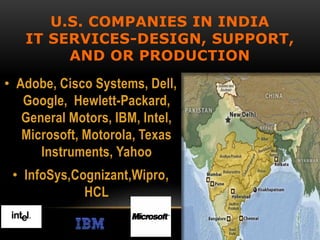
• Adobe, Cisco Systems, Dell,
Google, Hewlett-Packard,
General Motors, IBM, Intel,
Microsoft, Motorola, Texas
Instruments, Yahoo
• InfoSys,Cognizant,Wipro,
HCL
William H. Gates, Chairman and Chief
Software Architect Microsoft
Corporation
(b-1955):
Gates emphasized that India had emerged as a major global IT
hub not because of the availability of low-cost skills, as many
believe. Rather, it had more to do with the ''quality'' and ''world-
class skills'' to be found in India, he said. ''The key is the quality
of the human talent here. When people do software projects in
India, they do so because this is the place they can find people
with the latest skills. It is not on the (cheap) price (of labor),'' he
was quoted as saying by The Times of India newspaper. Gates
had high praise for the ''quality of educational institutions which
could make India into an IT superpower.'’ September 19, 2000.
http://www.atimes.com/ind-pak/BI19Df01.html
.”
Indians in the USA.
 Of the 1.5M Indians living in the USA, 1/5th of them live in the Silicon Valley.
 35% of Silicon Valley start-ups are by Indians.
 Indian students are the largest in number among foreign students in USA.
Statistics that show:
38% of doctors in the USA,
12% of scientists in the USA,
36% of NASA scientists,
34% of Microsoft employees,
28% of IBM employees,
17% of INTEL scientists,
13% of XEROX employees,
… are Indians.
1. India 44%
2. China 9%
3. Britain 5%
4. Philippines 3%
5. Canada 3%
6. Taiwan 2%
7. Japan 2%
8. Germany 2%
9. Pakistan 2%
10. France 2%
US H1-B Visa
applicants country
of origin
CHALLENGES
1) BACKGROUND
CHALLENGES
2) MARKET TREND
CHALLENGES
3) ORGANIZATIONAL DISTRIBUTION
CHALLENGES
4) INFRASTRUCTURE IMPLICATION
CHALLENGES
5) CONSIDERATION OF CRITICAL SUCCESS FACTOR
SUCCESS FACTOR BY
GDD
GDD = GLOBAL DEVELOPMENT AND DELIEVERY.
5 MAGIC RULES MUST FOLLOW :-
ENSURE COORDINATION AMONG ALL
PROJECTS.
ESTABLISH WELL DEFINED & CONSISTENT
WORKFIELD.
MANAGE YOUR INVENTORY AS WELL AS
INFORMATION.
COMMUNICATUON WITH COSTUMERS.
ESTABLISH FLEXIBLE,ADAPTABLE IT
INFRASTRUCTURE AND ARCHITECTURE.
CHALLENGES
6) PEOPLE VIEW TOWARDS INDUSTRY
CHALLENGES
7) YOUTH’S THINKING
CHALLENGES
8) PRESENT EDUCATIONAL SYSTEM
EDUCATIONAL SYSTEM:-
BUT INDUSTRY NEEDS PROFESSIONALS !!!!!!!!!
CHALLENGES
9) OUTSOURCING INDIA
CHALLENGES
10) GOVERNMENT CONTRIBUTION
CHALLENGES
11) ECONOMIC PROBLEMS & RESOURCES
CONCLUSION
IT SECTOR IS RAPIDLY GETTING
HUGE PARTICIPATION OF INDIAN
GROWTH
INDIA IS BECOMING GLOBAL
LEADER IN IT-SECTOR
REFERENCES
 WIKIPEDIA
 http://www.naascom.org//
 http://www.google.com/search
 SUVARNAMUKUT-2014
THANK YOU!!!!!!
ANY QUESTIONS ..?
MADE BY :- AKASH PURI
(S.Y. B. Tech. VIT , Pune)
THANK
YOU!!!!! AGAIN

Challenges Faced by Software Development Companies in India

  • 1.
  • 2.
    CHALLENGES FACED BYIT SOFTWARE DEVELOPMENT BUSINESS IN INDIA BY AKASH PURI
  • 3.
    • Introduction • ITSector in India • Challenges :- Background Market Trend Organizational Distribution Infrastructure Implication Consideration of Critical Success Factors People view towards Industry Youth’s Thinking Present Educational System “OUTSOURCING” India Government Contribution Economic Problems & Resources CONTENTS :
  • 4.
  • 5.
    IT SECTOR ININDIA • GDP contribution increased from 7.5% in 2012 nowdays it is 10%. • Aggregated revenue of it sector = $100 billion in 2012 and it is grown upto 9% in current revenue. • Major it hubs in india are Bangalore, Chennai, Hyderabad, Delhi, Mumbai, Pune • India produces about 100,000 new engineers a year. About 3 times the number of the U.S. • But still only 1.6 million people are employed in IT and service center jobs.
  • 6.
    U.S. COMPANIES ININDIA IT SERVICES-DESIGN, SUPPORT, AND OR PRODUCTION • Adobe, Cisco Systems, Dell, Google, Hewlett-Packard, General Motors, IBM, Intel, Microsoft, Motorola, Texas Instruments, Yahoo • InfoSys,Cognizant,Wipro, HCL
  • 7.
    William H. Gates,Chairman and Chief Software Architect Microsoft Corporation (b-1955): Gates emphasized that India had emerged as a major global IT hub not because of the availability of low-cost skills, as many believe. Rather, it had more to do with the ''quality'' and ''world- class skills'' to be found in India, he said. ''The key is the quality of the human talent here. When people do software projects in India, they do so because this is the place they can find people with the latest skills. It is not on the (cheap) price (of labor),'' he was quoted as saying by The Times of India newspaper. Gates had high praise for the ''quality of educational institutions which could make India into an IT superpower.'’ September 19, 2000. http://www.atimes.com/ind-pak/BI19Df01.html .”
  • 8.
    Indians in theUSA.  Of the 1.5M Indians living in the USA, 1/5th of them live in the Silicon Valley.  35% of Silicon Valley start-ups are by Indians.  Indian students are the largest in number among foreign students in USA. Statistics that show: 38% of doctors in the USA, 12% of scientists in the USA, 36% of NASA scientists, 34% of Microsoft employees, 28% of IBM employees, 17% of INTEL scientists, 13% of XEROX employees, … are Indians. 1. India 44% 2. China 9% 3. Britain 5% 4. Philippines 3% 5. Canada 3% 6. Taiwan 2% 7. Japan 2% 8. Germany 2% 9. Pakistan 2% 10. France 2% US H1-B Visa applicants country of origin
  • 9.
  • 10.
  • 11.
  • 12.
  • 13.
    CHALLENGES 5) CONSIDERATION OFCRITICAL SUCCESS FACTOR
  • 14.
    SUCCESS FACTOR BY GDD GDD= GLOBAL DEVELOPMENT AND DELIEVERY. 5 MAGIC RULES MUST FOLLOW :- ENSURE COORDINATION AMONG ALL PROJECTS. ESTABLISH WELL DEFINED & CONSISTENT WORKFIELD. MANAGE YOUR INVENTORY AS WELL AS INFORMATION. COMMUNICATUON WITH COSTUMERS. ESTABLISH FLEXIBLE,ADAPTABLE IT INFRASTRUCTURE AND ARCHITECTURE.
  • 15.
    CHALLENGES 6) PEOPLE VIEWTOWARDS INDUSTRY
  • 16.
  • 17.
  • 18.
  • 19.
    BUT INDUSTRY NEEDSPROFESSIONALS !!!!!!!!!
  • 20.
  • 23.
  • 24.
  • 26.
    CONCLUSION IT SECTOR ISRAPIDLY GETTING HUGE PARTICIPATION OF INDIAN GROWTH INDIA IS BECOMING GLOBAL LEADER IN IT-SECTOR
  • 27.
    REFERENCES  WIKIPEDIA  http://www.naascom.org// http://www.google.com/search  SUVARNAMUKUT-2014
  • 28.
  • 29.
  • 30.
    MADE BY :-AKASH PURI (S.Y. B. Tech. VIT , Pune) THANK YOU!!!!! AGAIN