Global
Marketing
Warren J. Keegan Mark C. Green
Branding and
Product
Decisions in
Global Marketing
Chapter 10
Copyright 2013, Pearson Education
Global
Marketing
Warren J. Keegan Mark C. Green
Global
Marketing
Global Edition
Warren J. Keegan Mark C. Green
Branding and
Product
Decisions in
Global Marketing
Chapter 10
Copyright 2013, Pearson Education
Learning Objectives
• Brand and product
concepts
• Local, international, and
global brands
• Product design issues
• Maslow’s needs
hierarchy
• Country of Origin brand
element
• Strategic alternatives
• New product continuum
• Types of innovation
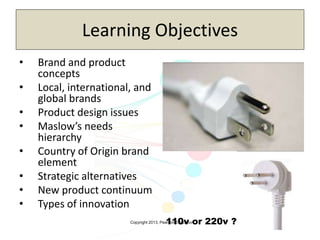
110v or 220v ?
Copyright 2013, Pearson Education
Basic Product Concepts
• A product is a good,
service, or idea
– Tangible Attributes
– Intangible Attributes
• Product classification
– Consumer goods
– Industrial goods
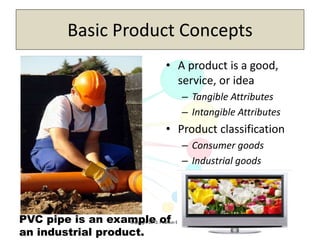
PVC pipe is an example of
an industrial product.
Copyright 2013, Pearson Education
Buyer Orientation
• Buyer orientation
– Amount of effort
expended
– Level of risk
– Buyer involvement
• Buyer orientation
framework
– Convenience
– Preference
– Shopping
– Specialty
Copyright 2013, Pearson Education
Brands
• Bundle of images and experiences in the
customer’s mind
• A promise made by a particular company
about a particular product
• A quality certification
• Differentiation between competing products
• The sum of impressions about a brand is the
Brand Image
Copyright 2013, Pearson Education
Brand Equity
• The added value that accrues to a product as a
result of investments in the marketing of the
brand
• An asset that represents the value created by
the relationship between the brand and
customer over time
Copyright 2013, Pearson Education
Brand Equity Benefits
• Greater loyalty
• Less vulnerability to marketing actions
• Less vulnerability to marketing crises
• Larger margins
• More inelastic consumer response to price increases
• More elastic consumer response to price decreases
• Increased marketing communication effectiveness
Copyright 2013, Pearson Education
Local Products and Brands
• Brands that have achieved success in a single
national market
• Represent the lifeblood of domestic
companies
• Entrenched local products/brands can be a
significant competitive hurdle to global
companies
Copyright 2013, Pearson Education
International Products
and Brands
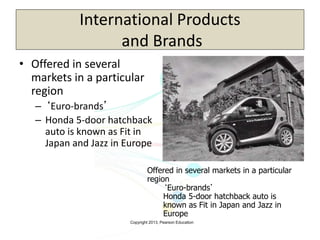
• Offered in several
markets in a particular
region
– ‘Euro-brands’
– Honda 5-door hatchback
auto is known as Fit in
Japan and Jazz in Europe
Offered in several markets in a particular
region
‘Euro-brands’
Honda 5-door hatchback auto is
known as Fit in Japan and Jazz in
Europe
Copyright 2013, Pearson Education
Global Products and Brands
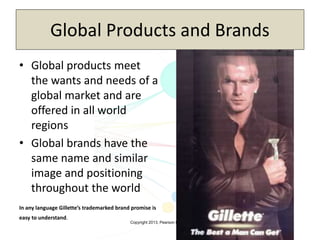
• Global products meet
the wants and needs of a
global market and are
offered in all world
regions
• Global brands have the
same name and similar
image and positioning
throughout the world
In any language Gillette’s trademarked brand promise is
easy to understand.
Copyright 2013, Pearson Education
Global Products and Brands
“A multinational has operations in different countries.
A global company views the world as a single
country. We know Argentina and France are
different, but we treat them the same. We sell them
the same products, we use the same production
methods, we have the same corporate policies. We
even use the same advertising—in a different
language, of course.”
- Alfred Zeien Former Gillette CEO
Copyright 2013, Pearson Education
Global Brand Characteristics
• Quality signal—allows a company to charge
premium price in a highly competitive market
• Global myth—marketers can use global
consumer culture positioning to link the brand
identity to any part of the world
• Social responsibility—shows how a company
addresses social problems
Copyright 2013, Pearson Education
Global Products and Brands
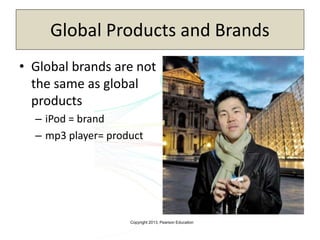
• Global brands are not
the same as global
products
– iPod = brand
– mp3 player= product
Copyright 2013, Pearson Education
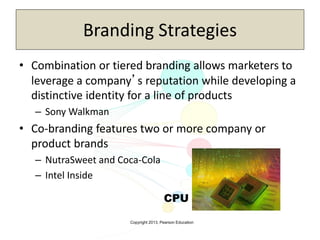
Branding Strategies
• Combination or tiered branding allows marketers to
leverage a company’s reputation while developing a
distinctive identity for a line of products
– Sony Walkman
• Co-branding features two or more company or
product brands
– NutraSweet and Coca-Cola
– Intel Inside
CPU
Copyright 2013, Pearson Education
Brand Extension
• Brand acts as an umbrella for new products
– Example: The Virgin Group
• Virgin Entertainment: Virgin Mega-stores and MGM Cinemas
• Virgin Trading: Virgin Cola and Virgin Vodka
• Virgin Radio
• Virgin Rail (UK only)
• Virgin Media Group: Virgin Publishing, Virgin Television,
Virgin Net (UK only)
• Virgin Hotels
• Virgin Travel Group: Virgin America Airways, Virgin Holidays,
Virgin Galactic
Copyright 2013, Pearson Education
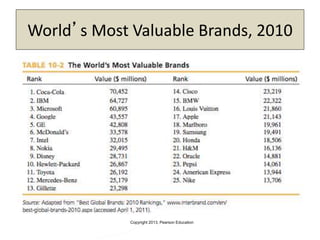
World’s Most Valuable Brands, 2010
Copyright 2013, Pearson Education
Global Brand Development
• Questions to ask when management seeks to
build a global brand:
– Does this move fit the company and/or its
markets?
– Will anticipated scale economies materialize?
– How difficult will it be to develop a global brand
team?
– Can a single brand be imposed on all markets
successfully?
Copyright 2013, Pearson Education
Global Brand Development
• Global Brand Leadership
– Using organizational structures, processes, and
cultures to allocate brand-building resources
globally, to create global synergies, and to develop
a global brand strategy that coordinates and
leverages country brand strategies
Copyright 2013, Pearson Education
Global Brand Development
1. Create a compelling value proposition
2. Think about all elements of brand identity
and select names, marks, and symbols that
have the potential for globalization
3. Research the alternatives of extending a
national brand versus adopting a new brand
identity globally
4. Develop a company-wide communication
system
Copyright 2013, Pearson Education
Global Brand Development
5. Develop a consistent planning process
Assign specific responsibility for
managing branding issues
6. Execute brand-building strategies
Harmonize, unravel confusion, and
eliminate complexity
Copyright 2013, Pearson Education
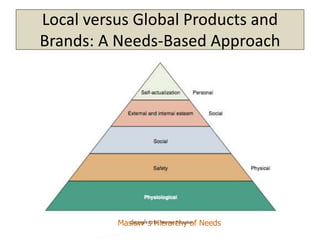
Local versus Global Products and
Brands: A Needs-Based Approach
Maslow’s Hierarchy of Needs
Copyright 2013, Pearson Education
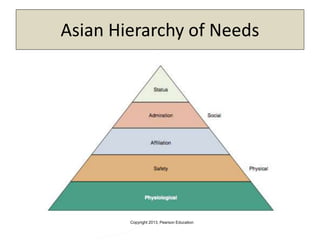
Asian Hierarchy of Needs
Copyright 2013, Pearson Education
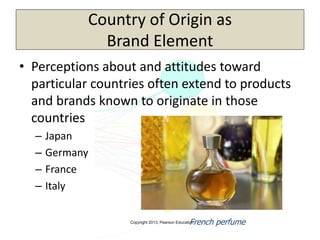
Country of Origin as
Brand Element
• Perceptions about and attitudes toward
particular countries often extend to products
and brands known to originate in those
countries
– Japan
– Germany
– France
– Italy
French perfume
Copyright 2013, Pearson Education
Packaging
• Consumer Packaged Goods refers to products
whose packaging is designed to protect or
contain the product during shipping, at retail, or
point of use
• Eco-Packaging is key because package designers
must address environmental issues
• Offers communication cues that provide
consumers with a basis for making a purchase
decision
Copyright 2013, Pearson Education
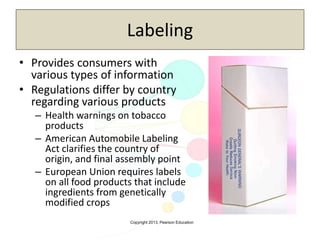
Labeling
• Provides consumers with
various types of information
• Regulations differ by country
regarding various products
– Health warnings on tobacco
products
– American Automobile Labeling
Act clarifies the country of
origin, and final assembly point
– European Union requires labels
on all food products that include
ingredients from genetically
modified crops
Copyright 2013, Pearson Education
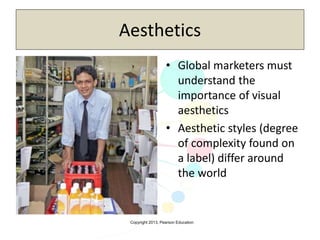
Aesthetics
• Global marketers must
understand the
importance of visual
aesthetics
• Aesthetic styles (degree
of complexity found on
a label) differ around
the world
Copyright 2013, Pearson Education
Product Warranties
• Express Warranty is a written guarantee that
assures the buyer is getting what they paid for
or provides a remedy in case of a product
failure
• Warranties can be used as a competitive tool
Copyright 2013, Pearson Education
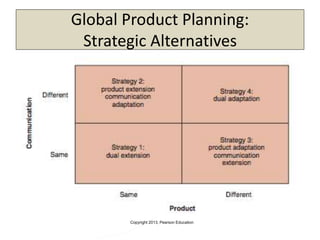
Extend, Adapt, Create: Strategic
Alternatives in Global Marketing
• Extension – offering product virtually
unchanged in markets outside of home
country
• Adaptation – changing elements of design,
function, and packaging according to needs of
different country markets
• Creation – developing new products for the
world market
Copyright 2013, Pearson Education
Global Product Planning:
Strategic Alternatives
Copyright 2013, Pearson Education
Product Invention
• Strategy 5:
– Important for reaching mass markets in less
industrialized nations and certain segments in
industrialized countries
• Hand-cranked radios for areas with no
electricity
• Total toothpaste by Colgate uses global benefit
segmentation
Copyright 2013, Pearson Education
How to Choose a Strategy?
• Two errors that management makes in
choosing a strategy
– NIH (Not invented here) syndrome means
managers ignore the advancements of subsidiaries
overseas
– Managers impose policies upon subsidiaries
because they assume what is right for customers
in one market is right in every market
Copyright 2013, Pearson Education
How to Choose a Strategy?
• The product itself, defined in terms of the
function or need it serves
• The market, defined in terms of the conditions
under which the product is used, preferences
of potential customers, and ability to buy the
product
• Adaptation and manufacturing costs the
company will incur
Copyright 2013, Pearson Education
New Products in Global Marketing
• Pursue opportunities in competitive arenas of
global marketplace
• Focus on one or only a few businesses
• Active involvement from senior management
• Ability to recruit and retain best employees
• Understand the importance of speed in
bringing product to market
Copyright 2013, Pearson Education
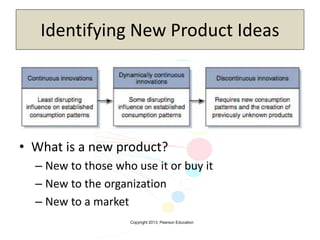
Identifying New Product Ideas
• What is a new product?
– New to those who use it or buy it
– New to the organization
– New to a market
Copyright 2013, Pearson Education
The International New Product
Department
• How big is the market for this product at various
prices?
• What are the likely competitive moves in
response to our activity?
• Can we market the product through existing
structure?
• Can we source the product at a cost that will yield
an adequate profit?
• Does product fit our strategic development plan?
Copyright 2013, Pearson Education
Testing New Products
• When do you test a new product?
– Whenever a product interacts with human,
mechanical, or chemical elements because there
is the potential for a surprising and unexpected
incompatibility
• Test could simply be observing the product
being used within the market
Copyright 2013, Pearson Education
Looking Ahead to Chapter 11
Pricing Decisions

ch10-150807164928-lva1-app6891 (1).pdf

  • 1.
    Global Marketing Warren J. KeeganMark C. Green Branding and Product Decisions in Global Marketing Chapter 10 Copyright 2013, Pearson Education Global Marketing Warren J. Keegan Mark C. Green Global Marketing Global Edition Warren J. Keegan Mark C. Green Branding and Product Decisions in Global Marketing Chapter 10
  • 2.
    Copyright 2013, PearsonEducation Learning Objectives • Brand and product concepts • Local, international, and global brands • Product design issues • Maslow’s needs hierarchy • Country of Origin brand element • Strategic alternatives • New product continuum • Types of innovation 110v or 220v ?
  • 3.
    Copyright 2013, PearsonEducation Basic Product Concepts • A product is a good, service, or idea – Tangible Attributes – Intangible Attributes • Product classification – Consumer goods – Industrial goods PVC pipe is an example of an industrial product.
  • 4.
    Copyright 2013, PearsonEducation Buyer Orientation • Buyer orientation – Amount of effort expended – Level of risk – Buyer involvement • Buyer orientation framework – Convenience – Preference – Shopping – Specialty
  • 5.
    Copyright 2013, PearsonEducation Brands • Bundle of images and experiences in the customer’s mind • A promise made by a particular company about a particular product • A quality certification • Differentiation between competing products • The sum of impressions about a brand is the Brand Image
  • 6.
    Copyright 2013, PearsonEducation Brand Equity • The added value that accrues to a product as a result of investments in the marketing of the brand • An asset that represents the value created by the relationship between the brand and customer over time
  • 7.
    Copyright 2013, PearsonEducation Brand Equity Benefits • Greater loyalty • Less vulnerability to marketing actions • Less vulnerability to marketing crises • Larger margins • More inelastic consumer response to price increases • More elastic consumer response to price decreases • Increased marketing communication effectiveness
  • 8.
    Copyright 2013, PearsonEducation Local Products and Brands • Brands that have achieved success in a single national market • Represent the lifeblood of domestic companies • Entrenched local products/brands can be a significant competitive hurdle to global companies
  • 9.
    Copyright 2013, PearsonEducation International Products and Brands • Offered in several markets in a particular region – ‘Euro-brands’ – Honda 5-door hatchback auto is known as Fit in Japan and Jazz in Europe Offered in several markets in a particular region ‘Euro-brands’ Honda 5-door hatchback auto is known as Fit in Japan and Jazz in Europe
  • 10.
    Copyright 2013, PearsonEducation Global Products and Brands • Global products meet the wants and needs of a global market and are offered in all world regions • Global brands have the same name and similar image and positioning throughout the world In any language Gillette’s trademarked brand promise is easy to understand.
  • 11.
    Copyright 2013, PearsonEducation Global Products and Brands “A multinational has operations in different countries. A global company views the world as a single country. We know Argentina and France are different, but we treat them the same. We sell them the same products, we use the same production methods, we have the same corporate policies. We even use the same advertising—in a different language, of course.” - Alfred Zeien Former Gillette CEO
  • 12.
    Copyright 2013, PearsonEducation Global Brand Characteristics • Quality signal—allows a company to charge premium price in a highly competitive market • Global myth—marketers can use global consumer culture positioning to link the brand identity to any part of the world • Social responsibility—shows how a company addresses social problems
  • 13.
    Copyright 2013, PearsonEducation Global Products and Brands • Global brands are not the same as global products – iPod = brand – mp3 player= product
  • 14.
    Copyright 2013, PearsonEducation Branding Strategies • Combination or tiered branding allows marketers to leverage a company’s reputation while developing a distinctive identity for a line of products – Sony Walkman • Co-branding features two or more company or product brands – NutraSweet and Coca-Cola – Intel Inside CPU
  • 15.
    Copyright 2013, PearsonEducation Brand Extension • Brand acts as an umbrella for new products – Example: The Virgin Group • Virgin Entertainment: Virgin Mega-stores and MGM Cinemas • Virgin Trading: Virgin Cola and Virgin Vodka • Virgin Radio • Virgin Rail (UK only) • Virgin Media Group: Virgin Publishing, Virgin Television, Virgin Net (UK only) • Virgin Hotels • Virgin Travel Group: Virgin America Airways, Virgin Holidays, Virgin Galactic
  • 16.
    Copyright 2013, PearsonEducation World’s Most Valuable Brands, 2010
  • 17.
    Copyright 2013, PearsonEducation Global Brand Development • Questions to ask when management seeks to build a global brand: – Does this move fit the company and/or its markets? – Will anticipated scale economies materialize? – How difficult will it be to develop a global brand team? – Can a single brand be imposed on all markets successfully?
  • 18.
    Copyright 2013, PearsonEducation Global Brand Development • Global Brand Leadership – Using organizational structures, processes, and cultures to allocate brand-building resources globally, to create global synergies, and to develop a global brand strategy that coordinates and leverages country brand strategies
  • 19.
    Copyright 2013, PearsonEducation Global Brand Development 1. Create a compelling value proposition 2. Think about all elements of brand identity and select names, marks, and symbols that have the potential for globalization 3. Research the alternatives of extending a national brand versus adopting a new brand identity globally 4. Develop a company-wide communication system
  • 20.
    Copyright 2013, PearsonEducation Global Brand Development 5. Develop a consistent planning process Assign specific responsibility for managing branding issues 6. Execute brand-building strategies Harmonize, unravel confusion, and eliminate complexity
  • 21.
    Copyright 2013, PearsonEducation Local versus Global Products and Brands: A Needs-Based Approach Maslow’s Hierarchy of Needs
  • 22.
    Copyright 2013, PearsonEducation Asian Hierarchy of Needs
  • 23.
    Copyright 2013, PearsonEducation Country of Origin as Brand Element • Perceptions about and attitudes toward particular countries often extend to products and brands known to originate in those countries – Japan – Germany – France – Italy French perfume
  • 24.
    Copyright 2013, PearsonEducation Packaging • Consumer Packaged Goods refers to products whose packaging is designed to protect or contain the product during shipping, at retail, or point of use • Eco-Packaging is key because package designers must address environmental issues • Offers communication cues that provide consumers with a basis for making a purchase decision
  • 25.
    Copyright 2013, PearsonEducation Labeling • Provides consumers with various types of information • Regulations differ by country regarding various products – Health warnings on tobacco products – American Automobile Labeling Act clarifies the country of origin, and final assembly point – European Union requires labels on all food products that include ingredients from genetically modified crops
  • 26.
    Copyright 2013, PearsonEducation Aesthetics • Global marketers must understand the importance of visual aesthetics • Aesthetic styles (degree of complexity found on a label) differ around the world
  • 27.
    Copyright 2013, PearsonEducation Product Warranties • Express Warranty is a written guarantee that assures the buyer is getting what they paid for or provides a remedy in case of a product failure • Warranties can be used as a competitive tool
  • 28.
    Copyright 2013, PearsonEducation Extend, Adapt, Create: Strategic Alternatives in Global Marketing • Extension – offering product virtually unchanged in markets outside of home country • Adaptation – changing elements of design, function, and packaging according to needs of different country markets • Creation – developing new products for the world market
  • 29.
    Copyright 2013, PearsonEducation Global Product Planning: Strategic Alternatives
  • 30.
    Copyright 2013, PearsonEducation Product Invention • Strategy 5: – Important for reaching mass markets in less industrialized nations and certain segments in industrialized countries • Hand-cranked radios for areas with no electricity • Total toothpaste by Colgate uses global benefit segmentation
  • 31.
    Copyright 2013, PearsonEducation How to Choose a Strategy? • Two errors that management makes in choosing a strategy – NIH (Not invented here) syndrome means managers ignore the advancements of subsidiaries overseas – Managers impose policies upon subsidiaries because they assume what is right for customers in one market is right in every market
  • 32.
    Copyright 2013, PearsonEducation How to Choose a Strategy? • The product itself, defined in terms of the function or need it serves • The market, defined in terms of the conditions under which the product is used, preferences of potential customers, and ability to buy the product • Adaptation and manufacturing costs the company will incur
  • 33.
    Copyright 2013, PearsonEducation New Products in Global Marketing • Pursue opportunities in competitive arenas of global marketplace • Focus on one or only a few businesses • Active involvement from senior management • Ability to recruit and retain best employees • Understand the importance of speed in bringing product to market
  • 34.
    Copyright 2013, PearsonEducation Identifying New Product Ideas • What is a new product? – New to those who use it or buy it – New to the organization – New to a market
  • 35.
    Copyright 2013, PearsonEducation The International New Product Department • How big is the market for this product at various prices? • What are the likely competitive moves in response to our activity? • Can we market the product through existing structure? • Can we source the product at a cost that will yield an adequate profit? • Does product fit our strategic development plan?
  • 36.
    Copyright 2013, PearsonEducation Testing New Products • When do you test a new product? – Whenever a product interacts with human, mechanical, or chemical elements because there is the potential for a surprising and unexpected incompatibility • Test could simply be observing the product being used within the market
  • 37.
    Copyright 2013, PearsonEducation Looking Ahead to Chapter 11 Pricing Decisions