Ethical Theories andPrinciples in
Programming Ethics
Utilitarianism:
Idea: Focus on creating the greatest good for the most people.
In Programming: Write code that benefits the majority, ensuring that it’s safe,
efficient, and accessible to all users.
Deontological Ethics (Duty-based):
Idea: Follow rules and duties, regardless of the consequences.
In Programming: Stick to coding standards, laws, and ethical guidelines, even if it's
more difficult or costly.
Virtue Ethics:
Idea: Focus on developing good character and virtues like honesty, fairness, and
responsibility.
In Programming: Be honest in your work, take responsibility for bugs or errors, and
contribute positively to the community.
3.
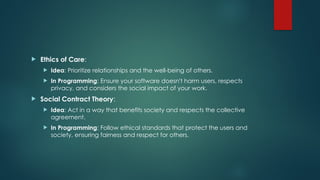
Ethics ofCare:
Idea: Prioritize relationships and the well-being of others.
In Programming: Ensure your software doesn't harm users, respects
privacy, and considers the social impact of your work.
Social Contract Theory:
Idea: Act in a way that benefits society and respects the collective
agreement.
In Programming: Follow ethical standards that protect the users and
society, ensuring fairness and respect for others.
4.
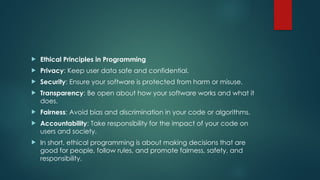
Ethical Principlesin Programming
Privacy: Keep user data safe and confidential.
Security: Ensure your software is protected from harm or misuse.
Transparency: Be open about how your software works and what it
does.
Fairness: Avoid bias and discrimination in your code or algorithms.
Accountability: Take responsibility for the impact of your code on
users and society.
In short, ethical programming is about making decisions that are
good for people, follow rules, and promote fairness, safety, and
responsibility.
5.
These ethicaltheories and principles provide a foundation for
ethical decision-making in programming. By understanding and
applying these principles, programmers can create software that is
responsible, trustworthy, and beneficial to society.
6.
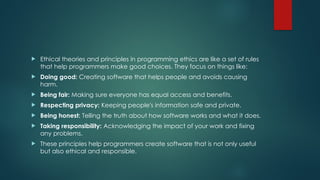
Ethical theoriesand principles in programming ethics are like a set of rules
that help programmers make good choices. They focus on things like:
Doing good: Creating software that helps people and avoids causing
harm.
Being fair: Making sure everyone has equal access and benefits.
Respecting privacy: Keeping people's information safe and private.
Being honest: Telling the truth about how software works and what it does.
Taking responsibility: Acknowledging the impact of your work and fixing
any problems.
These principles help programmers create software that is not only useful
but also ethical and responsible.
7.
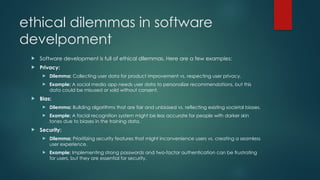
ethical dilemmas insoftware
develpoment
Software development is full of ethical dilemmas. Here are a few examples:
Privacy:
Dilemma: Collecting user data for product improvement vs. respecting user privacy.
Example: A social media app needs user data to personalize recommendations, but this
data could be misused or sold without consent.
Bias:
Dilemma: Building algorithms that are fair and unbiased vs. reflecting existing societal biases.
Example: A facial recognition system might be less accurate for people with darker skin
tones due to biases in the training data.
Security:
Dilemma: Prioritizing security features that might inconvenience users vs. creating a seamless
user experience.
Example: Implementing strong passwords and two-factor authentication can be frustrating
for users, but they are essential for security.
8.
Transparency:
Dilemma:Being transparent about how software works vs. protecting
proprietary information.
Example: Open-source software promotes transparency, but companies may
want to keep their algorithms secret for competitive advantage.
Accessibility:
Dilemma: Making software accessible to people with disabilities vs. focusing on
features for the majority.
Example: Ensuring that a website is usable by people with visual impairments
may require extra development time and resources.
These are just a few of the many ethical dilemmas that software
developers face. It's important to consider these issues carefully and make
choices that are ethical and responsible.