Heuristics
DESIGN AND ANALYSIS II - (c) Daniel R. Lewin
1
054402 Design and Analysis II
LECTURE 3: HEURISTICS FOR PROCESS
SYNTHESIS
Daniel R. Lewin
Department of Chemical Engineering
Technion, Haifa, Israel
Ref: Seider, Seader and Lewin (1999), Chapter 4
Heuristics
DESIGN AND ANALYSIS II - (c) Daniel R. Lewin
2
Introduction
 Chemical reaction (to eliminate differences in molecular type)
 Mixing and recycle (to distribute the chemicals)
 Separation (to eliminate differences in composition)
 Temperature, pressure and phase change
 Task integration (to combine tasks into unit operations)
 Recalling the process operations in process synthesis:
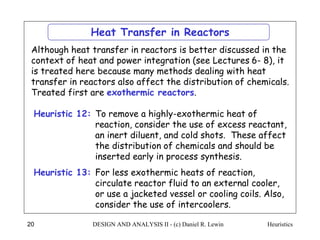
 This lecture deals with the heuristic rules that expedite
the selection and positioning of processing operations as
flowsheets are assembled.
 These rules are based on experience and hold in general,
but should be tested (e.g., by simulation) to ensure that
they apply in the specific application.
 Later, in Section B, we will see how algorithmic methods
are used to improve on design decisions.
Heuristics
DESIGN AND ANALYSIS II - (c) Daniel R. Lewin
3
Instructional Objectives
 Understand the importance of selecting reaction paths that do
not involve toxic or hazardous chemicals, and when unavoidable, to
reduce their presence by shortening residence times in the
process units and avoiding their storage in large quantities.
 Be able to distribute the chemicals in a process flowsheet, to
account for the presence of inert species, to purge species that
would otherwise build up to unacceptable concentrations, to
achieve a high selectivity to the desired products.
 Be able to apply heuristics in selecting separation processes to
separate liquids, vapors, and vapor-liquid mixtures.
 Be able to distribute the chemicals, by using excess reactants,
inert diluents, and cold shots, to remove the exothermic heats of
reaction.
 Understand the advantages of pumping a liquid rather than
compressing a vapor.
When you have finished studying this unit, you should:
Heuristics
DESIGN AND ANALYSIS II - (c) Daniel R. Lewin
4
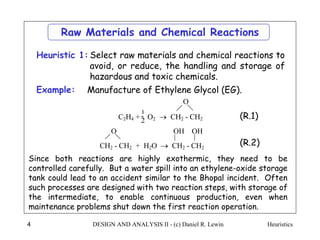
Select raw materials and chemical reactions to
avoid, or reduce, the handling and storage of
hazardous and toxic chemicals.
Heuristic 1:
Raw Materials and Chemical Reactions
Example: Manufacture of Ethylene Glycol (EG).
C2H4 + O2  CH2 - CH2
1
-
2
O
(R.1)
CH2 - CH2 + H2O  CH2 - CH2
O OH OH
(R.2)
Since both reactions are highly exothermic, they need to be
controlled carefully. But a water spill into an ethylene-oxide storage
tank could lead to an accident similar to the Bhopal incident. Often
such processes are designed with two reaction steps, with storage of
the intermediate, to enable continuous production, even when
maintenance problems shut down the first reaction operation.
Heuristics
DESIGN AND ANALYSIS II - (c) Daniel R. Lewin
5
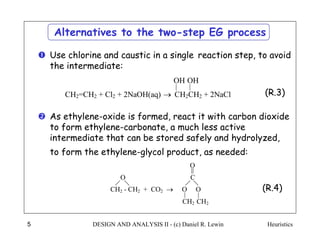
Alternatives to the two-step EG process
(R.3)
OH OH
CH2=CH2 + Cl2 + 2NaOH(aq)  CH2CH2 + 2NaCl
 Use chlorine and caustic in a single reaction step, to avoid
the intermediate:
 As ethylene-oxide is formed, react it with carbon dioxide
to form ethylene-carbonate, a much less active
intermediate that can be stored safely and hydrolyzed,
to form the ethylene-glycol product, as needed:
(R.4)
CH2 - CH2 + CO2  O O
O C
CH2 CH2
O
Heuristics
DESIGN AND ANALYSIS II - (c) Daniel R. Lewin
6
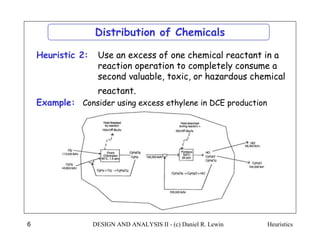
Distribution of Chemicals
Example: Consider using excess ethylene in DCE production
Use an excess of one chemical reactant in a
reaction operation to completely consume a
second valuable, toxic, or hazardous chemical
reactant.
Heuristic 2:
Heuristics
DESIGN AND ANALYSIS II - (c) Daniel R. Lewin
7
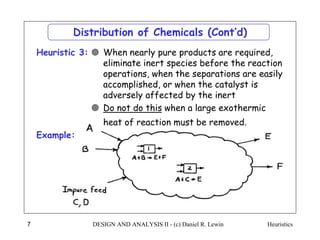
Example:
Distribution of Chemicals (Cont’d)
 When nearly pure products are required,
eliminate inert species before the reaction
operations, when the separations are easily
accomplished, or when the catalyst is
adversely affected by the inert
 Do not do this when a large exothermic
heat of reaction must be removed.
Heuristic 3:
Heuristics
DESIGN AND ANALYSIS II - (c) Daniel R. Lewin
8
Distribution of Chemicals (Cont’d)
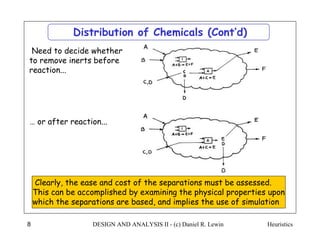
Need to decide whether
to remove inerts before
reaction...
Clearly, the ease and cost of the separations must be assessed.
This can be accomplished by examining the physical properties upon
which the separations are based, and implies the use of simulation
… or after reaction...
Heuristics
DESIGN AND ANALYSIS II - (c) Daniel R. Lewin
9
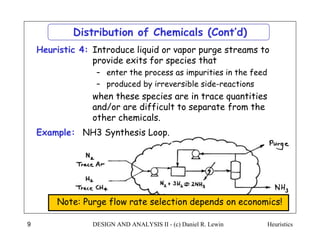
Introduce liquid or vapor purge streams to
provide exits for species that
– enter the process as impurities in the feed
– produced by irreversible side-reactions
when these species are in trace quantities
and/or are difficult to separate from the
other chemicals.
Heuristic 4:
Distribution of Chemicals (Cont’d)
Example: NH3 Synthesis Loop.
Note: Purge flow rate selection depends on economics!
Heuristics
DESIGN AND ANALYSIS II - (c) Daniel R. Lewin
10
Distribution of Chemicals (Cont’d)
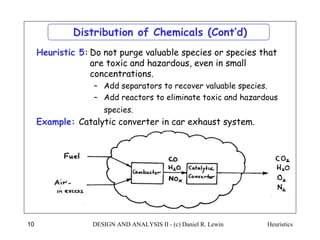
Do not purge valuable species or species that
are toxic and hazardous, even in small
concentrations.
– Add separators to recover valuable species.
– Add reactors to eliminate toxic and hazardous
species.
Heuristic 5:
Example: Catalytic converter in car exhaust system.
Heuristics
DESIGN AND ANALYSIS II - (c) Daniel R. Lewin
11
By-products that are produced in reversible
reactions, in small quantities, are usually not
recovered in separators or purged. Instead,
they are usually recycled to extinction.
Heuristic 6:
Distribution of Chemicals (Cont’d)
Often small quantities of chemicals are produced in side-
reactions. When the reaction proceeds irreversibly, small
quantities of by-products must be purged, otherwise they
will buildup in the process continuously until the process
must be shut down. When, however, the reaction proceeds
reversibly, it becomes possible to achieve an equilibrium
conversion at steady state by recycling product species
without removing them from the process. In so doing, it is
often said that undesired byproducts are recycled to
extinction.
Heuristics
DESIGN AND ANALYSIS II - (c) Daniel R. Lewin
12
Distribution of Chemicals (Cont’d)
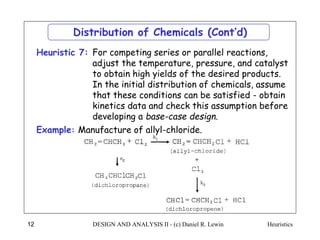
For competing series or parallel reactions,
adjust the temperature, pressure, and catalyst
to obtain high yields of the desired products.
In the initial distribution of chemicals, assume
that these conditions can be satisfied - obtain
kinetics data and check this assumption before
developing a base-case design.
Heuristic 7:
Example: Manufacture of allyl-chloride.
Heuristics
DESIGN AND ANALYSIS II - (c) Daniel R. Lewin
13
Allyl Chloride Manufacture (Cont’d)
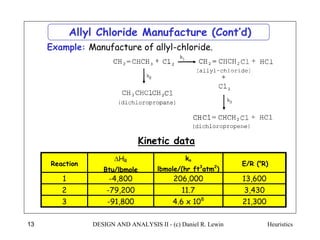
Example: Manufacture of allyl-chloride.
Reaction
HR
Btu/lbmole
ko
lbmole/(hr ft3
atm2
)
E/R (o
R)
1 -4,800 206,000 13,600
2 -79,200 11.7 3,430
3 -91,800 4.6 x 10⁸
21,300
Kinetic data
Heuristics
DESIGN AND ANALYSIS II - (c) Daniel R. Lewin
14
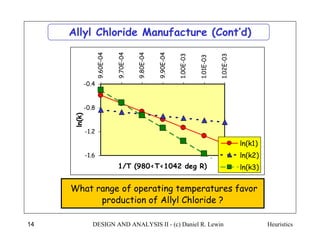
Allyl Chloride Manufacture (Cont’d)
-1.6
-1.2
-0.8
-0.4
9.60E-04
9.70E-04
9.80E-04
9.90E-04
1.00E-03
1.01E-03
1.02E-03
1/T (980<T<1042 deg R)
ln(k)
ln(k1)
ln(k2)
ln(k3)
What range of operating temperatures favor
production of Allyl Chloride ?
Heuristics
DESIGN AND ANALYSIS II - (c) Daniel R. Lewin
15
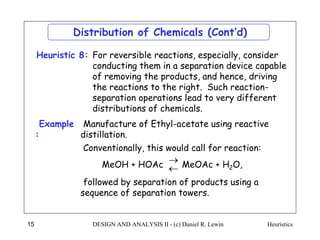
For reversible reactions, especially, consider
conducting them in a separation device capable
of removing the products, and hence, driving
the reactions to the right. Such reaction-
separation operations lead to very different
distributions of chemicals.
Heuristic 8:
Distribution of Chemicals (Cont’d)
Example
:
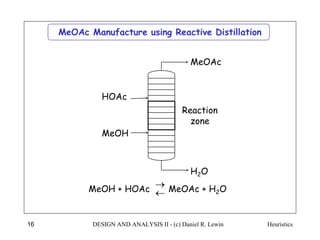
Manufacture of Ethyl-acetate using reactive
distillation.
Conventionally, this would call for reaction:
followed by separation of products using a
sequence of separation towers.
MeOH + HOAc MeOAc + H2O,


Heuristics
DESIGN AND ANALYSIS II - (c) Daniel R. Lewin
16
MeOAc Manufacture using Reactive Distillation
Reaction
zone
MeOAc
HOAc
MeOH
H2O
MeOH + HOAc MeOAc + H2O


Heuristics
DESIGN AND ANALYSIS II - (c) Daniel R. Lewin
17
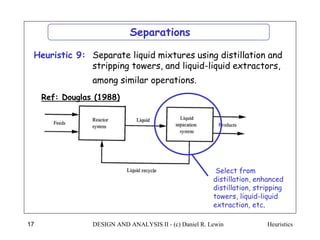
Ref: Douglas (1988)
Separate liquid mixtures using distillation and
stripping towers, and liquid-liquid extractors,
among similar operations.
Heuristic 9:
Separations
Select from
distillation, enhanced
distillation, stripping
towers, liquid-liquid
extraction, etc.
Heuristics
DESIGN AND ANALYSIS II - (c) Daniel R. Lewin
18
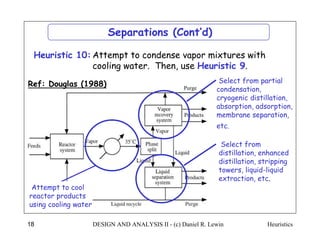
Ref: Douglas (1988)
Separations (Cont’d)
Attempt to condense vapor mixtures with
cooling water. Then, use Heuristic 9.
Heuristic 10:
Select from partial
condensation,
cryogenic distillation,
absorption, adsorption,
membrane separation,
etc.
Select from
distillation, enhanced
distillation, stripping
towers, liquid-liquid
extraction, etc.
Attempt to cool
reactor products
using cooling water
Heuristics
DESIGN AND ANALYSIS II - (c) Daniel R. Lewin
19
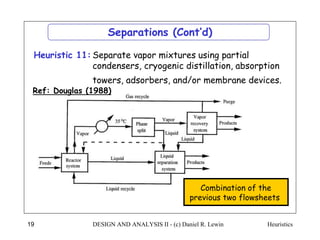
Ref: Douglas (1988)
Separations (Cont’d)
Separate vapor mixtures using partial
condensers, cryogenic distillation, absorption
towers, adsorbers, and/or membrane devices.
Heuristic 11:
Combination of the
previous two flowsheets
Heuristics
DESIGN AND ANALYSIS II - (c) Daniel R. Lewin
20
To remove a highly-exothermic heat of
reaction, consider the use of excess reactant,
an inert diluent, and cold shots. These affect
the distribution of chemicals and should be
inserted early in process synthesis.
Heuristic 12:
Heat Transfer in Reactors
For less exothermic heats of reaction,
circulate reactor fluid to an external cooler,
or use a jacketed vessel or cooling coils. Also,
consider the use of intercoolers.
Heuristic 13:
Although heat transfer in reactors is better discussed in the
context of heat and power integration (see Lectures 6- 8), it
is treated here because many methods dealing with heat
transfer in reactors also affect the distribution of chemicals.
Treated first are exothermic reactors.
Heuristics
DESIGN AND ANALYSIS II - (c) Daniel R. Lewin
21
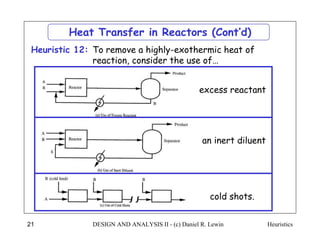
Heat Transfer in Reactors (Cont’d)
To remove a highly-exothermic heat of
reaction, consider the use of…
Heuristic 12:
excess reactant
cold shots.
an inert diluent
Heuristics
DESIGN AND ANALYSIS II - (c) Daniel R. Lewin
22
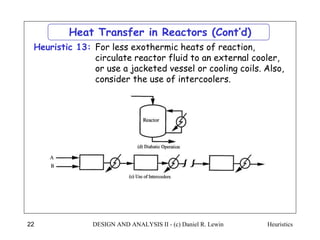
Heat Transfer in Reactors (Cont’d)
For less exothermic heats of reaction,
circulate reactor fluid to an external cooler,
or use a jacketed vessel or cooling coils. Also,
consider the use of intercoolers.
Heuristic 13:
Heuristics
DESIGN AND ANALYSIS II - (c) Daniel R. Lewin
23
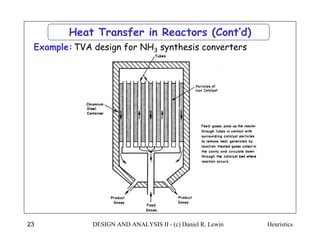
Heat Transfer in Reactors (Cont’d)
TVA design for NH3 synthesis converters
Example:
Heuristics
DESIGN AND ANALYSIS II - (c) Daniel R. Lewin
24
To control temperature for a highly-
endothermic heat of reaction, consider the use
of excess reactant an inert diluent, and hot
shots. These affect the distribution of
chemicals and should be inserted early in
process synthesis.
Heuristic 14:
Heat Transfer in Reactors (Cont’d)
For less endothermic heats of reaction,
circulate reactor fluid to an external heater,
or use a jacketed vessel or heating coils. Also,
consider the use of interheaters.
Heuristic 15:
Endothermic reactors are treated similarly:
Heuristics
DESIGN AND ANALYSIS II - (c) Daniel R. Lewin
25
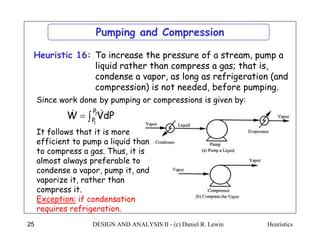
To increase the pressure of a stream, pump a
liquid rather than compress a gas; that is,
condense a vapor, as long as refrigeration (and
compression) is not needed, before pumping.
Heuristic 16:
Pumping and Compression

 2
1
P
P
dP
V
W 

Since work done by pumping or compressions is given by:
It follows that it is more
efficient to pump a liquid than
to compress a gas. Thus, it is
almost always preferable to
condense a vapor, pump it, and
vaporize it, rather than
compress it.
Exception: if condensation
requires refrigeration.
Heuristics
DESIGN AND ANALYSIS II - (c) Daniel R. Lewin
26
Process Design Heuristics - Summary
Next week: Separation Train Synthesis
 Understand the importance of selecting reaction paths that do
not involve toxic or hazardous chemicals, or to reduce their
presence by shortening residence times in the process units and
avoiding their storage in large quantities.
 Be able to distribute the chemicals in a process flowsheet, to
account for the presence of inert species, to purge species that
would otherwise build up to unacceptable concentrations, to
achieve a high selectivity to the desired products.
 Be able to apply heuristics in selecting separation processes to
separate liquids, vapors, and vapor-liquid mixtures.
 Be able to distribute the chemicals to remove exothermic heats
of reaction.
 Understand the advantages of pumping a liquid rather than
compressing a vapor.
We have covered 16 design heuristics, enabling you to:

CH03P.ppt

  • 1.
    Heuristics DESIGN AND ANALYSISII - (c) Daniel R. Lewin 1 054402 Design and Analysis II LECTURE 3: HEURISTICS FOR PROCESS SYNTHESIS Daniel R. Lewin Department of Chemical Engineering Technion, Haifa, Israel Ref: Seider, Seader and Lewin (1999), Chapter 4
  • 2.
    Heuristics DESIGN AND ANALYSISII - (c) Daniel R. Lewin 2 Introduction  Chemical reaction (to eliminate differences in molecular type)  Mixing and recycle (to distribute the chemicals)  Separation (to eliminate differences in composition)  Temperature, pressure and phase change  Task integration (to combine tasks into unit operations)  Recalling the process operations in process synthesis:  This lecture deals with the heuristic rules that expedite the selection and positioning of processing operations as flowsheets are assembled.  These rules are based on experience and hold in general, but should be tested (e.g., by simulation) to ensure that they apply in the specific application.  Later, in Section B, we will see how algorithmic methods are used to improve on design decisions.
  • 3.
    Heuristics DESIGN AND ANALYSISII - (c) Daniel R. Lewin 3 Instructional Objectives  Understand the importance of selecting reaction paths that do not involve toxic or hazardous chemicals, and when unavoidable, to reduce their presence by shortening residence times in the process units and avoiding their storage in large quantities.  Be able to distribute the chemicals in a process flowsheet, to account for the presence of inert species, to purge species that would otherwise build up to unacceptable concentrations, to achieve a high selectivity to the desired products.  Be able to apply heuristics in selecting separation processes to separate liquids, vapors, and vapor-liquid mixtures.  Be able to distribute the chemicals, by using excess reactants, inert diluents, and cold shots, to remove the exothermic heats of reaction.  Understand the advantages of pumping a liquid rather than compressing a vapor. When you have finished studying this unit, you should:
  • 4.
    Heuristics DESIGN AND ANALYSISII - (c) Daniel R. Lewin 4 Select raw materials and chemical reactions to avoid, or reduce, the handling and storage of hazardous and toxic chemicals. Heuristic 1: Raw Materials and Chemical Reactions Example: Manufacture of Ethylene Glycol (EG). C2H4 + O2  CH2 - CH2 1 - 2 O (R.1) CH2 - CH2 + H2O  CH2 - CH2 O OH OH (R.2) Since both reactions are highly exothermic, they need to be controlled carefully. But a water spill into an ethylene-oxide storage tank could lead to an accident similar to the Bhopal incident. Often such processes are designed with two reaction steps, with storage of the intermediate, to enable continuous production, even when maintenance problems shut down the first reaction operation.
  • 5.
    Heuristics DESIGN AND ANALYSISII - (c) Daniel R. Lewin 5 Alternatives to the two-step EG process (R.3) OH OH CH2=CH2 + Cl2 + 2NaOH(aq)  CH2CH2 + 2NaCl  Use chlorine and caustic in a single reaction step, to avoid the intermediate:  As ethylene-oxide is formed, react it with carbon dioxide to form ethylene-carbonate, a much less active intermediate that can be stored safely and hydrolyzed, to form the ethylene-glycol product, as needed: (R.4) CH2 - CH2 + CO2  O O O C CH2 CH2 O
  • 6.
    Heuristics DESIGN AND ANALYSISII - (c) Daniel R. Lewin 6 Distribution of Chemicals Example: Consider using excess ethylene in DCE production Use an excess of one chemical reactant in a reaction operation to completely consume a second valuable, toxic, or hazardous chemical reactant. Heuristic 2:
  • 7.
    Heuristics DESIGN AND ANALYSISII - (c) Daniel R. Lewin 7 Example: Distribution of Chemicals (Cont’d)  When nearly pure products are required, eliminate inert species before the reaction operations, when the separations are easily accomplished, or when the catalyst is adversely affected by the inert  Do not do this when a large exothermic heat of reaction must be removed. Heuristic 3:
  • 8.
    Heuristics DESIGN AND ANALYSISII - (c) Daniel R. Lewin 8 Distribution of Chemicals (Cont’d) Need to decide whether to remove inerts before reaction... Clearly, the ease and cost of the separations must be assessed. This can be accomplished by examining the physical properties upon which the separations are based, and implies the use of simulation … or after reaction...
  • 9.
    Heuristics DESIGN AND ANALYSISII - (c) Daniel R. Lewin 9 Introduce liquid or vapor purge streams to provide exits for species that – enter the process as impurities in the feed – produced by irreversible side-reactions when these species are in trace quantities and/or are difficult to separate from the other chemicals. Heuristic 4: Distribution of Chemicals (Cont’d) Example: NH3 Synthesis Loop. Note: Purge flow rate selection depends on economics!
  • 10.
    Heuristics DESIGN AND ANALYSISII - (c) Daniel R. Lewin 10 Distribution of Chemicals (Cont’d) Do not purge valuable species or species that are toxic and hazardous, even in small concentrations. – Add separators to recover valuable species. – Add reactors to eliminate toxic and hazardous species. Heuristic 5: Example: Catalytic converter in car exhaust system.
  • 11.
    Heuristics DESIGN AND ANALYSISII - (c) Daniel R. Lewin 11 By-products that are produced in reversible reactions, in small quantities, are usually not recovered in separators or purged. Instead, they are usually recycled to extinction. Heuristic 6: Distribution of Chemicals (Cont’d) Often small quantities of chemicals are produced in side- reactions. When the reaction proceeds irreversibly, small quantities of by-products must be purged, otherwise they will buildup in the process continuously until the process must be shut down. When, however, the reaction proceeds reversibly, it becomes possible to achieve an equilibrium conversion at steady state by recycling product species without removing them from the process. In so doing, it is often said that undesired byproducts are recycled to extinction.
  • 12.
    Heuristics DESIGN AND ANALYSISII - (c) Daniel R. Lewin 12 Distribution of Chemicals (Cont’d) For competing series or parallel reactions, adjust the temperature, pressure, and catalyst to obtain high yields of the desired products. In the initial distribution of chemicals, assume that these conditions can be satisfied - obtain kinetics data and check this assumption before developing a base-case design. Heuristic 7: Example: Manufacture of allyl-chloride.
  • 13.
    Heuristics DESIGN AND ANALYSISII - (c) Daniel R. Lewin 13 Allyl Chloride Manufacture (Cont’d) Example: Manufacture of allyl-chloride. Reaction HR Btu/lbmole ko lbmole/(hr ft3 atm2 ) E/R (o R) 1 -4,800 206,000 13,600 2 -79,200 11.7 3,430 3 -91,800 4.6 x 10⁸ 21,300 Kinetic data
  • 14.
    Heuristics DESIGN AND ANALYSISII - (c) Daniel R. Lewin 14 Allyl Chloride Manufacture (Cont’d) -1.6 -1.2 -0.8 -0.4 9.60E-04 9.70E-04 9.80E-04 9.90E-04 1.00E-03 1.01E-03 1.02E-03 1/T (980<T<1042 deg R) ln(k) ln(k1) ln(k2) ln(k3) What range of operating temperatures favor production of Allyl Chloride ?
  • 15.
    Heuristics DESIGN AND ANALYSISII - (c) Daniel R. Lewin 15 For reversible reactions, especially, consider conducting them in a separation device capable of removing the products, and hence, driving the reactions to the right. Such reaction- separation operations lead to very different distributions of chemicals. Heuristic 8: Distribution of Chemicals (Cont’d) Example : Manufacture of Ethyl-acetate using reactive distillation. Conventionally, this would call for reaction: followed by separation of products using a sequence of separation towers. MeOH + HOAc MeOAc + H2O,  
  • 16.
    Heuristics DESIGN AND ANALYSISII - (c) Daniel R. Lewin 16 MeOAc Manufacture using Reactive Distillation Reaction zone MeOAc HOAc MeOH H2O MeOH + HOAc MeOAc + H2O  
  • 17.
    Heuristics DESIGN AND ANALYSISII - (c) Daniel R. Lewin 17 Ref: Douglas (1988) Separate liquid mixtures using distillation and stripping towers, and liquid-liquid extractors, among similar operations. Heuristic 9: Separations Select from distillation, enhanced distillation, stripping towers, liquid-liquid extraction, etc.
  • 18.
    Heuristics DESIGN AND ANALYSISII - (c) Daniel R. Lewin 18 Ref: Douglas (1988) Separations (Cont’d) Attempt to condense vapor mixtures with cooling water. Then, use Heuristic 9. Heuristic 10: Select from partial condensation, cryogenic distillation, absorption, adsorption, membrane separation, etc. Select from distillation, enhanced distillation, stripping towers, liquid-liquid extraction, etc. Attempt to cool reactor products using cooling water
  • 19.
    Heuristics DESIGN AND ANALYSISII - (c) Daniel R. Lewin 19 Ref: Douglas (1988) Separations (Cont’d) Separate vapor mixtures using partial condensers, cryogenic distillation, absorption towers, adsorbers, and/or membrane devices. Heuristic 11: Combination of the previous two flowsheets
  • 20.
    Heuristics DESIGN AND ANALYSISII - (c) Daniel R. Lewin 20 To remove a highly-exothermic heat of reaction, consider the use of excess reactant, an inert diluent, and cold shots. These affect the distribution of chemicals and should be inserted early in process synthesis. Heuristic 12: Heat Transfer in Reactors For less exothermic heats of reaction, circulate reactor fluid to an external cooler, or use a jacketed vessel or cooling coils. Also, consider the use of intercoolers. Heuristic 13: Although heat transfer in reactors is better discussed in the context of heat and power integration (see Lectures 6- 8), it is treated here because many methods dealing with heat transfer in reactors also affect the distribution of chemicals. Treated first are exothermic reactors.
  • 21.
    Heuristics DESIGN AND ANALYSISII - (c) Daniel R. Lewin 21 Heat Transfer in Reactors (Cont’d) To remove a highly-exothermic heat of reaction, consider the use of… Heuristic 12: excess reactant cold shots. an inert diluent
  • 22.
    Heuristics DESIGN AND ANALYSISII - (c) Daniel R. Lewin 22 Heat Transfer in Reactors (Cont’d) For less exothermic heats of reaction, circulate reactor fluid to an external cooler, or use a jacketed vessel or cooling coils. Also, consider the use of intercoolers. Heuristic 13:
  • 23.
    Heuristics DESIGN AND ANALYSISII - (c) Daniel R. Lewin 23 Heat Transfer in Reactors (Cont’d) TVA design for NH3 synthesis converters Example:
  • 24.
    Heuristics DESIGN AND ANALYSISII - (c) Daniel R. Lewin 24 To control temperature for a highly- endothermic heat of reaction, consider the use of excess reactant an inert diluent, and hot shots. These affect the distribution of chemicals and should be inserted early in process synthesis. Heuristic 14: Heat Transfer in Reactors (Cont’d) For less endothermic heats of reaction, circulate reactor fluid to an external heater, or use a jacketed vessel or heating coils. Also, consider the use of interheaters. Heuristic 15: Endothermic reactors are treated similarly:
  • 25.
    Heuristics DESIGN AND ANALYSISII - (c) Daniel R. Lewin 25 To increase the pressure of a stream, pump a liquid rather than compress a gas; that is, condense a vapor, as long as refrigeration (and compression) is not needed, before pumping. Heuristic 16: Pumping and Compression   2 1 P P dP V W   Since work done by pumping or compressions is given by: It follows that it is more efficient to pump a liquid than to compress a gas. Thus, it is almost always preferable to condense a vapor, pump it, and vaporize it, rather than compress it. Exception: if condensation requires refrigeration.
  • 26.
    Heuristics DESIGN AND ANALYSISII - (c) Daniel R. Lewin 26 Process Design Heuristics - Summary Next week: Separation Train Synthesis  Understand the importance of selecting reaction paths that do not involve toxic or hazardous chemicals, or to reduce their presence by shortening residence times in the process units and avoiding their storage in large quantities.  Be able to distribute the chemicals in a process flowsheet, to account for the presence of inert species, to purge species that would otherwise build up to unacceptable concentrations, to achieve a high selectivity to the desired products.  Be able to apply heuristics in selecting separation processes to separate liquids, vapors, and vapor-liquid mixtures.  Be able to distribute the chemicals to remove exothermic heats of reaction.  Understand the advantages of pumping a liquid rather than compressing a vapor. We have covered 16 design heuristics, enabling you to:

Editor's Notes