Chapter 1:
Introduction to Project Management
Information Technology Project Management,
Fourth Edition
Information Technology Project Management, Fourth Edition 2
Learning Objectives
 Understand the growing need for better project
management, especially for information
technology projects.
 Explain what a project is, provide examples of
information technology projects, list various
attributes of projects, and describe the triple
constraint of projects.
Information Technology Project Management, Fourth Edition 3
Learning Objectives
 Describe project management and discuss key
elements of the project management framework,
including project stakeholders, the project
management knowledge areas, common tools and
techniques, and project success factors.
 Understand the role of the project manager by
describing what project managers do, what skills
they need, and what the career field is like for
information technology project managers.
Information Technology Project Management, Fourth Edition 4
Learning Objectives
 Describe the project management profession,
including its history, the role of professional
organizations such as the Project Management
Institute, the importance of certification and ethics,
and the growth of project management software.
Information Technology Project Management, Fourth Edition 5
Introduction
 Many organizations today have a new or renewed
interest in project management.
 Computer hardware, software, networks, and the use of
interdisciplinary and global work teams have radically
changed the work environment.
*PMI, The PMI Project Management Fact Book, Second Edition, 2001.
Information Technology Project Management, Fourth Edition 6
Advantages of Using Formal
Project Management
 Better control of financial, physical, and human resources.
 Improved customer relations.
 Shorter development times.
 Lower costs.
 Higher quality and increased reliability.
 Higher profit margins.
 Improved productivity.
 Better internal coordination.
 Higher worker morale (less stress).
Information Technology Project Management, Fourth Edition 7
What Is a Project?
 A project is “a temporary endeavor undertaken to
create a unique product, service, or result.”*
 Operations is work done to sustain the business.
 A project ends when its objectives have been
reached, or the project has been terminated.
 Projects can be large or small and take a short or
long time to complete.
*PMI, A Guide to the Project Management Body of Knowledge
(PMBOK® Guide) (2004), p. 5.
Information Technology Project Management, Fourth Edition 8
Project Attributes
 A project:
 Has a unique purpose.
 Is temporary.
 Is developed using progressive elaboration.
 Requires resources, often from various areas.
 Should have a primary customer or sponsor.
 The project sponsor usually provides the direction and
funding for the project.
 Involves uncertainty.
Information Technology Project Management, Fourth Edition 9
Project and Program Managers
 Project managers work with project sponsors, project
teams, and other people involved in projects to meet
project goals.
 Program: “A group of related projects managed in a
coordinated way to obtain benefits and control not
available from managing them individually.”*
 Program managers oversee programs and often act as
bosses for project managers.
*PMI, A Guide to the Project Management Body of Knowledge
(PMBOK® Guide) (2004), p. 16.
Information Technology Project Management, Fourth Edition 10
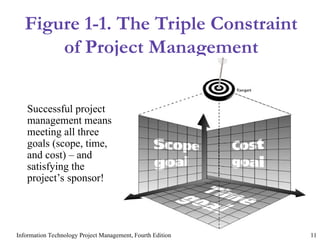
The Triple Constraint
 Every project is constrained in different ways by its:
 Scope goals: What work will be done?
 Time goals: How long should it take to complete?
 Cost goals: What should it cost?
 It is the project manager’s duty to balance these
three often-competing goals.
Information Technology Project Management, Fourth Edition 11
Figure 1-1. The Triple Constraint
of Project Management
Successful project
management means
meeting all three
goals (scope, time,
and cost) – and
satisfying the
project’s sponsor!
Information Technology Project Management, Fourth Edition 12
What is Project Management?
 Project management is “the application of
knowledge, skills, tools and techniques to project
activities to meet project requirements.”*
*PMI, A Guide to the Project Management Body of Knowledge
(PMBOK® Guide) (2004), p. 8.
Information Technology Project Management, Fourth Edition 13
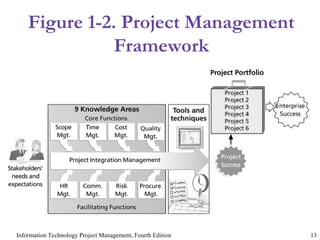
Figure 1-2. Project Management
Framework
Information Technology Project Management, Fourth Edition 14
Project Stakeholders
 Stakeholders are the people involved in or affected by
project activities.
 Stakeholders include:
 Project sponsor
 Project manager
 Project team
 Support staff
 Customers
 Users
 Suppliers
 Opponents to the project
Information Technology Project Management, Fourth Edition 15
Project Management Tools and
Techniques
 Project management tools and techniques assist
project managers and their teams in various aspects of
project management.
 Specific tools and techniques include:
 Project charters, scope statements, and WBS (scope).
 Gantt charts, network diagrams, critical path analyses,
critical chain scheduling (time).
 Cost estimates and earned value management (cost).
 See Table 1-1 for other examples.
Information Technology Project Management, Fourth Edition 16
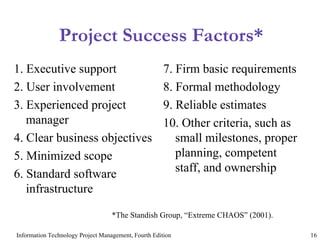
Project Success Factors*
1. Executive support
2. User involvement
3. Experienced project
manager
4. Clear business objectives
5. Minimized scope
6. Standard software
infrastructure
7. Firm basic requirements
8. Formal methodology
9. Reliable estimates
10. Other criteria, such as
small milestones, proper
planning, competent
staff, and ownership
*The Standish Group, “Extreme CHAOS” (2001).
Information Technology Project Management, Fourth Edition 17
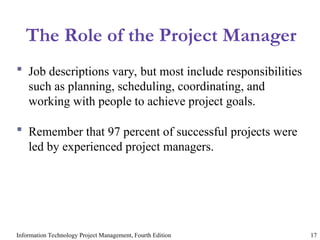
The Role of the Project Manager
 Job descriptions vary, but most include responsibilities
such as planning, scheduling, coordinating, and
working with people to achieve project goals.
 Remember that 97 percent of successful projects were
led by experienced project managers.
Information Technology Project Management, Fourth Edition 18
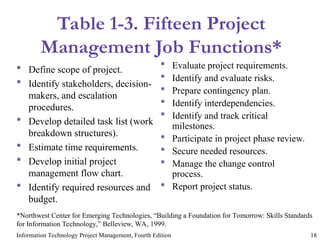
 Define scope of project.
 Identify stakeholders, decision-
makers, and escalation
procedures.
 Develop detailed task list (work
breakdown structures).
 Estimate time requirements.
 Develop initial project
management flow chart.
 Identify required resources and
budget.
 Evaluate project requirements.
 Identify and evaluate risks.
 Prepare contingency plan.
 Identify interdependencies.
 Identify and track critical
milestones.
 Participate in project phase review.
 Secure needed resources.
 Manage the change control
process.
 Report project status.
Table 1-3. Fifteen Project
Management Job Functions*
*Northwest Center for Emerging Technologies, “Building a Foundation for Tomorrow: Skills Standards
for Information Technology,” Belleview, WA, 1999.
Information Technology Project Management, Fourth Edition 19
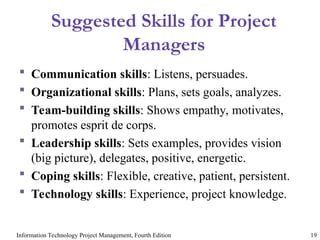
Suggested Skills for Project
Managers
 Communication skills: Listens, persuades.
 Organizational skills: Plans, sets goals, analyzes.
 Team-building skills: Shows empathy, motivates,
promotes esprit de corps.
 Leadership skills: Sets examples, provides vision
(big picture), delegates, positive, energetic.
 Coping skills: Flexible, creative, patient, persistent.
 Technology skills: Experience, project knowledge.
Information Technology Project Management, Fourth Edition 20
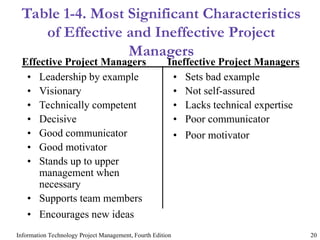
Table 1-4. Most Significant Characteristics
of Effective and Ineffective Project
Managers
• Leadership by example
• Visionary
• Technically competent
• Decisive
• Good communicator
• Good motivator
• Stands up to upper
management when
necessary
• Supports team members
• Encourages new ideas
• Sets bad example
• Not self-assured
• Lacks technical expertise
• Poor communicator
• Poor motivator
Effective Project Managers Ineffective Project Managers
Information Technology Project Management, Fourth Edition 21
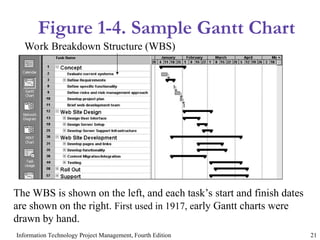
Figure 1-4. Sample Gantt Chart
The WBS is shown on the left, and each task’s start and finish dates
are shown on the right. First used in 1917, early Gantt charts were
drawn by hand.
Work Breakdown Structure (WBS)
Information Technology Project Management, Fourth Edition 22
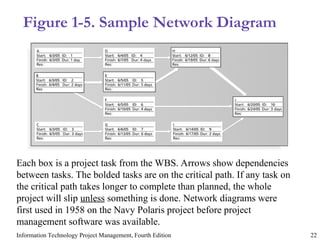
Figure 1-5. Sample Network Diagram
Each box is a project task from the WBS. Arrows show dependencies
between tasks. The bolded tasks are on the critical path. If any task on
the critical path takes longer to complete than planned, the whole
project will slip unless something is done. Network diagrams were
first used in 1958 on the Navy Polaris project before project
management software was available.
Information Technology Project Management, Fourth Edition 23
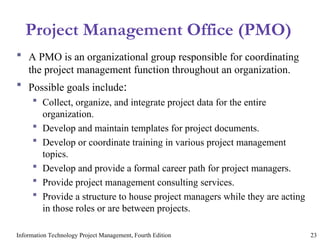
Project Management Office (PMO)
 A PMO is an organizational group responsible for coordinating
the project management function throughout an organization.
 Possible goals include:
 Collect, organize, and integrate project data for the entire
organization.
 Develop and maintain templates for project documents.
 Develop or coordinate training in various project management
topics.
 Develop and provide a formal career path for project managers.
 Provide project management consulting services.
 Provide a structure to house project managers while they are acting
in those roles or are between projects.
Information Technology Project Management, Fourth Edition 24
Chapter Summary
 As the number and complexity of projects continue to grow, it is
becoming even more important to practice good project
management.
 A project has several attributes, such as being unique, temporary
and developed incrementally.
 A framework for project management includes project
stakeholders, the nine knowledge areas, tools and techniques,
and creating project portfolios to ensure enterprise success.
 Successful project managers must possess and development
many skills and lead their teams by example.
 The project management profession continues to mature as more
people become certified and more tools are created.

Ch01 Introduction to Project Management.ppt

  • 1.
    Chapter 1: Introduction toProject Management Information Technology Project Management, Fourth Edition
  • 2.
    Information Technology ProjectManagement, Fourth Edition 2 Learning Objectives  Understand the growing need for better project management, especially for information technology projects.  Explain what a project is, provide examples of information technology projects, list various attributes of projects, and describe the triple constraint of projects.
  • 3.
    Information Technology ProjectManagement, Fourth Edition 3 Learning Objectives  Describe project management and discuss key elements of the project management framework, including project stakeholders, the project management knowledge areas, common tools and techniques, and project success factors.  Understand the role of the project manager by describing what project managers do, what skills they need, and what the career field is like for information technology project managers.
  • 4.
    Information Technology ProjectManagement, Fourth Edition 4 Learning Objectives  Describe the project management profession, including its history, the role of professional organizations such as the Project Management Institute, the importance of certification and ethics, and the growth of project management software.
  • 5.
    Information Technology ProjectManagement, Fourth Edition 5 Introduction  Many organizations today have a new or renewed interest in project management.  Computer hardware, software, networks, and the use of interdisciplinary and global work teams have radically changed the work environment. *PMI, The PMI Project Management Fact Book, Second Edition, 2001.
  • 6.
    Information Technology ProjectManagement, Fourth Edition 6 Advantages of Using Formal Project Management  Better control of financial, physical, and human resources.  Improved customer relations.  Shorter development times.  Lower costs.  Higher quality and increased reliability.  Higher profit margins.  Improved productivity.  Better internal coordination.  Higher worker morale (less stress).
  • 7.
    Information Technology ProjectManagement, Fourth Edition 7 What Is a Project?  A project is “a temporary endeavor undertaken to create a unique product, service, or result.”*  Operations is work done to sustain the business.  A project ends when its objectives have been reached, or the project has been terminated.  Projects can be large or small and take a short or long time to complete. *PMI, A Guide to the Project Management Body of Knowledge (PMBOK® Guide) (2004), p. 5.
  • 8.
    Information Technology ProjectManagement, Fourth Edition 8 Project Attributes  A project:  Has a unique purpose.  Is temporary.  Is developed using progressive elaboration.  Requires resources, often from various areas.  Should have a primary customer or sponsor.  The project sponsor usually provides the direction and funding for the project.  Involves uncertainty.
  • 9.
    Information Technology ProjectManagement, Fourth Edition 9 Project and Program Managers  Project managers work with project sponsors, project teams, and other people involved in projects to meet project goals.  Program: “A group of related projects managed in a coordinated way to obtain benefits and control not available from managing them individually.”*  Program managers oversee programs and often act as bosses for project managers. *PMI, A Guide to the Project Management Body of Knowledge (PMBOK® Guide) (2004), p. 16.
  • 10.
    Information Technology ProjectManagement, Fourth Edition 10 The Triple Constraint  Every project is constrained in different ways by its:  Scope goals: What work will be done?  Time goals: How long should it take to complete?  Cost goals: What should it cost?  It is the project manager’s duty to balance these three often-competing goals.
  • 11.
    Information Technology ProjectManagement, Fourth Edition 11 Figure 1-1. The Triple Constraint of Project Management Successful project management means meeting all three goals (scope, time, and cost) – and satisfying the project’s sponsor!
  • 12.
    Information Technology ProjectManagement, Fourth Edition 12 What is Project Management?  Project management is “the application of knowledge, skills, tools and techniques to project activities to meet project requirements.”* *PMI, A Guide to the Project Management Body of Knowledge (PMBOK® Guide) (2004), p. 8.
  • 13.
    Information Technology ProjectManagement, Fourth Edition 13 Figure 1-2. Project Management Framework
  • 14.
    Information Technology ProjectManagement, Fourth Edition 14 Project Stakeholders  Stakeholders are the people involved in or affected by project activities.  Stakeholders include:  Project sponsor  Project manager  Project team  Support staff  Customers  Users  Suppliers  Opponents to the project
  • 15.
    Information Technology ProjectManagement, Fourth Edition 15 Project Management Tools and Techniques  Project management tools and techniques assist project managers and their teams in various aspects of project management.  Specific tools and techniques include:  Project charters, scope statements, and WBS (scope).  Gantt charts, network diagrams, critical path analyses, critical chain scheduling (time).  Cost estimates and earned value management (cost).  See Table 1-1 for other examples.
  • 16.
    Information Technology ProjectManagement, Fourth Edition 16 Project Success Factors* 1. Executive support 2. User involvement 3. Experienced project manager 4. Clear business objectives 5. Minimized scope 6. Standard software infrastructure 7. Firm basic requirements 8. Formal methodology 9. Reliable estimates 10. Other criteria, such as small milestones, proper planning, competent staff, and ownership *The Standish Group, “Extreme CHAOS” (2001).
  • 17.
    Information Technology ProjectManagement, Fourth Edition 17 The Role of the Project Manager  Job descriptions vary, but most include responsibilities such as planning, scheduling, coordinating, and working with people to achieve project goals.  Remember that 97 percent of successful projects were led by experienced project managers.
  • 18.
    Information Technology ProjectManagement, Fourth Edition 18  Define scope of project.  Identify stakeholders, decision- makers, and escalation procedures.  Develop detailed task list (work breakdown structures).  Estimate time requirements.  Develop initial project management flow chart.  Identify required resources and budget.  Evaluate project requirements.  Identify and evaluate risks.  Prepare contingency plan.  Identify interdependencies.  Identify and track critical milestones.  Participate in project phase review.  Secure needed resources.  Manage the change control process.  Report project status. Table 1-3. Fifteen Project Management Job Functions* *Northwest Center for Emerging Technologies, “Building a Foundation for Tomorrow: Skills Standards for Information Technology,” Belleview, WA, 1999.
  • 19.
    Information Technology ProjectManagement, Fourth Edition 19 Suggested Skills for Project Managers  Communication skills: Listens, persuades.  Organizational skills: Plans, sets goals, analyzes.  Team-building skills: Shows empathy, motivates, promotes esprit de corps.  Leadership skills: Sets examples, provides vision (big picture), delegates, positive, energetic.  Coping skills: Flexible, creative, patient, persistent.  Technology skills: Experience, project knowledge.
  • 20.
    Information Technology ProjectManagement, Fourth Edition 20 Table 1-4. Most Significant Characteristics of Effective and Ineffective Project Managers • Leadership by example • Visionary • Technically competent • Decisive • Good communicator • Good motivator • Stands up to upper management when necessary • Supports team members • Encourages new ideas • Sets bad example • Not self-assured • Lacks technical expertise • Poor communicator • Poor motivator Effective Project Managers Ineffective Project Managers
  • 21.
    Information Technology ProjectManagement, Fourth Edition 21 Figure 1-4. Sample Gantt Chart The WBS is shown on the left, and each task’s start and finish dates are shown on the right. First used in 1917, early Gantt charts were drawn by hand. Work Breakdown Structure (WBS)
  • 22.
    Information Technology ProjectManagement, Fourth Edition 22 Figure 1-5. Sample Network Diagram Each box is a project task from the WBS. Arrows show dependencies between tasks. The bolded tasks are on the critical path. If any task on the critical path takes longer to complete than planned, the whole project will slip unless something is done. Network diagrams were first used in 1958 on the Navy Polaris project before project management software was available.
  • 23.
    Information Technology ProjectManagement, Fourth Edition 23 Project Management Office (PMO)  A PMO is an organizational group responsible for coordinating the project management function throughout an organization.  Possible goals include:  Collect, organize, and integrate project data for the entire organization.  Develop and maintain templates for project documents.  Develop or coordinate training in various project management topics.  Develop and provide a formal career path for project managers.  Provide project management consulting services.  Provide a structure to house project managers while they are acting in those roles or are between projects.
  • 24.
    Information Technology ProjectManagement, Fourth Edition 24 Chapter Summary  As the number and complexity of projects continue to grow, it is becoming even more important to practice good project management.  A project has several attributes, such as being unique, temporary and developed incrementally.  A framework for project management includes project stakeholders, the nine knowledge areas, tools and techniques, and creating project portfolios to ensure enterprise success.  Successful project managers must possess and development many skills and lead their teams by example.  The project management profession continues to mature as more people become certified and more tools are created.

Editor's Notes