7-1
Prepared by
Mr. Mulugeta Shiferaw
7-2
1. Indicate how to report cash
and related items.
2. Define receivables and explain
accounting issues related to
their recognition.
3. Explain accounting issues
related to valuation of
accounts receivable.
4. Explain accounting issues
related to recognition and
valuation of notes receivable.
5. Explain additional accounting
issues related to accounts and
notes receivables.
After studying this chapter, you should be able to:
Cash and Receivables
CHAPTER 3
LEARNING OBJECTIVES
7-3
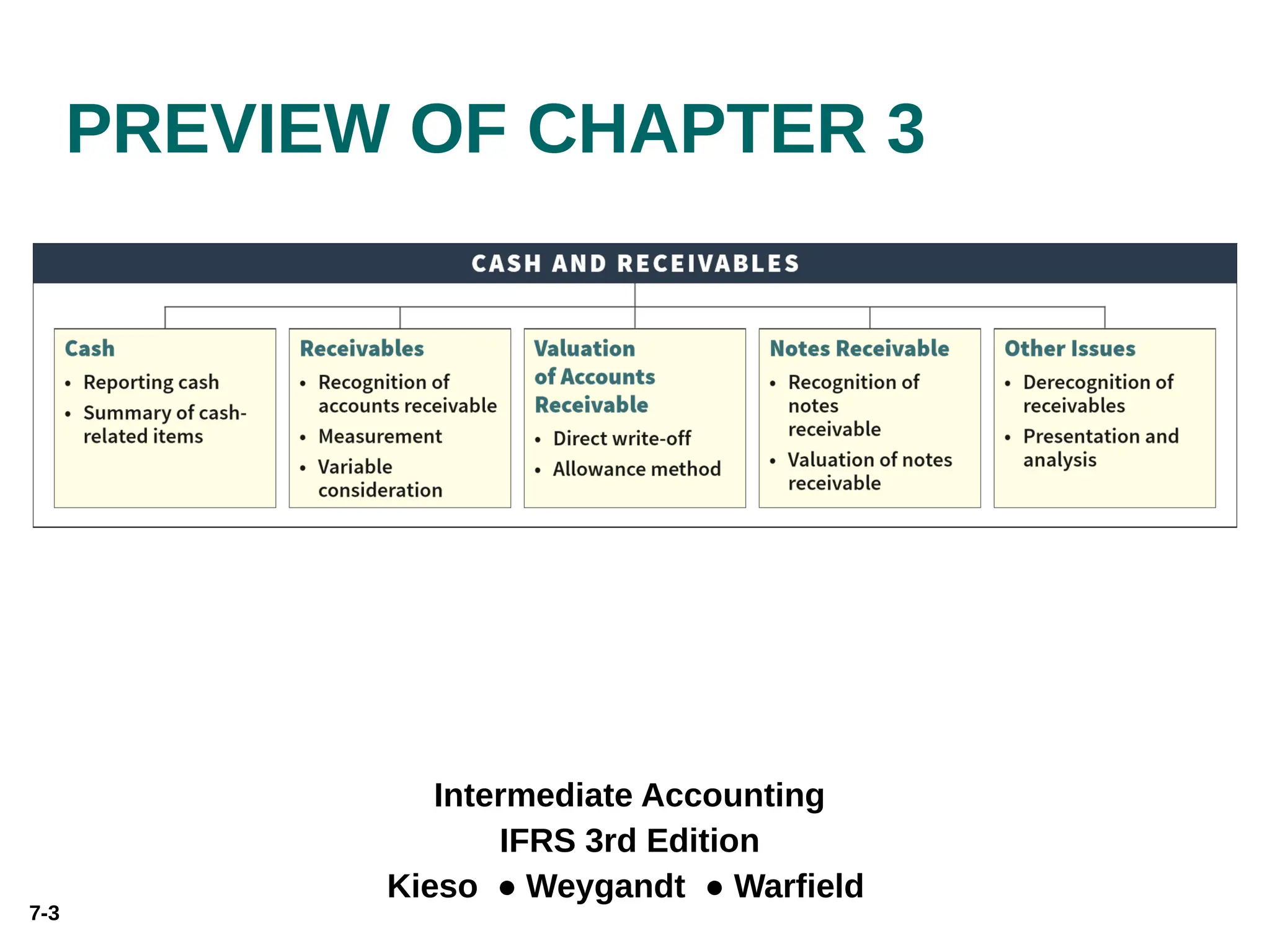
PREVIEW OF CHAPTER 3
Intermediate Accounting
IFRS 3rd Edition
Kieso ● Weygandt ● Warfield
7-4
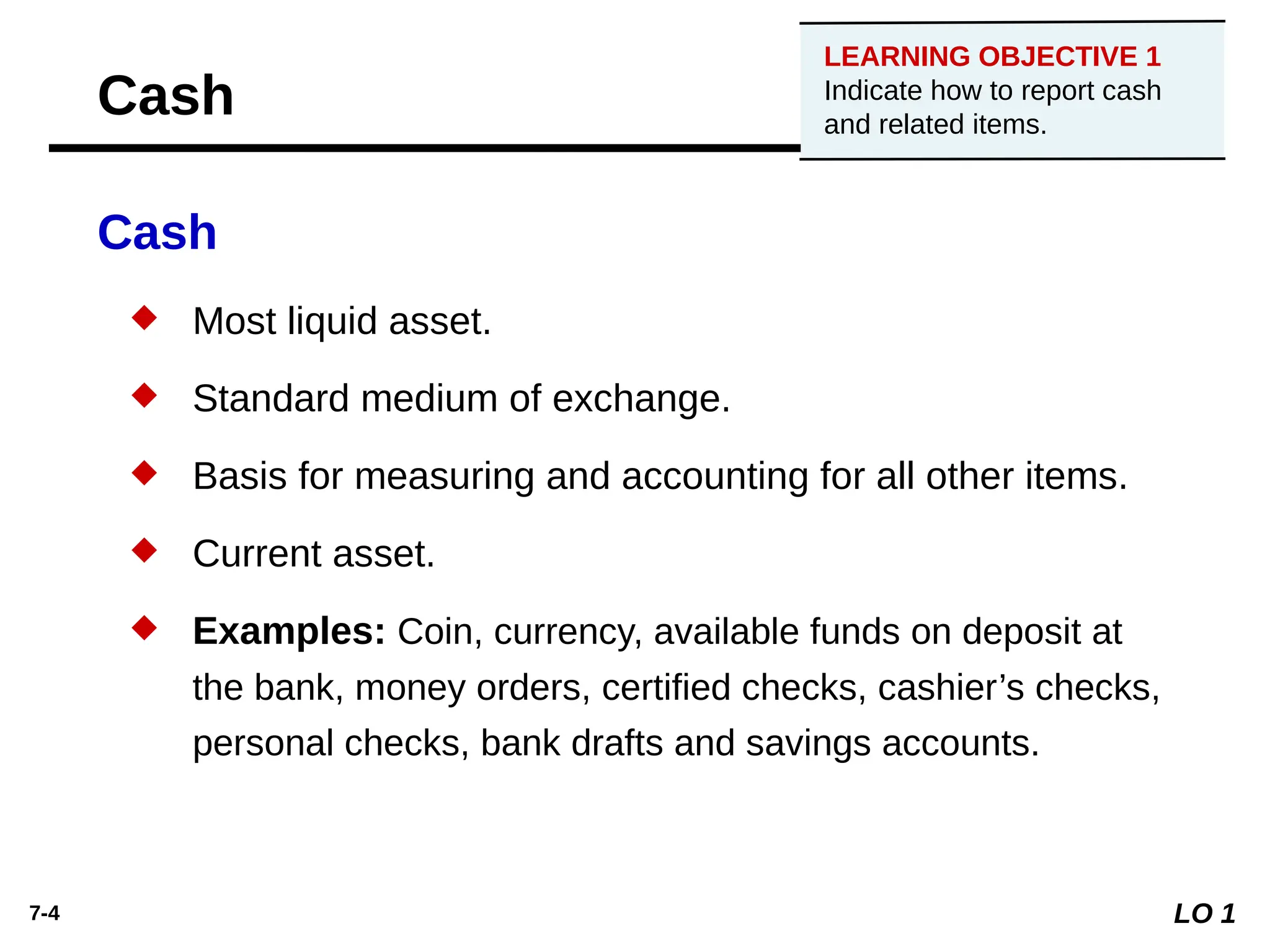
Cash
 Most liquid asset.
 Standard medium of exchange.
 Basis for measuring and accounting for all other items.
 Current asset.
 Examples: Coin, currency, available funds on deposit at
the bank, money orders, certified checks, cashier’s checks,
personal checks, bank drafts and savings accounts.
LO 1
LEARNING OBJECTIVE 1
Indicate how to report cash
and related items.
Cash
7-5
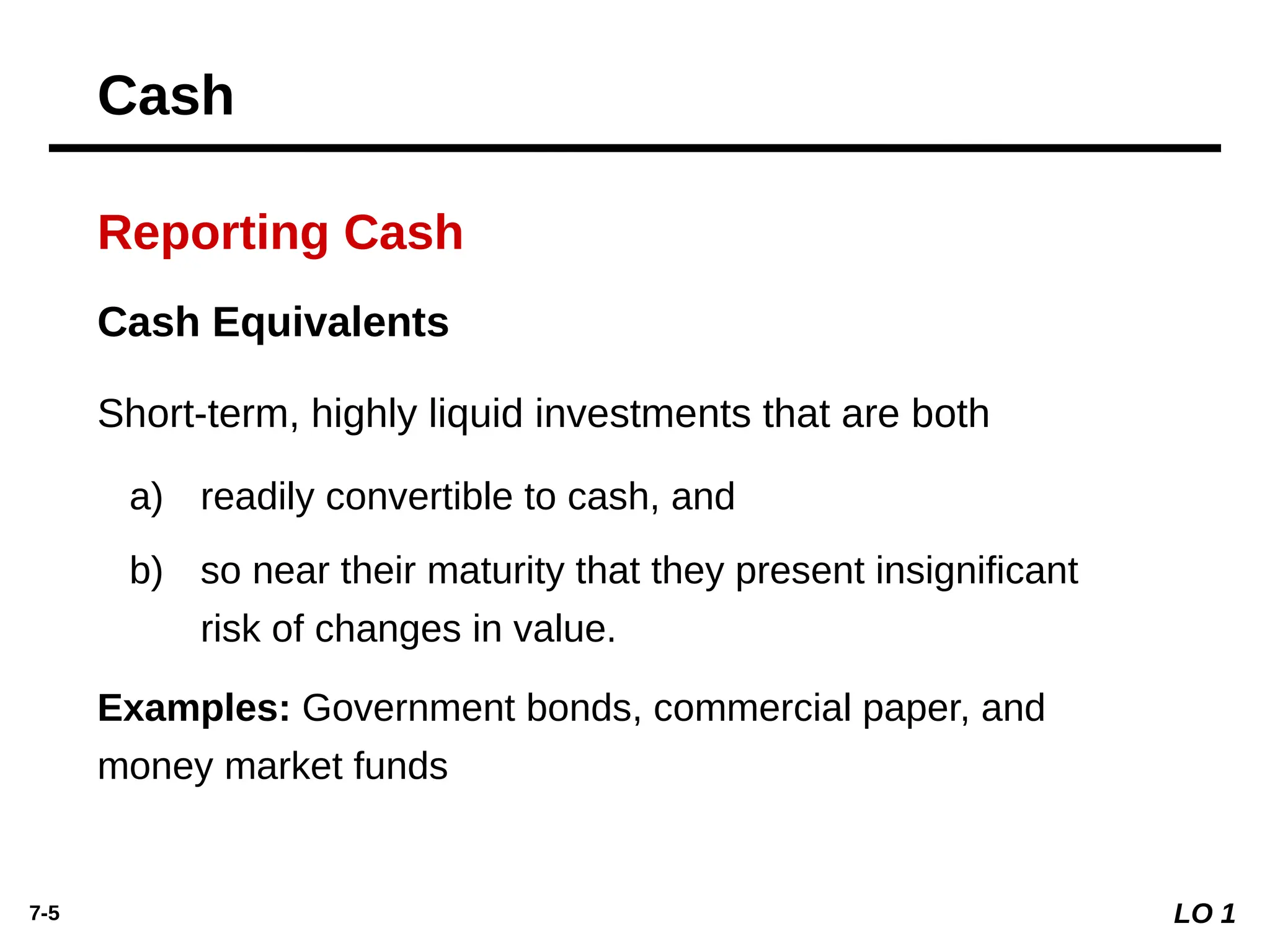
Cash Equivalents
Short-term, highly liquid investments that are both
a) readily convertible to cash, and
b) so near their maturity that they present insignificant
risk of changes in value.
Examples: Government bonds, commercial paper, and
money market funds
Reporting Cash
LO 1
Cash
7-6
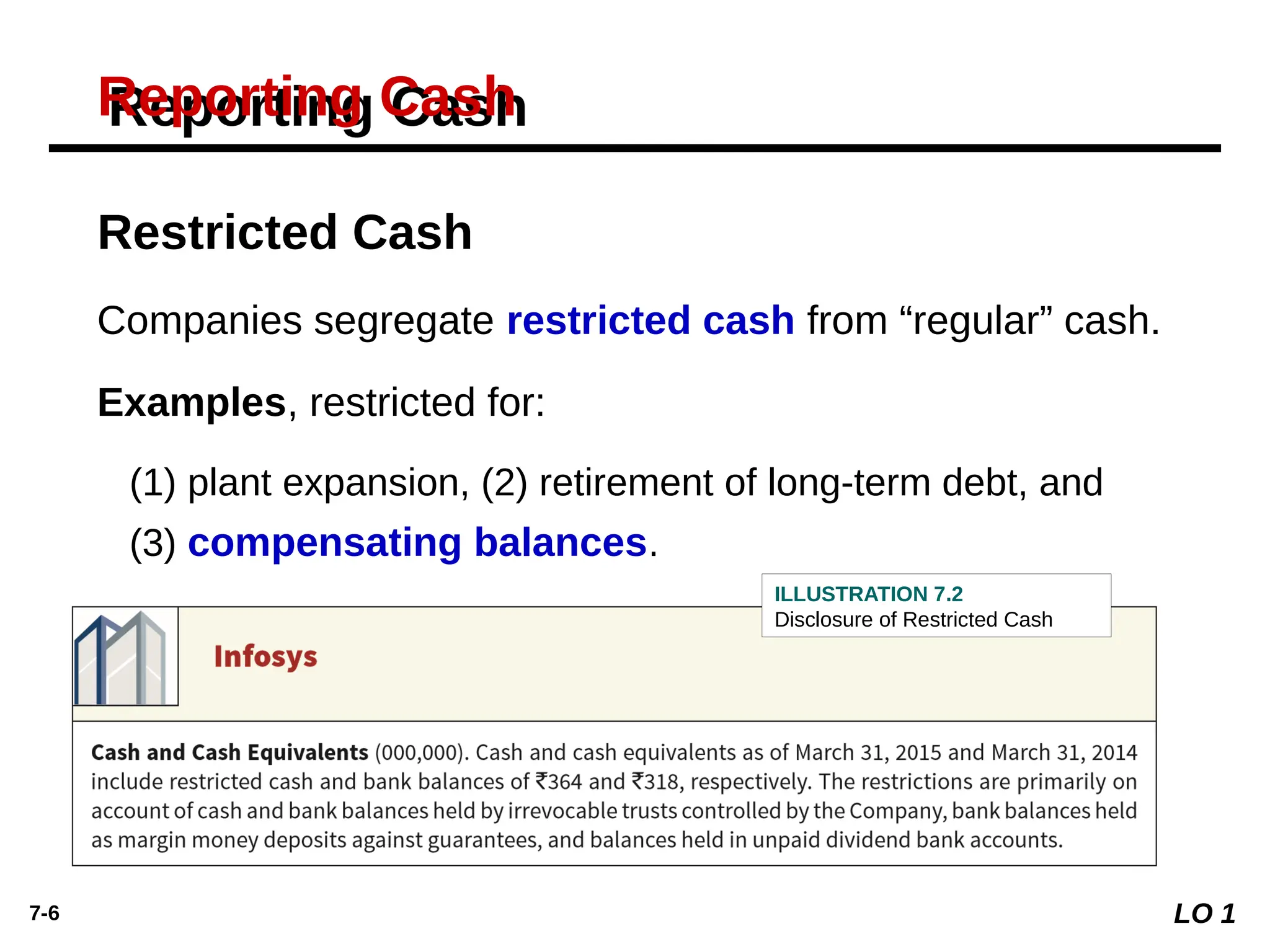
Companies segregate restricted cash from “regular” cash.
Examples, restricted for:
(1) plant expansion, (2) retirement of long-term debt, and
(3) compensating balances.
Reporting Cash
Restricted Cash
ILLUSTRATION 7.2
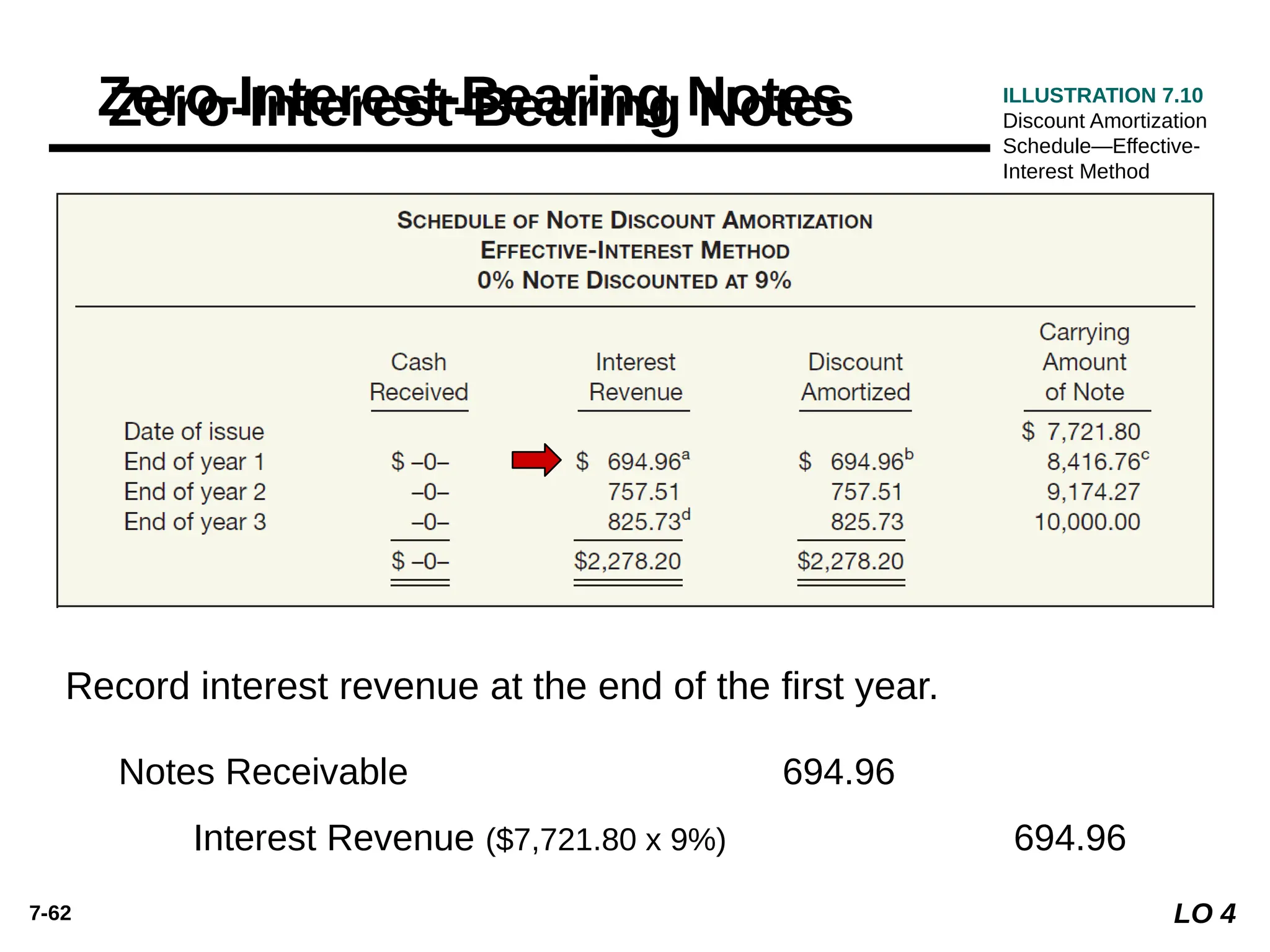
Disclosure of Restricted Cash
LO 1
7-7
Reporting Cash
Bank Overdrafts
Company writes a check for more than the amount in its
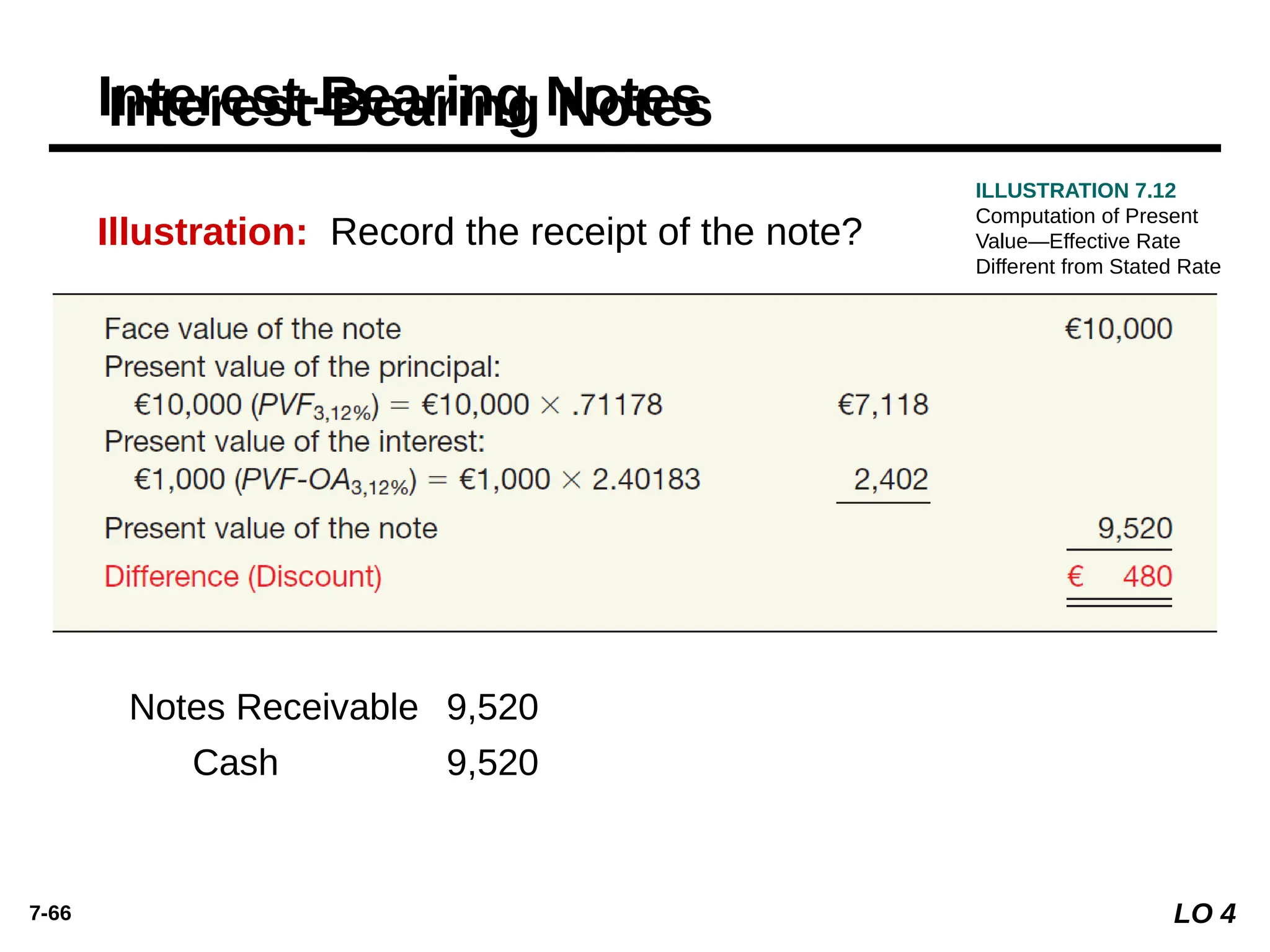
cash account.
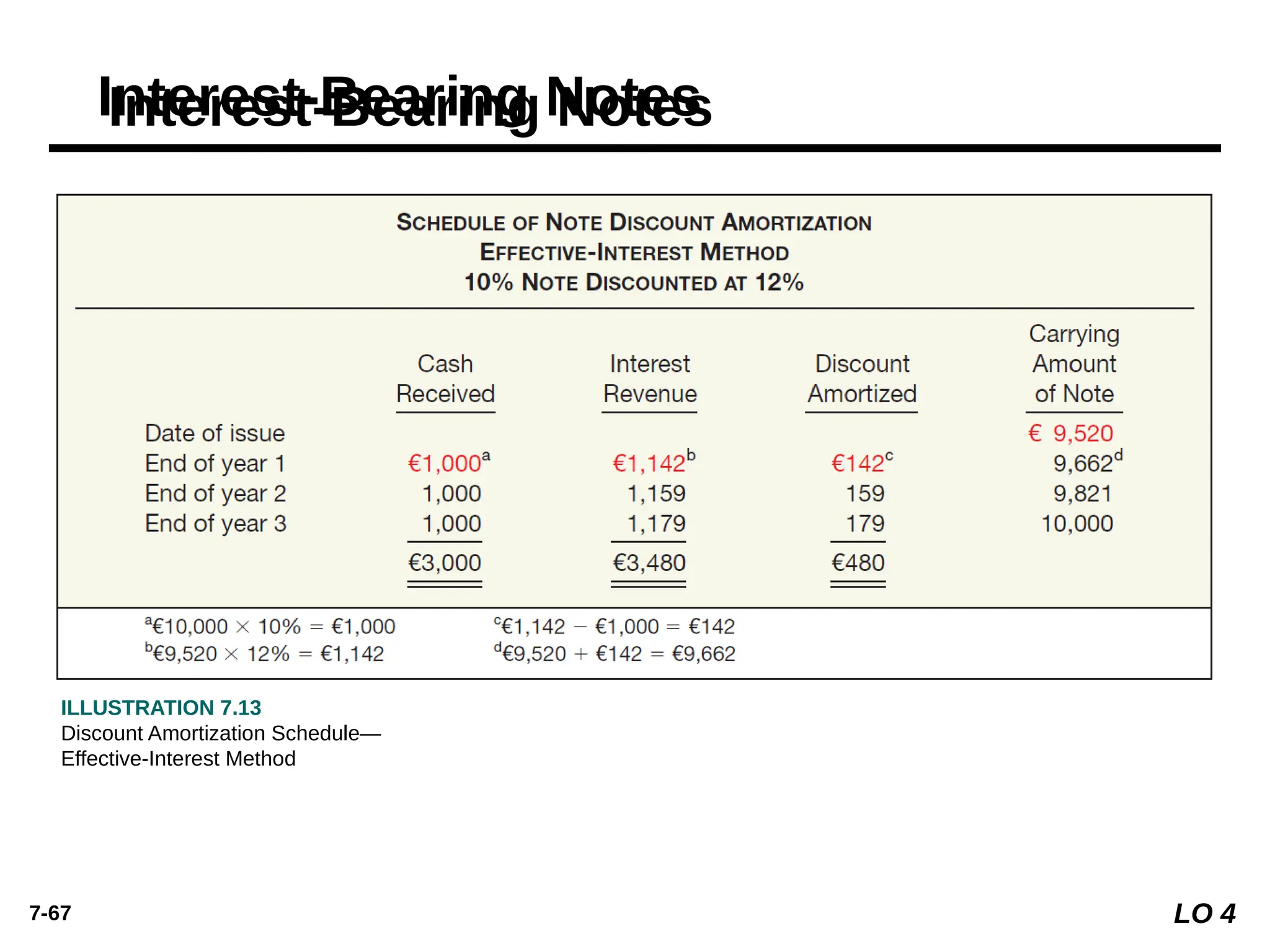
 Generally reported as a current liability.
 Included as a component of cash if such overdrafts are
repayable on demand and are an integral part of a
company’s cash management (such as the common
practice of establishing o setting arrangements against
ff
other accounts at the same bank).
LO 1
7-8
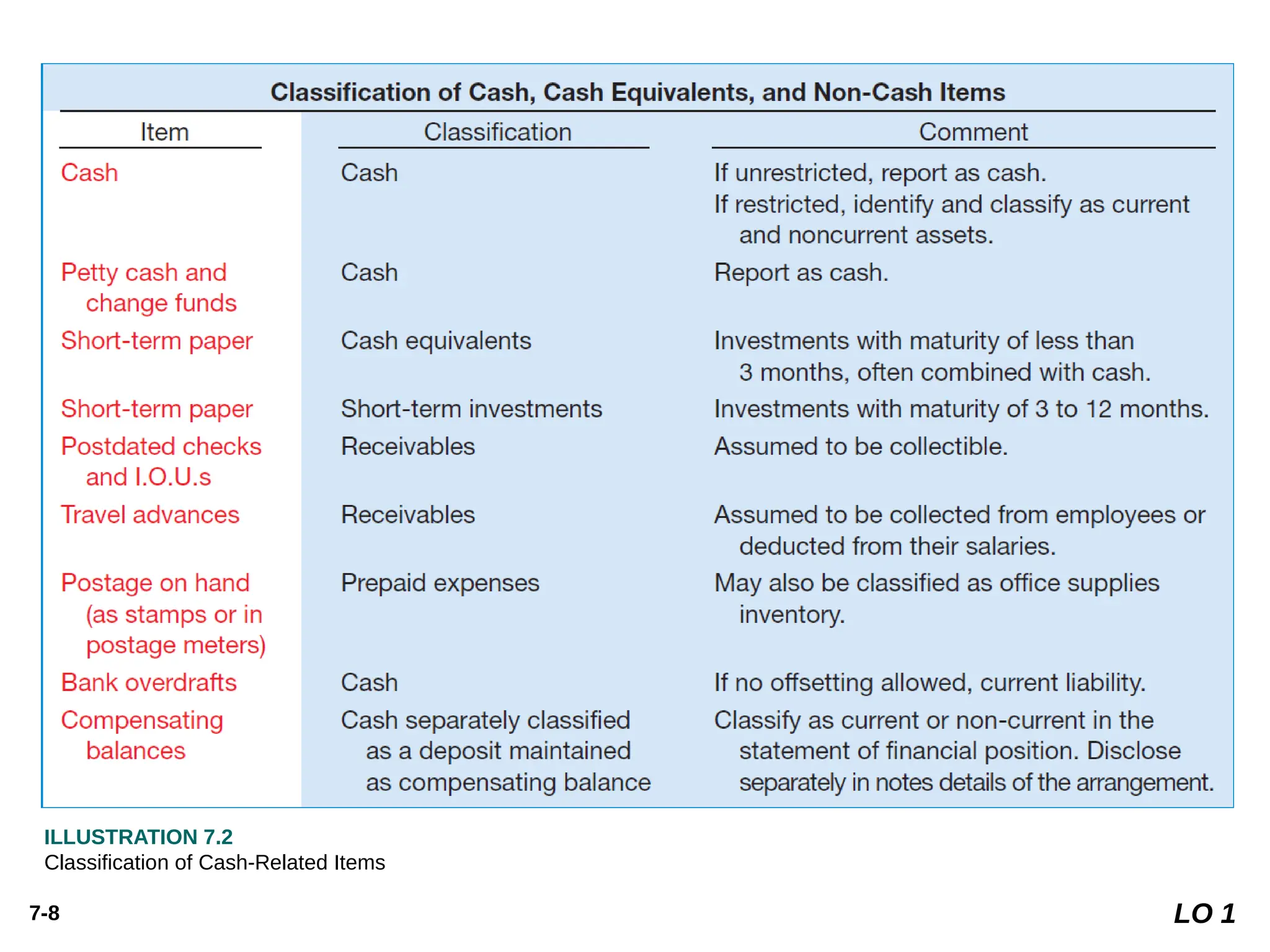
ILLUSTRATION 7.2
Classification of Cash-Related Items
LO 1
7-9
LEARNING OBJECTIVE 2
Define receivables and explain accounting
issues related to their recognition.
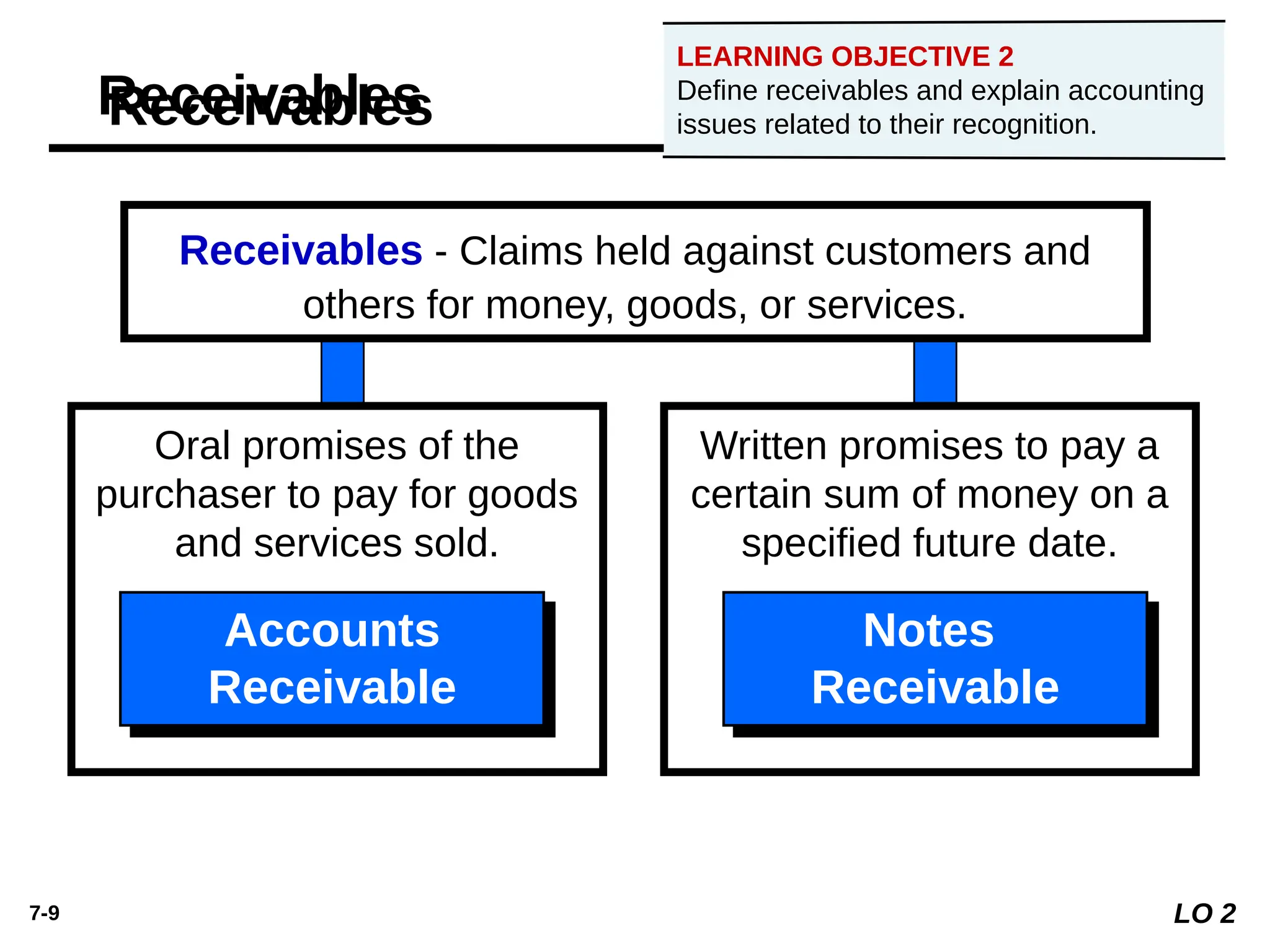
Receivables
Written promises to pay a
certain sum of money on a
specified future date.
Receivables - Claims held against customers and
others for money, goods, or services.
Oral promises of the
purchaser to pay for goods
and services sold.
Accounts
Receivable
Notes
Receivable
LO 2
7-10
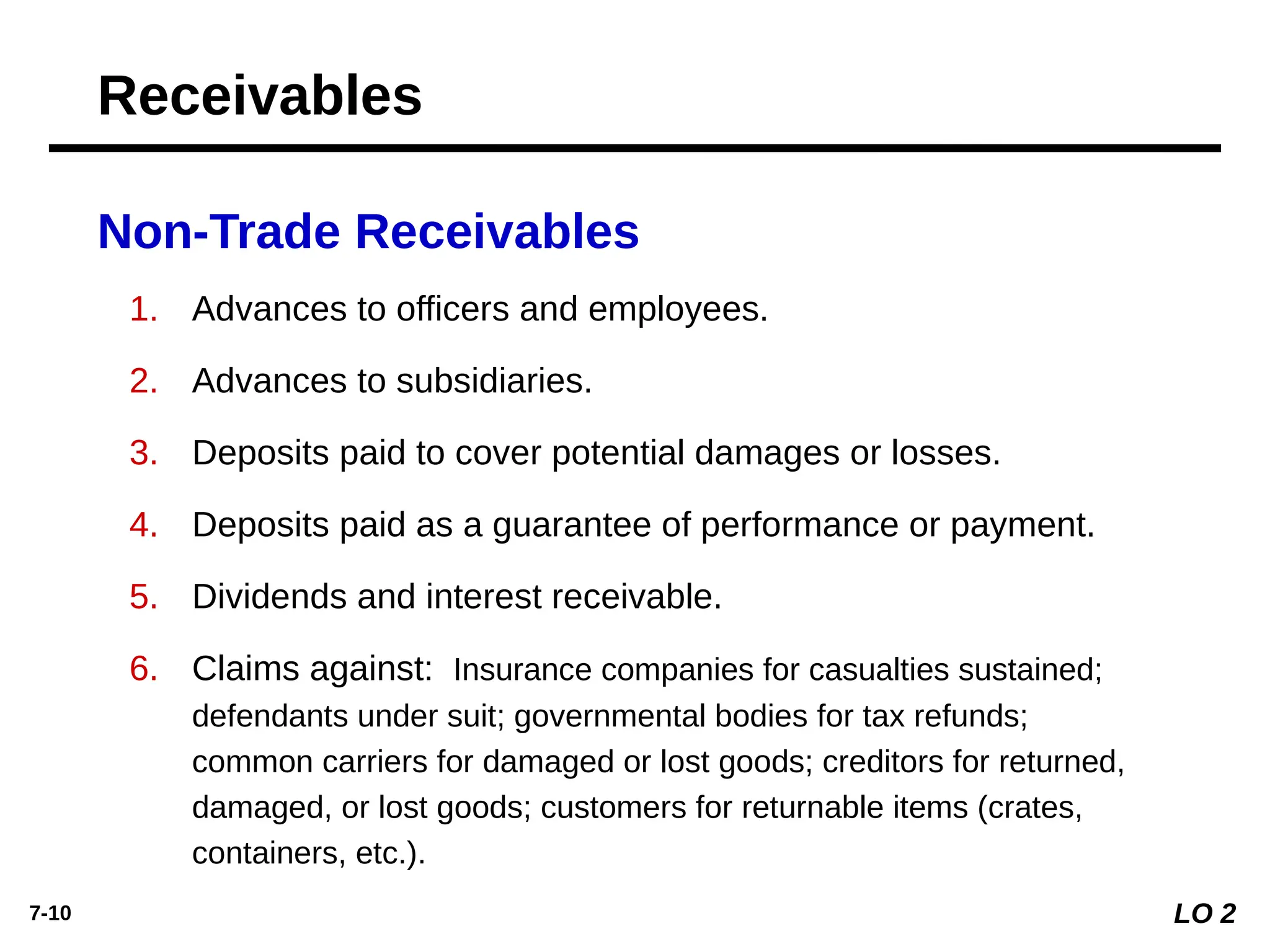
Non-Trade Receivables
1. Advances to officers and employees.
2. Advances to subsidiaries.
3. Deposits paid to cover potential damages or losses.
4. Deposits paid as a guarantee of performance or payment.
5. Dividends and interest receivable.
6. Claims against: Insurance companies for casualties sustained;
defendants under suit; governmental bodies for tax refunds;
common carriers for damaged or lost goods; creditors for returned,
damaged, or lost goods; customers for returnable items (crates,
containers, etc.).
LO 2
Receivables
7-11
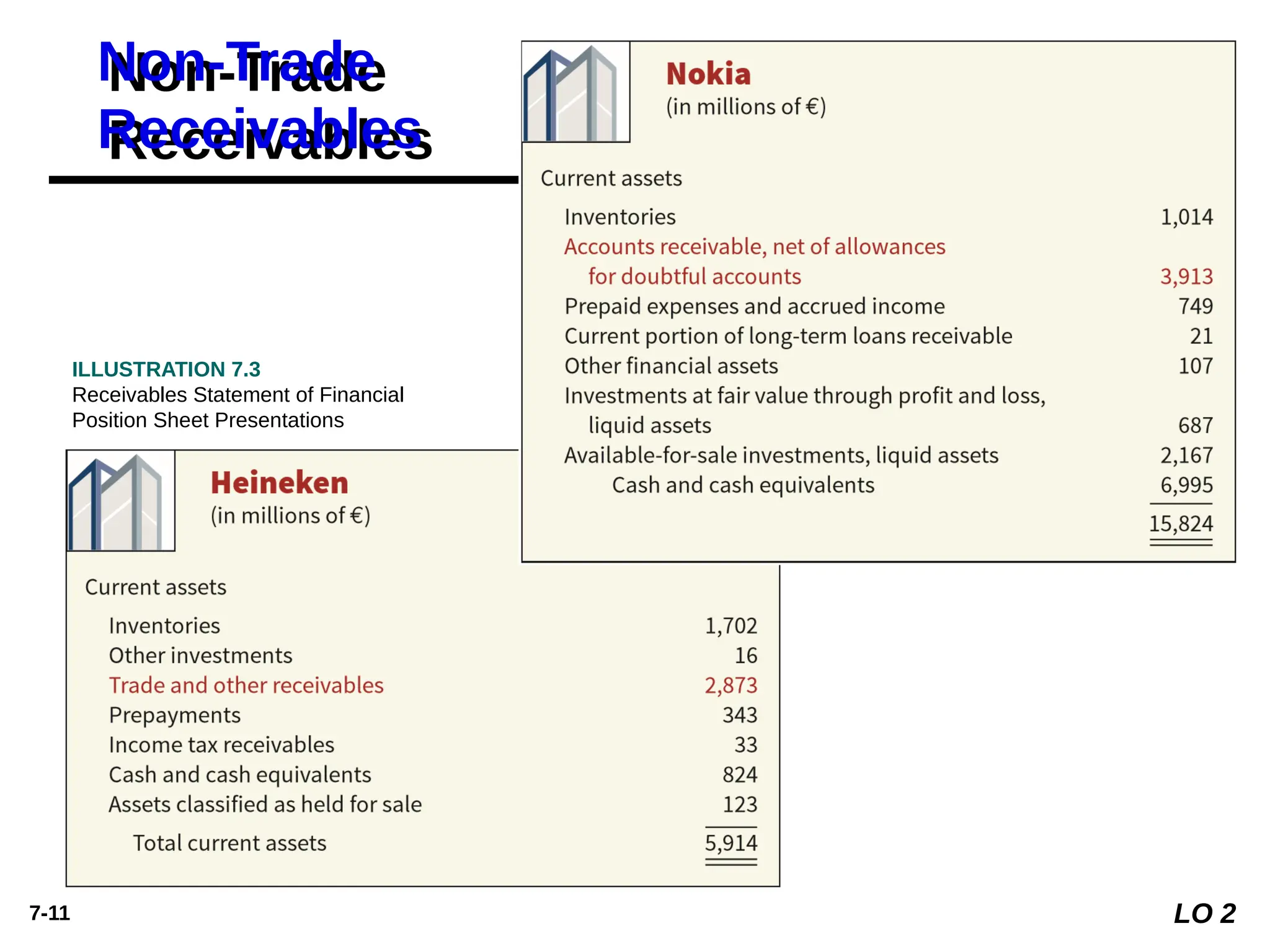
ILLUSTRATION 7.3
Receivables Statement of Financial
Position Sheet Presentations
Non-Trade
Receivables
LO 2
7-12
Recognition of Accounts Receivables
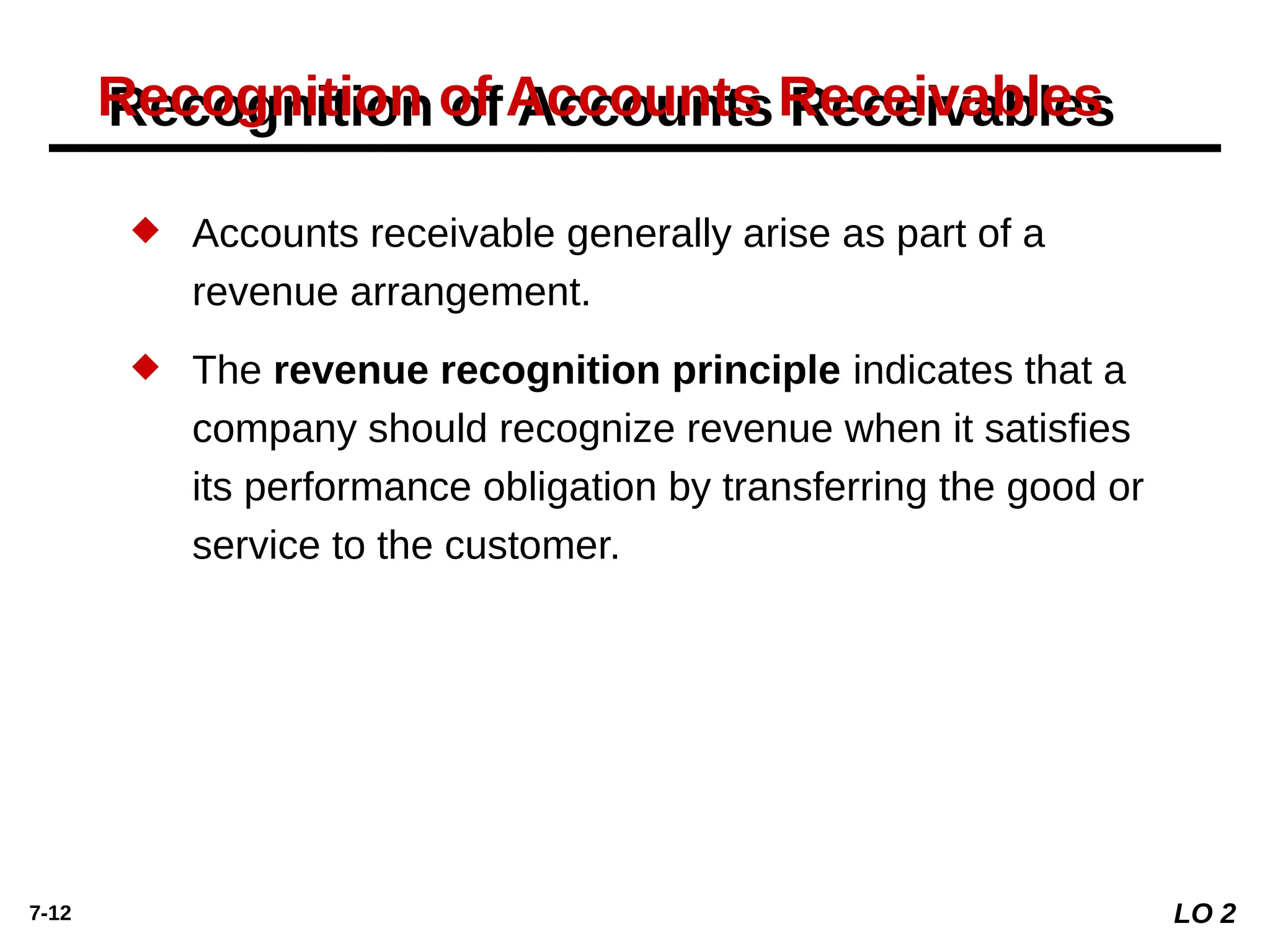
 Accounts receivable generally arise as part of a
revenue arrangement.
 The revenue recognition principle indicates that a
company should recognize revenue when it satisfies
its performance obligation by transferring the good or
service to the customer.
LO 2
7-13
Recognition of Accounts Receivables
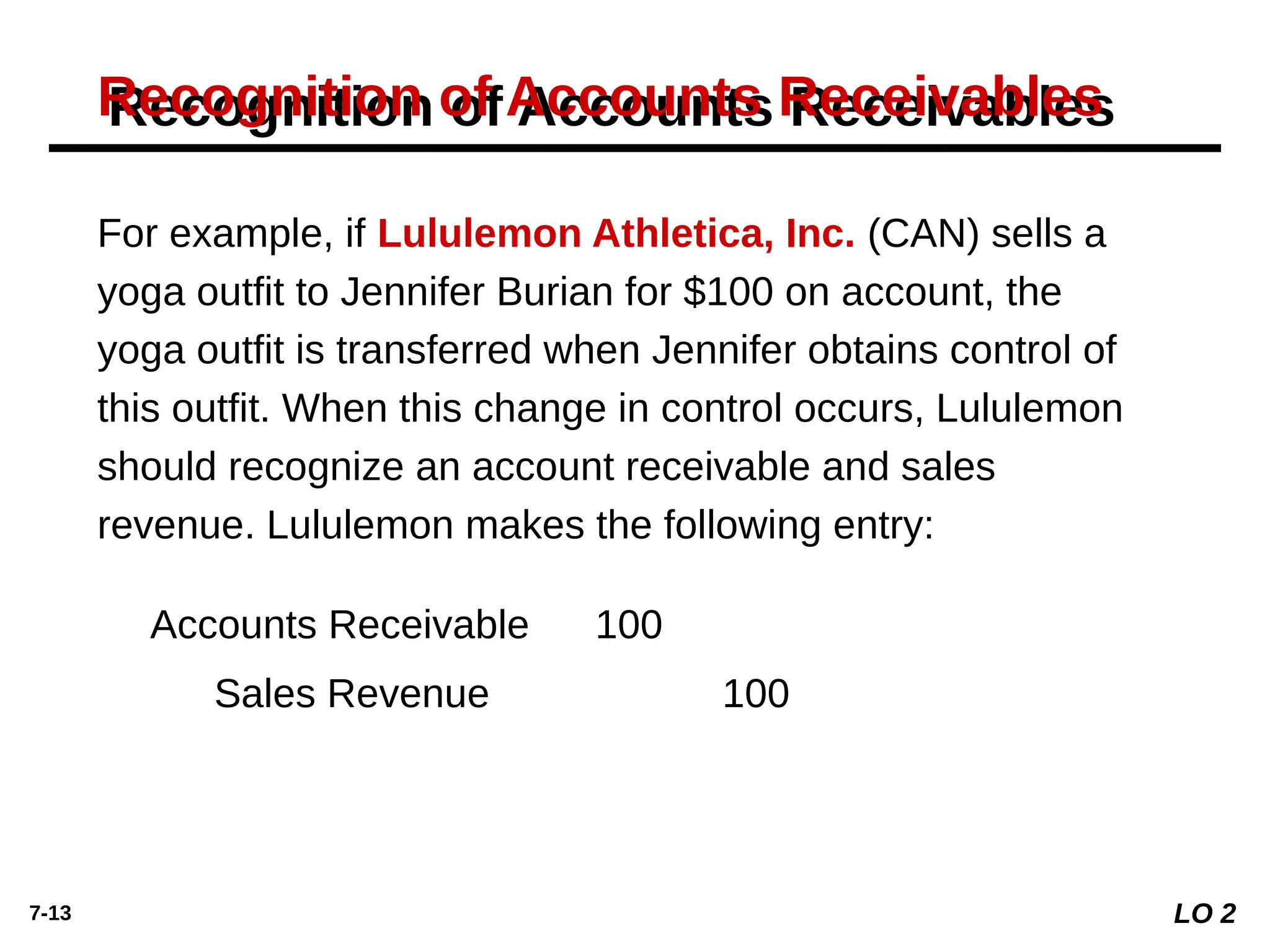
For example, if Lululemon Athletica, Inc. (CAN) sells a
yoga outfit to Jennifer Burian for $100 on account, the
yoga outfit is transferred when Jennifer obtains control of
this outfit. When this change in control occurs, Lululemon
should recognize an account receivable and sales
revenue. Lululemon makes the following entry:
Accounts Receivable 100
Sales Revenue 100
LO 2
7-14
Recognition of Accounts Receivables
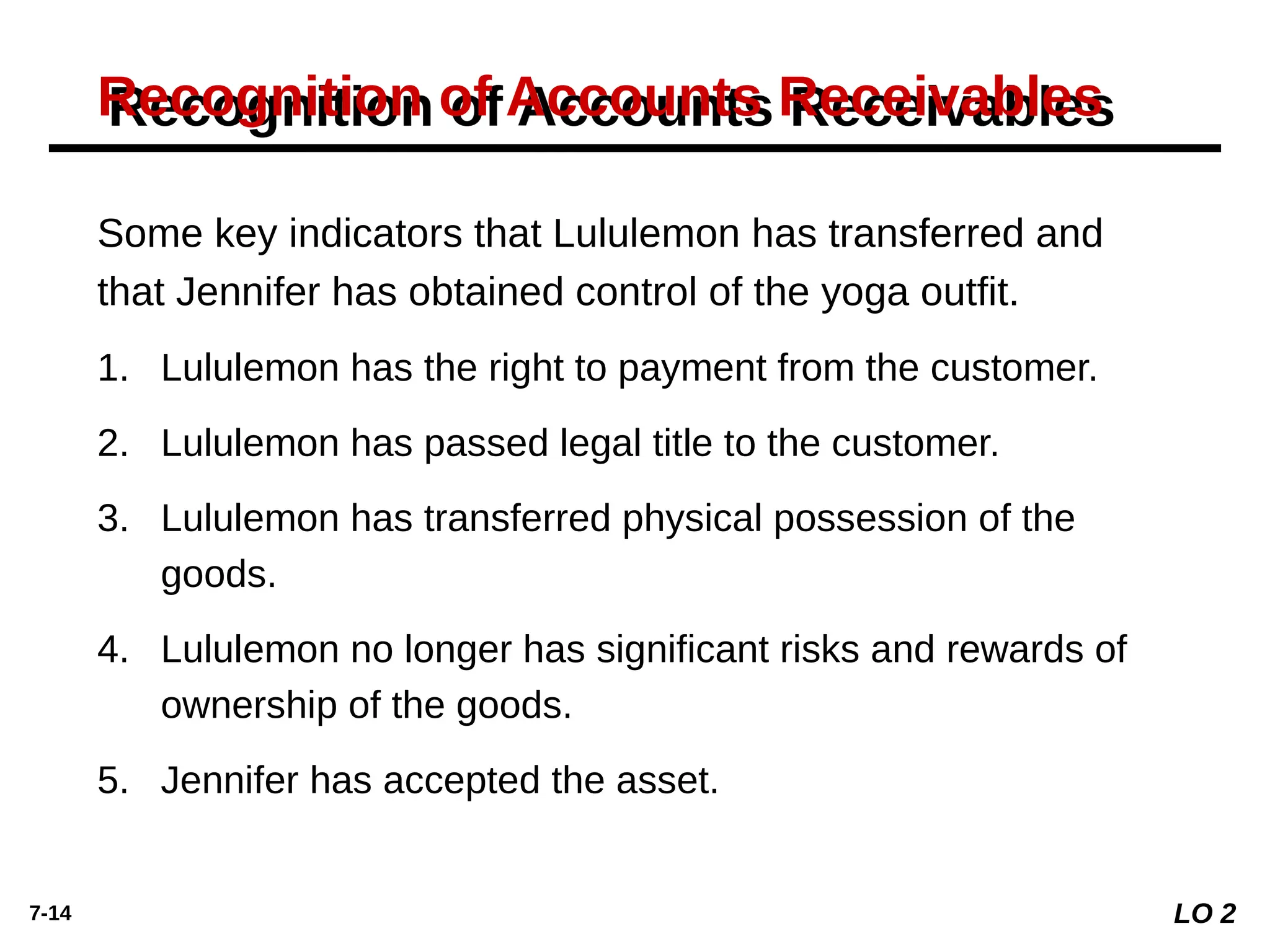
Some key indicators that Lululemon has transferred and
that Jennifer has obtained control of the yoga outfit.
1. Lululemon has the right to payment from the customer.
2. Lululemon has passed legal title to the customer.
3. Lululemon has transferred physical possession of the
goods.
4. Lululemon no longer has significant risks and rewards of
ownership of the goods.
5. Jennifer has accepted the asset.
LO 2
7-15
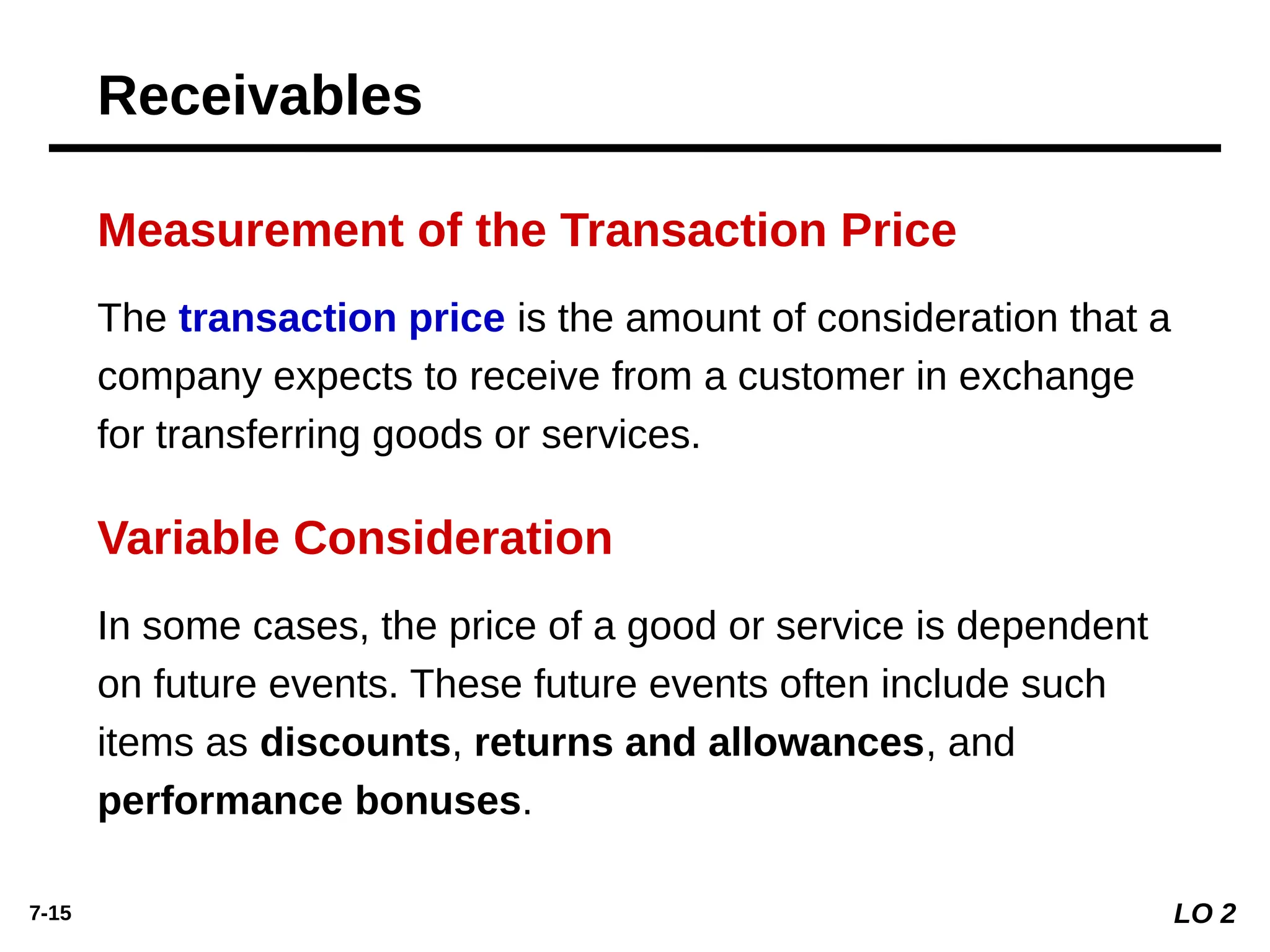
The transaction price is the amount of consideration that a
company expects to receive from a customer in exchange
for transferring goods or services.
Measurement of the Transaction Price
In some cases, the price of a good or service is dependent
on future events. These future events often include such
items as discounts, returns and allowances, and
performance bonuses.
Variable Consideration
Receivables
LO 2
7-16
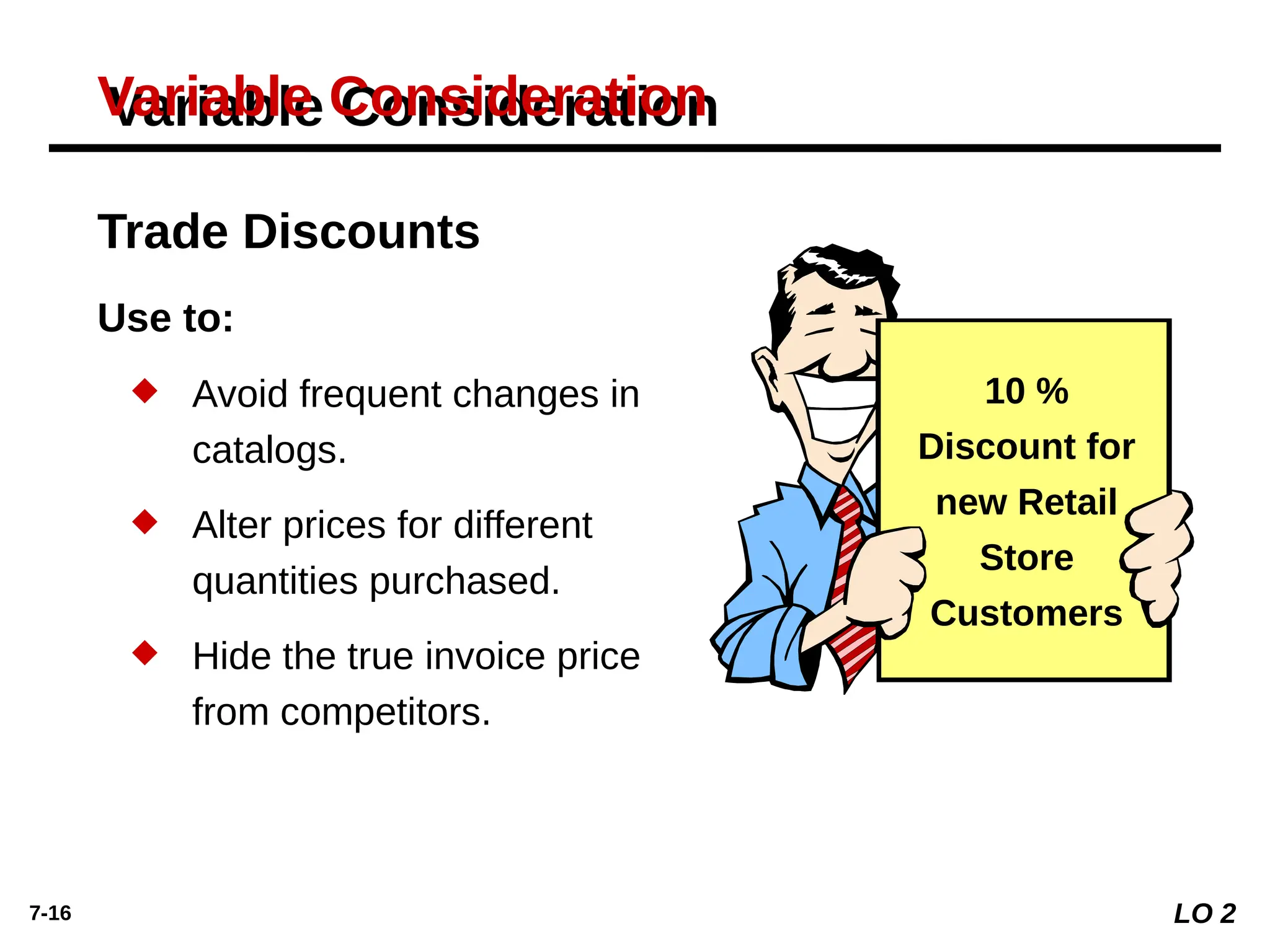
Variable Consideration
Use to:
 Avoid frequent changes in
catalogs.
 Alter prices for different
quantities purchased.
 Hide the true invoice price
from competitors.
10 %
Discount for
new Retail
Store
Customers
Trade Discounts
LO 2
7-17
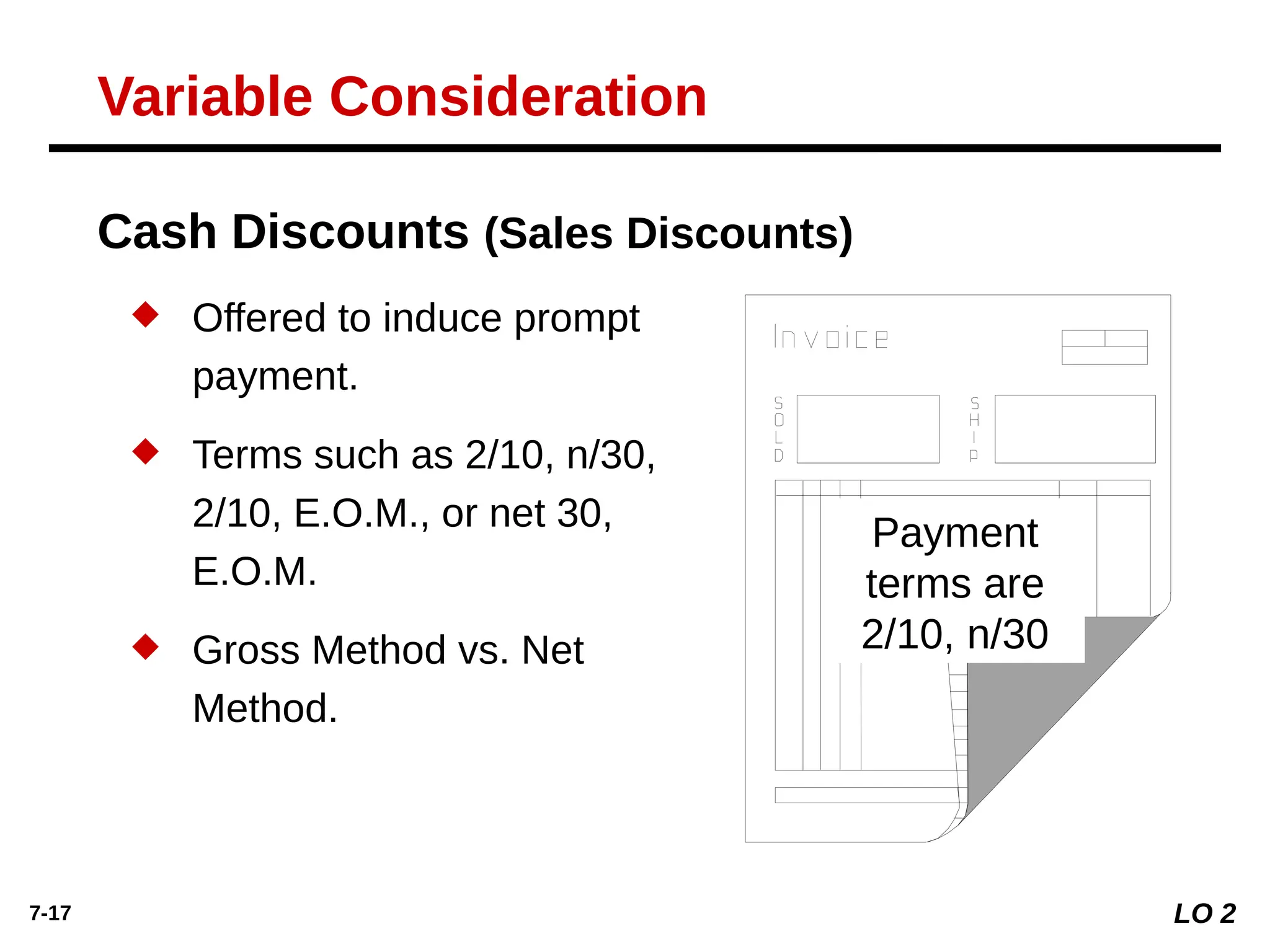
 Offered to induce prompt
payment.
 Terms such as 2/10, n/30,
2/10, E.O.M., or net 30,
E.O.M.
 Gross Method vs. Net
Method.
Cash Discounts (Sales Discounts)
Payment
terms are
2/10, n/30
LO 2
Variable Consideration
7-18
Cash Discounts (Sales Discounts)
ILLUSTRATION 7.5
Entries under Gross and Net Methods
LO 2
7-19
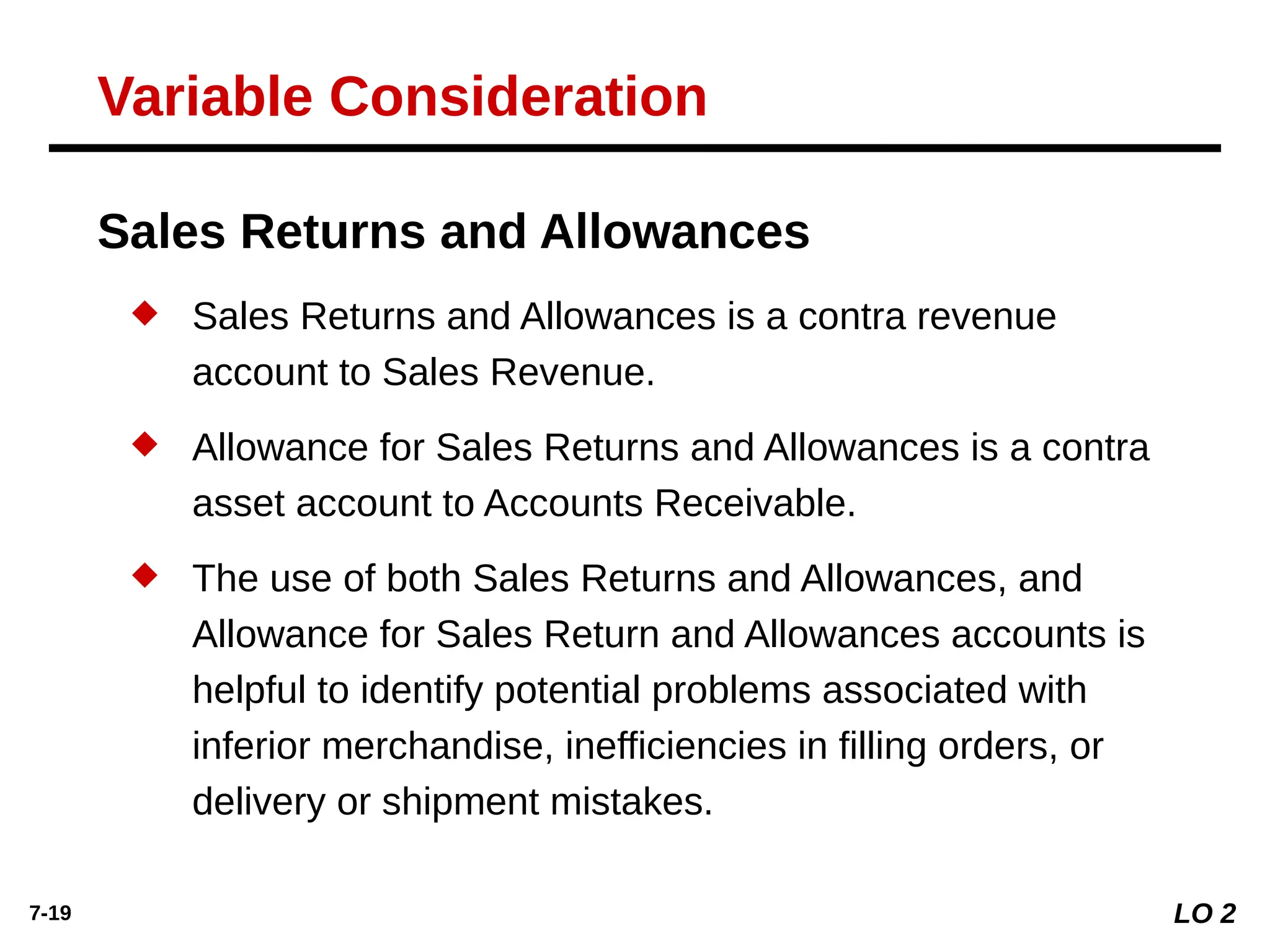
 Sales Returns and Allowances is a contra revenue
account to Sales Revenue.
 Allowance for Sales Returns and Allowances is a contra
asset account to Accounts Receivable.
 The use of both Sales Returns and Allowances, and
Allowance for Sales Return and Allowances accounts is
helpful to identify potential problems associated with
inferior merchandise, inefficiencies in filling orders, or
delivery or shipment mistakes.
Sales Returns and Allowances
LO 2
Variable Consideration
7-20
Illustration: Assume that Max Glass sells hurricane glass to
Oliver Builders. As part of the sales agreement, Max includes a
provision that if Oliver is dissatisfied with the product, Max will
grant an allowance on the sales price or agree to take the product
back.
On January 4, 2019, Max sells $5,000 of hurricane glass to Oliver
on account. Max records the sale on account as follows.
Sales Returns and Allowances
Accounts Receivable 5,000
Sales Revenue 5,000
LO 2
7-21
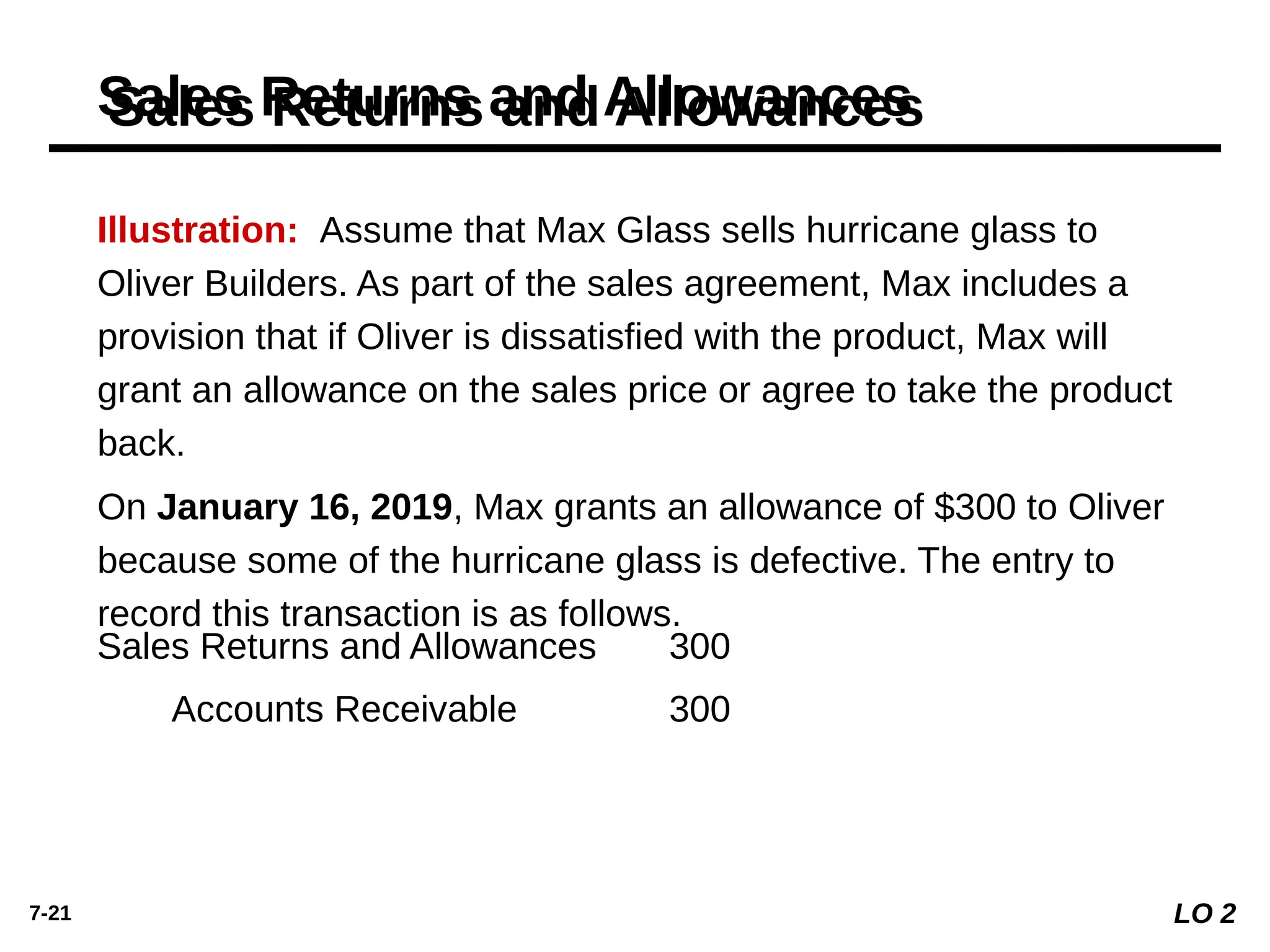
Illustration: Assume that Max Glass sells hurricane glass to
Oliver Builders. As part of the sales agreement, Max includes a
provision that if Oliver is dissatisfied with the product, Max will
grant an allowance on the sales price or agree to take the product
back.
On January 16, 2019, Max grants an allowance of $300 to Oliver
because some of the hurricane glass is defective. The entry to
record this transaction is as follows.
Sales Returns and Allowances
Sales Returns and Allowances 300
Accounts Receivable 300
LO 2
7-22
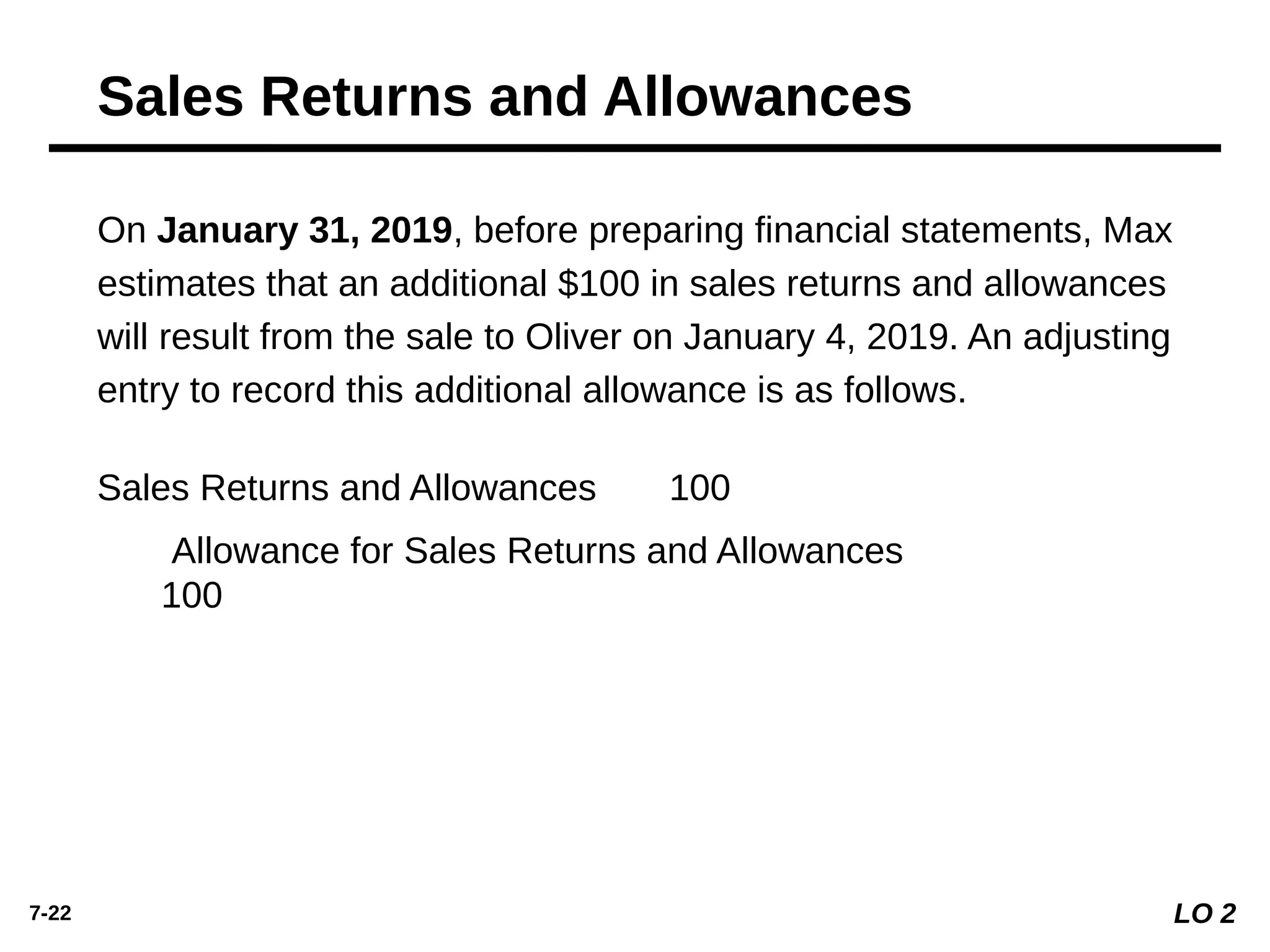
On January 31, 2019, before preparing financial statements, Max
estimates that an additional $100 in sales returns and allowances
will result from the sale to Oliver on January 4, 2019. An adjusting
entry to record this additional allowance is as follows.
Sales Returns and Allowances 100
Allowance for Sales Returns and Allowances
100
Sales Returns and Allowances
LO 2
7-23
 Theoretically, any revenue after the period of sale is interest
revenue.
 Companies ignore interest revenue related to accounts
receivable because the amount of the discount is not
usually material in relation to the net income for the period.
 The profession specifically excludes from present value
considerations “receivables arising from transactions with
customers in the normal course of business which are due
in customary trade terms not exceeding approximately one
year.”
Time Value of Money
Variable Consideration
LO 2
7-24
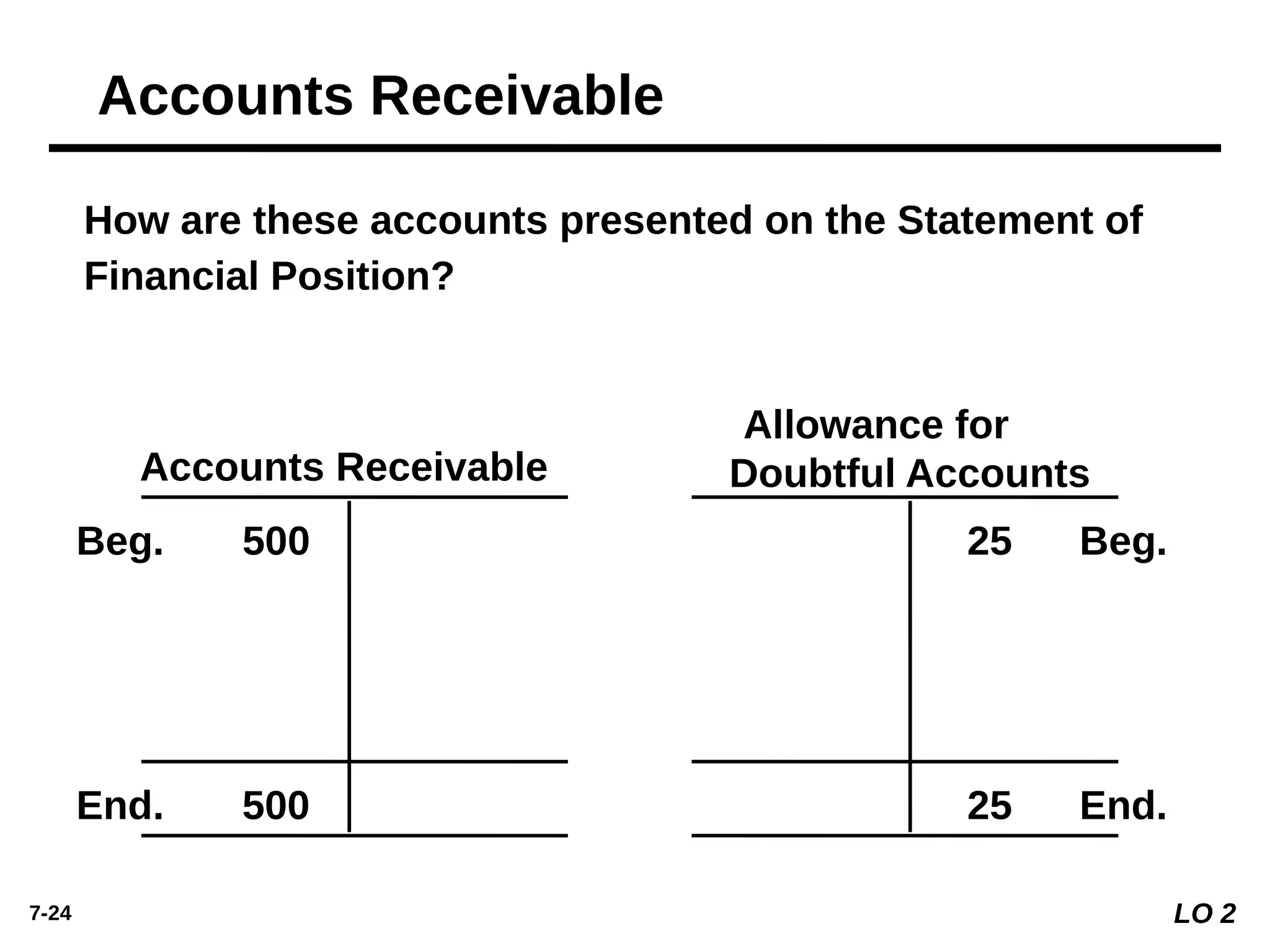
How are these accounts presented on the Statement of
Financial Position?
Accounts Receivable
Allowance for
Doubtful Accounts
Beg. 500 25 Beg.
End. 500 25 End.
LO 2
Accounts Receivable
7-25
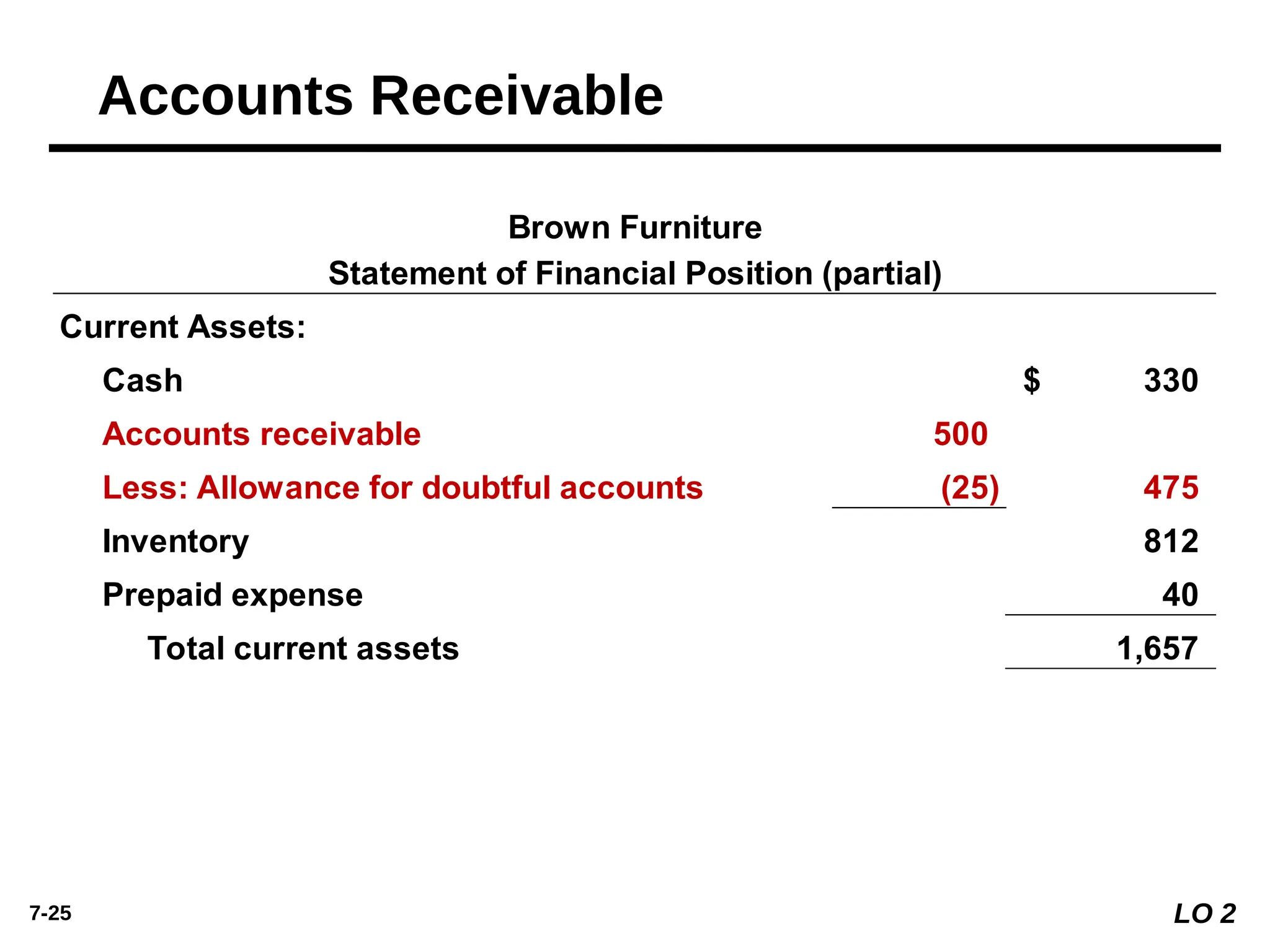
Current Assets:
Cash 330
$
Accounts receivable 500
Less: Allowance for doubtful accounts (25) 475
Inventory 812
Prepaid expense 40
Total current assets 1,657
Statement of Financial Position (partial)
Brown Furniture
LO 2
Accounts Receivable
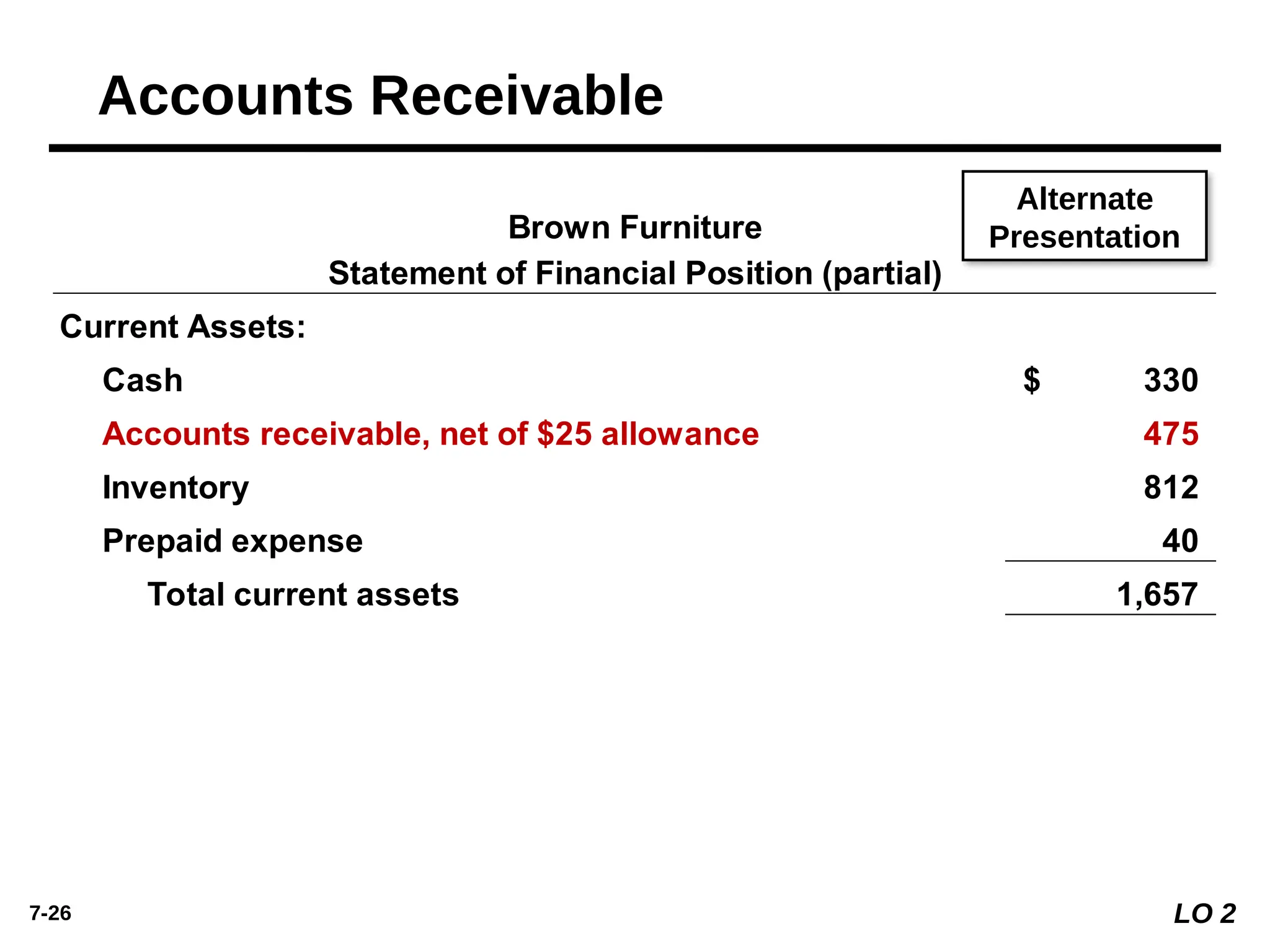
7-26
Current Assets:
Cash 330
$
Accounts receivable, net of $25 allowance 475
Inventory 812
Prepaid expense 40
Total current assets 1,657
Statement of Financial Position (partial)
Brown Furniture
Alternate
Presentation
LO 2
Accounts Receivable
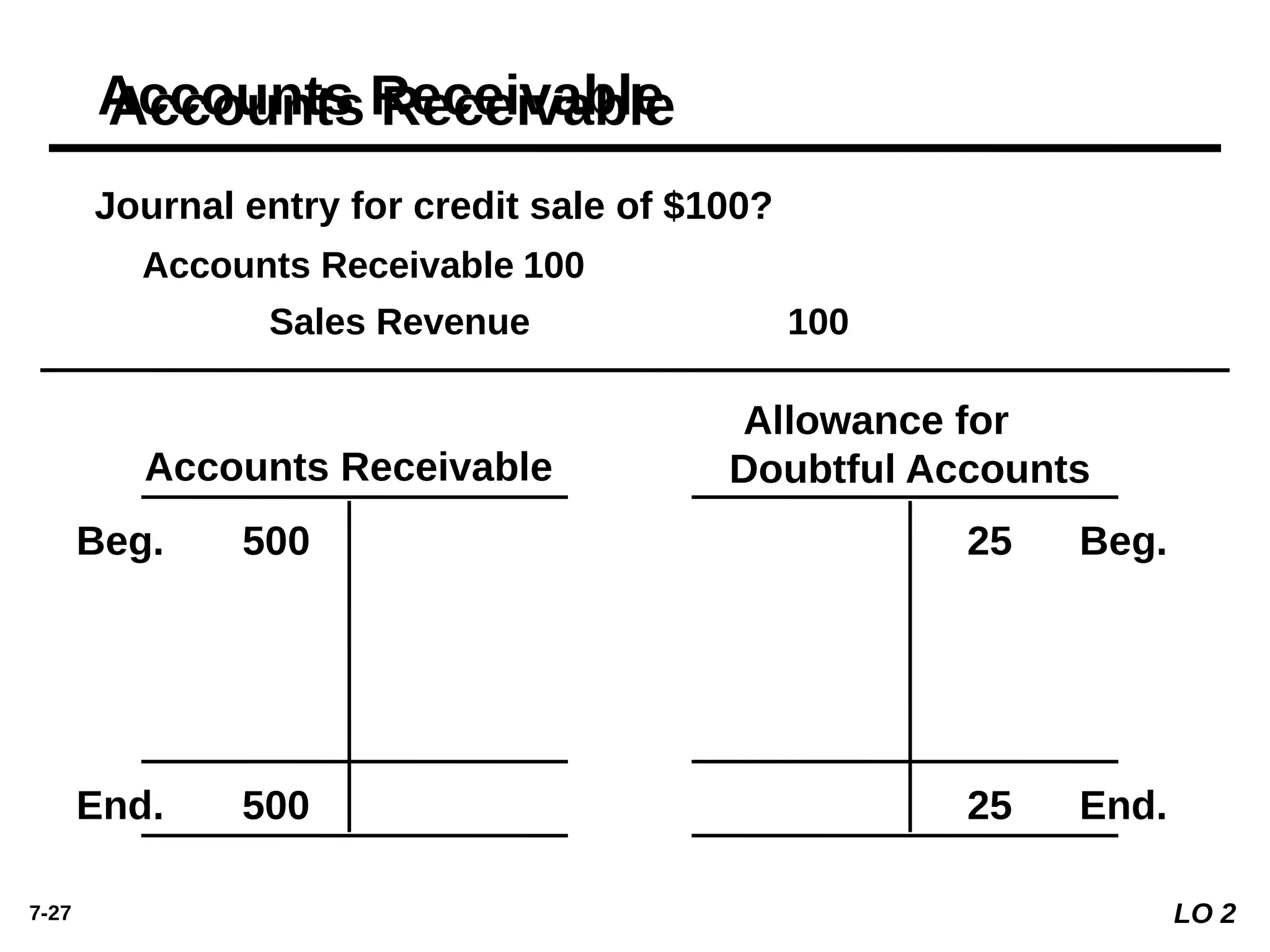
7-27
Accounts Receivable
Allowance for
Doubtful Accounts
Beg. 500 25 Beg.
End. 500 25 End.
Journal entry for credit sale of $100?
Accounts Receivable 100
Sales Revenue 100
Accounts Receivable
LO 2
7-28
Allowance for
Doubtful Accounts
Beg. 500 25 Beg.
End. 600 25 End.
Journal entry for credit sale of $100?
Accounts Receivable 100
Sales Revenue 100
Sale 100
Accounts Receivable
Accounts Receivable
LO 2
7-29
Allowance for
Doubtful Accounts
Beg. 500 25 Beg.
End. 600 25 End.
Sale 100
Collected $333 on account?
Cash 333
Accounts Receivable 333
Accounts Receivable
Accounts Receivable
LO 2
7-30
Allowance for
Doubtful Accounts
Beg. 500 25 Beg.
End. 267 25 End.
Sale 100
Collected $333 on account?
Cash 333
Accounts Receivable 333
333 Coll.
Accounts Receivable
Accounts Receivable
LO 2
7-31
Allowance for
Doubtful Accounts
Beg. 500 25 Beg.
End. 267 25 End.
Sale 100 333 Coll.
Adjustment of $15 for estimated bad debts?
Bad Debt Expense 15
Allowance for Doubtful Accounts 15
Accounts Receivable
LO 2
Accounts Receivable
7-32
Allowance for
Doubtful Accounts
Beg. 500 25 Beg.
End. 267 40 End.
Sale 100 333 Coll.
Adjustment of $15 for estimated bad debts?
Bad Debt Expense 15
Allowance for Doubtful Accounts 15
15 Est.
Accounts Receivable
LO 2
Accounts Receivable
7-33
Allowance for
Doubtful Accounts
Beg. 500 25 Beg.
End. 267 40 End.
Sale 100 333 Coll. 15 Est.
Write-off of uncollectible accounts for $10?
Allowance for Doubtful accounts 10
Accounts Receivable 10
Accounts Receivable
LO 2
Accounts Receivable
7-34
Allowance for
Doubtful Accounts
Beg. 500 25 Beg.
End. 257 30 End.
Sale 100 333 Coll. 15 Est.
Write-off of uncollectible accounts for $10?
Allowance for Doubtful accounts 10
Accounts Receivable 10
W/O 10
10 W/O
Accounts Receivable
LO 2
Accounts Receivable
7-35
Current Assets:
Cash 330
$
Accounts receivable, net of $30 allowance 227
Inventory 812
Prepaid expense 40
Total current assets 1,409
Statement of Financial Position (partial)
Brown Furniture
LO 2
Accounts Receivable
7-36
 Record credit losses as debits to Bad Debt Expense (or
Uncollectible Accounts Expense).
 Normal and necessary risk of doing business on credit.
 Two methods to account for uncollectible accounts:
1) Direct write-off method
2) Allowance method
Uncollectible Accounts Receivable
LO 3
Valuation of
Accounts
Receivable
LEARNING OBJECTIVE 3
Explain accounting issues
related to valuation of
accounts receivable.
7-37
Allowance Method
Losses are estimated:
 Percentage-of-sales.
 Percentage-of-receivables.
 IFRS requires when bad
debts are material in
amount.
Methods of Accounting for Uncollectible Accounts
Direct Write-Off Method
Theoretically deficient:
 Fails to record expenses as
incurred.
 Receivable not stated at
cash realizable value.
 Not appropriate when
amount uncollectible is
material.
Valuation of Accounts Receivable
LO 3
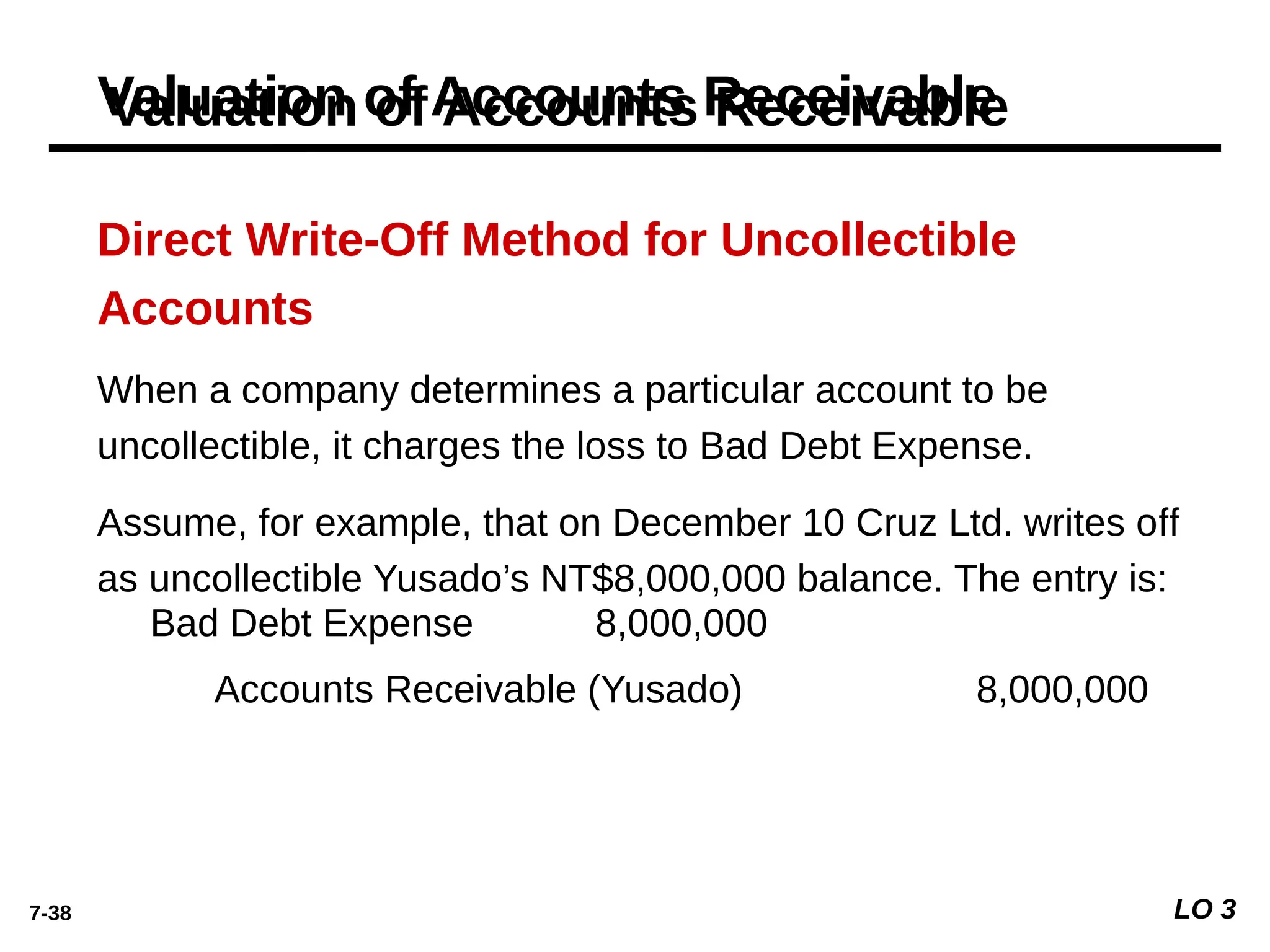
7-38 LO 3
Direct Write-Off Method for Uncollectible
Accounts
When a company determines a particular account to be
uncollectible, it charges the loss to Bad Debt Expense.
Assume, for example, that on December 10 Cruz Ltd. writes off
as uncollectible Yusado’s NT$8,000,000 balance. The entry is:
Valuation of Accounts Receivable
Bad Debt Expense 8,000,000
Accounts Receivable (Yusado) 8,000,000
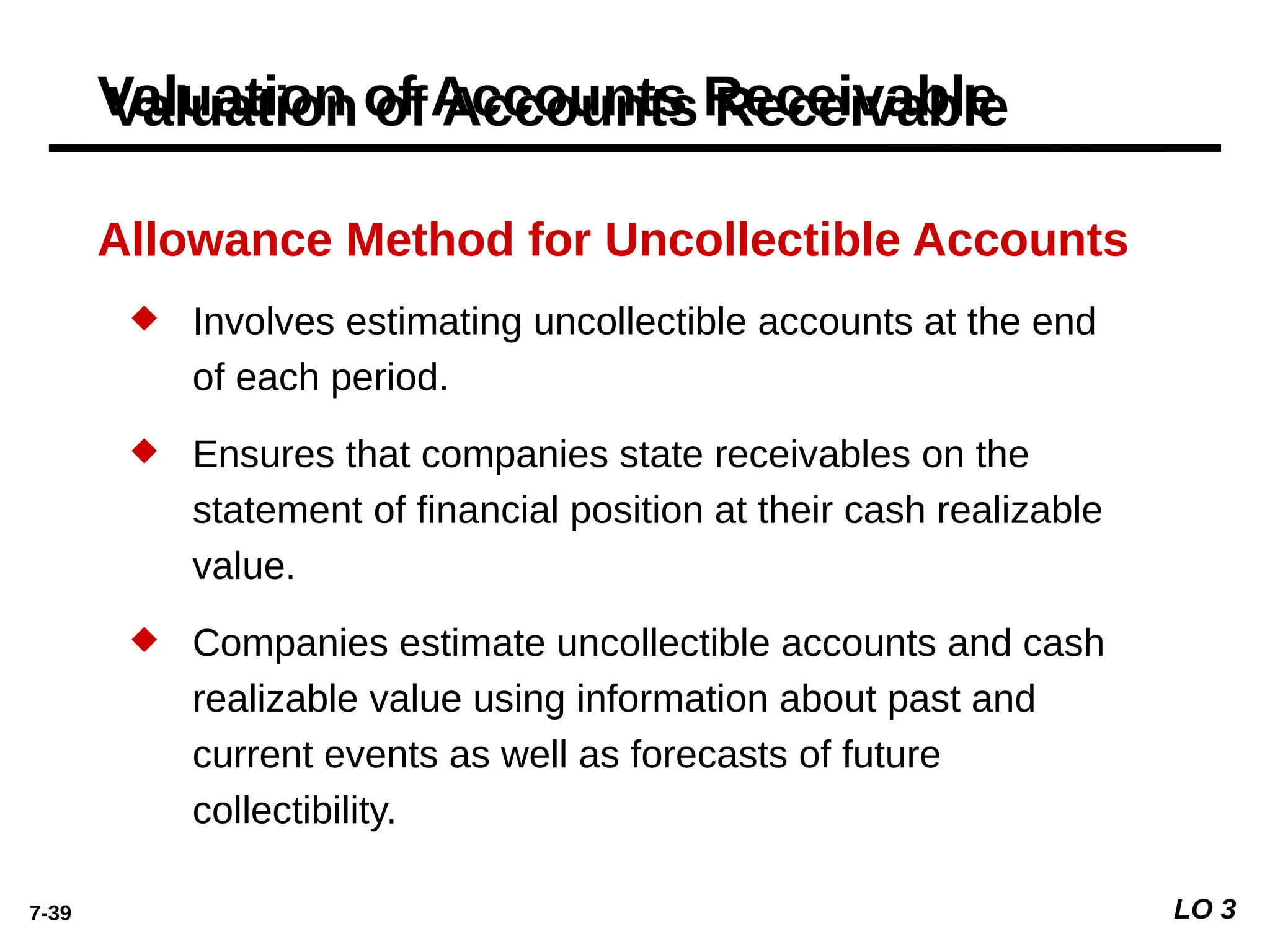
7-39 LO 3
Allowance Method for Uncollectible Accounts
 Involves estimating uncollectible accounts at the end
of each period.
 Ensures that companies state receivables on the
statement of financial position at their cash realizable
value.
 Companies estimate uncollectible accounts and cash
realizable value using information about past and
current events as well as forecasts of future
collectibility.
Valuation of Accounts Receivable
7-40 LO 3
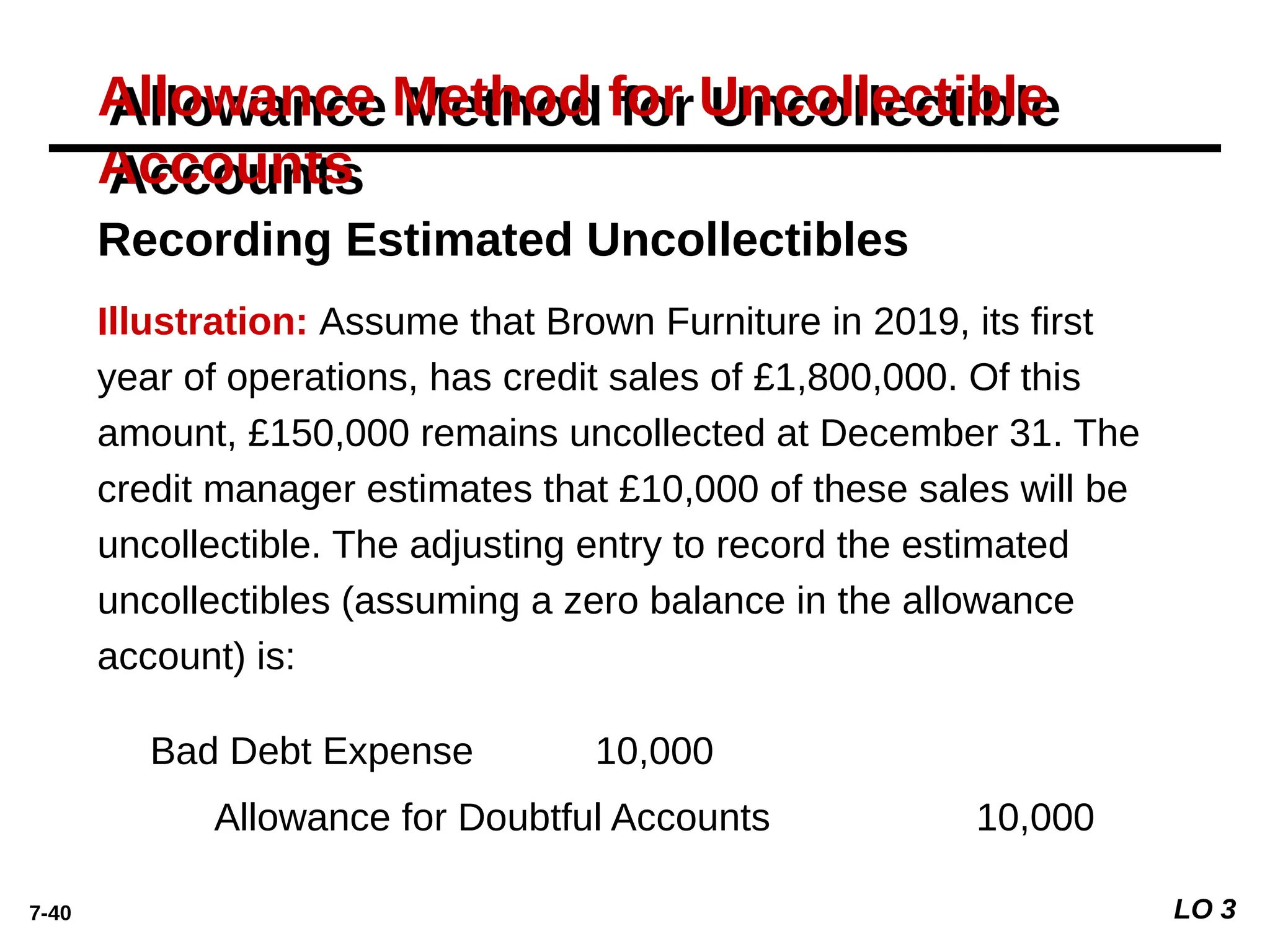
Recording Estimated Uncollectibles
Illustration: Assume that Brown Furniture in 2019, its first
year of operations, has credit sales of £1,800,000. Of this
amount, £150,000 remains uncollected at December 31. The
credit manager estimates that £10,000 of these sales will be
uncollectible. The adjusting entry to record the estimated
uncollectibles (assuming a zero balance in the allowance
account) is:
Allowance Method for Uncollectible
Accounts
Bad Debt Expense 10,000
Allowance for Doubtful Accounts 10,000
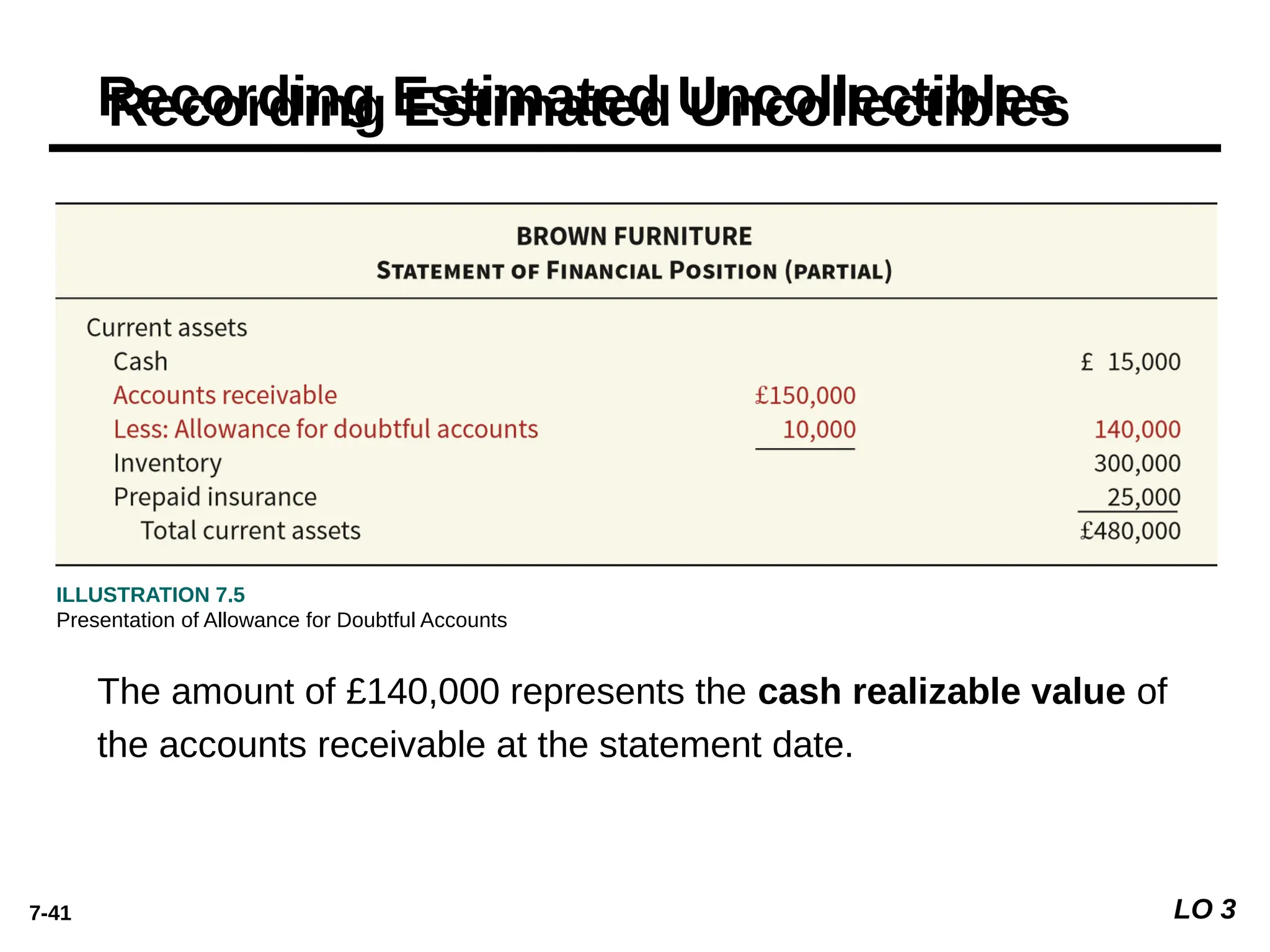
7-41 LO 3
Recording Estimated Uncollectibles
ILLUSTRATION 7.5
Presentation of Allowance for Doubtful Accounts
The amount of £140,000 represents the cash realizable value of
the accounts receivable at the statement date.
7-42 LO 3
Recording the Write-Off of an Uncollectible
Account
 When companies have exhausted all means of
collecting a past-due account and collection appears
impossible, the company should write off the account.
 In the credit card industry, for example, it is standard
practice to write off accounts that are 210 days past
due.
Allowance Method for Uncollectible
Accounts
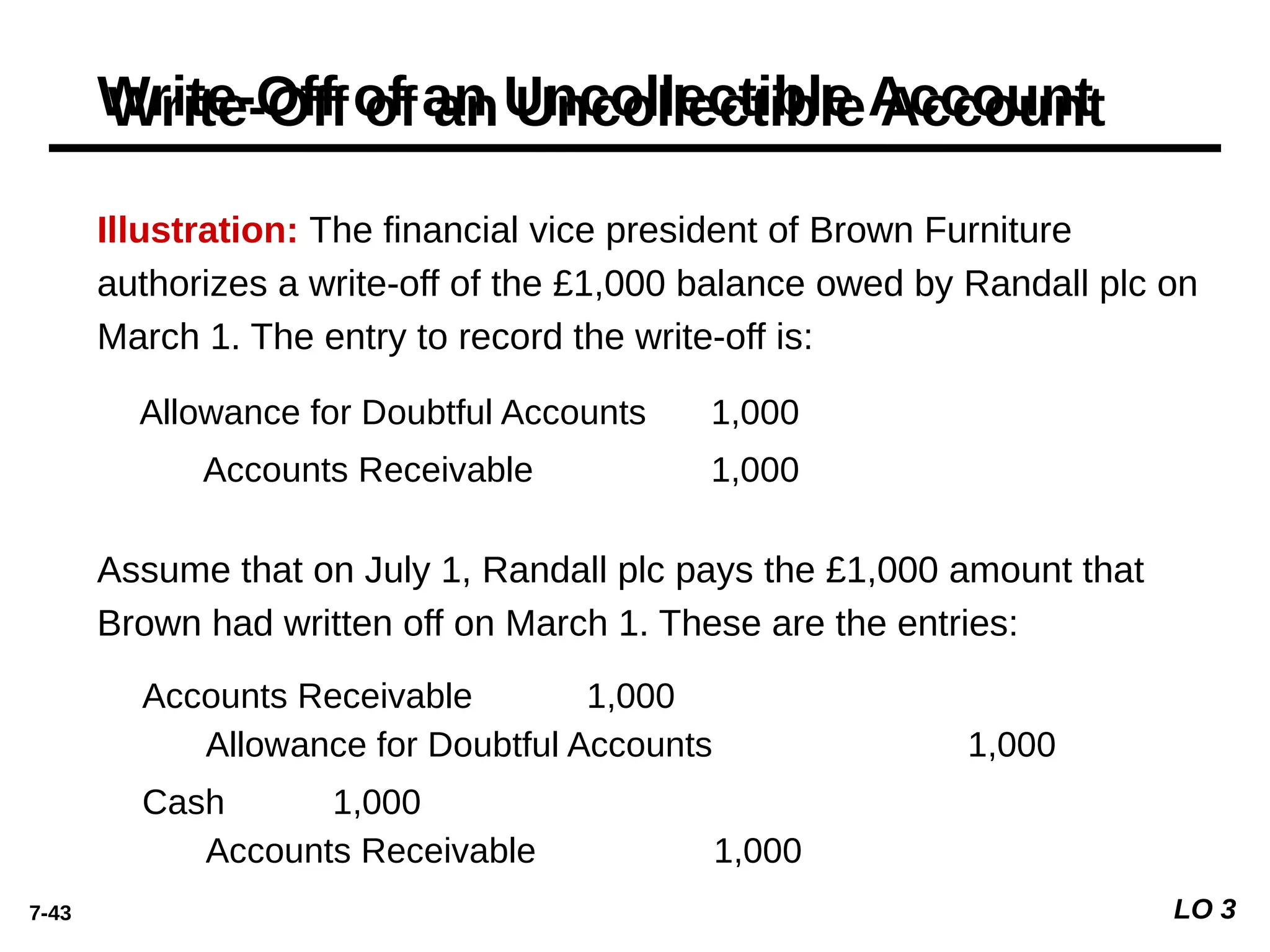
7-43
Illustration: The financial vice president of Brown Furniture
authorizes a write-off of the £1,000 balance owed by Randall plc on
March 1. The entry to record the write-off is:
Allowance for Doubtful Accounts 1,000
Accounts Receivable 1,000
Assume that on July 1, Randall plc pays the £1,000 amount that
Brown had written off on March 1. These are the entries:
Accounts Receivable 1,000
Allowance for Doubtful Accounts 1,000
Cash 1,000
Accounts Receivable 1,000
Write-Off of an Uncollectible Account
LO 3
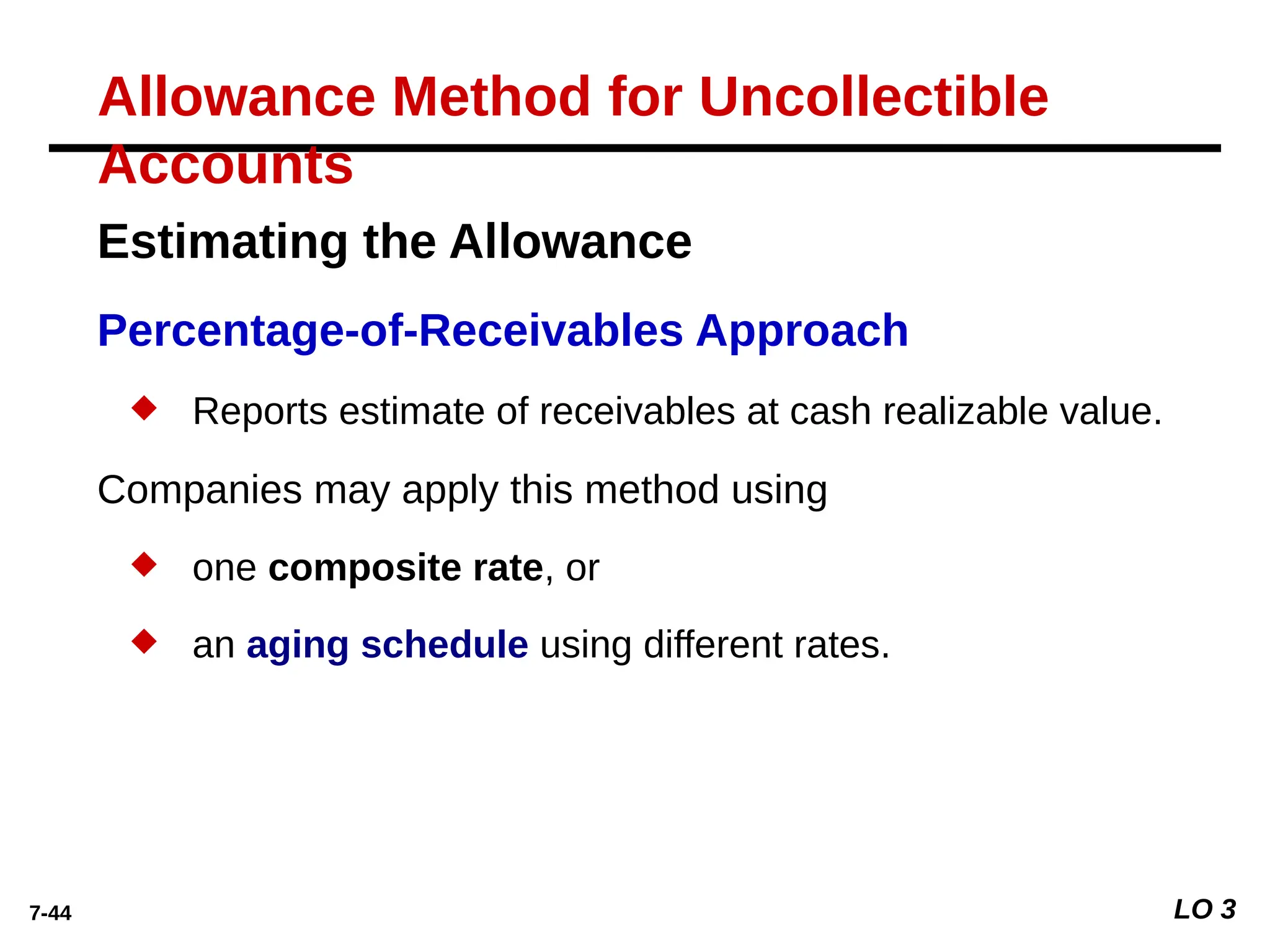
7-44 LO 3
Estimating the Allowance
Percentage-of-Receivables Approach
 Reports estimate of receivables at cash realizable value.
Companies may apply this method using
 one composite rate, or
 an aging schedule using different rates.
Allowance Method for Uncollectible
Accounts
7-45 LO 3
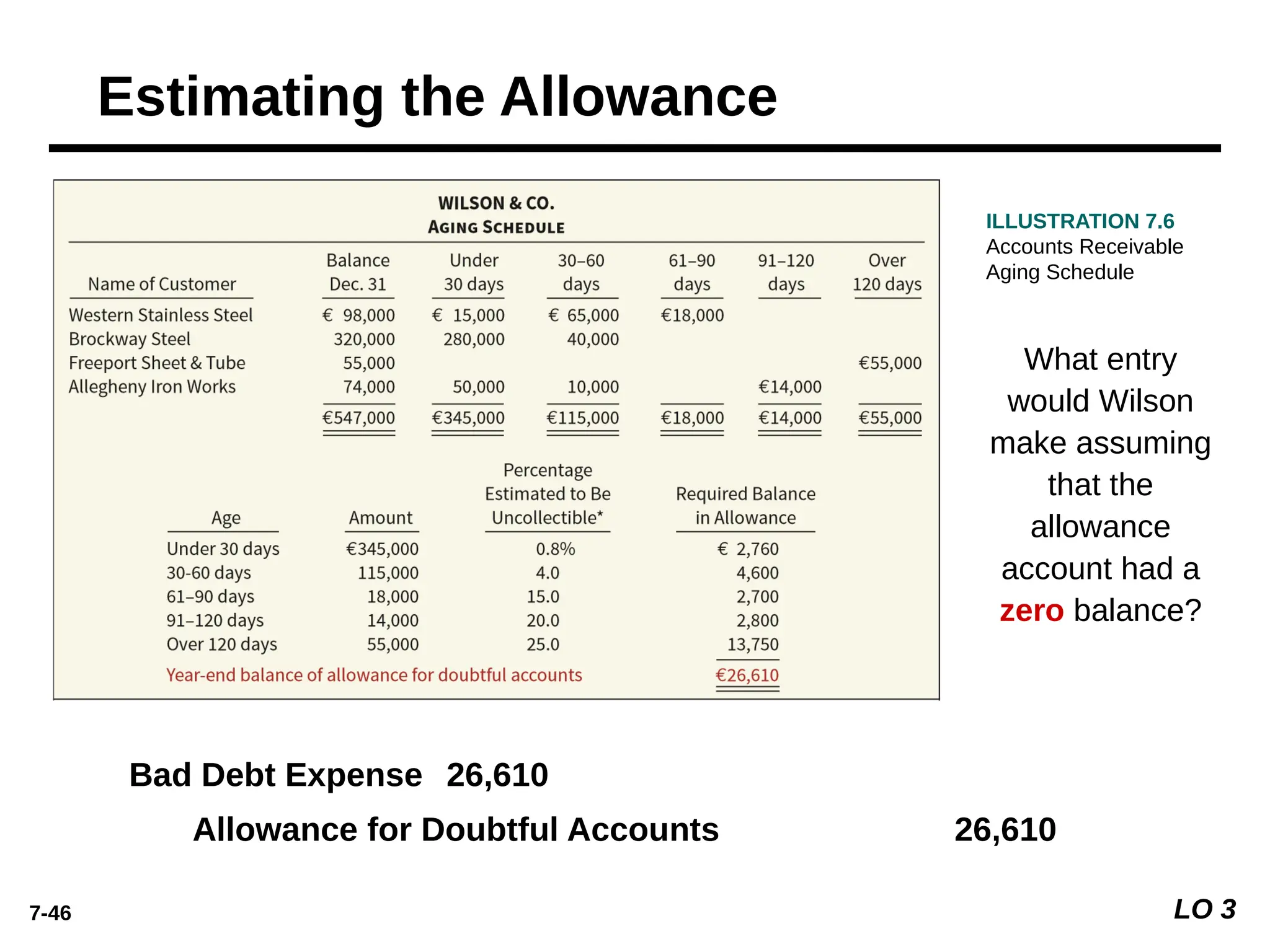
Estimating the Allowance ILLUSTRATION 7.6
Accounts Receivable
Aging Schedule
7-46 LO 3
Bad Debt Expense 26,610
Allowance for Doubtful Accounts 26,610
What entry
would Wilson
make assuming
that the
allowance
account had a
zero balance?
ILLUSTRATION 7.6
Accounts Receivable
Aging Schedule
Estimating the Allowance
7-47 LO 3
Bad Debt Expense (€26,610 – €800)25,810
Allowance for Doubtful Accounts 25,810
What entry
would Wilson
make assuming
the allowance
account had a
credit balance
of €800 before
adjustment?
Estimating the Allowance
ILLUSTRATION 7.6
Accounts Receivable
Aging Schedule
7-48 LO 3
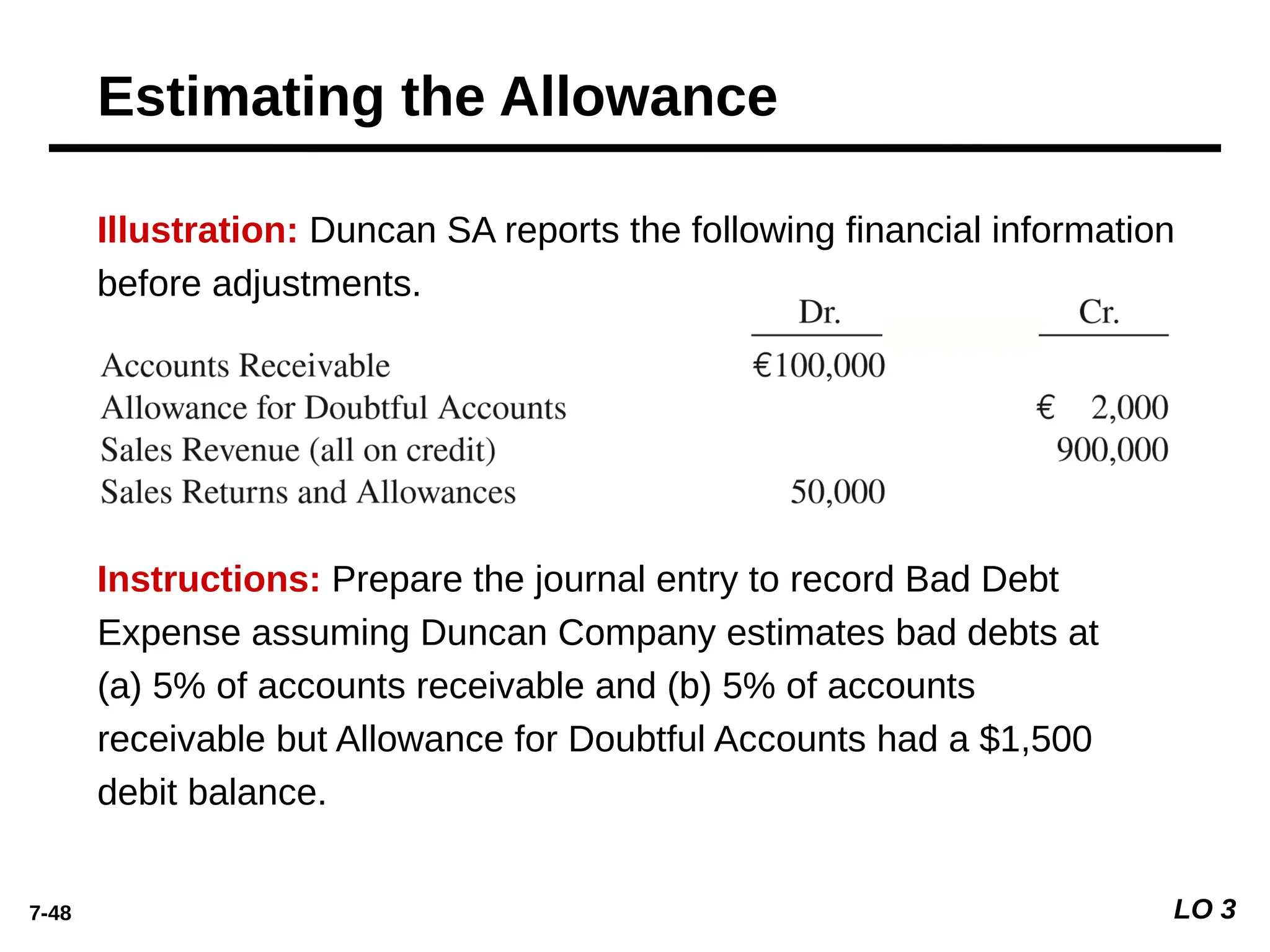
Instructions: Prepare the journal entry to record Bad Debt
Expense assuming Duncan Company estimates bad debts at
(a) 5% of accounts receivable and (b) 5% of accounts
receivable but Allowance for Doubtful Accounts had a $1,500
debit balance.
Estimating the Allowance
Illustration: Duncan SA reports the following financial information
before adjustments.
7-49 LO 3
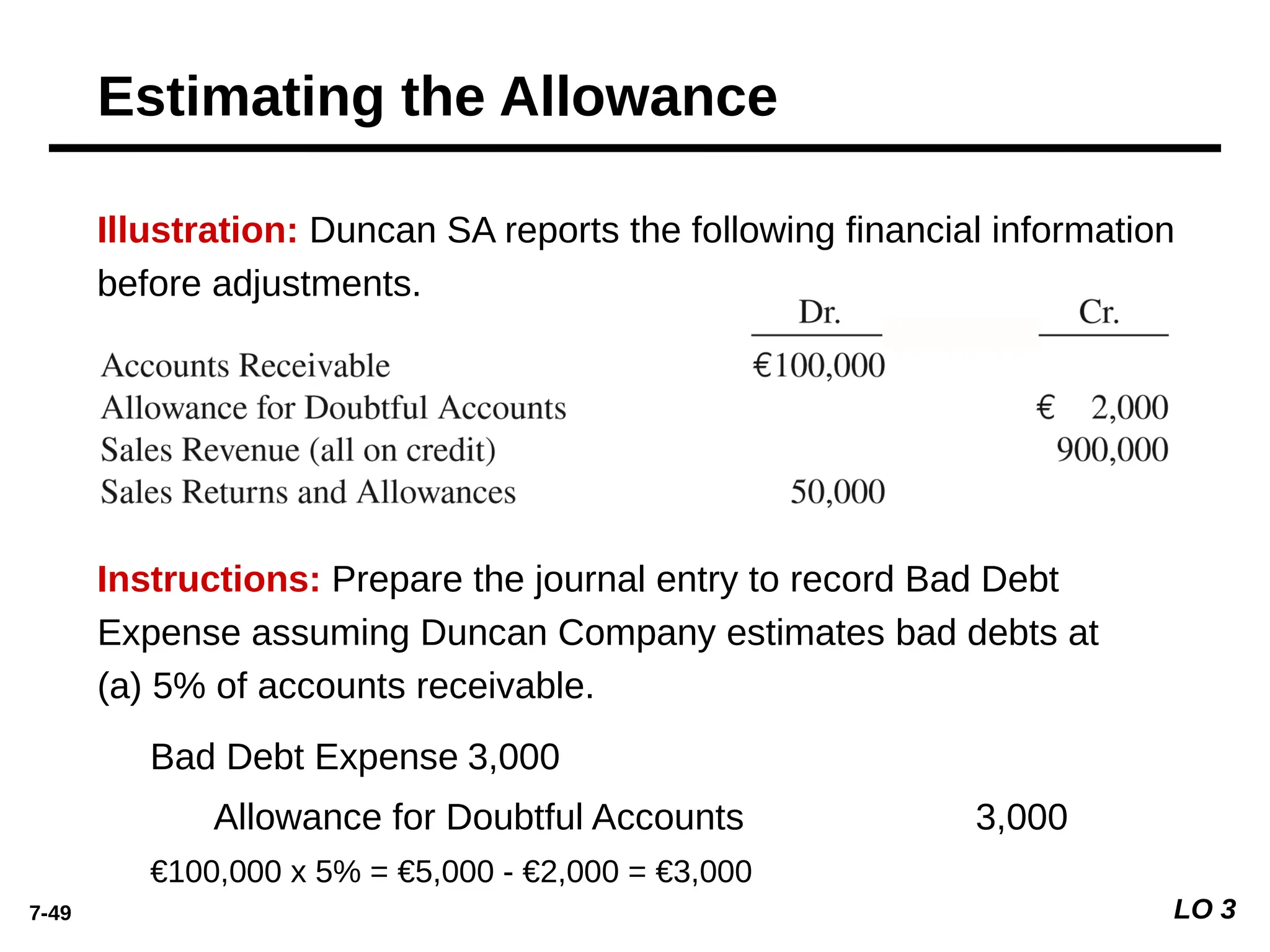
Bad Debt Expense 3,000
Allowance for Doubtful Accounts 3,000
€100,000 x 5% = €5,000 - €2,000 = €3,000
LO 3
Estimating the Allowance
Instructions: Prepare the journal entry to record Bad Debt
Expense assuming Duncan Company estimates bad debts at
(a) 5% of accounts receivable.
Illustration: Duncan SA reports the following financial information
before adjustments.
7-50 LO 3
Bad Debt Expense 6,500
Allowance for Doubtful Accounts 6,500
€100,000 x 5% = €5,000 + €1,500 = €6,500
LO 3
Estimating the Allowance
Instructions: Prepare the journal entry to record Bad Debt
Expense assuming Duncan Company estimates bad debts at (b)
5% of accounts receivable but the Allowance had a $1,500 debit
balance.
Illustration: Duncan SA reports the following financial information
before adjustments.
7-51
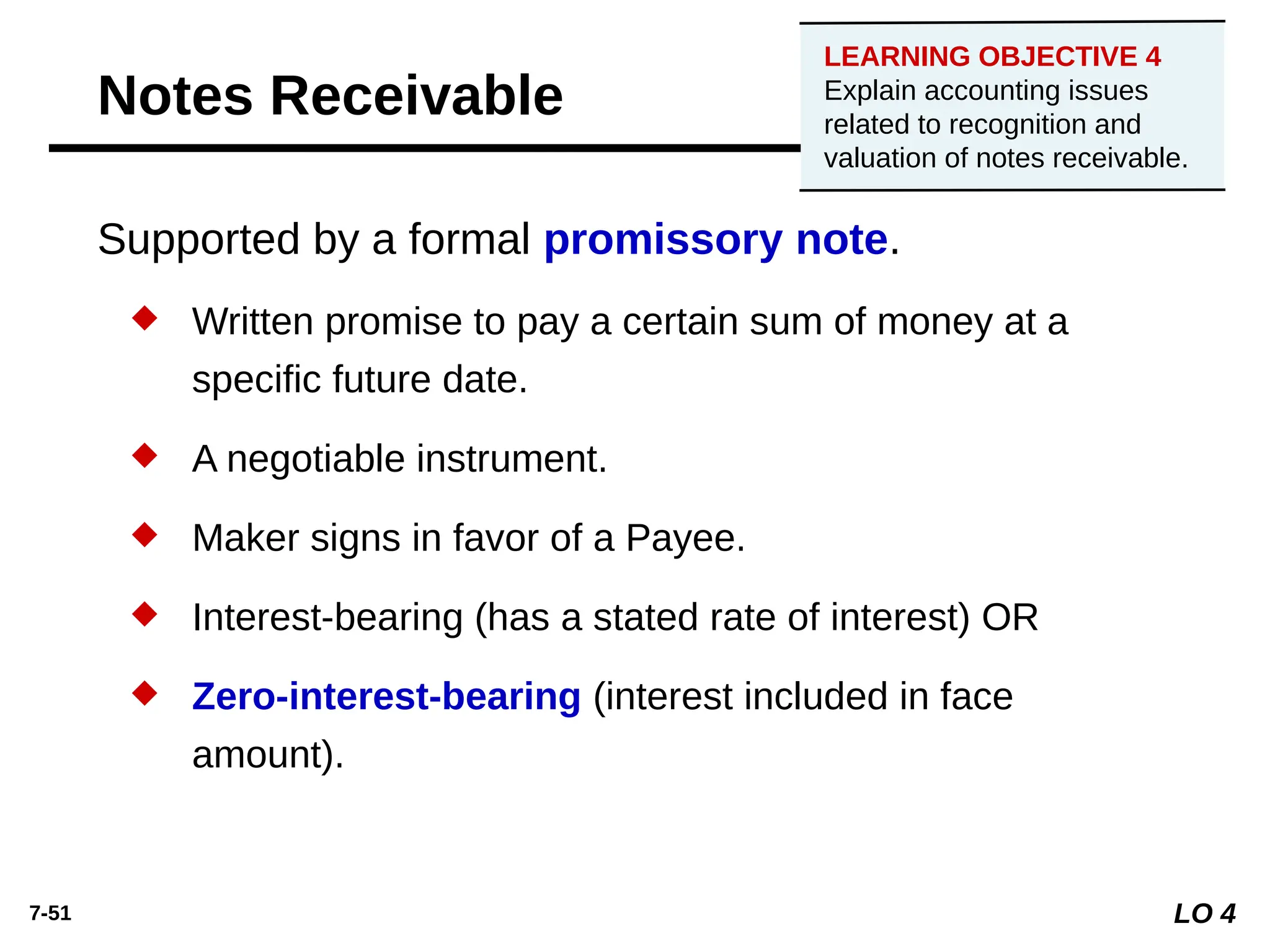
Supported by a formal promissory note.
 Written promise to pay a certain sum of money at a
specific future date.
 A negotiable instrument.
 Maker signs in favor of a Payee.
 Interest-bearing (has a stated rate of interest) OR
 Zero-interest-bearing (interest included in face
amount).
Notes Receivable
LO 4
LEARNING OBJECTIVE 4
Explain accounting issues
related to recognition and
valuation of notes receivable.
7-52
Generally originate from:
 Customers who need to extend payment period of an
outstanding receivable.
 High-risk or new customers.
 Loans to employees and subsidiaries.
 Sales of property, plant, and equipment.
 Lending transactions (the majority of notes).
LO 4
Notes Receivable
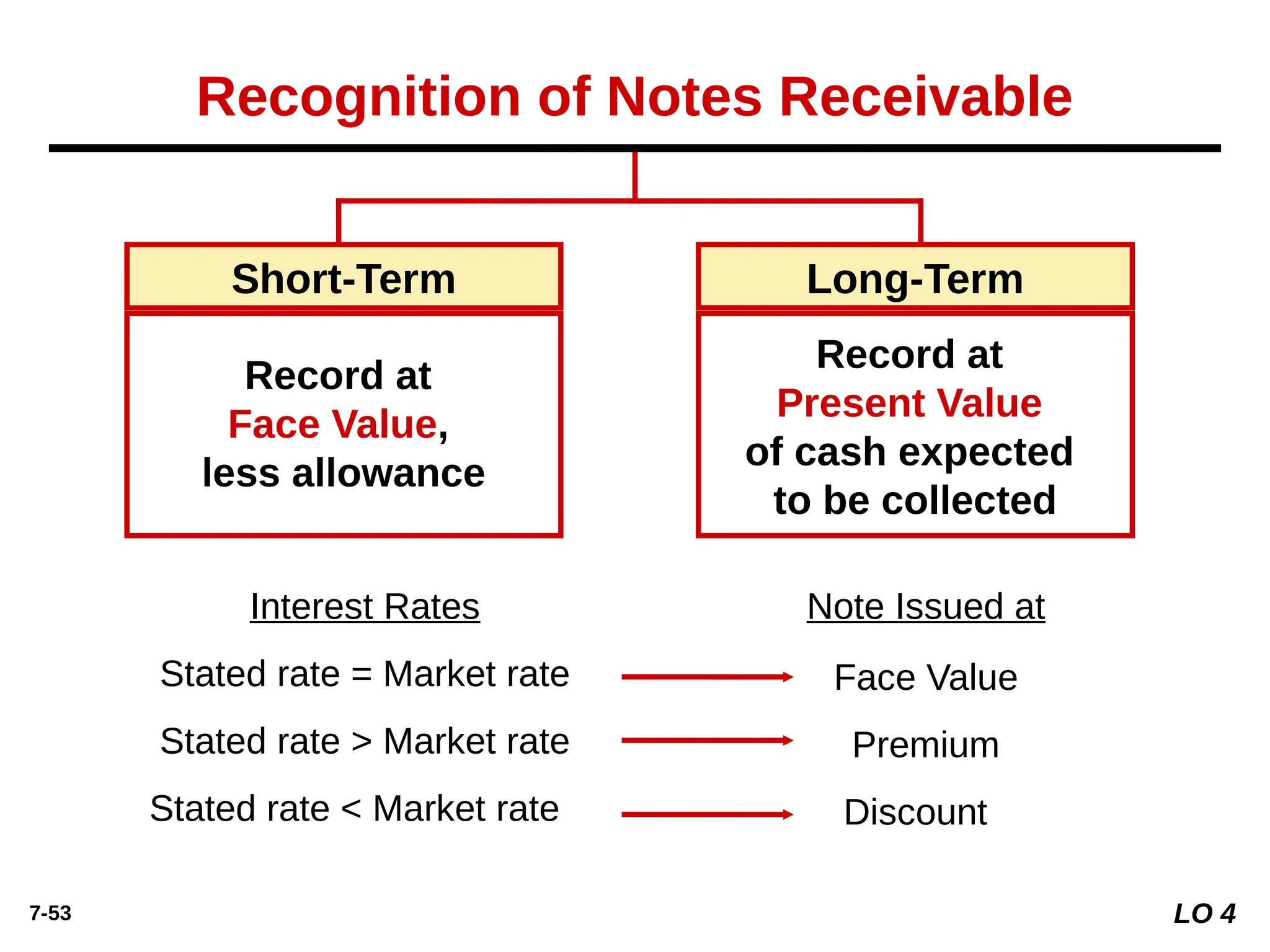
7-53
Short-Term Long-Term
Record at
Face Value,
less allowance
Record at
Present Value
of cash expected
to be collected
Interest Rates
Stated rate = Market rate
Stated rate > Market rate
Stated rate < Market rate
Note Issued at
Face Value
Premium
Discount
Recognition of Notes Receivable
LO 4
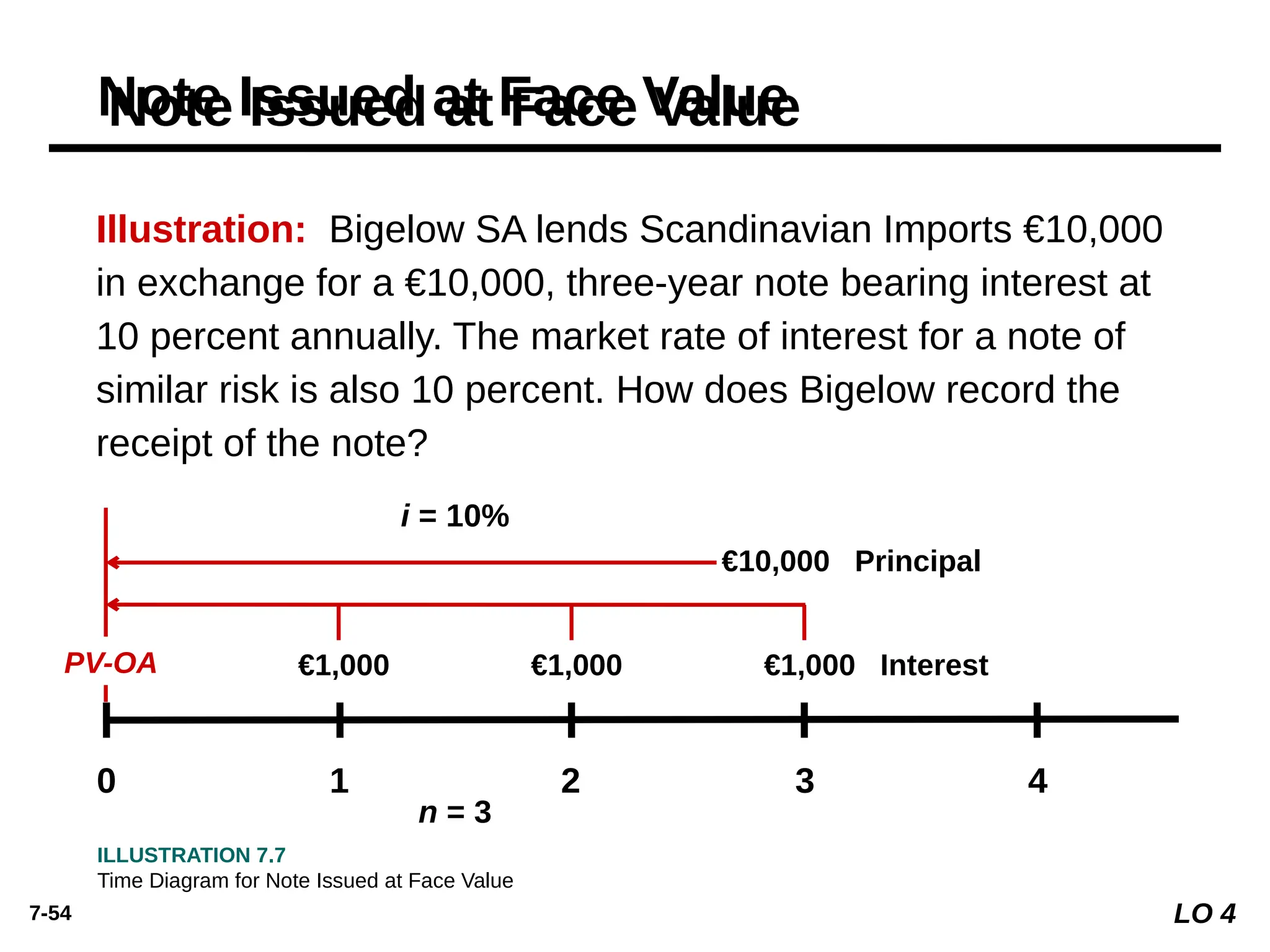
7-54
Illustration: Bigelow SA lends Scandinavian Imports €10,000
in exchange for a €10,000, three-year note bearing interest at
10 percent annually. The market rate of interest for a note of
similar risk is also 10 percent. How does Bigelow record the
receipt of the note?
Note Issued at Face Value
0 1 2 3
€1,000 €1,000 Interest
€1,000
€10,000 Principal
4
i = 10%
n = 3
PV-OA
ILLUSTRATION 7.7
Time Diagram for Note Issued at Face Value
LO 4
7-55
€1,000 x 2.48685 = €2,487
Interest Received Factor Present Value
Note Issued at Face Value
PV of Interest
LO 4
TABLE 6.4 PRESENT VALUE OF AN ORDINARY ANNUITY OF 1
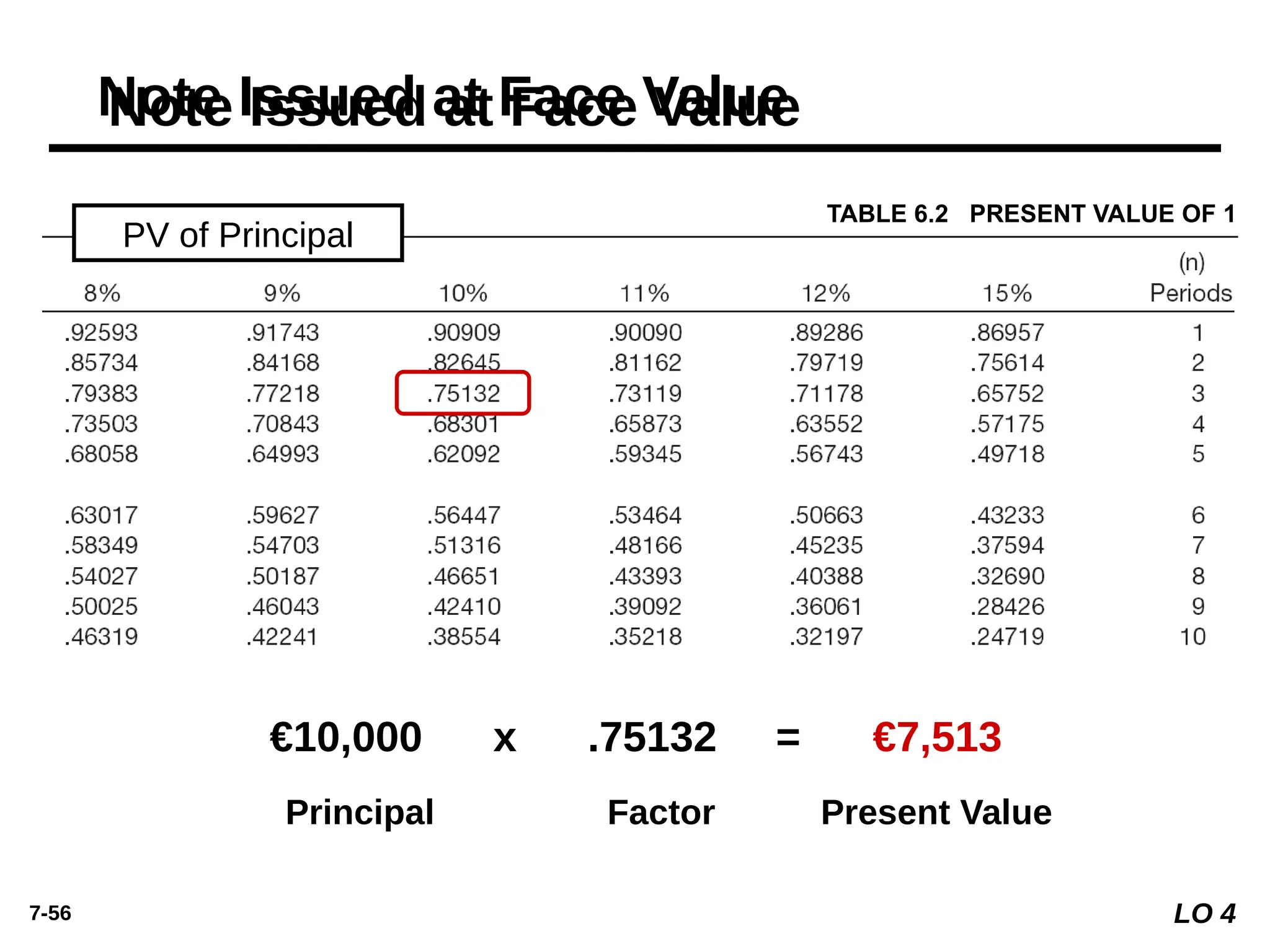
7-56
€10,000 x .75132 = €7,513
Principal Factor Present Value
Note Issued at Face Value
PV of Principal
LO 4
TABLE 6.2 PRESENT VALUE OF 1
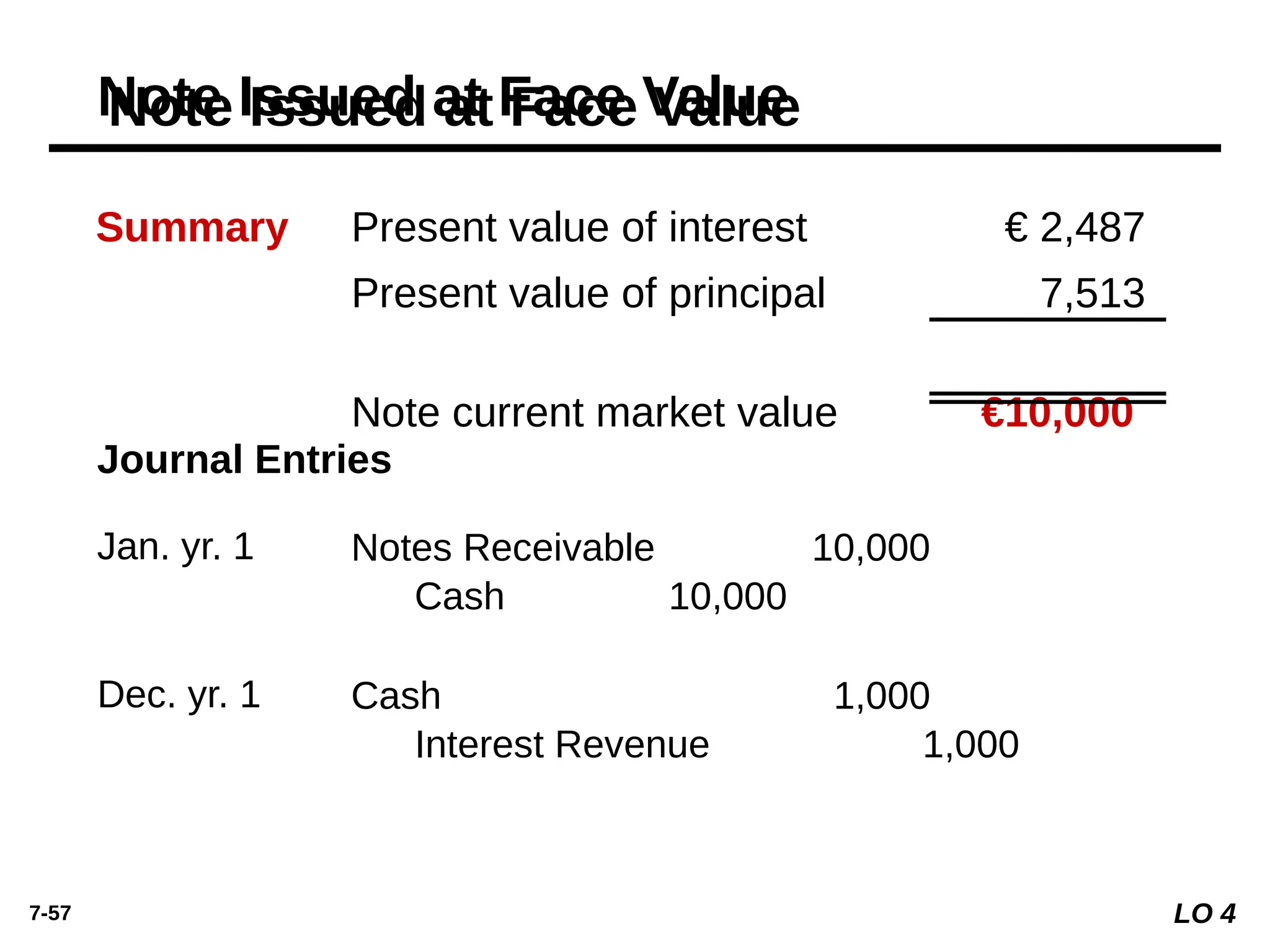
7-57
Summary Present value of interest € 2,487
Present value of principal 7,513
Note current market value €10,000
Note Issued at Face Value
Notes Receivable 10,000
Cash 10,000
Cash 1,000
Interest Revenue 1,000
Jan. yr. 1
Dec. yr. 1
Journal Entries
LO 4
7-58
Illustration: Jeremiah Company receives a three-year, $10,000
zero-interest-bearing note. The market rate of interest for a
note of similar risk is 9 percent. How does Jeremiah record the
receipt of the note?
Zero-Interest-Bearing Notes
0 1 2 3
$0 $0 Interest
$0
$10,000 Principal
4
i = 9%
n = 3
PV-0A
ILLUSTRATION 7.9
Time Diagram for Zero-
Interest-Bearing Note
LO 4
7-59
$10,000 x .77218 = $7,721.80
Principal Factor Present Value
Zero-Interest-Bearing Notes
PV of Principal
LO 4
TABLE 6.2 PRESENT VALUE OF 1
7-60
Zero-Interest-Bearing Notes
ILLUSTRATION 7.10
Discount Amortization Schedule—
Effective-Interest Method
LO 4
7-61
Zero-Interest-Bearing Notes ILLUSTRATION 7.10
Discount Amortization
Schedule—Effective-
Interest Method
Prepare the journal entry to record the receipt of the note.
Notes Receivable 7,721.80
Cash 7,721.80
LO 4
7-62
Zero-Interest-Bearing Notes ILLUSTRATION 7.10
Discount Amortization
Schedule—Effective-
Interest Method
Record interest revenue at the end of the first year.
Notes Receivable 694.96
Interest Revenue ($7,721.80 x 9%) 694.96
LO 4
7-63
Illustration: Morgan Group makes a loan to Marie Co. and
receives in exchange a three-year, €10,000 note bearing interest
at 10 percent annually. The market rate of interest for a note of
similar risk is 12 percent. Prepare the journal entry to record the
receipt of the note?
Interest-Bearing Notes
0 1 2 3
€1,000 €1,000 Interest
€1,000
€10,000 Principal
4
i = 12%
n = 3
PV-0A
LO 4
7-64
€1,000 x 2.40183 = €2,402
Interest Received Factor Present Value
Interest-Bearing Notes
PV of Interest
LO 4
TABLE 6.4 PRESENT VALUE OF AN ORDINARY ANNUITY OF 1
7-65
€10,000 x .71178 = €7,118
Principal Factor Present Value
Interest-Bearing Notes
PV of Principal
LO 4
TABLE 6.2 PRESENT VALUE OF 1
7-66
Illustration: Record the receipt of the note?
Interest-Bearing Notes
Notes Receivable 9,520
Cash 9,520
ILLUSTRATION 7.12
Computation of Present
Value—Effective Rate
Different from Stated Rate
LO 4
7-67
Interest-Bearing Notes
ILLUSTRATION 7.13
Discount Amortization Schedule—
Effective-Interest Method
LO 4
7-68
Interest-Bearing Notes ILLUSTRATION 7.13
Discount Amortization Schedule—
Effective-Interest Method
Record interest revenue at the end of the first year.
Cash 1,000
Notes Receivable 142
Interest Revenue 1,142
LO 4
7-69
Notes Receivable
Notes Received for Property, Goods, or Services
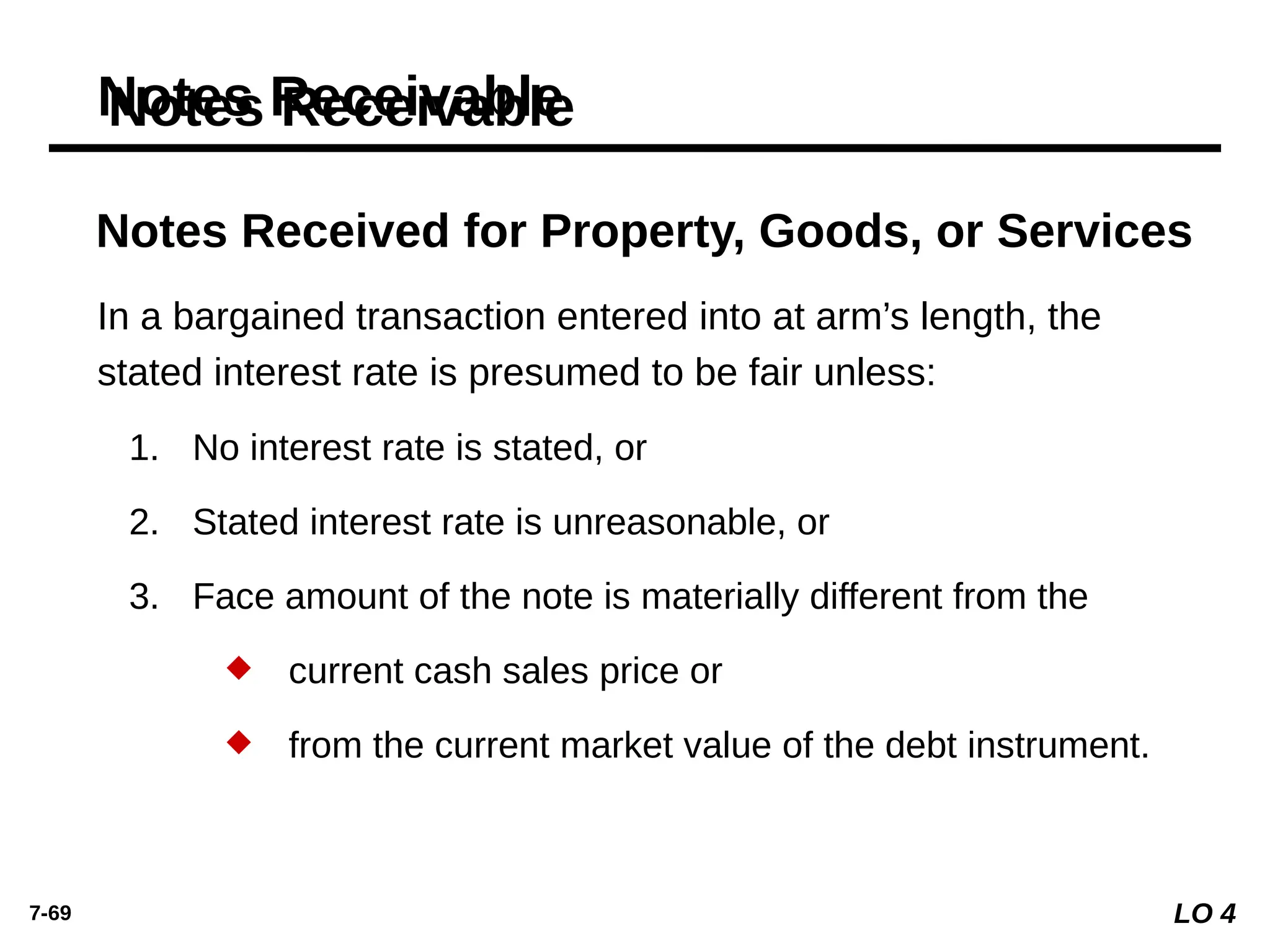
In a bargained transaction entered into at arm’s length, the
stated interest rate is presumed to be fair unless:
1. No interest rate is stated, or
2. Stated interest rate is unreasonable, or
3. Face amount of the note is materially different from the
 current cash sales price or
 from the current market value of the debt instrument.
LO 4
7-70
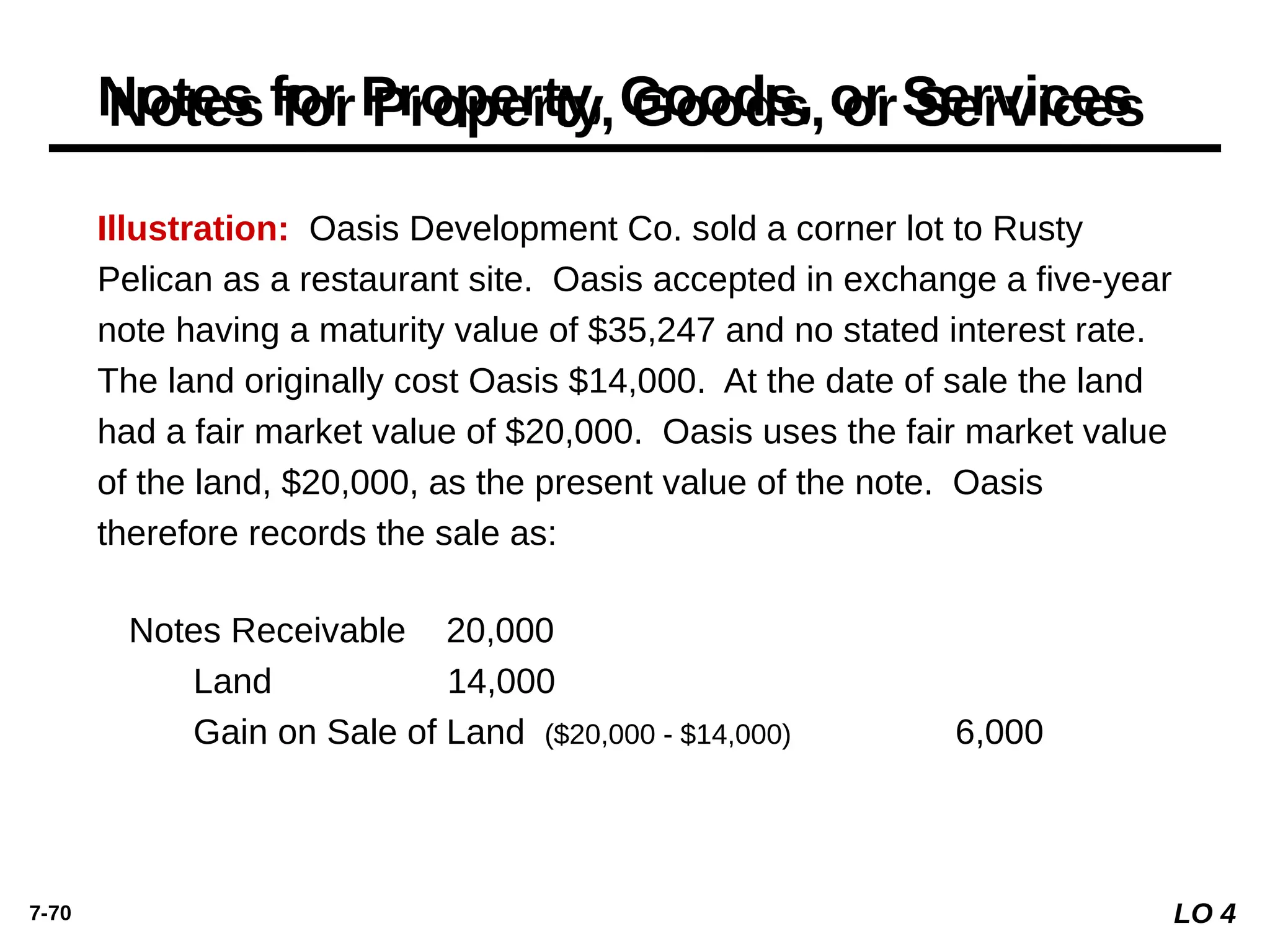
Notes for Property, Goods, or Services
Illustration: Oasis Development Co. sold a corner lot to Rusty
Pelican as a restaurant site. Oasis accepted in exchange a five-year
note having a maturity value of $35,247 and no stated interest rate.
The land originally cost Oasis $14,000. At the date of sale the land
had a fair market value of $20,000. Oasis uses the fair market value
of the land, $20,000, as the present value of the note. Oasis
therefore records the sale as:
Notes Receivable 20,000
Land 14,000
Gain on Sale of Land ($20,000 - $14,000) 6,000
LO 4
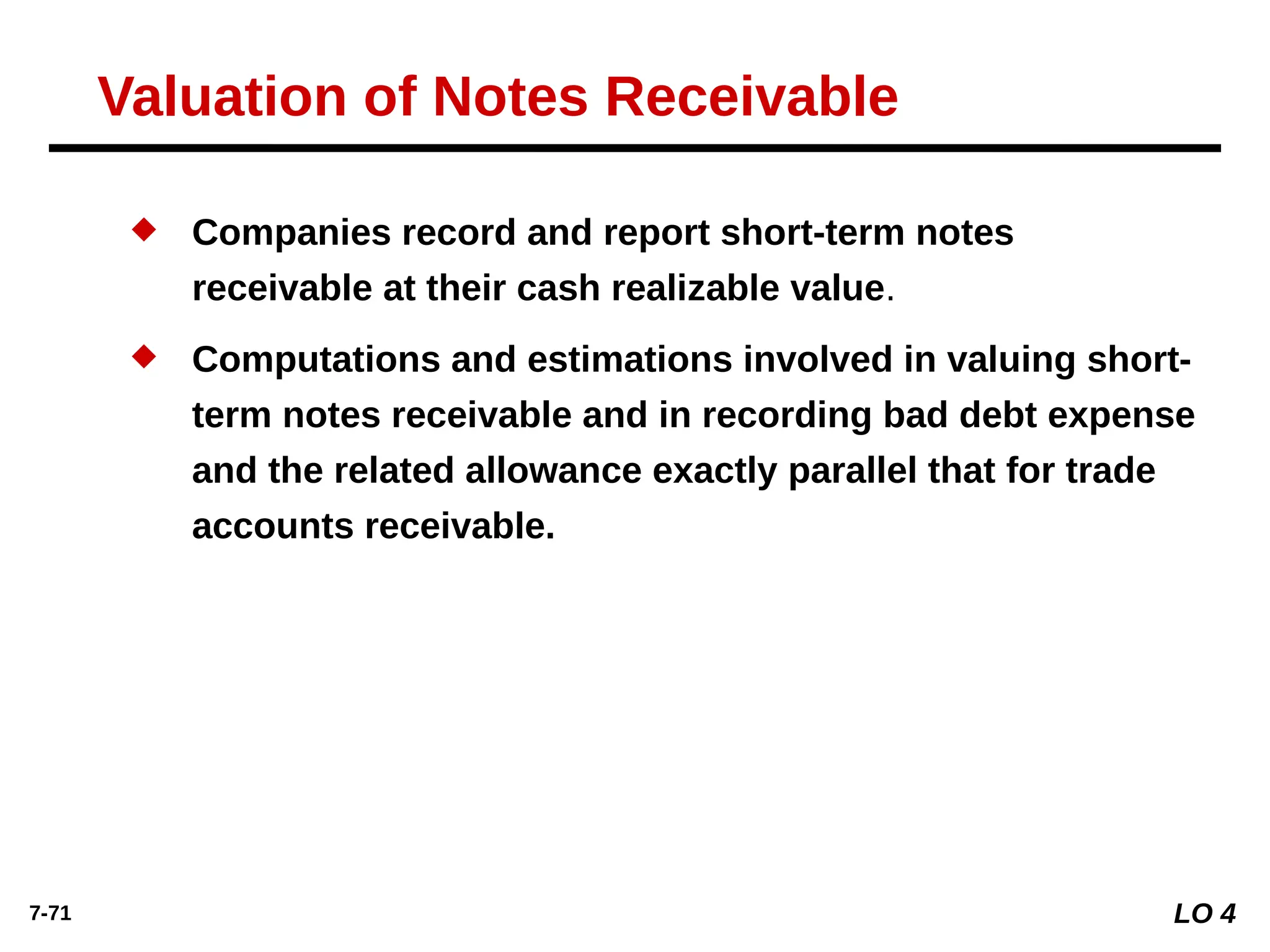
7-71
 Companies record and report short-term notes
receivable at their cash realizable value.
 Computations and estimations involved in valuing short-
term notes receivable and in recording bad debt expense
and the related allowance exactly parallel that for trade
accounts receivable.
Valuation of Notes Receivable
LO 4
7-72
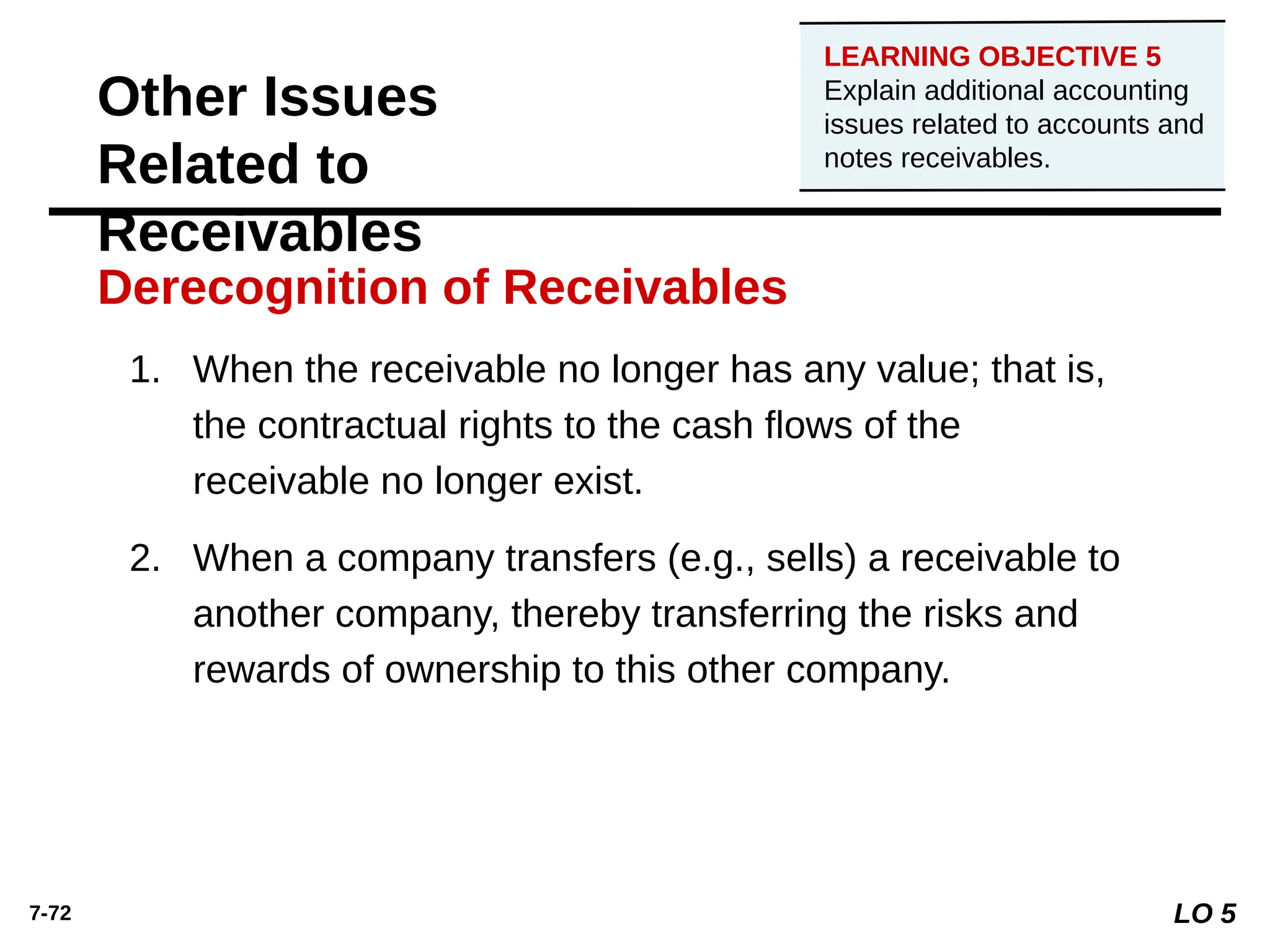
1. When the receivable no longer has any value; that is,
the contractual rights to the cash flows of the
receivable no longer exist.
2. When a company transfers (e.g., sells) a receivable to
another company, thereby transferring the risks and
rewards of ownership to this other company.
Derecognition of Receivables
Other Issues
Related to
Receivables
LO 5
LEARNING OBJECTIVE 5
Explain additional accounting
issues related to accounts and
notes receivables.
7-73
Various reasons for transfer of receivables to another party
 Accelerate the receipt of cash.
 Competition.
 Sell receivables because money is tight.
 Billing / collection are time-consuming and costly.
Transfer of receivables for cash happens in two ways:
1. Sales of receivables.
2. Secured borrowing.
Transfer of Receivables
LO 5
Derecognition of Receivables
7-74
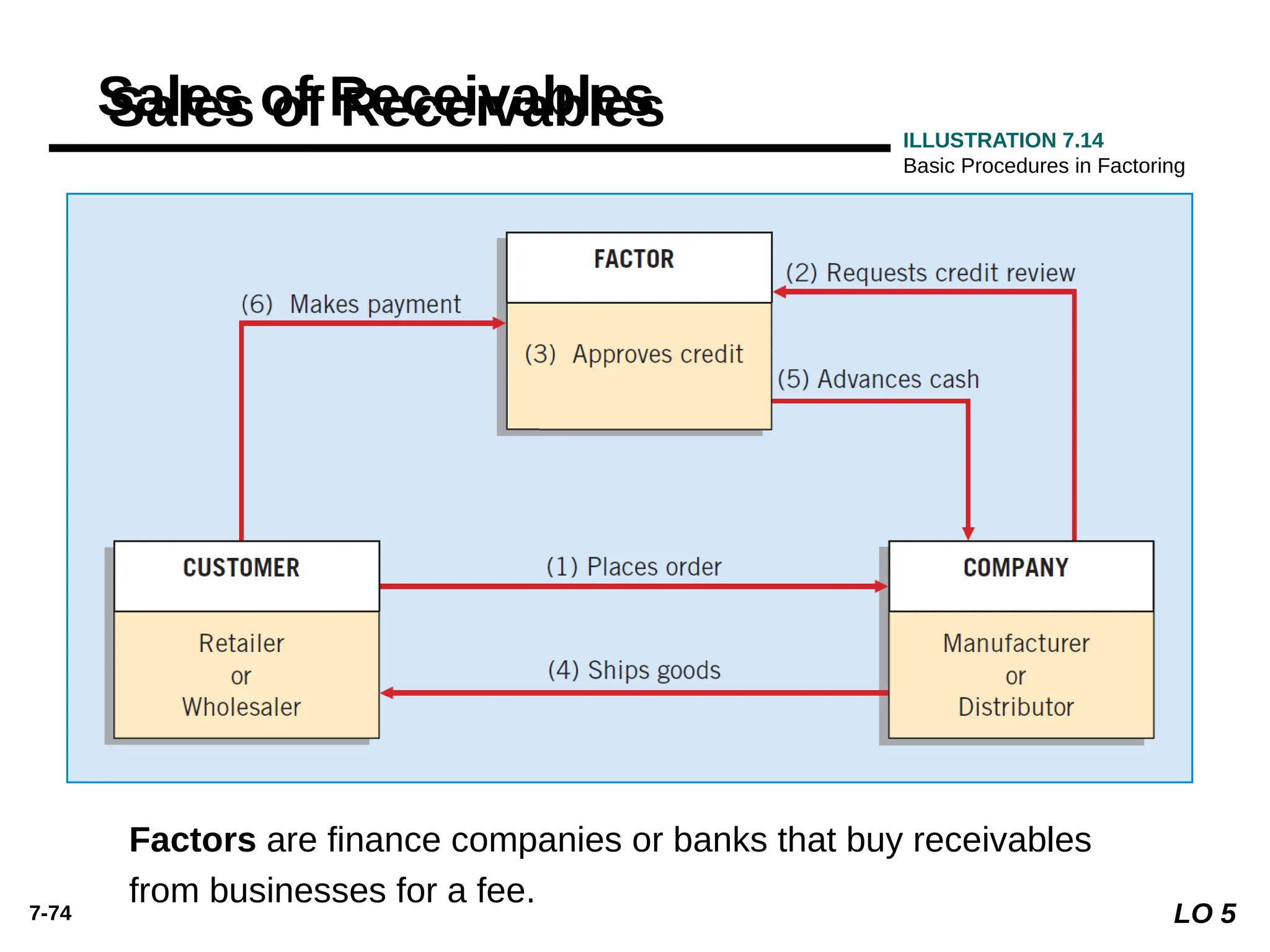
Factors are finance companies or banks that buy receivables
from businesses for a fee.
Sales of Receivables
ILLUSTRATION 7.14
Basic Procedures in Factoring
LO 5
7-75
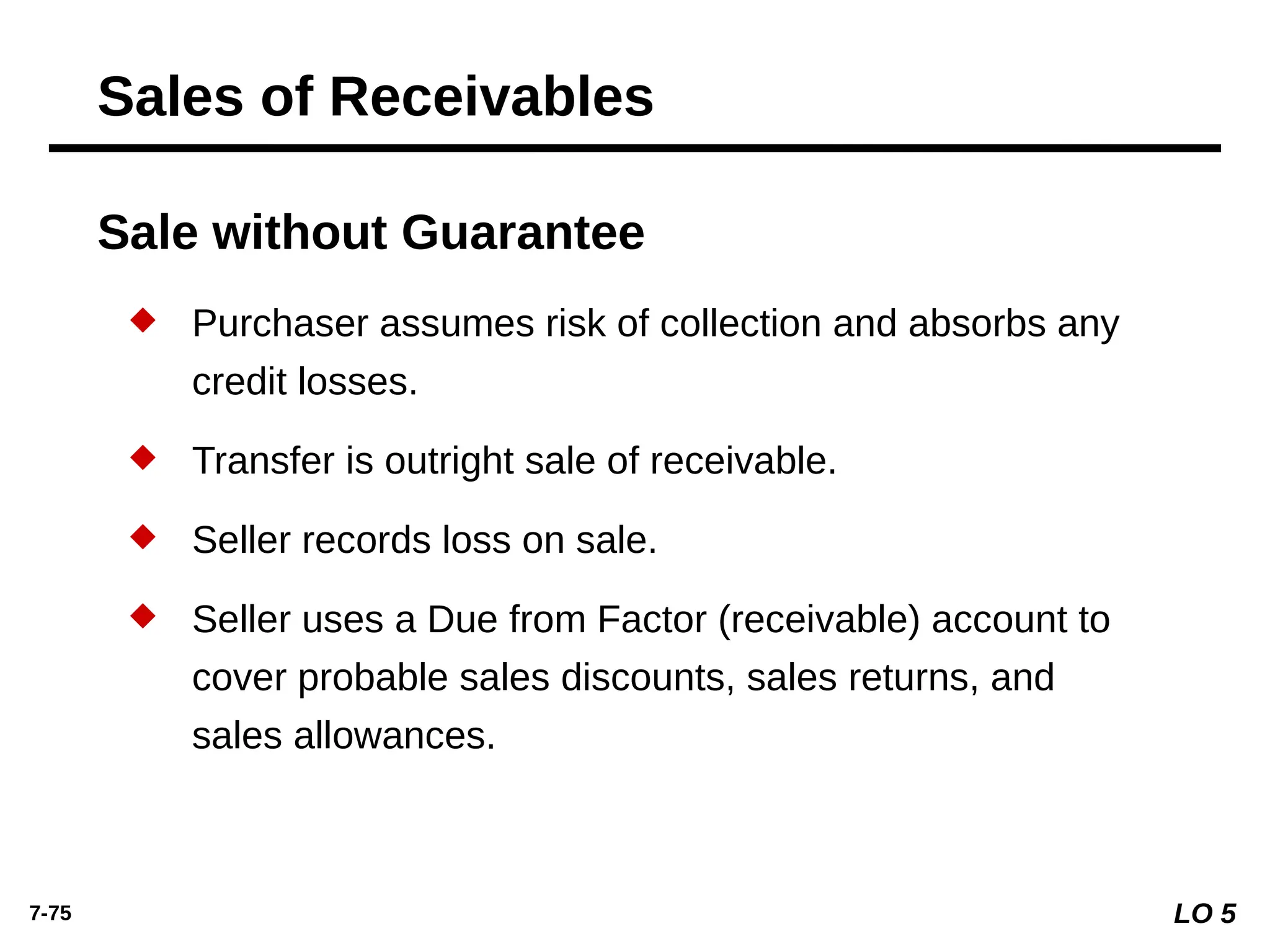
Sale without Guarantee
 Purchaser assumes risk of collection and absorbs any
credit losses.
 Transfer is outright sale of receivable.
 Seller records loss on sale.
 Seller uses a Due from Factor (receivable) account to
cover probable sales discounts, sales returns, and
sales allowances.
Sales of Receivables
LO 5
7-76
Sale without Guarantee
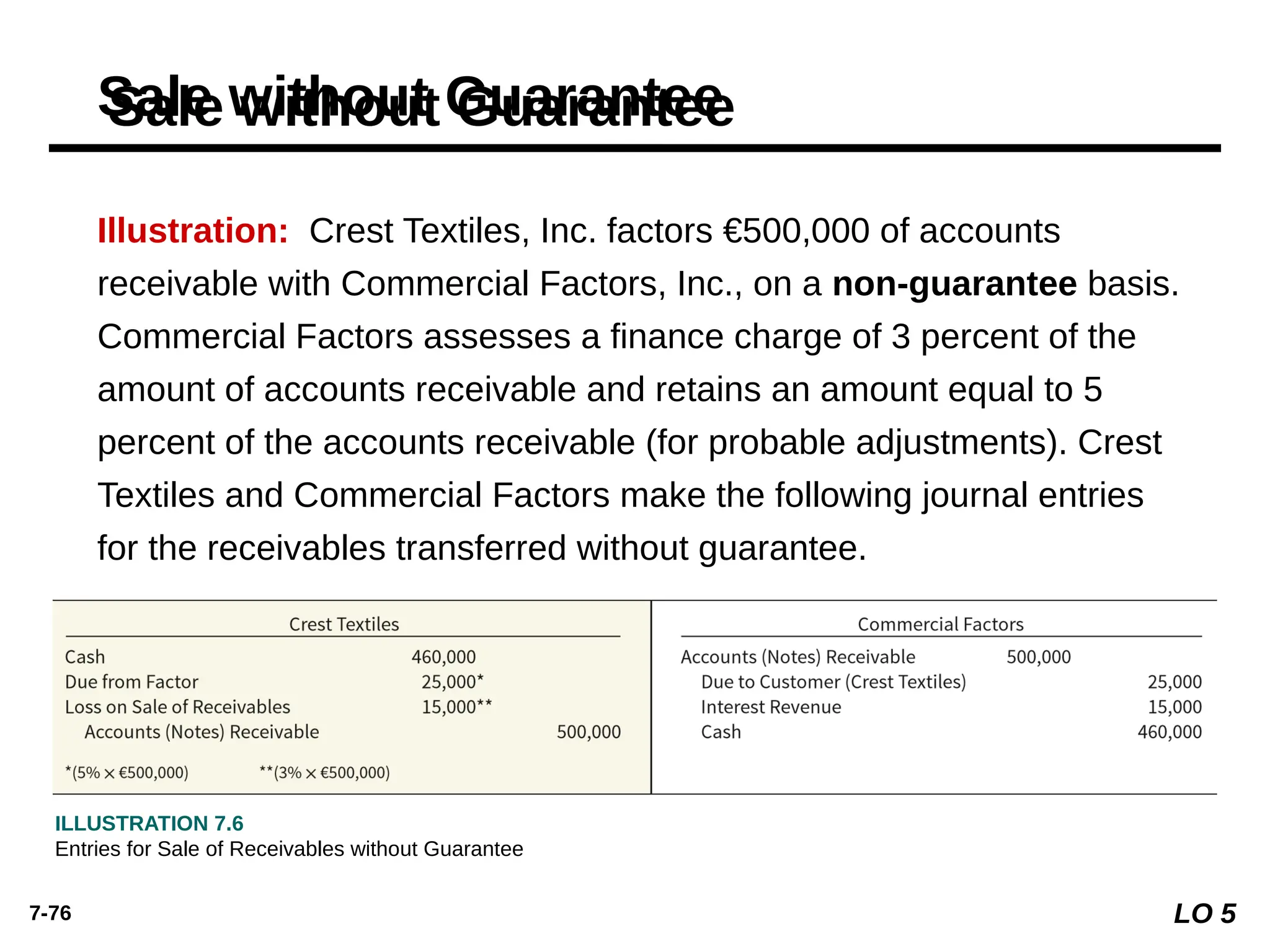
Illustration: Crest Textiles, Inc. factors €500,000 of accounts
receivable with Commercial Factors, Inc., on a non-guarantee basis.
Commercial Factors assesses a finance charge of 3 percent of the
amount of accounts receivable and retains an amount equal to 5
percent of the accounts receivable (for probable adjustments). Crest
Textiles and Commercial Factors make the following journal entries
for the receivables transferred without guarantee.
ILLUSTRATION 7.6
Entries for Sale of Receivables without Guarantee
LO 5
7-77
Sale with Guarantee
 Seller guarantees payment to purchaser.
 Transfer is considered a borrowing—sometimes referred
to as a failed sale.
Assume Crest Textiles sold the receivables on a
with guarantee basis.
Sales of Receivables
ILLUSTRATION 7.16
Sale with Guarantee
LO 5
7-78
Secured Borrowing
Illustration: On March 1, 2019, Meng Mills, Inc. provides (assigns)
NT$700,000 of its accounts receivable to Sino Bank as collateral for
a NT$500,000 note. Meng Mills continues to collect the accounts
receivable; the account debtors are not notified of the arrangement.
Sino Bank assesses a finance charge of 1 percent of the accounts
receivable and interest on the note of 12 percent. Meng Mills makes
monthly payments to the bank for all cash it collects on the
receivables.
Using receivables as collateral in a borrowing transaction.
Derecognition of Receivables
LO 5
7-79
ILLUSTRATION 7.17
Entries for Transfer of Receivables—Secured Borrowing
7-80
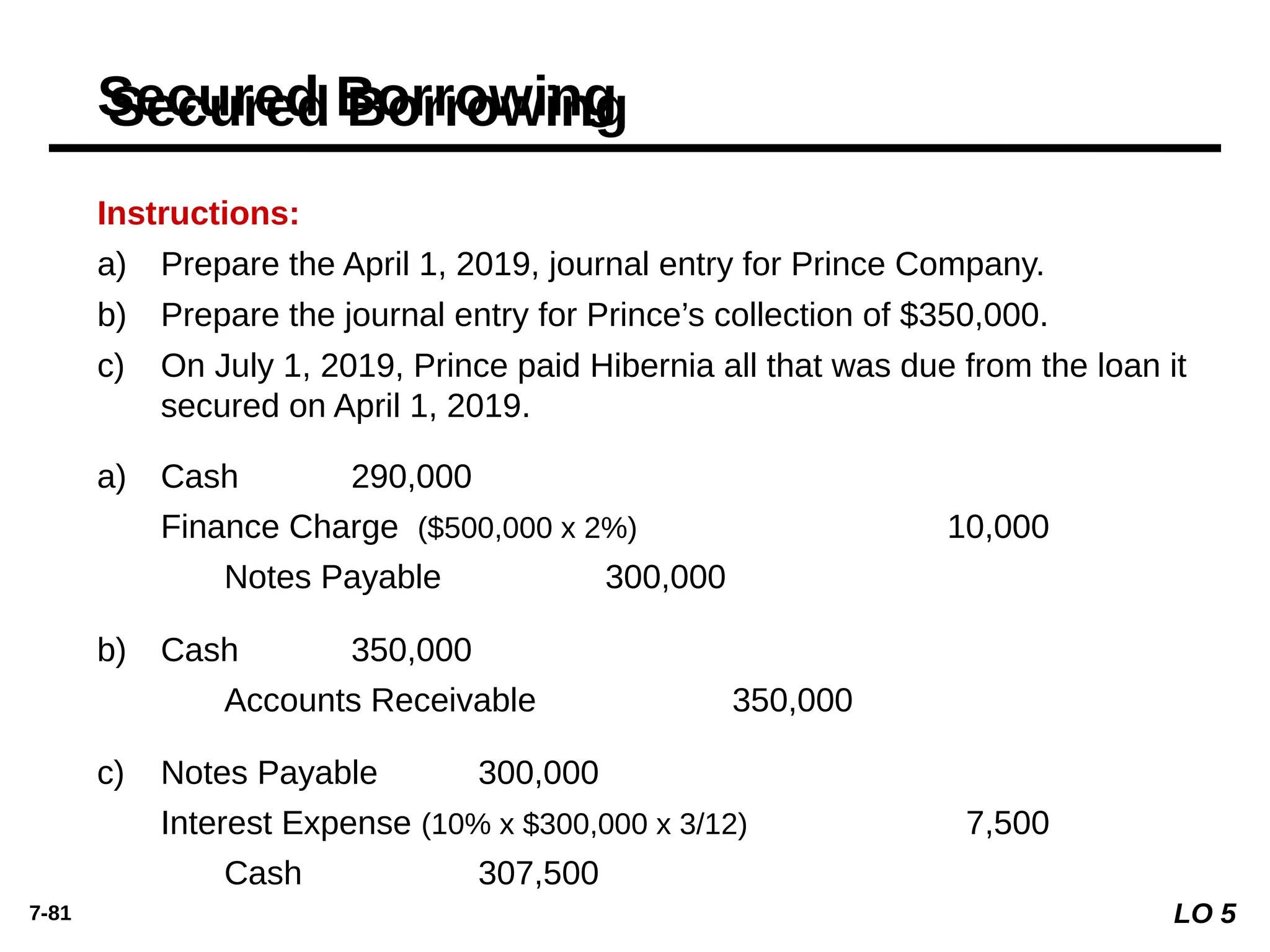
Illustration: On April 1, 2019, Prince Company assigns $500,000 of its
accounts receivable to the Hibernia Bank as collateral for a $300,000 loan
due July 1, 2019. The assignment agreement calls for Prince Company to
continue to collect the receivables. Hibernia Bank assesses a finance
charge of 2% of the accounts receivable, and interest on the loan is 10% (a
realistic rate of interest for a note of this type).
Secured Borrowing
Instructions:
a) Prepare the April 1, 2019, journal entry for Prince Company.
b) Prepare the journal entry for Prince’s collection of $350,000 of the
accounts receivable during the period from April 1, 2019, through
June 30, 2019.
c) On July 1, 2019, Prince paid Hibernia all that was due from the loan it
secured on April 1, 2019.
LO 5
7-81
Instructions:
a) Prepare the April 1, 2019, journal entry for Prince Company.
b) Prepare the journal entry for Prince’s collection of $350,000.
c) On July 1, 2019, Prince paid Hibernia all that was due from the loan it
secured on April 1, 2019.
Secured Borrowing
Cash 290,000
Finance Charge ($500,000 x 2%) 10,000
Notes Payable 300,000
a)
Cash 350,000
Accounts Receivable 350,000
b)
Notes Payable 300,000
Interest Expense (10% x $300,000 x 3/12) 7,500
Cash 307,500
c)
LO 5
7-82
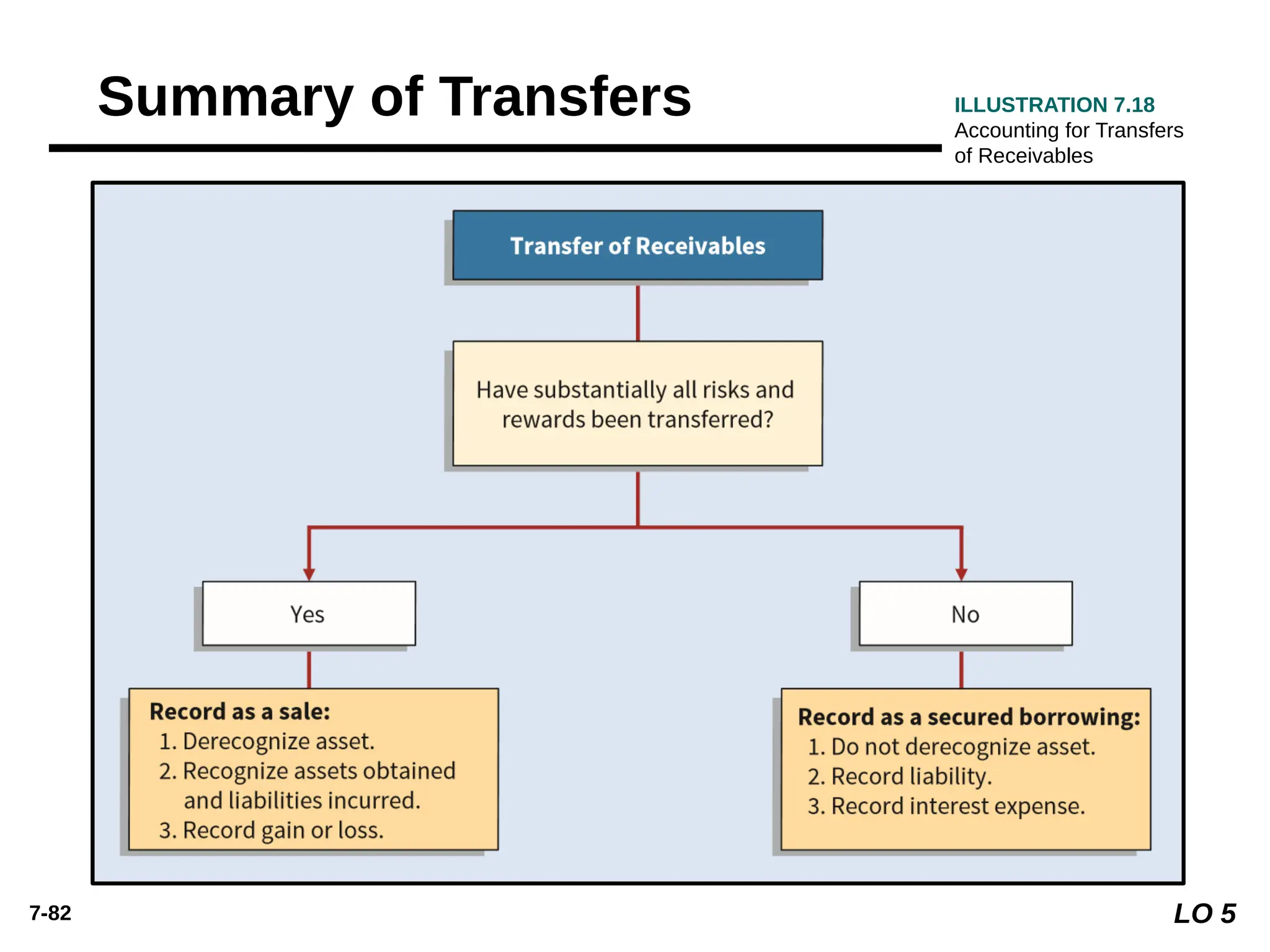
Summary of Transfers ILLUSTRATION 7.18
Accounting for Transfers
of Receivables
LO 5
7-83
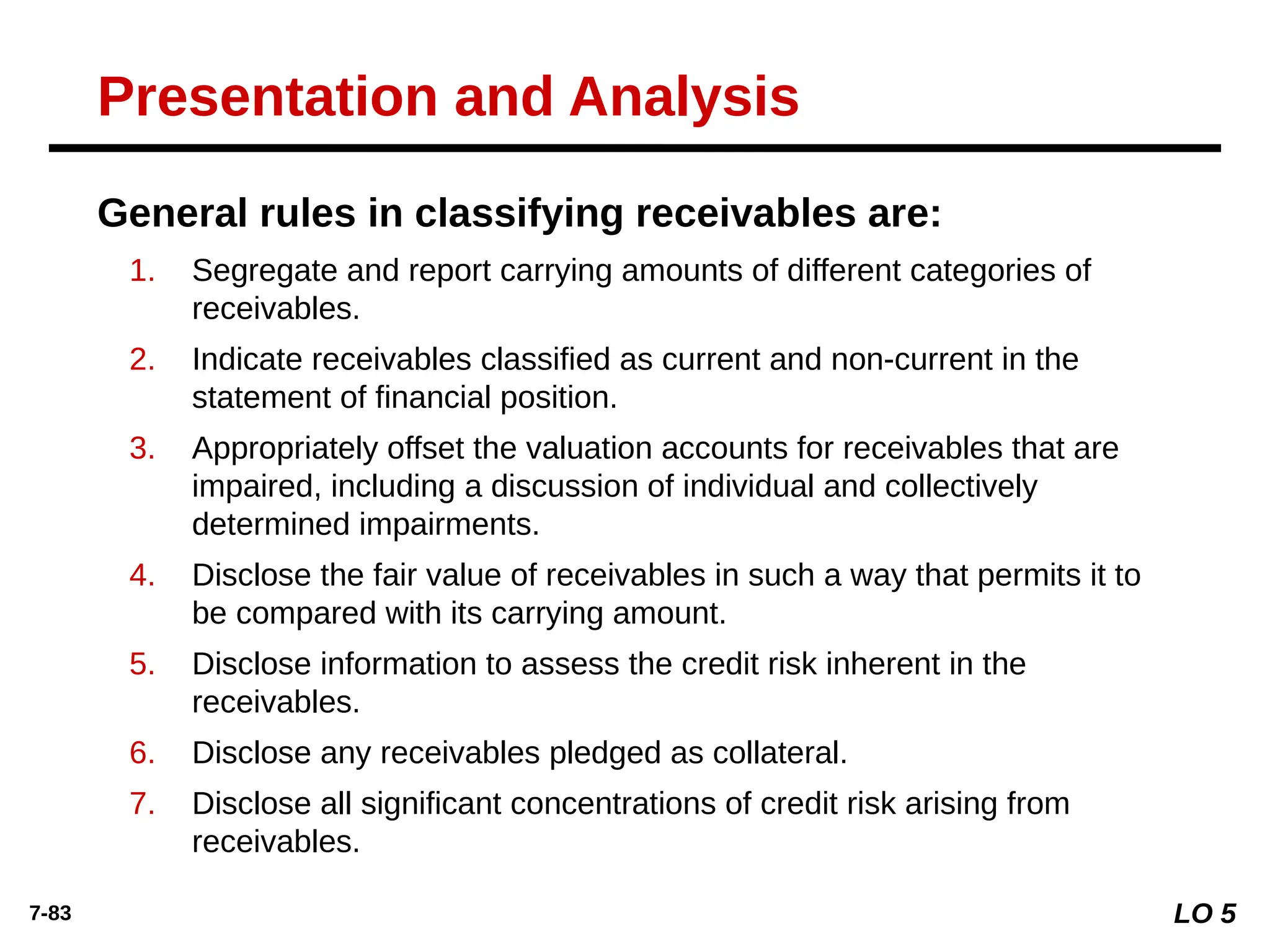
General rules in classifying receivables are:
1. Segregate and report carrying amounts of different categories of
receivables.
2. Indicate receivables classified as current and non-current in the
statement of financial position.
3. Appropriately offset the valuation accounts for receivables that are
impaired, including a discussion of individual and collectively
determined impairments.
4. Disclose the fair value of receivables in such a way that permits it to
be compared with its carrying amount.
5. Disclose information to assess the credit risk inherent in the
receivables.
6. Disclose any receivables pledged as collateral.
7. Disclose all significant concentrations of credit risk arising from
receivables.
Presentation and Analysis
LO 5
7-84
Analysis of Receivables
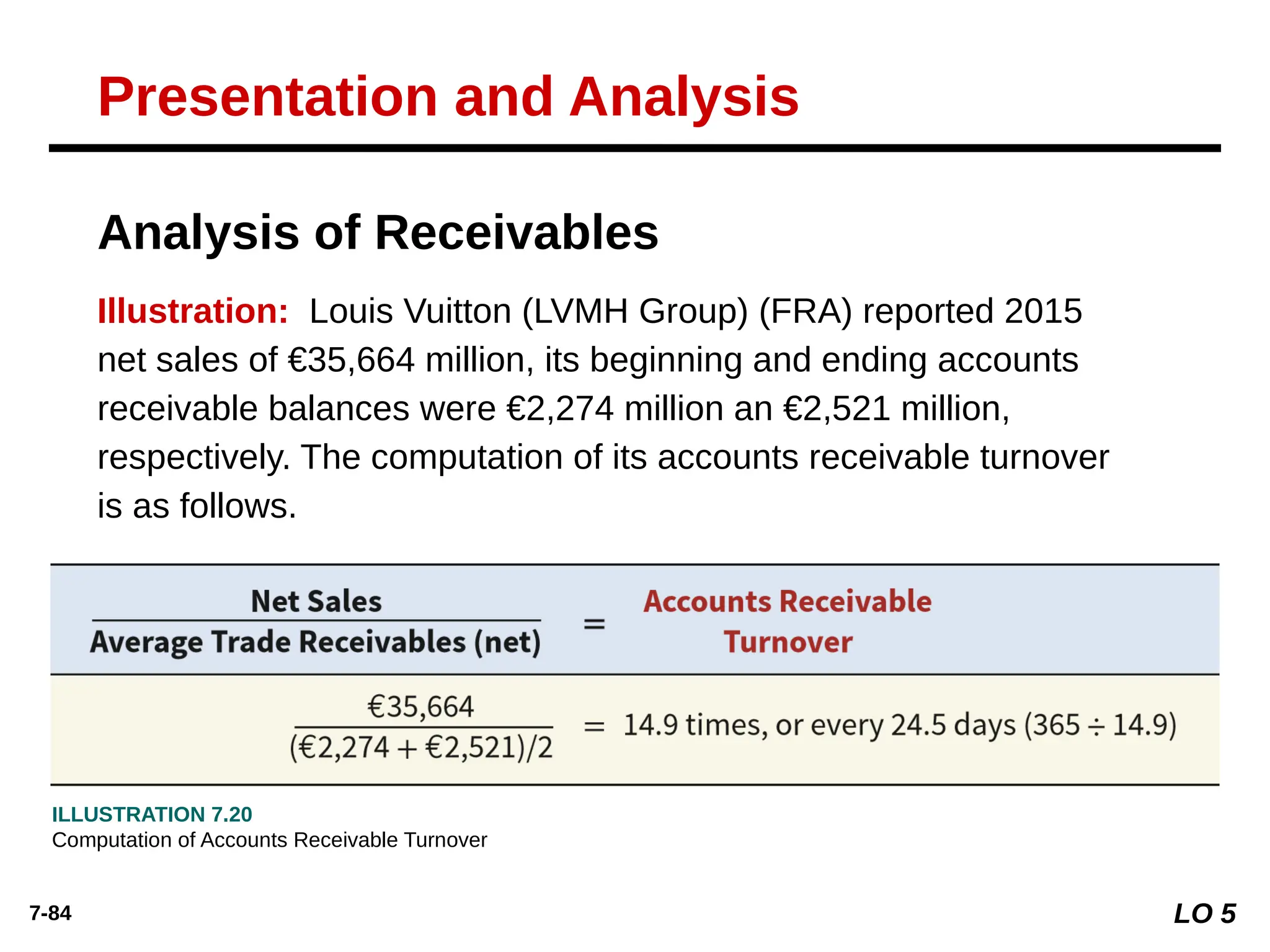
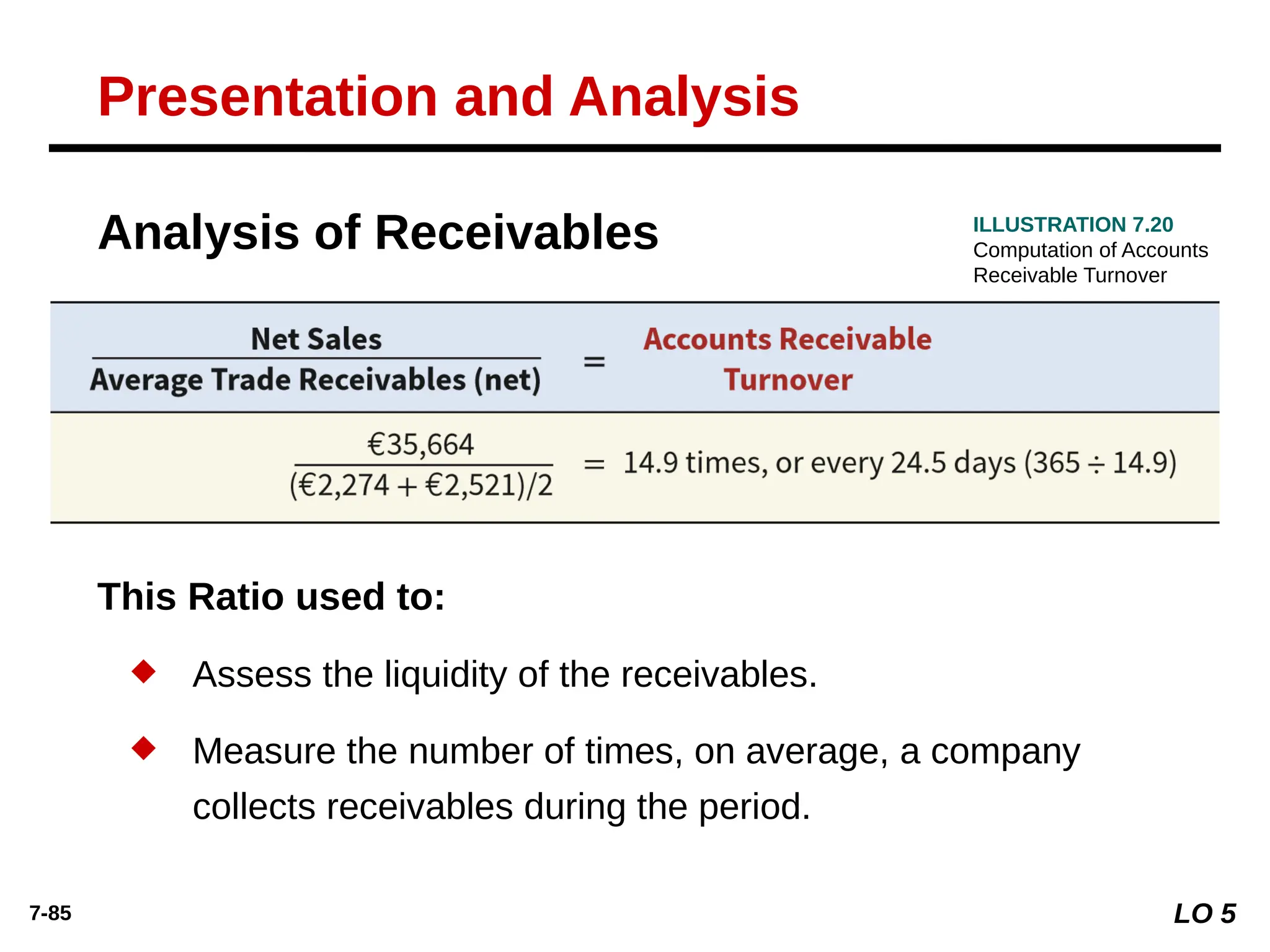
Illustration: Louis Vuitton (LVMH Group) (FRA) reported 2015
net sales of €35,664 million, its beginning and ending accounts
receivable balances were €2,274 million an €2,521 million,
respectively. The computation of its accounts receivable turnover
is as follows.
Presentation and Analysis
ILLUSTRATION 7.20
Computation of Accounts Receivable Turnover
LO 5
7-85
Analysis of Receivables
This Ratio used to:
 Assess the liquidity of the receivables.
 Measure the number of times, on average, a company
collects receivables during the period.
Presentation and Analysis
ILLUSTRATION 7.20
Computation of Accounts
Receivable Turnover
LO 5
7-86
Management faces two problems in accounting for cash
transactions:
1. Establish proper controls to prevent any unauthorized
transactions by officers or employees.
2. Provide information necessary to properly manage cash on
hand and cash transactions.
APPENDIX 7A Cash Controls
LEARNING OBJECTIVE 6
Explain common techniques employed to control cash.
LO 6
7-87
To obtain desired control objectives, a company can vary the
number and location of banks and the types of accounts.
► General checking account
► Collection float
► Lockbox accounts
► Imprest bank accounts
Using Bank Accounts
LO 6
7-88
Used to pay small amounts for miscellaneous expenses.
Steps:
1. Record the transfer of $300 to petty cash:
Petty Cash 300
Cash 300
2. Petty cash custodian obtains signed receipts from each
individual to whom he or she pays cash.
The Imprest Petty Cash System
LO 6
7-89
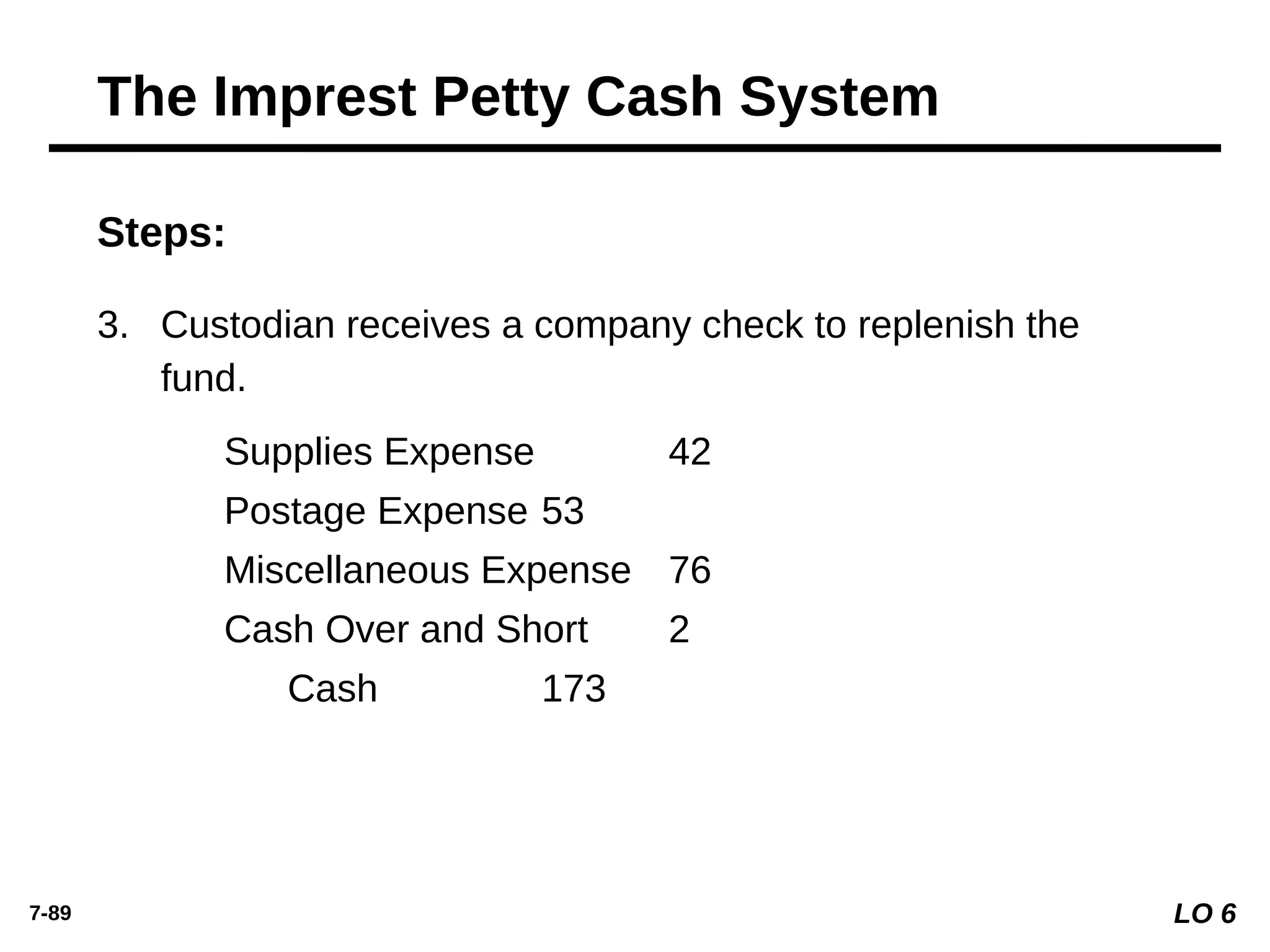
Steps:
Supplies Expense 42
Postage Expense 53
Miscellaneous Expense 76
Cash Over and Short 2
Cash 173
3. Custodian receives a company check to replenish the
fund.
LO 6
The Imprest Petty Cash System
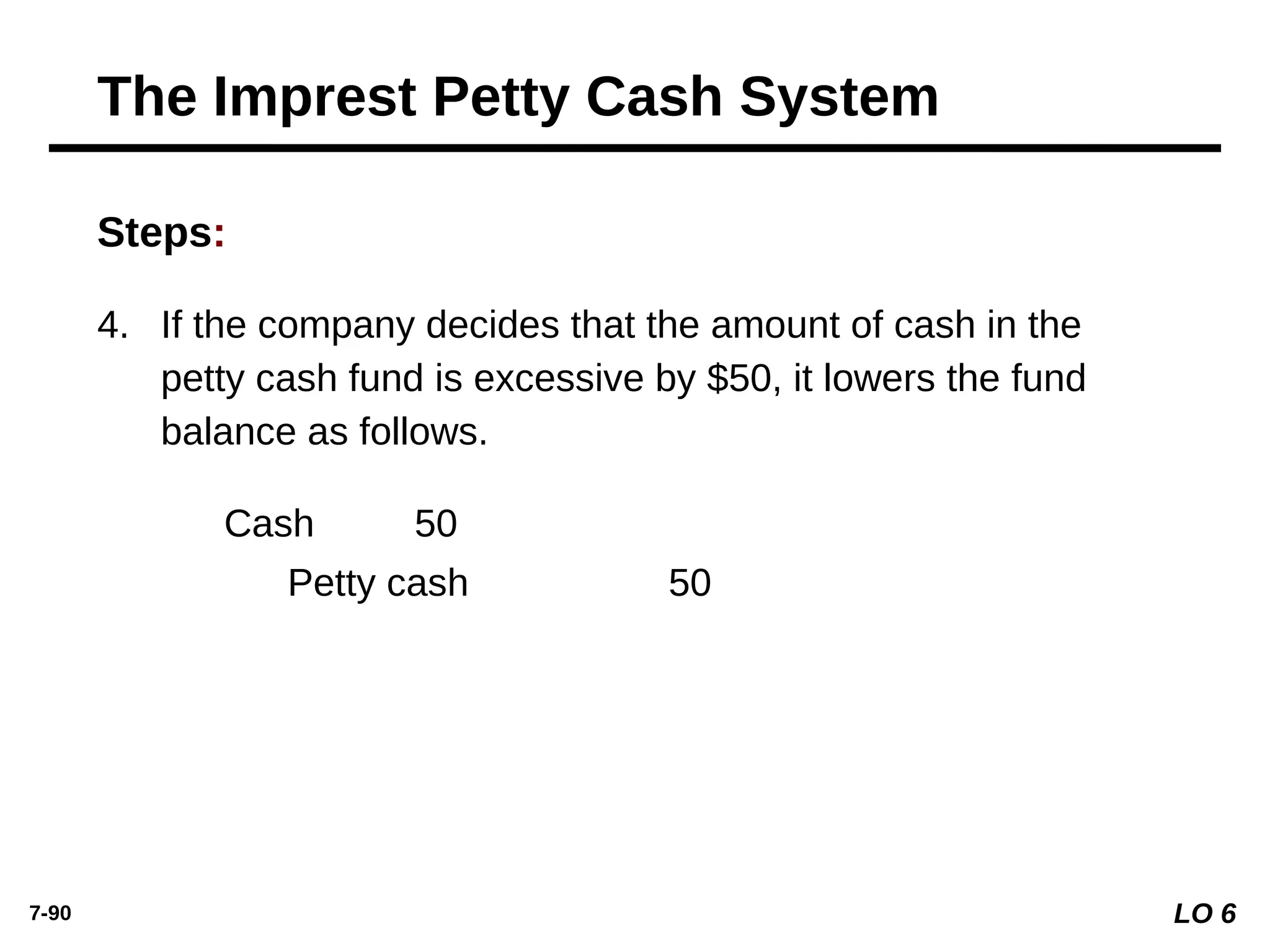
7-90
Steps:
Cash 50
Petty cash 50
4. If the company decides that the amount of cash in the
petty cash fund is excessive by $50, it lowers the fund
balance as follows.
LO 6
The Imprest Petty Cash System
7-91
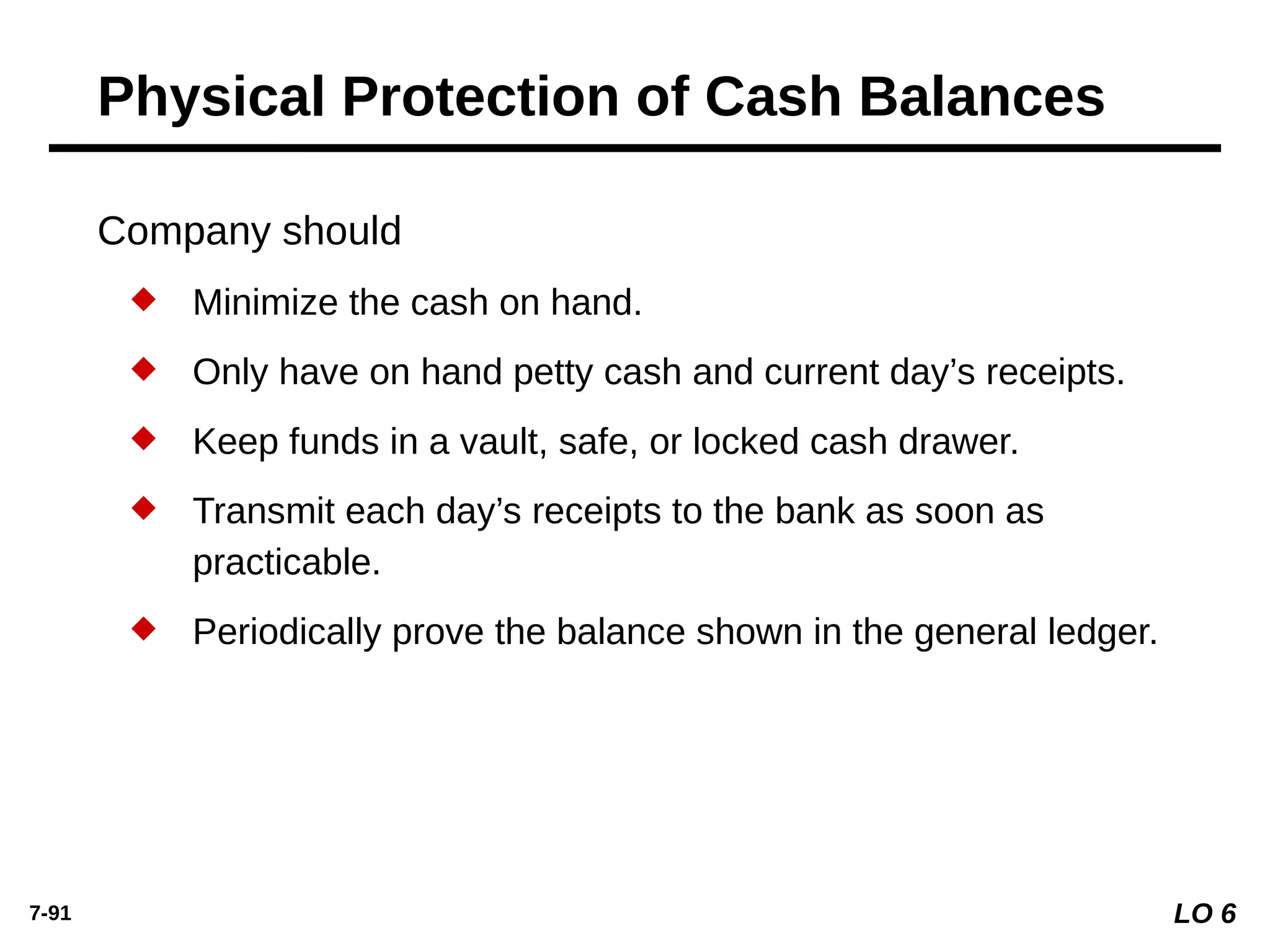
Company should
 Minimize the cash on hand.
 Only have on hand petty cash and current day’s receipts.
 Keep funds in a vault, safe, or locked cash drawer.
 Transmit each day’s receipts to the bank as soon as
practicable.
 Periodically prove the balance shown in the general ledger.
Physical Protection of Cash Balances
LO 6
7-92
Schedule explaining any differences between the bank’s
and the company’s records of cash.
Reconciling Items:
1. Deposits in transit.
2. Outstanding checks.
3. Bank charges
4. Bank credits.
5. Bank or depositor errors.
Time Lags
Reconciliation of Bank Balances
LO 6
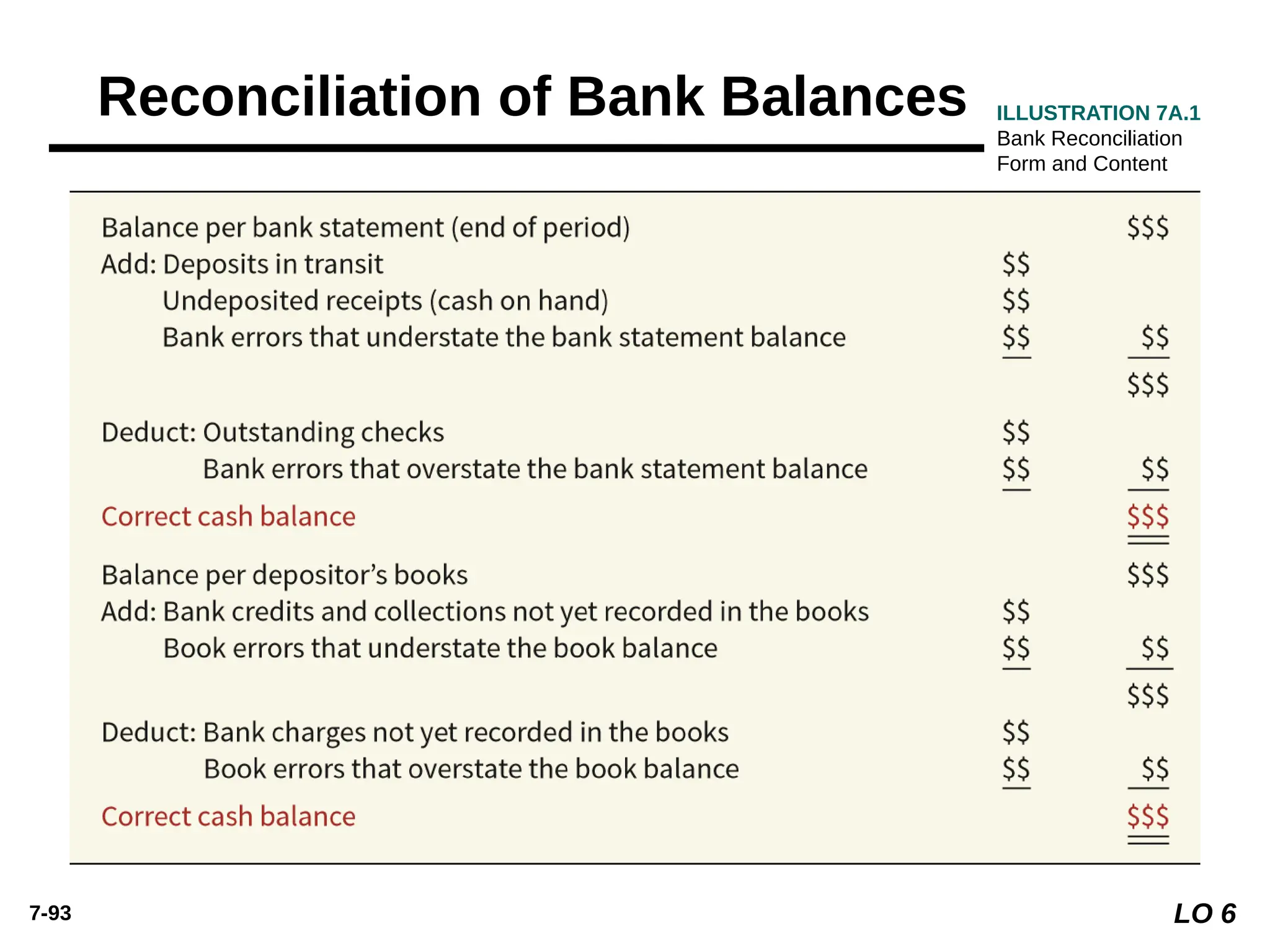
7-93 LO 6
Reconciliation of Bank Balances ILLUSTRATION 7A.1
Bank Reconciliation
Form and Content
7-94
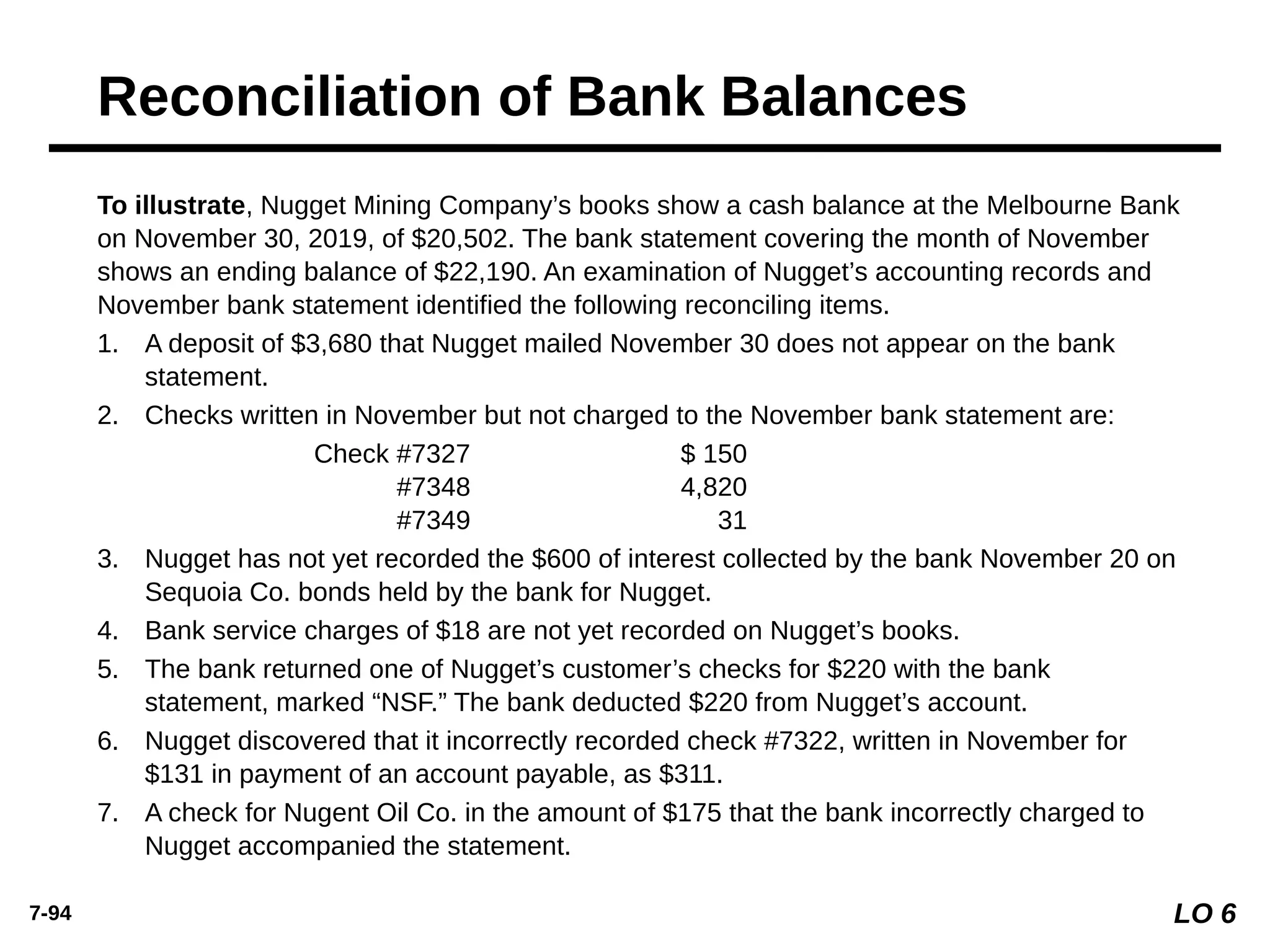
To illustrate, Nugget Mining Company’s books show a cash balance at the Melbourne Bank
on November 30, 2019, of $20,502. The bank statement covering the month of November
shows an ending balance of $22,190. An examination of Nugget’s accounting records and
November bank statement identified the following reconciling items.
1. A deposit of $3,680 that Nugget mailed November 30 does not appear on the bank
statement.
2. Checks written in November but not charged to the November bank statement are:
Check #7327 $ 150
#7348 4,820
#7349 31
3. Nugget has not yet recorded the $600 of interest collected by the bank November 20 on
Sequoia Co. bonds held by the bank for Nugget.
4. Bank service charges of $18 are not yet recorded on Nugget’s books.
5. The bank returned one of Nugget’s customer’s checks for $220 with the bank
statement, marked “NSF.” The bank deducted $220 from Nugget’s account.
6. Nugget discovered that it incorrectly recorded check #7322, written in November for
$131 in payment of an account payable, as $311.
7. A check for Nugent Oil Co. in the amount of $175 that the bank incorrectly charged to
Nugget accompanied the statement.
LO 6
Reconciliation of Bank Balances
7-95
ILLUSTRATION 7A.2
Sample Bank
Reconciliation
Reconciliation of Bank Balances
LO 6
7-96
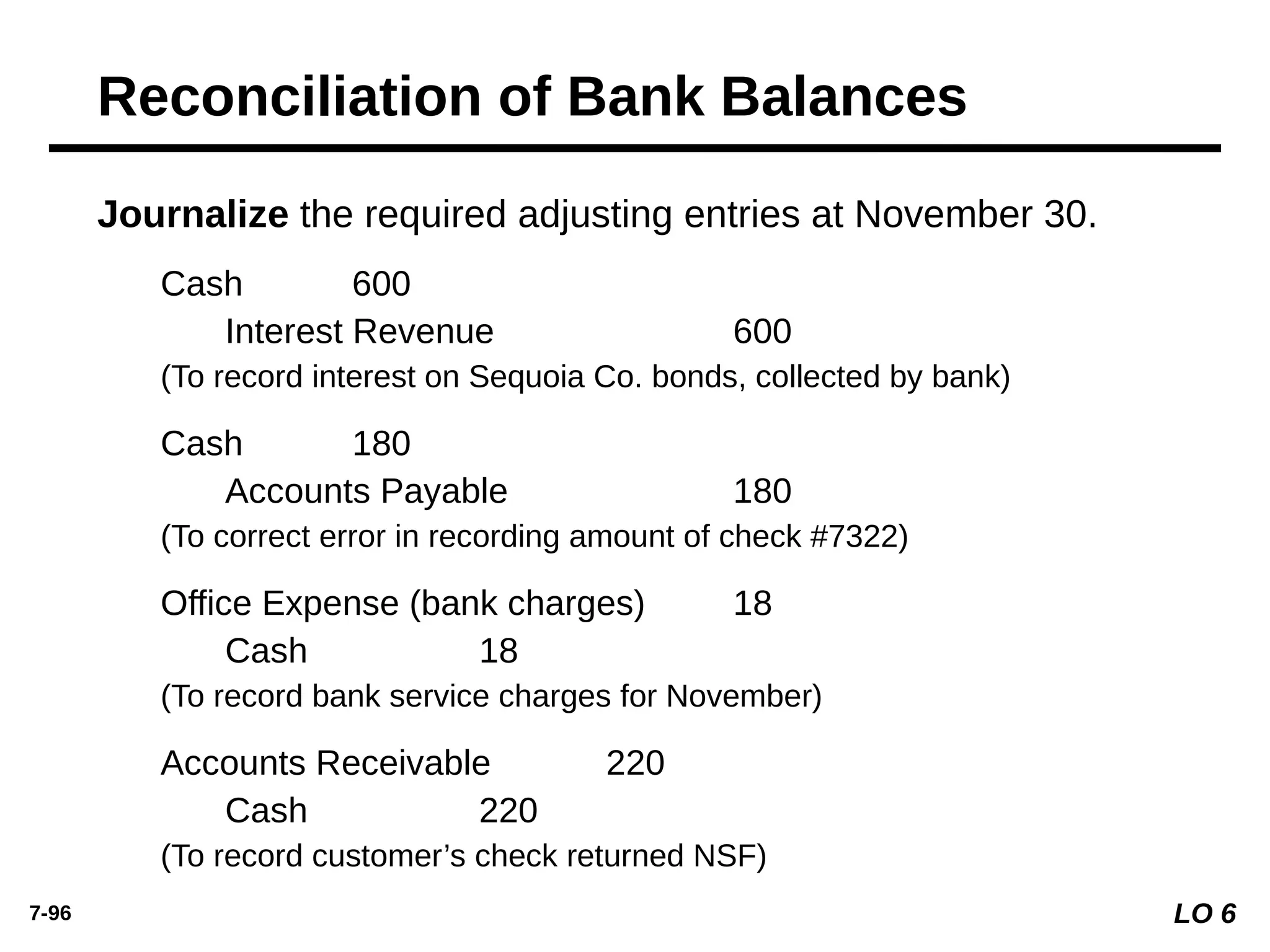
Cash 600
Interest Revenue 600
(To record interest on Sequoia Co. bonds, collected by bank)
Cash 180
Accounts Payable 180
(To correct error in recording amount of check #7322)
Office Expense (bank charges) 18
Cash 18
(To record bank service charges for November)
Accounts Receivable 220
Cash 220
(To record customer’s check returned NSF)
Journalize the required adjusting entries at November 30.
LO 6
Reconciliation of Bank Balances
7-97
The basic accounting and reporting issues related to recognition and
measurement of cash and receivables is similar between U.S. GAAP and
IFRS. For example, the definition of cash and cash equivalents as well as the
use of allowance accounts, how to record discounts, use of the allowance
method to account for bad debts, and factoring are similar for both IFRS and
U.S. GAAP. In the wake of the international credit crisis, the Boards worked
together to improve the accounting for loan impairments and securitizations.
GLOBAL ACCOUNTING INSIGHTS
LEARNING OBJECTIVE 7
Compare the accounting procedures for cash and receivables under IFRS and
U.S. GAAP.
LO 7
7-98
Relevant Facts
Following are the key similarities and differences between U.S. GAAP and
IFRS related to cash and receivables.
Similarities
• The accounting and reporting related to cash is essentially the same under
both U.S. GAAP and IFRS. In addition, the definition used for cash
equivalents is the same.
• Like IFRS, cash and receivables are generally reported in the current assets
section of the statement of financial position (balance sheet) under U.S.
GAAP.
GLOBAL ACCOUNTING INSIGHTS
LO 7
7-99
Relevant Facts
Following are the key similarities and differences between U.S. GAAP and
IFRS related to cash and receivables.
Similarities
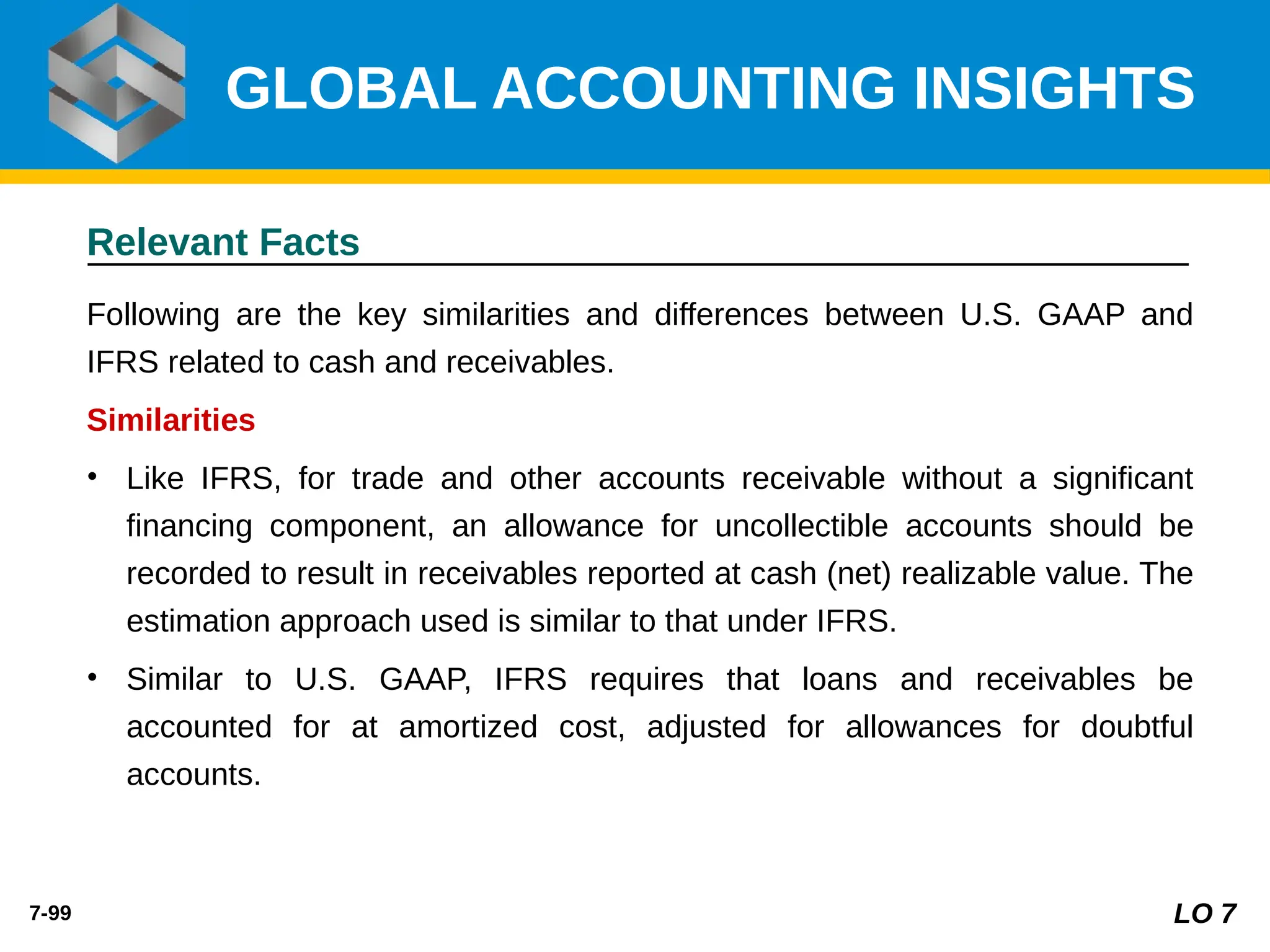
• Like IFRS, for trade and other accounts receivable without a significant
financing component, an allowance for uncollectible accounts should be
recorded to result in receivables reported at cash (net) realizable value. The
estimation approach used is similar to that under IFRS.
• Similar to U.S. GAAP, IFRS requires that loans and receivables be
accounted for at amortized cost, adjusted for allowances for doubtful
accounts.
GLOBAL ACCOUNTING INSIGHTS
LO 7
7-100
Relevant Facts
Differences
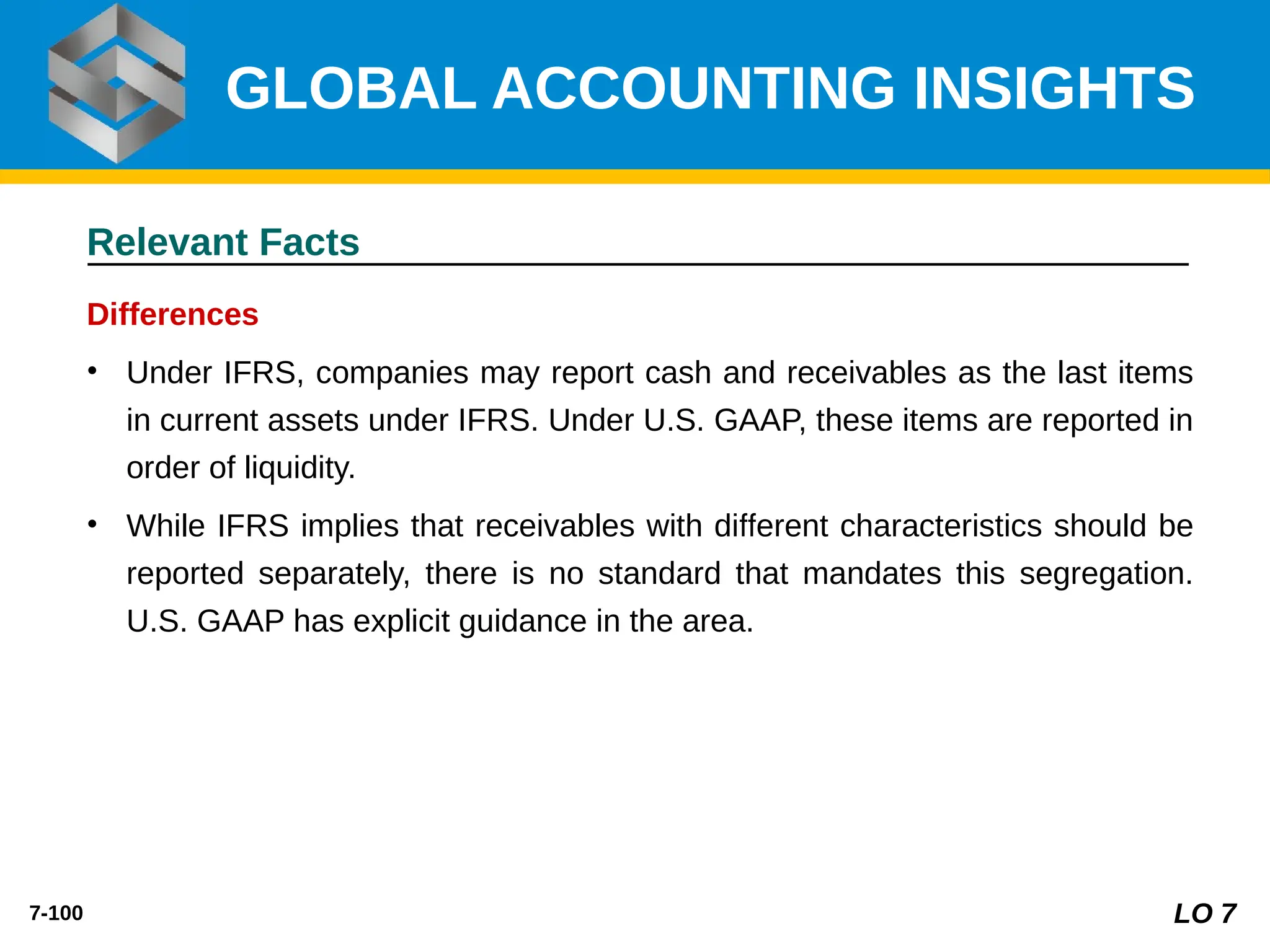
• Under IFRS, companies may report cash and receivables as the last items
in current assets under IFRS. Under U.S. GAAP, these items are reported in
order of liquidity.
• While IFRS implies that receivables with di erent characteristics should be
ff
reported separately, there is no standard that mandates this segregation.
U.S. GAAP has explicit guidance in the area.
GLOBAL ACCOUNTING INSIGHTS
LO 7
7-101
Relevant Facts
Differences
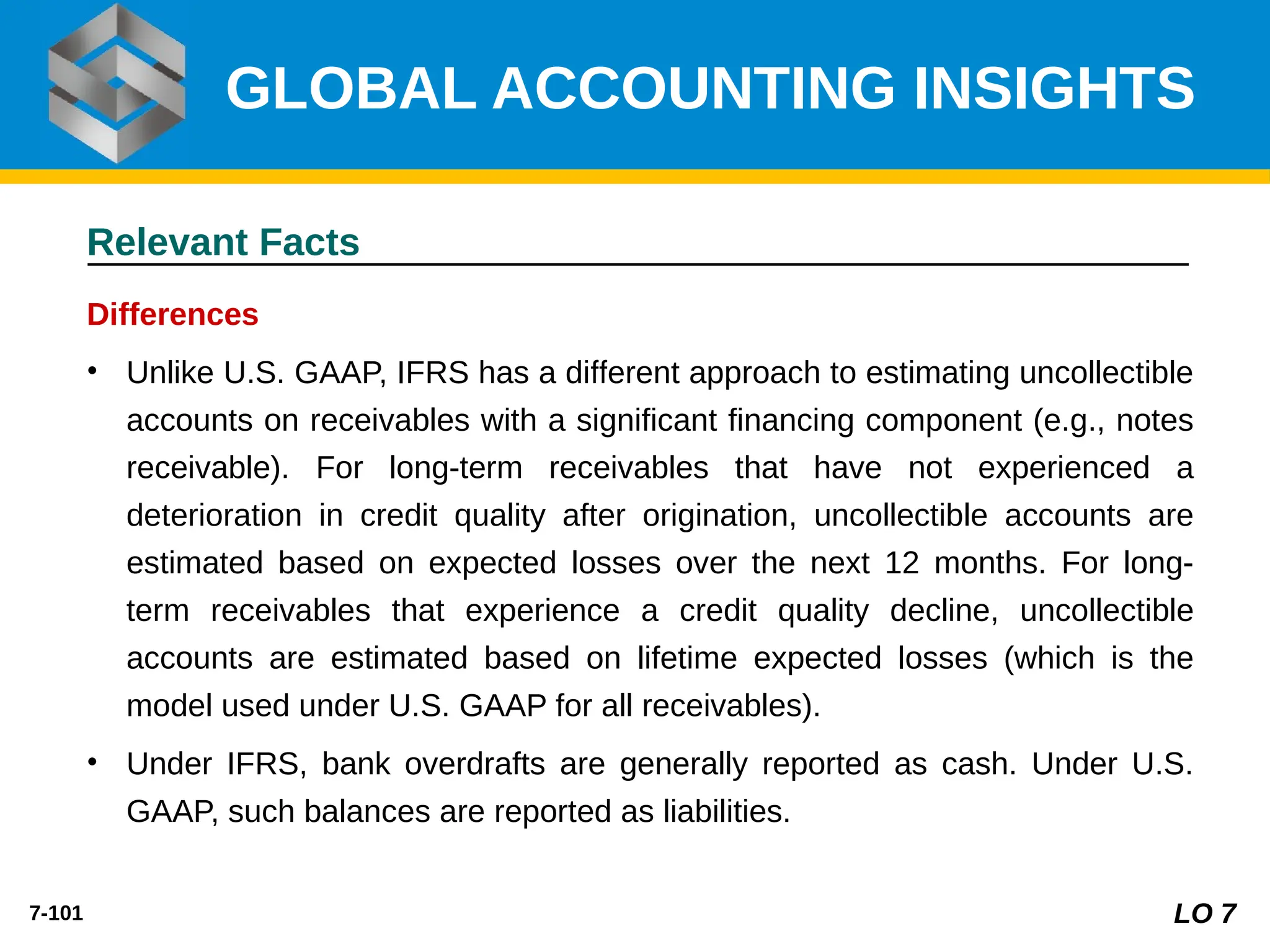
• Unlike U.S. GAAP, IFRS has a di erent approach to estimating uncollectible
ff
accounts on receivables with a significant financing component (e.g., notes
receivable). For long-term receivables that have not experienced a
deterioration in credit quality after origination, uncollectible accounts are
estimated based on expected losses over the next 12 months. For long-
term receivables that experience a credit quality decline, uncollectible
accounts are estimated based on lifetime expected losses (which is the
model used under U.S. GAAP for all receivables).
• Under IFRS, bank overdrafts are generally reported as cash. Under U.S.
GAAP, such balances are reported as liabilities.
GLOBAL ACCOUNTING INSIGHTS
LO 7
7-102
Relevant Facts
Differences
• IFRS and U.S. GAAP di er in the criteria used to account for transfers of
ff
receivables. IFRS is a combination of an approach focused on risks and
rewards and loss of control. U.S. GAAP uses loss of control as the primary
criterion (see the About the Numbers discussion below). In addition, IFRS
generally permits partial transfers; U.S. GAAP does not.
GLOBAL ACCOUNTING INSIGHTS
LO 7
7-103
On the Horizon
Both the IASB and the FASB have indicated that they believe that financial
statements would be more transparent and understandable if companies
recorded and reported all financial instruments at fair value. With the recently
issued guidance on impairments by both boards, IFRS and U.S. GAAP are
now more closely aligned with earlier recognition of impairments. Most believe
that both Boards’ approaches to estimating uncollectible accounts represent
improvements and address the weakness in previous bad debt accounting that
was highlighted by the financial crisis. Time will tell if one model or the other
provides more useful information to investors and creditors.
GLOBAL ACCOUNTING INSIGHTS
LO 7
7-104
Copyright © 2018 John Wiley & Sons, Inc. All rights reserved.
Reproduction or translation of this work beyond that permitted in
Section 117 of the 1976 United States Copyright Act without the
express written permission of the copyright owner is unlawful.
Request for further information should be addressed to the
Permissions Department, John Wiley & Sons, Inc. The purchaser
may make back-up copies for his/her own use only and not for
distribution or resale. The Publisher assumes no responsibility for
errors, omissions, or damages, caused by the use of these
programs or from the use of the information contained herein.
COPYRIGHT

ch0 3 cash and recievables1-2.pptx inter

  • 1.
  • 2.
    7-2 1. Indicate howto report cash and related items. 2. Define receivables and explain accounting issues related to their recognition. 3. Explain accounting issues related to valuation of accounts receivable. 4. Explain accounting issues related to recognition and valuation of notes receivable. 5. Explain additional accounting issues related to accounts and notes receivables. After studying this chapter, you should be able to: Cash and Receivables CHAPTER 3 LEARNING OBJECTIVES
  • 3.
    7-3 PREVIEW OF CHAPTER3 Intermediate Accounting IFRS 3rd Edition Kieso ● Weygandt ● Warfield
  • 4.
    7-4 Cash  Most liquidasset.  Standard medium of exchange.  Basis for measuring and accounting for all other items.  Current asset.  Examples: Coin, currency, available funds on deposit at the bank, money orders, certified checks, cashier’s checks, personal checks, bank drafts and savings accounts. LO 1 LEARNING OBJECTIVE 1 Indicate how to report cash and related items. Cash
  • 5.
    7-5 Cash Equivalents Short-term, highlyliquid investments that are both a) readily convertible to cash, and b) so near their maturity that they present insignificant risk of changes in value. Examples: Government bonds, commercial paper, and money market funds Reporting Cash LO 1 Cash
  • 6.
    7-6 Companies segregate restrictedcash from “regular” cash. Examples, restricted for: (1) plant expansion, (2) retirement of long-term debt, and (3) compensating balances. Reporting Cash Restricted Cash ILLUSTRATION 7.2 Disclosure of Restricted Cash LO 1
  • 7.
    7-7 Reporting Cash Bank Overdrafts Companywrites a check for more than the amount in its cash account.  Generally reported as a current liability.  Included as a component of cash if such overdrafts are repayable on demand and are an integral part of a company’s cash management (such as the common practice of establishing o setting arrangements against ff other accounts at the same bank). LO 1
  • 8.
  • 9.
    7-9 LEARNING OBJECTIVE 2 Definereceivables and explain accounting issues related to their recognition. Receivables Written promises to pay a certain sum of money on a specified future date. Receivables - Claims held against customers and others for money, goods, or services. Oral promises of the purchaser to pay for goods and services sold. Accounts Receivable Notes Receivable LO 2
  • 10.
    7-10 Non-Trade Receivables 1. Advancesto officers and employees. 2. Advances to subsidiaries. 3. Deposits paid to cover potential damages or losses. 4. Deposits paid as a guarantee of performance or payment. 5. Dividends and interest receivable. 6. Claims against: Insurance companies for casualties sustained; defendants under suit; governmental bodies for tax refunds; common carriers for damaged or lost goods; creditors for returned, damaged, or lost goods; customers for returnable items (crates, containers, etc.). LO 2 Receivables
  • 11.
    7-11 ILLUSTRATION 7.3 Receivables Statementof Financial Position Sheet Presentations Non-Trade Receivables LO 2
  • 12.
    7-12 Recognition of AccountsReceivables  Accounts receivable generally arise as part of a revenue arrangement.  The revenue recognition principle indicates that a company should recognize revenue when it satisfies its performance obligation by transferring the good or service to the customer. LO 2
  • 13.
    7-13 Recognition of AccountsReceivables For example, if Lululemon Athletica, Inc. (CAN) sells a yoga outfit to Jennifer Burian for $100 on account, the yoga outfit is transferred when Jennifer obtains control of this outfit. When this change in control occurs, Lululemon should recognize an account receivable and sales revenue. Lululemon makes the following entry: Accounts Receivable 100 Sales Revenue 100 LO 2
  • 14.
    7-14 Recognition of AccountsReceivables Some key indicators that Lululemon has transferred and that Jennifer has obtained control of the yoga outfit. 1. Lululemon has the right to payment from the customer. 2. Lululemon has passed legal title to the customer. 3. Lululemon has transferred physical possession of the goods. 4. Lululemon no longer has significant risks and rewards of ownership of the goods. 5. Jennifer has accepted the asset. LO 2
  • 15.
    7-15 The transaction priceis the amount of consideration that a company expects to receive from a customer in exchange for transferring goods or services. Measurement of the Transaction Price In some cases, the price of a good or service is dependent on future events. These future events often include such items as discounts, returns and allowances, and performance bonuses. Variable Consideration Receivables LO 2
  • 16.
    7-16 Variable Consideration Use to: Avoid frequent changes in catalogs.  Alter prices for different quantities purchased.  Hide the true invoice price from competitors. 10 % Discount for new Retail Store Customers Trade Discounts LO 2
  • 17.
    7-17  Offered toinduce prompt payment.  Terms such as 2/10, n/30, 2/10, E.O.M., or net 30, E.O.M.  Gross Method vs. Net Method. Cash Discounts (Sales Discounts) Payment terms are 2/10, n/30 LO 2 Variable Consideration
  • 18.
    7-18 Cash Discounts (SalesDiscounts) ILLUSTRATION 7.5 Entries under Gross and Net Methods LO 2
  • 19.
    7-19  Sales Returnsand Allowances is a contra revenue account to Sales Revenue.  Allowance for Sales Returns and Allowances is a contra asset account to Accounts Receivable.  The use of both Sales Returns and Allowances, and Allowance for Sales Return and Allowances accounts is helpful to identify potential problems associated with inferior merchandise, inefficiencies in filling orders, or delivery or shipment mistakes. Sales Returns and Allowances LO 2 Variable Consideration
  • 20.
    7-20 Illustration: Assume thatMax Glass sells hurricane glass to Oliver Builders. As part of the sales agreement, Max includes a provision that if Oliver is dissatisfied with the product, Max will grant an allowance on the sales price or agree to take the product back. On January 4, 2019, Max sells $5,000 of hurricane glass to Oliver on account. Max records the sale on account as follows. Sales Returns and Allowances Accounts Receivable 5,000 Sales Revenue 5,000 LO 2
  • 21.
    7-21 Illustration: Assume thatMax Glass sells hurricane glass to Oliver Builders. As part of the sales agreement, Max includes a provision that if Oliver is dissatisfied with the product, Max will grant an allowance on the sales price or agree to take the product back. On January 16, 2019, Max grants an allowance of $300 to Oliver because some of the hurricane glass is defective. The entry to record this transaction is as follows. Sales Returns and Allowances Sales Returns and Allowances 300 Accounts Receivable 300 LO 2
  • 22.
    7-22 On January 31,2019, before preparing financial statements, Max estimates that an additional $100 in sales returns and allowances will result from the sale to Oliver on January 4, 2019. An adjusting entry to record this additional allowance is as follows. Sales Returns and Allowances 100 Allowance for Sales Returns and Allowances 100 Sales Returns and Allowances LO 2
  • 23.
    7-23  Theoretically, anyrevenue after the period of sale is interest revenue.  Companies ignore interest revenue related to accounts receivable because the amount of the discount is not usually material in relation to the net income for the period.  The profession specifically excludes from present value considerations “receivables arising from transactions with customers in the normal course of business which are due in customary trade terms not exceeding approximately one year.” Time Value of Money Variable Consideration LO 2
  • 24.
    7-24 How are theseaccounts presented on the Statement of Financial Position? Accounts Receivable Allowance for Doubtful Accounts Beg. 500 25 Beg. End. 500 25 End. LO 2 Accounts Receivable
  • 25.
    7-25 Current Assets: Cash 330 $ Accountsreceivable 500 Less: Allowance for doubtful accounts (25) 475 Inventory 812 Prepaid expense 40 Total current assets 1,657 Statement of Financial Position (partial) Brown Furniture LO 2 Accounts Receivable
  • 26.
    7-26 Current Assets: Cash 330 $ Accountsreceivable, net of $25 allowance 475 Inventory 812 Prepaid expense 40 Total current assets 1,657 Statement of Financial Position (partial) Brown Furniture Alternate Presentation LO 2 Accounts Receivable
  • 27.
    7-27 Accounts Receivable Allowance for DoubtfulAccounts Beg. 500 25 Beg. End. 500 25 End. Journal entry for credit sale of $100? Accounts Receivable 100 Sales Revenue 100 Accounts Receivable LO 2
  • 28.
    7-28 Allowance for Doubtful Accounts Beg.500 25 Beg. End. 600 25 End. Journal entry for credit sale of $100? Accounts Receivable 100 Sales Revenue 100 Sale 100 Accounts Receivable Accounts Receivable LO 2
  • 29.
    7-29 Allowance for Doubtful Accounts Beg.500 25 Beg. End. 600 25 End. Sale 100 Collected $333 on account? Cash 333 Accounts Receivable 333 Accounts Receivable Accounts Receivable LO 2
  • 30.
    7-30 Allowance for Doubtful Accounts Beg.500 25 Beg. End. 267 25 End. Sale 100 Collected $333 on account? Cash 333 Accounts Receivable 333 333 Coll. Accounts Receivable Accounts Receivable LO 2
  • 31.
    7-31 Allowance for Doubtful Accounts Beg.500 25 Beg. End. 267 25 End. Sale 100 333 Coll. Adjustment of $15 for estimated bad debts? Bad Debt Expense 15 Allowance for Doubtful Accounts 15 Accounts Receivable LO 2 Accounts Receivable
  • 32.
    7-32 Allowance for Doubtful Accounts Beg.500 25 Beg. End. 267 40 End. Sale 100 333 Coll. Adjustment of $15 for estimated bad debts? Bad Debt Expense 15 Allowance for Doubtful Accounts 15 15 Est. Accounts Receivable LO 2 Accounts Receivable
  • 33.
    7-33 Allowance for Doubtful Accounts Beg.500 25 Beg. End. 267 40 End. Sale 100 333 Coll. 15 Est. Write-off of uncollectible accounts for $10? Allowance for Doubtful accounts 10 Accounts Receivable 10 Accounts Receivable LO 2 Accounts Receivable
  • 34.
    7-34 Allowance for Doubtful Accounts Beg.500 25 Beg. End. 257 30 End. Sale 100 333 Coll. 15 Est. Write-off of uncollectible accounts for $10? Allowance for Doubtful accounts 10 Accounts Receivable 10 W/O 10 10 W/O Accounts Receivable LO 2 Accounts Receivable
  • 35.
    7-35 Current Assets: Cash 330 $ Accountsreceivable, net of $30 allowance 227 Inventory 812 Prepaid expense 40 Total current assets 1,409 Statement of Financial Position (partial) Brown Furniture LO 2 Accounts Receivable
  • 36.
    7-36  Record creditlosses as debits to Bad Debt Expense (or Uncollectible Accounts Expense).  Normal and necessary risk of doing business on credit.  Two methods to account for uncollectible accounts: 1) Direct write-off method 2) Allowance method Uncollectible Accounts Receivable LO 3 Valuation of Accounts Receivable LEARNING OBJECTIVE 3 Explain accounting issues related to valuation of accounts receivable.
  • 37.
    7-37 Allowance Method Losses areestimated:  Percentage-of-sales.  Percentage-of-receivables.  IFRS requires when bad debts are material in amount. Methods of Accounting for Uncollectible Accounts Direct Write-Off Method Theoretically deficient:  Fails to record expenses as incurred.  Receivable not stated at cash realizable value.  Not appropriate when amount uncollectible is material. Valuation of Accounts Receivable LO 3
  • 38.
    7-38 LO 3 DirectWrite-Off Method for Uncollectible Accounts When a company determines a particular account to be uncollectible, it charges the loss to Bad Debt Expense. Assume, for example, that on December 10 Cruz Ltd. writes off as uncollectible Yusado’s NT$8,000,000 balance. The entry is: Valuation of Accounts Receivable Bad Debt Expense 8,000,000 Accounts Receivable (Yusado) 8,000,000
  • 39.
    7-39 LO 3 AllowanceMethod for Uncollectible Accounts  Involves estimating uncollectible accounts at the end of each period.  Ensures that companies state receivables on the statement of financial position at their cash realizable value.  Companies estimate uncollectible accounts and cash realizable value using information about past and current events as well as forecasts of future collectibility. Valuation of Accounts Receivable
  • 40.
    7-40 LO 3 RecordingEstimated Uncollectibles Illustration: Assume that Brown Furniture in 2019, its first year of operations, has credit sales of £1,800,000. Of this amount, £150,000 remains uncollected at December 31. The credit manager estimates that £10,000 of these sales will be uncollectible. The adjusting entry to record the estimated uncollectibles (assuming a zero balance in the allowance account) is: Allowance Method for Uncollectible Accounts Bad Debt Expense 10,000 Allowance for Doubtful Accounts 10,000
  • 41.
    7-41 LO 3 RecordingEstimated Uncollectibles ILLUSTRATION 7.5 Presentation of Allowance for Doubtful Accounts The amount of £140,000 represents the cash realizable value of the accounts receivable at the statement date.
  • 42.
    7-42 LO 3 Recordingthe Write-Off of an Uncollectible Account  When companies have exhausted all means of collecting a past-due account and collection appears impossible, the company should write off the account.  In the credit card industry, for example, it is standard practice to write off accounts that are 210 days past due. Allowance Method for Uncollectible Accounts
  • 43.
    7-43 Illustration: The financialvice president of Brown Furniture authorizes a write-off of the £1,000 balance owed by Randall plc on March 1. The entry to record the write-off is: Allowance for Doubtful Accounts 1,000 Accounts Receivable 1,000 Assume that on July 1, Randall plc pays the £1,000 amount that Brown had written off on March 1. These are the entries: Accounts Receivable 1,000 Allowance for Doubtful Accounts 1,000 Cash 1,000 Accounts Receivable 1,000 Write-Off of an Uncollectible Account LO 3
  • 44.
    7-44 LO 3 Estimatingthe Allowance Percentage-of-Receivables Approach  Reports estimate of receivables at cash realizable value. Companies may apply this method using  one composite rate, or  an aging schedule using different rates. Allowance Method for Uncollectible Accounts
  • 45.
    7-45 LO 3 Estimatingthe Allowance ILLUSTRATION 7.6 Accounts Receivable Aging Schedule
  • 46.
    7-46 LO 3 BadDebt Expense 26,610 Allowance for Doubtful Accounts 26,610 What entry would Wilson make assuming that the allowance account had a zero balance? ILLUSTRATION 7.6 Accounts Receivable Aging Schedule Estimating the Allowance
  • 47.
    7-47 LO 3 BadDebt Expense (€26,610 – €800)25,810 Allowance for Doubtful Accounts 25,810 What entry would Wilson make assuming the allowance account had a credit balance of €800 before adjustment? Estimating the Allowance ILLUSTRATION 7.6 Accounts Receivable Aging Schedule
  • 48.
    7-48 LO 3 Instructions:Prepare the journal entry to record Bad Debt Expense assuming Duncan Company estimates bad debts at (a) 5% of accounts receivable and (b) 5% of accounts receivable but Allowance for Doubtful Accounts had a $1,500 debit balance. Estimating the Allowance Illustration: Duncan SA reports the following financial information before adjustments.
  • 49.
    7-49 LO 3 BadDebt Expense 3,000 Allowance for Doubtful Accounts 3,000 €100,000 x 5% = €5,000 - €2,000 = €3,000 LO 3 Estimating the Allowance Instructions: Prepare the journal entry to record Bad Debt Expense assuming Duncan Company estimates bad debts at (a) 5% of accounts receivable. Illustration: Duncan SA reports the following financial information before adjustments.
  • 50.
    7-50 LO 3 BadDebt Expense 6,500 Allowance for Doubtful Accounts 6,500 €100,000 x 5% = €5,000 + €1,500 = €6,500 LO 3 Estimating the Allowance Instructions: Prepare the journal entry to record Bad Debt Expense assuming Duncan Company estimates bad debts at (b) 5% of accounts receivable but the Allowance had a $1,500 debit balance. Illustration: Duncan SA reports the following financial information before adjustments.
  • 51.
    7-51 Supported by aformal promissory note.  Written promise to pay a certain sum of money at a specific future date.  A negotiable instrument.  Maker signs in favor of a Payee.  Interest-bearing (has a stated rate of interest) OR  Zero-interest-bearing (interest included in face amount). Notes Receivable LO 4 LEARNING OBJECTIVE 4 Explain accounting issues related to recognition and valuation of notes receivable.
  • 52.
    7-52 Generally originate from: Customers who need to extend payment period of an outstanding receivable.  High-risk or new customers.  Loans to employees and subsidiaries.  Sales of property, plant, and equipment.  Lending transactions (the majority of notes). LO 4 Notes Receivable
  • 53.
    7-53 Short-Term Long-Term Record at FaceValue, less allowance Record at Present Value of cash expected to be collected Interest Rates Stated rate = Market rate Stated rate > Market rate Stated rate < Market rate Note Issued at Face Value Premium Discount Recognition of Notes Receivable LO 4
  • 54.
    7-54 Illustration: Bigelow SAlends Scandinavian Imports €10,000 in exchange for a €10,000, three-year note bearing interest at 10 percent annually. The market rate of interest for a note of similar risk is also 10 percent. How does Bigelow record the receipt of the note? Note Issued at Face Value 0 1 2 3 €1,000 €1,000 Interest €1,000 €10,000 Principal 4 i = 10% n = 3 PV-OA ILLUSTRATION 7.7 Time Diagram for Note Issued at Face Value LO 4
  • 55.
    7-55 €1,000 x 2.48685= €2,487 Interest Received Factor Present Value Note Issued at Face Value PV of Interest LO 4 TABLE 6.4 PRESENT VALUE OF AN ORDINARY ANNUITY OF 1
  • 56.
    7-56 €10,000 x .75132= €7,513 Principal Factor Present Value Note Issued at Face Value PV of Principal LO 4 TABLE 6.2 PRESENT VALUE OF 1
  • 57.
    7-57 Summary Present valueof interest € 2,487 Present value of principal 7,513 Note current market value €10,000 Note Issued at Face Value Notes Receivable 10,000 Cash 10,000 Cash 1,000 Interest Revenue 1,000 Jan. yr. 1 Dec. yr. 1 Journal Entries LO 4
  • 58.
    7-58 Illustration: Jeremiah Companyreceives a three-year, $10,000 zero-interest-bearing note. The market rate of interest for a note of similar risk is 9 percent. How does Jeremiah record the receipt of the note? Zero-Interest-Bearing Notes 0 1 2 3 $0 $0 Interest $0 $10,000 Principal 4 i = 9% n = 3 PV-0A ILLUSTRATION 7.9 Time Diagram for Zero- Interest-Bearing Note LO 4
  • 59.
    7-59 $10,000 x .77218= $7,721.80 Principal Factor Present Value Zero-Interest-Bearing Notes PV of Principal LO 4 TABLE 6.2 PRESENT VALUE OF 1
  • 60.
    7-60 Zero-Interest-Bearing Notes ILLUSTRATION 7.10 DiscountAmortization Schedule— Effective-Interest Method LO 4
  • 61.
    7-61 Zero-Interest-Bearing Notes ILLUSTRATION7.10 Discount Amortization Schedule—Effective- Interest Method Prepare the journal entry to record the receipt of the note. Notes Receivable 7,721.80 Cash 7,721.80 LO 4
  • 62.
    7-62 Zero-Interest-Bearing Notes ILLUSTRATION7.10 Discount Amortization Schedule—Effective- Interest Method Record interest revenue at the end of the first year. Notes Receivable 694.96 Interest Revenue ($7,721.80 x 9%) 694.96 LO 4
  • 63.
    7-63 Illustration: Morgan Groupmakes a loan to Marie Co. and receives in exchange a three-year, €10,000 note bearing interest at 10 percent annually. The market rate of interest for a note of similar risk is 12 percent. Prepare the journal entry to record the receipt of the note? Interest-Bearing Notes 0 1 2 3 €1,000 €1,000 Interest €1,000 €10,000 Principal 4 i = 12% n = 3 PV-0A LO 4
  • 64.
    7-64 €1,000 x 2.40183= €2,402 Interest Received Factor Present Value Interest-Bearing Notes PV of Interest LO 4 TABLE 6.4 PRESENT VALUE OF AN ORDINARY ANNUITY OF 1
  • 65.
    7-65 €10,000 x .71178= €7,118 Principal Factor Present Value Interest-Bearing Notes PV of Principal LO 4 TABLE 6.2 PRESENT VALUE OF 1
  • 66.
    7-66 Illustration: Record thereceipt of the note? Interest-Bearing Notes Notes Receivable 9,520 Cash 9,520 ILLUSTRATION 7.12 Computation of Present Value—Effective Rate Different from Stated Rate LO 4
  • 67.
    7-67 Interest-Bearing Notes ILLUSTRATION 7.13 DiscountAmortization Schedule— Effective-Interest Method LO 4
  • 68.
    7-68 Interest-Bearing Notes ILLUSTRATION7.13 Discount Amortization Schedule— Effective-Interest Method Record interest revenue at the end of the first year. Cash 1,000 Notes Receivable 142 Interest Revenue 1,142 LO 4
  • 69.
    7-69 Notes Receivable Notes Receivedfor Property, Goods, or Services In a bargained transaction entered into at arm’s length, the stated interest rate is presumed to be fair unless: 1. No interest rate is stated, or 2. Stated interest rate is unreasonable, or 3. Face amount of the note is materially different from the  current cash sales price or  from the current market value of the debt instrument. LO 4
  • 70.
    7-70 Notes for Property,Goods, or Services Illustration: Oasis Development Co. sold a corner lot to Rusty Pelican as a restaurant site. Oasis accepted in exchange a five-year note having a maturity value of $35,247 and no stated interest rate. The land originally cost Oasis $14,000. At the date of sale the land had a fair market value of $20,000. Oasis uses the fair market value of the land, $20,000, as the present value of the note. Oasis therefore records the sale as: Notes Receivable 20,000 Land 14,000 Gain on Sale of Land ($20,000 - $14,000) 6,000 LO 4
  • 71.
    7-71  Companies recordand report short-term notes receivable at their cash realizable value.  Computations and estimations involved in valuing short- term notes receivable and in recording bad debt expense and the related allowance exactly parallel that for trade accounts receivable. Valuation of Notes Receivable LO 4
  • 72.
    7-72 1. When thereceivable no longer has any value; that is, the contractual rights to the cash flows of the receivable no longer exist. 2. When a company transfers (e.g., sells) a receivable to another company, thereby transferring the risks and rewards of ownership to this other company. Derecognition of Receivables Other Issues Related to Receivables LO 5 LEARNING OBJECTIVE 5 Explain additional accounting issues related to accounts and notes receivables.
  • 73.
    7-73 Various reasons fortransfer of receivables to another party  Accelerate the receipt of cash.  Competition.  Sell receivables because money is tight.  Billing / collection are time-consuming and costly. Transfer of receivables for cash happens in two ways: 1. Sales of receivables. 2. Secured borrowing. Transfer of Receivables LO 5 Derecognition of Receivables
  • 74.
    7-74 Factors are financecompanies or banks that buy receivables from businesses for a fee. Sales of Receivables ILLUSTRATION 7.14 Basic Procedures in Factoring LO 5
  • 75.
    7-75 Sale without Guarantee Purchaser assumes risk of collection and absorbs any credit losses.  Transfer is outright sale of receivable.  Seller records loss on sale.  Seller uses a Due from Factor (receivable) account to cover probable sales discounts, sales returns, and sales allowances. Sales of Receivables LO 5
  • 76.
    7-76 Sale without Guarantee Illustration:Crest Textiles, Inc. factors €500,000 of accounts receivable with Commercial Factors, Inc., on a non-guarantee basis. Commercial Factors assesses a finance charge of 3 percent of the amount of accounts receivable and retains an amount equal to 5 percent of the accounts receivable (for probable adjustments). Crest Textiles and Commercial Factors make the following journal entries for the receivables transferred without guarantee. ILLUSTRATION 7.6 Entries for Sale of Receivables without Guarantee LO 5
  • 77.
    7-77 Sale with Guarantee Seller guarantees payment to purchaser.  Transfer is considered a borrowing—sometimes referred to as a failed sale. Assume Crest Textiles sold the receivables on a with guarantee basis. Sales of Receivables ILLUSTRATION 7.16 Sale with Guarantee LO 5
  • 78.
    7-78 Secured Borrowing Illustration: OnMarch 1, 2019, Meng Mills, Inc. provides (assigns) NT$700,000 of its accounts receivable to Sino Bank as collateral for a NT$500,000 note. Meng Mills continues to collect the accounts receivable; the account debtors are not notified of the arrangement. Sino Bank assesses a finance charge of 1 percent of the accounts receivable and interest on the note of 12 percent. Meng Mills makes monthly payments to the bank for all cash it collects on the receivables. Using receivables as collateral in a borrowing transaction. Derecognition of Receivables LO 5
  • 79.
    7-79 ILLUSTRATION 7.17 Entries forTransfer of Receivables—Secured Borrowing
  • 80.
    7-80 Illustration: On April1, 2019, Prince Company assigns $500,000 of its accounts receivable to the Hibernia Bank as collateral for a $300,000 loan due July 1, 2019. The assignment agreement calls for Prince Company to continue to collect the receivables. Hibernia Bank assesses a finance charge of 2% of the accounts receivable, and interest on the loan is 10% (a realistic rate of interest for a note of this type). Secured Borrowing Instructions: a) Prepare the April 1, 2019, journal entry for Prince Company. b) Prepare the journal entry for Prince’s collection of $350,000 of the accounts receivable during the period from April 1, 2019, through June 30, 2019. c) On July 1, 2019, Prince paid Hibernia all that was due from the loan it secured on April 1, 2019. LO 5
  • 81.
    7-81 Instructions: a) Prepare theApril 1, 2019, journal entry for Prince Company. b) Prepare the journal entry for Prince’s collection of $350,000. c) On July 1, 2019, Prince paid Hibernia all that was due from the loan it secured on April 1, 2019. Secured Borrowing Cash 290,000 Finance Charge ($500,000 x 2%) 10,000 Notes Payable 300,000 a) Cash 350,000 Accounts Receivable 350,000 b) Notes Payable 300,000 Interest Expense (10% x $300,000 x 3/12) 7,500 Cash 307,500 c) LO 5
  • 82.
    7-82 Summary of TransfersILLUSTRATION 7.18 Accounting for Transfers of Receivables LO 5
  • 83.
    7-83 General rules inclassifying receivables are: 1. Segregate and report carrying amounts of different categories of receivables. 2. Indicate receivables classified as current and non-current in the statement of financial position. 3. Appropriately offset the valuation accounts for receivables that are impaired, including a discussion of individual and collectively determined impairments. 4. Disclose the fair value of receivables in such a way that permits it to be compared with its carrying amount. 5. Disclose information to assess the credit risk inherent in the receivables. 6. Disclose any receivables pledged as collateral. 7. Disclose all significant concentrations of credit risk arising from receivables. Presentation and Analysis LO 5
  • 84.
    7-84 Analysis of Receivables Illustration:Louis Vuitton (LVMH Group) (FRA) reported 2015 net sales of €35,664 million, its beginning and ending accounts receivable balances were €2,274 million an €2,521 million, respectively. The computation of its accounts receivable turnover is as follows. Presentation and Analysis ILLUSTRATION 7.20 Computation of Accounts Receivable Turnover LO 5
  • 85.
    7-85 Analysis of Receivables ThisRatio used to:  Assess the liquidity of the receivables.  Measure the number of times, on average, a company collects receivables during the period. Presentation and Analysis ILLUSTRATION 7.20 Computation of Accounts Receivable Turnover LO 5
  • 86.
    7-86 Management faces twoproblems in accounting for cash transactions: 1. Establish proper controls to prevent any unauthorized transactions by officers or employees. 2. Provide information necessary to properly manage cash on hand and cash transactions. APPENDIX 7A Cash Controls LEARNING OBJECTIVE 6 Explain common techniques employed to control cash. LO 6
  • 87.
    7-87 To obtain desiredcontrol objectives, a company can vary the number and location of banks and the types of accounts. ► General checking account ► Collection float ► Lockbox accounts ► Imprest bank accounts Using Bank Accounts LO 6
  • 88.
    7-88 Used to paysmall amounts for miscellaneous expenses. Steps: 1. Record the transfer of $300 to petty cash: Petty Cash 300 Cash 300 2. Petty cash custodian obtains signed receipts from each individual to whom he or she pays cash. The Imprest Petty Cash System LO 6
  • 89.
    7-89 Steps: Supplies Expense 42 PostageExpense 53 Miscellaneous Expense 76 Cash Over and Short 2 Cash 173 3. Custodian receives a company check to replenish the fund. LO 6 The Imprest Petty Cash System
  • 90.
    7-90 Steps: Cash 50 Petty cash50 4. If the company decides that the amount of cash in the petty cash fund is excessive by $50, it lowers the fund balance as follows. LO 6 The Imprest Petty Cash System
  • 91.
    7-91 Company should  Minimizethe cash on hand.  Only have on hand petty cash and current day’s receipts.  Keep funds in a vault, safe, or locked cash drawer.  Transmit each day’s receipts to the bank as soon as practicable.  Periodically prove the balance shown in the general ledger. Physical Protection of Cash Balances LO 6
  • 92.
    7-92 Schedule explaining anydifferences between the bank’s and the company’s records of cash. Reconciling Items: 1. Deposits in transit. 2. Outstanding checks. 3. Bank charges 4. Bank credits. 5. Bank or depositor errors. Time Lags Reconciliation of Bank Balances LO 6
  • 93.
    7-93 LO 6 Reconciliationof Bank Balances ILLUSTRATION 7A.1 Bank Reconciliation Form and Content
  • 94.
    7-94 To illustrate, NuggetMining Company’s books show a cash balance at the Melbourne Bank on November 30, 2019, of $20,502. The bank statement covering the month of November shows an ending balance of $22,190. An examination of Nugget’s accounting records and November bank statement identified the following reconciling items. 1. A deposit of $3,680 that Nugget mailed November 30 does not appear on the bank statement. 2. Checks written in November but not charged to the November bank statement are: Check #7327 $ 150 #7348 4,820 #7349 31 3. Nugget has not yet recorded the $600 of interest collected by the bank November 20 on Sequoia Co. bonds held by the bank for Nugget. 4. Bank service charges of $18 are not yet recorded on Nugget’s books. 5. The bank returned one of Nugget’s customer’s checks for $220 with the bank statement, marked “NSF.” The bank deducted $220 from Nugget’s account. 6. Nugget discovered that it incorrectly recorded check #7322, written in November for $131 in payment of an account payable, as $311. 7. A check for Nugent Oil Co. in the amount of $175 that the bank incorrectly charged to Nugget accompanied the statement. LO 6 Reconciliation of Bank Balances
  • 95.
  • 96.
    7-96 Cash 600 Interest Revenue600 (To record interest on Sequoia Co. bonds, collected by bank) Cash 180 Accounts Payable 180 (To correct error in recording amount of check #7322) Office Expense (bank charges) 18 Cash 18 (To record bank service charges for November) Accounts Receivable 220 Cash 220 (To record customer’s check returned NSF) Journalize the required adjusting entries at November 30. LO 6 Reconciliation of Bank Balances
  • 97.
    7-97 The basic accountingand reporting issues related to recognition and measurement of cash and receivables is similar between U.S. GAAP and IFRS. For example, the definition of cash and cash equivalents as well as the use of allowance accounts, how to record discounts, use of the allowance method to account for bad debts, and factoring are similar for both IFRS and U.S. GAAP. In the wake of the international credit crisis, the Boards worked together to improve the accounting for loan impairments and securitizations. GLOBAL ACCOUNTING INSIGHTS LEARNING OBJECTIVE 7 Compare the accounting procedures for cash and receivables under IFRS and U.S. GAAP. LO 7
  • 98.
    7-98 Relevant Facts Following arethe key similarities and differences between U.S. GAAP and IFRS related to cash and receivables. Similarities • The accounting and reporting related to cash is essentially the same under both U.S. GAAP and IFRS. In addition, the definition used for cash equivalents is the same. • Like IFRS, cash and receivables are generally reported in the current assets section of the statement of financial position (balance sheet) under U.S. GAAP. GLOBAL ACCOUNTING INSIGHTS LO 7
  • 99.
    7-99 Relevant Facts Following arethe key similarities and differences between U.S. GAAP and IFRS related to cash and receivables. Similarities • Like IFRS, for trade and other accounts receivable without a significant financing component, an allowance for uncollectible accounts should be recorded to result in receivables reported at cash (net) realizable value. The estimation approach used is similar to that under IFRS. • Similar to U.S. GAAP, IFRS requires that loans and receivables be accounted for at amortized cost, adjusted for allowances for doubtful accounts. GLOBAL ACCOUNTING INSIGHTS LO 7
  • 100.
    7-100 Relevant Facts Differences • UnderIFRS, companies may report cash and receivables as the last items in current assets under IFRS. Under U.S. GAAP, these items are reported in order of liquidity. • While IFRS implies that receivables with di erent characteristics should be ff reported separately, there is no standard that mandates this segregation. U.S. GAAP has explicit guidance in the area. GLOBAL ACCOUNTING INSIGHTS LO 7
  • 101.
    7-101 Relevant Facts Differences • UnlikeU.S. GAAP, IFRS has a di erent approach to estimating uncollectible ff accounts on receivables with a significant financing component (e.g., notes receivable). For long-term receivables that have not experienced a deterioration in credit quality after origination, uncollectible accounts are estimated based on expected losses over the next 12 months. For long- term receivables that experience a credit quality decline, uncollectible accounts are estimated based on lifetime expected losses (which is the model used under U.S. GAAP for all receivables). • Under IFRS, bank overdrafts are generally reported as cash. Under U.S. GAAP, such balances are reported as liabilities. GLOBAL ACCOUNTING INSIGHTS LO 7
  • 102.
    7-102 Relevant Facts Differences • IFRSand U.S. GAAP di er in the criteria used to account for transfers of ff receivables. IFRS is a combination of an approach focused on risks and rewards and loss of control. U.S. GAAP uses loss of control as the primary criterion (see the About the Numbers discussion below). In addition, IFRS generally permits partial transfers; U.S. GAAP does not. GLOBAL ACCOUNTING INSIGHTS LO 7
  • 103.
    7-103 On the Horizon Boththe IASB and the FASB have indicated that they believe that financial statements would be more transparent and understandable if companies recorded and reported all financial instruments at fair value. With the recently issued guidance on impairments by both boards, IFRS and U.S. GAAP are now more closely aligned with earlier recognition of impairments. Most believe that both Boards’ approaches to estimating uncollectible accounts represent improvements and address the weakness in previous bad debt accounting that was highlighted by the financial crisis. Time will tell if one model or the other provides more useful information to investors and creditors. GLOBAL ACCOUNTING INSIGHTS LO 7
  • 104.
    7-104 Copyright © 2018John Wiley & Sons, Inc. All rights reserved. Reproduction or translation of this work beyond that permitted in Section 117 of the 1976 United States Copyright Act without the express written permission of the copyright owner is unlawful. Request for further information should be addressed to the Permissions Department, John Wiley & Sons, Inc. The purchaser may make back-up copies for his/her own use only and not for distribution or resale. The Publisher assumes no responsibility for errors, omissions, or damages, caused by the use of these programs or from the use of the information contained herein. COPYRIGHT