© 2010 SingerLewak. All rights reserved.
WELCOME
Opening Remarks
Today’s Workshop Format
Introducing our Distinguished Panelists:
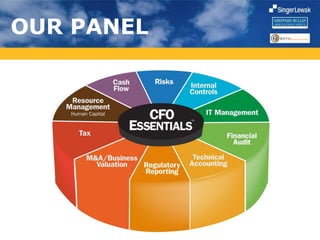
The CFO Essentials SingerLewak’s POVTM
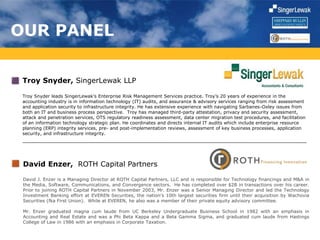
Troy Snyder - SingerLewak LLP
David Enzer – ROTH Capital Partners
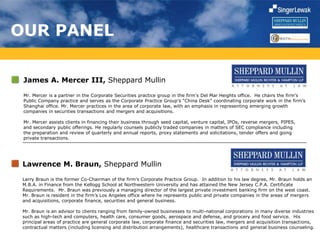
James A. Mercer III, Esq. – Sheppard Mullin
Lawrence M. Braun – Sheppard Mullin
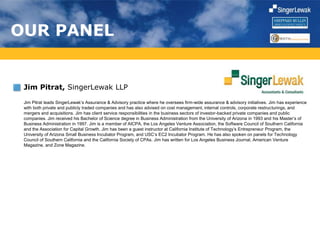
Jim Pitrat - SingerLewak LLP
OUR PANEL
Troy Snyder, SingerLewak LLP
Troy Snyder leads SingerLewak’s Enterprise Risk Management Services practice. Troy’s 20 years of experience in the
accounting industry is in information technology (IT) audits, and assurance & advisory services ranging from risk assessment
and application security to infrastructure integrity. He has extensive experience with navigating Sarbanes-Oxley issues from
both an IT and business process perspective. Troy has managed third-party attestation, privacy and security assessment,
attack and penetration services, OTS regulatory readiness assessment, data center migration test procedures, and facilitation
of an information technology strategic plan. He coordinates and directs internal IT audits which include enterprise resource
planning (ERP) integrity services, pre- and post-implementation reviews, assessment of key business processes, application
security, and infrastructure integrity.
David Enzer, ROTH Capital Partners
David J. Enzer is a Managing Director at ROTH Capital Partners, LLC and is responsible for Technology financings and M&A in
the Media, Software, Communications, and Convergence sectors. He has completed over $2B in transactions over his career.
Prior to joining ROTH Capital Partners in November 2003, Mr. Enzer was a Senior Managing Director and led the Technology
Investment Banking effort at EVEREN Securities, the nation’s 10th largest securities firm until their acquisition by Wachovia
Securities (fka First Union). While at EVEREN, he also was a member of their private equity advisory committee.
Mr. Enzer graduated magna cum laude from UC Berkeley Undergraduate Business School in 1982 with an emphasis in
Accounting and Real Estate and was a Phi Beta Kappa and a Beta Gamma Sigma, and graduated cum laude from Hastings
College of Law in 1986 with an emphasis in Corporate Taxation.
OUR PANEL
James A. Mercer III, Sheppard Mullin
Mr. Mercer is a partner in the Corporate Securities practice group in the firm's Del Mar Heights office. He chairs the firm’s
Public Company practice and serves as the Corporate Practice Group’s “China Desk” coordinating corporate work in the firm’s
Shanghai office. Mr. Mercer practices in the area of corporate law, with an emphasis in representing emerging growth
companies in securities transactions and mergers and acquisitions.
Mr. Mercer assists clients in financing their business through seed capital, venture capital, IPOs, reverse mergers, PIPES,
and secondary public offerings. He regularly counsels publicly traded companies in matters of SEC compliance including
the preparation and review of quarterly and annual reports, proxy statements and solicitations, tender offers and going
private transactions.
Lawrence M. Braun, Sheppard Mullin
Larry Braun is the former Co-Chairman of the firm’s Corporate Practice Group. In addition to his law degree, Mr. Braun holds an
M.B.A. in Finance from the Kellogg School at Northwestern University and has attained the New Jersey C.P.A. Certificate
Requirements. Mr. Braun was previously a managing director of the largest private investment banking firm on the west coast.
Mr. Braun is resident in the firm’s Los Angeles office where he represents public and private companies in the areas of mergers
and acquisitions, corporate finance, securities and general business.
Mr. Braun is an advisor to clients ranging from family-owned businesses to multi-national corporations in many diverse industries
such as high-tech and computers, health care, consumer goods, aerospace and defense, and grocery and food service. His
principal areas of practice are general corporate law, corporate finance and securities law, mergers and acquisition transactions,
contractual matters (including licensing and distribution arrangements), healthcare transactions and general business counseling.
OUR PANEL
Jim Pitrat, SingerLewak LLP
Jim Pitrat leads SingerLewak’s Assurance & Advisory practice where he oversees firm-wide assurance & advisory initiatives. Jim has experience
with both private and publicly traded companies and has also advised on cost management, internal controls, corporate restructurings, and
mergers and acquisitions. Jim has client service responsibilities in the business sectors of investor-backed private companies and public
companies. Jim received his Bachelor of Science degree in Business Administration from the University of Arizona in 1993 and his Master’s of
Business Administration in 1997. Jim is a member of AICPA, the Los Angeles Venture Association, the Software Council of Southern California
and the Association for Capital Growth. Jim has been a guest instructor at California Institute of Technology’s Entrepreneur Program, the
University of Arizona Small Business Incubator Program, and USC’s EC2 Incubator Program. He has also spoken on panels for Technology
Council of Southern California and the California Society of CPAs. Jim has written for Los Angeles Business Journal, American Venture
Magazine, and Zone Magazine.
OUR PANEL
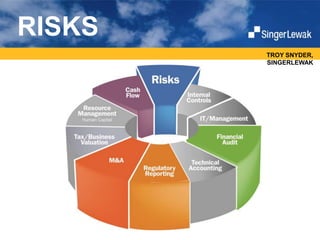
RISKS
TROY SNYDER,
SINGERLEWAK
RISKS
TROY SNYDER,
SINGERLEWAK
TOP 10 LIST OF
BUSINESS RISKS
#10: Executing Alliances and Transactions
#9: Social Acceptance Risk and Corporate
Social Responsibility
#8: Radical Greening
#7: Non-Traditional Entrants
#6: Cost Cutting
#10-6: RISKS TO BUSINESSES
TROY SNYDER,
SINGERLEWAK
RISKS
TROY SNYDER,
SINGERLEWAK
Emerging economies now dominate global growth
Strategic plans to acquire market share in
emerging markets
Risks with acquisitions remain high
Political risks to emerging markets could lead to
new trade barriers
Emerging economies can impact developed
economies as they grow
#5: EMERGING MARKETS
RISKS
TROY SNYDER,
SINGERLEWAK
Baby boomer’s looming retirement is a threat on the
talent pool for various skillsets
Skills in engineering sectors are not being replaced by
recent graduates
Banking institutions face loss of talent due to limited
compensation packages
Industries can partner with universities to train and
attract new talent
Firms can review retirement policy and encourage
experiences workers to stay on
Firms can create on the high quality internal training
programs for younger employees
# 4: MANAGING TALENT
RISKS
TROY SNYDER,
SINGERLEWAK
Fears of slow growth and a potential double dip after various
stimulus packages expire or are withdrawn
The economy is a major concern for all sectors especially
those directly that are billed as part of the financial crisis
Potential sovereign defaults have huge implications for the
economy
Concerns that a sovereign debt crisis could lead to another
round of downturn
Worries that bailout packages only postponed economy
problems
Lack of resources for stimulus packages if a double dip
recession returns
Fears leading to firms increasing cash reserves and
preserving liquid assets
# 3: SLOW RECOVERY – DOUBLE DIP RECESSION
RISKS
TROY SNYDER,
SINGERLEWAK
#2: ACCESS TO CREDIT
Access to credit is a long term risk
Lack of credit is leading to stunted growth
Increases in cost of obtaining credit cuts into potential earnings
Credit concerns leads to disruptions within the supply chain
Government backing is required for many companies to gain
access to credit
A withdraw of governmental support will lead to lack of credit
for multiple industries
Growth in national debt could lead to a second
credit crunch
RISKS
TROY SNYDER,
SINGERLEWAK
#1: REGULATION AND COMPLIANCE
Regulation and compliance risk affects all business sectors and
industries
Firm’s uncertainty of potential new regulatory actions can limit potential
growth and expansion
National regulations designed for protectionism can prevent
international firms from operating effectively over international borders
Potential uncoordinated and conflicting new regulations
Industry insiders worry over regulation will destroy shareholder value
Firms needs to rebuild the trust of governments and regulators that
their activities do not post a systemic risk to the national economy
BE PROACTIVE: PLAN AHEAD AND PREPARE
FOR NEW REGULATIONS
RISKS
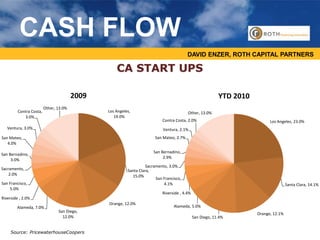
DAVID ENZER, ROTH CAPITAL PARTNERS
CASH FLOW
Los Angeles,
19.0%
Santa Clara,
15.0%
Orange, 12.0%
San Diego,
12.0%
Alameda, 7.0%
Riverside , 2.0%
San Francisco,
5.0%
Sacramento,
2.0%
San Bernadino,
3.0%
San Mateo,
4.0%
Ventura, 3.0%
Contra Costa,
3.0%
Other, 13.0%
2009
Los Angeles, 23.0%
Santa Clara, 14.1%
Orange, 12.1%
San Diego, 11.4%
Alameda, 5.0%
Riverside , 4.4%
San Francisco,
4.1%
Sacramento, 3.0%
San Bernadino,
2.9%
San Mateo, 2.7%
Ventura, 2.1%
Contra Costa, 2.0%
Other, 13.0%
YTD 2010
CA START UPS
Source: PricewaterhouseCoopers
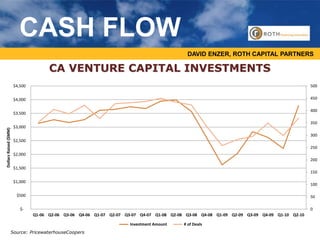
CA VENTURE CAPITAL INVESTMENTS
Source: PricewaterhouseCoopers
DAVID ENZER, ROTH CAPITAL PARTNERS
CASH FLOW
0
50
100
150
200
250
300
350
400
450
500
$-
$500
$1,000
$1,500
$2,000
$2,500
$3,000
$3,500
$4,000
$4,500
Q1-06 Q2-06 Q3-06 Q4-06 Q1-07 Q2-07 Q3-07 Q4-07 Q1-08 Q2-08 Q3-08 Q4-08 Q1-09 Q2-09 Q3-09 Q4-09 Q1-10 Q2-10
DollarsRaised($MM)
Investment Amount # of Deals
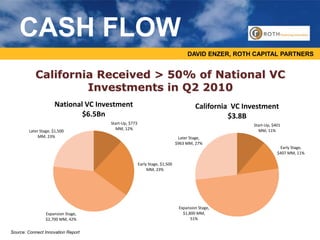
Start-Up, $401
MM, 11%
Early Stage,
$407 MM, 11%
Expansion Stage,
$1,800 MM,
51%
Later Stage,
$963 MM, 27%
California VC Investment
$3.8B
California Received > 50% of National VC
Investments in Q2 2010
Source: Connect Innovation Report
DAVID ENZER, ROTH CAPITAL PARTNERS
CASH FLOW
Start-Up, $773
MM, 12%
Early Stage, $1,500
MM, 23%
Expansion Stage,
$2,700 MM, 42%
Later Stage, $1,500
MM, 23%
National VC Investment
$6.5Bn
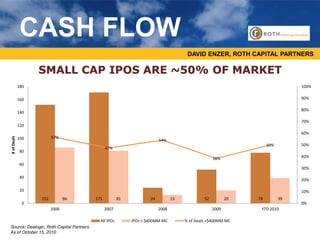
SMALL CAP IPOS ARE ~50% OF MARKET
Source: Dealogic, Roth Capital Partners
As of October 15, 2010
DAVID ENZER, ROTH CAPITAL PARTNERS
CASH FLOW
152 171 24 52 7886 81 13 20 39
57%
47%
54%
38%
50%
0%
10%
20%
30%
40%
50%
60%
70%
80%
90%
100%
0
20
40
60
80
100
120
140
160
180
2006 2007 2008 2009 YTD 2010
#ofDeals
All IPOs IPOs < $400MM MC % of Deals <$400MM MC
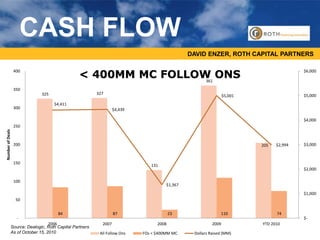
< 400MM MC FOLLOW ONS
DAVID ENZER, ROTH CAPITAL PARTNERS
CASH FLOW
Source: Dealogic, Roth Capital Partners
As of October 15, 2010
325 327
131
361
205
84 87 23 110 74
$4,411
$4,439
$1,367
$5,001
$2,994
$-
$1,000
$2,000
$3,000
$4,000
$5,000
$6,000
-
50
100
150
200
250
300
350
400
2006 2007 2008 2009 YTD 2010
NumberofDeals
All Follow Ons FOs < $400MM MC Dollars Raised (MM)
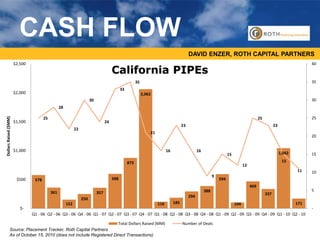
Source: Placement Tracker, Roth Capital Partners
As of October 15, 2010 (does not include Registered Direct Transactions)
DAVID ENZER, ROTH CAPITAL PARTNERS
CASH FLOW
California PIPEs
578
361
152
250
357
598
873
2,062
116 185
294
388
594
104
469
337
1,042
171
25
28
22
30
24
33
35
21
16
23
16
9
15
12
25
23
15
11
-
5
10
15
20
25
30
35
40
$-
$500
$1,000
$1,500
$2,000
$2,500
Q1 - 06 Q2 - 06 Q3 - 06 Q4 - 06 Q1 - 07 Q2 - 07 Q3 - 07 Q4 - 07 Q1 - 08 Q2 - 08 Q3 - 08 Q4 - 08 Q1 - 09 Q2 - 09 Q3 - 09 Q4 - 09 Q1 - 10 Q2 - 10
DollarsRaised($MM)
Total Dollars Raised (MM) Number of Deals
JAMIE MERCER, SHEPPARD MULLIN
CASH FLOW
TRENDS IN THE PIPE
MARKET
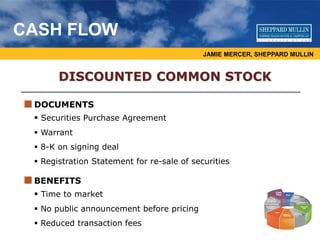
DOCUMENTS
ď‚§ Securities Purchase Agreement
ď‚§ Warrant
ď‚§ 8-K on signing deal
ď‚§ Registration Statement for re-sale of securities
BENEFITS
ď‚§ Time to market
ď‚§ No public announcement before pricing
ď‚§ Reduced transaction fees
JAMIE MERCER, SHEPPARD MULLIN
CASH FLOW
DISCOUNTED COMMON STOCK
DOCUMENTS
ď‚§ Equity Line Agreement
ď‚§ 8-K on signing deal
ď‚§ Registration Statement for sale of securities to agent
TERMS
ď‚§ Draw request and settle 5 days later
ď‚§ Priced at discount to market
CHAINSAW EFFECT
ď‚§ Provided equity financing
ď‚§ Death Spiral
JAMIE MERCER, SHEPPARD MULLIN
CASH FLOW
EQUITY LINE OF CREDIT
DOCUMENTS
ď‚§ Securities Purchase Agreement
ď‚§ Debenture and Warrants
ď‚§ 8-K on signing deal
TERMS
ď‚§ Interest payable in cash or stock
ď‚§ Stock payments priced at discount to market
ď‚§ Huge penalties for default
UNDERWRITING/LIQUIDITY
ď‚§ Provides issuer with capital upfront
ď‚§ Investors relied on conversion/liquidity for protection
JAMIE MERCER, SHEPPARD MULLIN
CASH FLOW
CONVERTIBLE DEBENTURE
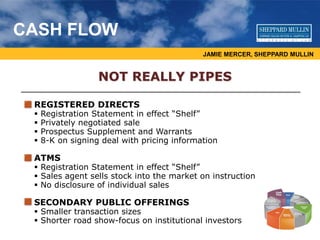
REGISTERED DIRECTS
 Registration Statement in effect “Shelf”
ď‚§ Privately negotiated sale
ď‚§ Prospectus Supplement and Warrants
ď‚§ 8-K on signing deal with pricing information
ATMS
 Registration Statement in effect “Shelf”
ď‚§ Sales agent sells stock into the market on instruction
ď‚§ No disclosure of individual sales
SECONDARY PUBLIC OFFERINGS
ď‚§ Smaller transaction sizes
ď‚§ Shorter road show-focus on institutional investors
JAMIE MERCER, SHEPPARD MULLIN
CASH FLOW
NOT REALLY PIPES
JAMIE MERCER, SHEPPARD MULLIN
REGULATORY REPORTING
SEC REGULATORY
DEVELOPMENTS FOR 2011
JAMIE MERCER, SHEPPARD MULLIN
REGULATORY REPORTING
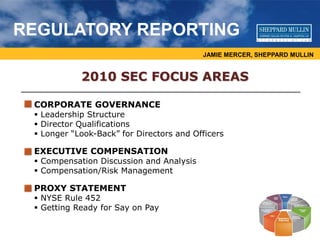
2010 SEC FOCUS AREAS
CORPORATE GOVERNANCE
ď‚§ Leadership Structure
ď‚§ Director Qualifications
 Longer “Look-Back” for Directors and Officers
EXECUTIVE COMPENSATION
ď‚§ Compensation Discussion and Analysis
ď‚§ Compensation/Risk Management
PROXY STATEMENT
ď‚§ NYSE Rule 452
ď‚§ Getting Ready for Say on Pay
JAMIE MERCER, SHEPPARD MULLIN
REGULATORY REPORTING
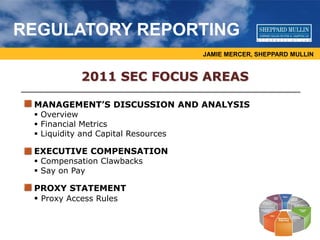
2011 SEC FOCUS AREAS
MANAGEMENT’S DISCUSSION AND ANALYSIS
ď‚§ Overview
ď‚§ Financial Metrics
ď‚§ Liquidity and Capital Resources
EXECUTIVE COMPENSATION
ď‚§ Compensation Clawbacks
ď‚§ Say on Pay
PROXY STATEMENT
ď‚§ Proxy Access Rules
LAWRENCE M. BRAUN, SHEPPARD MULLIN
ARE DEALS GETTING
DONE?
M&A
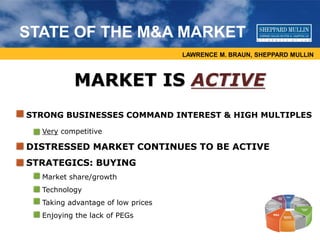
MARKET IS ACTIVE
STRONG BUSINESSES COMMAND INTEREST & HIGH MULTIPLES
Very competitive
DISTRESSED MARKET CONTINUES TO BE ACTIVE
STRATEGICS: BUYING
Market share/growth
Technology
Taking advantage of low prices
Enjoying the lack of PEGs
LAWRENCE M. BRAUN, SHEPPARD MULLIN
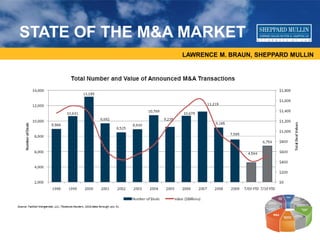
STATE OF THE M&A MARKET
MARKET IS ACTIVE (cont’d)
CROSS BORDER TRANSACTIONS
Up 109%
PEGS ARE PLAYING CATCH-UP
Selling poor performing portfolio companies
Selling “old” portfolio companies
Back in the market
Lots of dry powder
Lenders support quality credits
SELLERS
Tired
Taking advantage of low cap gains rates
LAWRENCE M. BRAUN, SHEPPARD MULLIN
STATE OF THE M&A MARKET
LAWRENCE M. BRAUN, SHEPPARD MULLIN
STATE OF THE M&A MARKET
LAWRENCE M. BRAUN, SHEPPARD MULLIN
STATE OF THE M&A MARKET
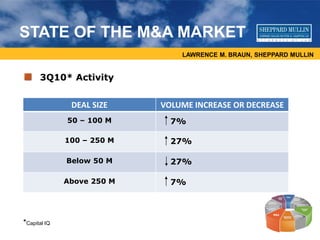
3Q10* Activity
DEAL SIZE VOLUME INCREASE OR DECREASE
50 – 100 M 7%
100 – 250 M 27%
Below 50 M 27%
Above 250 M 7%
*Capital IQ
LAWRENCE M. BRAUN, SHEPPARD MULLIN
STATE OF THE M&A MARKET
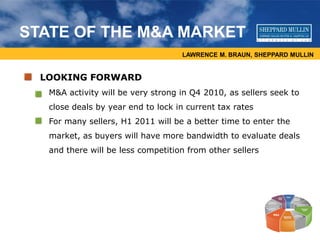
LOOKING FORWARD
• M&A activity will be very strong in Q4 2010, as sellers seek to
close deals by year end to lock in current tax rates
• For many sellers, H1 2011 will be a better time to enter the
market, as buyers will have more bandwidth to evaluate deals
and there will be less competition from other sellers
LAWRENCE M. BRAUN, SHEPPARD MULLIN
STATE OF THE M&A MARKET
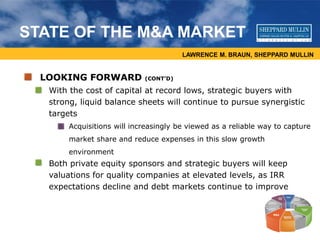
LOOKING FORWARD (CONT’D)
• With the cost of capital at record lows, strategic buyers with
strong, liquid balance sheets will continue to pursue synergistic
targets
• Acquisitions will increasingly be viewed as a reliable way to capture
market share and reduce expenses in this slow growth
environment
• Both private equity sponsors and strategic buyers will keep
valuations for quality companies at elevated levels, as IRR
expectations decline and debt markets continue to improve
LAWRENCE M. BRAUN, SHEPPARD MULLIN
STATE OF THE M&A MARKET
LAWRENCE M. BRAUN, SHEPPARD MULLIN
STATE OF THE M&A MARKET
LAWRENCE M. BRAUN, SHEPPARD MULLIN
STATE OF THE M&A MARKET
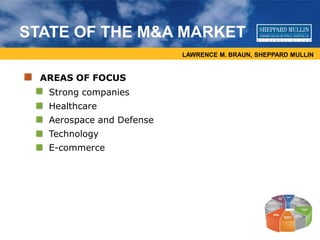
AREAS OF FOCUS
• Strong companies
• Healthcare
• Aerospace and Defense
• Technology
• E-commerce
LAWRENCE M. BRAUN, SHEPPARD MULLIN
WHAT SHOULD YOU
DO?
LAWRENCE M. BRAUN, SHEPPARD MULLIN
M&A
PREPARE, PREPARE, PREPARE
• Consider acquisitions of product lines, technology or
businesses that strengthen your business
• “Diligence Yourself”
• Be honest
• Credibility is key
• Common issues
• IP ownership
• Employee issues
• Audit issues
LAWRENCE M. BRAUN, SHEPPARD MULLIN
M&A
PREPARE, PREPARE, PREPARE (CONT’D)
• Motivate Management
• Consider a myriad of tax deferral techniques
• Confidentiality
LAWRENCE M. BRAUN, SHEPPARD MULLIN
M&A
ACCOUNTING RULE IMPACTING STRUCTURE
• Seller participation – Earnouts
• FAS 141(R)
JIM PITRAT, SINGERLEWAK
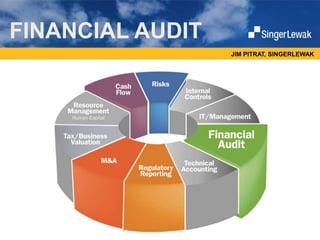
FINANCIAL AUDIT
JIM PITRAT, SINGERLEWAK
FINANCIAL ACCOUNTING AND
REPORTING UPDATE
NEW FOR 2010
RECURRING THEMES
ONLY A MATTER OF TIME
FINANCIAL AUDIT
JIM PITRAT, SINGERLEWAK
NEW VIE MODEL IN EFFECT
ď‚§ All prior analysis (FIN 46) should be revisited
ď‚§ Less Quantitative Analysis
ď‚§ More Qualitative
ď‚§ More should qualify for consolidation
ď‚§ Primary beneficiary and loss absorption concept drives accounting
ď‚§ Who benefits and who is obligated to absorb losses?
FINANCIAL AUDIT
NEW FOR 2010
JIM PITRAT, SINGERLEWAK
THE SEC ISSUED REVISED GUIDANCE ON
NON-GAAP DISCLOSURES
ď‚§ Improve consistency
ď‚§ Clarifies certain prior guidance viewed as constraining
FINANCIAL AUDIT
NEW FOR 2010
JIM PITRAT, SINGERLEWAK
THE SEC ISSUED REVISED GUIDANCE ON
LIQUIDITY DISCLOSURES IN MD&A
ď‚§ Improve liquidity and contingency reporting
 If financials don’t adequately demonstrate liquidity risk, MD&A
should
ď‚§Risk management policy disclosures may be required.
FINANCIAL AUDIT
NEW FOR 2010
JIM PITRAT, SINGERLEWAK
NEW FOR 2010
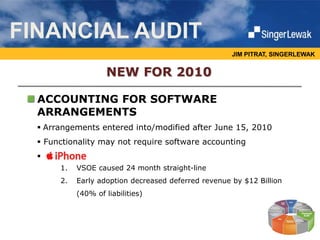
ACCOUNTING FOR SOFTWARE
ARRANGEMENTS
FINANCIAL AUDIT
ď‚§ Arrangements entered into/modified after June 15, 2010
ď‚§ Functionality may not require software accounting
ď‚§
1. VSOE caused 24 month straight-line
2. Early adoption decreased deferred revenue by $12 Billion
(40% of liabilities)
JIM PITRAT, SINGERLEWAK
NEW FOR 2010
MULTIPLE ELEMENT ARRANGEMENTS
FINANCIAL AUDIT
ď‚§ Creates the concept of Estimated Selling Price
1. VSOE
2. Third party evidence
3. Estimate
ď‚§ Revenue allocated on relative selling prices
ď‚§ No residual method
JIM PITRAT, SINGERLEWAK
RECURRING THEMES
BUSINESS COMBINATIONS
FINANCIAL AUDIT
 More “asset” acquisitions qualify as businesses
 Valuing contingencies – earnouts, commitments, minority
interest
ď‚§ Distressed acquisitions still problematic
ď‚§ Research and development costs
JIM PITRAT, SINGERLEWAK
FAIR VALUE
FINANCIAL AUDIT
ď‚§ Complex Instruments may require more disclosure
ď‚§ Determining losses (credit/non credit)
ď‚§ Income Statement vs. Balance Sheet
ď‚§ Other Than Temporary
 Liability – Non-Performance Risk Assessment
ď‚§ Quarterly Fair Value Disclosure
RECURRING THEMES
JIM PITRAT, SINGERLEWAK
ONLY A MATTER OF TIME
IFRS
FINANCIAL AUDIT
ď‚§ SEC intends to begin providing work-plan updates in October 2010
ď‚§ Convergence agenda anticipated in 2011
ď‚§ Conversions not before 2015 or 2016
JIM PITRAT, SINGERLEWAK
FASB/ IASB JOINT PROJECTS
FINANCIAL AUDIT
 Leases – Leases on the Balance Sheet
ď‚§ Right to use asset
ď‚§ Lease obligation
ď‚§ Revenue
ď‚§ Performance Obligation concept
ď‚§ Control transfer results in revenue
ď‚§ Warranties and Percentage Complete impacted
ONLY A MATTER OF TIME
JIM PITRAT, SINGERLEWAK
ONLY A MATTER OF TIME
PCAOB
FINANCIAL AUDIT
ď‚§ Focus on audits of foreign issuers and foreign subsidiaries and
use of foreign auditors
ď‚§ Proposed changes to audit risk assessment standard
ď‚§ Proposed changes to required auditor/audit committee
Communications
www.SheppardMullin.com www.Roth.com
310.445.5868
www.SingerLewak.com
877.754.4557
CONTACT US

CFO Essentials Workshop - Los Angeles

  • 1.
    © 2010 SingerLewak.All rights reserved.
  • 2.
    WELCOME Opening Remarks Today’s WorkshopFormat Introducing our Distinguished Panelists: The CFO Essentials SingerLewak’s POVTM Troy Snyder - SingerLewak LLP David Enzer – ROTH Capital Partners James A. Mercer III, Esq. – Sheppard Mullin Lawrence M. Braun – Sheppard Mullin Jim Pitrat - SingerLewak LLP
  • 3.
    OUR PANEL Troy Snyder,SingerLewak LLP Troy Snyder leads SingerLewak’s Enterprise Risk Management Services practice. Troy’s 20 years of experience in the accounting industry is in information technology (IT) audits, and assurance & advisory services ranging from risk assessment and application security to infrastructure integrity. He has extensive experience with navigating Sarbanes-Oxley issues from both an IT and business process perspective. Troy has managed third-party attestation, privacy and security assessment, attack and penetration services, OTS regulatory readiness assessment, data center migration test procedures, and facilitation of an information technology strategic plan. He coordinates and directs internal IT audits which include enterprise resource planning (ERP) integrity services, pre- and post-implementation reviews, assessment of key business processes, application security, and infrastructure integrity. David Enzer, ROTH Capital Partners David J. Enzer is a Managing Director at ROTH Capital Partners, LLC and is responsible for Technology financings and M&A in the Media, Software, Communications, and Convergence sectors. He has completed over $2B in transactions over his career. Prior to joining ROTH Capital Partners in November 2003, Mr. Enzer was a Senior Managing Director and led the Technology Investment Banking effort at EVEREN Securities, the nation’s 10th largest securities firm until their acquisition by Wachovia Securities (fka First Union). While at EVEREN, he also was a member of their private equity advisory committee. Mr. Enzer graduated magna cum laude from UC Berkeley Undergraduate Business School in 1982 with an emphasis in Accounting and Real Estate and was a Phi Beta Kappa and a Beta Gamma Sigma, and graduated cum laude from Hastings College of Law in 1986 with an emphasis in Corporate Taxation.
  • 4.
    OUR PANEL James A.Mercer III, Sheppard Mullin Mr. Mercer is a partner in the Corporate Securities practice group in the firm's Del Mar Heights office. He chairs the firm’s Public Company practice and serves as the Corporate Practice Group’s “China Desk” coordinating corporate work in the firm’s Shanghai office. Mr. Mercer practices in the area of corporate law, with an emphasis in representing emerging growth companies in securities transactions and mergers and acquisitions. Mr. Mercer assists clients in financing their business through seed capital, venture capital, IPOs, reverse mergers, PIPES, and secondary public offerings. He regularly counsels publicly traded companies in matters of SEC compliance including the preparation and review of quarterly and annual reports, proxy statements and solicitations, tender offers and going private transactions. Lawrence M. Braun, Sheppard Mullin Larry Braun is the former Co-Chairman of the firm’s Corporate Practice Group. In addition to his law degree, Mr. Braun holds an M.B.A. in Finance from the Kellogg School at Northwestern University and has attained the New Jersey C.P.A. Certificate Requirements. Mr. Braun was previously a managing director of the largest private investment banking firm on the west coast. Mr. Braun is resident in the firm’s Los Angeles office where he represents public and private companies in the areas of mergers and acquisitions, corporate finance, securities and general business. Mr. Braun is an advisor to clients ranging from family-owned businesses to multi-national corporations in many diverse industries such as high-tech and computers, health care, consumer goods, aerospace and defense, and grocery and food service. His principal areas of practice are general corporate law, corporate finance and securities law, mergers and acquisition transactions, contractual matters (including licensing and distribution arrangements), healthcare transactions and general business counseling.
  • 5.
    OUR PANEL Jim Pitrat,SingerLewak LLP Jim Pitrat leads SingerLewak’s Assurance & Advisory practice where he oversees firm-wide assurance & advisory initiatives. Jim has experience with both private and publicly traded companies and has also advised on cost management, internal controls, corporate restructurings, and mergers and acquisitions. Jim has client service responsibilities in the business sectors of investor-backed private companies and public companies. Jim received his Bachelor of Science degree in Business Administration from the University of Arizona in 1993 and his Master’s of Business Administration in 1997. Jim is a member of AICPA, the Los Angeles Venture Association, the Software Council of Southern California and the Association for Capital Growth. Jim has been a guest instructor at California Institute of Technology’s Entrepreneur Program, the University of Arizona Small Business Incubator Program, and USC’s EC2 Incubator Program. He has also spoken on panels for Technology Council of Southern California and the California Society of CPAs. Jim has written for Los Angeles Business Journal, American Venture Magazine, and Zone Magazine.
  • 6.
  • 7.
  • 8.
  • 9.
    #10: Executing Alliancesand Transactions #9: Social Acceptance Risk and Corporate Social Responsibility #8: Radical Greening #7: Non-Traditional Entrants #6: Cost Cutting #10-6: RISKS TO BUSINESSES TROY SNYDER, SINGERLEWAK RISKS
  • 10.
    TROY SNYDER, SINGERLEWAK Emerging economiesnow dominate global growth Strategic plans to acquire market share in emerging markets Risks with acquisitions remain high Political risks to emerging markets could lead to new trade barriers Emerging economies can impact developed economies as they grow #5: EMERGING MARKETS RISKS
  • 11.
    TROY SNYDER, SINGERLEWAK Baby boomer’slooming retirement is a threat on the talent pool for various skillsets Skills in engineering sectors are not being replaced by recent graduates Banking institutions face loss of talent due to limited compensation packages Industries can partner with universities to train and attract new talent Firms can review retirement policy and encourage experiences workers to stay on Firms can create on the high quality internal training programs for younger employees # 4: MANAGING TALENT RISKS
  • 12.
    TROY SNYDER, SINGERLEWAK Fears ofslow growth and a potential double dip after various stimulus packages expire or are withdrawn The economy is a major concern for all sectors especially those directly that are billed as part of the financial crisis Potential sovereign defaults have huge implications for the economy Concerns that a sovereign debt crisis could lead to another round of downturn Worries that bailout packages only postponed economy problems Lack of resources for stimulus packages if a double dip recession returns Fears leading to firms increasing cash reserves and preserving liquid assets # 3: SLOW RECOVERY – DOUBLE DIP RECESSION RISKS
  • 13.
    TROY SNYDER, SINGERLEWAK #2: ACCESSTO CREDIT Access to credit is a long term risk Lack of credit is leading to stunted growth Increases in cost of obtaining credit cuts into potential earnings Credit concerns leads to disruptions within the supply chain Government backing is required for many companies to gain access to credit A withdraw of governmental support will lead to lack of credit for multiple industries Growth in national debt could lead to a second credit crunch RISKS
  • 14.
    TROY SNYDER, SINGERLEWAK #1: REGULATIONAND COMPLIANCE Regulation and compliance risk affects all business sectors and industries Firm’s uncertainty of potential new regulatory actions can limit potential growth and expansion National regulations designed for protectionism can prevent international firms from operating effectively over international borders Potential uncoordinated and conflicting new regulations Industry insiders worry over regulation will destroy shareholder value Firms needs to rebuild the trust of governments and regulators that their activities do not post a systemic risk to the national economy BE PROACTIVE: PLAN AHEAD AND PREPARE FOR NEW REGULATIONS RISKS
  • 15.
    DAVID ENZER, ROTHCAPITAL PARTNERS
  • 16.
    DAVID ENZER, ROTHCAPITAL PARTNERS CASH FLOW Los Angeles, 19.0% Santa Clara, 15.0% Orange, 12.0% San Diego, 12.0% Alameda, 7.0% Riverside , 2.0% San Francisco, 5.0% Sacramento, 2.0% San Bernadino, 3.0% San Mateo, 4.0% Ventura, 3.0% Contra Costa, 3.0% Other, 13.0% 2009 Los Angeles, 23.0% Santa Clara, 14.1% Orange, 12.1% San Diego, 11.4% Alameda, 5.0% Riverside , 4.4% San Francisco, 4.1% Sacramento, 3.0% San Bernadino, 2.9% San Mateo, 2.7% Ventura, 2.1% Contra Costa, 2.0% Other, 13.0% YTD 2010 CA START UPS Source: PricewaterhouseCoopers
  • 17.
    CA VENTURE CAPITALINVESTMENTS Source: PricewaterhouseCoopers DAVID ENZER, ROTH CAPITAL PARTNERS CASH FLOW 0 50 100 150 200 250 300 350 400 450 500 $- $500 $1,000 $1,500 $2,000 $2,500 $3,000 $3,500 $4,000 $4,500 Q1-06 Q2-06 Q3-06 Q4-06 Q1-07 Q2-07 Q3-07 Q4-07 Q1-08 Q2-08 Q3-08 Q4-08 Q1-09 Q2-09 Q3-09 Q4-09 Q1-10 Q2-10 DollarsRaised($MM) Investment Amount # of Deals
  • 18.
    Start-Up, $401 MM, 11% EarlyStage, $407 MM, 11% Expansion Stage, $1,800 MM, 51% Later Stage, $963 MM, 27% California VC Investment $3.8B California Received > 50% of National VC Investments in Q2 2010 Source: Connect Innovation Report DAVID ENZER, ROTH CAPITAL PARTNERS CASH FLOW Start-Up, $773 MM, 12% Early Stage, $1,500 MM, 23% Expansion Stage, $2,700 MM, 42% Later Stage, $1,500 MM, 23% National VC Investment $6.5Bn
  • 19.
    SMALL CAP IPOSARE ~50% OF MARKET Source: Dealogic, Roth Capital Partners As of October 15, 2010 DAVID ENZER, ROTH CAPITAL PARTNERS CASH FLOW 152 171 24 52 7886 81 13 20 39 57% 47% 54% 38% 50% 0% 10% 20% 30% 40% 50% 60% 70% 80% 90% 100% 0 20 40 60 80 100 120 140 160 180 2006 2007 2008 2009 YTD 2010 #ofDeals All IPOs IPOs < $400MM MC % of Deals <$400MM MC
  • 20.
    < 400MM MCFOLLOW ONS DAVID ENZER, ROTH CAPITAL PARTNERS CASH FLOW Source: Dealogic, Roth Capital Partners As of October 15, 2010 325 327 131 361 205 84 87 23 110 74 $4,411 $4,439 $1,367 $5,001 $2,994 $- $1,000 $2,000 $3,000 $4,000 $5,000 $6,000 - 50 100 150 200 250 300 350 400 2006 2007 2008 2009 YTD 2010 NumberofDeals All Follow Ons FOs < $400MM MC Dollars Raised (MM)
  • 21.
    Source: Placement Tracker,Roth Capital Partners As of October 15, 2010 (does not include Registered Direct Transactions) DAVID ENZER, ROTH CAPITAL PARTNERS CASH FLOW California PIPEs 578 361 152 250 357 598 873 2,062 116 185 294 388 594 104 469 337 1,042 171 25 28 22 30 24 33 35 21 16 23 16 9 15 12 25 23 15 11 - 5 10 15 20 25 30 35 40 $- $500 $1,000 $1,500 $2,000 $2,500 Q1 - 06 Q2 - 06 Q3 - 06 Q4 - 06 Q1 - 07 Q2 - 07 Q3 - 07 Q4 - 07 Q1 - 08 Q2 - 08 Q3 - 08 Q4 - 08 Q1 - 09 Q2 - 09 Q3 - 09 Q4 - 09 Q1 - 10 Q2 - 10 DollarsRaised($MM) Total Dollars Raised (MM) Number of Deals
  • 22.
  • 23.
    JAMIE MERCER, SHEPPARDMULLIN CASH FLOW TRENDS IN THE PIPE MARKET
  • 24.
    DOCUMENTS ď‚§ Securities PurchaseAgreement ď‚§ Warrant ď‚§ 8-K on signing deal ď‚§ Registration Statement for re-sale of securities BENEFITS ď‚§ Time to market ď‚§ No public announcement before pricing ď‚§ Reduced transaction fees JAMIE MERCER, SHEPPARD MULLIN CASH FLOW DISCOUNTED COMMON STOCK
  • 25.
    DOCUMENTS ď‚§ Equity LineAgreement ď‚§ 8-K on signing deal ď‚§ Registration Statement for sale of securities to agent TERMS ď‚§ Draw request and settle 5 days later ď‚§ Priced at discount to market CHAINSAW EFFECT ď‚§ Provided equity financing ď‚§ Death Spiral JAMIE MERCER, SHEPPARD MULLIN CASH FLOW EQUITY LINE OF CREDIT
  • 26.
    DOCUMENTS ď‚§ Securities PurchaseAgreement ď‚§ Debenture and Warrants ď‚§ 8-K on signing deal TERMS ď‚§ Interest payable in cash or stock ď‚§ Stock payments priced at discount to market ď‚§ Huge penalties for default UNDERWRITING/LIQUIDITY ď‚§ Provides issuer with capital upfront ď‚§ Investors relied on conversion/liquidity for protection JAMIE MERCER, SHEPPARD MULLIN CASH FLOW CONVERTIBLE DEBENTURE
  • 27.
    REGISTERED DIRECTS  RegistrationStatement in effect “Shelf”  Privately negotiated sale  Prospectus Supplement and Warrants  8-K on signing deal with pricing information ATMS  Registration Statement in effect “Shelf”  Sales agent sells stock into the market on instruction  No disclosure of individual sales SECONDARY PUBLIC OFFERINGS  Smaller transaction sizes  Shorter road show-focus on institutional investors JAMIE MERCER, SHEPPARD MULLIN CASH FLOW NOT REALLY PIPES
  • 28.
  • 29.
    JAMIE MERCER, SHEPPARDMULLIN REGULATORY REPORTING SEC REGULATORY DEVELOPMENTS FOR 2011
  • 30.
    JAMIE MERCER, SHEPPARDMULLIN REGULATORY REPORTING 2010 SEC FOCUS AREAS CORPORATE GOVERNANCE  Leadership Structure  Director Qualifications  Longer “Look-Back” for Directors and Officers EXECUTIVE COMPENSATION  Compensation Discussion and Analysis  Compensation/Risk Management PROXY STATEMENT  NYSE Rule 452  Getting Ready for Say on Pay
  • 31.
    JAMIE MERCER, SHEPPARDMULLIN REGULATORY REPORTING 2011 SEC FOCUS AREAS MANAGEMENT’S DISCUSSION AND ANALYSIS  Overview  Financial Metrics  Liquidity and Capital Resources EXECUTIVE COMPENSATION  Compensation Clawbacks  Say on Pay PROXY STATEMENT  Proxy Access Rules
  • 32.
    LAWRENCE M. BRAUN,SHEPPARD MULLIN
  • 33.
    LAWRENCE M. BRAUN,SHEPPARD MULLIN ARE DEALS GETTING DONE? M&A
  • 34.
    MARKET IS ACTIVE STRONGBUSINESSES COMMAND INTEREST & HIGH MULTIPLES Very competitive DISTRESSED MARKET CONTINUES TO BE ACTIVE STRATEGICS: BUYING Market share/growth Technology Taking advantage of low prices Enjoying the lack of PEGs LAWRENCE M. BRAUN, SHEPPARD MULLIN STATE OF THE M&A MARKET
  • 35.
    MARKET IS ACTIVE(cont’d) CROSS BORDER TRANSACTIONS Up 109% PEGS ARE PLAYING CATCH-UP Selling poor performing portfolio companies Selling “old” portfolio companies Back in the market Lots of dry powder Lenders support quality credits SELLERS Tired Taking advantage of low cap gains rates LAWRENCE M. BRAUN, SHEPPARD MULLIN STATE OF THE M&A MARKET
  • 36.
    LAWRENCE M. BRAUN,SHEPPARD MULLIN STATE OF THE M&A MARKET
  • 37.
    LAWRENCE M. BRAUN,SHEPPARD MULLIN STATE OF THE M&A MARKET 3Q10* Activity DEAL SIZE VOLUME INCREASE OR DECREASE 50 – 100 M 7% 100 – 250 M 27% Below 50 M 27% Above 250 M 7% *Capital IQ
  • 38.
    LAWRENCE M. BRAUN,SHEPPARD MULLIN STATE OF THE M&A MARKET LOOKING FORWARD • M&A activity will be very strong in Q4 2010, as sellers seek to close deals by year end to lock in current tax rates • For many sellers, H1 2011 will be a better time to enter the market, as buyers will have more bandwidth to evaluate deals and there will be less competition from other sellers
  • 39.
    LAWRENCE M. BRAUN,SHEPPARD MULLIN STATE OF THE M&A MARKET LOOKING FORWARD (CONT’D) • With the cost of capital at record lows, strategic buyers with strong, liquid balance sheets will continue to pursue synergistic targets • Acquisitions will increasingly be viewed as a reliable way to capture market share and reduce expenses in this slow growth environment • Both private equity sponsors and strategic buyers will keep valuations for quality companies at elevated levels, as IRR expectations decline and debt markets continue to improve
  • 40.
    LAWRENCE M. BRAUN,SHEPPARD MULLIN STATE OF THE M&A MARKET
  • 41.
    LAWRENCE M. BRAUN,SHEPPARD MULLIN STATE OF THE M&A MARKET
  • 42.
    LAWRENCE M. BRAUN,SHEPPARD MULLIN STATE OF THE M&A MARKET AREAS OF FOCUS • Strong companies • Healthcare • Aerospace and Defense • Technology • E-commerce
  • 43.
    LAWRENCE M. BRAUN,SHEPPARD MULLIN WHAT SHOULD YOU DO?
  • 44.
    LAWRENCE M. BRAUN,SHEPPARD MULLIN M&A PREPARE, PREPARE, PREPARE • Consider acquisitions of product lines, technology or businesses that strengthen your business • “Diligence Yourself” • Be honest • Credibility is key • Common issues • IP ownership • Employee issues • Audit issues
  • 45.
    LAWRENCE M. BRAUN,SHEPPARD MULLIN M&A PREPARE, PREPARE, PREPARE (CONT’D) • Motivate Management • Consider a myriad of tax deferral techniques • Confidentiality
  • 46.
    LAWRENCE M. BRAUN,SHEPPARD MULLIN M&A ACCOUNTING RULE IMPACTING STRUCTURE • Seller participation – Earnouts • FAS 141(R)
  • 47.
  • 48.
    JIM PITRAT, SINGERLEWAK FINANCIALACCOUNTING AND REPORTING UPDATE NEW FOR 2010 RECURRING THEMES ONLY A MATTER OF TIME FINANCIAL AUDIT
  • 49.
    JIM PITRAT, SINGERLEWAK NEWVIE MODEL IN EFFECT ď‚§ All prior analysis (FIN 46) should be revisited ď‚§ Less Quantitative Analysis ď‚§ More Qualitative ď‚§ More should qualify for consolidation ď‚§ Primary beneficiary and loss absorption concept drives accounting ď‚§ Who benefits and who is obligated to absorb losses? FINANCIAL AUDIT NEW FOR 2010
  • 50.
    JIM PITRAT, SINGERLEWAK THESEC ISSUED REVISED GUIDANCE ON NON-GAAP DISCLOSURES ď‚§ Improve consistency ď‚§ Clarifies certain prior guidance viewed as constraining FINANCIAL AUDIT NEW FOR 2010
  • 51.
    JIM PITRAT, SINGERLEWAK THESEC ISSUED REVISED GUIDANCE ON LIQUIDITY DISCLOSURES IN MD&A  Improve liquidity and contingency reporting  If financials don’t adequately demonstrate liquidity risk, MD&A should Risk management policy disclosures may be required. FINANCIAL AUDIT NEW FOR 2010
  • 52.
    JIM PITRAT, SINGERLEWAK NEWFOR 2010 ACCOUNTING FOR SOFTWARE ARRANGEMENTS FINANCIAL AUDIT ď‚§ Arrangements entered into/modified after June 15, 2010 ď‚§ Functionality may not require software accounting ď‚§ 1. VSOE caused 24 month straight-line 2. Early adoption decreased deferred revenue by $12 Billion (40% of liabilities)
  • 53.
    JIM PITRAT, SINGERLEWAK NEWFOR 2010 MULTIPLE ELEMENT ARRANGEMENTS FINANCIAL AUDIT ď‚§ Creates the concept of Estimated Selling Price 1. VSOE 2. Third party evidence 3. Estimate ď‚§ Revenue allocated on relative selling prices ď‚§ No residual method
  • 54.
    JIM PITRAT, SINGERLEWAK RECURRINGTHEMES BUSINESS COMBINATIONS FINANCIAL AUDIT  More “asset” acquisitions qualify as businesses  Valuing contingencies – earnouts, commitments, minority interest  Distressed acquisitions still problematic  Research and development costs
  • 55.
    JIM PITRAT, SINGERLEWAK FAIRVALUE FINANCIAL AUDIT  Complex Instruments may require more disclosure  Determining losses (credit/non credit)  Income Statement vs. Balance Sheet  Other Than Temporary  Liability – Non-Performance Risk Assessment  Quarterly Fair Value Disclosure RECURRING THEMES
  • 56.
    JIM PITRAT, SINGERLEWAK ONLYA MATTER OF TIME IFRS FINANCIAL AUDIT ď‚§ SEC intends to begin providing work-plan updates in October 2010 ď‚§ Convergence agenda anticipated in 2011 ď‚§ Conversions not before 2015 or 2016
  • 57.
    JIM PITRAT, SINGERLEWAK FASB/IASB JOINT PROJECTS FINANCIAL AUDIT  Leases – Leases on the Balance Sheet  Right to use asset  Lease obligation  Revenue  Performance Obligation concept  Control transfer results in revenue  Warranties and Percentage Complete impacted ONLY A MATTER OF TIME
  • 58.
    JIM PITRAT, SINGERLEWAK ONLYA MATTER OF TIME PCAOB FINANCIAL AUDIT ď‚§ Focus on audits of foreign issuers and foreign subsidiaries and use of foreign auditors ď‚§ Proposed changes to audit risk assessment standard ď‚§ Proposed changes to required auditor/audit committee Communications
  • 59.