Acknowledgements: This project, part of a larger, long‐term assessment of community and business use of 
broadband, is supported by the Blandin Foundation of Grand Rapids, Minnesota; the Carlson Chair of Tourism, 
University of Minnesota; Southwest Initiative Foundation, Hutchinson, Minnesota; University of Minnesota, 
Crookston, EDA Center; and University of Minnesota Extension Center for Community Vitality.
Hans Muessig is Program Director for the Minnesota Intelligent Rural Communities (MIRC) program in the Center for 
Community Vitality, University of Minnesota Extension. Tara R. Daun is a research assistant in the MIRC program.
References: A companion paper Assessing the Digital Presence of Rural Minnesota Businesses: Basic Methods & Findings 
includes references for the data quoted here. It is available from the authors upon request and can be found on the MIRC web 
site http://www.extension.umn.edu/community/mirc.
Are Tourism Businesses Using the Internet? 
An Initial Assessment of Digital Presence and Sophistication in Minnesota Communities
Hans Muessig and Tara R. Daun
hmuessig@umn.edu   taragreiman@hotmail.com
0.00
10.00
20.00
30.00
40.00
50.00
60.00
70.00
Percent of Tourism Businesses with Digital Prsence
Community
Tourism's Digital Presence by 
Community
Websites
Ineffective
Websites
Social Media
Verified
GooglePlaces
Community 
Number of 
Businesses 
% with 
Website 
% Websites 
Scored 0 
% with 
Social 
Media 
% 
GooglePlace 
Activity 
Population 
(2010 
Census) 
INTERVENTION 
COMMUNITIES 
 
Akeley 84 27.06  17.39 9.52 10.71 432
Hoffman 106 31.13  21.21 9.43 11.32 681
Starbuck 127 44.09  16.07 5.51 12.60 ↓1,302
Sebeka 135 22.96  22.58 1.48 17.04 711
Menahga 181 42.54  14.29 6.08 10.50 1,306
New York Mills 210 34.29  19.44 6.67 7.62 1,199
Jackson 288 46.18  13.53 10.07 14.93 ↓3,299
Windom 350 42.57  14.77 7.71 14.57 4,646
Big Stone 
County 
403  43.18  21.26  9.68  6.20  ↓5,269 
Lac qui Parle 
County 
465  37.63  21.71  7.74  5.59  ↓7,259 
Leech Lake  485  47.01  19.30  9.69  11.75  NA 
Cook County 490 53.27  9.20 15.1 24.9 5,176
Thief River 
Falls 
560  48.57  20.22  10.71  14.64  8,576 
Swift County 587 40.20  16.53 7.67 7.33 ↓9,783
Yellow 
Medicine 
County 
598  37.63  13.78  9.70  7.63  ↓10,438 
Stevens county 620 40.18  14.62 10.48 15.48 ↓9,726
Chippewa 
County 
677  39.59  17.54  6.79  11.37  ↓12,441 
Worthington 914 43.65  21.50 12.04 12.04 12,764
Benton County 1073 47.53  12.75 13.79 15.00 38,451
Grand Rapids 1236 52.75  14.57 14.08 16.99 10,869
Winona 1432 58.73  16.77 15.36 25.77 27,592
Kandiyohi 
County 
2173  46.62  15.24  9.57  15.83  ↓41,203 
Intervention 
Group 
Averages 
  42.15  17.01  9.49  13.17   
Controls  
Silver Bay 111 49.55  14.55 5.41 18.02 ↓1,887
Osakis 184 34.24  3.17 6.52 11.41 1,740
Warroad 192 54.17  16.35 25.96 10.42 1,781
Slayton 250 44.00  17.27 9.60 12.4 2,153
Lakefield 150 42.00  17.46 11.33 10.67 1,759
Control 
Averages 
  44.79  13.76  11.76  12.58   
 
DISCUSSION
In an increasingly digital and mobile world if a business fails to adapt and 
establish a digital presence many customers won’t easily find them. This 
may put many of the businesses that rely on tourism at a competitive 
disadvantage that will only grow as the number of people who rely on the 
web, GPSs and mobile maps for travel information increases. Some tourism 
businesses clearly see the necessity of getting online. This is shown in the 
number of hotels, motels, and bed and breakfasts with websites. However, 
evidence shows that there is ample room for improving digital presence 
amongst all sectors and communities.
APPLICATIONS AND IMPORTANCE
These methods may help other communities to analyze their own digital 
presence. In doing so, communities can target critical areas for 
improvement and further promote the local tourism industry. One MIRC 
community, for example, used the data to target which businesses could 
most benefit from Internet class. As research continues, we also hope to 
identify a series of best practices that will help inform Extension’s Center for 
Tourism programs to strengthen Minnesota’s tourism industry. 
Rural Minnesota businesses, including tourism, are handicapped by poor or 
non‐existent Internet service in their area. This disadvantage is then 
compounded by their lack of an effective presence on the Internet. Relying 
heavily on out‐of‐towners, tourism‐related businesses are even more likely 
to be searched for even before potential customers arrive in town. By 
providing a complete, professional, and high‐quality image online, 
businesses are able to be seen by a wider variety of people than before; 
they are able to engage with potential customers before they walk in the 
door and provide a level of engagement previously unseen. Businesses 
eschewing digital presence receive none of these benefits.                   5/2012
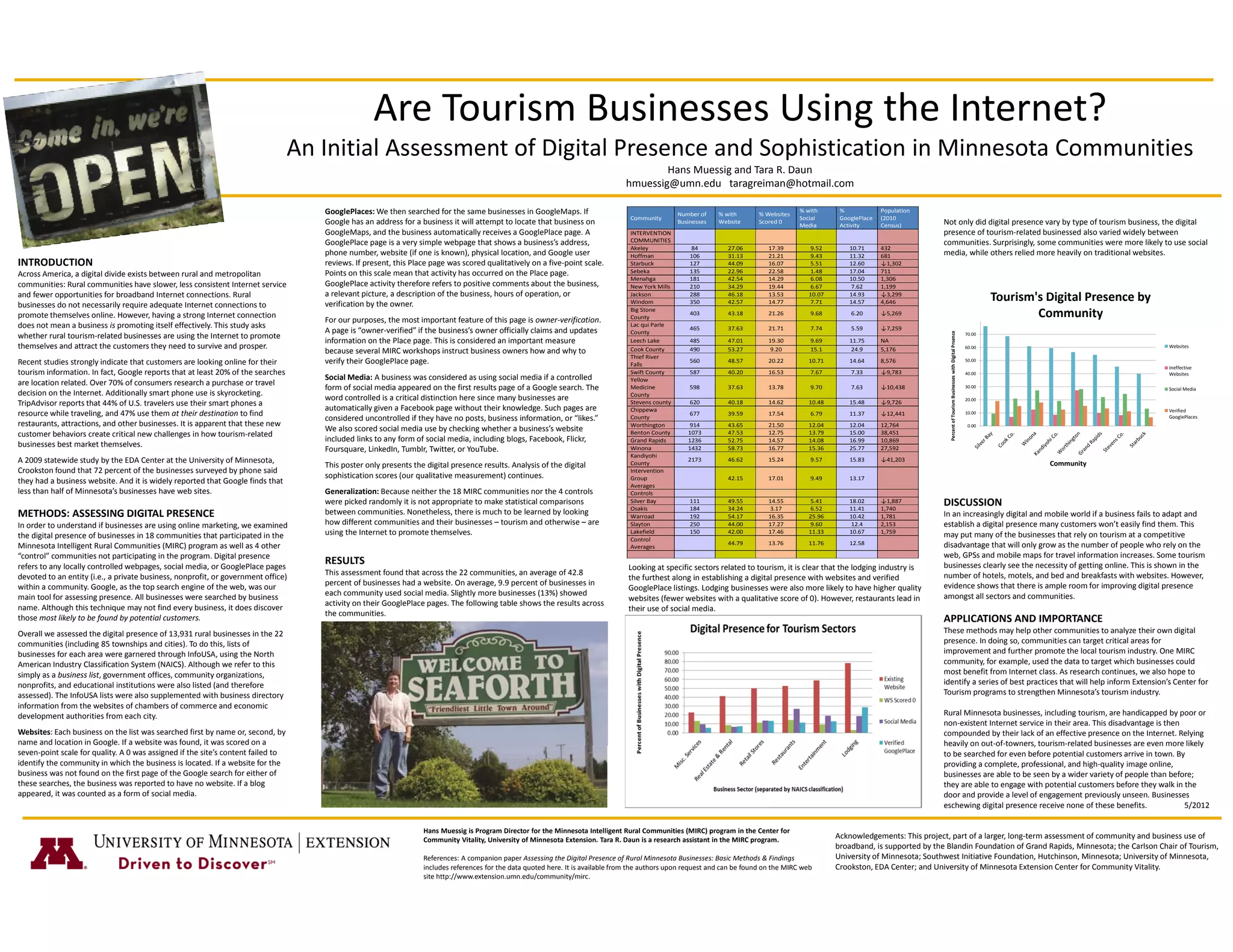
Not only did digital presence vary by type of tourism business, the digital 
presence of tourism‐related businessed also varied widely between 
communities. Surprisingly, some communities were more likely to use social 
media, while others relied more heavily on traditional websites.
Looking at specific sectors related to tourism, it is clear that the lodging industry is 
the furthest along in establishing a digital presence with websites and verified 
GooglePlace listings. Lodging businesses were also more likely to have higher quality 
websites (fewer websites with a qualitative score of 0). However, restaurants lead in 
their use of social media.
INTRODUCTION
Across America, a digital divide exists between rural and metropolitan 
communities: Rural communities have slower, less consistent Internet service 
and fewer opportunities for broadband Internet connections. Rural 
businesses do not necessarily require adequate Internet connections to 
promote themselves online. However, having a strong Internet connection 
does not mean a business is promoting itself effectively. This study asks 
whether rural tourism‐related businesses are using the Internet to promote 
themselves and attract the customers they need to survive and prosper. 
Recent studies strongly indicate that customers are looking online for their 
tourism information. In fact, Google reports that at least 20% of the searches 
are location related. Over 70% of consumers research a purchase or travel 
decision on the Internet. Additionally smart phone use is skyrocketing. 
TripAdvisor reports that 44% of U.S. travelers use their smart phones a 
resource while traveling, and 47% use them at their destination to find 
restaurants, attractions, and other businesses. It is apparent that these new 
customer behaviors create critical new challenges in how tourism‐related 
businesses best market themselves.
A 2009 statewide study by the EDA Center at the University of Minnesota, 
Crookston found that 72 percent of the businesses surveyed by phone said 
they had a business website. And it is widely reported that Google finds that 
less than half of Minnesota’s businesses have web sites. 
METHODS: ASSESSING DIGITAL PRESENCE
In order to understand if businesses are using online marketing, we examined 
the digital presence of businesses in 18 communities that participated in the 
Minnesota Intelligent Rural Communities (MIRC) program as well as 4 other 
“control” communities not participating in the program. Digital presence 
refers to any locally controlled webpages, social media, or GooglePlace pages 
devoted to an entity (i.e., a private business, nonprofit, or government office) 
within a community. Google, as the top search engine of the web, was our 
main tool for assessing presence. All businesses were searched by business 
name. Although this technique may not find every business, it does discover 
those most likely to be found by potential customers.
Overall we assessed the digital presence of 13,931 rural businesses in the 22 
communities (including 85 townships and cities). To do this, lists of 
businesses for each area were garnered through InfoUSA, using the North 
American Industry Classification System (NAICS). Although we refer to this 
simply as a business list, government offices, community organizations, 
nonprofits, and educational institutions were also listed (and therefore 
assessed). The InfoUSA lists were also supplemented with business directory 
information from the websites of chambers of commerce and economic 
development authorities from each city.
Websites: Each business on the list was searched first by name or, second, by 
name and location in Google. If a website was found, it was scored on a 
seven‐point scale for quality. A 0 was assigned if the site’s content failed to 
identify the community in which the business is located. If a website for the 
business was not found on the first page of the Google search for either of 
these searches, the business was reported to have no website. If a blog 
appeared, it was counted as a form of social media. 
GooglePlaces: We then searched for the same businesses in GoogleMaps. If 
Google has an address for a business it will attempt to locate that business on 
GoogleMaps, and the business automatically receives a GooglePlace page. A 
GooglePlace page is a very simple webpage that shows a business’s address, 
phone number, website (if one is known), physical location, and Google user 
reviews. If present, this Place page was scored qualitatively on a five‐point scale. 
Points on this scale mean that activity has occurred on the Place page. 
GooglePlace activity therefore refers to positive comments about the business, 
a relevant picture, a description of the business, hours of operation, or 
verification by the owner. 
For our purposes, the most important feature of this page is owner‐verification. 
A page is “owner‐verified” if the business’s owner officially claims and updates 
information on the Place page. This is considered an important measure 
because several MIRC workshops instruct business owners how and why to 
verify their GooglePlace page. 
Social Media: A business was considered as using social media if a controlled 
form of social media appeared on the first results page of a Google search. The 
word controlled is a critical distinction here since many businesses are 
automatically given a Facebook page without their knowledge. Such pages are 
considered uncontrolled if they have no posts, business information, or “likes.” 
We also scored social media use by checking whether a business’s website 
included links to any form of social media, including blogs, Facebook, Flickr, 
Foursquare, LinkedIn, Tumblr, Twitter, or YouTube.
This poster only presents the digital presence results. Analysis of the digital 
sophistication scores (our qualitative measurement) continues.
Generalization: Because neither the 18 MIRC communities nor the 4 controls 
were picked randomly it is not appropriate to make statistical comparisons 
between communities. Nonetheless, there is much to be learned by looking 
how different communities and their businesses – tourism and otherwise – are 
using the Internet to promote themselves.
RESULTS
This assessment found that across the 22 communities, an average of 42.8 
percent of businesses had a website. On average, 9.9 percent of businesses in 
each community used social media. Slightly more businesses (13%) showed 
activity on their GooglePlace pages. The following table shows the results across 
the communities.

Are Tourism Businesses Using the Internet? An Initial Assessment of Digital Presence and Sophistication in Minnesota Communities

  • 1.
    Acknowledgements: This project, part of a larger, long‐term assessment of community and business use of  broadband, is supported by the Blandin Foundation of Grand Rapids, Minnesota; the Carlson Chair of Tourism,  University of Minnesota; Southwest Initiative Foundation, Hutchinson, Minnesota; University of Minnesota,  Crookston, EDA Center; and University of Minnesota Extension Center for Community Vitality. Hans Muessig is Program Director for the Minnesota Intelligent Rural Communities (MIRC) program in the Center for  Community Vitality, University of Minnesota Extension. Tara R. Daun is a research assistant in the MIRC program. References: A companion paper Assessing the Digital Presence of Rural Minnesota Businesses: Basic Methods & Findings  includes references for the data quoted here. It is available from the authors upon request and can be found on the MIRC web  site http://www.extension.umn.edu/community/mirc. Are Tourism Businesses Using the Internet?  An Initial Assessment of Digital Presence and Sophistication in Minnesota Communities Hans Muessig and Tara R. Daun hmuessig@umn.edu   taragreiman@hotmail.com 0.00 10.00 20.00 30.00 40.00 50.00 60.00 70.00 Percent of Tourism Businesses with Digital Prsence Community Tourism's Digital Presence by  Community Websites Ineffective Websites Social Media Verified GooglePlaces Community  Number of  Businesses  % with  Website  % Websites  Scored 0  % with  Social  Media  %  GooglePlace  Activity  Population  (2010  Census)  INTERVENTION  COMMUNITIES    Akeley 8427.06  17.39 9.52 10.71 432 Hoffman 106 31.13  21.21 9.43 11.32 681 Starbuck 127 44.09  16.07 5.51 12.60 ↓1,302 Sebeka 135 22.96  22.58 1.48 17.04 711 Menahga 181 42.54  14.29 6.08 10.50 1,306 New York Mills 210 34.29  19.44 6.67 7.62 1,199 Jackson 288 46.18  13.53 10.07 14.93 ↓3,299 Windom 350 42.57  14.77 7.71 14.57 4,646 Big Stone  County  403  43.18  21.26  9.68  6.20  ↓5,269  Lac qui Parle  County  465  37.63  21.71  7.74  5.59  ↓7,259  Leech Lake  485  47.01  19.30  9.69  11.75  NA  Cook County 490 53.27  9.20 15.1 24.9 5,176 Thief River  Falls  560  48.57  20.22  10.71  14.64  8,576  Swift County 587 40.20  16.53 7.67 7.33 ↓9,783 Yellow  Medicine  County  598  37.63  13.78  9.70  7.63  ↓10,438  Stevens county 620 40.18  14.62 10.48 15.48 ↓9,726 Chippewa  County  677  39.59  17.54  6.79  11.37  ↓12,441  Worthington 914 43.65  21.50 12.04 12.04 12,764 Benton County 1073 47.53  12.75 13.79 15.00 38,451 Grand Rapids 1236 52.75  14.57 14.08 16.99 10,869 Winona 1432 58.73  16.77 15.36 25.77 27,592 Kandiyohi  County  2173  46.62  15.24  9.57  15.83  ↓41,203  Intervention  Group  Averages    42.15  17.01  9.49  13.17    Controls   Silver Bay 111 49.55  14.55 5.41 18.02 ↓1,887 Osakis 184 34.24  3.17 6.52 11.41 1,740 Warroad 192 54.17  16.35 25.96 10.42 1,781 Slayton 250 44.00  17.27 9.60 12.4 2,153 Lakefield 150 42.00  17.46 11.33 10.67 1,759 Control  Averages    44.79  13.76  11.76  12.58      DISCUSSION In an increasingly digital and mobile world if a business fails to adapt and  establish a digital presence many customers won’t easily find them. This  may put many of the businesses that rely on tourism at a competitive  disadvantage that will only grow as the number of people who rely on the  web, GPSs and mobile maps for travel information increases. Some tourism  businesses clearly see the necessity of getting online. This is shown in the  number of hotels, motels, and bed and breakfasts with websites. However,  evidence shows that there is ample room for improving digital presence  amongst all sectors and communities. APPLICATIONS AND IMPORTANCE These methods may help other communities to analyze their own digital  presence. In doing so, communities can target critical areas for  improvement and further promote the local tourism industry. One MIRC  community, for example, used the data to target which businesses could  most benefit from Internet class. As research continues, we also hope to  identify a series of best practices that will help inform Extension’s Center for  Tourism programs to strengthen Minnesota’s tourism industry.  Rural Minnesota businesses, including tourism, are handicapped by poor or  non‐existent Internet service in their area. This disadvantage is then  compounded by their lack of an effective presence on the Internet. Relying  heavily on out‐of‐towners, tourism‐related businesses are even more likely  to be searched for even before potential customers arrive in town. By  providing a complete, professional, and high‐quality image online,  businesses are able to be seen by a wider variety of people than before;  they are able to engage with potential customers before they walk in the  door and provide a level of engagement previously unseen. Businesses  eschewing digital presence receive none of these benefits.                   5/2012 Not only did digital presence vary by type of tourism business, the digital  presence of tourism‐related businessed also varied widely between  communities. Surprisingly, some communities were more likely to use social  media, while others relied more heavily on traditional websites. Looking at specific sectors related to tourism, it is clear that the lodging industry is  the furthest along in establishing a digital presence with websites and verified  GooglePlace listings. Lodging businesses were also more likely to have higher quality  websites (fewer websites with a qualitative score of 0). However, restaurants lead in  their use of social media. INTRODUCTION Across America, a digital divide exists between rural and metropolitan  communities: Rural communities have slower, less consistent Internet service  and fewer opportunities for broadband Internet connections. Rural  businesses do not necessarily require adequate Internet connections to  promote themselves online. However, having a strong Internet connection  does not mean a business is promoting itself effectively. This study asks  whether rural tourism‐related businesses are using the Internet to promote  themselves and attract the customers they need to survive and prosper.  Recent studies strongly indicate that customers are looking online for their  tourism information. In fact, Google reports that at least 20% of the searches  are location related. Over 70% of consumers research a purchase or travel  decision on the Internet. Additionally smart phone use is skyrocketing.  TripAdvisor reports that 44% of U.S. travelers use their smart phones a  resource while traveling, and 47% use them at their destination to find  restaurants, attractions, and other businesses. It is apparent that these new  customer behaviors create critical new challenges in how tourism‐related  businesses best market themselves. A 2009 statewide study by the EDA Center at the University of Minnesota,  Crookston found that 72 percent of the businesses surveyed by phone said  they had a business website. And it is widely reported that Google finds that  less than half of Minnesota’s businesses have web sites.  METHODS: ASSESSING DIGITAL PRESENCE In order to understand if businesses are using online marketing, we examined  the digital presence of businesses in 18 communities that participated in the  Minnesota Intelligent Rural Communities (MIRC) program as well as 4 other  “control” communities not participating in the program. Digital presence  refers to any locally controlled webpages, social media, or GooglePlace pages  devoted to an entity (i.e., a private business, nonprofit, or government office)  within a community. Google, as the top search engine of the web, was our  main tool for assessing presence. All businesses were searched by business  name. Although this technique may not find every business, it does discover  those most likely to be found by potential customers. Overall we assessed the digital presence of 13,931 rural businesses in the 22  communities (including 85 townships and cities). To do this, lists of  businesses for each area were garnered through InfoUSA, using the North  American Industry Classification System (NAICS). Although we refer to this  simply as a business list, government offices, community organizations,  nonprofits, and educational institutions were also listed (and therefore  assessed). The InfoUSA lists were also supplemented with business directory  information from the websites of chambers of commerce and economic  development authorities from each city. Websites: Each business on the list was searched first by name or, second, by  name and location in Google. If a website was found, it was scored on a  seven‐point scale for quality. A 0 was assigned if the site’s content failed to  identify the community in which the business is located. If a website for the  business was not found on the first page of the Google search for either of  these searches, the business was reported to have no website. If a blog  appeared, it was counted as a form of social media.  GooglePlaces: We then searched for the same businesses in GoogleMaps. If  Google has an address for a business it will attempt to locate that business on  GoogleMaps, and the business automatically receives a GooglePlace page. A  GooglePlace page is a very simple webpage that shows a business’s address,  phone number, website (if one is known), physical location, and Google user  reviews. If present, this Place page was scored qualitatively on a five‐point scale.  Points on this scale mean that activity has occurred on the Place page.  GooglePlace activity therefore refers to positive comments about the business,  a relevant picture, a description of the business, hours of operation, or  verification by the owner.  For our purposes, the most important feature of this page is owner‐verification.  A page is “owner‐verified” if the business’s owner officially claims and updates  information on the Place page. This is considered an important measure  because several MIRC workshops instruct business owners how and why to  verify their GooglePlace page.  Social Media: A business was considered as using social media if a controlled  form of social media appeared on the first results page of a Google search. The  word controlled is a critical distinction here since many businesses are  automatically given a Facebook page without their knowledge. Such pages are  considered uncontrolled if they have no posts, business information, or “likes.”  We also scored social media use by checking whether a business’s website  included links to any form of social media, including blogs, Facebook, Flickr,  Foursquare, LinkedIn, Tumblr, Twitter, or YouTube. This poster only presents the digital presence results. Analysis of the digital  sophistication scores (our qualitative measurement) continues. Generalization: Because neither the 18 MIRC communities nor the 4 controls  were picked randomly it is not appropriate to make statistical comparisons  between communities. Nonetheless, there is much to be learned by looking  how different communities and their businesses – tourism and otherwise – are  using the Internet to promote themselves. RESULTS This assessment found that across the 22 communities, an average of 42.8  percent of businesses had a website. On average, 9.9 percent of businesses in  each community used social media. Slightly more businesses (13%) showed  activity on their GooglePlace pages. The following table shows the results across  the communities.